A dead or deeply discharged battery is where charger speed starts to matter. A 1A maintainer may be excellent for winter storage, but it can take an impractically long time to restore a full-size automotive battery. For this guide to the best fast car battery charger, I focused primarily on chargers in the 10A–25A range that can replenish meaningful battery capacity quickly while still providing automatic voltage regulation, maintenance charging, and important electrical protections.
My primary recommendation is the NOCO GENIUS10 10A Smart Battery Charger. It is not the highest-amperage model here, but its combination of 10A charging, 6V/12V support, AGM and lithium modes, thermal compensation, deeply discharged battery recovery, repair functionality, and compact construction makes it one of the most complete choices for everyday vehicle owners.
If charging speed is your main concern, the Schumacher SC1280 15A Fully Automatic Battery Charger is particularly compelling. Its 15A rapid-charge output is better suited to recovering a discharged full-size car or truck battery when you do not want to wait all day for a small maintainer.
For maximum charging current among my mainstream smart-charger picks, I would look closely at the TowerTop 2/10/25A Smart Car Battery Charger. Its selectable 25A maximum output, lower-current settings, automatic charging, maintenance capability, winter mode, and engine-start assistance make it especially useful for garages dealing with larger batteries.
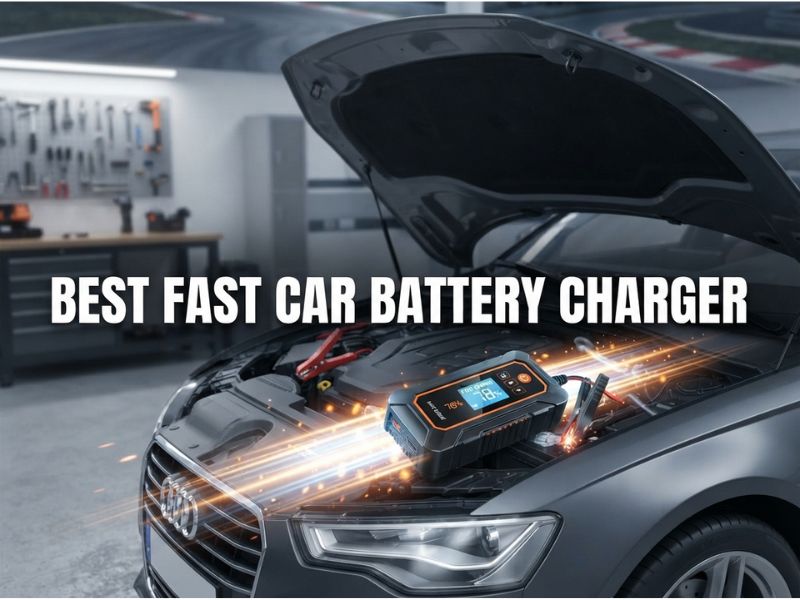
7 Best Fast Car Battery Charger
| Image | Product Name | Check Price |
|---|---|---|
Best Choice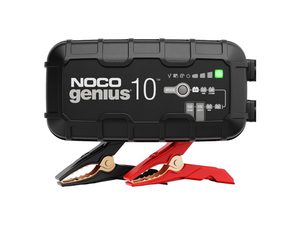 | NOCO GENIUS10 10A Smart Battery Charger – Best Overall | Check Price |
Second Best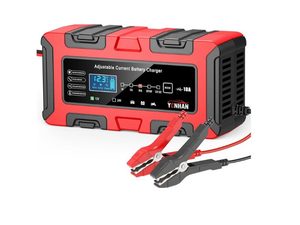 | YONHAN 10A 12V/24V Smart Battery Charger | Check Price |
Third Choice | NEXPEAK NC201 10A Smart Battery Charger | Check Price |
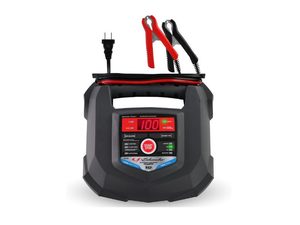 | Schumacher 15A Fully Automatic Battery Charger | Check Price |
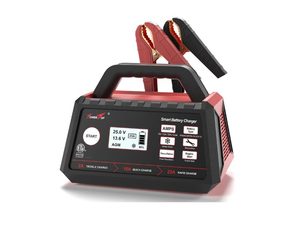 | TowerTop 2/10/25A Smart Car Battery Charger | Check Price |
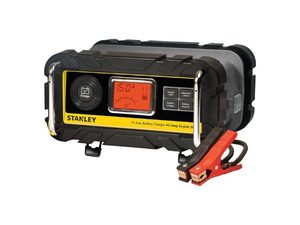 | STANLEY 15A Automatic Battery Charger | Check Price |
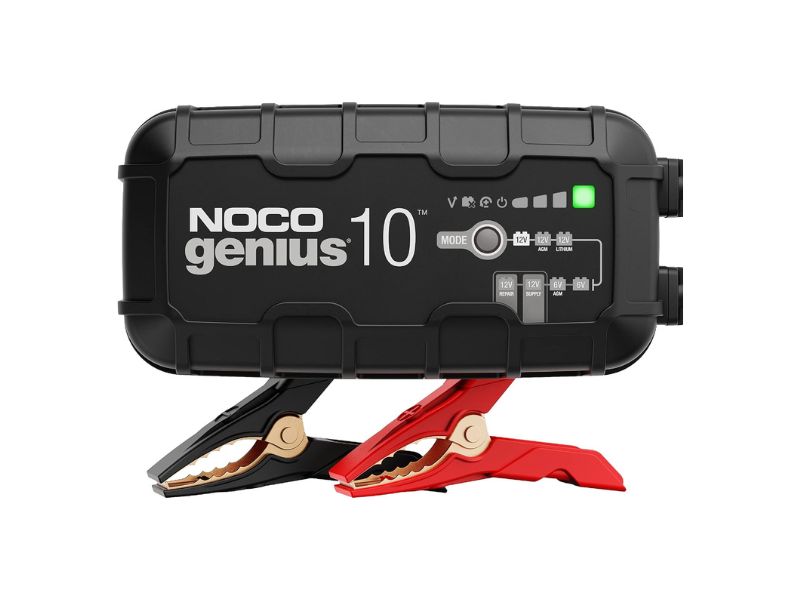
1. NOCO GENIUS10 10A Smart Battery Charger – Best Overall
Key Features
- 10A charging current
- 6V and 12V support
- Flooded, AGM, gel, EFB, maintenance-free, calcium, and supported lithium battery compatibility
- Up to 230Ah charging capacity
- Automatic maintenance mode
- Temperature-compensated charging
- 12V battery repair mode
- Force Mode for extremely low-voltage batteries
- Reverse-polarity protection
- Spark protection
- IP65-rated housing
The NOCO GENIUS10 is my primary recommendation because it balances charging speed with sophisticated battery management better than most conventional home chargers.
A 10-amp charging rate is substantially more useful for restoring automotive batteries than a typical 0.75A, 1A, or 2A maintainer. At the same time, 10A remains manageable enough for a compact charger that can stay on a garage shelf or travel with your maintenance equipment.
NOCO rates the GENIUS10 for batteries up to 230Ah and maintenance of batteries beyond that charging range. This makes it suitable for normal car batteries, larger truck batteries, marine batteries, deep-cycle batteries, motorcycles, lawn equipment, and recreational vehicles when the battery chemistry is supported.
Battery compatibility is one of its strongest advantages.
The charger handles common wet/flooded, AGM, gel, EFB, maintenance-free, and calcium lead-acid batteries, plus supported 12V lithium batteries equipped with an appropriate battery management system.
That versatility matters because modern vehicles increasingly use AGM and EFB batteries, especially cars equipped with automatic start-stop systems.
The GENIUS10 also incorporates an integrated thermal sensor. Charging voltage requirements change with temperature, so a charger that behaves identically in a freezing garage and a hot summer workshop may not charge as accurately.
Temperature compensation helps reduce undercharging in cold conditions and excessive charging voltage in warmer environments.
Another major advantage is low-voltage recovery.
The charger can normally detect very discharged batteries down to approximately 1V. A manual Force Mode can be used for batteries below the normal detection threshold.
Force Mode requires extra care because manually forcing charging means the user must verify battery voltage, chemistry, and polarity correctly.
The GENIUS10 is also capable of long-term battery maintenance after normal charging is complete. That means you do not need a separate maintainer for a vehicle that spends weeks in storage.
What I Like
I particularly like the combination of 10A output, broad chemistry support, thermal compensation, and low-voltage recovery.
It is powerful enough to be a genuine charger while remaining compact enough for everyday home use.
The dedicated AGM and lithium modes also make it more future-proof than a simple lead-acid-only bench charger.
What I Do Not Like
Ten amps is quick compared with maintenance chargers, but it is not the fastest option in this guide.
Owners who regularly recharge 80Ah–100Ah batteries from deep discharge may appreciate a 15A or 25A charger more.
There is also no conventional large LCD with detailed voltage and current readouts.
Verdict
The NOCO GENIUS10 offers the strongest balance of charging speed, battery compatibility, safety technology, intelligent charging, and compact construction.
Best for: Most drivers wanting one premium smart charger for cars, SUVs, motorcycles, AGM batteries, lithium batteries, and seasonal maintenance.
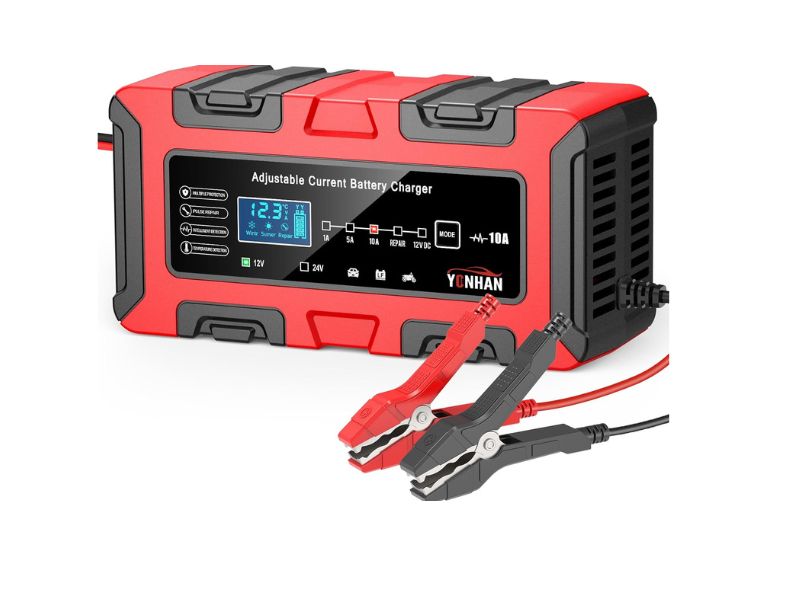
2. YONHAN 10A 12V/24V Smart Battery Charger – Best Budget Fast Charger
Key Features
- Up to 10A charging
- 12V and 24V operation
- Automatic smart charging
- Large LCD information display
- AGM, gel, SLA, flooded, and other lead-acid battery support
- Repair/desulfation mode
- Temperature compensation
- Winter and summer charging adjustment
- Maintenance charging
- Multiple safety protections
The YONHAN 10A has become popular because it offers a substantial amount of charger functionality without the cost normally associated with sophisticated automotive charging equipment.
At up to 10 amps, it occupies the same useful charging-speed category as the NOCO GENIUS10 for common 12V batteries.
Its biggest difference is the interface.
The YONHAN uses a large LCD that provides real-time information including battery voltage, charging current, temperature, charge status, and active charging mode.
For DIY users, this can make the charging process much easier to understand.
Rather than watching a few LEDs and wondering what the charger is doing, you can see how voltage and current change as the battery progresses through its charging cycle.
It also supports 24V lead-acid batteries, giving it an advantage for buyers maintaining trucks, equipment, or specialty battery systems that fall outside ordinary passenger-car use.
Temperature compensation automatically alters charging behavior according to ambient conditions.
This is particularly useful in a detached garage where summer and winter temperatures can vary dramatically.
A dedicated repair mode is available for older or sulfated lead-acid batteries.
Battery repair requires realistic expectations. Pulse or desulfation charging may improve certain batteries affected by sulfation, but it cannot repair physical plate damage, shorted cells, severe corrosion, cracked cases, or batteries that have reached the end of their chemical service life.
What I Like
The combination of 10A charging, 12V/24V support, and a detailed LCD provides excellent value.
I also like being able to see voltage and current rather than relying completely on simple indicator lights.
Temperature-aware charging makes it more useful for year-round garage use.
What I Do Not Like
It is designed primarily around lead-acid battery families rather than providing the broad lithium support of the GENIUS10.
Its interface and operating modes require slightly more attention than a completely simplified set-and-forget charger.
Verdict
The YONHAN is one of the strongest value choices for buyers wanting reasonably fast automotive charging and detailed battery information without moving into expensive workshop equipment.
Best for: Budget-conscious DIY mechanics, 12V/24V lead-acid batteries, cars, trucks, boats, and seasonal equipment.
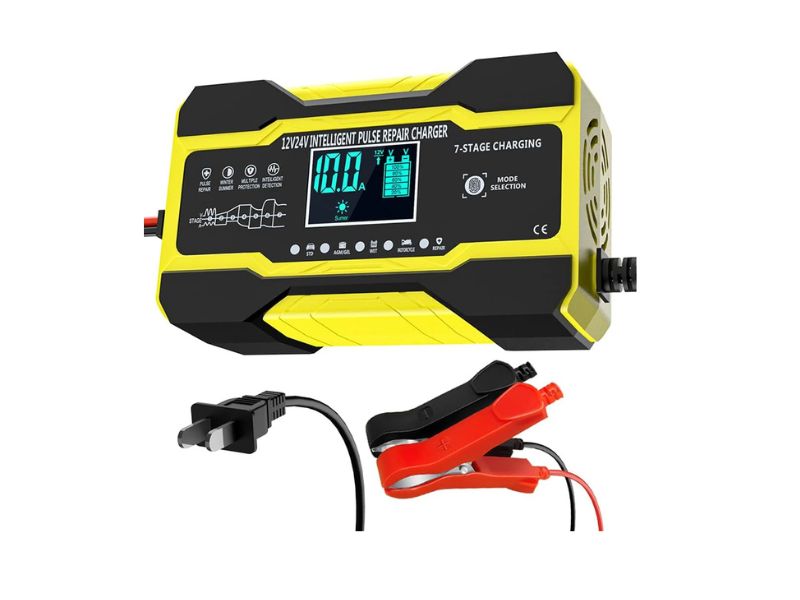
3. NEXPEAK NC201 10A Smart Battery Charger – Best for Battery Repair Features
Key Features
- Up to 10A 12V charging
- 12V and 24V compatibility
- Automatic multi-stage charging
- Digital display
- Temperature compensation
- Pulse repair mode
- Float/maintenance charging
- Reverse-polarity protection
- Overcurrent protection
- Overtemperature protection
- Lead-acid battery compatibility
The NEXPEAK NC201 is another 10A-class charger that focuses heavily on battery condition monitoring and repair functionality.
For typical automotive charging, its output is fast enough to make a meaningful difference compared with trickle chargers.
A standard full-size automotive battery might contain roughly 50Ah–80Ah of capacity. If only half of that capacity needs replacing, a 10A charger can return the bulk of the missing energy in a few hours under favorable conditions.
Charging does not remain at maximum output until the very end.
As battery voltage rises, a smart charger reduces current during the absorption stage. That means the final portion of charging takes longer than a simple amp-hour calculation suggests.
The NC201 automatically manages these charging stages instead of requiring you to manually lower amperage.
Its LCD can display charging information such as battery voltage and current, which makes it useful for owners who want more feedback during the process.
The pulse repair function is another reason buyers consider the NC201.
A lead-acid battery left partially discharged can develop sulfate crystal buildup on its plates. Certain charging techniques may reduce some recoverable sulfation.
However, repair mode should never be viewed as an alternative to battery replacement when a battery is mechanically damaged or can no longer pass a proper load or conductance test.
What I Like
The NEXPEAK combines useful 10A charging speed with strong diagnostic-style feedback.
Its repair and temperature-compensation features also make it better suited to older batteries than a basic fixed-output charger.
The 12V/24V compatibility increases its usefulness for equipment owners.
What I Do Not Like
The controls and screen contain more information than a beginner may actually need.
Lithium support also varies by model/version, so buyers should verify chemistry compatibility rather than assuming every battery can be connected.
Verdict
The NC201 makes the most sense for DIY users who want fast charging plus additional tools for managing older conventional lead-acid batteries.
Best for: Older batteries, DIY garages, trucks, boats, lawn equipment, and users who value repair functions.
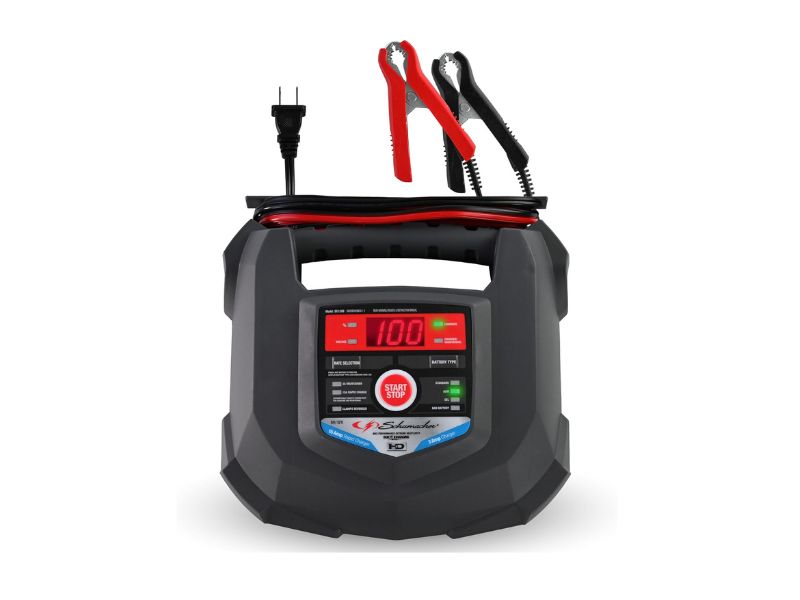
4. Schumacher 15A Fully Automatic Battery Charger – Best 15A Rapid Charger
Key Features
- 15A rapid charging
- Lower-current maintenance function
- 6V and 12V battery support
- Standard flooded, AGM, gel, and deep-cycle compatibility
- Automatic voltage detection
- Microprocessor-controlled charging
- Automatic charge-rate selection
- Float-mode monitoring
- Digital display
- Reverse-hookup protection
If speed is more important to you than ultra-compact size, the Schumacher SC1280 deserves serious consideration.
Its 15A maximum charging output gives it a clear speed advantage over the 10A chargers above when battery conditions permit the higher current.
That matters most with larger batteries.
Imagine a 70Ah battery sitting near 50% charge. Roughly 35Ah may need to be restored. A simplistic 15A calculation suggests a little over two hours for that energy, but actual charging takes longer because of efficiency losses and current tapering near full charge.
Still, 15A can produce a noticeable real-world time advantage over 5A or 10A charging.
The SC1280 also automatically detects whether you have connected a 6V or 12V battery and selects an appropriate charging process.
Supported battery types include standard flooded, AGM, gel, and deep-cycle lead-acid batteries.
After bulk charging, the unit can transition into maintenance operation, reducing the risk of overcharging and making it useful for vehicles that remain parked after charging is complete.
The digital display allows you to monitor voltage and charge percentage.
That is particularly helpful when you need to make a quick decision about whether a battery has enough energy for the vehicle to return to service.
What I Like
The main advantage is straightforward: 15A is genuinely useful charging current for a full-size car battery.
I also like having automatic voltage detection and charge-rate control rather than requiring the owner to manually adjust the charger throughout the cycle.
The digital display is clear and practical.
What I Do Not Like
It is larger than compact smart chargers.
It also lacks the lithium versatility found on some newer chargers.
Owners maintaining tiny motorcycle batteries may prefer a charger with finer low-current control.
Verdict
The Schumacher SC1280 is my preferred option when fast recovery of standard automotive batteries matters more than having the smallest charger possible.
Best for: Cars, SUVs, trucks, marine batteries, deep-cycle batteries, and owners regularly dealing with partially discharged batteries.
5. BLACK+DECKER BC15BD 15A Automatic Battery Charger – Best With 40A Engine Start
Key Features
- 15A charging output
- 40A engine-start assistance
- 12V operation
- AGM, gel, and wet lead-acid compatibility
- Fully automatic three-stage charging
- Battery reconditioning function
- Alternator check
- Battery voltage test
- Backlit LCD
- Reverse-polarity protection
- ETL-certified design
The BLACK+DECKER BC15BD offers a useful combination of fast charging and garage-oriented diagnostics.
Its 15A charging rate puts it firmly in rapid home-charger territory.
Unlike a small maintainer that may require a full day to restore significant energy, the BC15BD can return meaningful capacity to a normal automotive battery within a few hours depending on battery size and starting state of charge.
It also includes 40A engine-start assistance.
This should not be confused with a portable jump starter. The charger must be connected to AC power, and the engine-start function must be used according to the unit’s duty-cycle instructions.
Still, when a partially charged battery needs additional cranking support, the feature can be very useful in a home garage.
The BC15BD supports common 12V AGM, gel, and wet lead-acid batteries.
A battery-reconditioning feature is designed to address certain sulfation-related problems, while an alternator check provides a quick indication of whether the charging system appears to be operating normally.
The backlit display is another practical advantage.
It allows you to view charging progress and diagnostic information without interpreting a large number of small indicator lights.
What I Like
I like the combination of 15A charging, a 40A start-assist function, and alternator testing.
This gives the unit considerably more garage utility than a basic smart charger.
The backlit display is also convenient in poorly lit workshops.
What I Do Not Like
It only supports 12V charging, limiting its usefulness around vintage 6V systems.
It is also bulkier than small wall-style smart chargers.
Engine-start assistance requires household power, so it does not replace a portable battery booster.
Verdict
The BC15BD is a strong choice for home mechanics wanting a fast charger plus basic starting and charging-system diagnostic functions.
Best for: Home garages, 12V cars and trucks, AGM batteries, alternator checking, and engine-start assistance.
6. TowerTop 2/10/25A Smart Car Battery Charger – Fastest Adjustable Pick

Key Features
- 2A / 10A / 25A adjustable charging
- Automatic charging mode
- 12V lead-acid compatibility
- AGM, gel, wet, MF, EFB, calcium, and deep-cycle support
- 100A engine-start assistance
- Eight-stage smart charging
- Battery repair/desulfation
- Winter mode
- LCD information display
- Float maintenance
- Multiple electrical protections
The TowerTop immediately stands out because it provides a maximum 25A charging rate while retaining lower-current settings.
That flexibility is extremely useful.
You may want 25A when trying to restore a large 90Ah battery quickly, but the same aggressive output would be unnecessary for maintaining a smaller powersports battery.
Selectable 2A and 10A settings allow one charger to cover a much wider range of jobs.
The charging process uses multiple stages including soft start, bulk charging, absorption, analysis, repair, float, and maintenance-related operation.
At maximum output, this is one of the fastest chargers in the group.
A 25A charger can theoretically replace 50Ah of missing energy in around two hours before considering efficiency losses and charging taper.
Real charging time will always vary, but the difference compared with a 1A or 2A maintainer is enormous.
The 100A engine-start assistance feature provides additional garage versatility.
Again, it is not a portable jump pack. It uses AC power and is intended to assist starting according to the charger’s prescribed procedure.
Winter mode adjusts the charging profile for colder conditions, while repair functionality is available for certain sulfated batteries.
What I Like
The greatest advantage is the ability to select 2A, 10A, or 25A instead of being locked into one charging rate.
This allows the TowerTop to function as a maintenance charger, general-purpose charger, or genuinely rapid charger.
The LCD and engine-start assistance also add value.
What I Do Not Like
The larger enclosure requires more storage space.
Users must pay attention to charging mode and battery specifications rather than assuming the highest amperage is always the correct choice.
The 12V-focused configuration also limits flexibility compared with multi-voltage models.
Verdict
The TowerTop is my favorite choice when maximum charging speed and adjustable current are the priorities.
Best for: Large automotive batteries, trucks, RVs, deep-cycle batteries, and garages that need both fast and low-current charging.
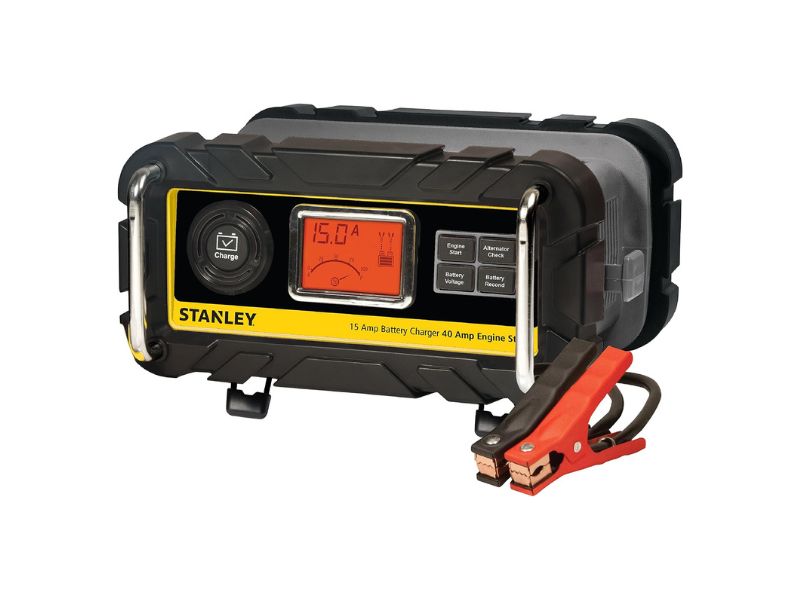
7. STANLEY 15A Automatic Battery Charger – Best Garage Multi-Function Charger
Key Features
- 15A automatic charging
- 40A engine-start assistance
- 12V operation
- Lead-acid and supported lithium charging modes
- Automatic float maintenance
- Battery reconditioning
- Alternator test
- Battery-condition analysis
- Reverse-polarity protection
- Digital display
The STANLEY BC15BS is another traditional bench charger with enough output for meaningful automotive battery recovery.
Its 15A charge rate places it alongside the Schumacher and BLACK+DECKER models in terms of general charging class.
It is designed primarily for garage use rather than permanent vehicle storage.
After the battery reaches an appropriate state of charge, the charger automatically transitions into float monitoring rather than continuing to force high current into the battery.
The BC15BS also provides a 40A engine-start function.
For a partially discharged battery that does not quite have enough cranking power, start assistance may help get the engine operating while AC power is available.
The unit also incorporates battery reconditioning and an alternator-testing function.
These tools do not replace a professional charging-system diagnosis, but they can help a home mechanic distinguish between a simple discharged battery and an obvious charging-system problem.
The digital display provides charging information without requiring external measurement tools for basic monitoring.
What I Like
The 15A output and 40A start assistance make this a practical home-garage charger.
Alternator checking and battery reconditioning expand its usefulness beyond basic charging.
I also like automatic float maintenance after the main charging cycle.
What I Do Not Like
It is not designed around the compact portability that makes smaller smart chargers easy to store.
The 12V focus also makes it less versatile for unusual 6V applications.
For deeply discharged batteries, automatic detection may sometimes require a minimum remaining voltage before normal charging can begin.
Verdict
The STANLEY BC15BS is best viewed as a versatile garage station for charging, maintaining, testing, and providing occasional starting assistance.
Best for: Home garages, conventional 12V vehicles, battery maintenance, and basic charging-system checks.
Fast Car Battery Charger Comparison
| Product | Max Charge Rate | Voltage | Main Battery Types | Maintainer | Repair Mode | Start Assist | Display | Best For |
| NOCO GENIUS10 | 10A | 6V/12V | Flooded, AGM, gel, EFB, lithium | Yes | Yes | No | LED indicators | Best overall |
| YONHAN 10A | 10A | 12V/24V | AGM, gel, flooded, SLA | Yes | Yes | No | LCD | Budget value |
| NEXPEAK NC201 | 10A | 12V/24V | Lead-acid families | Yes | Yes | No | LCD | Battery repair |
| Schumacher SC1280 | 15A | 6V/12V | Standard, AGM, gel, deep-cycle | Yes | Battery care | No | Digital | Rapid everyday charging |
| BLACK+DECKER BC15BD | 15A | 12V | AGM, gel, wet | Yes | Yes | 40A | Backlit LCD | Garage diagnostics |
| TowerTop 2/10/25A | 25A | 12V | AGM, gel, wet, EFB, deep-cycle | Yes | Yes | 100A | LCD | Fastest adjustable charging |
| STANLEY BC15BS | 15A | 12V | Lead-acid, supported lithium | Yes | Yes | 40A | Digital | Multi-function garage use |
For most drivers, the NOCO GENIUS10 offers the strongest balance because 10A is fast enough for normal charging while the unit also provides excellent chemistry support and sophisticated battery management.
If charging time matters more than compactness, the Schumacher SC1280 moves up the list because its 15A output can restore automotive battery capacity faster.
For very large batteries, the TowerTop 25A provides the greatest maximum charging output and lets you reduce amperage when full power is unnecessary.
How I Chose These Fast Car Battery Chargers
A high amp number by itself does not make a charger good.
The first factor I considered was usable charging current.
Small maintainers under approximately 2A are excellent products for certain jobs, but they do not fit the intent of someone searching specifically for a fast battery charger.
I therefore concentrated primarily on chargers capable of approximately 10A or more.
The second factor was battery compatibility.
Modern vehicle batteries can include:
- Flooded lead-acid
- AGM
- EFB
- Gel
- Deep-cycle
- LiFePO4 lithium
Not every charger supports all of these chemistries.
Third, I considered automatic charging management.
A proper fast charger should not simply deliver maximum current continuously. It should monitor battery voltage and reduce charging current as the battery approaches full charge.
Temperature management was another consideration.
Charging lead-acid batteries in extreme heat or cold requires different voltage behavior, so automatic temperature compensation can provide more accurate charging.
Finally, I looked at practical features such as reverse-polarity protection, repair modes, digital displays, float maintenance, engine-start assistance, portability, and ease of connection.
Buying Guide: How to Choose the Best Fast Car Battery Charger
Start With Charging Amps
Charging amperage is the specification most directly related to speed.
A 1A charger may need a very long time to restore a full-size automotive battery.
A 5A charger is considerably better but still relatively slow when the battery is deeply discharged.
A 10A charger provides a good balance for most home users.
A 15A charger is better when batteries regularly need significant recharging.
A 20A–25A charger becomes particularly useful for large automotive, marine, RV, and deep-cycle batteries.
Do not automatically use the highest available setting.
The appropriate charging rate depends on the battery’s capacity, chemistry, temperature, condition, and manufacturer recommendations.
Understand Amp-Hours
Automotive battery capacity is commonly expressed in amp-hours (Ah).
A simplified example makes charging speed easier to understand.
Suppose you have a 60Ah battery at approximately 50% charge.
Around 30Ah of capacity may need to be restored.
At a perfect constant:
- 5A would require roughly 6 hours
- 10A would require roughly 3 hours
- 15A would require roughly 2 hours
- 25A would require roughly 1.2 hours
Real charging takes longer.
Chargers lose some energy as heat, batteries are not perfectly efficient, and smart chargers reduce current as full charge approaches.
Therefore, these figures should only be used to understand the relative difference between charger sizes.
Why Charging Slows Near Full Capacity
Lead-acid batteries do not accept maximum current throughout the complete charge cycle.
During the bulk stage, the charger can supply relatively high current.
As the battery voltage rises, the charger enters the absorption stage and gradually reduces current.
The final 10%–20% of charging can therefore take disproportionately long.
This is normal.
Trying to force maximum current through the battery until the very end could create excessive heat, gassing, water loss, or damage.
Fast charging is about safely increasing current during the stages where the battery can accept it—not eliminating normal charging chemistry.
10A vs. 15A vs. 25A Battery Charger
10A Chargers
A 10A model is my preferred all-around size for many home users.
It provides enough current to restore a normal car battery overnight or considerably faster depending on discharge level, yet the charger can remain compact and easy to store.
NOCO GENIUS10, YONHAN, and NEXPEAK fall into this category.
15A Chargers
Moving from 10A to 15A can reduce charging time noticeably on large batteries.
This category makes particular sense when:
- You maintain multiple cars
- Vehicles frequently sit unused
- You own larger SUVs or pickups
- Battery discharge is a recurring issue
- You want same-day charging
Schumacher SC1280, BLACK+DECKER BC15BD, and STANLEY BC15BS fit here.
25A Chargers
A 25A charger is better suited to larger batteries and buyers who genuinely prioritize charging speed.
The TowerTop allows you to select lower current when necessary, which is preferable to having a high-output unit with no adjustment.
For a normal 40Ah compact-car battery, 25A may be unnecessary.
For a 100Ah deep-cycle or large truck battery, the additional current can save substantial time.
Fast Charger vs. Trickle Charger
A fast battery charger is designed to restore a meaningful amount of missing battery capacity relatively quickly.
A trickle charger operates at low current.
Older trickle chargers might continuously deliver a small current regardless of battery condition.
Modern products described as trickle chargers are often actually smart maintainers that transition into float operation.
A maintainer is ideal for keeping a battery healthy during storage.
It is not ideal when you discover a deeply discharged battery at 8 a.m. and need the car running later that morning.
For many vehicle owners, the ideal solution is a fast smart charger that can also switch automatically to maintenance mode.
Fast Charger vs. Jump Starter
These devices solve different problems.
A battery charger connects to AC power and replenishes energy in the vehicle battery.
A jump starter contains its own battery and delivers a brief high-current burst intended to crank the engine immediately.
A charger is better when you have access to household power and enough time to restore the battery.
A jump starter is better when you are stranded away from an outlet.
Some bench chargers provide an engine-start-assistance function, but that does not make them portable jump starters.
AGM Battery Charging
AGM batteries require appropriate charging voltage.
You should not assume that every conventional automotive charger is ideal for AGM technology.
Look for an explicit AGM mode or AGM compatibility.
AGM batteries are commonly found in:
- Start-stop vehicles
- Luxury cars
- Performance vehicles
- SUVs
- Vehicles with high electrical loads
- Cars with batteries located inside the passenger compartment or trunk
NOCO GENIUS10, YONHAN, Schumacher SC1280, BLACK+DECKER BC15BD, TowerTop, and STANLEY offer suitable modes or compatibility depending on the specific battery configuration.
Always confirm the battery label.
What About EFB Batteries?
Enhanced Flooded Battery (EFB) technology is common in some vehicles equipped with start-stop systems.
EFB is still a flooded lead-acid design but provides improved cycling capability compared with traditional starter batteries.
A charger that explicitly supports EFB is preferable.
The NOCO GENIUS10 includes EFB compatibility, while several other smart chargers use charging profiles suitable for common enhanced lead-acid batteries.
Check the charger’s instructions before selecting a mode.
Fast Charging Lithium Automotive Batteries
Lithium batteries require special care.
Automotive lithium starter batteries commonly use LiFePO4 chemistry, but you should never assume that a lead-acid charger can be used on lithium.
The charger must explicitly support the battery chemistry.
The battery should also have an appropriate Battery Management System (BMS).
The NOCO GENIUS10 provides a dedicated supported lithium mode.
Certain versions of TowerTop and STANLEY chargers also support specific lithium batteries.
Always follow the battery manufacturer’s charging requirements.
Temperature Compensation
Charging voltage changes with temperature.
A lead-acid battery typically requires somewhat higher charging voltage when cold and lower voltage when hot.
A charger with automatic temperature compensation can adjust accordingly.
This matters if you charge batteries in:
- An unheated winter garage
- Extremely hot summer conditions
- A detached workshop
- An outdoor equipment building
- Regions with large seasonal temperature swings
NOCO, YONHAN, and NEXPEAK are particularly attractive if temperature-aware charging is important.
Battery Repair and Desulfation Modes
Lead-acid batteries produce lead sulfate as part of normal discharge.
Problems occur when batteries remain undercharged for extended periods and sulfate crystals become more difficult to convert during normal charging.
Repair or desulfation modes use specialized charging behavior intended to address certain sulfation conditions.
They can sometimes help.
They cannot fix:
- Shorted cells
- Broken plates
- Major plate shedding
- Internal mechanical damage
- Severe electrolyte loss
- Frozen batteries
- Cracked cases
- Batteries that have simply reached end of life
A repair mode is useful, but it should never be the primary reason to keep an obviously failing battery in service.
How Fast Can You Safely Charge a Car Battery?
The answer depends on battery capacity and manufacturer specifications.
For a typical 50Ah–80Ah automotive lead-acid battery, 10A–15A smart charging represents a practical home-use range.
Some large batteries can safely accept more.
Small motorcycle batteries may require much less.
A properly designed smart charger automatically reduces current as the battery approaches full charge.
However, automatic operation does not eliminate the need to select the correct battery type and follow the manufacturer’s maximum recommended charging rate.
Can Fast Charging Damage a Car Battery?
Fast charging within the battery manufacturer’s limits is generally safe with a quality smart charger.
Problems arise when charging current or voltage exceeds what the battery can tolerate.
Excessive charging can create:
- Heat
- Water loss
- Gas production
- Plate corrosion
- Reduced service life
- Swelling
- Thermal problems
This is why automatic multi-stage charging is preferable to an old manual charger left at maximum output indefinitely.
How to Safely Charge a Car Battery
Inspect the battery before connecting anything.
Do not charge a battery that is:
- Cracked
- Leaking
- Severely swollen
- Frozen
- Physically damaged
Charge in a well-ventilated location.
Lead-acid batteries can release hydrogen during charging, especially under abnormal conditions.
Keep flames, cigarettes, sparks, and other ignition sources away.
Confirm battery voltage and chemistry.
Follow both the vehicle and charger instructions regarding connection locations.
Modern vehicles sometimes use designated under-hood positive and ground points rather than direct battery-terminal connections.
Connect the clamps with the charger unplugged when the manufacturer’s procedure specifies this.
Verify polarity carefully.
Then connect AC power and select the correct charging mode.
Allow the smart charger to complete its cycle.
Can You Fast Charge a Battery While It Is Still in the Car?
In many vehicles, yes.
Modern smart chargers are often specifically designed for charging installed batteries.
However, vehicle manufacturers may provide specific requirements.
Cars equipped with an Intelligent Battery Sensor (IBS) or other battery-management system may require the negative charger connection to be made to a designated chassis ground rather than directly to the negative battery terminal.
This ensures that the vehicle can measure charging current correctly.
Always check the owner’s manual when uncertain.
Do You Need to Disconnect the Battery?
Not necessarily.
Disconnecting the battery can erase:
- Radio presets
- Clock settings
- Adaptive transmission information
- Window initialization
- Seat memory
- Other learned electronic settings
Some vehicles can also require special procedures after battery disconnection.
A smart charger designed for in-vehicle use can often charge safely without disconnecting the battery, provided the manufacturer’s instructions are followed.
What Does an Engine-Start Function Do?
Bench chargers such as the BLACK+DECKER, TowerTop, and STANLEY provide engine-start assistance.
This function temporarily supplies substantially more current than normal charging.
It can help a weak battery crank the engine.
There are important limitations.
The charger still requires AC power.
Start-assistance modes often have strict maximum operating times followed by required cooling periods.
Never repeatedly crank the engine with a bench charger beyond its specified duty cycle.
For true roadside independence, use a portable jump starter instead.
Why Won’t My Fast Charger Recognize the Battery?
Smart chargers use voltage detection for safety.
If battery voltage falls below the charger’s minimum threshold, it may interpret the condition as:
- No battery connected
- Incorrect connection
- Defective battery
Some chargers provide a manual low-voltage or force mode.
The NOCO GENIUS10, for example, includes a Force Mode intended for extremely discharged batteries.
Manual modes deserve extra caution because some automatic safety logic may be bypassed.
Confirm voltage and polarity before forcing charging.
Why Does My Charger Start Fast and Then Slow Down?
That is normal smart-charging behavior.
During the bulk stage, the battery can accept relatively high current.
As it approaches the target voltage, charging enters absorption and current gradually falls.
Near full charge, the charger may supply only a fraction of its maximum output.
This protects the battery.
A 15A charger therefore does not necessarily deliver 15A continuously from 0% to 100%.
How to Estimate Car Battery Charging Time
A useful rough formula is:
Charging time ≈ missing amp-hours ÷ charger amps, plus additional time for inefficiency and final absorption charging.
For example, consider a 70Ah battery at about 40% state of charge.
It may need approximately 42Ah returned.
With a:
10A charger: bulk replacement might require roughly 4–5 hours.
15A charger: bulk replacement might require roughly 3 hours.
25A charger: bulk replacement may occur in under 2 hours when the battery can safely accept that current.
Full charging still takes longer because current tapers near the end.
These are estimates, not guaranteed charge times.
What Size Charger for a 50Ah Battery?
A 10A charger is an excellent practical choice.
It provides a charge rate equivalent to roughly 20% of battery capacity at maximum output, although actual smart-charger current changes during the charging cycle.
For gentler charging when time is not important, 5A also works.
If the battery manufacturer allows it and rapid recovery matters, a 15A charger can reduce charging time further.
What Size Charger for a 70Ah Battery?
For a 70Ah automotive battery, 10A–15A is a useful range.
Ten amps offers a good balance between speed and compact charger size.
Fifteen amps is better when the battery regularly needs significant energy restored.
A 25A charger can be appropriate if the battery manufacturer permits that charging rate and you genuinely need faster recovery.
What Size Charger for a 100Ah Battery?
Large 100Ah batteries benefit significantly from higher charging current.
A 5A charger could require a very long charging session after deep discharge.
A 10A charger is workable.
A 15A charger is better.
A 20A–25A charger can dramatically shorten recovery time while remaining practical for home garages when the battery supports the rate.
This is where the TowerTop becomes particularly attractive.
Charging in Cold Weather
Cold temperatures reduce battery performance.
The chemical reactions inside a lead-acid battery slow down, while the engine itself usually becomes more difficult to crank.
The result is a frustrating combination: the battery can deliver less power exactly when the starter requires more.
Use a charger with winter mode or temperature compensation whenever possible.
Never attempt to charge a frozen battery.
A frozen battery may be internally or externally damaged and can present a serious safety hazard.
Charging in Hot Weather
Heat is also harmful to batteries.
High temperature accelerates chemical activity, water loss, corrosion, and battery aging.
A charger using excessive voltage in hot conditions can make these effects worse.
Temperature-compensated smart chargers reduce charging voltage when appropriate.
Keep the charger adequately ventilated so its own electronics can dissipate heat.
Common Fast Battery Charger Mistakes
Choosing the Highest Amps Without Checking Battery Size
A 25A charger may be excellent for a large battery but unnecessary for a small powersports battery.
Match charging current to capacity.
Selecting the Wrong Battery Chemistry
Do not charge AGM, lithium, or other specialized batteries using an incompatible mode.
Expecting Repair Mode to Restore Every Battery
A charger cannot reverse all physical and chemical battery failure.
Trying to Charge a Frozen Battery
This can be dangerous.
Allow the battery to reach a safe temperature and inspect it first.
Ignoring Ventilation
Lead-acid battery charging can release flammable gas.
Confusing Engine Start With a Portable Jump Starter
A bench charger’s start-assist feature requires AC power.
Disconnecting Modern Vehicles Without Checking the Manual
Battery disconnection may trigger electronic resets or require reinitialization.
Assuming 100% on the Charger Means the Battery Is Healthy
A worn battery may reach normal voltage but still fail under cranking load.
Frequently Asked Questions
What is the best fast car battery charger?
The NOCO GENIUS10 is my best overall fast smart charger for most drivers.
Its 10A output is powerful enough for practical automotive charging while its 6V/12V support, AGM mode, lithium compatibility, thermal compensation, low-voltage recovery, maintenance function, and repair mode make it unusually versatile. Buyers who prioritize maximum charging speed over compactness should consider a 15A Schumacher or 25A TowerTop instead.
What is the fastest car battery charger in this list?
The TowerTop provides the highest normal charging output at up to 25 amps.
Its adjustable settings allow you to choose lower currents when maximum charging speed is unnecessary. Whether 25A is appropriate depends on battery capacity and manufacturer recommendations. Larger automotive, RV, marine, and deep-cycle batteries benefit most from the additional output.
Is a 10A battery charger fast?
Yes, 10A is a practical fast-charging rate for many automotive batteries.
It is dramatically quicker than a 1A or 2A maintainer while remaining compact and manageable. A partially discharged 50Ah–70Ah battery can often recover enough energy within several hours, although actual charging time depends on state of charge, chemistry, temperature, and battery condition.
Is a 15A charger better than a 10A charger?
A 15A charger can charge faster, but higher current is not always necessary.
For a large automotive battery, 15A can reduce charging time noticeably. For small batteries or long-term maintenance, 10A or lower may be more appropriate. Smart chargers reduce output automatically as the battery approaches full charge.
Is a 25A charger too powerful for a car battery?
Not necessarily, but the battery must be rated to accept that charging current.
Large automotive and deep-cycle batteries can often accept substantial bulk-charging current. Smaller batteries may require lower settings. A charger with selectable amperage is useful because it lets you match output to the battery.
How long does a 10A charger take to charge a car battery?
A typical partially discharged battery may need several hours with a 10A charger.
For example, replacing roughly 30Ah of missing capacity requires at least about three hours in a simplified calculation. Real charging takes longer because of energy losses and current tapering during the absorption stage.
How long does a 15A charger take?
A 15A charger can restore a typical partially discharged car battery in a few hours.
Actual time varies enormously with battery size and state of charge. A battery that only needs 20Ah restored may recover much faster than an 80Ah battery that has been deeply discharged.
Can I charge a car battery in one hour?
Sometimes you can restore enough energy to start the car, but a full charge usually takes longer.
A high-output charger can put substantial energy into a partially discharged battery within one hour. Completely recharging a deeply discharged battery safely generally requires more time because charging current must taper as the battery approaches full capacity.
Can a fast charger ruin a battery?
Excessive current or voltage can damage a battery, but smart charging reduces that risk.
Use a charger appropriate for the battery’s voltage, chemistry, and capacity. Modern multi-stage chargers automatically reduce charging current as necessary, but the user still needs to select compatible settings.
Can I leave a fast charger connected overnight?
An automatic charger with maintenance mode can often remain connected overnight when permitted.
Once charging is complete, a proper smart charger transitions into float or monitoring mode instead of continuing to deliver maximum current. Always follow the specific charger’s instructions.
Does AGM need a special charger?
AGM batteries should be charged with equipment specifically compatible with AGM chemistry.
AGM charging voltage requirements differ from some conventional flooded-battery profiles. Choose the dedicated AGM mode when the charger provides one.
Can I use a fast charger on a start-stop battery?
Yes, provided the charger supports the AGM or EFB battery installed in the vehicle.
Start-stop systems commonly use AGM or EFB technology. Check the battery label and select a compatible charging mode. Vehicle-specific connection instructions also matter because many start-stop cars use battery-monitoring sensors.
Can I charge a lithium car battery quickly?
Only use a charger specifically approved for the lithium battery chemistry involved.
LiFePO4 starter batteries require an appropriate lithium charging profile and functioning BMS. Never use a lead-acid repair or desulfation mode on a lithium battery unless explicitly instructed by its manufacturer.
Why does my 15A charger only show 3A?
Smart chargers reduce current when the battery cannot or no longer needs to accept full output.
Current normally falls as the battery approaches full charge. Temperature, battery resistance, chemistry, condition, and selected mode can also limit charging current.
Is a battery fully charged at 12 volts?
No, a healthy resting 12V lead-acid battery is generally above 12 volts when fully charged.
Many fully charged batteries rest around 12.6–12.8V, depending on chemistry, temperature, recent charging, and measurement conditions. Voltage immediately after charging may be temporarily higher because of surface charge.
Why does my battery show full but fail to start the car?
A battery can have normal voltage but insufficient cranking capacity.
Aged batteries may develop high internal resistance. Voltage appears acceptable with no load, then collapses when the starter demands hundreds of amps. A proper load or conductance test can reveal this failure.
Can a charger fix a sulfated battery?
Some sulfated batteries improve with repair charging, but recovery is never guaranteed.
Repair modes cannot correct shorted cells, broken plates, severe corrosion, physical damage, or complete chemical deterioration. Replace a battery that cannot pass proper testing after charging.
Should I choose NOCO or Schumacher?
Choose NOCO for versatility and compactness; choose Schumacher when 15A charging speed matters more.
The GENIUS10 supports a wider variety of chemistries and has excellent temperature-aware charging. The SC1280 provides more normal charging current and can therefore restore large lead-acid batteries faster.
Is TowerTop faster than NOCO GENIUS10?
Yes, the selected TowerTop can provide up to 25A versus the NOCO’s 10A.
That does not automatically make it better for every battery. The NOCO offers broader battery-management functionality in a smaller package, while TowerTop is particularly attractive when large-battery charging speed matters.
Should I buy a fast charger or a jump starter?
Buy a charger for restoring battery capacity and a jump starter for immediate roadside starting.
The tools complement each other. A charger needs an AC outlet but actually replenishes the battery. A jump starter provides temporary cranking power without requiring household electricity.
Conclusion
Finding the best fast car battery charger means balancing charging speed with battery compatibility and intelligent charging control. A charger that produces 25 amps but does not match your battery is not automatically better than a well-managed 10A model.
My primary recommendation is the NOCO GENIUS10 10A Smart Battery Charger. Its output is fast enough for practical automotive charging while 6V/12V operation, AGM and EFB compatibility, supported lithium charging, temperature compensation, repair mode, low-voltage recovery, and long-term maintenance make it unusually versatile.
The YONHAN 10A Smart Battery Charger is particularly attractive for value-focused buyers who want 12V/24V compatibility and a detailed LCD. The NEXPEAK NC201 is another strong 10A option when repair functionality and real-time charging information are priorities.
If charging speed is more important, the Schumacher SC1280 and BLACK+DECKER BC15BD both provide 15A charging suitable for larger automotive batteries. The BLACK+DECKER also adds engine-start assistance and alternator checking.
For maximum normal charging output, the TowerTop 2/10/25A Smart Car Battery Charger is the standout. Its selectable current lets you use lower settings for maintenance or full 25A power when a large battery needs substantial energy restored quickly.
The STANLEY BC15BS rounds out the group as a capable 15A garage charger with maintenance, reconditioning, alternator testing, and engine-start assistance.
For most car owners I would choose the NOCO GENIUS10. If I regularly dealt with large, deeply discharged batteries and wanted to minimize charging time, I would move to the Schumacher SC1280 or TowerTop 25A.