Finding the best cordless car battery charger can be confusing because “cordless” means several different things in the automotive battery market. Some devices are true portable chargers with an internal battery that can transfer energy into a vehicle battery without remaining connected to a wall outlet.
Others are battery-powered jump starters that deliver a short burst of current to start the engine but do not fully recharge the car battery. Knowing that distinction is critical before deciding which product belongs in your trunk.
For most drivers looking for completely portable roadside battery assistance, my primary recommendation is the NOCO Boost GB40 1000A Portable Lithium Jump Starter. Its compact design, established ownership history, 1,000A starting output, spark-proof connections, reverse-polarity protection, and compatibility with gasoline engines up to 6.0L make it one of the easiest cordless solutions to keep permanently in a car. It is technically a jump starter rather than a conventional battery charger, but that is exactly what most drivers actually need when stranded with a dead starting battery.
For buyers who prefer a more traditional heavy-duty jump box, I would consider the Clore Automotive Jump-N-Carry JNC660. Its 425 cranking amps, 1,700 peak amps, 46-inch #2 AWG cables, substantial clamps, and professional-style internal battery make it especially attractive for garages, farms, workshops, larger vehicles, and repeated starting situations where compact size is less important.
The HULKMAN Alpha85 2000A Smart Jump Starter is my third recommendation when you want more starting reserve combined with modern features. Its 20,000mAh internal battery, large status display, fast USB-C charging, 12V accessory output, and broad gasoline/diesel engine compatibility make it a particularly convenient cordless emergency power system.
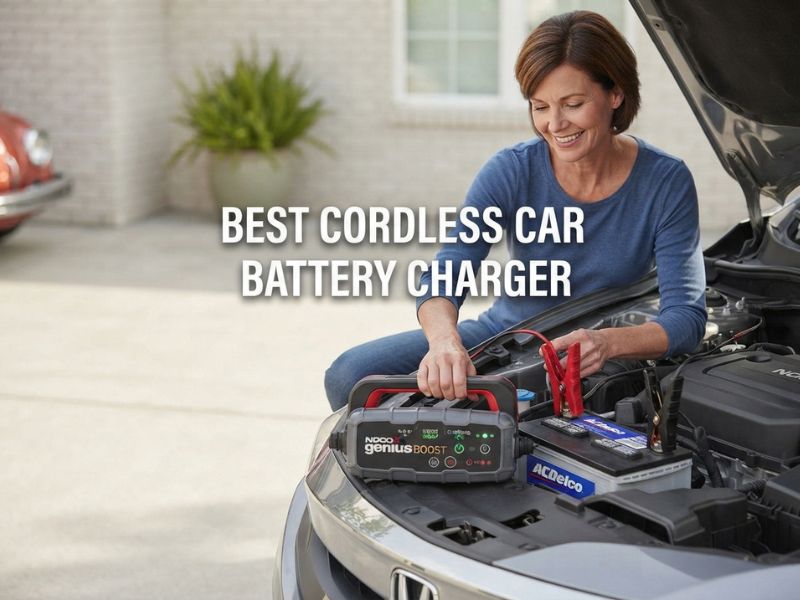
There is one important exception in this list: CTEK CS FREE is an actual portable battery charger and maintainer, not simply a jump starter. If your goal is specifically to transfer charge into a 12V car battery without having a wall outlet beside the vehicle, scroll to product #7. It is a more exact match for “cordless charger,” although the conventional jump packs above have much larger established buyer-feedback bases.
7 Best Cordless Car Battery Charger
| Image | Product Name | Check Price |
|---|---|---|
Best Choice | NOCO Boost GB40 1000A Portable Lithium Jump Starter | Check Price |
Second Best | Clore Automotive Jump-N-Carry JNC660 | Check Price |
Third Choice | HULKMAN Alpha85 2000A Smart Jump Starter | Check Price |
 | AstroAI S8 1500A Car Battery Jump Starter | Check Price |
 | NEXPOW Q10S Portable Car Jump Starter | Check Price |
 | GOOLOO GP4000 4000A Portable Jump Starter | |
 | CTEK CS FREE 12V Portable Battery Charger | Check Price |
Cordless Car Battery Charger vs. Cordless Jump Starter
Before comparing products, it helps to understand what you are actually buying.
A battery charger gradually transfers energy into the vehicle battery. Depending on charger output and battery capacity, restoring a deeply discharged automotive battery can take hours.
A jump starter works differently. It temporarily supplies the large amount of current required by the starter motor. Once the engine starts, the vehicle’s charging system takes over.
This means a jump starter can get you moving much faster, but it does not necessarily restore the battery to a healthy state of charge.
Most compact devices sold for cordless roadside use fall into the second category.
The CTEK CS FREE is unusual because its internal battery and charging electronics can actually transfer energy into a compatible 12V vehicle battery. It also provides Adaptive Boost functionality to put enough energy into a flat battery to start the vehicle.
This distinction matters because the right product depends on your goal:
- Choose a jump starter if you want immediate roadside starting.
- Choose a true portable charger if you need to add charge without nearby AC power.
- Choose a conventional plug-in smart charger if you need complete charging and maintenance at home.
Best Cordless Car Battery Charger
1. NOCO Boost GB40 1000A Portable Lithium Jump Starter – Best Overall

The NOCO GB40 is my primary recommendation for the average driver because it combines useful starting power with extremely convenient storage.
It delivers 1,000 amps of peak starting current and is designed for gasoline engines up to 6.0 liters and diesel engines up to 3.0 liters. That range comfortably covers many sedans, crossovers, SUVs, motorcycles, and light trucks.
Key Features
- 1,000A peak starting output
- 12V lead-acid battery applications
- Up to 6.0L gasoline engines
- Up to 3.0L diesel engines
- Spark-proof connection technology
- Reverse-polarity protection
- IP65-rated housing
- Approximately 2.4-pound design
- USB device charging
- 100-lumen LED flashlight
- Manual Override for extremely low-voltage batteries
The biggest reason I like the GB40 is that it is practical enough to remain in the vehicle.
Traditional booster boxes can weigh 15 to 20 pounds and occupy a significant amount of cargo space. The GB40 is small enough for a trunk organizer, emergency bag, under-seat compartment, or other protected storage area.
Safety is another strong point.
The smart connection system helps identify reverse polarity, while spark-proof circuitry provides extra reassurance for drivers who only connect to a car battery occasionally.
NOCO also provides a Manual Override function for batteries below the unit’s normal voltage-detection threshold.
That feature needs to be treated carefully. Manual Override disables some normal automatic safety protection, so it should only be used after confirming battery voltage, polarity, chemistry, and physical condition.
The IP65-rated enclosure is useful for roadside equipment because dust, rain, snow, and general trunk contamination are realistic concerns.
The GB40 also works as a small USB power bank. This is helpful if your vehicle battery is dead and you need to keep a phone powered while arranging assistance.
Its limitation is straightforward: it is a jump starter, not a full battery charger.
After starting the engine, you still need to determine why the battery discharged. A proper smart charger may be necessary to restore it completely.
What I Like
The GB40 is compact enough to carry everywhere, has a huge real-world ownership base, and provides a sensible engine-capacity range for normal passenger vehicles.
The safety interface is also easier for occasional users than traditional unprotected booster cables.
What I Do Not Like
It cannot replace a proper battery charger when a lead-acid battery needs a complete controlled recharge.
The short clamp cables can also be less convenient on vehicles with difficult battery access.
Verdict
For most drivers who search for a cordless battery charger because they want portable protection from a dead car battery, the NOCO GB40 is the most sensible all-around choice.
2. Clore Automotive Jump-N-Carry JNC660 – Best Heavy-Duty Cordless Jump Box

The JNC660 is much larger and heavier than a modern lithium jump starter, but its traditional construction has advantages when repeated cranking performance matters.
Clore specifies 1,700 peak amps and 425 cranking amps, along with 46-inch #2 AWG welding-cable leads and industrial-grade clamps.
Key Features
- 1,700 peak amps
- 425 cranking amps
- Clore PROFORMER internal battery
- 46-inch cable reach
- Heavy #2 AWG cables
- Industrial-grade clamps
- Built-in automatic charger
- Voltmeter
- 12V DC accessory outlet
- Approximately 18-pound weight
Peak-current figures dominate the portable jump-starter market, but the JNC660 also gives you a published cranking-amp rating.
That makes its performance easier to understand when the starter motor needs sustained current rather than a very short pulse.
The long cables are another meaningful advantage.
Modern cars sometimes locate the battery underneath panels, seats, trunk floors, or other difficult positions. Some vehicles provide remote jump terminals instead. Forty-six-inch cables give you substantially more freedom in positioning the jump box.
Industrial clamps also provide a large conductive contact area.
The JNC660 has an internal automatic charger, so maintaining its own battery is straightforward when AC power is available. You can keep the unit charged and ready in a garage.
Once charged, however, you do not need an extension cord while actually jump-starting the vehicle.
That is why it qualifies as a cordless starting solution even though recharging the JNC660 itself eventually requires external power.
The major disadvantage is its weight.
At approximately 18 pounds, it is many times heavier than the NOCO GB40, AstroAI S8, or other lithium models.
What I Like
Heavy cables, substantial clamps, published cranking performance, and professional-style construction give the JNC660 an advantage for repeated use.
What I Do Not Like
It is far too bulky for anyone whose main priority is a tiny emergency pack.
Its traditional internal battery also requires more attention to maintenance charging than many modern lithium packs.
Verdict
The JNC660 is my preferred choice for garages, work trucks, farms, workshops, and drivers who value sustained cranking capability over minimum weight.
3. HULKMAN Alpha85 2000A Smart Jump Starter – Best Smart Display

The HULKMAN Alpha85 combines high starting capacity with one of the clearest interfaces in this group.
It is rated at 2,000A peak output, with support for gasoline engines up to 8.5L and diesel engines up to 6.0L. Its internal battery capacity is listed at 20,000mAh.
Key Features
- 2,000A peak output
- 20,000mAh internal battery
- Up to 8.5L gasoline engines
- Up to 6.0L diesel engines
- 3.3-inch status display
- 65W charging capability
- USB-A and USB-C
- 12V DC accessory output
- IP65-rated construction
- Multiple electronic safety protections
The Alpha85 is especially appealing for someone who wants a jump starter to communicate what is happening rather than relying solely on tiny indicator lights.
Its 3.3-inch display provides battery status, operating information, and error codes.
That is useful because jump-starting often happens in stressful circumstances. A clear error message can be much easier to interpret than remembering what a particular blinking LED means.
The 20,000mAh internal battery also makes the Alpha85 useful as a power bank.
USB-A and USB-C connections can keep phones and other compatible electronics running during roadside problems or power outages.
Another advantage is recharge speed.
HULKMAN specifies 65W fast charging, allowing the internal battery to recharge much more quickly than many older USB-powered jump packs when compatible charging hardware is used.
Its engine-size range also gives it considerably more reserve than the GB40.
For households with a combination of passenger cars, larger SUVs, pickups, or diesel vehicles, that versatility can justify the additional size.
Again, though, this is a starter/booster rather than a traditional battery charger.
What I Like
The display is excellent, output is substantial, and the large internal battery adds useful emergency-device charging capability.
What I Do Not Like
It is bigger and heavier than minimalist lithium starters, and buyers who only own a compact gasoline car may never use the extra capacity.
Verdict
Choose the Alpha85 when you want a modern cordless jump starter with high starting reserve, fast recharging, and a particularly informative user interface.
4. AstroAI S8 1500A Car Battery Jump Starter – Best Compact Value
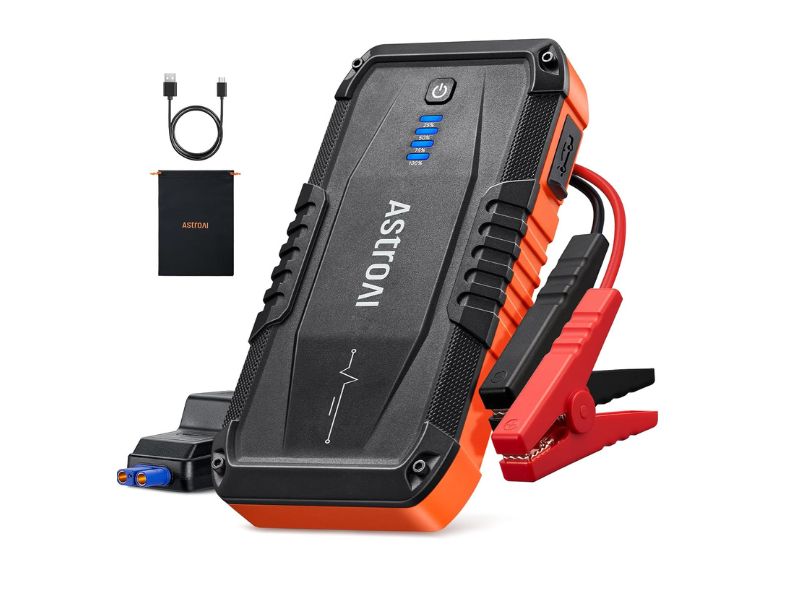
The AstroAI S8 provides a strong combination of size, simplicity, and engine compatibility.
Its 1,500A peak output is designed for gasoline engines up to 6.0L and diesel engines up to 3.0L, putting it in a practical range for ordinary passenger vehicles.
Key Features
- 1,500A peak output
- 12V starting
- Up to 6.0L gasoline
- Up to 3.0L diesel
- Compact lithium construction
- Smart battery clamps
- Boost function
- Multiple electronic protections
- Three-mode flashlight
- USB power-bank capability
The S8 is appealing if you want emergency battery support without dedicating much trunk space to it.
Its published weight is under a pound in the manufacturer’s current comparison information, making it substantially easier to carry than a traditional jump box.
The smart clamp system includes multiple forms of electrical protection, and a boost function is available when battery voltage is too low for normal operation.
That makes the unit useful for common situations such as:
- Interior lights left on overnight
- Car stored for several weeks
- Battery weakened by cold weather
- Older battery struggling to crank
- Occasional motorcycle or lawn-equipment starting
The flashlight adds additional roadside usefulness, while the internal battery can provide USB power.
As with the NOCO GB40, it is important not to confuse “battery booster” with “battery charger.”
Once the vehicle starts, a deeply discharged lead-acid battery still needs a proper charging cycle.
What I Like
It is compact, lightweight, simple, and provides enough published engine capacity for a large percentage of normal vehicles.
What I Do Not Like
It does not provide the large internal energy reserve or substantial cable hardware of heavier premium units.
Verdict
The AstroAI S8 is a strong value-focused cordless emergency starter for cars, crossovers, motorcycles, and smaller trucks.
5. NEXPOW Q10S Portable Car Jump Starter – Best Budget High-Output Option

The NEXPOW Q10S targets buyers who want a higher published peak-current specification without moving into an oversized emergency power station.
The current Q10S family is a compact 12V lithium jump-starter platform with smart clamps, USB device charging, and emergency-light functionality. NEXPOW continues to support the Q10S with model-specific manuals and technical guidance.
Key Features
- Portable 12V jump-starting
- Lithium battery construction
- Smart clamp system
- Low-voltage boost capability
- USB charging
- Emergency flashlight
- Compact storage footprint
- Suitable for passenger vehicles and light trucks
The main attraction is straightforward: you get a small self-contained battery source that can live in an emergency kit and eliminate the need for another vehicle.
For buyers on a tighter budget, this can be much more useful than carrying conventional jumper cables alone.
A power bank function is also relevant in an emergency.
A dead vehicle battery often means the 12V accessory sockets are unavailable, so having a separate USB source helps keep a phone, GPS device, or other small electronic equipment powered.
As with every lithium booster, internal charge level matters.
Do not assume that because the device was charged six months ago it is automatically ready today. Check it regularly and recharge according to the manufacturer’s storage guidance.
What I Like
It offers a useful combination of compact dimensions, high advertised output, smart clamps, and emergency electronics.
What I Do Not Like
Peak-amp claims across different manufacturers are not directly standardized enough to compare purely by the biggest number.
I would therefore choose based on engine compatibility and proven performance rather than assuming more advertised amps automatically means a better starter.
Verdict
The NEXPOW Q10S is well suited to buyers who want a portable, relatively affordable battery booster that can remain in the car for occasional emergencies.
6. GOOLOO GP4000 4000A Portable Jump Starter – Best Large Power Reserve

The GOOLOO GP4000 is aimed at users who want more internal energy storage and substantial published starting capacity.
The unit combines an advertised 4,000A peak output with a 24,000mAh lithium-polymer battery, smart jumper cables, USB charging, and a 12V accessory adapter.
Key Features
- 4,000A advertised peak output
- 24,000mAh battery capacity
- 12V vehicle starting
- Smart jumper cables
- USB charging
- USB-C connectivity
- Emergency flashlight
- 12V accessory adapter
- Protective storage case
Large internal battery capacity provides two advantages.
First, the jump pack has more stored energy available for multiple starting attempts.
Second, it becomes more useful as a general emergency power bank.
That makes the GP4000 appealing for:
- Road trips
- Camping
- Larger vehicles
- Multi-car households
- Power outages
- Drivers who routinely charge electronics away from AC power
The included storage case also matters more than it sounds.
A proper case keeps the clamps and cables with the unit and protects ports from random trunk cargo.
The biggest caution is again the headline amp number.
A 4,000A sticker does not automatically mean four times the real-world starting performance of a 1,000A unit. Testing methodologies, pulse duration, battery chemistry, internal resistance, clamp design, and cable resistance affect actual cranking behavior.
Treat engine compatibility and product quality as more meaningful than peak amps alone.
What I Like
The large internal battery makes the GP4000 more versatile than a minimalist starter, especially for longer road trips.
What I Do Not Like
The additional capacity increases size and weight, and its purpose is still engine starting rather than complete controlled battery recharging.
Verdict
The GP4000 is best for drivers who want both cordless jump-start capability and a substantial portable emergency power bank.
7. CTEK CS FREE 12V Portable Battery Charger – Best True Cordless Charger

The CTEK CS FREE is the most technically accurate answer to this article’s keyword.
Unlike the six products above, this is an actual portable battery charger and maintainer with its own internal energy storage.
CTEK specifies a 66Wh internal lithium-ion battery, up to 20A/240W output, compatibility with 12V batteries from approximately 10–130Ah, and support for common lead-acid types as well as LiFePO4.
Key Features
- True portable battery charging
- 12V operation
- Up to 20A / 240W output
- 66Wh internal lithium-ion battery
- 10–130Ah battery range
- WET, MF, AGM, EFB, GEL, Ca/Ca support
- LiFePO4 compatibility
- Adaptive Boost
- USB-C input
- USB-A and USB-C device outputs
- Optional solar charging capability
- IP54-rated construction
CTEK designed the CS FREE specifically for a problem conventional chargers cannot solve: what happens when the vehicle is nowhere near an electrical outlet?
Its internal battery allows it to put energy into the vehicle battery without an AC cord connected during use.
Adaptive Boost is another important distinction.
Instead of behaving like a traditional high-current jump starter that dumps a very large burst of current directly into the starter circuit, the CS FREE adds energy to the vehicle battery so that the battery can start the vehicle itself.
CTEK states that Adaptive Boost can give a compatible flat battery enough energy to start in around 15 minutes under suitable conditions.
The unit can also operate as a charger and maintainer from other energy sources.
Optional accessories allow charging from:
- A separate 12V service battery
- Solar power
- Vehicle accessory power
This makes it particularly interesting for cars stored where AC electricity is unavailable.
Battery chemistry support is another strength. In addition to common flooded and AGM batteries, CTEK includes EFB, gel, calcium-based lead-acid, and LiFePO4 compatibility.
There are limitations.
The internal battery contains only 66Wh. A typical automotive starting battery may store several hundred watt-hours. Therefore, one fully charged CS FREE does not contain enough energy to take every completely flat large car battery all the way to 100%.
That is not a design failure; it is basic energy capacity.
Its internal pack is primarily valuable for providing enough controlled energy to get the vehicle started, while longer full charging can use USB-C, solar, or another 12V source.
What I Like
This is the only product in the guide that genuinely provides cordless vehicle-battery charging rather than simply high-current jump starting.
It also supports a broad range of 12V battery chemistries and can transition into maintenance applications.
What I Do Not Like
It is more specialized and generally more expensive than a simple lithium jump starter.
The 66Wh internal battery also cannot magically replace the hundreds of watt-hours stored by a large fully charged automotive battery.
Verdict
If you interpret “cordless car battery charger” literally and want to transfer charge into the vehicle battery without a wall outlet, the CTEK CS FREE is the clear specialist choice.
Cordless Car Battery Charger Comparison
| Product | Device Type | 12V Support | Main Output | Battery/Engine Coverage | Main Advantage | Best For |
| NOCO Boost GB40 | Lithium jump starter | Yes | 1,000A peak | 6.0L gas / 3.0L diesel | Compact proven design | Most passenger cars |
| Clore JNC660 | Lead-acid jump box | Yes | 1,700A peak / 425A cranking | Heavy-duty automotive | Cables and cranking power | Garage and repeated use |
| HULKMAN Alpha85 | Lithium jump starter | Yes | 2,000A peak | 8.5L gas / 6.0L diesel | Smart display | Larger vehicles |
| AstroAI S8 | Lithium jump starter | Yes | 1,500A peak | 6.0L gas / 3.0L diesel | Compact value | Cars and crossovers |
| NEXPOW Q10S | Lithium jump starter | Yes | High-output booster | Passenger/light truck | Portability | Budget emergency kit |
| GOOLOO GP4000 | Lithium jump starter | Yes | 4,000A advertised peak | Large 12V vehicles | 24,000mAh reserve | Road trips and larger vehicles |
| CTEK CS FREE | True portable charger | Yes | 20A / 240W max | 10–130Ah batteries | Actual cordless charging | Off-grid battery charging |
Quick Comparison
The NOCO GB40 remains my primary pick for the broadest group of drivers because most people searching for a cordless battery solution really need something that can start a dead vehicle immediately.
The Clore JNC660 is more appropriate for heavy-duty repeated use, while the HULKMAN Alpha85 combines substantial engine capacity with an excellent digital interface.
The AstroAI S8 and NEXPOW Q10S are more compact value-oriented choices. The GOOLOO GP4000 provides a larger internal power reserve.
For actual cordless charging rather than jump-starting, the CTEK CS FREE stands alone as the most direct solution.
How I Chose These Cordless Battery Solutions
The first requirement was independence from another running vehicle.
Traditional jumper cables were excluded because they require a donor vehicle.
I then evaluated:
- Established buyer-feedback history
- 12V automotive relevance
- Internal battery capacity
- Starting capability
- Battery-charging capability
- Gas and diesel engine compatibility
- Clamp design
- Reverse-polarity protection
- Spark protection
- Portability
- Weather resistance
- Recharge options
- USB power capability
- Low-voltage operation
- Storage requirements
- Long-term usefulness
I also distinguished charging from starting rather than treating those terms as interchangeable.
That distinction is important for EEAT because a jump starter can solve the immediate problem of a car that will not crank without actually restoring the battery to a full state of charge.
How to Choose the Best Cordless Car Battery Charger
Decide Whether You Need Charging or Starting
This is the first decision.
If your goal is:
“My battery is dead and I need the engine running now.”
Buy a lithium jump starter.
If your goal is:
“My car is parked away from an outlet and I need to add charge to its battery.”
Choose a true portable charger such as the CTEK CS FREE.
If your goal is:
“My vehicle sits in my garage for months and I want to keep the battery healthy.”
A plug-in smart maintainer is normally more economical than either option.
Match the Device to Engine Size
A jump starter must have enough output for the starter motor.
Engine displacement is a useful guide.
A compact four-cylinder gasoline engine requires much less cranking power than a large diesel pickup.
That is why manufacturers often provide separate maximum ratings for:
- Gasoline engines
- Diesel engines
Diesels normally require more starting current because of their higher compression.
Buy according to your largest engine, particularly if one jump starter will move between multiple vehicles.
Do Not Buy by Peak Amps Alone
Peak-current numbers have become extremely large.
One product might advertise 1,000A while another advertises 4,000A or more.
This does not mean the second product automatically provides four times better starting performance.
Real performance depends on:
- Internal battery chemistry
- Cell discharge capability
- Internal resistance
- Cable resistance
- Clamp contact
- Temperature
- Pulse duration
- Vehicle starter demand
- Condition of the dead battery
The engine-size rating and established real-world history are generally more useful than chasing the biggest number printed on the box.
Consider Battery Chemistry
Flooded Lead-Acid
Traditional flooded batteries remain common in passenger vehicles.
Jump starters generally work alongside these batteries because they supply power to the 12V starting circuit.
True chargers need an appropriate lead-acid charging profile.
AGM
Absorbent Glass Mat batteries are common in premium vehicles, start-stop cars, SUVs, trucks, and applications with high electrical demand.
When using a true charger, verify explicit AGM compatibility.
EFB
Enhanced Flooded Batteries are often used in start-stop vehicles.
Again, actual chargers should support the chemistry.
The CTEK CS FREE explicitly covers EFB.
Gel
Gel batteries require controlled charging voltage and should only be connected to a charger approved for gel chemistry.
LiFePO4
Lithium iron phosphate vehicle batteries have very different charging requirements and commonly include a Battery Management System.
The CS FREE explicitly supports compatible 12V LiFePO4 batteries.
A conventional lead-acid repair or desulfation charger should never automatically be assumed safe for lithium.
Starting Amps and Charging Amps Are Different
This distinction causes substantial confusion.
A jump starter may advertise:
2,000A peak
while a real battery charger may advertise:
20A output.
That does not mean the jump starter charges 100 times faster.
Peak starting current is a short-duration output intended for the starter motor.
Charging current is controlled current transferred into the battery over a much longer period.
They are different measurements for different jobs.
Consider Internal Battery Capacity
Cordless equipment must store energy somewhere.
Lithium jump starters often express capacity in:
- mAh
- Ah
- Wh
Watt-hours (Wh) are particularly useful because they represent stored energy more directly.
A large automotive battery may store hundreds of watt-hours.
This is why a small handheld jump pack can easily provide enough current to crank an engine yet cannot completely recharge an empty 70Ah battery.
Starting requires high power for seconds.
Charging requires substantial energy over time.
Why True Cordless Chargers Are Rare
Charging a car battery takes a lot of energy.
Consider a hypothetical 12V 70Ah battery.
Its nominal energy capacity is roughly:
12V × 70Ah = 840Wh
Actual usable and charging energy differs, but this illustrates the scale.
A portable charger containing a 66Wh internal battery simply cannot transfer 840Wh of energy without receiving additional power from somewhere.
Therefore true cordless chargers normally focus on:
- Adding enough energy to start
- Topping up partially discharged batteries
- Maintenance charging
- Connecting to solar
- Drawing from a separate service battery
Physics limits what a pocket-size device can accomplish.
Jump Starter vs Traditional Charger
Cordless Jump Starter Advantages
- Works anywhere
- No AC outlet required
- Starts a vehicle quickly
- Compact
- Easy to carry
- Useful for emergencies
- Often includes USB charging
- Often includes a flashlight
Cordless Jump Starter Limitations
- Does not normally fully charge the vehicle battery
- Internal pack requires periodic recharging
- Extreme temperature affects lithium performance
- Low-quality packs may exaggerate peak-current claims
Traditional Smart Charger Advantages
- Fully restores battery charge
- Supports controlled charging stages
- Good for battery maintenance
- Often includes desulfation or repair modes
- Can remain connected during vehicle storage
Traditional Smart Charger Limitations
- Requires an external power source
- Charging takes time
- Less useful when stranded away from electricity
Is a Cordless Jump Starter Better Than Jumper Cables?
For emergency convenience, usually yes.
Traditional jumper cables require:
- Another vehicle
- Access to both batteries
- Correct vehicle positioning
- Cooperation from another driver
A self-contained booster eliminates those requirements.
However, jumper cables have one significant advantage: they do not contain an internal battery that can lose charge during storage.
For maximum redundancy, keeping both is reasonable.
Why Reverse-Polarity Protection Matters
Incorrect clamp connection can cause:
- Sparks
- Electrical damage
- Fuse damage
- Battery damage
- Equipment failure
Modern smart jump packs typically identify reversed connections before allowing full current flow.
Nevertheless, always confirm:
Red = positive (+)
and follow the exact grounding procedure specified by the vehicle and booster manufacturer.
Electronics are a backup safety layer, not a replacement for correct connection.
When Manual Boost Mode Is Needed
Some batteries discharge so deeply that a smart jump starter cannot detect them.
The device may interpret extremely low voltage as no battery being connected.
Manual override or boost modes can force output.
Use them cautiously.
Before overriding automatic protection, verify:
- Battery is 12V
- Polarity is correct
- Battery chemistry is compatible
- Battery is not frozen
- Case is not cracked
- Battery is not swollen
- No electrolyte is leaking
If you are uncertain about battery condition, professional testing is safer than forcing a connection.
Cold Weather Performance
Cold weather creates a double problem.
The car battery loses available starting capacity while the engine requires more cranking effort.
Lithium booster packs can also provide less output when extremely cold.
For winter reliability:
- Choose adequate starting reserve
- Keep the unit properly charged
- Store within the manufacturer’s permitted temperature range
- Check it before winter
- Warm a severely cold jump pack when practical
- Keep terminals clean
A larger unit may provide useful additional margin for cold-weather starting.
Can a Cordless Charger Fix a Bad Battery?
No charger can repair every battery failure.
A battery may be:
- Simply discharged
- Sulfated
- Internally shorted
- Physically damaged
- Frozen
- Severely aged
- Unable to retain charge
A charger can restore energy to a healthy discharged battery.
Certain smart charging strategies may improve some sulfation.
Nothing can electronically rebuild broken internal components.
If the battery repeatedly goes flat after proper charging, have the battery and vehicle charging system tested.
Why the Battery Went Dead Matters
Do not stop troubleshooting once the engine starts.
Common causes include:
Lights Left On
Interior, cargo, vanity, or exterior lights can drain a battery overnight.
Vehicle Stored Too Long
Modern cars use electricity even while parked.
Alarm systems, telematics, keyless entry, and computer modules create small continuous loads.
Old Battery
Capacity naturally declines with age.
Eventually, charging only delays replacement.
Alternator Failure
If the alternator does not restore the energy used for starting, the battery will go dead again.
Parasitic Drain
A faulty module, accessory, relay, dash camera, or other component can continue drawing excessive current while the car is switched off.
Corroded Connections
High resistance at battery terminals can cause slow cranking and charging problems even when the battery itself remains serviceable.
How to Use a Cordless Jump Starter Safely
Always use the instructions for your exact vehicle and device.
A general sequence is:
1. Switch the Vehicle Off
Turn off:
- Ignition
- Lights
- Climate controls
- Heated seats
- Audio system
- Unnecessary accessories
2. Inspect the Battery
Do not attempt a normal jump start on a battery that appears:
- Cracked
- Leaking
- Frozen
- Severely swollen
- Mechanically damaged
3. Identify the Correct Connection Points
Modern vehicles may use remote jump terminals instead of direct battery access.
Check the owner’s manual.
4. Connect Positive Correctly
Attach the positive clamp to the designated positive point.
5. Connect the Negative Side
Use the battery negative terminal or specified chassis ground according to the vehicle and booster instructions.
6. Confirm the Device Shows a Safe Connection
Do not ignore warnings.
7. Activate the Booster
Normal automatic mode should be used whenever possible.
8. Start the Engine
Crank only for the permitted duration.
9. Disconnect Promptly
Follow the specified removal sequence.
10. Recharge the Booster
Do not place a depleted unit back into long-term storage.
What to Do After Jump-Starting the Car
Getting the engine started does not mean the battery is fully charged.
A deeply discharged lead-acid battery can require several hours of controlled charging.
The better approach is to:
- Determine why it went dead.
- Charge it with an appropriate smart charger.
- Allow the charging cycle to finish.
- Let the battery rest.
- Test its health.
- Check alternator operation if necessary.
Simply driving around the block may not fully restore a severely discharged battery.
How Often Should You Recharge a Cordless Jump Starter?
Check it periodically rather than assuming it will remain ready forever.
Useful times to inspect charge level include:
- Before winter
- Before summer road trips
- Before long-distance travel
- After every jump start
- After charging USB devices
- After several months in storage
Follow the manufacturer’s recommended charging interval.
Where Should You Store It?
The ideal location is:
- Dry
- Secure
- Protected from direct sunlight
- Protected from liquids
- Away from extreme engine heat
- Easy to access
- Protected from loose metal objects
A storage case is useful because it keeps clamps from contacting tools and protects cables from physical damage.
Do not bury the jump starter under luggage if you may need it during a roadside emergency.
Is It Safe to Leave a Lithium Jump Starter in a Car?
Generally, yes, when manufacturer temperature limits are followed.
However, interior vehicle temperatures can become extreme.
A parked car in direct summer sun can reach temperatures far higher than outside air.
Extreme heat accelerates lithium-cell degradation and can create safety concerns.
Likewise, extreme cold reduces available output.
Follow the storage specifications for your exact product.
Do You Need an Air Compressor Too?
Some emergency battery systems also include tire inflators.
Combining tools can be convenient because battery failures and low tires are two common roadside problems.
However, an all-in-one product typically becomes:
- Larger
- Heavier
- More complicated
If trunk space is limited, combining functions makes sense.
If maximum jump-start reliability is the priority, a dedicated jump starter plus a separate compact inflator may provide greater flexibility.
Important Maintenance Tips
Check Charge Level
A dead booster cannot help a dead car.
Inspect the Clamps
Look for corrosion, weak springs, broken insulation, and damaged conductors.
Inspect the Cables
Do not use cables with exposed copper or heat damage.
Keep Ports Covered
Water, dust, and metal debris can contaminate USB or charging connections.
Test Before a Long Trip
Do not wait until an emergency to learn how your jump starter works.
Read the manual and identify your vehicle’s proper jump points beforehand.
Recharge After Use
Even one difficult jump start can consume significant stored energy.
Common Buying Mistakes
Assuming Every Portable Jump Starter Is a Charger
This is the biggest mistake associated with this keyword.
Most lithium jump packs do not fully charge an automotive battery.
Buying Based Only on Peak Amps
Extremely high numbers are not a guarantee of better real-world performance.
Ignoring Engine Type
Diesel engines normally need greater cranking capability.
Forgetting Battery Voltage
These recommendations are primarily intended for 12V automotive applications.
Do not connect a 12V starter across a 24V system unless the device specifically supports that configuration.
Ignoring Battery Chemistry
True charging requires a compatible charging profile.
This is particularly important for LiFePO4 and other lithium batteries.
Never Checking the Unit During Storage
Every internal battery self-discharges to some degree.
Assuming a Jump Start Fixes the Battery
It only gets the engine running.
A failing or deeply discharged battery still needs diagnosis.
Frequently Asked Questions
What is the best cordless car battery charger?
For most drivers needing cordless emergency starting, I recommend the NOCO GB40.
Its compact lithium design, 1,000A output, safety protections, and broad passenger-vehicle compatibility make it particularly practical.
If you specifically need true cordless charging rather than jump-starting, the CTEK CS FREE is the more technically accurate choice.
Is there really a cordless car battery charger?
Yes, but true cordless chargers are far less common than cordless jump starters.
The CTEK CS FREE contains an internal battery and can transfer energy into a compatible 12V vehicle battery without remaining connected to AC power.
Most other portable battery packs provide jump-start current rather than a complete charging cycle.
Can a cordless jump starter fully charge my car battery?
Usually not.
Its purpose is to provide enough current to start the engine.
A full-size automotive battery stores far more energy than most compact jump packs. Use a proper charger afterward if the battery has been deeply discharged.
What is the difference between a booster and a charger?
A booster provides short-term high current, while a charger gradually restores stored battery energy.
A jump starter may crank an engine in seconds.
Charging the same deeply discharged battery can take hours.
How many amps do I need?
Choose according to engine size and fuel type rather than relying solely on peak amperage.
A unit rated for approximately 6.0L gasoline engines is more than adequate for most four-cylinder cars.
Large diesel pickups require considerably more reserve.
Is 1,000A enough for a car?
Yes, a quality 1,000A unit can start many passenger vehicles.
The NOCO GB40, for example, is designed for gasoline engines up to 6.0L and diesel engines up to 3.0L.
Is 2,000A better than 1,000A?
It provides more potential starting reserve, but it is not automatically necessary.
Buy enough capacity for your engine and operating conditions. Oversizing slightly is useful, but carrying an unnecessarily huge booster adds weight and cost.
Can I use a cordless battery starter on an AGM battery?
Most 12V jump starters can assist compatible AGM starting systems.
For actual charging, make sure the charger explicitly supports AGM chemistry.
Can I use one on a lithium car battery?
Only when the battery and device manufacturers explicitly permit it.
Lithium batteries use a battery management system and can have very different recovery requirements.
The CTEK CS FREE specifically lists compatible 12V LiFePO4 batteries among its supported chemistries.
Can a jump starter damage vehicle electronics?
A properly designed and correctly connected unit minimizes risk, but correct procedure still matters.
Use the vehicle’s designated jump points, observe polarity, follow the device instructions, and never experiment with override modes unnecessarily.
Can I use a jump starter if the car battery reads zero volts?
Some models provide manual override for extremely low voltage, but additional caution is required.
A near-zero reading could indicate severe discharge or an internal battery problem.
Inspect the battery and verify voltage, chemistry, and polarity before forcing output.
Why won’t my cordless jump starter work?
Common causes include low charge, poor clamp contact, reverse polarity, extreme battery discharge, or an engine beyond the starter’s capability.
Corroded battery terminals can also prevent sufficient current transfer.
Will driving recharge the battery after a jump?
The alternator may restore some charge, but a short drive may not fully recharge a deeply discharged battery.
A controlled smart charging cycle is preferable after a severe discharge.
How long should I drive after jump-starting?
There is no universal driving time that guarantees a full recharge.
Alternator output, battery capacity, state of discharge, temperature, vehicle electrical load, and charging strategy all vary.
Use a dedicated charger when a complete recharge is important.
Why does my battery keep dying?
Repeated discharge usually indicates an underlying battery or vehicle problem.
Possible causes include an old battery, alternator fault, abnormal parasitic drain, loose terminals, corrosion, or an accessory that continues drawing power while parked.
Can a cordless charger repair a bad battery?
It can recharge a healthy discharged battery, but it cannot fix every type of battery failure.
A battery with a shorted cell, physical damage, severe deterioration, or inability to retain charge generally needs replacement.
Is the CTEK CS FREE a jump starter?
It is better described as an adaptive booster, portable charger, and maintainer.
Instead of delivering a traditional massive jump-start pulse directly to the starter motor, Adaptive Boost transfers controlled energy into the vehicle battery so the battery can help start the vehicle.
How long does the CTEK CS FREE take to help a flat battery start?
CTEK specifies approximately 15 minutes under suitable conditions using Adaptive Boost.
Actual results depend on battery size, state of discharge, temperature, condition, and vehicle starting demand.
Can I charge a battery with the CTEK CS FREE using solar power?
Yes, compatible optional accessories can allow off-grid charging from solar or another 12V battery source.
That makes it particularly useful for vehicle storage locations without nearby AC electricity.
Should I keep jumper cables if I own a cordless jump starter?
Keeping both provides useful redundancy.
The jump starter is more convenient when no donor vehicle is available, while jumper cables do not depend on an internal battery being charged.
Conclusion
Choosing the best cordless car battery charger starts with understanding whether you really need charging or immediate starting capability.
For most drivers, the NOCO Boost GB40 remains my primary recommendation. Its massive established ownership history, compact dimensions, practical 1,000A output, broad passenger-vehicle engine range, IP65 construction, and straightforward safety system make it an excellent device to keep in a car for dead-battery emergencies.
The Clore Jump-N-Carry JNC660 makes more sense for heavy-duty and repeated use because its substantial cables, industrial clamps, and published cranking output prioritize sustained starting performance over compactness.
The HULKMAN Alpha85 is the better modern high-capacity option when a large display, fast charging, USB power, and greater gasoline/diesel engine compatibility are priorities. AstroAI S8 and NEXPOW Q10S provide more compact value-focused alternatives, while the GOOLOO GP4000 offers additional internal power capacity for larger vehicles and extended trips.
However, buyers who literally need a cordless charger rather than a cordless jump starter should focus on the CTEK CS FREE. Its internal battery, controlled 12V charging, Adaptive Boost technology, AGM/EFB/LiFePO4 compatibility, and off-grid power options make it the most direct solution for charging a vehicle battery where a normal electrical outlet is unavailable.
For everyday roadside protection, I would start with the NOCO GB40. For actual off-grid battery charging, choose the CTEK CS FREE.