A bulky bench charger can be inconvenient when you only need a dependable way to charge or maintain a 12V car battery at home.
The best compact car battery charger should be small enough to store in a toolbox, garage cabinet, or vehicle emergency kit while still providing intelligent charge control, dependable safety protection, and compatibility with the battery chemistry in your car.
Charging speed also matters: tiny 0.75A to 1A units are excellent for maintenance and long-term storage, while a 4A or 5A compact charger is much more useful when you regularly need to restore a partially discharged full-size automotive battery.
Modern compact chargers are also far smarter than old manual trickle chargers. Good models can monitor battery voltage, adjust charging automatically, transition into maintenance mode after the battery reaches full charge, and protect against common problems such as reverse polarity or overcharging.
Some add AGM modes, lithium compatibility, temperature compensation, desulfation, low-voltage recovery, or permanent ring-terminal connections, making them suitable for everything from a daily driver to a classic car stored for winter.
My primary recommendation is the NOCO GENIUS1 1A 6V/12V Smart Battery Charger. Its exceptionally compact dimensions, automatic temperature compensation, AGM and lithium modes, Force Mode for deeply discharged batteries, integrated maintenance function, and extensive safety system make it the strongest all-around option when portability matters more than rapid charging.
For a vehicle that spends long periods parked, I also like the Battery Tender Junior 12V 750mA Charger and Maintainer. Its simple automatic charging cycle, float maintenance, quick-connect system, long cable reach, and compact housing make it particularly convenient for seasonal or rarely driven vehicles.
If low purchase cost and simple operation are higher priorities, the MOTOPOWER MP00205A 12V 800mA Automatic Battery Charger is another useful choice. It is small, lightweight, automatic, and designed around maintenance, trickle charging, and desulfation of common 12V lead-acid batteries.
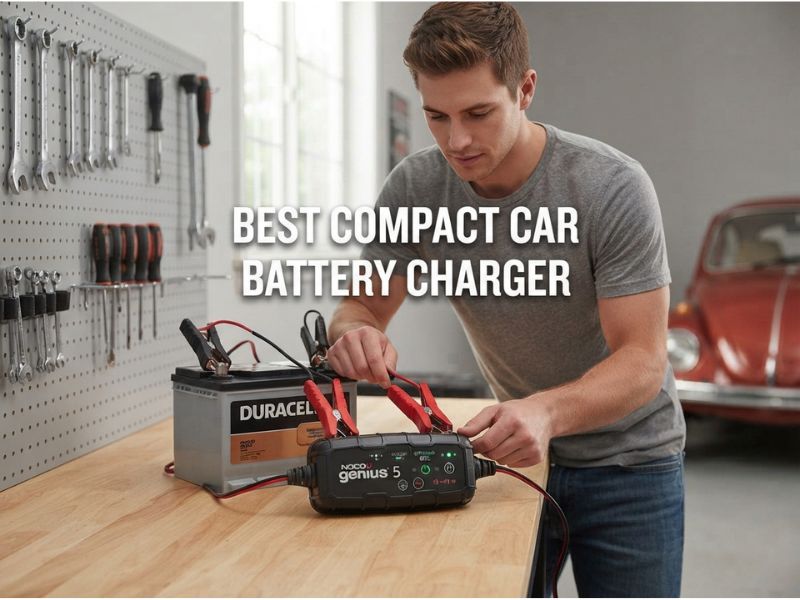
Best Compact Car Battery Charger
| Image | Product Name | Check Price |
|---|---|---|
Best Choice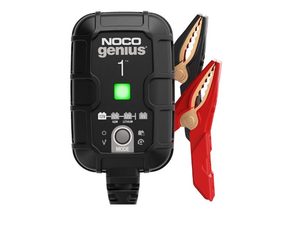 | NOCO GENIUS1 1A 6V/12V Smart Battery Charger | Check Price |
Second Best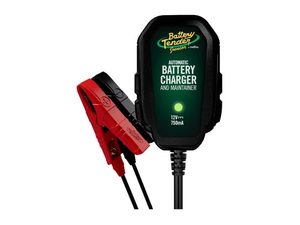 | Battery Tender Junior 12V 750mA Charger and Maintainer | Check Price |
Third Choice | MOTOPOWER 12V 800mA Automatic Battery Charger | Check Price |
 | BLACK+DECKER BM3B 6V/12V Automatic Battery Charger | Check Price |
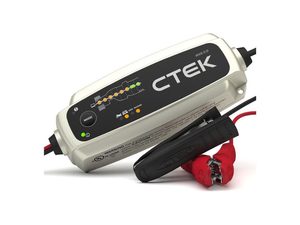 | CTEK MXS 5.0 12V 4.3A Battery Charger and Maintainer | Check Price |
1. NOCO GENIUS1 1A 6V/12V Smart Battery Charger – Best Overall

The NOCO GENIUS1 is my first choice when the goal is to get the most battery-management capability from the smallest practical package.
At approximately 3.62 x 2.32 x 1.26 inches and 0.77 pound, it is genuinely compact rather than simply being smaller than a traditional garage charger. That makes it easy to keep on a shelf, inside a tool cabinet, or with a seasonal vehicle without sacrificing much storage space.
Key Features
- 1A charging output
- 6V and 12V operation
- Flooded lead-acid compatibility
- AGM mode
- EFB, gel, calcium, and maintenance-free support
- Compatible lithium charging mode
- Automatic maintenance
- Temperature compensation
- Low-voltage detection
- Force Mode
- Reverse-polarity protection
- Spark protection
- Overcharge protection
- Integrated clamps and eyelet connection
The biggest reason I rank the GENIUS1 first is its battery compatibility. It works with common flooded lead-acid, AGM, gel, EFB, maintenance-free, calcium, and compatible lithium batteries. That gives it more flexibility than a basic 12V lead-acid maintainer.
Its integrated thermal sensor is particularly useful for automotive applications. Battery charging behavior changes with temperature. A charger that works in an air-conditioned garage in Florida may encounter very different conditions in an unheated Minnesota garage during January.
The GENIUS1 automatically adjusts its charging strategy in response to ambient temperature, helping reduce the chance of undercharging in cold weather or applying unnecessarily high charging voltage in hot conditions.
Another standout feature is low-voltage recovery. The automatic charger can detect a deeply discharged battery down to approximately 1 volt. For batteries below the normal detection threshold, Force Mode allows manual charging activation.
Force Mode should be used carefully. When you override normal battery detection, you need to verify battery voltage, chemistry, polarity, and physical condition yourself before starting.
The 1A maximum output is also important to understand. This charger is excellent for maintaining a car battery, keeping a rarely used vehicle ready, and slowly charging a partially discharged battery. It is not designed for rapid recovery of a large battery.
A full-size 80Ah automotive battery at around 50% state of charge may take roughly 60 hours under the manufacturer’s approximate charging-time guidance. If fast charging is your main goal, the CTEK MXS 5.0 farther down this list is more appropriate.
What I Like
- Extremely compact dimensions
- Very lightweight
- Wide battery-chemistry compatibility
- 6V and 12V operation
- Excellent AGM support
- Automatic temperature compensation
- Useful low-voltage charging
- Force Mode for extreme discharge
- Automatic maintenance
- Strong electrical protections
- Permanent eyelet connection capability
What I Do Not Like
- 1A charging is slow for a large depleted car battery.
- Simple LED indicators provide less information than an LCD.
- Buyers who only maintain one basic flooded battery may not need all its modes.
Verdict
The NOCO GENIUS1 is the best compact car battery charger for most buyers who prioritize size, smart charging, and battery compatibility.
It is especially good for maintaining a second vehicle, classic car, weekend car, AGM-equipped vehicle, motorcycle, or other battery that sits unused.
2. Battery Tender Junior 12V 750mA Charger and Maintainer – Best for Long-Term Storage

The Battery Tender Junior is one of the most straightforward options in this guide.
It measures approximately 4.4 x 2.15 x 2.9 inches and weighs less than a pound for the charger itself, making it small enough for almost any garage or storage setup.
Key Features
- 12V charging
- 750mA output
- Automatic charging
- Float maintenance
- Lead-acid compatibility
- AGM compatibility
- Gel compatibility
- Sealed battery compatibility
- Quick-disconnect connection
- Alligator clips
- Ring-terminal connection
- Reverse-polarity protection
- Spark protection
- Approximately 12-foot total reach
Its 750mA output tells you exactly where this charger fits.
This is primarily a battery maintainer, not a fast automotive battery charger.
If your car already has a healthy battery and you want to park it for several weeks or months, that is an advantage rather than a weakness. The charger can gradually replace energy lost to normal self-discharge and small vehicle parasitic loads without requiring a large, high-output charger.
The charging process is automatic. Once the battery reaches the appropriate charge state, the unit transitions into maintenance behavior instead of continuing to bulk-charge indefinitely.
I particularly like its quick-disconnect system for seasonal vehicles.
You can permanently attach the ring-terminal harness to approved battery connection points and route the connector somewhere accessible. When the car enters storage, connecting the charger takes only a few seconds.
That setup works well for:
- Classic cars
- Convertibles
- Weekend sports cars
- Seasonal vehicles
- Motorcycles
- Lawn equipment
- Backup vehicles
One limitation is battery size. This particular Junior model is designed around relatively small lead-acid batteries and maintenance applications. Owners of large car batteries who expect significant recharging should choose a higher-output charger.
It is also lead-acid focused. If you need support for an aftermarket lithium starter battery, use a charger specifically designed for that chemistry.
What I Like
- Very small housing
- Lightweight construction
- Excellent for long-term storage
- Automatic float maintenance
- Simple operation
- Long cable reach
- Quick-disconnect connection
- Ring terminals included
- Strong safety features
- Good fit for vehicles that sit
What I Do Not Like
- 750mA charging is extremely slow for a discharged automotive battery.
- Primarily intended for maintenance and smaller batteries.
- No standard lithium mode on this particular version.
- No detailed display.
Verdict
The Battery Tender Junior is my favorite compact choice for a vehicle that spends most of its time parked.
If the battery begins storage in healthy, fully charged condition, a low-output smart maintainer is often all you need.
3. MOTOPOWER 12V 800mA Automatic Battery Charger – Best Budget Pick

The MOTOPOWER MP00205A is a compact, inexpensive option for drivers who mainly want automatic 12V lead-acid battery maintenance.
It combines charging, maintaining, trickle charging, and desulfation functions without requiring the larger housing associated with high-current automotive chargers.
Key Features
- 12V operation
- 800mA charging output
- Automatic charge control
- Maintenance mode
- Desulfation function
- Lead-acid battery support
- AGM compatibility
- Gel battery compatibility
- Sealed battery support
- Reverse-polarity protection
- Short-circuit protection
- Overcharge protection
- Compact lightweight housing
Its 800mA output places it in almost the same usage category as the Battery Tender Junior.
If you have a stored vehicle with a healthy battery, the charger provides enough current to counteract normal self-discharge and many modest key-off electrical loads.
It can also charge a partially discharged battery, but patience is required.
A 60Ah battery missing 30Ah of capacity theoretically requires more than 37 hours at 0.8A before charging losses and the final absorption stage are even considered.
This is why I recommend thinking of the MOTOPOWER primarily as a compact maintenance charger.
Its automatic desulfation function is another useful feature, although expectations should remain realistic.
Lead sulfate forms naturally during discharge. When a lead-acid battery remains undercharged for a long time, sulfation can become harder to reverse and usable battery capacity declines.
Appropriate charging can sometimes improve mild recoverable sulfation. It cannot repair a shorted cell, damaged plates, leaking case, internal corrosion, or a battery that has reached the end of its normal service life.
The MOTOPOWER is particularly attractive if you own several vehicles and want an inexpensive dedicated maintainer for each one rather than moving one premium charger between them.
What I Like
- Very compact
- Affordable
- Simple automatic operation
- Maintenance functionality
- Desulfation mode
- Suitable for common 12V lead-acid batteries
- Useful electrical protection
- Little setup required
What I Do Not Like
- 800mA output is slow.
- 12V-only design is less versatile than the NOCO.
- Limited charging information compared with LCD-equipped units.
- Not intended for rapidly restoring large depleted batteries.
Verdict
The MOTOPOWER MP00205A is my budget recommendation for straightforward 12V battery maintenance.
It makes the most sense when portability, low cost, and set-and-maintain operation are more important than charging speed.
4. BLACK+DECKER BM3B 6V/12V Automatic Battery Charger – Best Connection Options
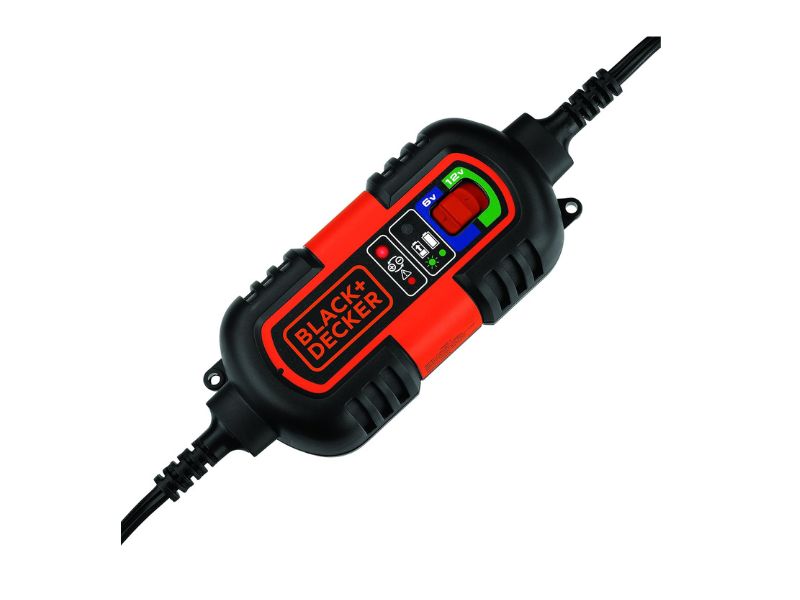
The BLACK+DECKER BM3B is an older but still useful compact charger that stands out because of its multiple connection methods.
It supports both 6V and 12V batteries and includes traditional clips plus ring-terminal connections.
Key Features
- 6V and 12V operation
- Automatic high-frequency charging
- Automatic float mode
- AGM battery support
- Gel battery support
- Wet lead-acid support
- Battery clips
- Ring-terminal connections
- Compatible accessory-socket charging arrangement
- Reverse-polarity protection
- Short-circuit protection
- Integrated mounting provision
Its main appeal is flexibility.
For normal use, connect it using the battery clips.
For a stored car, install the ring-terminal harness and leave it attached.
On certain vehicles, an appropriate accessory-socket connection can make battery maintenance even easier.
However, you cannot assume that every vehicle’s 12V accessory socket remains electrically connected to the battery after the ignition is switched off.
Many modern vehicles disconnect those sockets entirely.
Others switch them off after the control modules enter sleep mode.
Check your owner’s manual before choosing this connection method.
The BM3B automatically shifts between charging and float maintenance, so it is appropriate for extended connection when used according to its instructions.
Its compact inline design is also easy to mount near a workbench or garage outlet.
The main limitation is again charging speed. This style of compact maintainer is intended more for keeping a battery healthy than rapidly restoring one that has gone completely flat.
What I Like
- 6V and 12V support
- Small, storage-friendly design
- Several connection choices
- Ring terminals included
- Automatic float charging
- AGM, gel, and wet battery support
- Straightforward controls
- Useful for stored vehicles
What I Do Not Like
- Low-current design is slow for full-size battery recovery.
- Accessory-socket charging does not work on every vehicle.
- No lithium charging mode.
- Limited status information.
Verdict
Choose the BLACK+DECKER BM3B if you value flexible installation and connection options.
It works particularly well as a compact garage maintainer for conventional lead-acid batteries.
5. CTEK MXS 5.0 12V 4.3A Battery Charger and Maintainer – Best Compact Fast Charger

The CTEK MXS 5.0 is the product I would choose if you like the small size of a maintainer but need substantially more charging capability.
Its maximum output is approximately 4.3A, giving it more than four times the current available from a 1A unit.
That difference matters when a full-size automotive battery is already significantly discharged.
Key Features
- Up to 4.3A charging output
- 12V operation
- Eight-stage automatic charging
- AGM program
- EFB compatibility
- Flooded lead-acid support
- Gel compatibility
- Automatic temperature compensation
- Reconditioning mode
- Float maintenance
- Pulse maintenance
- Reverse-polarity protection
- Spark protection
- IP65-rated enclosure
- Charges batteries up to 110Ah
- Maintains batteries up to 160Ah
The MXS 5.0 uses an eight-stage automatic charging sequence rather than simply applying one fixed charging voltage.
The process includes battery analysis, bulk charging, absorption, evaluation, and long-term maintenance behavior.
Its stated charging range reaches 110Ah, while maintenance capability extends to larger batteries up to 160Ah. That makes it a much more realistic full-size car battery charger than the sub-1A units above.
The dedicated AGM program is important for modern vehicles.
AGM batteries are widely used in cars with:
- Start-stop systems
- High electrical loads
- Premium electronics
- Frequent cycling
- Advanced charging strategies
You should not assume that every flooded-battery charging program is automatically ideal for AGM.
The CTEK also provides automatic temperature compensation, helping the charging process respond to seasonal garage conditions.
Its Recond mode provides a specialized process for certain deeply discharged lead-acid batteries. This is not something I would activate routinely on a healthy battery or use without checking the instructions.
The charger is longer than the tiny GENIUS1, but its slim profile and 1.3-pound weight still make it compact compared with traditional automotive chargers capable of similar charging rates.
What I Like
- Much faster than 0.75–1A maintainers
- Excellent 12V automotive battery capability
- Eight-stage charging
- AGM program
- EFB compatibility
- Temperature compensation
- Reconditioning function
- Float and pulse maintenance
- IP65-rated enclosure
- Strong battery-capacity range
- Lightweight for its output
What I Do Not Like
- Larger than the ultra-compact first four products.
- 12V-only operation limits versatility.
- No standard lithium charging mode.
- More charger than you need if your only goal is maintaining a small battery.
Verdict
The CTEK MXS 5.0 is the best compact option when charging speed matters.
It is especially appropriate for full-size automotive batteries, AGM-equipped cars, start-stop vehicles, collector cars, and drivers who want one device for both charging and maintenance.
Best Compact Car Battery Charger Comparison
| Product | Output | Voltage | Main Battery Types | Maintenance | Temp. Compensation | Recovery Feature | Best For |
| NOCO GENIUS1 | 1A | 6V/12V | Flooded, AGM, EFB, Gel, Lithium | Yes | Yes | Force Mode | Best overall |
| Battery Tender Junior | 0.75A | 12V | Flooded, AGM, Gel | Yes | Automatic control | Maintenance focused | Long-term storage |
| MOTOPOWER MP00205A | 0.8A | 12V | Flooded, AGM, Gel, sealed | Yes | Automatic control | Desulfation | Budget maintenance |
| BLACK+DECKER BM3B | Low current | 6V/12V | Wet, AGM, Gel | Yes | Automatic control | Automatic charging | Flexible connections |
| CTEK MXS 5.0 | 4.3A | 12V | Flooded, AGM, EFB, Gel | Yes | Yes | Recond mode | Faster charging |
For pure compactness and all-around versatility, the NOCO GENIUS1 is my first choice. It gives you an unusually broad set of charging modes in a charger that weighs less than a pound.
The Battery Tender Junior and MOTOPOWER are better thought of as compact maintainers. They are ideal when the battery is normally healthy but the vehicle sits unused.
The CTEK MXS 5.0 is the clear choice if you need a compact charger that can restore a partially discharged full-size car battery in a more practical amount of time.
How I Chose These Compact Car Battery Chargers
Small physical dimensions were important, but size alone was not enough.
I prioritized chargers that balance compact storage with genuine automotive usefulness.
Important factors included:
- Physical dimensions
- Weight
- Charging amperage
- 6V and 12V support
- AGM compatibility
- EFB compatibility
- Lithium support where applicable
- Automatic maintenance
- Low-voltage recovery
- Temperature compensation
- Reverse-polarity protection
- Spark protection
- Connection options
- Long-term storage suitability
- Charging speed
- Ease of operation
- Established customer history
I also considered whether each product fits a different buying situation rather than selecting five nearly identical chargers.
Buying Guide: Choosing the Best Compact Car Battery Charger
Decide Whether You Need Charging or Maintenance
This is the most important decision.
A battery maintainer and a fast automotive charger are not necessarily the same thing.
If the vehicle battery is already healthy and you simply want to prevent it from discharging while parked, a 0.75A to 1A smart maintainer is often ideal.
If your battery regularly becomes substantially discharged, one amp can be frustratingly slow.
For real battery recovery, consider approximately 4A to 10A depending on battery capacity and the manufacturer’s recommendations.
Understand Charging Amps
Charging current determines how quickly energy can be returned to the battery.
Consider a hypothetical 60Ah automotive battery that is at roughly 50% state of charge.
It needs approximately 30Ah restored.
Ignoring charging losses and current tapering:
- 0.75A would theoretically require about 40 hours.
- 1A would require around 30 hours.
- 2A would require around 15 hours.
- 5A would require around 6 hours.
- 10A would require around 3 hours.
Real charging times are longer because lead-acid charging becomes slower near full charge.
This is why the NOCO GENIUS1 is excellent for maintenance while the CTEK MXS 5.0 is more suitable when you need actual charging speed.
How Compact Is Compact?
There is no official dimension that defines a compact charger.
For this guide, I favor products that can easily fit:
- In a small toolbox
- On a narrow garage shelf
- Inside a vehicle storage compartment
- In an emergency-equipment bin
- Beside a permanently stored car
The NOCO GENIUS1 is particularly small at roughly 3.62 inches tall and only 1.26 inches deep.
By comparison, larger 10A, 15A, and 25A garage chargers may offer faster charging but occupy considerably more space.
Check Your Battery Chemistry
Modern cars use several battery technologies.
The charger needs to match the battery.
Flooded Lead-Acid
This remains common in conventional vehicles.
Chargers may identify the program as:
- Standard
- Wet
- Flooded
- STD
- Lead-acid
AGM
Absorbent Glass Mat batteries are common in higher-end vehicles and cars with demanding electrical systems.
A dedicated AGM program is preferable when recommended by the battery manufacturer.
EFB
Enhanced Flooded Battery technology is common in certain start-stop vehicles.
Some chargers explicitly list EFB compatibility.
Gel
Gel-cell batteries have different charging requirements and should only be used with a compatible charging program.
Lithium
Some specialty automotive and powersports batteries use lithium iron phosphate technology.
Never connect an ordinary lead-acid-only charger to a lithium battery unless the battery manufacturer explicitly permits it.
The NOCO GENIUS1 is the most versatile option in this group if multiple battery chemistries are important.
6V vs. 12V Battery Chargers
Nearly every modern passenger car uses a 12V electrical system.
However, 6V charging capability can be valuable if you also own:
- Classic cars
- Vintage motorcycles
- Antique tractors
- Specialized equipment
The NOCO GENIUS1 and BLACK+DECKER BM3B provide both 6V and 12V operation.
Battery Tender Junior and CTEK MXS 5.0 models covered here are primarily 12V devices.
Compact Charger vs. Trickle Charger
These terms are sometimes treated as interchangeable, but they describe different things.
“Compact” refers to physical size.
“Trickle charger” traditionally refers to a low-current charging method.
A compact charger can still supply several amps.
Likewise, a large charger may include a low-current maintenance mode.
For long-term car storage, I prefer a smart automatic maintainer rather than an old unregulated trickle charger.
Battery Charger vs. Battery Maintainer
A charger is intended to restore energy.
A maintainer is primarily designed to preserve the battery once it is already charged.
Modern smart devices often perform both jobs.
For example, the CTEK MXS 5.0 can perform relatively meaningful bulk charging and then transition into maintenance.
The Battery Tender Junior is much more heavily focused on maintenance because of its low current.
Understanding that distinction prevents one of the most common purchase disappointments in this category.
What Is Automatic Float Mode?
Once a lead-acid battery reaches full charge, it no longer needs maximum charging current.
An automatic charger reduces its output or transitions into float maintenance.
This keeps the battery near the appropriate charge level while replacing small losses from:
- Self-discharge
- Security systems
- Clocks
- Control modules
- Keyless-entry receivers
- Telematics
- Other parasitic vehicle loads
This is especially useful for a car that may remain parked for weeks.
What Is Temperature Compensation?
Charging voltage requirements change with temperature.
Cold batteries may require different charging behavior than hot batteries.
An automatic thermal sensor can modify the charging profile based on ambient conditions.
I consider this particularly useful for garages in areas with significant seasonal changes.
For example, a charger in:
- Minneapolis
- Chicago
- Denver
- Buffalo
- Boston
may encounter very cold winter conditions.
Meanwhile, garages in:
- Phoenix
- Las Vegas
- Dallas
- Houston
- Southern California
can become extremely hot in summer.
Temperature-aware charging helps a smart charger cope with these differences.
What Is Desulfation?
Sulfation develops when lead sulfate crystals remain on lead-acid battery plates, particularly after the battery spends extended periods partially discharged.
Certain smart chargers use a specialized charging routine intended to address recoverable sulfation.
This can sometimes improve battery performance.
It cannot repair every aging battery.
No compact charger can fix:
- A shorted cell
- Broken internal connections
- Severe plate shedding
- A cracked case
- Electrolyte leakage
- Severe physical swelling
- Major internal corrosion
If the battery repeatedly fails after receiving a full charge, it needs proper testing.
What Is Force Mode?
Smart chargers normally need to detect battery voltage before starting.
A battery that has been severely discharged may fall below the automatic detection threshold.
Force Mode manually activates charging.
The NOCO GENIUS1 provides this capability for batteries below its normal low-voltage detection threshold.
Because the charger is no longer relying entirely on normal detection logic, you must carefully verify:
- Battery voltage
- Battery type
- Polarity
- Battery condition
before using manual override.
Is a 1-Amp Compact Charger Enough for a Car?
Yes for maintenance, but often too slow for rapid charging.
A 1A unit is excellent when:
- The car sits unused.
- The battery is normally healthy.
- You want winter storage maintenance.
- You charge overnight or longer.
- You are not in a hurry.
It is less suitable when:
- The battery is frequently deeply discharged.
- You need the car again within a few hours.
- You maintain several high-capacity batteries.
For those jobs, a compact 4A or 5A charger offers a better balance.
Best Compact Charger for AGM Car Batteries
For AGM batteries, I would choose either the NOCO GENIUS1 or CTEK MXS 5.0.
The NOCO is significantly smaller and supports several additional battery chemistries.
The CTEK provides more charging current and is therefore better when a full-size AGM battery is actually low rather than simply being maintained.
Always select the charging program recommended by the battery manufacturer.
Best Compact Charger for Winter Storage
My first choice is the NOCO GENIUS1 because temperature compensation and automatic maintenance make it particularly well suited to changing garage temperatures.
The Battery Tender Junior is another strong choice if the car enters storage with an already healthy conventional lead-acid battery.
For larger AGM batteries, the CTEK MXS 5.0 provides more charging capacity.
Best Compact Charger for a Classic Car
Battery requirements vary enormously among classic vehicles.
Some vintage cars use 6V electrical systems, which immediately makes a dual-voltage charger more useful.
The NOCO GENIUS1 supports both 6V and 12V batteries.
For a 12V classic car stored several months each year, Battery Tender Junior is another simple maintenance option.
Permanent ring-terminal connections can be particularly convenient because you can connect the maintainer without repeatedly manipulating battery clamps.
Best Charger for a Start-Stop Car
Many start-stop vehicles use AGM or EFB batteries.
The correct battery program matters.
The CTEK MXS 5.0 is particularly strong here because it is designed around modern lead-acid technologies including AGM and EFB.
The NOCO GENIUS1 is another strong option when compactness matters most.
How to Connect a Compact Car Battery Charger
Always follow the instructions for both the vehicle and charger.
Many modern cars specify dedicated charging points rather than requiring direct access to the battery.
A typical process is:
- Turn the vehicle and unnecessary accessories off.
- Confirm battery voltage and chemistry.
- Inspect the battery for damage.
- Keep the charger disconnected from AC power during initial attachment if instructed.
- Connect the positive lead to the designated positive terminal.
- Connect the negative lead to the recommended negative or chassis-ground point.
- Connect the charger to AC power.
- Select the correct battery mode.
- Confirm that the charger indicates normal charging.
- Allow the automatic cycle to complete.
- Disconnect according to the manufacturer’s specified sequence.
Do not improvise around battery safety.
Can You Charge a Car Battery Without Removing It?
Yes, many modern smart chargers are designed to charge an installed battery.
However, your vehicle manual takes priority.
Cars with intelligent battery sensors may specify a particular ground connection so the battery-management system can register incoming charging current correctly.
Certain specialized high-voltage reconditioning modes may also have different connection requirements.
Can You Leave a Compact Charger Connected Overnight?
A properly designed automatic charger can generally remain connected through a normal charging cycle when used according to its instructions.
Many maintainers are specifically designed for extended connection.
That does not mean every battery charger should be left unattended indefinitely.
Use only the modes intended for automatic charging and maintenance.
Inspect the battery and equipment before long-term connection.
Can You Leave a Maintainer Connected for Months?
Yes, when the charger is specifically designed for long-term float or maintenance operation.
This is one of the primary uses of products such as the NOCO GENIUS1 and Battery Tender Junior.
The charger monitors the battery after charging and supplies energy as required rather than continuously applying full charging current.
Where Should You Store a Compact Battery Charger?
Compact chargers are easy to store, but the location should remain dry and protected.
Good options include:
- Garage cabinet
- Toolbox
- Workshop shelf
- Vehicle emergency bin
- Storage cabinet near the parked vehicle
Avoid storing charging equipment where it can be exposed to standing water, corrosive chemicals, or physical damage.
Follow the charger’s specified operating and storage temperatures.
How Often Should a Stored Car Battery Be Maintained?
If the vehicle will remain unused for several weeks or months, connecting an automatic maintainer from the beginning of storage is often easier than periodically allowing the battery to discharge and then recharging it.
A fully charged lead-acid battery generally handles storage better than one that spends weeks partially discharged.
Repeated deep discharge can accelerate battery deterioration.
Why Does a Parked Car Battery Go Dead?
A parked vehicle is not electrically inactive.
Modern cars may continue powering:
- Alarm systems
- Immobilizers
- Clocks
- Keyless-entry receivers
- Cellular modules
- Memory circuits
- Battery-management electronics
- Other control modules
The battery also experiences natural self-discharge.
An older battery, cold weather, frequent short trips, or abnormal parasitic draw can accelerate the problem.
Can a Compact Charger Fix a Bad Battery?
No charger can repair every failed battery.
Charging may recover a battery that is simply discharged.
Certain modes may improve mild sulfation.
But replacement may be necessary if the battery has:
- A bad cell
- Severe capacity loss
- Internal damage
- Swelling
- Leakage
- Cracked housing
- Repeated load-test failure
Do not continue charging a physically damaged battery.
Compact Charger Safety Tips
Inspect the battery before every charging session.
Do not charge a battery that is:
- Frozen
- Swollen
- Cracked
- Leaking
- Severely overheated
- Producing unusual odors
Avoid sparks and flames near lead-acid batteries.
Use the correct charging mode.
Confirm polarity before connecting.
Do not let metal tools bridge the battery terminals.
Route cables away from:
- Cooling fans
- Belts
- Pulleys
- Hot exhaust components
- Sharp metal edges
Smart safety features are valuable, but they do not replace correct operating procedures.
Common Mistakes to Avoid
Buying a Tiny Charger for Fast Recovery
A 750mA charger may work perfectly but still require days to recharge a large depleted battery.
Match amperage to your intended use.
Ignoring Battery Chemistry
Do not automatically use the same charging mode on AGM, flooded, gel, EFB, and lithium batteries.
Leaving the Car Unused Until the Battery Is Dead
A maintainer works best when connected before severe discharge occurs.
Assuming Repair Mode Fixes Everything
Battery reconditioning has limits.
An internally damaged or worn-out battery still needs replacement.
Ignoring the Cause of Repeated Discharge
If a daily-driven car repeatedly needs charging, investigate:
- Battery condition
- Alternator output
- Parasitic draw
- Terminal corrosion
- Cable condition
- Driving pattern
A charger can temporarily restore the battery without fixing the underlying fault.
Frequently Asked Questions
What is the best compact car battery charger?
The NOCO GENIUS1 is my best overall compact car battery charger.
Its 1A output, extremely small dimensions, 6V/12V capability, AGM and lithium modes, temperature compensation, Force Mode, automatic maintenance, and extensive electrical protections create an unusually versatile package.
What is the smallest good car battery charger?
The NOCO GENIUS1 is one of the smallest full-featured smart chargers in this comparison.
Its housing is only a few inches in each dimension and weighs less than a pound. Despite the small size, it supports several lead-acid battery types plus compatible lithium batteries.
Is a compact battery charger powerful enough for a car?
Yes, but charging speed depends on output current.
A 1A charger can maintain a full-size battery and eventually recharge a partially discharged one, but the process may take many hours. A compact 4A to 5A charger is more practical when faster recovery matters.
Is a 1A or 5A charger better for a car?
Choose 1A for maintenance and around 5A for faster charging.
If the car sits for weeks and the battery normally remains healthy, 1A is sufficient. If you frequently need to restore a discharged automotive battery, a 4A to 5A charger saves considerable time.
Can a small charger charge a completely dead battery?
Some can, provided the battery remains serviceable and the charger can recognize very low voltage.
Models with manual low-voltage override, such as the NOCO GENIUS1’s Force Mode, can sometimes begin charging when ordinary smart detection cannot recognize the battery.
Can I use a compact charger on an AGM battery?
Yes, when the charger has an appropriate AGM mode or explicitly supports AGM batteries.
Both the NOCO GENIUS1 and CTEK MXS 5.0 provide strong AGM support.
Can I charge a lithium car battery with these chargers?
Only use a charger that explicitly supports your specific lithium battery chemistry.
The NOCO GENIUS1 includes a compatible lithium mode. Several other products in this guide are primarily intended for lead-acid batteries.
Is Battery Tender Junior strong enough for a car?
It is best viewed as a maintainer rather than a fast full-size automotive charger.
It works very well for keeping an appropriate battery charged during storage, but its 750mA output makes recovery of a deeply discharged large car battery slow.
Is CTEK MXS 5.0 compact?
Yes, particularly considering its 4.3A output and full automotive charging capability.
It is larger than tiny wall-style maintainers but still lightweight and slim compared with traditional high-output garage chargers.
Can I leave a smart charger connected to my car battery?
Yes, if the charger is specifically designed for automatic long-term maintenance and the manufacturer permits continuous connection.
The charger should transition into an appropriate float or maintenance mode after charging is complete.
Is a compact charger the same as a jump starter?
No. A battery charger and a jump starter perform different jobs.
A charger gradually restores battery energy using household AC power. A jump starter delivers a very short burst of high current to crank the engine immediately.
How long will a 1A charger take to charge a car battery?
It can take one to several days depending on battery capacity and state of charge.
An 80Ah battery at approximately 50% depth of discharge can require roughly 60 hours with a 1A charger under typical manufacturer estimates.
How long will a 5A charger take?
A 5A charger can restore a partially discharged full-size automotive battery much faster than a 1A model.
Exact time depends on capacity, temperature, battery health, initial charge level, and the automatic charging algorithm.
Do compact car chargers prevent overcharging?
Good automatic models are designed to reduce or stop active charging once the battery reaches the appropriate state of charge.
They then monitor the battery and provide maintenance charging when necessary.
Should I buy a charger with temperature compensation?
It is particularly valuable if the charger will be used in an unheated or very hot garage.
Battery charging characteristics change with temperature, so automatic compensation improves year-round charging accuracy.
What compact charger is best for winter storage?
The NOCO GENIUS1 is my first choice because it combines maintenance charging with automatic temperature compensation.
The Battery Tender Junior is another excellent storage choice for an appropriate 12V lead-acid battery that starts storage in healthy condition.
What compact charger is best for a large car battery?
The CTEK MXS 5.0 is the strongest option in this list for larger automotive batteries.
Its 4.3A output provides significantly faster charging than the 0.75A to 1A maintainers while remaining relatively compact and lightweight.
Do I need to disconnect the car battery before charging?
Usually not with an appropriate modern smart charger, but follow your vehicle and charger instructions.
Some vehicles specify dedicated charging points, while certain specialized repair modes may have different requirements.
Will a battery charger fix a battery that will not hold a charge?
No, a battery that cannot retain energy after proper charging may be failing internally.
Have it tested rather than repeatedly relying on a charger. A charging tool cannot repair every form of battery degradation.
Conclusion
The best compact car battery charger depends primarily on whether you need long-term maintenance or meaningful battery recovery.
My primary recommendation is the NOCO GENIUS1 1A 6V/12V Smart Battery Charger. Its tiny housing, broad battery compatibility, temperature compensation, AGM and lithium programs, automatic maintenance, Force Mode, and excellent electrical safety features make it the most versatile small charger for most garages.
If your main concern is keeping a seasonal or rarely driven vehicle ready, the Battery Tender Junior 12V 750mA Charger and Maintainer is a particularly simple solution. It is compact, automatic, easy to permanently connect, and designed around long-term battery care.
The MOTOPOWER MP00205A offers similar maintenance capability in an inexpensive package, making it a useful option when you want a small dedicated charger without paying for advanced features.
The BLACK+DECKER BM3B is particularly attractive when several connection methods are important, while the CTEK MXS 5.0 is the strongest choice for drivers who need significantly faster charging from a still-compact device.
For ordinary battery maintenance, I would choose the NOCO GENIUS1 first. If you regularly need to recharge a partially discharged full-size car battery rather than simply maintain it, the CTEK MXS 5.0 is the more practical compact solution.