Cold weather is one of the hardest conditions for a car battery. As temperatures drop, a lead-acid battery’s available cranking power falls while the engine simultaneously becomes harder to turn because lubricants thicken. A battery that seemed perfectly usable during fall can suddenly struggle on the first truly cold morning.
That is why the best car battery charger for cold weather should do more than simply push current into a battery. I look for intelligent voltage control, temperature compensation, AGM compatibility, adequate charging amperage, safe maintenance capability, and a practical way to recover deeply discharged batteries.
My primary recommendation is the NOCO GENIUS10 10A Smart Battery Charger. Its integrated thermal sensor automatically adapts charging to ambient temperature, helping prevent the undercharging that can occur in cold conditions. The 10-amp output is also significantly more useful than a small maintainer when a full-size automotive battery needs meaningful recovery before the next freezing morning.
For buyers who mainly maintain a healthy battery through winter and do not need the faster recovery of a 10-amp charger, the NOCO GENIUS5 5A Smart Battery Charger offers nearly the same smart charging features in a smaller package. It supports 6V and 12V batteries, AGM charging, long-term maintenance, thermal compensation, and low-voltage battery recovery.
The Schumacher Electric SC1281 Battery Charger and 100A Engine Starter is my third recommendation for drivers who face a different winter problem: a deeply discharged battery when the vehicle needs to start now. It does not rely on the same compact temperature-compensated charging approach as the NOCO models, but its 30A boost and 100A engine-start functions make it extremely useful in a cold garage when slow charging alone is not enough.
These five chargers are arranged with established buyer feedback as a major ranking factor while keeping the cold-weather use case central. Charging speed, ambient-temperature adjustment, AGM support, battery maintenance, recovery features, weather resistance, and overall winter practicality all influenced the final selection.
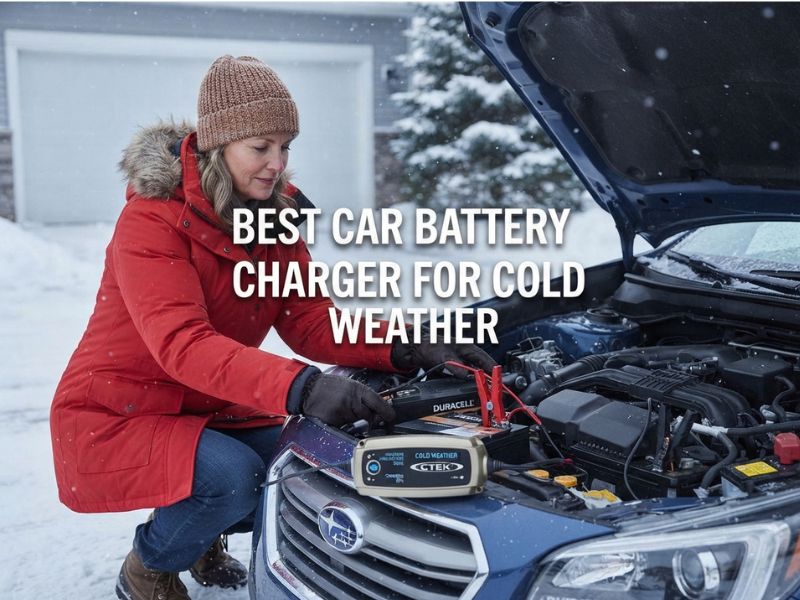
Best Car Battery Charger for Cold Weather
| Image | Product Name | Check Price |
|---|---|---|
Best Choice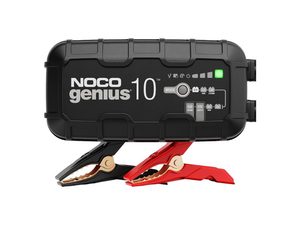 | NOCO GENIUS10 10A Smart Battery Charger – Best Overall | Check Price |
Second Best | NOCO GENIUS5 5A Smart Battery Charger | Check Price |
Third Choice | Schumacher Electric Battery Charger and 100A Engine Starter | Check Price |
 | CTEK MXS 5.0 12V Battery Charger and Maintainer | Check Price |
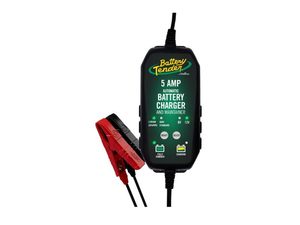 | Battery Tender 5A Power Tender Battery Charger and Maintainer | Check Price |
1. NOCO GENIUS10 10A Smart Battery Charger – Best Overall

Key Features
- 10A charging output
- 6V and 12V operation
- Integrated thermal sensor
- Automatic temperature compensation
- Flooded, AGM, gel, EFB, and maintenance-free support
- 12V lithium charging mode
- Force Mode for extremely low-voltage batteries
- 12V Repair Mode
- Automatic long-term maintenance
- Reverse-polarity protection
The NOCO GENIUS10 is my first choice for winter because its design directly addresses one of the most important cold-weather charging problems: charging voltage should change with temperature.
Lead-acid battery chemistry responds differently at low and high temperatures. In cold conditions, a fixed-voltage charger can fail to return the battery to an optimal state of charge. The GENIUS10 uses an internal temperature sensor to adjust the charging process automatically.
That is particularly valuable in an unheated garage, detached workshop, barn, carport, or other environment where winter temperatures fluctuate significantly.
NOCO specifies thermal compensation designed to prevent undercharging in cold conditions down to approximately -4°F within the charger’s operating range.
The second reason I rank the GENIUS10 first is charging speed.
A 1A or 2A maintainer is excellent for keeping an already charged battery healthy, but restoring a partially depleted 70Ah or 90Ah automotive battery can take a long time at those rates.
The GENIUS10 supplies up to 10 amps, which is much more practical when a vehicle has been sitting for several weeks and the battery needs substantial recovery.
It supports normal flooded batteries as well as AGM, which is particularly important today. Many modern vehicles use AGM batteries because of start-stop systems, high electrical loads, and demanding electronics.
Another valuable winter function is Force Mode.
Most automatic chargers need to detect a minimum battery voltage before beginning a normal charge cycle. If a battery has been drained extremely low, the charger may assume nothing is connected.
Force Mode allows the user to manually initiate charging on a deeply discharged battery when appropriate.
That feature requires extra care because some automatic safeguards are reduced during manual activation. It should only be used after confirming battery voltage, polarity, physical condition, and manufacturer instructions.
The GENIUS10 also includes a 12V Repair Mode designed to address certain sulfation and stratification conditions in lead-acid batteries.
Cold weather does not create sulfation by itself, but vehicles that sit undercharged throughout winter can develop it more quickly.
Repair mode cannot fix a physically damaged or worn-out battery, but it adds useful battery-care capability.
What I Like
The GENIUS10 combines nearly every feature I want for winter battery care: temperature compensation, sufficient charging current, AGM support, deep-discharge recovery, maintenance charging, and a compact body.
The 10A output is especially important. It is powerful enough to function as a real battery charger rather than being primarily a storage maintainer.
What I Do Not Like
It costs more than basic 1A to 5A maintainers.
It also does not provide a dedicated 100A or 200A engine-start function like a large AC-powered garage charger.
Verdict
For most vehicles, the NOCO GENIUS10 is the best car battery charger for cold weather because it combines genuine winter-oriented temperature compensation with enough charging output to recover a full-size automotive battery in a reasonable period.
2. NOCO GENIUS5 5A Smart Battery Charger – Best for Winter Maintenance

Key Features
- 5A charging output
- 6V and 12V compatibility
- Automatic thermal compensation
- Standard lead-acid support
- AGM charging mode
- 12V lithium support
- Force Mode
- 12V Repair Mode
- Automatic maintenance charging
- Compact housing
The NOCO GENIUS5 uses many of the same intelligent charging technologies as the GENIUS10 but reduces maximum output from 10 amps to 5 amps.
That makes it an excellent choice when your main objective is keeping a battery healthy throughout winter rather than rapidly recovering a heavily discharged battery.
Like the GENIUS10, it contains an integrated thermal sensor that adjusts charging according to ambient temperature.
This matters because an unheated garage may spend days well below freezing and then warm significantly when the weather changes.
Instead of relying on one fixed charging voltage, the charger adapts.
The GENIUS5 can also remain connected as a battery maintainer once charging is complete.
This is particularly useful for vehicles that spend much of winter parked:
- Classic cars
- Sports cars
- Convertibles
- Secondary vehicles
- Seasonal trucks
- Motorcycles
- ATVs
- Lawn and garden equipment
A battery gradually self-discharges even when disconnected.
When installed in a modern vehicle, small electrical loads from security modules, keyless-entry systems, computers, clocks, and telematics can accelerate the process.
Keeping the battery correctly maintained prevents it from sitting partially discharged for weeks at a time.
Five amps is enough for normal automotive charging, but charging time becomes the main difference between the GENIUS5 and GENIUS10.
If a large battery is at 50% state of charge, the 10A charger will generally restore it considerably faster.
For a vehicle that stays connected most of winter, that speed difference matters much less.
What I Like
The GENIUS5 gives buyers the temperature-compensated charging technology that makes the GENIUS10 so useful in winter but in a smaller and less expensive package.
Its maintenance capability is ideal for seasonal storage.
What I Do Not Like
Five amps can feel slow when a large truck or SUV battery is deeply discharged.
If winter frequently leaves your battery substantially depleted, I would spend more for the GENIUS10.
Verdict
Choose the GENIUS5 when your main goal is maintaining a car through winter and correcting occasional moderate discharge rather than performing the fastest possible battery recovery.
3. Schumacher Electric Battery Charger and 100A Engine Starter – Best for Cold-Weather Starting

Key Features
- 6V and 12V battery support
- Automatic charging
- Up to 100A engine-start assistance
- 30A boost mode
- Standard battery compatibility
- AGM compatibility
- Gel and deep-cycle support
- Battery testing
- Alternator testing
- Reverse hook-up protection
The Schumacher SC1281 solves a slightly different winter problem than my first two picks.
Imagine waking up on a freezing morning and discovering that the engine barely cranks.
A 5A maintainer is excellent battery-care equipment, but it may not provide the rapid assistance needed when you have to leave shortly.
The SC1281 provides a 30A boost mode and 100A engine-start function in addition to normal battery charging.
The boost setting is useful when the battery needs a short period of higher-current recovery before another starting attempt.
The 100A engine-start function then provides temporary starting assistance while the starter motor cranks.
That combination can be particularly valuable during winter because cold temperatures create two simultaneous problems.
The battery produces less usable starting power.
At the same time, the engine needs more cranking torque because cold lubricants create more mechanical resistance.
The SC1281 also works with 6V and 12V batteries and supports standard, AGM, gel, and deep-cycle lead-acid battery types.
AGM compatibility is important because many modern luxury vehicles, SUVs, trucks, and start-stop vehicles use AGM starter batteries.
Another feature I appreciate is the built-in battery and alternator testing capability.
If the car needs charging repeatedly, the real problem may not simply be cold weather.
A weak alternator, failing battery, poor connection, or parasitic electrical draw could be causing the repeated discharge.
The diagnostic functions can provide useful initial information before more extensive testing.
The disadvantage is physical size.
At more than 12 pounds, this is considerably larger and heavier than a compact 5A or 10A smart charger.
It also requires AC power during engine-start operation, meaning it is a garage solution rather than an independent roadside jump starter.
What I Like
The SC1281 provides something most compact smart chargers cannot: meaningful AC-powered engine-start assistance.
Its 30A boost mode is also excellent when you need faster recovery from a heavily discharged battery.
What I Do Not Like
It lacks the same emphasis on automatic ambient-temperature compensation that makes the NOCO and CTEK models particularly attractive for unattended winter maintenance.
It is also larger and heavier.
Verdict
The Schumacher SC1281 is my preferred winter charger when getting a weak vehicle started quickly is just as important as routine battery maintenance.
4. CTEK MXS 5.0 12V Battery Charger and Maintainer – Best Premium Winter Maintainer

Key Features
- Fully automatic charging
- Approximately 4.3A output
- 12V lead-acid operation
- AGM mode
- Built-in temperature compensation
- Eight-step charging program
- Reconditioning mode
- Float/pulse maintenance
- Reverse-polarity protection
- Long-term storage capability
The CTEK MXS 5.0 has developed a strong reputation among owners who care more about battery conditioning and long-term maintenance than maximum charging speed.
Its most relevant feature for this article is automatic temperature compensation.
The charger monitors temperature and adjusts its charging approach so the battery receives appropriate voltage under changing environmental conditions.
That makes it particularly attractive for a car parked in an unheated garage all winter.
The MXS 5.0 also uses an eight-step charging process.
Rather than simply supplying a fixed current until the battery reaches a certain voltage, the charger moves through multiple battery-analysis, charging, absorption, and maintenance phases.
An AGM-specific setting is useful for modern automotive batteries.
CTEK also provides a reconditioning program intended for certain deeply discharged lead-acid batteries.
Once the battery reaches full charge, the charger can transition to long-term float and pulse maintenance.
That is ideal for classic cars, collectible vehicles, weekend cars, and vehicles that remain stored throughout winter.
One limitation is output.
At roughly 4.3 amps, the MXS 5.0 is primarily a charger and maintainer rather than a rapid recovery device.
It can recharge a full-size car battery, but owners of large batteries need to be patient.
If a battery is substantially depleted and you need the car tomorrow morning, the GENIUS10’s 10A capability is more appealing.
What I Like
I particularly like the combination of automatic temperature compensation and sophisticated long-term maintenance.
CTEK also has a straightforward interface once you understand the available battery modes.
What I Do Not Like
Charging is slower than with a 10A model.
It is also 12V focused rather than a broader 6V/12V solution.
Verdict
The CTEK MXS 5.0 is one of my favorite choices for a valuable vehicle that spends much of winter in storage and needs careful battery maintenance rather than rapid charging.
5. Battery Tender 5A Power Tender Battery Charger and Maintainer – Best Simple Cold-Weather Maintainer

Key Features
- 5A charging output
- Automatic multi-stage charging
- Temperature-compensated charging
- AGM compatibility
- Flooded battery compatibility
- Gel battery support
- Automatic float maintenance
- Spark protection
- Reverse-polarity protection
- Compact construction
The Battery Tender 5A Power Tender rounds out this list with a simple philosophy: provide enough current for practical automotive charging while remaining excellent at long-term maintenance.
Automatic temperature compensation is particularly valuable for winter use.
As ambient temperature falls, charging requirements change. The charger adjusts the voltage automatically instead of forcing the user to compensate manually.
Its 5A output places it in roughly the same practical charging class as the GENIUS5.
That is enough for maintenance and normal overnight-style recovery on many passenger-car batteries, although larger or deeply discharged batteries require more time.
Once charging is complete, the unit transitions automatically into a maintenance mode rather than continuing to push full current.
This makes it suitable for vehicles stored for weeks or months.
Battery Tender’s straightforward charging approach can be appealing to drivers who do not need numerous manual repair or specialty modes.
Connect the charger correctly, allow it to complete the charging cycle, and let the maintenance system manage the battery afterward.
What I Like
The 5A Power Tender provides automatic winter-oriented voltage compensation in a simple package.
Its automatic maintenance behavior makes it especially useful for seasonal vehicles.
What I Do Not Like
It does not provide the 10A recovery speed of my first choice.
Drivers interested in extensive battery repair controls may also prefer the NOCO or CTEK alternatives.
Verdict
The Battery Tender 5A is a dependable choice when your priority is straightforward cold-weather charging and long-term battery maintenance without unnecessary complexity.
Best Car Battery Charger for Cold Weather Comparison
| Product | Charge Output | Voltage | Temp. Compensation | AGM Support | Deep Battery Recovery | Engine Start | Best For |
| NOCO GENIUS10 | 10A | 6V/12V | Yes | Yes | Force + Repair modes | No | Best overall |
| NOCO GENIUS5 | 5A | 6V/12V | Yes | Yes | Force + Repair modes | No | Winter maintenance |
| Schumacher SC1281 | Up to 30A boost | 6V/12V | Standard automatic control | Yes | 30A boost | 100A | Cold-start emergencies |
| CTEK MXS 5.0 | Approx. 4.3A | 12V | Yes | Yes | Recondition mode | No | Premium storage maintenance |
| Battery Tender 5A | 5A | 12V | Yes | Yes | Automatic recovery charging | No | Simple winter maintenance |
Quick Comparison
For most drivers, the NOCO GENIUS10 is the best-balanced winter charger. It has genuine temperature compensation and twice the charging output of many popular 5A models.
The GENIUS5 is better if the vehicle spends most of winter connected to a maintainer and rapid charging is rarely required.
Choose the Schumacher SC1281 when cold-weather starting assistance matters. Its 30A boost and 100A engine-start functions make it more capable during a “car will not start this morning” situation.
The CTEK MXS 5.0 excels at careful seasonal maintenance, while the Battery Tender 5A offers a simpler approach to temperature-compensated winter charging.
Why Cold Weather Is Hard on Car Batteries
A car battery does not suddenly become smaller in winter, but its chemistry becomes less efficient as temperature drops.
Lead-acid batteries rely on electrochemical reactions between their plates and electrolyte.
Lower temperature slows those reactions.
The result is less available cranking current at exactly the time the engine needs more cranking power.
At around freezing, a battery already delivers less usable power than it would on a mild day.
At severe subzero temperatures, the reduction becomes much more dramatic.
Meanwhile, the engine presents a greater mechanical load.
Motor oil thickens.
Transmission and accessory components create additional resistance.
The starter motor therefore needs more electrical current to achieve sufficient cranking speed.
This explains a common winter experience:
A battery starts the vehicle perfectly throughout summer and fall, then appears to “die” during the first serious cold spell.
Often, the cold did not suddenly destroy the battery.
It exposed a battery that had already lost some reserve capacity.
Why Temperature Compensation Matters
Temperature-compensated charging is one of the most important features I look for in a winter charger.
Charging voltage that works correctly at comfortable room temperature may not be optimal when a battery is sitting in a freezing garage.
In colder conditions, lead-acid batteries often require a somewhat higher charging voltage to reach a proper full state of charge.
In hotter conditions, that same voltage could increase the risk of overcharging.
A charger with an integrated temperature sensor adjusts the charging profile automatically.
This is particularly valuable for long-term maintenance because outdoor and garage temperatures can change dramatically over several months.
The charger does not simply assume the battery lives permanently at room temperature.
Why a Fully Charged Battery Matters More in Winter
Keeping a battery close to full charge provides two major winter advantages.
First, it gives the starter motor the maximum available electrical reserve when the engine is hardest to crank.
Second, a discharged lead-acid battery is more vulnerable to freezing than a fully charged one.
As the battery discharges, the electrolyte changes and its freezing point rises significantly.
That means winter battery maintenance is not just about making the engine start tomorrow morning.
Keeping a stored lead-acid battery properly charged can also reduce the risk associated with severe freezing conditions.
AGM Batteries and Cold Weather
AGM batteries are common in modern vehicles, especially those with:
- Start-stop systems
- High electrical loads
- Luxury electronics
- Powerful audio systems
- Large SUVs
- European vehicles
- Performance vehicles
AGM stands for Absorbent Glass Mat.
The electrolyte is held within glass-fiber separators rather than freely sloshing inside the battery case.
AGM batteries can deliver excellent starting performance, but they still need an appropriate charging profile.
A charger should explicitly support AGM charging.
Using the correct AGM mode helps the battery reach an appropriate state of charge without relying on a generic profile that may not match its needs.
The NOCO GENIUS10, GENIUS5, Schumacher SC1281, CTEK MXS 5.0, and Battery Tender models listed here all provide options suitable for common AGM applications.
What Size Battery Charger Do You Need for Winter?
1A to 2A
This range is best viewed as maintenance charging for normal automotive batteries.
It can keep a healthy stored battery ready but may take a very long time to recover a deeply discharged large battery.
4A to 5A
Five amps is an excellent compromise for seasonal storage.
It is still gentle enough for maintenance-oriented use but much faster than a 1A trickle charger.
For a vehicle that remains connected most of winter, this is often plenty.
10A
Ten amps is my preferred all-around output for a normal car or SUV battery.
It can maintain the battery but also has enough output to recover meaningful lost capacity overnight or during a day in the garage.
This is one reason the GENIUS10 is my top choice.
20A to 30A
High-current charging or boost modes are useful when faster recovery matters.
They are better suited to larger batteries or situations where you cannot wait many hours.
50A to 100A+
At this point you are generally talking about engine-start assistance, not ordinary battery maintenance.
These modes provide temporary high current to help the vehicle crank.
How Long Does It Take to Charge a Car Battery in Winter?
Charging time depends on:
- Battery capacity
- State of charge
- Battery chemistry
- Battery temperature
- Charger amperage
- Battery age
- Battery health
- Vehicle parasitic loads
A simple estimate can still be useful.
Suppose you have a 70Ah battery that is approximately 50% discharged.
Roughly 35Ah of usable energy needs to be restored.
A theoretical 5A charger would require approximately seven hours just to return that bulk energy.
Actual charging takes longer because current typically tapers as the battery approaches full charge and charging is not perfectly efficient.
A 10A charger can substantially reduce that recovery time.
This is why I favor higher charging output for winter unless the unit will primarily be used as a permanent maintainer.
Battery Charger vs Battery Maintainer in Winter
These terms are related but not identical.
Battery Charger
A charger is intended to restore a battery that has lost significant energy.
It usually provides several amps or more.
Battery Maintainer
A maintainer keeps an already charged battery near full charge for long periods.
Its required output can be quite low.
Smart Charger/Maintainer
Modern products often combine both functions.
They begin by providing meaningful charging current.
As the battery approaches full charge, output decreases.
Once charging is complete, the unit enters a monitoring or float-maintenance stage.
For winter storage, this combined approach is ideal.
Should You Leave a Charger Connected All Winter?
A proper automatic charger designed for long-term maintenance can generally remain connected according to its manufacturer’s instructions.
Do not assume every charger can do this.
Old manual chargers and simple fixed-output chargers may continue supplying current even after the battery is full.
A modern maintainer monitors battery voltage and applies only the energy required to compensate for self-discharge and vehicle electrical loads.
Long-term connection is particularly useful for:
- Classic cars
- Seasonal sports cars
- Vehicles stored at vacation homes
- Motorcycles
- Boats
- RVs
- Farm equipment
- Backup vehicles
Always inspect the battery before seasonal storage and use the correct charging mode.
Should You Charge a Frozen Car Battery?
No. Never attempt to charge a frozen lead-acid battery.
A severely discharged battery can freeze at temperatures much warmer than a fully charged battery.
Charging a frozen battery can be dangerous because internal damage may have occurred and charging can produce gas and pressure.
If you suspect the battery is frozen:
Do not attempt to jump-start it.
Do not connect a high-current charger.
Move the battery or vehicle to an appropriate environment only if doing so can be performed safely and according to manufacturer recommendations.
Allow professional evaluation if the battery appears swollen, cracked, leaking, or physically distorted.
What About Lithium Car Batteries Below Freezing?
Lithium batteries require special attention.
Many LiFePO4 batteries should not be charged below approximately 32°F unless the battery’s internal BMS or heating system specifically allows cold-temperature charging.
Discharging and charging limits are not always the same.
A battery may be capable of supplying current below freezing while still being unsuitable for charging at that temperature.
Never assume a charger’s lithium mode overrides the battery manufacturer’s temperature limitations.
Check both the charger instructions and battery specifications.
This is especially important for specialty, powersports, RV, and performance applications using lithium starter batteries.
Can a Charger Fix a Battery That Dies Every Cold Morning?
Sometimes the battery is merely undercharged.
Other times, charging only hides a larger problem.
Common causes include:
- Aging battery
- Sulfation
- Weak alternator
- Excessive parasitic draw
- Corroded terminals
- Loose ground connection
- Short driving cycles
- Extremely low temperatures
- Incorrect battery size
- Failing starter motor
If you fully charge the battery and it repeatedly loses starting capability after one night, test the battery and charging system rather than continuously reconnecting the charger.
Why Short Trips Are Bad for Batteries in Winter
Starting an engine uses a meaningful amount of battery energy.
The alternator must replace that energy afterward.
During winter, drivers often use:
- Heated seats
- Rear defrosters
- Headlights
- HVAC blowers
- Heated steering wheels
- Windshield heaters
- Additional electronics
These loads reduce the amount of alternator output available for replenishing the battery.
If your trips are only five or ten minutes long, the battery may never return to full charge.
Repeating this cycle can gradually lower its state of charge until the first extremely cold morning exposes the problem.
Connecting a smart charger periodically can be useful for vehicles driven primarily on short winter trips.
How to Use a Car Battery Charger in Cold Weather
Inspect the Battery
Check for:
- Cracks
- Swelling
- Leaks
- Frozen electrolyte
- Damaged terminals
- Heavy corrosion
Do not charge a visibly damaged or frozen battery.
Confirm Battery Chemistry
Determine whether you have:
- Flooded lead-acid
- AGM
- Gel
- EFB
- Lithium
Select the appropriate charging mode.
Confirm Voltage
Most modern vehicles use 12V systems.
Do not assume.
Select 6V only when working with a genuine 6V battery.
Make Secure Connections
Follow the charger and vehicle manufacturer’s instructions for clamp placement.
Some vehicles have dedicated remote charging points.
Select the Correct Mode
If you have an AGM battery, choose AGM mode.
Do not choose a repair or Force Mode unless the situation requires it and you understand the operating procedure.
Allow the Charger to Complete Its Cycle
Do not unplug simply because the battery reaches enough voltage to start the engine.
Allowing a smart charger to complete the absorption stage can produce a more complete state of charge.
Cold-Weather Charging Safety
Charge in a Ventilated Area
Lead-acid batteries can release hydrogen gas while charging.
Avoid flames, smoking, sparks, and ignition sources.
Avoid Damaged Extension Cords
Winter garages frequently require an extension cord.
Use a properly rated cord suitable for the charger and environment.
Keep Connections Dry
Even weather-resistant chargers should be used according to their environmental rating.
Do not assume every charger can safely sit in snow or standing water.
Avoid Charging a Battery That Is Hot, Swollen, or Leaking
These conditions can indicate serious internal failure.
Disconnect only when it can be done safely and seek professional assistance.
Do Not Use Repair Mode Casually
High-voltage battery-repair modes are specialized tools.
Certain vehicle electronics may require the battery to be disconnected before repair-mode charging.
Follow both vehicle and charger instructions.
How to Prepare a Car Battery for Winter
Test the Battery Before Winter
Do not wait for the first freezing morning.
A battery that already has weak cold-cranking performance should be identified early.
Clean Battery Terminals
Corrosion increases electrical resistance.
That resistance matters most when hundreds of amps need to reach the starter motor.
Fully Charge the Battery
Entering winter at a partial state of charge immediately reduces available reserve.
Check the Alternator
A healthy battery will still become discharged if the vehicle’s charging system is weak.
Use a Maintainer on Infrequently Driven Vehicles
If a car sits for several weeks at a time, maintaining it is easier than repeatedly recovering it from deep discharge.
Cold Cranking Amps and Winter Battery Performance
Cold Cranking Amps, or CCA, measures a battery’s ability to supply starting current under cold conditions.
Higher CCA generally provides more starting reserve, assuming the battery is properly sized and compatible with the vehicle.
However, buying a high-CCA battery does not eliminate the need to keep it charged.
An 800-CCA battery at a low state of charge can perform worse than a smaller properly charged battery.
That is why winter charging and maintenance remain valuable even with a premium automotive battery.
Common Winter Battery-Charging Mistakes
Waiting Until the Car Will Not Start
Preventive maintenance is easier than recovering a completely discharged battery.
Using a Tiny Maintainer for Emergency Recovery
A 1A unit can eventually add energy, but it may take far too long when a large battery is severely depleted.
Ignoring AGM Mode
Modern AGM batteries deserve the correct charging profile.
Charging a Frozen Battery
This can create a serious safety risk.
Assuming the Alternator Will Fully Recharge a Dead Battery
Alternators maintain battery charge well during normal driving but are not always the ideal tool for recovering a deeply discharged battery.
Using Repair Mode With Vehicle Electronics Connected Without Checking Instructions
Some high-voltage repair cycles may not be suitable with sensitive electronics attached.
Ignoring a Repeatedly Dead Battery
Repeated discharge indicates an underlying issue that should be diagnosed.
Frequently Asked Questions
What is the best car battery charger for cold weather?
The NOCO GENIUS10 is my top choice for most drivers.
Its integrated thermal sensor automatically compensates for ambient temperature, reducing the risk of undercharging in cold weather. The 10A output also gives it enough charging power to recover normal automotive batteries substantially faster than common 1A to 5A maintainers. AGM support, Force Mode, Repair Mode, 6V/12V compatibility, and automatic long-term maintenance further improve its usefulness during winter.
Does cold weather affect battery charging?
Yes. Battery chemistry and ideal charging voltage change as temperature drops.
A conventional fixed-voltage charger may not charge a cold lead-acid battery as effectively as a temperature-compensated model. Smart chargers with thermal sensing can automatically increase or decrease the charging voltage within their designed operating range. This helps maintain a more appropriate state of charge as garage and outdoor temperatures change throughout the year.
Is a 5A or 10A charger better for winter?
A 10A charger is better for faster recovery, while 5A is excellent for maintenance.
If your vehicle sits connected for most of winter, a 5A charger has ample time to keep the battery healthy. If the battery frequently becomes partially discharged and you need faster recovery, a 10A model such as the GENIUS10 is more practical. Large truck batteries also benefit more from the additional charging current.
Should I trickle-charge my car battery all winter?
Use an automatic battery maintainer rather than an uncontrolled traditional trickle charger.
A smart maintainer monitors battery condition and adjusts its output after the battery reaches full charge. This makes it suitable for extended seasonal storage. A basic charger that continuously supplies fixed current should not automatically be treated as safe for indefinite connection.
Can I charge a car battery outside in winter?
Only if the charger is approved for the environmental conditions and the battery is not frozen.
Check the charger’s operating-temperature range and weather-resistance rating. Protect electrical connections from moisture, snow, and standing water. An unheated but dry garage is generally a more convenient location for charging than an exposed driveway during snow or freezing rain.
At what temperature does a car battery freeze?
The freezing point varies dramatically with the battery’s state of charge.
A fully charged lead-acid battery can tolerate much colder temperatures than a deeply discharged one. This is another reason keeping batteries properly charged is important during severe winter weather. If a battery appears swollen or you suspect it is frozen, do not charge or jump-start it.
Can I use an AGM charger in cold weather?
Yes, provided the charger supports your AGM battery and operates within the stated temperature range.
Temperature compensation is particularly useful. AGM batteries have specific charging requirements, and a smart AGM-compatible charger can adapt voltage more appropriately than a generic fixed-output charger. Always use the battery mode recommended by the charger manufacturer.
Is the NOCO GENIUS5 good enough for a car battery?
Yes, 5A is sufficient for normal charging and excellent for long-term maintenance.
The limitation is speed. Recovering a large or deeply discharged battery takes longer at 5A than at 10A. For a vehicle that remains connected throughout winter, the difference is often unimportant. For frequent recovery charging, I prefer the GENIUS10.
What is the best charger for a car stored all winter?
The CTEK MXS 5.0, NOCO GENIUS5, and Battery Tender 5A are all strong storage-oriented choices.
Each is designed around automatic charging and maintenance. Temperature compensation makes them particularly appropriate for unheated winter storage. My preference is the GENIUS5 for versatility, while the CTEK is especially appealing for owners who value its sophisticated multi-stage maintenance process.
What charger should I use for a truck in cold weather?
A 10A or higher charger is generally more convenient for a full-size truck battery.
Truck batteries often have greater capacity than compact-car batteries, so a low-output maintainer can take many hours to restore substantial lost charge. The GENIUS10 is an excellent general-purpose option. If you also want AC-powered engine-start assistance, the Schumacher SC1281 provides a 30A boost and 100A start mode.
Can a battery be too dead for a smart charger?
Yes, some automatic chargers cannot initially detect an extremely low-voltage battery.
Certain models provide a manual recovery function. NOCO’s Force Mode is designed for situations where battery voltage is too low for normal detection. Manual modes should be used carefully because automatic safety functions may be reduced.
Does battery repair mode really work?
It may help certain sulfated lead-acid batteries, but it cannot repair physical battery failure.
Repair or reconditioning cycles can sometimes improve batteries affected by sulfation or prolonged undercharging. They cannot fix a shorted cell, cracked plates, severe capacity loss, frozen battery, or other structural damage. A battery that repeatedly fails testing should be replaced rather than continually reconditioned.
Can I leave the NOCO GENIUS10 connected overnight?
Yes, it is designed for automatic charging and long-term maintenance when used correctly.
Once the battery reaches an appropriate charge state, the smart charging system reduces output and monitors the battery rather than continuously delivering 10 amps. Always use the correct battery mode and follow the manufacturer’s installation and safety instructions.
Is a car battery charger better than a jump starter in winter?
They serve different purposes.
A battery charger restores the battery’s energy and can keep it healthy throughout winter. A portable jump starter supplies a short burst of current to get the engine running during an emergency. For strong winter preparedness, owning both is ideal: keep a smart charger in the garage and a properly charged jump starter in the vehicle.
Why does my car start after charging but die again the next day?
The battery may be failing or the vehicle may have a charging-system or parasitic-draw problem.
Charging restores energy temporarily, but it cannot make a worn-out battery retain capacity. Test battery health, alternator output, terminals, grounds, and key-off current draw if repeated overnight discharge continues.
Conclusion
Cold weather exposes weaknesses in automotive batteries faster than almost any other condition. Lower temperatures reduce available battery power while simultaneously making the engine harder to crank, so keeping the battery at a healthy state of charge becomes especially important during winter.
My first recommendation for the best car battery charger for cold weather is the NOCO GENIUS10. Its integrated temperature compensation directly addresses cold-weather undercharging, while the 10A output provides enough power for meaningful automotive battery recovery. AGM support, deep-discharge Force Mode, Repair Mode, and automatic maintenance give it a particularly complete winter feature set.
The NOCO GENIUS5 is the option I would choose for a vehicle that primarily needs seasonal maintenance. It provides the same core thermal-compensation concept with lower charging output and a smaller footprint.
For drivers who need rapid starting assistance in a cold garage, the Schumacher SC1281 brings 30A boost charging and a 100A engine-start mode that conventional maintainers cannot match.
The CTEK MXS 5.0 is excellent for carefully maintaining a stored vehicle through a long winter, while the Battery Tender 5A Power Tender provides a straightforward temperature-compensated option for owners who value simplicity.
For most cars, SUVs, and light trucks, I would buy the NOCO GENIUS10. Its combination of winter-aware charging, useful 10A recovery speed, battery-type versatility, and long-term maintenance makes it the most complete choice of these five.