A modern intelligent car battery charger does much more than push current into a battery. The better models monitor battery condition, automatically adjust charging voltage and current, move through multiple charging stages, compensate for temperature, and switch into maintenance mode once the battery reaches full charge. That makes them much easier to use safely than older manual chargers, especially when you maintain several vehicles or leave a charger connected during storage.
My primary recommendation is the NOCO GENIUS1 1A 6V/12V Smart Battery Charger. It has by far the strongest review history among the five products selected here and combines automatic charging, maintenance, temperature compensation, AGM support, compatible lithium charging, and battery-repair functionality in an unusually compact package. Its 1A output is slow for a deeply discharged large car battery, but it is exceptionally useful for maintenance and gradual charging.
For long-term battery preservation, the Battery Tender Junior 12V 750mA Smart Charger is another highly established option. Its four-stage automatic charging system is designed primarily around smaller batteries and storage maintenance, so I would choose it for keeping an already healthy car battery topped up rather than rapid dead-battery recovery.
The Battery Tender Plus 12V 1.25A Battery Charger provides a little more charging capability and is specifically positioned for automotive batteries as well as motorcycles and other vehicles. Drivers who regularly need to restore substantially discharged car batteries should look farther down the ranking at the GENIUS10 or GENIUS5, which have much higher charging output despite having fewer total customer reviews.
Best Intelligent Car Battery Charger
| Image | Product Name | Check Price |
|---|---|---|
Best Choice | NOCO GENIUS1 1A 6V/12V Smart Battery Charger – Best Overall | |
| Second Best | ||
| Third Choice | ||
1. NOCO GENIUS1 1A 6V/12V Smart Battery Charger – Best Overall
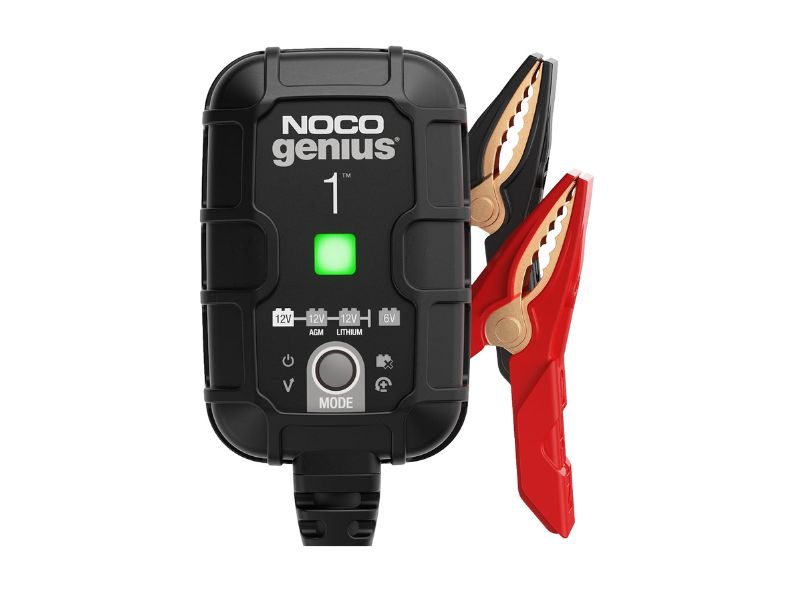
The NOCO GENIUS1 takes my first position because it combines one of the largest customer histories in the smart-charger category with a sophisticated set of automatic battery-management features.
This compact charger supports both 6V and 12V systems, making it more versatile than a basic 12V-only maintainer. It works with common flooded lead-acid, AGM, GEL, and supported lithium battery types when the correct operating mode is selected.
Its intelligent charging system monitors battery condition rather than continuously supplying the same current.
Temperature compensation is particularly valuable. Batteries behave differently in summer heat and winter cold, and the charger automatically modifies charging behavior to account for temperature.
GENIUS1 can also transition into automatic maintenance after the main charging cycle is complete. That makes it useful for vehicles that sit unused for long periods.
The biggest limitation is its 1A output. A typical automotive battery can have dozens of amp-hours of capacity, so recovering a deeply discharged car battery may take a long time.
Think of GENIUS1 primarily as an intelligent maintainer and gradual charger rather than a fast automotive recovery charger.
Key Features
- 1A smart charging
- 6V and 12V battery support
- Flooded lead-acid compatibility
- AGM and GEL support
- Compatible lithium mode
- Automatic temperature compensation
- Battery maintenance function
- Desulfation and repair functionality
- Force Mode for very low-voltage batteries
- Automatic safety protections
What I Like
I particularly like the combination of compact dimensions and broad battery compatibility. It can stay in a small garage toolbox yet handle considerably more battery types than a basic trickle charger.
Its automatic maintenance function is also ideal for classic cars, seasonal vehicles, secondary cars, and vehicles stored during extended travel.
What I Do Not Like
A 1A charging rate is simply not fast when a full-size automotive battery has been substantially discharged.
Verdict
The NOCO GENIUS1 is the best overall intelligent car battery charger in this review-volume-focused list if maintenance, versatility, and compact size matter more than maximum charging speed. Current listings show a review history exceeding roughly 60,000, substantially ahead of most comparable smart chargers.
2. Battery Tender Junior 12V 750mA Smart Charger – Best for Battery Maintenance

Battery Tender Junior has an exceptionally large customer history and is one of the most recognizable automatic battery maintainers available.
It provides 750mA of charging current and uses an intelligent four-stage charging process rather than applying continuous uncontrolled current.
The process includes initialization, bulk charging, absorption, and float maintenance. Once charging is complete, the system monitors battery voltage and provides maintenance current as required.
For a car owner, that makes Junior particularly useful for a vehicle that spends most of its time parked.
Think about:
- Classic cars
- Weekend vehicles
- Convertibles
- Seasonal cars
- Stored vehicles
- Motorcycles and ATVs
- Lawn equipment
Battery Tender specifies compatibility with standard 12V flooded lead-acid, AGM, GEL, and sealed maintenance-free batteries.
It also provides temperature compensation and several electrical safety protections.
There is an important limitation, however.
Battery Tender positions Junior primarily for batteries between approximately 3Ah and 30Ah. Standard passenger-car batteries are often considerably larger.
It can maintain an appropriately charged larger automotive battery, but if you have a dead 60Ah or 80Ah car battery, this is not the charger I would choose to restore it quickly.
Key Features
- 750mA charging output
- 12V operation
- Four-stage intelligent charging
- Automatic float maintenance
- AGM compatibility
- GEL compatibility
- Flooded battery support
- Automatic temperature compensation
- Reverse-polarity protection
- Spark-proof connection design
- Quick-connect battery harness
What I Like
Battery Tender Junior excels at preventing the problem rather than waiting for a battery to become completely discharged.
Install it on an infrequently driven vehicle and its intelligent maintenance system can keep the battery at an appropriate state of charge without the constant output associated with old-fashioned trickle chargers.
What I Do Not Like
The 750mA charging current is too low for convenient recovery of deeply discharged full-size automotive batteries.
Verdict
Choose the Battery Tender Junior when your primary objective is intelligent long-term battery maintenance. Its customer history is exceptionally strong, with current market data showing roughly 49,000+ reviews. The manufacturer specifies four-stage automatic charging, temperature compensation, and a 3–30Ah optimized battery range.
3. Battery Tender Plus 12V 1.25A Battery Charger – Best Long-Term Car Maintainer

Battery Tender Plus takes the basic concept behind Junior and makes it more automotive-friendly.
Its 1.25A charging output is still relatively gentle, but Battery Tender rates this model for automotive batteries up to approximately 80Ah.
That makes it a much more natural fit for ordinary passenger cars.
The charger automatically manages the charging process instead of requiring the user to watch battery voltage and manually shut the charger off.
When the battery reaches the appropriate state of charge, it transitions into maintenance operation.
That is particularly useful for automotive starter batteries because they are not designed to repeatedly sit deeply discharged.
Allowing a car battery to remain partially discharged for extended periods can contribute to sulfation and premature capacity loss.
A properly matched maintainer helps prevent this by compensating for self-discharge and small parasitic electrical loads.
Battery Tender Plus works with common AGM, GEL, sealed, and flooded lead-acid batteries.
The included quick-connect system also allows you to choose between ordinary clamps and permanently installed ring terminals.
Key Features
- 1.25A charging output
- 12V operation
- Automatic intelligent charging
- Float maintenance
- Automotive batteries up to approximately 80Ah
- AGM support
- GEL compatibility
- Flooded battery compatibility
- Reverse-polarity protection
- Quick-disconnect connections
What I Like
The Plus is better suited to normal automotive battery capacity than the smaller Junior while preserving the simplicity that makes automatic maintainers attractive.
It is especially useful for a car that sits for weeks between drives.
What I Do Not Like
1.25 amps still cannot compete with a 5A or 10A charger when a large battery requires significant capacity restoration.
Verdict
The Battery Tender Plus is one of the strongest intelligent options for owners who prioritize long-term automotive battery health rather than rapid charging. Current review data places it around the 21,000+ review level, and the manufacturer specifies automotive support up to roughly 80Ah.
4. NOCO GENIUS10 10A 6V/12V Smart Battery Charger – Best for Fast Intelligent Charging

The GENIUS10 is the model I would choose if you actually expect to recharge significantly discharged car batteries on a regular basis.
Its 10A maximum charging output is ten times the nominal output of GENIUS1.
That difference has major practical consequences.
Imagine a battery needs approximately 30Ah of capacity restored.
Ignoring charging losses and the slower final absorption stage:
- A 1A charger could require roughly 30 hours or more.
- A 5A charger could require roughly six hours or more.
- A 10A charger could theoretically restore that amount considerably faster.
Real charging time will vary, but the point remains: amperage matters when you need actual battery recovery.
GENIUS10 combines the higher charging rate with the intelligent functions found throughout the GENIUS family.
It supports 6V and 12V systems, multiple lead-acid battery types, supported lithium batteries, temperature compensation, maintenance charging, Force Mode, and a specialized repair program for applicable 12V lead-acid batteries.
This is why I consider it the most capable actual car charger among these five products, even though it appears fourth when ranking strictly by review count.
Key Features
- 10A charging output
- 6V and 12V support
- Flooded lead-acid compatibility
- AGM mode
- GEL and EFB compatibility
- Supported lithium mode
- Automatic temperature compensation
- Maintenance charging
- 12V Repair Mode
- Force Mode
- Supply functionality for appropriate applications
- Advanced safety protection
What I Like
The combination of intelligent charging and meaningful output makes GENIUS10 highly versatile.
It can maintain batteries, but unlike a tiny maintainer, it also has enough current to recharge normal automotive batteries in a much more reasonable timeframe.
What I Do Not Like
It costs more, occupies more space, and is unnecessary if your only requirement is maintaining an already charged vehicle.
Verdict
The NOCO GENIUS10 is my preferred choice for drivers who actually need faster smart charging. Current category data shows roughly 20,000+ customer reviews, while maintaining broad compatibility with automotive and specialty batteries.
5. NOCO GENIUS5 5A 6V/12V Smart Battery Charger – Best Balanced Smart Charger

The NOCO GENIUS5 is arguably the sweet spot in the GENIUS lineup for a typical home garage.
Its 5A output provides substantially faster charging than GENIUS1 while avoiding the size and additional capacity of GENIUS10.
For many automotive batteries, five amps is enough for practical overnight charging.
At the same time, its intelligent electronics make the charger useful for maintenance and a variety of battery types.
Like GENIUS1 and GENIUS10, it supports 6V and 12V systems and provides charging profiles for common lead-acid batteries, AGM batteries, and compatible lithium batteries.
Automatic temperature compensation alters charging behavior according to environmental conditions.
This is more important than it may initially sound.
Lead-acid battery charging voltage requirements change with temperature. A charging profile suitable for a hot garage is not necessarily ideal in freezing conditions.
The GENIUS5 also includes automatic maintenance and battery repair functionality.
For the average homeowner, I think 5 amps is a very sensible balance between speed and flexibility.
Key Features
- 5A output
- 6V and 12V charging
- Standard lead-acid support
- AGM compatibility
- Compatible lithium charging
- Automatic temperature compensation
- Maintenance mode
- Battery repair functionality
- Force Mode
- Intelligent safety protections
What I Like
Five amps is enough to make the charger useful for genuine automotive battery recovery without making it unnecessarily large.
It is the product I would seriously consider if I wanted one charger for a daily driver, weekend car, motorcycle, lawn tractor, and other household batteries.
What I Do Not Like
GENIUS10 is a better choice when charging speed is the primary consideration.
Verdict
The NOCO GENIUS5 provides the best balance between charger size, automatic intelligence, battery compatibility, and practical automotive charging speed. It currently carries roughly 20,000+ reviews, putting it among the most established smart chargers in its class.
Intelligent Car Battery Charger Comparison
| Product | Max Output | Voltage | Smart Maintenance | AGM | Lithium Mode | Main Strength | Best Use |
| NOCO GENIUS1 | 1A | 6V/12V | Yes | Yes | Yes | Compact versatility | Maintenance and slow charging |
| Battery Tender Junior | 0.75A | 12V | Yes | Yes | No standard lithium mode | Long-term maintenance | Stored vehicles |
| Battery Tender Plus | 1.25A | 12V | Yes | Yes | Battery-specific | Automotive maintenance | Cars that sit |
| NOCO GENIUS10 | 10A | 6V/12V | Yes | Yes | Yes | Fast smart charging | Discharged car batteries |
| NOCO GENIUS5 | 5A | 6V/12V | Yes | Yes | Yes | Balanced charging | General home garage |
Which One Should You Buy?
For the widest combination of popularity, compact size, maintenance capability, and battery compatibility, NOCO GENIUS1 remains my first recommendation.
However, do not confuse highest review volume with fastest charging.
If your primary problem is a dead or substantially discharged automotive battery, I would choose NOCO GENIUS10 first.
If you want a balance between charging speed and compact size, NOCO GENIUS5 is arguably the most practical choice.
Battery Tender Junior is strongest for maintenance, while Battery Tender Plus is the more automotive-oriented option of the two.
What Is an Intelligent Car Battery Charger?
An intelligent battery charger is an electronically controlled charger that monitors the battery and modifies charging behavior automatically.
Older manual chargers often required the user to select current, monitor voltage, estimate charging time, and disconnect the charger when finished.
A modern smart charger can automate much of that process.
Depending on the model, it may monitor:
- Battery voltage
- State of charge
- Charging current
- Ambient temperature
- Battery resistance
- Charging progress
- Connection polarity
It can then alter its output to match the battery’s needs.
This is why the terms smart charger and intelligent charger are generally used to describe the same broad category.
How Intelligent Battery Charging Works
Smart charging usually happens in several stages.
Manufacturers use different algorithms and terminology, but the basic process is similar.
Initialization
The charger checks whether a battery is connected and may evaluate battery voltage, polarity, and condition.
If polarity is incorrect, many modern chargers refuse to begin charging.
Bulk Charging
During bulk charging, the charger delivers relatively high available current.
This restores most of the missing battery capacity.
Absorption
As the battery approaches full charge, the charger holds charging voltage within an appropriate range and allows current to taper.
This prevents the battery from being pushed aggressively after most capacity has already been restored.
Float or Maintenance
Once charging is complete, the charger reduces its output.
It then monitors the battery and supplies only the energy needed to compensate for self-discharge or small vehicle loads.
This is what makes a smart maintainer useful during long-term storage.
Smart Charger vs Traditional Battery Charger
The main difference is automatic control.
A traditional manual charger may provide relatively fixed output and require monitoring by the user.
An intelligent charger continuously evaluates charging conditions.
Intelligent Charger Advantages
A good smart charger may provide:
- Automatic charge-stage control
- Overcharge prevention
- Temperature compensation
- Maintenance charging
- Reverse-polarity protection
- Short-circuit protection
- Chemistry-specific charging modes
- Low-voltage battery recovery
- Automatic shutoff or standby behavior
For most home users, intelligent chargers are much more convenient.
What Amp Charger Does a Car Battery Need?
Charging current determines how quickly energy can be restored.
1A Charger
One amp is excellent for:
- Maintenance
- Small batteries
- Seasonal storage
- Gradual charging
- Motorcycles
- Classic cars that remain plugged into a maintainer
It is slow for a large depleted battery.
2A Charger
Two amps remains relatively gentle but provides moderately faster recovery.
It works well for:
- Small automotive batteries
- Motorcycle batteries
- Maintenance
- Overnight top-ups
5A Charger
Five amps is one of the best general-purpose choices.
It provides reasonable charging speed without requiring a large charger.
For a typical homeowner, 5A is often the sweet spot.
10A Charger
Ten amps is preferable when charging time matters.
It works well for:
- Normal passenger-car batteries
- SUVs
- Larger batteries
- Deeply discharged batteries
- Frequent automotive charging
For this type of use, GENIUS10 is the strongest option among the five chargers reviewed here.
How Long Does an Intelligent Charger Take to Charge a Car Battery?
Charging time depends heavily on battery capacity and depth of discharge.
Consider a 60Ah battery at approximately 50% charge.
Roughly 30Ah needs to be restored.
A simplified calculation produces:
| Charger | Theoretical Initial Estimate |
| 1A | 30+ hours |
| 1.25A | 24+ hours |
| 2A | 15+ hours |
| 5A | 6+ hours |
| 10A | 3+ hours |
These figures are not exact charging times.
Real charging takes longer because batteries are not 100% efficient and intelligent chargers reduce current as the battery approaches full charge.
Battery age and temperature also matter.
What Battery Types Do Smart Chargers Support?
Never select a charger purely because your battery is 12 volts.
Battery chemistry matters.
Flooded Lead-Acid Batteries
Traditional flooded starter batteries contain liquid electrolyte.
They remain common in cars, trucks, motorcycles, tractors, boats, and equipment.
Most intelligent automotive chargers support them.
AGM Batteries
AGM stands for Absorbent Glass Mat.
These sealed lead-acid batteries are common in:
- Modern luxury vehicles
- Start-stop vehicles
- Performance cars
- Motorcycles
- SUVs
- Vehicles with high electrical loads
AGM batteries can require different charging voltages from traditional flooded batteries.
Use the charger’s AGM mode when required.
GEL Batteries
Gel-cell batteries use gelled electrolyte.
They can be sensitive to excessive charging voltage.
Use only a charger or mode specifically approved for GEL batteries.
EFB Batteries
Enhanced Flooded Batteries are often found in vehicles with entry-level start-stop systems.
Check whether the charger’s standard or dedicated mode is approved for EFB technology.
Lithium Batteries
Some vehicles, particularly motorcycles and performance applications, use lithium batteries such as LiFePO4.
Never assume that a lead-acid charger is safe for lithium.
Use a dedicated lithium-compatible charging mode and follow the battery manufacturer’s instructions.
The NOCO GENIUS chargers reviewed here provide compatible lithium charging modes.
Why Temperature Compensation Matters
Battery chemistry reacts to temperature.
Cold conditions generally require different charging voltage behavior than hot conditions.
An intelligent charger with temperature compensation automatically modifies its charging strategy.
That helps reduce:
- Undercharging in cold weather
- Excessive charging voltage in hot weather
- Unnecessary battery stress
- Inconsistent seasonal charging
This feature is particularly valuable when charging in an unheated garage.
What Is Battery Desulfation?
Sulfation occurs in lead-acid batteries when lead sulfate crystals accumulate and harden on the battery plates.
It becomes more likely when a battery remains partially or fully discharged for a long period.
Some intelligent chargers offer a repair or desulfation mode.
These programs may use specialized voltage or pulse patterns in an attempt to improve certain recoverable batteries.
But expectations need to remain realistic.
A charger cannot repair:
- Shorted cells
- Broken internal connections
- Severely deteriorated plates
- Physical case damage
- Frozen battery damage
- Batteries that have reached the end of their usable life
Repair mode is useful technology, not a guaranteed battery resurrection feature.
What Is Force Mode?
Some intelligent chargers need to detect minimum battery voltage before they will begin charging.
An extremely discharged battery may fall below that detection threshold.
A Force Mode or manual charging mode allows certain chargers to initiate output anyway.
This can help recover deeply discharged batteries.
However, manual override may bypass some automatic protections.
Always verify:
- Battery voltage
- Battery chemistry
- Positive terminal
- Negative terminal
- Correct charger mode
before activating it.
Can You Leave an Intelligent Charger Connected Overnight?
For a healthy battery and a properly selected charging mode, a quality automatic smart charger is designed to manage the charging process without continuous manual adjustment.
Once the battery reaches full charge, maintenance-capable chargers reduce output.
That makes overnight charging considerably easier than using an old manual charger.
However, you should still inspect the battery before charging.
Never charge a battery that is:
- Cracked
- Leaking
- Severely swollen
- Frozen
- Physically damaged
- Producing unusual heat or odor
Follow the battery and vehicle manufacturer’s instructions.
Can You Leave a Smart Charger Connected for Months?
Some smart chargers and maintainers are specifically designed for extended storage.
This is useful for:
- Classic cars
- Sports cars
- Seasonal vehicles
- Motorcycles
- RV starter batteries
- Boats
- Lawn equipment
The charger monitors battery condition and supplies maintenance current only as required.
Even so, occasionally inspect the battery, charger, outlet, and cables rather than treating electrical equipment as something that never needs attention.
Why Stored Cars Need Battery Maintenance
A modern vehicle continues consuming electricity after the ignition is turned off.
Small loads may include:
- Alarm systems
- Keyless-entry receivers
- Control-module memory
- Telematics
- Clocks
- Security systems
- Tracking equipment
These loads are normally small enough that regular driving keeps the battery charged.
When the vehicle sits for weeks, they can contribute to significant discharge.
A smart maintainer compensates for that gradual loss.
Smart Charger vs Trickle Charger
These terms are often incorrectly treated as identical.
A traditional trickle charger may simply provide constant low current.
An intelligent maintainer monitors the battery and adjusts or suspends charging as needed.
For long-term storage, I prefer automatic maintenance technology.
Continuously overcharging a lead-acid battery can contribute to:
- Electrolyte loss
- Excessive gassing
- Heat
- Plate corrosion
- Shortened battery life
An intelligent maintenance cycle is designed to avoid that behavior.
Smart Charger vs Jump Starter
A battery charger and jump starter perform completely different jobs.
Intelligent Battery Charger
A charger:
- Uses household electrical power
- Restores battery capacity gradually
- Can take hours
- Can maintain the battery
- May provide repair functions
Jump Starter
A jump starter:
- Contains its own battery
- Produces a short burst of high current
- Can potentially start an engine immediately
- Does not properly recharge the vehicle battery
If you need to leave immediately, a jump starter is the more useful emergency tool.
If you want to restore the battery properly, use a charger.
Smart Charger vs Alternator
An alternator maintains the electrical system while the engine is running and replaces energy consumed during normal starting.
It should not automatically be treated as the ideal solution for recovering a severely discharged battery.
A deeply discharged battery can place a substantial load on the charging system.
Using an external intelligent charger allows the battery to recover through a controlled charging program.
Can an Intelligent Charger Save a Dead Battery?
Sometimes.
The answer depends on why the battery is dead.
A charger may successfully recover a healthy battery that became discharged because:
- Lights were left on
- The vehicle sat unused
- A door was left open
- Cold weather reduced available capacity
- An accessory drained the battery
It may not recover a battery suffering from:
- Failed cells
- Internal shorts
- Severe sulfation
- Plate deterioration
- Physical damage
- End-of-life capacity loss
A battery that repeatedly goes dead needs diagnosis.
Common Reasons a Car Battery Keeps Dying
If charging fixes the battery only temporarily, consider possible underlying causes.
Aging Battery
Automotive batteries have a finite service life.
Capacity declines as internal components deteriorate.
Alternator Problems
If the charging system does not properly recharge the battery while driving, repeated discharge will continue.
Parasitic Draw
An electrical circuit may continue consuming excessive power while the vehicle is off.
Corroded Terminals
Poor terminal connections create resistance and can interfere with both starting and charging.
Short Driving Trips
Repeated very short trips may not replace all the energy used during engine starting.
Extreme Temperatures
Both excessive heat and severe cold can accelerate battery problems.
How to Choose the Best Intelligent Car Battery Charger
Determine Battery Voltage
Most modern passenger vehicles use 12V batteries.
Older vehicles and specialty equipment may use 6V.
A 6V/12V charger provides additional flexibility.
Identify Battery Chemistry
Look directly at the battery label.
Determine whether it is:
- Flooded
- AGM
- GEL
- EFB
- Lithium/LiFePO4
Choose a charger supporting that exact chemistry.
Determine Battery Capacity
Check the amp-hour rating when available.
A larger battery generally benefits from higher charging current if reasonably fast charging is important.
Decide Between Charging and Maintenance
If the car runs regularly but occasionally gets a discharged battery, consider 5A–10A.
If the car spends months parked, a lower-output intelligent maintainer can be perfectly appropriate.
Look for Temperature Compensation
This is particularly useful when the vehicle is stored in an unconditioned garage.
Prioritize Safety Features
Useful protections include:
- Reverse polarity
- Short circuit
- Overvoltage
- Overtemperature
- Spark protection
- Automatic charging control
Consider Cable Length
Your electrical outlet may not be directly beside the car.
Check AC and DC lead lengths before buying.
Use extension cords only when permitted and properly rated.
Frequently Asked Questions
What is the best intelligent car battery charger?
NOCO GENIUS1 is my primary review-volume-based recommendation for intelligent charging and maintenance.
It combines automatic charging, temperature compensation, multiple battery modes, maintenance capability, and advanced low-voltage functions in a compact package. Its 1A output is best suited to maintenance and gradual charging. If faster dead-battery recovery is important, GENIUS10 is a stronger choice.
What does an intelligent battery charger do?
It automatically monitors the battery and adjusts charging behavior according to battery condition.
Unlike a basic charger delivering relatively fixed output, an intelligent model can change charging stages, taper current as the battery fills, maintain the battery afterward, detect reversed connections, and compensate for temperature.
Is a smart charger better for a car battery?
For most home users, a quality smart charger is easier and safer to manage than an old manual charger.
Automatic charging stages reduce the amount of monitoring required and make long-term maintenance practical.
What amp smart charger should I buy?
Five amps is a good general-purpose choice, while 10 amps is better for faster automotive charging.
A 1A charger is excellent for maintenance but can take more than a day to restore substantial capacity to a large battery.
Is a 1A smart charger enough for a car?
Yes for maintenance, but it is slow for a significantly discharged automotive battery.
If your goal is keeping a stored car topped up, one amp can be very effective. If your battery regularly needs substantial recharging, consider 5A or 10A.
Is a 10A charger safe for a car battery?
A correctly configured intelligent 10A charger is appropriate for many automotive batteries.
Check battery capacity and chemistry before charging. The charger’s automatic controls regulate output as charging progresses.
Can I use an intelligent charger on an AGM battery?
Yes, if the charger specifically supports AGM batteries.
Select the recommended AGM mode whenever required. AGM batteries can use different charging voltage characteristics from conventional flooded batteries.
Can an intelligent charger charge a lithium car battery?
Only if both the charger and battery explicitly support the relevant lithium chemistry.
Do not use a standard lead-acid mode on a lithium battery unless the battery manufacturer specifically permits it.
Can I leave a smart charger connected overnight?
A proper automatic charger is designed to manage charging and transition into maintenance when appropriate.
Always use the correct battery mode and follow the vehicle and battery manufacturer’s charging instructions.
Does a smart charger stop when the battery is full?
Most modern intelligent chargers reduce or suspend charging and enter a maintenance stage.
They continue monitoring battery voltage and may resume limited charging when necessary.
Can an intelligent charger revive a completely dead battery?
It may recover a deeply discharged but otherwise healthy battery, depending on its voltage and condition.
Some models include Force Mode or low-voltage recovery. A physically failed battery cannot be repaired simply by charging it.
What is repair mode on a car battery charger?
Repair mode uses a specialized charging program intended for certain degraded lead-acid batteries.
It may help in some sulfation-related situations but cannot fix shorted cells, physical damage, or severely worn-out batteries.
What is the difference between NOCO GENIUS1 and GENIUS5?
GENIUS5 provides five times the maximum charging output, making it much faster for automotive batteries.
GENIUS1 is excellent for maintenance, smaller batteries, and slow charging. GENIUS5 provides a more practical balance for regular car-battery charging.
What is the difference between GENIUS5 and GENIUS10?
GENIUS10 provides twice the maximum charging output of GENIUS5.
GENIUS10 makes more sense for larger batteries or faster recovery. GENIUS5 is smaller and provides adequate speed for many home users.
Is Battery Tender Junior good for a car?
It is better as a car battery maintainer than as a fast car-battery charger.
Its 750mA output can keep a healthy battery charged during storage, but substantially discharged large automotive batteries require a long charging time.
Is Battery Tender Plus better for cars than Junior?
Yes, its 1.25A output and larger supported battery range make it more automotive-oriented.
Junior remains particularly attractive for motorcycles and smaller powersports batteries.
Do intelligent chargers prevent overcharging?
A properly functioning automatic charger regulates output after the battery reaches full charge.
This is one of the biggest benefits of smart charging technology compared with uncontrolled conventional trickle charging.
Does a battery need to be disconnected from the car before charging?
Not always, but follow the vehicle manufacturer’s instructions.
Some vehicles provide dedicated charging terminals or require specific grounding points because of battery-monitoring electronics.
Can I charge my battery while it is still installed?
Many vehicles allow in-car charging when the correct procedure and charging points are used.
Consult your owner’s manual before connecting the charger, particularly on modern vehicles with battery-management systems.
Why does my battery charger say full but my car still will not start?
A battery can show normal voltage while lacking enough cranking capacity to start the engine.
A failing battery may accept a surface charge yet collapse under starter load. Poor terminals, wiring issues, or starter problems can produce similar symptoms.
Conclusion
Choosing the best intelligent car battery charger starts with understanding what you expect the charger to do.
If you mainly want automatic maintenance and gradual charging, the NOCO GENIUS1 is my first recommendation. Its enormous ownership history, broad battery compatibility, automatic temperature compensation, maintenance capability, and compact dimensions make it one of the most practical smart chargers for general home use.
The Battery Tender Junior is even more maintenance-focused. It is a particularly strong choice when a car, motorcycle, ATV, or other small vehicle spends long periods in storage.
The Battery Tender Plus provides a more automotive-oriented 1.25A design and works particularly well for protecting a passenger-car battery that is not driven regularly.
For genuinely discharged batteries, charging output becomes much more important. The NOCO GENIUS10 is the strongest choice in this list when fast automotive charging is a priority, while the NOCO GENIUS5 offers what may be the best all-around compromise between charging speed, compact size, maintenance capability, and battery compatibility.
For most buyers who primarily want to keep a healthy vehicle battery ready, I would begin with the NOCO GENIUS1. If you expect to routinely recharge substantially depleted car batteries, I would skip the low-current maintainers and choose the GENIUS5 or GENIUS10 instead.