If you are looking for the best lithium car battery charger, choosing the correct charger matters more than simply buying the highest-amperage model. Automotive lithium batteries—especially 12V LiFePO4 batteries—need a charging profile designed for lithium chemistry rather than the charging and desulfation behavior intended for traditional lead-acid batteries.
My primary recommendation is the NOCO GENIUS1 1A Smart Battery Charger. It has the largest established buyer-feedback history among these picks, supports a dedicated 12V lithium charging mode, offers automatic maintenance, and is exceptionally compact. I particularly like it for stored vehicles and smaller lithium batteries where charging speed is less important than safe long-term maintenance.
For an actual car-size lithium battery that needs faster recovery, I would choose the NOCO GENIUS10 10A Smart Battery Charger. Its 10-amp output and support for batteries up to 230Ah make it far more practical for large automotive, truck, RV, marine, and deep-cycle applications while retaining dedicated lithium functionality.
The NOCO GENIUS5 5A Smart Battery Charger is my balanced alternative. Five amps is enough to make overnight charging practical for many automotive batteries without making the charger particularly bulky. It is the model I would consider first if you need one charger for both lithium and conventional vehicle batteries but do not require the extra speed of a 10A unit.
Before choosing any charger, verify the label on your battery. The lithium modes discussed here are primarily intended for compatible 12V lithium-ion batteries, including LiFePO4 batteries with an appropriate Battery Management System (BMS). They are not chargers for the high-voltage traction battery in an electric vehicle.
Best Lithium Car Battery Chargers
| Image | Product Name | Check Price |
|---|---|---|
Best Choice | NOCO GENIUS1 1A Smart Battery Charger – Best Overall Compact Pick | Check Price |
Second Best | NOCO GENIUS10 10A Smart Battery Charger | Check Price |
Third Choice | NOCO GENIUS5 5A Smart Battery Charger | Check Price |
 | NOCO GENIUS2 2A Smart Battery Charger | Check Price |
 | Battery Tender 4A 6V/12V Battery Charger and Maintainer | Check Price |
1. NOCO GENIUS1 1A Smart Battery Charger – Best Overall Compact Pick

Key Features
- 1A charging output
- 6V and 12V charger
- Dedicated 12V lithium mode
- Supports compatible LiFePO4 batteries with BMS
- Up to 30Ah normal charging capacity
- Maintenance for larger battery capacities
- Automatic temperature compensation
- Reverse-polarity protection
- Spark-proof connection system
- Automatic maintenance operation
- Compact 0.77-pound design
The NOCO GENIUS1 ranks first because it combines an exceptionally large ownership history with a genuinely compact design and broad battery compatibility.
For lithium users, the important feature is its dedicated 12V Lithium mode. This mode is designed for suitable 12V lithium-ion batteries, including lithium iron phosphate batteries equipped with a Battery Management System.
That distinction matters.
A standard lead-acid charger can use charging stages or voltage behavior that are inappropriate for lithium chemistry. Likewise, the desulfation functions associated with lead-acid battery maintenance should not be treated as lithium-battery repair functions. Sulfation is a lead-acid phenomenon.
The GENIUS1 removes much of that confusion by allowing you to select the correct chemistry-specific mode.
Its 1-amp output also defines the ideal buyer.
This is an excellent lithium battery maintainer, but it is not a fast car-battery charger.
NOCO rates normal charging capacity up to about 30Ah. Many automotive lithium starter batteries can fall within or near that range because lithium starter batteries often achieve substantial cranking capability without requiring the same large Ah capacity as conventional lead-acid batteries.
However, larger LiFePO4 batteries used in RVs, boats, off-grid systems, auxiliary installations, and deep-cycle applications can easily reach 50Ah, 100Ah, 200Ah, or more. A one-amp charger becomes painfully slow on those batteries.
Where the GENIUS1 really shines is storage.
Imagine a sports car with a lightweight LiFePO4 starter battery that is driven only on weekends. You do not necessarily need 10 amps every day. What you need is a small intelligent charger that can keep the battery ready without continually forcing unnecessary current into it.
Its automatic maintenance behavior suits that job very well.
The charger also includes temperature compensation. This feature is valuable for conventional battery chemistries, although lithium owners must still respect the temperature restrictions of the battery itself.
That point deserves emphasis: a charger being able to operate in freezing weather does not mean your lithium battery is safe to charge below freezing.
Many LiFePO4 batteries should not accept charging current below approximately 32°F unless they have internal heating or a BMS specifically designed to permit low-temperature charging. Always follow the battery manufacturer’s specification.
The GENIUS1 also provides protection against reverse polarity, short circuits, overheating, and overcharging.
At less than a pound, storage is effortless. It can stay in a garage cabinet, tool bag, trailer compartment, or vehicle storage area without becoming another bulky piece of equipment.
What I Like
I like the enormous real-world ownership history, tiny dimensions, dedicated lithium profile, simple controls, automatic maintenance, and broad battery versatility.
The 1A output also makes sense for a vehicle that stays connected for extended periods rather than needing rapid recovery.
What I Do Not Like
One amp is slow.
If your 50Ah or 100Ah lithium battery is genuinely discharged, this is not the charger I would want when the vehicle needs to be ready quickly.
The GENIUS1 also should not be purchased because of its desulfation marketing if your only battery is lithium. Desulfation applies to compatible lead-acid batteries, not LiFePO4 cells.
Verdict
The NOCO GENIUS1 is my best compact lithium car battery charger for storage maintenance, lightweight automotive lithium batteries, powersports batteries, and users who value proven popularity more than charging speed.
For regularly recharging large car-size batteries, I would move directly to the GENIUS5 or GENIUS10.
2. NOCO GENIUS10 10A Smart Battery Charger – Best for Fast Lithium Charging

Key Features
- 10A charging current
- 6V and 12V operation
- Dedicated 12V lithium mode
- Supports compatible lithium iron phosphate batteries with BMS
- Up to 230Ah charging capacity
- Automatic maintenance
- Temperature-aware charging
- IP65 housing
- Reverse-polarity protection
- Spark-proof design
- 12V power-supply mode
- Approximately 3.33 pounds
The GENIUS10 is the model I would personally favor when the phrase lithium car battery charger means actually recharging a full-size automotive or deep-cycle battery rather than maintaining one during storage.
The difference comes down to charging current.
Ten amps provides ten times the nominal charging current of the GENIUS1.
That does not mean every battery charges exactly ten times faster because charging current tapers, BMS behavior differs, battery temperature matters, and charging efficiency is not perfect. Still, the practical time difference can be enormous.
Consider an 80Ah battery at roughly 50% state of charge.
A very low-current maintainer can require an extended charging period. A 10A smart charger can return the bulk of that missing capacity in a much more useful timeframe.
That matters if the vehicle needs to be back on the road the same day or the following morning.
NOCO rates the GENIUS10 for batteries up to 230Ah, giving it much broader applicability than the smallest models.
That range covers far more than conventional cars.
Potential applications include compatible batteries in:
- Passenger cars
- Performance cars
- SUVs
- Pickup trucks
- RVs
- Boats
- Camper vans
- Auxiliary battery systems
- Deep-cycle applications
- Powersports equipment
The dedicated 12V Lithium mode is designed for compatible 12V lithium-ion batteries, including LiFePO4 batteries with an appropriate BMS.
The GENIUS10 can also charge conventional flooded, AGM, gel, EFB, and maintenance-free batteries.
That makes it particularly attractive in a household with mixed vehicles.
You might have a lightweight LiFePO4 battery in a performance vehicle, an AGM battery in an SUV, and a conventional lead-acid battery in lawn equipment. Instead of keeping separate chargers for every chemistry, you can select the appropriate mode on one unit.
Another useful feature is 12V Supply Mode.
A regulated power-supply mode can be useful during certain service operations, including maintaining vehicle memory while changing a battery, when performed according to the charger’s and vehicle manufacturer’s instructions.
The IP65 housing provides useful protection against dust and water exposure associated with normal garage environments.
At about 3.33 pounds, the GENIUS10 is heavier than the small maintainers, but it remains remarkably compact compared with traditional high-output shop chargers.
The biggest warning applies to lithium temperature.
Do not see the GENIUS10’s wide operating-temperature specification and assume every lithium battery can be charged in those conditions.
The battery’s BMS and cell manufacturer determine the acceptable lithium charging temperature.
Cold-weather charging is one of the most important differences between LiFePO4 and lead-acid battery care.
What I Like
The 10A output is much better matched to automotive-size batteries.
I also like the 230Ah capacity range, lithium mode, compact housing, IP65 protection, supply function, and ability to handle multiple battery chemistries.
What I Do Not Like
It costs more and is physically larger than the GENIUS1 and GENIUS2.
Ten amps may also be unnecessary for very small powersports lithium batteries, so battery capacity and manufacturer charging-current limits should always be checked first.
Verdict
The NOCO GENIUS10 is my preferred choice for genuinely charging large lithium automotive batteries.
If speed, high battery capacity, and multi-vehicle versatility matter more than minimum size, this is the strongest performer in the group.
3. NOCO GENIUS5 5A Smart Battery Charger – Best Balanced Pick

Key Features
- 5A charging output
- 6V and 12V support
- Dedicated 12V lithium charging mode
- LiFePO4 compatibility with suitable BMS-equipped batteries
- Up to 120Ah charging capacity
- Automatic battery maintenance
- Automatic temperature compensation
- IP65 housing
- Spark-proof protection
- Reverse-polarity protection
- Low-voltage recovery capability
- Approximately 1.5-pound weight
The GENIUS5 occupies the most useful middle ground in the lineup.
One or two amps is excellent for maintenance but slow for a discharged vehicle battery.
Ten amps provides faster charging but costs more and creates a larger charger.
At five amps, the GENIUS5 gives you meaningful car-battery charging ability while keeping the unit small enough to live permanently in a garage drawer.
NOCO rates it for batteries up to 120Ah, which is enough for many common automotive and recreational applications.
That makes the GENIUS5 much better suited to everyday car ownership than a tiny maintainer.
A 30Ah lithium starter battery can be charged without the waiting associated with a 1A unit, while a 50Ah, 80Ah, or 100Ah compatible battery still falls within the charger’s normal capacity range.
The dedicated Lithium mode applies the appropriate charging profile for compatible 12V lithium-ion batteries, including LiFePO4 batteries with Battery Management Systems.
It can also charge conventional batteries.
This flexibility is one of the strongest reasons to buy it.
Many households are still transitioning between battery technologies. Your newer performance vehicle might use lithium, while your daily driver uses AGM and your older pickup uses flooded lead-acid.
Owning a charger capable of safely supporting several battery chemistries is more practical than buying a lithium-only device unless your garage is completely standardized around LiFePO4.
The GENIUS5 also has a built-in thermal sensor that adjusts charging behavior according to ambient temperature.
Again, that does not override lithium-cell limitations.
If the BMS prohibits charging below freezing, respect the battery’s limitation regardless of what the charger can physically tolerate.
NOCO’s protection system covers reverse polarity, overheating, overcharging, open-circuit conditions, and short circuits.
Its IP65-rated body is useful for a device likely to spend years around garages, workshops, boats, and recreational equipment.
One point that sometimes causes confusion is Repair Mode.
The GENIUS5 includes repair functionality for suitable 12V lead-acid batteries.
Do not use lead-acid repair logic as a way to “repair” a LiFePO4 battery.
Lithium batteries rely on their BMS and cell-level characteristics, and problems such as an internally damaged cell or defective BMS require appropriate diagnosis rather than desulfation.
What I Like
Five amps feels particularly well matched to normal home use.
The 120Ah capacity range, dedicated lithium mode, small dimensions, multiple battery chemistries, temperature compensation, and automatic maintenance make the GENIUS5 exceptionally versatile.
What I Do Not Like
A large 100Ah battery can still take many hours to charge if deeply discharged.
The GENIUS10 is substantially better when charging time is important.
Verdict
The NOCO GENIUS5 is the best balanced lithium car charger here.
For many households, it offers the ideal compromise between compact storage, reasonable charging speed, lithium capability, and compatibility with conventional automotive batteries.
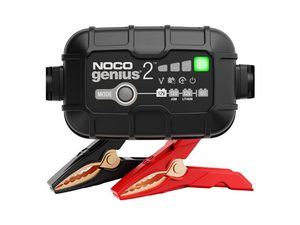
4. NOCO GENIUS2 2A Smart Battery Charger – Best for Smaller Lithium Batteries

Key Features
- 2A charging output
- 6V and 12V operation
- Dedicated 12V lithium mode
- Compatible with appropriate BMS-equipped LiFePO4 batteries
- Up to 40Ah charging capacity
- Maintenance capability
- Automatic temperature compensation
- IP65 housing
- Reverse-polarity protection
- Spark-proof design
- Compact approximately 1.1-pound construction
The GENIUS2 is essentially a more capable maintenance-oriented choice for buyers who find one amp too limiting but do not need a full-size 5A or 10A automotive charger.
Its 2A charging current makes it particularly appropriate for smaller lithium starter batteries.
This can include batteries used in:
- Motorcycles
- ATVs
- UTVs
- Performance vehicles
- Lightweight sports cars
- Small marine applications
- Lawn equipment
- Specialty vehicles
NOCO rates normal charging capacity up to approximately 40Ah.
That is an important specification to remember.
A lot of lithium automotive starter batteries have lower amp-hour ratings than equivalent lead-acid batteries because lithium cells can provide strong cranking performance while maintaining lower weight.
For those applications, 40Ah can be perfectly adequate.
If your battery is a 100Ah RV LiFePO4 pack, however, a two-amp charger is not an efficient solution when substantial recharging is required.
The GENIUS2 includes a separate lithium mode for BMS-equipped 12V lithium batteries rather than asking the user to treat them like conventional lead-acid batteries.
This chemistry selection is critical because the charging voltage and finishing behavior differ.
The charger also provides automatic maintenance operation, making it useful for a collector or performance vehicle that spends much of the year parked.
At approximately 1.1 pounds, the device remains easy to mount or store.
The included mounting capability can be useful in a permanent garage setup where a specific vehicle regularly receives maintenance charging.
Temperature compensation and a weather-resistant IP65 enclosure provide additional durability.
As with the other NOCO models, low-voltage recovery capability exists for deeply discharged batteries.
Lithium users should be cautious here.
A lithium battery showing extremely low terminal voltage may have a BMS that deliberately disconnected the cells because of undervoltage, overcurrent, temperature, or another protective condition.
Do not bypass protective behavior unless the battery and charger manufacturers explicitly allow the procedure.
What I Like
The GENIUS2 is small, simple, highly established, and twice as powerful as a basic 1A maintainer while retaining a dedicated lithium mode.
What I Do Not Like
Two amps is still too slow for recovering large lithium batteries quickly.
Its 40Ah normal charging range also makes the GENIUS5 a better general-purpose automotive choice.
Verdict
Choose the GENIUS2 for smaller lithium automotive and powersports batteries, particularly when storage maintenance and compactness matter more than rapid charging.
5. Battery Tender 4A 6V/12V Battery Charger and Maintainer – Best Multi-Chemistry Alternative

Key Features
- 4A charging output
- 6V and 12V selection
- Dedicated LiFePO4 battery mode
- Flooded, AGM, gel, sealed, and lithium compatibility
- Automatic multi-stage charging
- Automatic maintenance
- Reverse-polarity protection
- Spark-resistant connection
- Alligator clips and ring-terminal connection options
- 5-year limited warranty
Battery Tender provides the strongest non-NOCO alternative in this group.
Its 4-amp output is particularly attractive because it falls close to the practical charging range I like for ordinary automotive use.
Four amps is substantially faster than the 1A or 2A maintenance chargers but still moderate enough to work well with many vehicle batteries when the battery manufacturer permits that charge rate.
The charger allows battery chemistry to be selected manually, including a dedicated LiFePO4 profile.
That manual chemistry selection is actually something I appreciate.
Automation is convenient, but forcing the user to explicitly identify the chemistry reduces ambiguity. If you are connecting a lithium battery, you intentionally select lithium rather than hoping an algorithm correctly interprets the battery.
The unit supports both 6V and 12V applications.
This gives it value beyond modern passenger cars. Vintage vehicles, motorcycles, powersports equipment, boats, and other supported battery systems can potentially share the same charger.
For car-size use, four amps represents a sensible charging threshold.
If a lithium starter battery is only moderately discharged, the charger can restore useful capacity without taking the enormous amount of time associated with sub-1A maintenance devices.
The charger’s automatic multi-stage system transitions from active charging into maintenance instead of simply supplying four amps indefinitely.
That makes it useful for vehicles that sit between drives.
Battery Tender also provides ring-terminal connections.
Permanent ring-terminal leads are especially convenient on cars where the battery is difficult to access. Once installed correctly, you can connect the charger without repeatedly removing trim or positioning clamps deep inside the engine bay.
This is common on performance cars and specialty vehicles where the battery may be in the trunk, under a seat, or behind panels.
One consideration is that the product is less compact than some of the smallest NOCO models.
It also does not offer the 10A charging speed of the GENIUS10.
Still, four amps is a practical output for many owners.
What I Like
I like the dedicated LiFePO4 setting, useful 4A output, 6V/12V flexibility, permanent ring-terminal option, automatic maintenance, and long warranty.
What I Do Not Like
It lacks the 10A speed available from the GENIUS10 and does not have quite the same compact design as the smallest chargers.
Verdict
The Battery Tender 4A is my favorite alternative-brand lithium battery charger, particularly for owners who appreciate an established maintenance-focused charging system and clearly selectable lithium chemistry.
Lithium Car Battery Charger Comparison
| Product | Output | Voltage | Lithium Support | Normal Battery Capacity | Maintenance | Weather Protection | Best For |
| NOCO GENIUS1 | 1A | 6V/12V | 12V lithium/LiFePO4 with compatible BMS | Up to 30Ah | Yes | IP60 | Storage and compact use |
| NOCO GENIUS10 | 10A | 6V/12V | 12V lithium/LiFePO4 with compatible BMS | Up to 230Ah | Yes | IP65 | Fast automotive charging |
| NOCO GENIUS5 | 5A | 6V/12V | 12V lithium/LiFePO4 with compatible BMS | Up to 120Ah | Yes | IP65 | Best balance |
| NOCO GENIUS2 | 2A | 6V/12V | 12V lithium/LiFePO4 with compatible BMS | Up to 40Ah | Yes | IP65 | Small lithium batteries |
| Battery Tender 4A | 4A | 6V/12V | Dedicated LiFePO4 mode | Up to about 100Ah | Yes | Garage-oriented | Multi-chemistry charging |
The comparison shows why simply ranking chargers by popularity does not tell the entire story.
The NOCO GENIUS1 has the strongest ownership history and is an excellent compact maintainer, but its one-amp output is not ideal for quickly recharging a large battery.
The GENIUS10 is much better for full-size automotive and deep-cycle batteries because its 10A output dramatically reduces charging time.
The GENIUS5 offers the most balanced middle ground, while the GENIUS2 is better suited to smaller lithium batteries.
Battery Tender’s 4A charger provides another practical option for users who want clearly selectable LiFePO4 charging with solid automotive capability.
What Is a Lithium Car Battery Charger?
A lithium car battery charger is a charger with a charging profile specifically designed for compatible automotive lithium batteries.
In most consumer vehicle applications, that means 12V lithium iron phosphate, commonly abbreviated LiFePO4 or LFP.
A 12V LiFePO4 battery is typically a four-cell battery pack with a nominal voltage around 12.8V.
Its charging requirements differ from traditional lead-acid batteries.
A proper lithium charger controls voltage and current according to the needs of lithium cells and works with the battery’s internal Battery Management System.
The BMS helps monitor and protect the battery from conditions such as:
- Excessive voltage
- Excessive discharge
- Excessive current
- Unsafe temperature
- Cell imbalance, depending on design
The charger and BMS therefore work together.
The charger provides the correct external charging profile, while the BMS provides internal battery protection.
Lithium Starter Battery vs. EV Battery
This distinction is extremely important.
The chargers in this guide are for compatible low-voltage automotive batteries, typically 12V lithium starter, auxiliary, powersports, marine, or deep-cycle batteries.
They do not charge the high-voltage traction battery in an electric vehicle.
An electric vehicle may contain a traction battery operating at hundreds of volts while also having a separate 12V low-voltage battery.
A normal 12V lithium charger must never be connected to the high-voltage traction system.
EV traction-battery charging requires the vehicle’s dedicated onboard charging equipment and compatible EV supply equipment.
LiFePO4 vs. Lead-Acid Batteries
Understanding battery chemistry makes charger selection easier.
LiFePO4
Lithium iron phosphate batteries offer several advantages:
- Lower weight
- High usable capacity
- Low self-discharge
- Strong cycle life
- High cranking performance from compact packages
- Stable lithium chemistry
- Good storage characteristics
They also have special requirements.
Lithium batteries need appropriate charging voltages, rely heavily on BMS protection, and can have important low-temperature charging restrictions.
Lead-Acid
Traditional automotive batteries include:
- Flooded
- AGM
- EFB
- Gel
- Maintenance-free lead-acid
Lead-acid batteries are heavier and have lower usable depth of discharge, but they remain extremely common and tolerate different charging conditions.
Lead-acid batteries can also develop sulfation when left partially discharged.
This is why many smart chargers advertise desulfation and repair modes.
LiFePO4 batteries do not sulfate like lead-acid batteries.
Therefore, never select a lead-acid repair mode because you believe it will rejuvenate a lithium battery.
How to Choose the Best Lithium Car Battery Charger
Confirm the Battery Chemistry First
Do not select a charger just because the battery is labeled “lithium.”
Lithium batteries use several chemistries.
Automotive applications commonly use LiFePO4, but other lithium-ion formulations exist.
Check the battery label and owner’s documentation.
The charger must explicitly support that chemistry.
Verify Battery Voltage
Most modern starter batteries in cars are nominally 12V.
However, you should never assume voltage.
Some vintage and specialty systems use other voltages.
A 6V/12V charger provides greater versatility, but its lithium mode may only support 12V lithium batteries.
Read the charger’s mode specifications carefully.
Check for a Battery Management System
The NOCO lithium modes discussed here are designed for lithium batteries equipped with an appropriate BMS.
The BMS is an essential safety component in modern lithium battery systems.
If you are working with a custom lithium pack without a BMS, do not assume a normal automotive charger is appropriate.
Match Charging Amps to Battery Capacity
Charging amperage has a major impact on charging time.
A simplified way to think about the five chargers is:
1A: Small battery charging and maintenance.
2A: Powersports and smaller automotive lithium batteries.
4A–5A: Practical general-purpose automotive range.
10A: Larger car, truck, RV, marine, and deep-cycle batteries.
Do not automatically choose the highest current.
Lithium battery manufacturers often specify a recommended and maximum charge current.
The charger must stay within those limits.
Understanding the C-Rate
Lithium charging current is often discussed using C-rate.
Suppose you have a 100Ah battery.
Charging at 0.1C equals:
100Ah × 0.1 = 10A.
For a 40Ah battery:
40Ah × 0.1 = 4A.
This does not mean 0.1C is universally ideal.
Different battery manufacturers specify different allowable charging currents.
The calculation simply provides a way to compare charger output to battery capacity.
Always use the battery manufacturer’s recommended charge rate.
How Long Does It Take to Charge a Lithium Car Battery?
Charging time depends primarily on:
- Battery capacity
- Starting state of charge
- Charger output
- BMS behavior
- Temperature
- Current taper near full charge
- Electrical loads
- Battery health
Consider a 40Ah battery at approximately 50% state of charge.
Roughly 20Ah needs to be replaced.
Ignoring taper and losses:
A 1A charger could require around 20 hours.
A 2A charger could require around 10 hours.
A 5A charger could require around four hours.
A 10A charger could theoretically replace the bulk energy in around two hours.
Actual times will differ.
The example simply demonstrates why charger amperage matters.
Why LiFePO4 Batteries Need a Lithium Charging Mode
A charger cannot treat all battery chemistries identically.
Lead-acid charging commonly uses charging stages and maintenance voltages designed around lead chemistry.
Lithium iron phosphate cells have different voltage characteristics.
A proper lithium mode avoids inappropriate lead-acid behavior and controls the charging cycle around lithium requirements.
This is particularly important near full charge, where precise voltage management matters.
A dedicated lithium profile also avoids treating the battery as sulfated lead-acid equipment.
Do Lithium Batteries Need Float Charging?
Lithium batteries generally do not need continuous traditional float charging in the same way lead-acid batteries do.
A well-designed lithium-compatible maintainer should use a maintenance strategy appropriate for lithium chemistry rather than continuously holding the battery at an unnecessarily high state of charge.
This is another reason to use a dedicated lithium mode instead of placing a LiFePO4 battery on an old lead-acid trickle charger.
Can You Leave a Lithium Charger Connected?
Yes, when both the battery and charger are designed for automatic long-term maintenance.
Products such as the chargers in this guide include automatic control rather than delivering uncontrolled current continuously.
However, the battery manufacturer’s instructions remain important.
Some lithium battery manufacturers recommend particular storage states of charge rather than maintaining the battery permanently at 100%.
Follow the battery manufacturer’s storage guidance if it differs from the charger manufacturer’s general recommendations.
Charging Lithium Batteries in Cold Weather
This is one of the most important safety considerations.
Many LiFePO4 batteries should not be charged below approximately 32°F (0°C).
Charging lithium iron phosphate cells below their permitted temperature can cause lithium plating and permanent cell damage.
Better lithium batteries may include a BMS that blocks charging when the cells are too cold.
Some batteries include internal heaters that warm the cells before accepting charging current.
Do not assume a charger’s wide operating-temperature range means the battery itself can accept charge at that temperature.
In cold regions of the United States—including Minnesota, Wisconsin, Michigan, North Dakota, Montana, Colorado, Maine, and other northern areas—low-temperature charging protection should be one of the first specifications you check.
Lithium Battery Charging in Hot Weather
Heat also matters.
High temperatures accelerate battery aging and can trigger BMS protection.
A charger with temperature monitoring can improve charging management, but it cannot correct an overheated or damaged lithium battery.
Avoid charging a battery that is outside its manufacturer’s permitted temperature range.
Allow a hot battery to cool naturally before charging.
Can You Charge a Lithium Battery While It Is Still in the Car?
Usually yes when the vehicle, battery, and charger manufacturers permit it.
Many smart chargers are specifically designed for batteries installed in vehicles.
However, modern cars can use complex battery monitoring and energy-management systems.
Some vehicles specify dedicated positive and negative charging points.
Connecting directly to the battery terminals may bypass a battery-monitoring sensor in certain vehicles.
Always check the vehicle owner’s manual.
This is especially important with:
- European performance cars
- Start-stop vehicles
- Luxury vehicles
- Cars with intelligent battery sensors
- Vehicles with trunk-mounted batteries
- Cars using aftermarket lithium starter batteries
Can You Use a Regular Charger on a Lithium Car Battery?
Only if the charger explicitly supports your lithium battery chemistry.
A charger being physically capable of producing 12–14 volts does not make it appropriate.
Old lead-acid chargers may include:
- Equalization
- Desulfation
- High-voltage pulses
- Incorrect float behavior
- Inappropriate finishing voltages
Any of these can create problems with lithium batteries.
The safe approach is simple: use a charger with a dedicated lithium mode approved for your battery.
Can You Use AGM Mode on LiFePO4?
No. Use the lithium mode specified for your battery rather than AGM mode.
AGM is a lead-acid technology.
The voltage ranges may sometimes appear similar, but the batteries behave differently and require different maintenance logic.
Never choose a charging mode merely because its voltage looks close.
Lithium Battery Charger vs. Battery Maintainer
A charger restores energy after the battery has been discharged.
A maintainer prevents a stored battery from gradually becoming discharged.
Many modern smart chargers perform both functions.
The correct output depends heavily on use.
If your sports car sits all winter with a full battery, a 1A maintainer may be ideal.
If your 100Ah lithium battery is at 40% state of charge and needs to be ready tomorrow, a 10A charger is considerably more useful.
Lithium Charger vs. Jump Starter
These products are also frequently confused.
A lithium battery charger usually requires AC electricity and gradually restores the vehicle battery.
A jump starter contains its own internal battery and delivers a brief burst of high current to crank the engine.
A jump starter does not necessarily recharge the vehicle battery.
For a complete automotive emergency setup, the two tools complement one another.
Keep a smart battery charger in the garage for proper battery care.
Keep a compatible jump starter in the vehicle for roadside emergencies.
How to Charge a Lithium Car Battery Safely
First, identify the battery.
Confirm:
- Voltage
- Chemistry
- Capacity
- BMS requirements
- Recommended charging current
- Charging-temperature range
Inspect the battery for physical damage.
Do not charge a battery that appears:
- Swollen
- Cracked
- Punctured
- Leaking
- Burned
- Severely overheated
- Mechanically damaged
Verify the charger’s lithium mode.
Make the connection according to the charger and vehicle manufacturer’s instructions.
Select the correct 12V Lithium/LiFePO4 mode.
Monitor the first charging session so you become familiar with the charger’s indicators.
Allow the charger and BMS to complete the charging cycle.
Disconnect it according to the manufacturer’s recommended sequence.
What Does a Lithium Battery BMS Do?
A Battery Management System is essentially the battery’s internal supervisory electronics.
Depending on the design, the BMS may monitor:
- Individual cell voltage
- Total battery voltage
- Charge current
- Discharge current
- Battery temperature
- Cell balancing
- Short-circuit conditions
The BMS may disconnect charging or discharging if it detects unsafe conditions.
This can occasionally make a battery appear “dead” even though the cells still contain energy.
The BMS may simply be in protection mode.
Consult the battery manufacturer before attempting to override a protection state.
Why Won’t My Charger Detect My Lithium Battery?
Possible reasons include:
- The battery voltage is extremely low
- The BMS has disconnected the terminals
- The battery is too cold
- The battery is too hot
- Clamps are not making good contact
- Polarity is incorrect
- The wrong charging mode is selected
- The internal BMS has a fault
- The battery has suffered cell damage
Do not automatically activate a manual override.
Determine why normal charging is being blocked first.
Can a Lithium Charger Revive a Completely Dead Battery?
Sometimes, but a lithium battery at extremely low voltage requires more caution than a normal discharged battery.
The BMS may have intentionally shut the battery down.
If the cells have actually fallen below their safe voltage range, permanent damage may have occurred.
Some chargers provide low-voltage recovery features, but these should only be used when the battery manufacturer permits recovery.
A battery that repeatedly falls into undervoltage protection needs diagnosis.
Signs a Lithium Car Battery May Need Replacement
A charger cannot repair every battery problem.
Replacement or professional testing may be appropriate if you notice:
- Repeated failure to hold charge
- BMS faults that repeatedly return
- Severe voltage drop under starter load
- Physical swelling
- Unusual heat
- Internal rattling or physical damage
- Battery shutdown at normal loads
- Significant capacity loss
- Charger repeatedly reporting battery faults
Lithium batteries can last a long time, but they are not permanent.
Common Lithium Charging Mistakes
Using Lead-Acid Repair Mode
Lead-acid desulfation is not lithium battery repair.
Never deliberately run a LiFePO4 battery through a lead-acid repair cycle.
Charging Below the Battery’s Temperature Limit
Cold charging can permanently damage certain lithium cells.
Let the BMS and battery manufacturer’s temperature limits guide you.
Choosing a Charger by Peak Amps Alone
Battery capacity and manufacturer specifications matter more than buying the largest charger available.
Ignoring the BMS
If the BMS blocks charging, determine the reason rather than immediately trying to bypass it.
Assuming Every 12V Lithium Battery Is the Same
Different cell chemistries, BMS designs, maximum currents, and charging voltages exist.
Using the Wrong Vehicle Connection Point
Modern vehicles may require specific charging terminals.
Check the owner’s manual.
Confusing the 12V Battery With an EV Traction Battery
Never connect these chargers to a high-voltage EV propulsion battery.
Frequently Asked Questions
What is the best lithium car battery charger?
The NOCO GENIUS1 is my top compact pick, while the GENIUS10 is better for fast charging.
The GENIUS1 has an exceptionally established ownership history and works particularly well for maintaining smaller lithium batteries. If you regularly need to recharge full-size or high-capacity automotive LiFePO4 batteries, the GENIUS10’s 10A output makes it substantially more practical.
Is NOCO GENIUS1 good for lithium batteries?
Yes, it has a dedicated 12V lithium charging mode for compatible BMS-equipped lithium batteries.
Its main limitation is its 1A output. That makes it excellent for smaller batteries and maintenance but slow for high-capacity automotive or deep-cycle lithium batteries.
Is NOCO GENIUS10 good for LiFePO4?
Yes, its dedicated 12V lithium mode supports compatible lithium iron phosphate batteries with an appropriate BMS.
Its 10A output and large battery-capacity range make it particularly useful for automotive, marine, RV, and deep-cycle applications.
Is a 5A charger enough for a lithium car battery?
Five amps is a useful general-purpose charging rate for many automotive lithium batteries.
Whether it is ideal depends on the battery’s amp-hour capacity and recommended charging current. Always follow the battery manufacturer’s specification.
Can I charge a 100Ah lithium battery with a 5A charger?
Yes, if the battery manufacturer allows that charging profile, but charging will take longer than with a 10A charger.
A 5A charger can be perfectly suitable when charging time is not critical.
Can I leave a lithium battery charger connected overnight?
Yes, when both the charger and battery support automatic lithium charging and maintenance.
Use the correct lithium mode and follow the battery manufacturer’s instructions regarding long-term storage.
Does LiFePO4 need a special charger?
A dedicated LiFePO4-compatible charging profile is strongly recommended.
Lithium iron phosphate batteries have different charging requirements from flooded, AGM, gel, and other lead-acid batteries.
Can I use an AGM charger for a lithium battery?
Do not use AGM mode unless the lithium battery manufacturer explicitly approves it.
AGM is a lead-acid technology. Use a dedicated lithium mode whenever available.
Can a lithium charger charge an AGM battery?
Only if the charger also includes a separate AGM mode.
Multi-chemistry products such as the NOCO GENIUS models can support both technologies, but you must select the correct setting for the connected battery.
What voltage does a 12V LiFePO4 battery charge to?
Many 12V LiFePO4 batteries use a charging voltage in roughly the mid-14V range, but the exact limit depends on the battery.
Follow the battery manufacturer’s specification rather than manually choosing a voltage based on a generic figure.
Can I charge LiFePO4 below freezing?
Many LiFePO4 batteries should not be charged below 32°F unless specifically designed for it.
Some batteries contain low-temperature BMS protection or internal heaters. Follow the battery manufacturer’s minimum charging temperature.
Can I use a lithium charger on my electric car?
Not for the high-voltage traction battery.
These products are low-voltage battery chargers. Electric vehicles require dedicated EV charging equipment for the traction battery.
Why does my lithium battery show zero volts?
The BMS may have disconnected the battery, or the battery may be severely discharged or damaged.
Check the battery manufacturer’s recovery procedure before attempting manual override or low-voltage charging.
Does a lithium car battery need a maintainer?
Not always, but maintenance can be useful for vehicles that sit for extended periods.
Parasitic vehicle loads can slowly drain even a low-self-discharge lithium battery. A compatible smart maintainer can keep a stored vehicle ready.
Is 10A too much for a lithium car battery?
Not necessarily, but the battery manufacturer’s maximum charge-current specification determines whether 10A is appropriate.
A large automotive or deep-cycle LiFePO4 battery may accept considerably more than 10A, while a small powersports battery may have a much lower recommended limit.
What happens if I use a lead-acid charger on LiFePO4?
The charging profile may be inappropriate and could trigger the BMS or damage the battery.
Old chargers may also use desulfation or equalization stages that lithium batteries do not need. Use a charger specifically approved for LiFePO4.
Final Verdict
Choosing the best lithium car battery charger starts with identifying your battery rather than focusing on charger marketing.
Verify that the battery is actually lithium, determine whether it uses LiFePO4 chemistry, confirm the nominal voltage and amp-hour capacity, check that it has an appropriate BMS, and read its recommended charging-current and temperature limits.
My primary recommendation is the NOCO GENIUS1 1A Smart Battery Charger. Its huge real-world ownership history, dedicated lithium mode, compact body, automatic maintenance, and safety protections make it particularly attractive for smaller lithium starter batteries and vehicles that spend long periods parked.
However, charging speed changes my recommendation for owners of larger batteries.
The NOCO GENIUS10 is the model I would select if I regularly needed to recharge car-size, truck, RV, marine, or high-capacity LiFePO4 batteries. Ten amps is far more practical than one or two amps when a meaningful amount of energy needs to be restored.
The NOCO GENIUS5 provides the strongest middle ground. Its five-amp output, 120Ah battery range, dedicated lithium mode, compact design, and multi-chemistry support make it an excellent general-purpose garage charger.
The GENIUS2 is better suited to smaller lithium starter and powersports batteries, while the Battery Tender 4A provides an excellent alternative with dedicated LiFePO4 selection and a highly practical four-amp output.
For a vehicle that primarily needs maintenance, I would choose the NOCO GENIUS1.
For normal automotive charging and maintenance, I would choose the NOCO GENIUS5.
For faster charging or larger-capacity batteries, I would choose the NOCO GENIUS10.
Whichever model you buy, never treat “12V lithium” as a universal specification. Correct chemistry, BMS compatibility, charging current, and temperature limits are what ultimately determine whether a lithium charger is appropriate for your car battery.