Choosing the best Schumacher car battery charger depends on whether you mainly need routine charging, long-term battery maintenance, or enough extra power to help start a vehicle with a weak battery. Schumacher makes everything from compact automatic chargers to large wheeled garage units, so matching the charger to your actual use matters more than simply choosing the highest amp rating.
My primary recommendation is the Schumacher Electric SC1281 6V/12V Fully Automatic Battery Charger and Engine Starter. It combines automatic charging, multiple battery-type support, a powerful boost mode, engine-start assistance, and battery-testing functions. For a homeowner who wants one charger capable of handling several automotive jobs, it provides the most complete overall package.
If you mainly want fast automatic charging without a large engine-start function, I prefer the Schumacher Electric SC1280 15A Rapid Battery Charger and Maintainer. Its 15A charging rate, compact construction, digital display, and maintenance capability make it especially practical for normal cars, SUVs, trucks, motorcycles, and marine batteries.
For a garage where larger vehicles and severely discharged batteries are common, the Schumacher Electric SC1309 Wheeled Battery Charger and 200A Engine Starter is the heavy-duty alternative. It adds a 40A boost function, 200A engine-start assistance, long-reach cables, wheels, and a retractable handle for easier movement around a workshop.
Best Schumacher Car Battery Charger
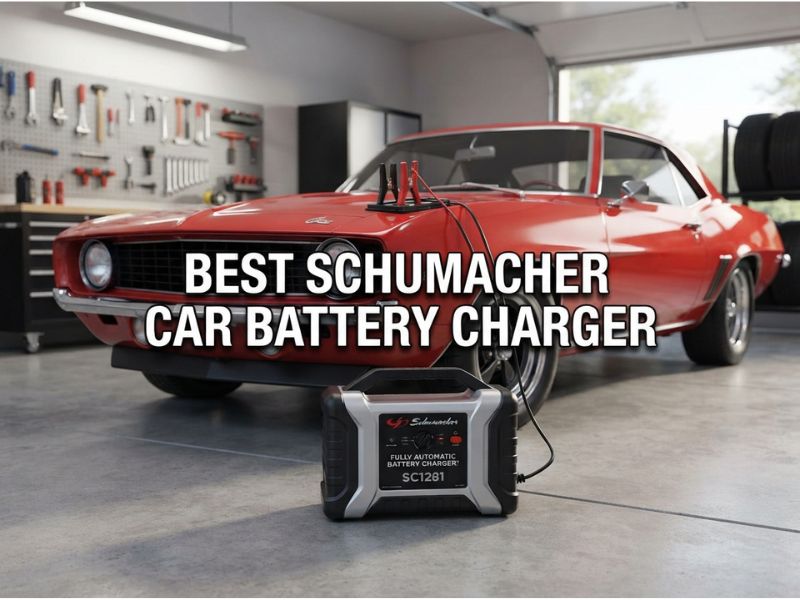
1. Schumacher Electric SC1281 Fully Automatic Battery Charger and Engine Starter – Best Overall

Key Features
- 6V and 12V battery charging
- Automatic multi-stage charging
- Up to 30A boost function
- 100A engine-start assistance
- Standard battery compatibility
- AGM battery compatibility
- Gel battery compatibility
- Deep-cycle battery support
- Battery and alternator testing
- Reverse-hookup protection
- Digital display
The Schumacher SC1281 is my first choice because it offers substantially more functionality than an ordinary battery charger while remaining manageable for a home garage.
Its normal charging system automatically controls the charging process rather than requiring you to constantly adjust amperage manually. Multi-stage charging changes the output as the battery moves toward a full state of charge, helping the charger balance charging speed with battery care.
The biggest advantage over the SC1280 is its boost and engine-start capability.
If a battery is deeply discharged but still serviceable, the boost function can put energy into it more quickly. If the vehicle needs more immediate help, the 100A engine-start mode can provide temporary starting assistance while the charger remains connected to AC power.
This makes the SC1281 useful for households with:
- Cars
- SUVs
- Pickup trucks
- Motorcycles
- Boats
- Lawn equipment
- Deep-cycle batteries
- Seasonal vehicles
Battery compatibility is another strength. The unit supports common standard flooded, AGM, gel, and deep-cycle lead-acid batteries.
The integrated battery and alternator testing functions are also genuinely useful. If a battery repeatedly becomes discharged, you can perform basic diagnostics instead of assuming the battery itself is always responsible.
At approximately 12 pounds, however, this is not a tiny charger. It is better thought of as a portable garage tool than something intended for a glove compartment.
What I Like
- Excellent overall feature set
- Strong customer-feedback history
- 6V and 12V capability
- Automatic charging
- 30A boost functionality
- 100A engine-start assistance
- Battery testing
- Alternator testing
- Supports several common lead-acid battery types
- Useful digital display
- Reverse-polarity protection
What I Do Not Like
- Considerably heavier than compact chargers
- More controls than a basic plug-and-charge unit
- Does not provide dedicated modern lithium charging
- Requires household AC power for engine-start assistance
Verdict
The Schumacher SC1281 is the best choice for most buyers who want one charger to handle charging, maintenance, diagnostics, boosting, and emergency starting assistance.
2. Schumacher Electric SC1280 15A Rapid Battery Charger and Maintainer – Best Compact Charger
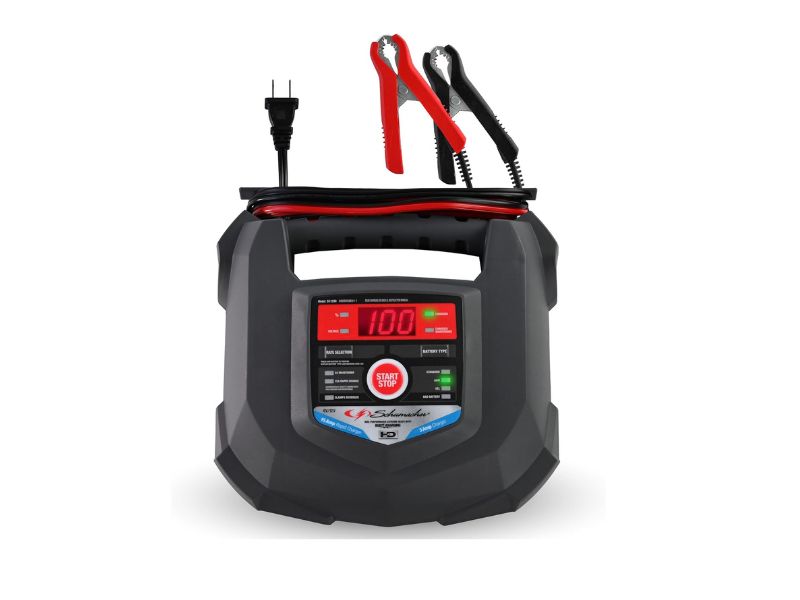
Key Features
- 15A rapid charging
- 3A maintenance capability
- 6V and 12V battery support
- Automatic voltage detection
- Automatic charge-rate selection
- Standard lead-acid support
- AGM compatibility
- Gel-cell compatibility
- Deep-cycle battery support
- Digital voltage display
- Charge-percentage display
- Reverse-hookup protection
The Schumacher SC1280 is the model I would choose if you do not need an engine-start function.
Its biggest advantage is the 15A rapid charging rate packed into a relatively compact charger.
Fifteen amps provides meaningfully faster charging than the 1A, 2A, or 5A maintainers commonly used for seasonal battery storage. This makes the SC1280 much more practical when a car battery is substantially discharged and you want to restore it without waiting an unnecessarily long time.
The charger automatically detects whether an appropriate connected battery is 6V or 12V and manages its charging process electronically.
Its digital display gives you battery voltage and charging-percentage information, making it much easier to understand what is happening than chargers that rely solely on a few colored LEDs.
Once charging is complete, the charger can transition into a maintenance function rather than continually applying maximum current.
This makes the SC1280 useful for both battery recovery and longer-term battery care.
Battery compatibility is broad for conventional automotive use. It supports standard flooded, AGM, gel, and deep-cycle batteries.
The major difference compared with the SC1281 is that you do not get high-current engine-start assistance.
That may actually be an advantage for shoppers who simply want a compact, capable battery charger without paying for functions they rarely use.
What I Like
- Approximately 21,000 customer ratings
- Strong 15A rapid charging
- Much lighter than the SC1281
- Automatic voltage detection
- 6V and 12V battery support
- Digital battery information
- Automatic maintenance
- AGM compatibility
- Deep-cycle support
- Straightforward operation
What I Do Not Like
- No dedicated engine-start function
- No lithium battery mode
- Less useful for emergency starting
- Compact housing feels lighter-duty than large shop chargers
Verdict
The SC1280 is my favorite Schumacher model for buyers who primarily want a fast, compact automatic battery charger and maintainer.
3. Schumacher Electric SC1309 Wheeled Battery Charger and 200A Engine Starter – Best Heavy-Duty Pick
Key Features
- 6V and 12V charging
- 200A engine-start assistance
- 40A boost mode
- Automatic charging
- 2A maintenance capability
- Standard lead-acid compatibility
- AGM battery support
- Deep-cycle battery compatibility
- Battery and alternator tester
- 8-gauge output cables
- Approximately 12 feet of total cable reach
- Wheels and retractable handle
The Schumacher SC1309 is in a completely different class from the first two products.
At roughly 30 pounds, it is a full-size wheeled garage charger and engine starter designed for users who value power and cable reach more than portability.
Its headline feature is the 200A engine-start mode.
That is twice the engine-start output offered by the SC1281 and makes the SC1309 particularly attractive for larger vehicles and garage environments where dead batteries are encountered regularly.
The 40A boost mode provides another useful middle step. Instead of immediately attempting an engine start, you can supply substantial charging current to a deeply discharged battery and give it time to recover.
For normal battery care, the charger automatically manages charging and can move into a low-current maintenance stage.
The integrated battery and alternator tester provides basic diagnostic information, while the heavy output cables are designed to remain flexible even in colder conditions.
I particularly like its long total cable reach.
Large pickups and other vehicles can have awkward battery locations, and longer cables let you position the charger more conveniently instead of balancing a heavy unit beside the engine compartment.
The wheels and retractable handle make movement around a garage much easier, but this is still not a charger most people will want to lift frequently.
What I Like
- Powerful 200A engine-start function
- 40A boost capability
- Good for larger vehicles
- Wheeled construction
- Retractable handle
- Long output-cable reach
- Heavy-gauge cables
- Automatic battery charging
- Battery and alternator testing
- Works with AGM and deep-cycle batteries
What I Do Not Like
- Approximately 30 pounds
- Requires substantial storage space
- Excessive for owners of one small car
- Less convenient than SC1280 for routine charging
Verdict
Choose the Schumacher SC1309 when you need a heavy-duty garage charger for trucks, SUVs, multiple vehicles, or frequent dead-battery recovery.
Schumacher Car Battery Charger Comparison
| Feature | Schumacher SC1281 | Schumacher SC1280 | Schumacher SC1309 |
| Voltage | 6V / 12V | 6V / 12V | 6V / 12V |
| Primary Charging | Automatic | 15A rapid | Automatic |
| Boost Mode | Up to 30A | No dedicated high boost | 40A |
| Engine Start | 100A | No | 200A |
| Maintenance | Yes | Yes | Yes |
| Standard Battery | Yes | Yes | Yes |
| AGM Battery | Yes | Yes | Yes |
| Gel Battery | Yes | Yes | Check exact application |
| Deep-Cycle | Yes | Yes | Yes |
| Battery Tester | Yes | Yes | Yes |
| Alternator Test | Yes | Limited testing focus | Yes |
| Digital Display | Yes | Yes | Yes |
| Portability | Good | Excellent | Fair |
| Best For | Overall garage use | Routine charging | Heavy-duty garage use |
Quick Comparison
The Schumacher SC1281 offers the best overall combination of charging and emergency functionality. It is the model I recommend when you want one machine that can charge batteries normally but also provide boost and engine-start assistance when necessary.
The Schumacher SC1280 makes more sense if battery charging is your main priority. Its 15A output is fast enough for normal automotive use, while its smaller and lighter housing is easier to store.
The Schumacher SC1309 should be considered when you regularly work with trucks, SUVs, multiple vehicles, or deeply discharged batteries. Its 40A boost and 200A starting functions make it the most powerful of these three.
Why Schumacher Battery Chargers Are Popular
Schumacher has produced automotive battery equipment for decades, and its charger lineup covers a wide range of use cases.
Instead of focusing only on small maintainers, the company offers products for:
- Automatic battery charging
- Seasonal maintenance
- High-current battery boosting
- Engine-start assistance
- Battery testing
- Alternator testing
- Marine batteries
- Deep-cycle batteries
- Garage and workshop use
This range makes Schumacher especially relevant to homeowners who maintain more than one vehicle.
How to Choose the Best Schumacher Car Battery Charger
Decide Whether You Need Engine Start
This is probably the easiest way to narrow your options.
If you only want to charge and maintain batteries, choose the SC1280.
If you want normal charging plus occasional emergency engine-start assistance, the SC1281 offers a better balance.
If high-output starting assistance is a regular requirement, the SC1309 is more appropriate.
Consider Charging Speed
Charging amperage influences how quickly a charger can replenish a battery.
A low-current maintainer may supply only 1 or 2 amps. That is excellent for preventing a stored battery from gradually discharging, but it can take a long time to recover a depleted automotive battery.
A charger around 10 to 15 amps is much more practical for routine home-garage charging.
The SC1280’s 15A capability is one reason I like it for normal car owners.
Understand Boost Mode
Boost charging sits between ordinary charging and engine-start assistance.
It provides considerably more charging current for a limited period so a low battery can recover enough energy to start the vehicle.
The SC1281 provides a substantial boost function, while the larger SC1309 can provide up to 40A in boost mode.
Boost mode should be used according to the charger and battery manufacturer’s instructions rather than as the default charging setting.
Understand Engine-Start Mode
An AC-powered charger with engine-start capability works differently from a portable jump starter.
A portable jump starter stores electricity in an internal battery.
A Schumacher charger such as the SC1281 or SC1309 draws energy from a household AC outlet and provides high current to assist the vehicle battery while you attempt to start the engine.
This means these chargers are excellent around a garage but are not substitutes for a cordless jump starter during a roadside emergency.
SC1281 vs. SC1280
This is probably the most important Schumacher comparison for the average buyer.
Choose the SC1281 If:
- You want engine-start assistance
- You regularly work on several vehicles
- Battery and alternator diagnostics matter
- You want boost charging
- Size and weight are not major concerns
Choose the SC1280 If:
- You primarily need battery charging
- Compact storage matters
- You want 15A rapid charging
- You do not need engine-start capability
- You frequently maintain batteries during storage
For most buyers who want maximum versatility, I prefer the SC1281.
For straightforward charging, the SC1280 is arguably the better value.
SC1281 vs. SC1309
These two chargers both offer engine-start capability, but they target different users.
The SC1281 is relatively portable and provides 100A starting assistance.
The SC1309 provides substantially stronger 200A engine-start output and 40A boost capability but weighs around 30 pounds.
The SC1309 also includes wheels and a retractable handle because it is intended to move around a garage rather than be carried frequently.
Choose the SC1281 for a normal home garage.
Choose the SC1309 for larger vehicles and heavier use.
What Battery Types Can Schumacher Chargers Handle?
Battery compatibility varies by model.
Common battery types supported across these three include:
- Flooded lead-acid
- Maintenance-free lead-acid
- AGM
- Deep-cycle
- Gel on supported models
Always select the charging mode recommended for your exact battery.
AGM batteries, in particular, can require a different charging profile from standard flooded batteries.
Can Schumacher Chargers Charge AGM Batteries?
Yes, all three models reviewed here support AGM applications within their stated specifications.
AGM batteries are increasingly common in newer vehicles because they can handle higher electrical loads and frequent starting cycles.
When the charger provides a battery-type selection, make sure the correct AGM mode is selected.
Can Schumacher Chargers Charge Lithium Batteries?
The models reviewed here are primarily designed around lead-acid battery applications.
Do not connect a lithium starter battery to a charger unless the exact Schumacher model and battery manufacturer specifically confirm compatibility.
Lithium batteries require a charging profile appropriate for their chemistry and battery-management system.
What Is Automatic Multi-Stage Charging?
Older chargers often applied charging current with relatively limited control.
Modern automatic chargers adjust their behavior throughout the charging cycle.
The stages can include:
- Initial battery detection
- Bulk charging
- Absorption
- Charge completion
- Float maintenance
- Monitoring
The charger may lower current as battery voltage increases.
This helps bring the battery to an appropriate state of charge without continually forcing maximum current into it.
Is a Schumacher Charger Safe to Leave Connected?
Models with automatic maintenance can remain connected when their instructions specifically permit long-term maintenance.
Once charging is complete, the charger reduces its output and monitors battery condition.
However, automatic charging does not mean charging equipment should be completely ignored indefinitely.
Periodically inspect:
- Battery condition
- Clamps
- Charger cables
- AC cord
- Charging environment
Never attempt to charge a visibly damaged, leaking, swollen, or frozen battery.
Best Schumacher Charger for a Dead Battery
For a severely discharged but otherwise healthy automotive battery, I prefer the SC1281.
It provides several options.
You can allow the automatic charging system to restore the battery normally, use the boost function when appropriate, or use engine-start assistance when you need to start the vehicle sooner.
The SC1309 provides even more high-current capability but makes more sense for garages dealing with larger vehicles regularly.
Best Schumacher Charger for AGM Batteries
The SC1280 and SC1281 are both excellent options for normal AGM automotive batteries.
I prefer the SC1280 when you simply want to recharge and maintain the battery.
The SC1281 is better if you also want engine-start and diagnostic capabilities.
Always confirm your particular battery’s recommended charging voltage and select the appropriate charger setting.
Best Schumacher Charger for Trucks
For normal light-duty pickup trucks, the SC1281 provides an excellent combination of portability and output.
For larger trucks, workshops, or situations where very weak batteries are common, I prefer the SC1309.
Its 200A starting assistance and 40A boost mode provide greater headroom.
Remember that some diesel trucks use two 12V batteries. Follow the vehicle manufacturer’s approved charging procedure for dual-battery systems.
Can a Schumacher Charger Revive a Completely Dead Battery?
It depends on why the battery is dead.
A healthy battery that has simply been discharged because lights were left on may be rechargeable.
A battery with:
- A shorted cell
- Internal physical damage
- Severe plate deterioration
- A cracked case
- Frozen electrolyte
- Severe corrosion
may not recover regardless of charger quality.
Automatic chargers may also need to detect a minimum amount of battery voltage before beginning their normal charging process.
If a battery repeatedly refuses to charge or quickly becomes discharged again, have it professionally tested.
Battery Charger vs. Battery Maintainer
These functions are related but different.
Charger
A battery charger restores energy to a depleted battery.
Higher charging amperage generally reduces charging time.
Maintainer
A maintainer keeps an already charged or nearly charged battery at an appropriate state during storage.
This is useful for:
- Seasonal cars
- Classic vehicles
- Motorcycles
- Boats
- Lawn tractors
- Backup vehicles
The SC1280 and SC1281 can perform both charging and maintenance functions.
Battery Charger vs. Jump Starter
A battery charger requires time to replenish the battery.
A jump starter provides a short burst of high current.
The SC1281 and SC1309 blur this distinction because they include an AC-powered engine-start function.
However, they still require access to household power.
For roadside emergencies away from electrical outlets, a portable lithium jump starter remains more practical.
How Long Does a Schumacher Charger Take to Charge a Car Battery?
There is no single charging time because several factors matter:
- Battery capacity
- Charger amperage
- Battery state of charge
- Battery chemistry
- Temperature
- Battery age
- Charging efficiency
A 15A charger can restore a typical automotive battery considerably faster than a 1A maintainer.
However, smart chargers reduce current as the battery approaches full charge, so actual charging time is not simply battery amp-hours divided by charger amps.
How to Use a Schumacher Car Battery Charger Safely
Before connecting the charger, identify your battery voltage and chemistry.
Inspect the battery for:
- Cracks
- Swelling
- Leakage
- Loose terminals
- Severe corrosion
- Signs of freezing
Do not charge a physically damaged or frozen battery.
Turn the vehicle off.
Connect the clamps according to the vehicle and charger instructions.
Confirm correct polarity.
Plug the charger into AC power.
Select the proper battery voltage and chemistry if the unit does not make the selection automatically.
Choose the appropriate charging mode.
Allow the automatic charger to complete its cycle.
Disconnect the equipment in the sequence specified by the manufacturer.
Lead-acid batteries can produce flammable gases during certain charging conditions, so use the charger in an appropriately ventilated area away from flames and sparks.
Common Schumacher Battery Charger Mistakes
Using Engine Start as Normal Charging
Engine-start mode is intended for a short burst of starting assistance.
It is not a substitute for normal charging.
Selecting the Wrong Battery Type
A standard flooded battery and an AGM battery may require different charging profiles.
Check the battery label before selecting the mode.
Assuming More Amps Are Always Better
A 200A engine-start rating does not make the SC1309 automatically better than the SC1280.
For ordinary battery charging, the smaller SC1280 can actually be more convenient.
Charging a Failed Battery Repeatedly
If the battery will not hold charge, identify the cause rather than continually reconnecting the charger.
Ignoring the Alternator
A perfectly healthy battery can repeatedly become discharged if the vehicle charging system is malfunctioning.
This is why integrated alternator testing on the SC1281 and SC1309 can be useful.
Frequently Asked Questions
What is the best Schumacher car battery charger?
The Schumacher SC1281 is my best overall choice for most home garages.
It combines automatic 6V/12V charging with boost capability, 100A engine-start assistance, multiple lead-acid battery modes, battery testing, and alternator testing. The SC1280 is better if you only want fast charging, while the SC1309 is better for heavy-duty garage use.
Which Schumacher battery charger has the most reviews?
The SC1281 and SC1280 both have exceptionally large owner-feedback histories.
Current listing data shows each at roughly the 21,000-rating level, with the SC1281 slightly ahead in the current snapshots I checked. Both have significantly more customer feedback than most specialized Schumacher garage chargers.
Is Schumacher a good battery charger brand?
Schumacher is an established automotive charging brand with options ranging from maintainers to professional-style engine starters.
Its strongest advantage is product variety. Buyers can choose a lightweight automatic charger, a combination charger and engine starter, or a large wheeled shop unit without leaving the same product family.
Is the Schumacher SC1281 worth buying?
Yes, particularly if you want more than basic battery charging.
Its engine-start assistance, boost mode, automatic charging, battery testing, and alternator testing make it useful for households with several vehicles. If you only need charging and maintenance, however, the smaller SC1280 may be more practical.
Is the Schumacher SC1280 better than the SC1281?
The SC1280 is better for compact rapid charging, while the SC1281 offers more overall functionality.
The SC1280 provides a strong 15A charging rate in a much lighter housing. The SC1281 adds boost and engine-start capabilities but takes up more space.
Can the Schumacher SC1281 jump-start a car?
It provides an AC-powered 100A engine-start assistance mode.
It is not a cordless jump starter. The charger must be connected to an appropriate AC power source while providing starting assistance.
Can the Schumacher SC1280 start a car?
The SC1280 is primarily a rapid charger and maintainer rather than a dedicated engine-start unit.
If engine-start assistance is important, choose the SC1281 or SC1309 instead.
Which Schumacher charger is best for a truck?
The SC1281 is suitable for many normal pickups, while the SC1309 is better for heavier garage use.
The SC1309 provides substantially greater engine-start and boost output, but it is also much larger and heavier.
Which Schumacher charger is best for AGM batteries?
The SC1280 and SC1281 are excellent choices for supported AGM batteries.
Make sure the correct battery type is selected according to the charger’s instructions. The appropriate charging profile helps an AGM battery reach full charge safely.
Does a Schumacher charger automatically shut off?
Fully automatic Schumacher chargers regulate charging instead of continually applying maximum current.
They can transition into maintenance or monitoring behavior once charging is complete. Exact operation varies by model, so follow the instructions supplied with your charger.
Can I leave my Schumacher battery charger connected overnight?
Automatic models can generally complete charging without constant supervision when used according to their instructions.
Use the charger in a dry, ventilated, safe location and never charge a damaged battery. For long-term connection, make sure the exact model includes an appropriate maintenance function.
What does bad battery mean on a Schumacher charger?
It generally means the charger has detected behavior inconsistent with a normally chargeable battery.
Possible causes include a failed cell, severe sulfation, inability to accept charge, incorrect battery voltage, or other battery problems. Check the charger manual for the exact indicator or fault code.
Why won’t my Schumacher charger charge a completely dead battery?
Some automatic chargers need to detect minimum battery voltage before starting a normal charging cycle.
A battery that has fallen extremely low may not be recognized. It can also indicate internal battery failure. Do not bypass charger safety systems unless the manufacturer provides a specific approved procedure.
Can Schumacher chargers test an alternator?
Some models can, including the SC1281 and SC1309.
An alternator test can help identify whether repeated battery discharge is caused by a charging-system problem instead of the battery itself.
How many amps should I use to charge a car battery?
Around 10 to 15 amps is a practical charging rate for many automotive batteries.
Lower amperage charges more slowly, while higher amperage can shorten charging time when the battery supports it. Always follow the battery manufacturer’s charging recommendations.
Conclusion
Choosing the best Schumacher car battery charger becomes straightforward once you decide whether your priority is normal charging, emergency starting capability, or heavy-duty garage use.
My primary recommendation is the Schumacher Electric SC1281 Fully Automatic Battery Charger and Engine Starter. Its exceptionally strong customer-feedback history, 6V/12V operation, boost mode, 100A engine-start assistance, broad lead-acid compatibility, and diagnostic functions make it the most versatile choice for most home garages.
The Schumacher Electric SC1280 15A Rapid Battery Charger and Maintainer is the better choice if you mainly need fast automatic charging and want something much lighter and easier to store.
For larger vehicles and more demanding workshop use, the Schumacher Electric SC1309 Wheeled Battery Charger and 200A Engine Starter provides the highest starting assistance and boost capability of these three.
For most homeowners, I would choose the SC1281. If you already own a portable jump starter and simply need a reliable charger, the more compact SC1280 is likely the smarter purchase.