Finding the best wheeled car battery charger makes sense when a small handheld maintainer no longer provides enough charging speed or engine-start capability for your garage. A quality rolling charger can handle larger automotive batteries, provide a high-amperage boost for deeply discharged batteries, and move easily between cars, trucks, SUVs, motorcycles, and other equipment.
My primary recommendation is the Schumacher Electric SC1353 Wheeled Automatic Battery Charger and Engine Starter. I prefer it for most home garages because it combines automatic multi-stage charging, 6V/12V compatibility, a 40A boost, 200A engine-start function, battery maintenance, and built-in diagnostic capabilities. Unlike a traditional manual wheel charger, it requires less charging supervision and is easier for occasional users to manage correctly.
For buyers who specifically want old-school manual control, the Schumacher Electric SC1446 Wheeled Manual Battery Charger and Engine Starter is my next choice. Its mechanical timer, analog ammeter, 10A charging mode, powerful boost settings, and 200A engine-start function make it particularly appealing for garages where deeply discharged batteries are common.
The Schumacher Electric SC1437 Wheeled Manual Battery Charger and Engine Starter is the smaller-capacity alternative. It delivers 6A normal charging, a 25A boost, and 150A engine starting. I would consider it when you want the rugged construction and mobility of a floor charger but do not need the additional output of the SC1446.
Best Wheeled Car Battery Charger
1. Schumacher Electric SC1353 Wheeled Automatic Battery Charger and Engine Starter – Best Overall

Key Features
- 6V and 12V battery compatibility
- 200A engine-start mode
- 40A boost charging
- 6A-to-2A automatic charge and maintenance
- Automatic multi-stage charging
- Standard, AGM, and deep-cycle battery compatibility
- Automatic voltage detection
- Float-mode monitoring
- Battery reconditioning function
- Battery and alternator testing
- Reverse-hookup protection
- Digital display and LED indicators
- Wheeled steel cabinet
- Retractable handle
- Heavy-duty clamps and cables
The Schumacher SC1353 is my first choice because it provides the heavy-duty functionality buyers expect from a wheeled charger without forcing them to manually control every charging stage.
That distinction matters.
Traditional shop chargers are powerful, but many require the operator to choose the charging rate, set a mechanical timer, monitor an analog gauge, and stop the charging process at the appropriate time. That approach gives experienced technicians excellent control, but it adds responsibility.
The SC1353 uses microprocessor-controlled automatic charging instead.
Once the charger is connected correctly and the appropriate battery type is selected, it can automatically manage charging current and transition between charging stages. That makes it much more approachable for a homeowner who wants professional-style capacity without constantly monitoring the battery.
The normal charging system operates between approximately 6A and 2A, depending on battery condition and charging stage.
Six amps is not an extremely aggressive automotive charging rate, but it is a useful balance for normal overnight battery charging and maintenance. It is substantially more purposeful than a tiny 1A maintainer while remaining controlled enough for regular battery care.
Where the SC1353 becomes considerably more useful is its 40A boost mode.
A battery that is heavily discharged may need a meaningful amount of energy before it can crank an engine successfully. Rather than waiting for hours at the normal charge rate, boost mode can add charge much more rapidly.
Then there is the 200A engine-start function.
This feature allows the charger to provide substantial current to assist with starting an engine while the charger remains connected to AC power.
That makes the SC1353 much more than an ordinary battery maintainer.
If you have several vehicles in a garage, workshop, farm, or home fleet, one rolling unit can handle normal charging, maintenance, battery recovery, and starting assistance.
Battery compatibility is another reason I rank it first.
It supports 6V and 12V batteries and common automotive battery types including standard flooded lead-acid, AGM, and deep-cycle designs.
The automatic voltage-detection feature reduces setup complexity because the unit can recognize whether it is connected to an appropriate 6V or 12V battery.
Its battery-maintenance function is also valuable for vehicles that sit.
After the battery reaches the appropriate state of charge, float-mode monitoring helps maintain it without continuously applying maximum charging current.
That is particularly useful for classic cars, seasonal vehicles, work trucks, boats, and equipment that may remain parked for weeks.
The SC1353 also provides diagnostic capabilities.
The built-in battery and alternator tester can help determine whether a no-start problem is simply a discharged battery or whether the charging system may need further investigation.
That does not replace professional electrical-system testing, but it gives a home mechanic useful information without requiring another basic tester.
The physical construction suits garage use.
A steel cabinet protects the charging hardware, while compact wheels and a retractable handle make it easier to move the charger between vehicles.
This is one of the biggest reasons to choose a wheeled charger in the first place.
A powerful transformer-style charger can be relatively heavy. Wheels allow you to move that weight instead of repeatedly carrying it.
What I Like
The automatic charging system is the biggest advantage. It delivers the capabilities of a substantial wheeled charger while requiring much less manual monitoring.
I also like the combination of normal charging, 40A boost, 200A starting assistance, battery maintenance, and electrical-system testing. For a home garage with multiple vehicles, those functions cover most common battery situations.
The support for both 6V and 12V batteries also makes the SC1353 more versatile than 12V-only alternatives.
What I Do Not Like
Its normal charging rate is not as aggressive as some shop chargers, so users who want maximum manual fast-charge capability may prefer the SC1446.
It is also significantly larger than a modern handheld smart charger. If you maintain only one passenger car and rarely encounter dead batteries, a floor-standing wheeled unit may be unnecessary.
Verdict
The Schumacher SC1353 is the best wheeled car battery charger for most home garages because it combines substantial power with automatic charging intelligence.
It is my preferred choice for users who want charging, maintenance, boost charging, engine starting, and basic diagnostics without managing a manual timer throughout every charging session.
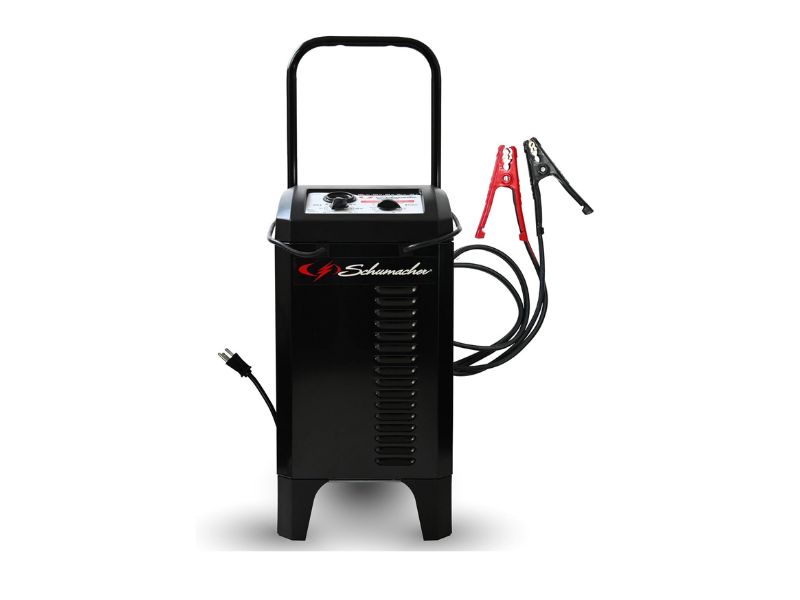
2. Schumacher Electric SC1446 Wheeled Manual Battery Charger and Engine Starter – Best Heavy-Duty Manual Pick
Key Features
- 6V and 12V compatibility
- 10A standard charging
- 20A and 40A boost settings
- 200A 12V engine-start mode
- 135-minute manual timer
- Analog ammeter
- Standard battery compatibility
- AGM compatibility
- Gel battery compatibility
- Deep-cycle battery compatibility
- Heavy-duty steel construction
- Retractable handle
- Solid wheels
- 8-gauge output cables
- Heavy-duty color-coded clamps
The Schumacher SC1446 is the model I would choose when direct manual control matters more than automatic charging convenience.
Its design is intentionally traditional.
Instead of relying on a microprocessor to make most charging decisions, the SC1446 provides a 135-minute mechanical timer and an analog ammeter.
That means you control how the battery is charged and for how long.
Experienced mechanics often appreciate this type of charger because automatic battery chargers can occasionally refuse to begin charging when battery voltage has fallen extremely low.
A manual charger gives the operator more direct control over the charging process.
That flexibility comes with additional responsibility.
You need to understand the battery you are charging, select the correct voltage and current setting, monitor progress, and avoid excessive charging.
For someone comfortable working around lead-acid batteries, that is not necessarily a disadvantage. It can actually be one of the reasons to buy this style of charger.
The SC1446 provides a 10A normal 12V charging mode, which is more aggressive than the SC1353’s normal automatic charging output.
Ten amps is a practical rate for many normal automotive starter batteries.
For example, if a 60Ah battery needs roughly 30Ah restored, a simple theoretical calculation would put 10A charging at around three hours before accounting for inefficiency and the way charging slows as the battery approaches full capacity.
Actual charging time will vary, but the comparison demonstrates why 10A charging is much more practical than a 1A maintainer when a battery is seriously discharged.
The SC1446 also includes 20A and 40A boost charging.
These higher-current settings are useful when you need to add meaningful charge to a deeply discharged battery before attempting to start the engine.
Then there is the 200A engine-start mode.
For a garage dealing with cars, SUVs, trucks, and other larger vehicles, this can save considerable time.
Instead of waiting until the battery has been completely recharged, engine-start mode can provide additional cranking assistance while the unit remains connected to AC power.
Battery compatibility is broad.
The SC1446 is designed for common 6V and 12V lead-acid batteries, including standard, AGM, gel, and deep-cycle types.
That makes it useful for more than passenger cars.
Depending on the battery and charging requirements, the same shop charger may serve motorcycles, ATVs, trucks, RV batteries, marine equipment, tractors, and other equipment.
The analog ammeter gives immediate visual feedback.
Digital displays are easier for some users, but an analog needle remains useful when you want to see charging current rise and fall in real time.
The cabinet is built for garage duty.
A steel case, retractable handle, compact wheels, heavy-duty clamps, and thick output cables create a much more substantial tool than a pocket charger.
Its cables also provide enough reach to position the unit conveniently beside most vehicles.
The major difference between the SC1446 and my top-ranked SC1353 comes down to manual versus automatic operation.
If you want the charger to manage battery maintenance automatically, choose SC1353.
If you want to control charging time and output yourself, the SC1446 is the stronger option.
What I Like
I like the combination of 10A charging, two boost settings, and a 200A starting function.
The mechanical timer is also useful for experienced users because it prevents the charger from simply running indefinitely while still leaving charging decisions in the operator’s hands.
Its rugged steel construction and substantial clamps make it feel appropriate for a workshop environment.
What I Do Not Like
Manual charging requires more knowledge and attention.
This is not the charger I would recommend to someone who wants to connect a battery, walk away, and let a microprocessor manage everything automatically.
The unit is also relatively heavy, although the wheels substantially reduce the inconvenience.
Verdict
Choose the Schumacher SC1446 if you specifically want a powerful manual wheeled charger.
For workshop users who understand charging current, battery condition, and charging time, its direct control can be an advantage rather than a limitation.
3. Schumacher Electric SC1437 Wheeled Manual Battery Charger and Engine Starter – Best Lower-Power Wheeled Pick

Key Features
- 12V battery charging
- 6A standard charging
- 25A boost mode
- 150A engine-start capability
- 135-minute manual timer
- Analog ammeter
- Standard lead-acid battery support
- AGM compatibility
- Gel compatibility
- Deep-cycle compatibility
- Steel cabinet
- Wheels and retractable handle
- 8-gauge charging cables
- Heavy-duty clamps
The Schumacher SC1437 is essentially the choice for buyers who like the rugged manual approach of the SC1446 but do not need as much output.
Its normal charging rate is 6 amps.
That is sufficient for ordinary automotive battery charging, particularly when you are comfortable leaving the battery on charge for several hours.
Six amps also makes the unit somewhat easier to use for smaller batteries than a charger built primarily around very high output.
The 25A boost setting provides a middle ground when normal 6A charging is too slow.
A substantially discharged battery can receive a faster initial charge before you switch back to a lower charging rate.
For immediate starting assistance, the charger delivers up to 150A engine-start output.
That is below the 200A capability of the other two models, but it remains useful for many passenger vehicles.
Someone whose garage consists mainly of standard sedans, crossovers, small trucks, motorcycles, and lawn equipment may not need anything larger.
Like the SC1446, the SC1437 is manually operated.
A 135-minute timer determines how long charging continues, while the analog ammeter helps you monitor battery charging current.
This old-school setup has advantages.
There is less dependence on automated voltage detection, and the operator retains control over the charging cycle.
But you need to know what you are doing.
A manual charger should not simply be connected to a battery at an arbitrary setting and ignored for the rest of the day.
Check the battery specifications, select an appropriate charge rate, monitor charging, and follow the manufacturer’s safety instructions.
Another important difference is voltage compatibility.
The SC1437 is primarily a 12V charger, whereas the SC1353 and SC1446 provide broader 6V/12V capability.
If you own vintage 6V vehicles or equipment, that difference alone may justify choosing another model.
For ordinary modern passenger vehicles, however, 12V compatibility covers the typical application.
The chassis remains one of its strengths.
You get the steel cabinet, wheeled format, retractable handle, thick cables, and substantial clamps expected from a garage-oriented charger.
This is especially useful if you regularly move the charger between several vehicles.
What I Like
The SC1437 gives you the basic advantages of a shop-style wheeled charger without requiring the additional output of the SC1446.
The 6A charge rate, 25A boost, and 150A start modes create a useful progression from normal charging to emergency engine assistance.
I also like its simple analog controls. There is very little interface complexity.
What I Do Not Like
It lacks the automatic multi-stage charging and maintenance intelligence of the SC1353.
The 150A starting output and 25A boost are also less capable than the SC1446’s 200A start and 40A boost.
Its 12V focus reduces versatility for anyone working with older 6V equipment.
Verdict
The Schumacher SC1437 is best for buyers who want a straightforward wheeled manual charger primarily for normal 12V passenger vehicles.
It is not as versatile as the SC1353 or as powerful as the SC1446, but its simpler specification may be exactly what a smaller home garage needs.
Wheeled Car Battery Charger Comparison
| Product | Charger Type | Normal Charge | Boost | Engine Start | Voltage | Battery Types | Diagnostics | Best For |
| Schumacher SC1353 | Fully automatic | 6A–2A | 40A | 200A | 6V/12V | Standard, AGM, deep-cycle | Battery + alternator | Best overall |
| Schumacher SC1446 | Manual | 10A | 20A/40A | 200A | 6V/12V | Standard, AGM, gel, deep-cycle | No dedicated tester | Heavy-duty manual use |
| Schumacher SC1437 | Manual | 6A | 25A | 150A | 12V | Standard, AGM, gel, deep-cycle | No dedicated tester | Smaller garage setups |
The SC1353 is the easiest recommendation for most homeowners because its automatic operation reduces the amount of battery-charging knowledge required while still providing substantial boost and starting capability.
The SC1446 is stronger when you specifically want manual control and faster standard charging.
The SC1437 is the simpler alternative for 12V applications where 150A starting assistance is sufficient.
What Is a Wheeled Car Battery Charger?
A wheeled battery charger is a relatively large AC-powered automotive charger built into a floor-standing cabinet with wheels and a handle.
Traditional wheeled chargers are common in:
- Automotive repair shops
- Home garages
- Farms
- Fleet facilities
- Dealership service departments
- Equipment workshops
- Marine service areas
Their larger cabinets can accommodate more substantial charging hardware than many handheld units.
They also tend to offer high-amperage boost and engine-start functions.
The wheels are not simply cosmetic.
A substantial charger can weigh 20–40 pounds or more. Moving that equipment repeatedly around a garage becomes much easier when it rolls.
Wheeled Charger vs Small Smart Charger
These products overlap, but their strengths are different.
Small Smart Charger
A compact 1A–10A charger is excellent for:
- Routine battery maintenance
- Overnight charging
- Motorcycle batteries
- Seasonal vehicles
- Small garage storage
- Automatic operation
It may fit on a shelf or even in a toolbox.
Wheeled Charger
A wheeled unit becomes more attractive when you need:
- High-current battery boosting
- Engine-start assistance
- Frequent dead-battery recovery
- Heavy-duty clamps and cables
- Multiple vehicle support
- Workshop durability
- Easier movement of heavier charging hardware
If you only maintain one modern sedan, a wheeled charger may be excessive.
If you frequently work on several vehicles, it can be one of the most useful electrical tools in the garage.
Automatic vs Manual Wheeled Battery Chargers
This is the most important decision in this category.
Automatic Chargers
An automatic charger monitors the battery and modifies its charging behavior electronically.
Depending on the model, it may automatically control:
- Charging current
- Charging voltage
- Charging stages
- Float maintenance
- Battery voltage detection
- Overcharging prevention
The SC1353 uses this approach.
For most homeowners, I prefer automatic charging because it reduces monitoring requirements.
Manual Chargers
Manual chargers put more responsibility in the user’s hands.
You may need to select:
- Battery voltage
- Charging rate
- Charging duration
- Boost mode
The SC1446 and SC1437 use mechanical timers and analog charging meters.
Experienced users often appreciate manual chargers because they provide direct control and may work in situations where some automatic chargers cannot recognize an extremely discharged battery.
The trade-off is that incorrect settings or excessive charging time can damage a battery.
How Many Amps Should a Car Battery Charger Have?
There is no single correct number.
Your ideal charging current depends on battery capacity and how quickly you need to restore it.
2A Charging
A 2A charger is good for:
- Maintenance
- Small batteries
- Slow overnight charging
- Motorcycle batteries
It is slow for large discharged car batteries.
6A Charging
Six amps provides a useful middle ground.
It can recharge a normal automotive battery over several hours without requiring the output of a high-current fast charger.
Both SC1353 and SC1437 operate around this range during normal charging.
10A Charging
Ten amps is more practical when charging speed matters.
The SC1446 provides a 10A normal charge setting.
For many normal automotive batteries, 10A is enough to restore useful capacity within a reasonable garage-work timeframe.
25A–40A Boost Charging
Boost modes are intended to add charge quickly to a substantially discharged battery.
They should not automatically be treated as the ideal long-term charging rate.
Follow the charger and battery manufacturer’s instructions regarding boost duration.
What Does 150A or 200A Engine Start Mean?
The engine-start setting is different from normal charging.
Starting an engine requires a short burst of high electrical current.
A wheeled charger connected to AC power can provide additional current to help the battery crank the starter motor.
The SC1437 provides up to 150A starting assistance, while SC1353 and SC1446 offer 200A engine-start modes.
These settings are intended for short starting attempts.
They are not 150A or 200A continuous battery-charging modes.
Always follow the specified crank/rest cycle to prevent overheating the charger, cables, starter motor, or battery.
6V vs 12V Wheeled Battery Chargers
Most modern passenger vehicles use a 12V starting battery.
However, 6V systems remain relevant for:
- Vintage cars
- Classic trucks
- Older tractors
- Antique motorcycles
- Specialty equipment
If you work on older equipment, buying a 6V/12V charger is worthwhile.
The SC1353 and SC1446 provide that broader voltage flexibility.
For a garage containing only modern 12V vehicles, the SC1437’s 12V limitation may not matter.
Battery Types You May Need to Charge
Battery chemistry is just as important as battery voltage.
Flooded Lead-Acid
Traditional flooded batteries remain common in cars, trucks, tractors, boats, and equipment.
They contain liquid electrolyte and may have removable or sealed caps depending on design.
AGM
Absorbent Glass Mat batteries are increasingly common.
They are used in many:
- Start-stop vehicles
- Luxury cars
- Performance vehicles
- Trucks
- SUVs
- Motorcycles
Always confirm that your charger supports AGM batteries.
Gel
Gel-cell batteries have different charging requirements from ordinary flooded batteries.
Use only a charger approved for gel chemistry.
Deep-Cycle
Deep-cycle batteries are designed to deliver energy over longer periods rather than simply providing short engine-starting bursts.
They are common in marine and recreational applications.
The chargers reviewed here offer varying levels of deep-cycle compatibility.
Lithium
This point is important.
The three wheeled chargers reviewed here are primarily designed around lead-acid battery systems.
Do not connect a lithium vehicle battery simply because the voltage appears similar.
Use a charger specifically approved for the exact lithium chemistry and battery-management system.
How Long Does It Take to Charge a Car Battery?
Charging time depends on:
- Battery amp-hour capacity
- Remaining state of charge
- Charging current
- Battery temperature
- Battery age
- Battery chemistry
- Charging efficiency
A rough estimation can still help.
Suppose a 60Ah battery is approximately 50% discharged.
Around 30Ah needs to be replaced.
Ignoring losses:
At 2A: about 15 hours.
At 6A: about 5 hours.
At 10A: about 3 hours.
Real charging takes longer because efficiency is not perfect and charging current normally decreases as the battery approaches full charge.
Use these calculations for planning, not as a substitute for monitoring an actual battery.
When Should You Use Boost Mode?
Boost mode is useful when a battery is too discharged to start the vehicle but you do not want to wait through a complete normal charging cycle.
For example, a 40A boost can put substantially more energy into the battery over a short period than a 6A normal charge.
However, more current also creates more heat and battery stress.
Use boost only according to the charger’s instructions.
Avoid repeatedly using high-current boost as a substitute for diagnosing a battery that continually goes dead.
When Should You Use Engine-Start Mode?
Engine-start mode is intended for situations where the battery has insufficient cranking power and the charger is positioned near an AC outlet.
A typical process is:
Connect the charger correctly.
Select the correct voltage and starting mode.
Allow any recommended preliminary charging time.
Attempt to crank the engine for the permitted number of seconds.
Allow the specified cooldown period between attempts.
Do not continuously crank the engine while the charger remains in high-output mode.
If the vehicle still will not start after several properly performed attempts, the problem may not be the battery.
Why Does a Car Battery Keep Going Dead?
A wheeled charger can solve the immediate problem, but repeated battery discharge indicates something else may need attention.
Common possibilities include:
- Old battery
- Failing alternator
- Loose battery connections
- Corroded terminals
- Parasitic electrical drain
- Lights left on
- Faulty charging-system wiring
- Vehicle stored for long periods
- Extreme temperatures
If you repeatedly need the 40A boost or 200A starter function, test the battery and charging system.
Battery Charger vs Jump Starter
A wheeled charger with an engine-start function may resemble a jump starter in practice, but the two tools work differently.
Wheeled Charger/Starter
It normally:
- Requires an AC electrical outlet
- Charges the vehicle battery
- Can provide boost charging
- May provide engine-start assistance
- Is designed primarily for garage use
Portable Jump Starter
It:
- Contains its own internal battery
- Does not require an outlet during the jump
- Is designed for roadside emergencies
- Can be stored inside the vehicle
- Does not properly recharge the vehicle battery
For a home garage, a wheeled charger is generally more capable.
For a dead battery in a parking lot, a portable jump starter is much more useful.
Battery Charger vs Battery Maintainer
A charger restores significant energy.
A maintainer primarily keeps a charged battery from gradually discharging.
The SC1353 can perform both functions because it provides automatic charging and maintenance.
Manual models such as SC1446 and SC1437 are better treated as supervised charging tools rather than long-term unattended maintainers.
Should You Buy a Manual or Automatic Charger?
Choose an automatic model if you:
- Want easier operation
- Prefer reduced monitoring
- Maintain stored vehicles
- Are not highly experienced with batteries
- Want automatic float maintenance
Choose a manual model if you:
- Understand charging rates
- Want direct control
- Frequently encounter extremely discharged batteries
- Prefer mechanical timers and analog meters
- Work regularly in a garage or workshop
For most homeowners, my preference is automatic.
For experienced mechanics, the answer is less clear-cut.
Why Wheels Matter
High-powered floor chargers are heavier than compact maintainers.
A quality wheeled design makes it easier to move the unit:
- Between garage bays
- Around a truck
- Across a workshop
- Between stored vehicles
- From a storage wall to the driveway
Look for solid wheels, a usable handle, and enough cable length that the charger does not have to sit directly against the vehicle.
Cable Gauge and Length
Heavy charging and engine starting involve substantial current.
Cable quality therefore matters.
Thicker cables reduce electrical resistance and heat.
The reviewed Schumacher floor chargers use relatively substantial output cables designed for workshop use.
Length matters as well.
A cable that is too short can force you to position the heavy charger awkwardly beside the battery.
Check both:
- AC power-cord length
- DC clamp-cable length
before choosing a permanent garage location.
Analog Meter vs Digital Display
Neither is automatically better.
Analog Ammeter
Advantages include:
- Immediate current indication
- Simple construction
- Easy observation of current taper
- Traditional workshop familiarity
SC1446 and SC1437 use this approach.
Digital Display
Advantages include:
- Clear status information
- Easier reading for occasional users
- More automated operating feedback
SC1353 uses a more modern interface.
For home use, I generally prefer the digital automatic system.
Experienced technicians may prefer the direct feedback of an analog ammeter.
Safety Tips for Using a Wheeled Battery Charger
Battery charging involves electricity, high current, and potentially explosive hydrogen gas.
Work in a ventilated location.
Keep flames, cigarettes, and sparks away from lead-acid batteries.
Inspect the battery before charging.
Do not charge a battery that is:
- Cracked
- Leaking
- Frozen
- Severely swollen
- Physically damaged
Verify positive and negative terminals carefully.
Follow the connection sequence specified by the vehicle and charger manufacturer.
Keep the charger away from moving engine components.
Do not place the charger directly on top of the battery.
Use the correct battery voltage and chemistry settings.
Never assume that the highest charge rate is automatically the best charge rate.
Can You Charge the Battery While It Is in the Car?
Many vehicles allow in-car battery charging, but procedures vary.
Modern vehicles may have:
- Battery monitoring sensors
- Dedicated positive charging terminals
- Specific chassis ground points
- Batteries mounted beneath seats
- Batteries mounted in trunks
- Sensitive electronic control modules
Consult the vehicle owner’s manual.
If the manufacturer provides dedicated charging points, use them.
Can a Wheeled Charger Revive a Completely Dead Battery?
Sometimes.
A healthy battery that was accidentally drained may recover normally after appropriate charging.
Manual chargers can have an advantage when battery voltage is extremely low because some automatic chargers require a minimum detectable voltage before beginning normal operation.
However, no charger can reliably repair every failed battery.
Replacement may be necessary if the battery has:
- A shorted cell
- Severe plate damage
- Internal mechanical failure
- Extensive sulfation
- Freeze damage
- Very low remaining capacity
A battery load test can help determine whether the battery still has useful cranking capacity after charging.
Common Buying Mistakes
Choosing Only by Engine-Start Amps
A 250A starter is not automatically better for routine battery charging than a 200A unit.
Look at normal charge rates and operating features too.
Ignoring Automatic vs Manual Operation
This changes the entire user experience.
Decide which style you actually want before comparing amperage.
Assuming Every Charger Supports Lithium
Many traditional floor chargers do not.
Verify chemistry explicitly.
Buying 12V Only When You Own Vintage Equipment
If you work with older 6V batteries, dual-voltage capability is valuable.
Expecting a Wheeled Charger to Be Portable Roadside Equipment
These chargers require AC power.
They belong in garages and workshops rather than trunks.
Leaving a Manual Charger Unattended
Manual chargers require supervision and proper timer/current settings.
Using Engine-Start Mode Repeatedly
Follow the required duty cycle.
High starting current creates considerable heat.
Frequently Asked Questions
What is the best wheeled car battery charger?
The Schumacher SC1353 is my best overall choice for most home garages.
Its automatic multi-stage charging, 6V/12V support, 40A boost, 200A engine-start capability, battery maintenance, reverse-polarity protection, and diagnostic functions make it easier to use than traditional manual floor chargers while retaining serious garage capability.
What is the best manual wheeled battery charger?
The Schumacher SC1446 is my preferred manual option.
It provides a 10A normal charging mode, 20A and 40A boost settings, a 200A engine-start function, mechanical timer, analog ammeter, and heavy-duty wheeled steel construction.
Are wheeled battery chargers better than portable chargers?
They are better for high-output garage work but less convenient for simple maintenance.
A small smart charger is easier to store and often better for long-term automatic maintenance. A wheeled charger becomes worthwhile when you need boost charging, engine starting, heavy cables, and frequent work on multiple vehicles.
How many amps should a wheeled car battery charger have?
Around 6A–10A is useful for normal charging, with higher boost modes for faster battery recovery.
The right charge rate depends on battery capacity and manufacturer recommendations. Higher current reduces charging time but should be used appropriately.
Is a 200A battery charger too powerful?
The 200A figure normally refers to short engine-start assistance, not continuous battery charging.
Normal charging occurs at much lower current. Follow the charger’s specified starting duty cycle and never treat the engine-start setting as a standard charging mode.
Is 10 amps enough to charge a car battery?
Yes, 10A is a practical charging rate for many normal passenger-car batteries.
It provides significantly faster recovery than a 1A or 2A maintainer while remaining within the range commonly used for automotive charging.
Is 6 amps enough for a car battery?
Yes, although it will charge more slowly than a 10A charger.
Six amps works well when you have several hours or overnight to restore the battery. Battery capacity and depth of discharge determine total charging time.
What is boost charging?
Boost charging temporarily uses higher current to add energy to a discharged battery more quickly.
It is useful before an engine-start attempt but should be used according to manufacturer instructions rather than as a permanent charging setting.
What does engine start mean on a battery charger?
Engine-start mode provides high current for a short period to assist the battery while cranking the engine.
The charger must normally remain plugged into AC power. Observe the specified maximum crank time and cooldown period.
Is an automatic wheeled charger better than a manual one?
Automatic chargers are easier for most homeowners, while manual chargers provide greater direct control.
I prefer SC1353 for general home use. Experienced users who specifically want manual charging control may prefer SC1446.
Can a wheeled charger charge AGM batteries?
Yes, if the specific charger lists AGM compatibility.
All three models reviewed here are designed for common lead-acid applications that include AGM support. Always confirm the correct operating mode.
Can these chargers charge lithium batteries?
Do not use them on lithium batteries unless the exact charger explicitly approves your battery chemistry.
Traditional wheeled automotive chargers are primarily intended for lead-acid systems. Lithium batteries require chemistry-specific charging control.
Can I use a wheeled charger on a truck?
Yes, provided the truck’s battery voltage and chemistry fall within the charger’s specifications.
High engine-start output makes wheeled chargers particularly attractive for SUVs and trucks.
Will a charger fix a bad battery?
No charger can permanently repair a battery with serious internal damage.
A charger can restore energy to a discharged healthy battery and some repair modes may help limited sulfation problems. A battery with failed cells or severely reduced capacity needs replacement.
Why will my car not start after charging the battery?
The battery may lack cranking capacity or the problem may be elsewhere in the starting system.
Possible causes include a failed battery, corroded terminals, bad starter, alternator problems, poor wiring connections, or another electrical fault.
Can I leave a manual wheel charger connected overnight?
Only if the charging duration and settings are appropriate and the manufacturer’s instructions permit it.
Manual chargers require active supervision. An automatic maintainer is a better choice for long-term unattended battery maintenance.
Can I use a wheeled charger as a battery maintainer?
Some automatic models can maintain batteries, while manual models are generally better treated as supervised chargers.
The SC1353 provides automatic float-mode monitoring, making it the strongest maintenance choice among these three products.
Buying Recommendation
The best wheeled car battery charger depends largely on whether you want automatic battery management or direct manual control.
For most homeowners, I recommend the Schumacher SC1353. Its automatic charging system is easier to manage, while the 40A boost and 200A engine-start capabilities give it enough muscle for serious dead-battery situations. The built-in battery and alternator testing functions make it even more useful in a multi-vehicle garage.
The Schumacher SC1446 is the better choice for experienced users who specifically prefer a manual charger. Its 10A normal charge mode, 40A maximum boost, 200A starting assistance, analog ammeter, and mechanical timer provide considerably more direct control over the charging process.
The Schumacher SC1437 offers the same traditional workshop style in a lower-output 12V package. Its 6A charge, 25A boost, and 150A engine-start functions are sufficient for many normal passenger vehicles without stepping up to the larger SC1446.
If I were buying one wheeled charger for a typical home garage, SC1353 would remain my first choice. Automatic control makes it easier to use correctly, while its boost and engine-start modes preserve the heavy-duty advantages that make a wheeled charger worth owning in the first place.