
A good jump starter is more than a portable battery with jumper cables. The best models provide enough starting power for your vehicle, have reliable clamps and cables, include important safety protections, and can hold a charge while stored in your vehicle.
If you are asking what is a good jump starter, start by looking at your vehicle rather than simply choosing the model with the highest advertised peak amperage. A compact jump starter may be ideal for a small sedan, while a larger heavy-duty jump starter may be necessary for a truck, SUV, or diesel engine.
A good jump starter should also be easy to use when your vehicle will not start. Features such as reverse-polarity protection, spark-proof clamps, a battery indicator, USB charging, and a built-in flashlight can make a significant difference during an emergency.
What Is a Good Jump Starter?
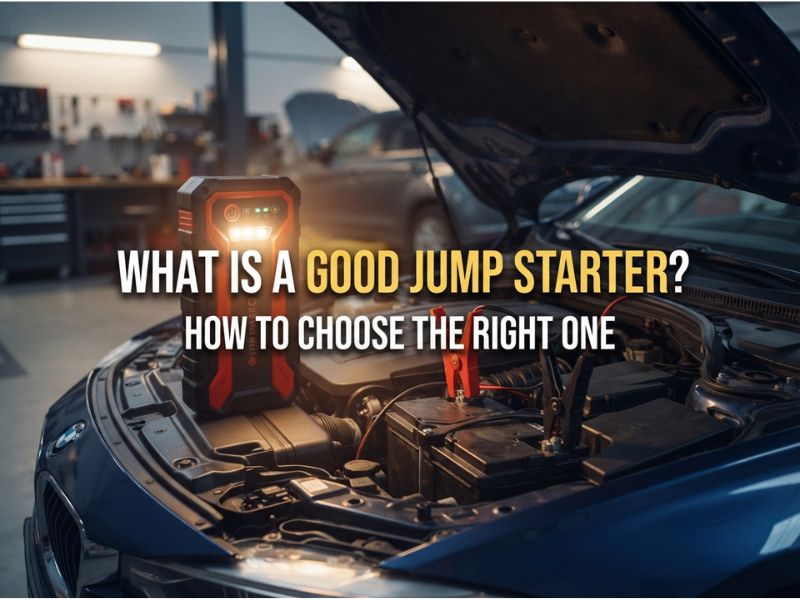
A good jump starter is a portable battery-powered device capable of supplying a high amount of current to help start a vehicle with a weak or discharged battery.
The right jump starter should meet your vehicle’s electrical and engine requirements while providing enough reserve capacity for emergency use.
Several characteristics separate a good jump starter from a poor one:
- Sufficient starting current for your engine
- Compatibility with your vehicle’s engine size
- Reliable jumper clamps and cables
- Reverse-polarity protection
- Spark-proof or short-circuit protection
- A durable battery pack
- A clear battery-level indicator
- Convenient charging options
- A design suitable for storage in your vehicle
The most important factor is compatibility. A powerful jump starter is not necessarily a good choice if it is poorly suited to your vehicle.
How Much Power Should a Good Jump Starter Have?
The amount of power you need depends primarily on the vehicle’s engine and battery requirements.
Manufacturers commonly advertise jump starters using peak amps and sometimes starting amps or similar ratings. Peak amperage can indicate the maximum current the unit may deliver under specific conditions, but it should not be the only specification you consider.
For a small gasoline-powered car, a compact jump starter may provide sufficient starting capability. Larger gasoline engines, diesel engines, trucks, and SUVs generally require a more powerful model.
As a general guideline:
| Vehicle Type | Typical Jump Starter Class |
| Small 4-cylinder gasoline car | Compact |
| Mid-size sedan/SUV | Medium-duty |
| Large gasoline V6/V8 | High-output |
| Pickup truck | High-output |
| Diesel truck/SUV | Heavy-duty |
| Commercial/heavy-duty vehicle | Specialized heavy-duty unit |
Always check the manufacturer’s stated gasoline and diesel engine-size compatibility before purchasing.
Peak Amps vs. Starting Amps
One of the most confusing parts of shopping for a jump starter is understanding amperage ratings.
Peak amps represent a maximum current figure under particular conditions. It can be useful when comparing products from the same manufacturer, but peak amperage alone does not tell you exactly how well a jump starter will perform in every real-world situation.
Starting amps or similar operating-current ratings can provide additional information about the unit’s practical starting capability.
The quality of the battery cells, internal electronics, cables, clamps, temperature, and condition of the vehicle battery can all affect actual performance.
For that reason, don’t automatically assume that a 4,000-amp jump starter will always perform better than a reputable 2,000-amp model.
What Size Jump Starter Do You Need?
Choosing the correct size starts with identifying your vehicle.
Check:
Engine type: Gasoline and diesel engines have different starting requirements.
Engine displacement: Larger engines generally require more starting power.
Vehicle type: A compact sedan typically has different requirements from a full-size pickup.
Battery condition: A completely dead or severely damaged battery can be more difficult to start than one that is simply weak.
Manufacturer rating: The jump starter manufacturer should specify the engine sizes and vehicle types supported by the unit.
If you drive a typical four-cylinder gasoline vehicle, you usually don’t need the largest jump starter available.
If you own a large V8, diesel pickup, or work truck, choose a model specifically rated for that application.
What Makes a Jump Starter Good for a Car?
For a typical car, a good jump starter should balance power, portability, reliability, and safety.
A compact lithium jump starter can be particularly convenient because it takes up little space and can remain in the glove box, trunk, or emergency kit.
Look for:
- Adequate amperage for your engine
- Quality jumper clamps
- Reverse-polarity protection
- Short-circuit protection
- A clear charge indicator
- USB charging
- A durable carrying case
- A built-in flashlight
You don’t necessarily need a massive heavy-duty jump starter for an ordinary four-cylinder sedan.
What Makes a Good Jump Starter for an SUV or Truck?
SUVs and trucks often have larger engines and batteries than compact cars, so choosing a higher-output model can provide additional starting capability.
A good truck jump starter should have sufficient cold-cranking capability for the application and should be explicitly rated for the engine size.
For a large gasoline V8 or diesel engine, consider a heavy-duty jump starter rather than a small emergency unit intended for compact cars.
Cable length and clamp size can also become more important on larger vehicles because the battery may be positioned farther from convenient access points.
What Makes a Good Jump Starter for a Diesel Engine?
Diesel engines can require substantially more starting power than many gasoline engines, particularly in cold weather.
If you have a diesel pickup, SUV, van, or commercial vehicle, look for a jump starter specifically rated for diesel engines.
Pay close attention to the manufacturer’s recommended diesel engine displacement rather than relying only on a peak-amp number.
A jump starter that is adequate for a 3.0-liter gasoline engine, for example, should not automatically be assumed to be suitable for a larger diesel engine.
For diesel vehicles, choosing a unit with additional power capacity can provide a useful margin when temperatures are low or the battery is heavily discharged.
Lithium-Ion vs. Lead-Acid Jump Starters
Modern portable jump starters are commonly based on lithium-ion battery technology, although larger traditional units can use lead-acid batteries.
Lithium Jump Starters
Lithium jump starters are popular because they are:
- Compact
- Lightweight
- Portable
- Relatively easy to store
- Capable of providing high current from a small package
They can also include USB outputs for charging phones and other electronic devices.
Lead-Acid Jump Starters
Traditional lead-acid jump starters are generally larger and heavier.
Their advantages can include substantial battery capacity and rugged designs, but they are less convenient to carry than compact lithium units.
For most everyday drivers, a reputable lithium jump starter is likely to be the more convenient option.
Why Safety Features Matter
A good jump starter should make it difficult to connect the unit incorrectly.
One of the most useful features is reverse-polarity protection.
If the positive and negative clamps are accidentally connected to the wrong terminals, the jump starter can detect the incorrect connection and prevent or limit the electrical output.
Other useful protections can include:
- Short-circuit protection
- Over-current protection
- Over-voltage protection
- Over-temperature protection
- Reverse-connection protection
- Spark-proof technology
These features don’t eliminate the need to connect the clamps correctly, but they can reduce the consequences of common mistakes.
What Are Good Jump Starter Clamps?
The clamps are one of the most important physical components of a jump starter.
Good clamps should provide a secure grip on the battery terminals and have sufficiently thick cables to handle the required current.
Look for clamps that are:
Strong: They should stay firmly attached to the terminals.
Well insulated: The handles should help prevent accidental contact between conductive parts.
Adequately sized: Larger battery terminals and heavy-duty applications may benefit from larger clamps.
Durable: The cables and clamp connections should withstand repeated use and storage.
A jump starter with impressive electronic specifications is not very useful if its clamps are poorly made.
Does Battery Capacity Matter in a Jump Starter?
Yes. Battery capacity matters because it determines how much energy the jump starter stores.
Capacity may be listed using different specifications depending on the manufacturer, including milliamp-hours (mAh) or watt-hours (Wh).
A higher capacity can potentially provide more available energy, but capacity should not be confused with starting current.
A jump starter needs both:
- Enough stored energy
- The ability to deliver high current when starting the engine
Therefore, don’t choose a jump starter solely because it has the largest mAh number.
Should a Good Jump Starter Have USB-C?
USB-C is a useful feature, particularly on newer portable jump starters.
Depending on the model, USB-C can be used to recharge the jump starter and may also allow the device to charge phones, tablets, or other electronics.
Some models support faster charging through compatible USB-C power sources.
If you’re buying a new jump starter, USB-C charging can make the unit more convenient because you may already have compatible chargers and cables at home or in your vehicle.
Is a Built-In Flashlight Useful?
A built-in flashlight is not essential to the jump-starting function, but it can be extremely useful during an emergency.
Vehicle batteries often fail at inconvenient times, including at night or in poorly lit parking areas.
A jump starter with an integrated LED light can help you:
- Locate the battery
- Identify the positive and negative terminals
- Attach the clamps
- Inspect the engine compartment
Some models also include flashing or emergency-light modes.
It’s a secondary feature, but one that can add practical value to an emergency kit.
How Long Should a Good Jump Starter Hold a Charge?
A good jump starter should retain enough charge during storage to remain useful when you need it.
However, all rechargeable batteries gradually lose charge over time.
For this reason, don’t put a jump starter in your trunk and forget about it for years.
Check the battery indicator periodically and recharge the unit according to the manufacturer’s storage recommendations.
Temperature also matters. Extreme heat inside a vehicle can accelerate battery aging, while very cold conditions can temporarily reduce battery performance.
Can a Jump Starter Start a Completely Dead Battery?
A jump starter can sometimes start a vehicle when the battery is severely discharged, but there are limits.
A jump starter provides electrical power to assist the vehicle’s starting system. It does not repair a failed battery.
If the battery has an internal short, damaged cells, severe corrosion, or another mechanical/electrical problem, a jump starter may not be able to start the vehicle.
Some modern jump starters also have a manual override or boost mode for batteries whose voltage has fallen extremely low. This feature should only be used according to the manufacturer’s instructions because it may disable some automatic safety protections.
Can a Good Jump Starter Recharge a Car Battery?
A jump starter and a battery charger have different purposes.
A jump starter is designed to provide a large amount of current for a short period to help start an engine.
A car battery charger is designed to replenish the battery over a longer period using controlled charging current.
Some jump starters may include limited battery-charging functionality, but you should not assume that a jump starter can fully recharge a vehicle battery.
If the vehicle battery is repeatedly going flat, the underlying issue should also be investigated. Possible causes include an aging battery, alternator problems, parasitic electrical drain, or excessive accessory use.
Portable vs. Heavy-Duty Jump Starters
Your intended use should determine the type you buy.
Portable Jump Starter
A portable model is ideal for drivers who want an emergency device that can easily fit in a vehicle.
Advantages include:
- Small size
- Low weight
- Easy storage
- USB charging
- Built-in electronics
- Convenient emergency features
These models are particularly suitable for everyday cars and smaller SUVs when properly rated.
Heavy-Duty Jump Starter
A heavy-duty model is more appropriate for larger vehicles, diesel engines, commercial applications, or frequent professional use.
They generally provide larger cables, clamps, batteries, and starting capability.
The trade-off is increased size and weight.
What Should You Avoid in a Jump Starter?
Not every jump starter with a large number printed on the box is a good purchase.
Be cautious about models that:
- Make unrealistic amperage claims
- Don’t specify engine compatibility
- Have poor-quality clamps
- Lack basic safety protections
- Provide little information about the battery
- Have unclear charging instructions
- Don’t provide meaningful warranty or manufacturer support
An extremely cheap model can look attractive until you actually need it during an emergency.
For an emergency device, reliability is more important than a flashy specification.
Best Features to Look for in a Good Jump Starter
If you’re comparing several models, use this checklist:
| Feature | Why It Matters |
| Engine compatibility | Ensures adequate starting capability |
| Peak/start current | Indicates available starting power |
| Battery capacity | Determines stored energy |
| Reverse-polarity protection | Helps prevent connection mistakes |
| Short-circuit protection | Adds electrical safety |
| Quality clamps | Provides a reliable connection |
| USB-C charging | Convenient modern charging |
| Battery indicator | Shows remaining charge |
| LED flashlight | Useful during nighttime emergencies |
| Durable housing | Helps withstand vehicle storage |
| Warranty | Provides additional purchase protection |
How to Choose a Good Jump Starter
The easiest way to choose the right model is to follow a few steps.
1. Identify Your Vehicle
Find your vehicle’s engine size and determine whether it uses gasoline or diesel.
2. Check the Manufacturer’s Rating
Compare your vehicle with the jump starter’s stated engine compatibility.
3. Choose Enough Power
Don’t choose a model that is barely rated for your vehicle. Additional capacity can provide a useful margin, particularly for larger engines and cold conditions.
4. Prioritize Safety
Look for reverse-polarity, short-circuit, over-current, and over-temperature protection.
5. Check the Clamps
Make sure the cables and clamps appear suitable for your vehicle.
6. Consider Portability
If you want to keep the device in your car permanently, a compact lithium model may be preferable.
7. Check Charging Options
USB-C or another convenient charging method can make routine maintenance easier.
8. Consider Warranty and Support
A jump starter is an emergency product. Manufacturer support can matter if the unit fails when you need it.
How to Maintain a Jump Starter
Even a high-quality jump starter won’t be useful if its battery is empty when your car breaks down.
Follow these maintenance practices:
Keep it charged: Check its charge level periodically.
Store it properly: Follow the manufacturer’s recommended storage temperature.
Protect it from moisture: Keep the unit dry.
Inspect the cables: Look for cuts, exposed wires, damaged insulation, or loose connections.
Check the clamps: Make sure the clamps remain clean and undamaged.
Recharge after use: If you use the jump starter to start a vehicle, recharge it afterward according to the manufacturer’s instructions.
Regular maintenance takes only a few minutes but can make a major difference during an emergency.
Frequently Asked Questions
What is a good jump starter for a regular car?
A compact lithium jump starter with adequate engine compatibility, reliable clamps, and safety features is generally a good choice for a regular gasoline-powered car. Choose the model based on your engine size rather than simply selecting the highest advertised amp rating.
Is a 1,000-amp jump starter enough?
A 1,000-amp jump starter can be suitable for some smaller gasoline engines, but suitability depends on the manufacturer’s engine-size rating and the vehicle’s specific requirements. Don’t use the amp number alone to determine compatibility.
Is a 2,000-amp jump starter better?
A 2,000-amp model may provide greater starting capability, but higher advertised peak amperage does not automatically mean better overall quality. Battery quality, safety electronics, clamps, cables, and manufacturer specifications are also important.
What is the best jump starter for a truck?
For a truck, choose a jump starter specifically rated for the truck’s engine size and fuel type. Larger gasoline engines and diesel trucks generally require higher-output units than compact cars.
What is the best jump starter for a diesel?
A good diesel jump starter should be specifically rated for the engine’s displacement and diesel applications. Diesel engines can require substantial starting power, especially in cold weather.
Should I buy a lithium jump starter?
For most everyday drivers, a lithium jump starter is a practical choice because it is compact, lightweight, and capable of delivering high starting current. Choose a reputable model with appropriate safety protections.
How often should I charge my jump starter?
Follow the manufacturer’s storage and charging recommendations. Check the charge level periodically rather than assuming the device will remain fully charged indefinitely.
Can I keep a jump starter in my car?
Yes, many portable jump starters are designed for vehicle storage. However, follow the manufacturer’s recommended temperature limits because prolonged exposure to extreme heat can accelerate battery degradation.
Final Answer: What Is a Good Jump Starter?
So, what is a good jump starter? It is a model that provides enough starting power for your vehicle, has dependable clamps and cables, includes essential safety protections, and can reliably hold a charge while stored in your vehicle.
For a small gasoline car, a compact lithium jump starter may be all you need. Larger SUVs, trucks, and diesel vehicles generally require a higher-output model specifically rated for their engine size.
When choosing one, don’t focus only on the advertised peak amps. Look at engine compatibility, battery capacity, safety features, clamp quality, charging options, portability, and manufacturer support.
The best jump starter is ultimately the one that is properly matched to your vehicle and remains charged and ready when you actually need it.