If you are wondering, can I charge a jump starter with a battery charger, the answer is usually no—not unless the jump starter manufacturer specifically says that it is compatible. Most modern portable jump starters contain a built-in lithium-ion battery, and they are designed to be recharged through a specific USB port, AC adapter, or manufacturer-supplied charging cable.
A traditional automotive battery charger is designed primarily for 12-volt lead-acid car batteries, not the internal battery pack inside a portable jump starter. Connecting the wrong charger can cause overcharging, overheating, battery damage, or even a safety hazard.
The safest approach is to use the charging method specified in the jump starter’s owner’s manual.
Can I Charge a Jump Starter With a Battery Charger?
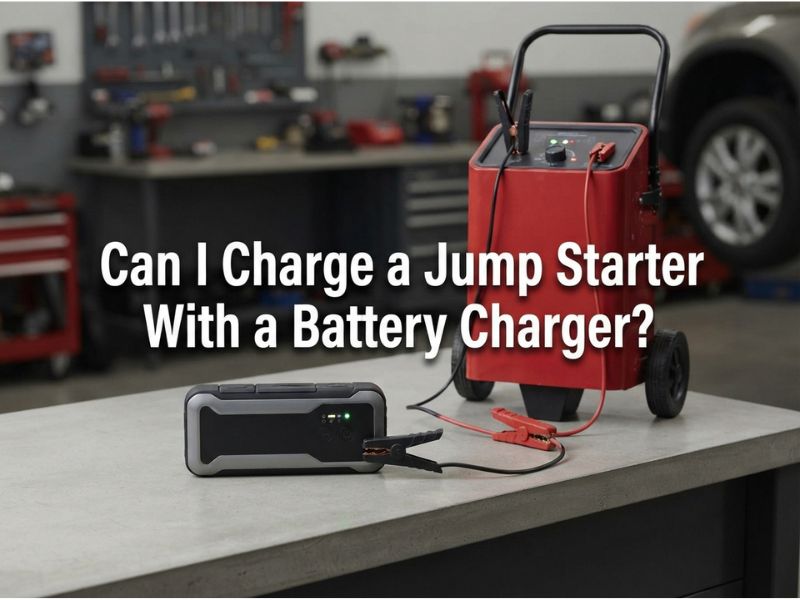
In most cases, you should not charge a jump starter with a standard car battery charger. A portable jump starter is a separate electronic device with its own internal battery management system (BMS) and charging circuitry.
A conventional battery charger connects directly to a vehicle battery and regulates charging according to the characteristics of that battery. A jump starter, however, normally has an internal charging circuit that expects power from a compatible input.
For example, a jump starter may have one of these charging methods:
- USB-C input
- Micro-USB input
- 12V DC charging input
- Dedicated AC wall charger
- Manufacturer-specific charging adapter
If the manufacturer provides a dedicated charging port, use that port rather than connecting a battery charger directly to the jump starter’s clamps.
Why a Regular Battery Charger Is Different
A typical 12V battery charger is designed to charge a vehicle’s lead-acid, AGM, or similar battery. It may provide a charging voltage and current that are not appropriate for the internal lithium battery used by a portable jump starter.
A lithium battery requires carefully controlled voltage, current, and charging stages. The jump starter’s internal charging electronics are responsible for providing this control.
Bypassing those electronics can damage the battery pack or charging system.
What Happens If You Connect a Battery Charger to a Jump Starter?
The result depends on the design of the jump starter and the type of charger.
If you connect a conventional charger to the jump starter’s vehicle-starting clamps, several problems can occur. The charger may not recognize the jump starter as a normal automotive battery, and the internal electronics may not be designed to accept charging power through the clamps.
Potential problems include:
Overheating: Excessive current can generate heat inside the battery or electronic components.
Battery damage: The internal battery cells can be damaged if they receive an unsuitable charging voltage or current.
Charging failure: Some jump starters have protection circuits that simply prevent charging when power is applied incorrectly.
Electronic damage: Applying voltage to the wrong terminals can damage the jump starter’s control circuitry.
Fire or thermal event: Damaged or improperly charged lithium batteries can present a serious safety risk.
Because of these risks, do not experiment with different charging methods just because the connector appears to fit.
How Should You Charge a Portable Jump Starter?
The correct method depends on the model, but the general process is straightforward.
First, check the owner’s manual or the charging instructions printed on the jump starter. Identify the designated charging input.
Connect the supplied charging cable or approved adapter to the jump starter’s charging port. Then connect the other end to the appropriate power source.
Some models can be charged from a wall outlet using an AC adapter. Others can use a USB-C charger, USB power adapter, or a vehicle’s 12V outlet.
Allow the jump starter to charge until its battery indicator shows that it is fully charged.
Avoid leaving the device connected indefinitely unless the manufacturer specifically states that it is safe to do so.
Can You Use a Car Battery Charger to Charge a Jump Starter Battery?
Generally, a car battery charger should not be used to directly charge the internal battery of a portable jump starter.
A car battery charger is intended to work with a compatible automotive battery. A jump starter contains a battery pack plus electronic components such as a battery management system, charging controller, protection circuit, and voltage regulation circuitry.
These systems are designed to work together.
If your jump starter has a dedicated 12V charging input and the manufacturer specifically states that a certain automotive charger can be used with it, follow those instructions. Otherwise, use the original or manufacturer-approved charger.
Can You Charge a Jump Starter Through the Jumper Cables?
Usually, no.
The jumper cables or clamps on a portable jump starter are primarily designed to deliver high current from the jump starter to a vehicle battery or starter circuit during an emergency start.
They are not necessarily designed to receive charging current.
This distinction is important because the charging port and jumper clamps can serve completely different electrical functions.
For most portable jump starters, charge the unit through its designated charging port, not through the red and black jumper clamps.
Can You Charge a Jump Starter With a 12V Charger?
It depends on what the manufacturer means by a “12V charger.”
A 12V power source is not automatically suitable for every 12V device. The actual input voltage, current, connector polarity, charging circuit, and battery chemistry all matter.
For example, a jump starter might accept power from a vehicle’s 12V accessory outlet through a specific charging cable. That does not mean you can connect a generic 12V battery charger directly to the jump starter.
Always check the device’s specified input requirements before using an alternative charger.
What Charger Should You Use for a Lithium Jump Starter?
For a lithium-ion or lithium-polymer jump starter, use the manufacturer-approved charging adapter or cable whenever possible.
Many newer jump starters use USB-C charging, while older models may use Micro-USB or a dedicated DC input.
The charger should match the jump starter’s specified requirements for:
- Input voltage
- Charging current
- Connector type
- Polarity, when applicable
- Supported charging protocol
- Battery chemistry
If the manufacturer specifies a particular USB-C power rating, use a compatible charger rather than assuming every USB-C charger will provide the same charging performance.
Can You Charge a Jump Starter With a USB Charger?
Many modern portable jump starters can be charged with a USB charger, particularly models equipped with USB-C charging.
However, USB-C compatibility does not necessarily mean every USB charger will charge the device at the same speed.
Some jump starters support standard USB charging, while others support higher-power charging technologies.
Check the manufacturer’s specifications to determine the recommended USB charger and charging power.
One advantage of USB charging is convenience. You may be able to recharge the jump starter from a wall adapter, laptop power source, power bank, or vehicle USB outlet, depending on the model.
How Long Does It Take to Charge a Jump Starter?
Charging time varies considerably between models.
A small portable jump starter may take several hours to recharge, while a larger unit with a higher-capacity battery can take longer. Fast-charging models may require significantly less time when paired with a compatible power adapter.
Charging time depends on:
Battery capacity: Larger battery packs generally require more energy to reach full charge.
Charger output: A compatible higher-output charger can reduce charging time when the jump starter supports it.
Battery condition: An aging or damaged battery may charge differently from a healthy battery.
Charging technology: Some models include fast-charging systems designed specifically for their internal battery.
Instead of relying on a generic charging time, follow the manufacturer’s stated charging instructions.
How Do You Know When a Jump Starter Is Fully Charged?
Most portable jump starters have a battery level indicator.
Depending on the model, the indicator may use:
- LED lights
- A percentage display
- A digital screen
- A charging animation
- A full-battery symbol
A four-light system, for example, may show progressively higher charge levels as the battery fills.
Do not assume that an indicator showing power means the battery is fully charged. Check the manufacturer’s instructions to understand what each indicator means.
Can a Jump Starter Be Overcharged?
Modern jump starters normally include overcharge protection as part of their battery management system. This helps control charging once the battery reaches its target voltage.
However, built-in protection does not mean you should use an incompatible charger or ignore the manufacturer’s charging instructions.
A damaged charger, damaged battery, faulty charging circuit, or extreme temperature can create unsafe conditions.
For best results, use the recommended charging equipment and inspect the jump starter before charging it.
If the unit becomes unusually hot, swells, smells unusual, leaks, or behaves abnormally while charging, disconnect it from power and stop using it.
Is It Safe to Leave a Jump Starter Charging Overnight?
Whether you can leave a jump starter charging overnight depends on the manufacturer’s instructions.
Some modern devices are designed with charging protection that makes normal unattended charging less problematic. However, it is still better to follow the manufacturer’s recommended charging procedure.
For additional safety, charge the unit on a dry, nonflammable surface away from excessive heat and moisture. Do not charge a visibly damaged or swollen battery.
If the owner’s manual specifically recommends disconnecting the charger after reaching full capacity, follow that instruction.
What If Your Jump Starter Will Not Charge?
If your jump starter does not charge, do not immediately try a car battery charger.
Start with the basics:
- Check that the charging cable is properly connected.
- Try the manufacturer’s recommended power adapter.
- Inspect the charging port for dirt or physical damage.
- Check whether the charging indicator turns on.
- Allow the device to cool if it has recently been used.
- Check the owner’s manual for a reset or recovery procedure.
- Try a different compatible power source if the manufacturer allows it.
If the jump starter still refuses to charge, the internal battery, charging circuit, cable, or power adapter may be faulty.
Opening the unit and attempting to charge the battery cells directly is not recommended unless you are qualified to work with lithium battery systems.
Can a Jump Starter Charge a Car Battery?
A jump starter and a battery charger perform different jobs.
A jump starter is designed to provide a large amount of electrical current for a short period to help start a vehicle with a weak or discharged battery.
A battery charger is designed to provide a controlled charging current over a longer period to restore the vehicle battery’s charge.
Some jump starters also include a charging or maintenance function, but you should not assume that every portable jump starter can fully recharge a car battery.
If your goal is to restore a deeply discharged vehicle battery, a proper automotive battery charger is generally the more appropriate tool.
Jump Starter vs. Battery Charger
The two devices can look similar in purpose, but their electrical functions are different.
| Feature | Jump Starter | Battery Charger |
| Main purpose | Emergency engine starting | Recharging a vehicle battery |
| Typical use | Short, high-current output | Longer controlled charging |
| Internal battery | Usually yes | Usually no |
| Connects to car battery | Yes | Yes |
| Designed to recharge itself | Yes | Not applicable |
| Directly interchangeable | No | No |
A jump starter stores energy inside its own battery. A battery charger normally receives electricity from an external power source and transfers it into a vehicle battery.
That is why a conventional battery charger should not automatically be treated as a charger for the jump starter itself.
Important Safety Tips When Charging a Jump Starter
Follow these precautions whenever you recharge a portable jump starter:
- Use the recommended charging cable and adapter.
- Never intentionally charge the unit through its jumper clamps unless the manufacturer specifically permits it.
- Do not use a charger with an unknown voltage or current rating.
- Keep the device away from water and excessive heat.
- Do not charge a jump starter that is swollen, cracked, leaking, or visibly damaged.
- Stop charging if the device becomes unusually hot or produces an unusual smell.
- Keep lithium-powered equipment away from open flames and other ignition sources.
- Store the jump starter according to the manufacturer’s temperature and storage recommendations.
Proper charging is especially important for lithium-based jump starters because their battery cells require controlled charging.
Frequently Asked Questions
Can I use a regular battery charger on a jump starter?
Usually, no. A regular automotive battery charger is designed to charge a vehicle battery, not the internal battery pack of a portable jump starter. Use the charging method specified by the jump starter manufacturer.
Can I charge a jump starter from a car?
Some jump starters can be recharged from a vehicle’s 12V accessory outlet using the supplied charging cable. Check the manufacturer’s specifications before doing this.
Can I charge a jump starter with a USB charger?
Yes, if the jump starter is designed to accept USB charging. Use a compatible USB charger and cable that meet the manufacturer’s input requirements.
Can I charge a jump starter through the clamps?
Generally, no. The clamps are normally designed to deliver starting current to a vehicle, not to recharge the jump starter. Use its dedicated charging input instead.
Can I use a 12V battery charger on a lithium jump starter?
Not unless the manufacturer specifically states that the charger and charging method are compatible. A generic 12V battery charger may not provide the correct charging characteristics for a lithium battery pack.
How often should I charge my jump starter?
Check the manufacturer’s storage recommendations. If the jump starter is stored for long periods, periodically checking and maintaining its charge can help ensure it is ready for an emergency.
Final Answer: Can I Charge a Jump Starter With a Battery Charger?
So, can I charge a jump starter with a battery charger? In most cases, you should not use a conventional automotive battery charger to charge a portable jump starter. A jump starter has its own internal battery and charging circuitry, and it should normally be charged through its designated USB, DC, or manufacturer-supplied charging port.
A standard car battery charger is designed for charging compatible vehicle batteries and is not automatically suitable for a jump starter’s internal battery. Using the wrong charging method can cause battery damage, overheating, charging failure, or a safety hazard.
The safest rule is simple: use the charger and charging method specified by the jump starter manufacturer. If you are unsure about compatibility, check the owner’s manual or the charging specifications printed on the device before connecting any charger.