As of October 2026, Oklahoma generally requires at least 25% visible light transmission (VLT) on a vehicle’s front side windows, rear side windows, and rear window. Tint on the windshield is restricted to the upper portion: it must not extend below the AS-1 line or more than five inches from the top, whichever is closer to the top. Side and rear window tint must also have no more than 25% luminous reflectance.
These limits come from Oklahoma Statutes, Title 47, Section 12-422. A 25% VLT reading means the finished glass-and-film combination allows one-quarter of visible light through. A film labeled 25% may make already-tinted factory glass darker than the legal minimum.
There are narrow exceptions, including certain vehicles manufactured before the 1996 model year, eligible buses and taxicabs, and approved medical exemptions. Generic online tint charts sometimes describe different rules for SUVs, so checking the actual statute matters.
In this article, I cover Oklahoma’s legal tint limits for every window, windshield strip measurements, reflectivity and color restrictions, exceptions, medical exemption procedures, penalties, and how to test your car’s finished tint before driving.
What Is the Legal Window Tint in Oklahoma? 2026 Limits
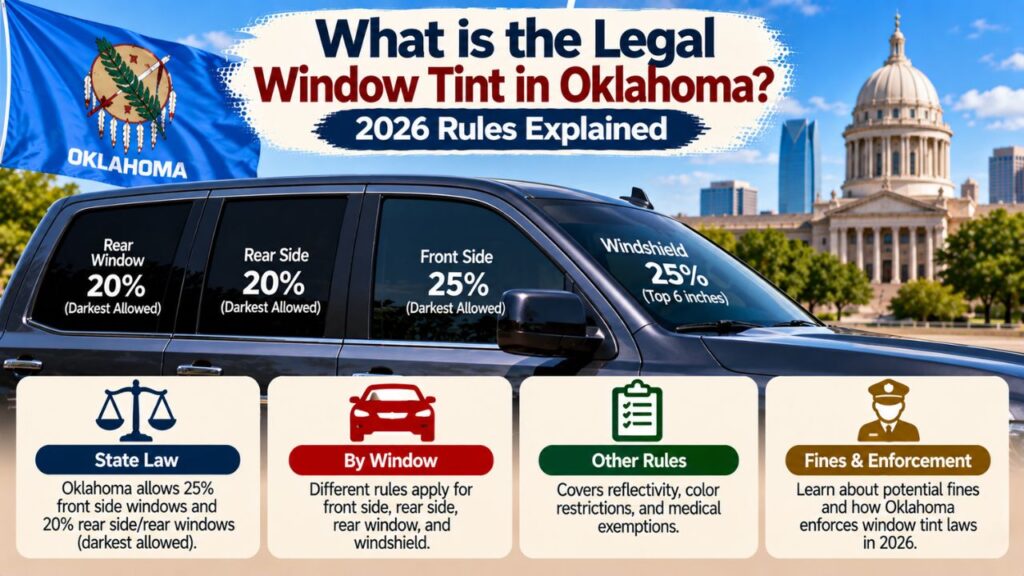
Oklahoma’s window tint requirements are established under Title 47, Section 12-422 of the Oklahoma Statutes.
The law permits qualifying window film on side and rear glass when the completed window meets specified light-transmission and reflectivity requirements.
Oklahoma Legal Window Tint Percentage Chart
| Window Location | Legal Tint Requirement |
| Front windshield | Tint only above the AS-1 line or within the top 5 inches, whichever is closer to the top |
| Front driver-side window | Minimum 25% VLT |
| Front passenger-side window | Minimum 25% VLT |
| Rear side windows | Minimum 25% VLT, unless a specific exception applies |
| Rear windshield | Minimum 25% VLT, unless a specific exception applies |
| Side and rear window reflectivity | Maximum 25% luminous reflectance |
The limits above describe the general rules for ordinary registered motor vehicles.
Some specifically identified vehicle categories and older vehicles qualify for different treatment.
The Oklahoma window tint statute, 47 O.S. §12-422, establishes the 25% light-transmission threshold, 25% reflectance limit, windshield restrictions, and statutory exceptions.
Front Side Window Tint Law
The driver-side and front passenger-side windows must transmit at least 25% of visible light after the applicable film and glazing are considered together.
That means:
- 50% VLT is above the legal minimum.
- 35% VLT is above the legal minimum.
- 25% VLT meets the stated minimum.
- 20% VLT falls below the general legal minimum.
- 5% VLT falls below the general legal minimum.
These comparisons refer to the finished window’s measured VLT, not simply the number printed on a roll of tint film.
A film labeled 35% may produce a finished window reading below 25% when applied over existing factory glass.
Always check the combined result.
Rear Side Window Tint Law
The general statutory rule also applies to rear side windows.
They must transmit at least 25% of visible light unless a specific exception applies.
Some online tint charts claim that SUVs, trucks, and vans can have unrestricted rear tint in Oklahoma.
However, the wording of Section 12-422 does not establish a blanket exemption for ordinary SUVs or pickup trucks.
Instead, it identifies particular exceptions, including qualifying older vehicles and certain licensed buses and taxicabs.
For an ordinary modern vehicle, follow the 25% threshold unless a competent Oklahoma authority confirms that a specific exception applies.
Rear Windshield Tint Law
The general minimum light transmission for the rear windshield is also 25%.
A qualifying medical exemption or another statutory exception may change that requirement.
The rear window’s final VLT should be measured after the film is applied.
Do not assume that the rear windshield is exempt simply because the vehicle has two outside mirrors.
Oklahoma’s specific older-vehicle exception has additional conditions.
Key Takeaway: For a conventional modern passenger vehicle in Oklahoma, the general rule is at least 25% VLT on the front side, rear side, and rear windows, with no more than 25% luminous reflectance.
What Is the Legal Windshield Tint in Oklahoma?
Oklahoma restricts aftermarket windshield tint to a narrow area at the top of the glass.
Under the statute, the film may not extend below:
- The manufacturer’s AS-1 line, or
- Five inches from the top of the windshield,
whichever is closer to the top edge.
This means the permitted strip is not automatically five inches deep on every windshield.
What Is the AS-1 Line?
The AS-1 line is a marking found near the upper portion of certain automotive windshields.
It identifies a boundary associated with the upper area where particular windshield treatments may be permitted under applicable rules.
Depending on the windshield, the marking may appear as “AS-1” or be indicated by the manufacturer’s glazing information.
If the AS-1 line is less than five inches from the top, that line establishes the lower boundary for the permitted strip.
If the line is farther than five inches from the top, the statutory five-inch limit controls.
Example of a Legal Windshield Sun Strip
Suppose the AS-1 line is located four inches below the top edge.
The aftermarket tint strip must not extend below that four-inch boundary.
If the AS-1 line is located six inches below the top edge, the film may extend no more than five inches from the top.
The permitted area is therefore whichever measurement allows the shorter strip.
Can You Tint the Entire Windshield in Oklahoma?
Under the ordinary statutory rule, aftermarket tint that alters the color or reduces light transmission is not generally permitted across the full windshield.
That includes very light films marketed primarily for infrared heat rejection.
A nearly transparent appearance does not automatically make full-windshield film legal.
Medical exemptions are a separate process and should never be assumed to authorize a windshield installation without explicit approval.
What Colors Are Allowed on the Windshield Strip?
Oklahoma expressly prohibits red and amber film in the permitted upper windshield area.
The strip must also comply with the law’s restrictions on obstructing the driver’s view.
Mirrored or mirror-like finishes are not included among the permitted sunscreening materials described in the statute.
How Does Oklahoma’s 25% Window Tint Law Work?
The 25% requirement concerns Visible Light Transmission, commonly abbreviated VLT.
It measures how much visible light passes through a window.
A higher VLT means a lighter window.
A lower VLT means a darker window.
Understanding Window Tint Percentages
| VLT Percentage | Appearance | General Oklahoma Side/Rear Window Status |
| 70% | Very light | Meets the minimum |
| 50% | Light | Meets the minimum |
| 35% | Medium | Meets the minimum |
| 30% | Medium-dark | Meets the minimum |
| 25% | Dark | At the legal minimum |
| 20% | Very dark | Below the general minimum |
| 15% | Very dark | Requires a qualifying exception |
| 5% | Extremely dark | Below the general minimum |
These classifications assume the numbers represent actual measured VLT for the complete window assembly.
They do not automatically describe whether a film with that advertised shade will be legal after installation.
Is 25% Tint Legal in Oklahoma?
Yes, if the completed window measures at least 25% VLT, satisfies the reflectivity limit, and meets other applicable requirements.
However, selecting a film labeled 25% doesn’t guarantee that result.
Original automotive glass already absorbs or reflects some visible light.
Adding a film rated at 25% can reduce the finished transmission below 25%.
For that reason, installers often select film with a higher advertised VLT to provide a margin above the legal minimum.
Is 20% Tint Legal in Oklahoma?
For ordinary side and rear windows subject to the general rule, 20% VLT is below Oklahoma’s 25% minimum.
A legal exception may apply to certain vehicles or individuals with an approved medical exemption.
Without such an exception, don’t assume 20% tint is compliant.
Is 5% Tint Legal in Oklahoma?
A finished window measuring 5% VLT falls below Oklahoma’s general 25% requirement.
The statute’s special older-vehicle rear-window exception establishes a minimum of 10%, not 5%.
The medical exemption rule also establishes a minimum of 15% VLT.
Therefore, 5% tint should not be treated as an ordinary legal option for registered passenger vehicles under these provisions.
How Factory Glass Affects Legal Tint in Oklahoma
One of the most common mistakes is confusing the film’s advertised VLT with the final light transmission of the glass.
A vehicle window may already reduce visible light before any film is installed.
When aftermarket tint is added, the combined VLT becomes lower.
How to Calculate Combined Window Tint VLT
A simplified formula is:
Final VLT (%) = (Glass VLT × Film VLT) ÷ 100
For example:
- Original glass VLT: 70%
- Added film VLT: 35%
Final VLT:
70 × 35 ÷ 100 = 24.5%
The finished window would transmit approximately 24.5% of visible light.
That is slightly below Oklahoma’s general 25% minimum.
Combined VLT Examples
| Original Glass VLT | Film VLT | Estimated Final VLT | Meets 25% Minimum? |
| 80% | 50% | 40% | Yes |
| 75% | 50% | 37.5% | Yes |
| 75% | 35% | 26.25% | Yes, mathematically |
| 70% | 35% | 24.5% | No |
| 80% | 30% | 24% | No |
| 75% | 20% | 15% | No |
These figures use a simplified multiplication method.
Actual measurements may vary because of the properties of the glass, film, and testing equipment.
For legal compliance, rely on a suitable window tint meter rather than calculations alone.
Practical Tip: Avoid choosing a film that produces a theoretical reading barely above 25%. A reasonable margin can help account for actual glass transmission and measurement variation.
Does Oklahoma Have Different Tint Laws for SUVs and Trucks?
This is an area where online window tint information can be inconsistent.
Some commercial tint charts distinguish passenger sedans from SUVs, vans, and pickup trucks, suggesting that rear tint may be unrestricted on multipurpose vehicles.
However, Oklahoma’s published Section 12-422 states a general 25% transmission requirement for side and rear glass without creating a blanket exception based solely on an SUV or pickup-truck body style.
Legal Tint Comparison by Vehicle Type
| Vehicle Type | Front Side Windows | Rear Side Windows | Rear Window |
| Modern passenger sedan | 25% minimum | 25% minimum | 25% minimum |
| Modern SUV | 25% minimum | 25% general rule | 25% general rule |
| Modern pickup truck | 25% minimum | 25% general rule | 25% general rule |
| Modern passenger van | 25% minimum | 25% general rule | 25% general rule |
| Qualifying pre-1996 vehicle | 25% minimum | May qualify for 10% | May qualify for 10% |
| Qualifying licensed bus or taxicab | General rules apply to nonexempt windows | Special statutory exception | Special statutory exception |
The older-vehicle exception requires specified outside mirrors.
The bus and taxicab exception applies to windows behind the driver’s seat on vehicles licensed under the relevant statutory definitions.
Before applying darker film to a modern SUV, truck, or van, obtain confirmation from the relevant Oklahoma authority rather than relying exclusively on a generic online chart.
What Are Oklahoma’s Window Tint Reflectivity Rules?
Window tint darkness and reflectivity are different characteristics.
VLT measures how much visible light passes through the window.
Luminous reflectance measures how much light is reflected outward.
Under Oklahoma’s statute, qualifying side and rear window tint must have no more than 25% luminous reflectance.
Can You Have Reflective Window Tint?
A film with some reflectivity may satisfy the law if it remains within the permitted reflectance limit and meets the other statutory conditions.
However, the law’s definition of permitted sunscreening materials specifically excludes mirrored or mirror-like finishes.
A highly reflective film should not be assumed legal merely because its VLT is above 25%.
Ask the installer for the film’s reflectivity specifications.
Are Mirror Tints Legal in Oklahoma?
Mirrored or mirror-like finishes are excluded from the statutory description of qualifying glass-coating materials.
Therefore, highly mirrored automotive film should be avoided for a standard Oklahoma tint installation.
A film’s darkness and reflectivity must be evaluated separately.
A 35% VLT film could still present a compliance problem if its reflectivity is excessive.
Are Red or Amber Window Tints Legal?
Oklahoma specifically prohibits red and amber material in the permitted upper windshield strip.
The statute does not express that provision as a universal ban on those colors for every side or rear window.
However, other visibility and reflectivity requirements still apply.
For unusual colored films, confirm their legality with Oklahoma authorities before installation.
Does Oklahoma Allow Medical Exemptions for Darker Window Tint?
Yes. Oklahoma provides a medical exemption process for qualifying individuals who need protection from direct sunlight.
A medical diagnosis alone does not automatically authorize darker window tint.
The applicant must obtain the required approval.
Who Can Qualify for a Medical Tint Exemption?
The law permits consideration of an exemption for an individual with a documented medical reason to be shielded from direct sunlight.
The application must be supported by an appropriate licensed physician’s written attestation.
The exemption may apply to a vehicle owned by the individual or one in which the person is a habitual passenger.
Approval depends on the state’s requirements.
What Is the Darkest Tint Allowed With a Medical Exemption?
Under Oklahoma Administrative Code 670:15-13-5, the minimum permitted light transmission under the medical exemption process is 15% VLT.
An exemption permitting less than 20% VLT may result in a daylight-driving-only restriction or other appropriate driver-license limitations.
The rule does not authorize an exemption from the luminous reflectance limit.
Therefore, a medical exemption is not unrestricted permission to install any shade or reflective film.
How to Apply for a Medical Window Tint Exemption
The general application process involves:
- Obtaining the prescribed Oklahoma tinted-window exemption application.
- Completing the applicant and vehicle information.
- Having the required medical information completed by the appropriate licensed healthcare provider.
- Submitting the form to the designated state office.
- Receiving formal approval before relying on the exemption.
- Keeping the issued exemption documentation available while operating the vehicle.
The Oklahoma Department of Public Safety’s official tinted-window exemption application provides the application form and submission instructions.
The application identifies the Medical Standards Unit and provides the submission email address medicaldesk@dps.ok.gov.
Verify the latest submission instructions before applying.
Do You Need to Carry the Medical Exemption Letter?
Yes. Oklahoma’s medical exemption rules require the approved exemption letter to be presented upon request by law enforcement.
The letter identifies the approved vehicle and permitted tint percentage.
The exemption is not transferable to a different vehicle.
Do not assume an approval for side or rear windows automatically permits full-windshield tint.
Follow the specific conditions written in the state’s authorization.
Are There Other Exceptions to Oklahoma’s 25% Tint Law?
Yes. Section 12-422 includes several specific exceptions.
These should be interpreted narrowly rather than treated as general permission for darker tint.
Vehicles Manufactured Before the 1996 Model Year
Certain vehicles manufactured before the 1996 model year may have as little as 10% VLT on their rear side or rear windows.
However, the exception has requirements.
The vehicle must have outside mirrors on both the left and right sides, positioned to provide the driver with a view of the highway at least 200 feet behind the vehicle.
The 10% provision applies to the windows behind the driver and the rear window.
It does not establish a general 10% allowance for the front side windows.
Licensed Buses and Taxicabs
The statute contains an exception for windows behind the driver’s seat in certain vehicles licensed as buses or taxicabs.
The vehicle must fall within the applicable statutory definitions.
An ordinary SUV or privately owned van does not become exempt simply because it carries several passengers.
Law Enforcement and Other Special Vehicles
The statute also includes exemptions for certain government-owned law enforcement vehicles, implements of husbandry, and other specifically identified categories.
These exceptions do not apply automatically to privately owned passenger cars.
For unusual vehicle classifications, confirm the applicable requirements before installing film.
What Happens if Your Window Tint Is Too Dark in Oklahoma?
Driving with noncompliant window tint can result in a traffic violation.
Section 12-422 makes violations of its requirements misdemeanors, with penalties governed by Oklahoma’s motor vehicle penalty provisions.
The specific consequences can depend on the circumstances, enforcement process, and court.
Can You Get a Ticket for Illegal Tint?
Yes.
A law enforcement officer may identify a possible violation based on the window’s appearance or a light-transmission measurement.
A window tint meter can determine whether the completed glass meets the required VLT.
A driver may face a citation and associated costs when tint does not comply.
How Much Is an Oklahoma Window Tint Ticket?
Oklahoma’s general misdemeanor penalty provision, 47 O.S. §17-101, includes a fine range of 5–500 for applicable violations, along with other potential statutory penalties.
That range does not mean every window tint citation results in a $500 fine.
Actual fines, court costs, and case outcomes may vary.
Avoid relying on an unverified online claim that every first-time tint violation receives only a warning or a fixed low-cost ticket.
Can Illegal Tint Cause Problems During an Inspection?
Yes.
Service Oklahoma’s vehicle inspection checklist for driving tests includes compliance with Title 47’s windshield tint requirements.
Excessively tinted glass can also create enforcement problems outside a formal inspection.
Don’t assume a vehicle is compliant simply because it passed a previous inspection or has not yet received a citation.
What Should You Do After Receiving an Illegal Tint Citation?
If your vehicle has been cited:
- Review the alleged violation.
- Check the applicable court or citation instructions.
- Measure the affected window if the VLT is disputed.
- Keep any legitimate exemption documentation available.
- Arrange lawful film removal or replacement when necessary.
- Meet any stated court or compliance deadline.
Do not assume removing the tint automatically cancels a citation.
Follow the actual instructions provided by the issuing authority or court.
How to Check Whether Your Window Tint Is Legal in Oklahoma
The best way to verify tint darkness is to measure the finished glass using a suitable VLT meter.
An advertised film percentage is not enough.
Step 1: Identify the Windows to Be Tested
Check the windows where aftermarket tint is installed.
For a standard modern passenger vehicle, focus on:
- Driver-side front window
- Passenger-side front window
- Rear side windows
- Rear windshield
Also inspect the windshield if any aftermarket film has been installed.
Step 2: Measure Visible Light Transmission
Use a calibrated tint meter compatible with the window’s glass construction.
Follow the equipment manufacturer’s instructions.
Some meters require access to both sides of the glass, while others use different measurement methods.
Take readings from suitable portions of the glass away from obstructions or damaged film.
Step 3: Compare the Results With the Legal Limit
For ordinary side and rear windows, compare the measured VLT against the 25% minimum.
A reading below 25% indicates that the window falls below the general threshold unless a valid exception applies.
Remember that reflectivity is a separate requirement.
A VLT meter does not necessarily verify luminous reflectance.
Step 4: Check the Windshield Strip
Locate the windshield’s AS-1 line.
Measure downward from the top edge of the glass.
Verify that the tint does not extend farther than the shorter of the two permitted boundaries.
Check that the strip is not red or amber.
Step 5: Review Any Exemption Documentation
If a medical or other special exemption applies, confirm:
- The authorization is valid.
- The vehicle is the one identified.
- The permitted percentage matches the installed film.
- The applicable conditions are being followed.
Do not rely on an exemption issued for another person or vehicle.
How to Choose a Legal Window Tint Percentage in Oklahoma
The darkest permitted tint isn’t necessarily the best option for every vehicle.
A film that finishes slightly above 25% VLT may be lawful, but it can still make nighttime visibility less comfortable than a lighter film.
Is 35% Tint a Good Choice for Oklahoma?
A finished window measuring 35% VLT satisfies Oklahoma’s general 25% minimum.
It provides a noticeable tint without approaching the darkness of 20% or 5% film.
However, a film labeled 35% may produce a finished window below 25%.
Ask the installer to check the original glass and predict the combined VLT before application.
Is 50% Tint Legal in Oklahoma?
A finished 50% VLT window is above Oklahoma’s general minimum.
It provides a lighter appearance and allows more visible light through than 35% or 25% tint.
A high-performance ceramic film with a relatively light shade may still provide useful solar heat rejection.
That makes it worth considering for drivers who value outward visibility.
Can Ceramic Tint Be Illegal?
Yes.
Ceramic technology does not exempt a film from Oklahoma’s VLT, reflectivity, or windshield restrictions.
A ceramic film that leaves the finished window at 20% VLT generally does not meet the standard 25% minimum.
Likewise, a nearly clear ceramic film applied across a windshield can raise legal concerns despite its light appearance.
Choose the film based on legal specifications, not the ceramic label.
Should You Leave a Margin Above 25%?
Yes, this is a practical approach.
If a calculated combination is barely above 25%, actual measurements could reveal that it falls below the minimum.
Choosing a film that produces a comfortably higher finished VLT can reduce the risk of noncompliance.
For example, a suitable film producing 35%–50% final VLT may provide a useful combination of legal margin, visibility, and appearance.
The exact product should be selected after measuring the original glass.
What Must Oklahoma Window Tint Installers Provide?
Oklahoma law places obligations on businesses that sell or install regulated window tint products.
Under Section 12-422(G), a seller or installer must provide a written statement as part of the sale or installation contract.
The certification must state that:
- The product complies with Oklahoma’s light-transmission and reflectivity requirements.
- Installation on the driver’s or passenger’s side window may be illegal in some other states.
The statement must appear in bold-face type.
This requirement helps distinguish a properly documented installation from one supported only by verbal assurances.
Questions to Ask Before Paying for Window Tint
Before booking an installation, ask:
- What is the estimated final VLT of the finished window?
- Will the installer measure the factory glass before adding film?
- Does the film meet Oklahoma’s reflectivity requirements?
- Is the proposed windshield strip within the AS-1 or five-inch limit?
- Will the installer provide the required written compliance certification?
- What warranty and film specifications are included?
- Can the installer measure the finished window after installation?
If a shop offers 20% film on ordinary front side windows without discussing legal compliance, obtain clarification before proceeding.
Does a Tint Shop’s Guarantee Make Dark Tint Legal?
No.
An installer may provide a warranty against film defects or a statement about the product’s specifications.
However, a shop cannot override state law.
The actual finished window must meet the applicable requirements, regardless of the installer or film brand.
Common Mistakes That Make Window Tint Illegal in Oklahoma
Several avoidable errors lead to confusion about Oklahoma’s tint limits.
Choosing 25% Film Without Checking Factory Glass
The legal minimum applies to the completed window.
Adding 25% film over glass that already reduces visible light can produce an illegal final reading.
Assuming Rear Windows Have No Limits
Oklahoma’s published statute has a general 25% rule for side and rear glass.
It contains specific exceptions, but not a blanket exemption simply because a vehicle is an SUV.
Using a Five-Inch Windshield Strip Below the AS-1 Line
The legal boundary is whichever is closer to the top: the AS-1 line or five inches.
A five-inch strip may be too deep if the AS-1 line is higher.
Ignoring Reflectivity
Even when the VLT is acceptable, excessive reflectivity can make the installation noncompliant.
Assuming Medical Conditions Automatically Permit Dark Tint
A person must obtain the required exemption authorization.
A medical note by itself should not be treated as permission to ignore the standard rule.
Believing All 2026 Online Tint Charts Are Accurate
Commercial tint charts sometimes summarize laws differently or omit statutory exceptions.
For important legal decisions, consult the actual Oklahoma statute and applicable administrative rules.
Conclusion
So, what is the legal window tint in Oklahoma? Under the general rules in effect as of October 2026, front side, rear side, and rear windows must transmit at least 25% of visible light, while permitted side and rear tint must have no more than 25% luminous reflectance.
Windshield tint is restricted to the upper section above the AS-1 line or within five inches of the top, whichever allows the shorter strip.
Certain older vehicles, licensed buses and taxicabs, and approved medical exemptions receive special treatment under the statute.
The most important practical point is that Oklahoma’s 25% limit applies to the finished glass-and-film combination, not just the film’s advertised shade.
Before installing tint, measure the factory glass, select an appropriate film, verify reflectivity, and check that the installer provides the required documentation.
Following these steps can help you achieve the appearance and heat protection you want while keeping the installation within Oklahoma’s applicable requirements.
FAQs About What Is the Legal Window Tint in Oklahoma
What Is the Darkest Legal Tint in Oklahoma?
For ordinary side and rear windows under Oklahoma’s general rule, the minimum is 25% VLT. The finished glass must allow at least 25% of visible light through. Certain statutory exceptions may permit darker rear windows or approved medical tint.
Is 20% Window Tint Legal in Oklahoma?
Generally, no. A finished window measuring 20% VLT falls below the standard 25% minimum. A qualifying exception or approved medical exemption may change the applicable requirement.
Is 15% Tint Legal in Oklahoma With a Medical Exemption?
An approved medical exemption may permit light transmission as low as 15% VLT under the applicable administrative rule. Approval is not automatic, and an exemption permitting less than 20% VLT may lead to a daylight-driving-only restriction.
Can You Have 5% Tint on Rear Windows in Oklahoma?
Not under the general rule. Even the special exception for qualifying vehicles manufactured before the 1996 model year specifies a minimum of 10% VLT for eligible rear windows, along with outside-mirror requirements.
What Is the Legal Windshield Tint Strip in Oklahoma?
The tint may extend only to the AS-1 line or five inches below the top of the windshield, whichever is closer to the top. Red and amber tint are prohibited in that permitted strip.
Is 35% Ceramic Tint Legal in Oklahoma?
A finished window measuring 35% VLT satisfies the general minimum. However, 35% film installed over factory glass may produce a darker combined result. Ceramic film must meet the same legal tint requirements as other automotive films.
Are Oklahoma Window Tint Laws Different for SUVs and Trucks?
Section 12-422 states a general minimum of 25% VLT for side and rear windows without providing a blanket rear-window exemption for ordinary SUVs or pickup trucks. Because some third-party charts say otherwise, verify any claimed vehicle-specific exception against the statute or with the appropriate Oklahoma authority before installing darker film.