Tennessee law generally requires aftermarket-tinted side and rear windows to transmit at least 35% of visible light, while the windshield must remain at least 70% VLT outside the manufacturer’s original shade band. These rules are set out in Tennessee Code § 55-9-107 and apply to vehicles driven on public roads, subject to specific statutory exceptions.
The most common mistake is assuming that a film advertised as “35% tint” automatically meets the law. Factory glass already reduces light transmission, so a 35% film can leave the finished window noticeably darker than the legal threshold. Professional installers must also provide a compliance label and signed receipt.
Tennessee allows a medical exemption process for qualifying conditions affected by ultraviolet light, but the state says it cannot authorize an exemption for windshield tint. Certain federally permitted factory glass configurations and other statutory vehicle categories receive separate consideration.
In this article, I explain the legal VLT limits for each window, how the rules affect cars, trucks, and SUVs, and how to calculate final tint darkness. You’ll also learn about installer stickers, medical exemptions, roadside testing, penalties, and practical steps to keep your vehicle compliant in 2026.
What is the Window Tint Law in Tennessee for Each Window?
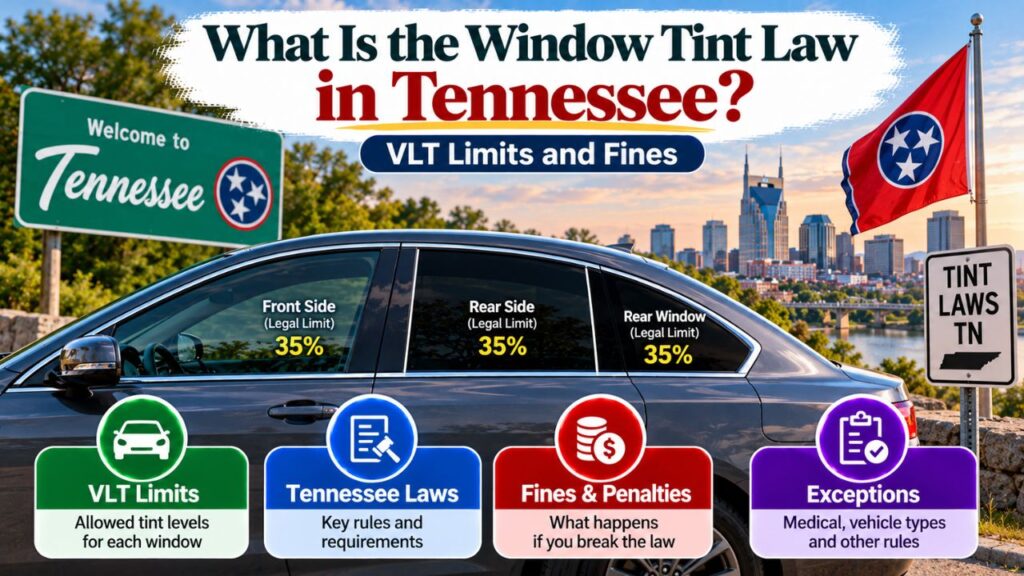
Tennessee’s automotive tint requirements are established by Tennessee Code Annotated § 55-9-107.
The law regulates the amount of visible light transmitted through vehicle windows after tinting materials are applied.
The standard minimum is 35% visible light transmission for covered side and rear windows, while the windshield has a separate 70% rule.
These requirements were checked against the available Tennessee Code and state guidance in October 2026.
Tennessee Window Tint Limits for 2026
| Vehicle window | General legal VLT requirement | Main consideration |
| Windshield | At least 70% VLT | Manufacturer-installed shade band exception |
| Front driver-side window | At least 35% VLT | Applies regardless of vehicle type |
| Front passenger-side window | At least 35% VLT | Applies regardless of vehicle type |
| Rear side windows | Generally at least 35% VLT | Specific federal glazing and statutory exceptions |
| Rear windshield | Generally at least 35% VLT | Specific federal glazing and statutory exceptions |
VLT means Visible Light Transmission.
A lower VLT percentage produces a darker window.
For example:
- 70% VLT allows 70% of visible light through.
- 50% VLT allows 50% through.
- 35% VLT allows 35% through.
- 20% VLT allows 20% through.
- 5% VLT allows only 5% through.
The statute prohibits covered aftermarket tint that falls below the applicable minimum.
Therefore, a measured 35% VLT meets the general side-window threshold, while 34% falls below it.
However, measurements near the limit can be affected by equipment accuracy and installation conditions.
The 2025 Tennessee Code, § 55-9-107, provides the governing restrictions, installer obligations, exceptions, and enforcement rules.
Does the 35% Tint Rule Apply Across Tennessee?
Yes. Tennessee’s statewide window tint law applies on public roads throughout the state.
Cities such as Nashville, Memphis, Knoxville, Chattanooga, and Clarksville are covered by the statewide statute.
Local enforcement practices may vary, but vehicle owners should use the state requirements as their starting point.
The legal requirements also depend on the window, vehicle classification, and applicable statutory exceptions.
What Is the Legal Front Window Tint in Tennessee?
For ordinary vehicles, the front driver-side and front passenger-side windows must maintain at least 35% VLT after tinting.
The front door window requirement applies to cars, SUVs, trucks, and vans.
Tennessee’s statute specifically prevents the listed vehicle-category exceptions from removing the minimum requirement for front door windows.
Is 35% Tint Legal on Front Windows?
Yes, if the completed glass-and-film combination transmits at least 35% of visible light.
However, installing film labeled 35% does not guarantee a legal result.
For example, if the original glass has 80% VLT and a 35% film is added:
0.80 × 0.35 = 0.28
The estimated final VLT is 28%.
That is below Tennessee’s general 35% minimum.
Therefore, choose film based on the final window measurement rather than its advertised percentage alone.
Is 20% Tint Legal on Front Windows?
No, not under Tennessee’s ordinary front side-window rule.
A finished front window measuring 20% VLT is darker than the required 35% minimum.
An approved medical exemption may authorize a different level of tint, but it must be issued through Tennessee’s official process.
A doctor’s note alone is not sufficient.
Is 5% Tint Legal on Front Windows?
No, except where an applicable approved medical exemption specifically permits it.
Five percent tint is extremely dark and allows very little visible light through.
It is substantially below Tennessee’s normal front side-window requirement.
It can also make nighttime driving more difficult.
What Is the Legal Windshield Tint in Tennessee?
Tennessee requires the main windshield to maintain at least 70% visible light transmission, with a specific exception for the manufacturer’s standard installed shade band.
The windshield rule is different from the 35% side-window requirement.
Does Tennessee Allow Full Windshield Tint?
Do not assume that a full-windshield tint installation is legal simply because the product is labeled 70% VLT.
The law prohibits modifications that reduce the windshield below 70% VLT, apart from the factory shade-band exception.
Federal vehicle glazing requirements also affect what professional installers may apply.
Tennessee’s Department of Safety states that its medical tint exemption program cannot authorize windshield tinting.
For this reason, drivers should obtain clear confirmation from the appropriate authorities before considering any aftermarket full-windshield film.
The safest compliance approach is to preserve the windshield’s factory glazing characteristics.
Can You Have a Windshield Tint Strip?
The statute expressly recognizes the manufacturer’s standard installed shade band.
This should not be confused with unrestricted permission to install an aftermarket strip of any width or darkness.
Some online guides refer to an AS-1 line or a fixed number of inches.
However, Tennessee’s statutory language specifically identifies the manufacturer’s installed shade band rather than establishing a universal aftermarket strip measurement.
Confirm the requirements before applying a separate aftermarket windshield strip.
Is 50% Windshield Tint Legal in Tennessee?
No.
A windshield measuring 50% VLT is below the state’s 70% windshield threshold.
This applies even when a seller advertises the film as ceramic or heat-rejecting.
Film technology does not override the light-transmission rules.
Are Rear Window Tint Laws Different for Tennessee SUVs and Trucks?
Tennessee’s general statutory limit for covered aftermarket tint is 35% VLT.
However, the law includes an exception for vehicle models that federal glazing regulations permit to have darker glass on certain windows.
This distinction is important for SUVs, pickup trucks, vans, and other multipurpose vehicles.
Rear Windows on Passenger Cars
For a conventional passenger car, the general 35% VLT rule applies to covered aftermarket-tinted rear side windows and rear glass.
Therefore, installing 20% or 5% aftermarket tint on an ordinary passenger car’s rear windows should not be assumed legal.
Unless a specific exemption applies, maintain at least 35% VLT.
Rear Windows on SUVs, Vans, and Pickup Trucks
Certain SUVs, vans, and pickup trucks have factory privacy glass that is darker than the glass typically used on passenger cars.
Federal Motor Vehicle Safety Standard No. 205 allows certain vehicle classifications to use darker glazing behind the driver.
Tennessee’s statute recognizes specific federally permitted glazing configurations.
However, the exception is tied to qualifying vehicles and windows rather than providing unrestricted permission for every aftermarket rear-window tint installation.
Do not assume that any SUV or pickup can legally receive 5% aftermarket rear tint.
If your vehicle has factory-dark rear windows, confirm its federal classification and the applicability of Tennessee’s statutory exception before installing additional film.
Do Factory-Tinted Rear Windows Need to Be Removed?
No. Factory privacy glass isn’t the same as an aftermarket film applied to ordinary clear glass.
If the darker factory glazing is permitted under the applicable federal standards and Tennessee exception, it generally does not need to be removed.
In most cases, factory privacy glass is part of the glass construction and cannot simply be peeled off.
Adding aftermarket film is a separate modification that needs its own compliance review.
Key Takeaway: The 35% front door window rule applies broadly, while certain rear windows may qualify for specific statutory exceptions. Vehicle owners should not assume that all rear windows are exempt.
How to Calculate Legal Window Tint Percentage in Tennessee
A frequent source of tint violations is misunderstanding how film darkness combines with the original glass.
Many factory vehicle windows already reduce visible light transmission.
Applying film further reduces the amount of light that passes through.
Use the Combined VLT Formula
A simplified calculation is:
Final VLT = Factory Glass VLT × Window Film VLT
Convert each percentage to a decimal before multiplying.
Then multiply the result by 100 to express it as a percentage.
For example:
Factory glass VLT: 80%
Film VLT: 50%
0.80 × 0.50 = 0.40
Final VLT = 40%
This would be above Tennessee’s general 35% side-window minimum.
Examples of Final Tint Darkness
Assuming factory glass with 80% VLT:
| Installed film VLT | Approximate final VLT | General 35% rule |
| 70% | 56% | Meets |
| 50% | 40% | Meets |
| 45% | 36% | Meets, but close |
| 40% | 32% | Below minimum |
| 35% | 28% | Below minimum |
| 20% | 16% | Below minimum |
| 5% | 4% | Below minimum |
These figures are mathematical examples.
Actual vehicle glass varies, and tint film may have manufacturing tolerances.
Professional measurement is needed to confirm compliance.
Why You Should Avoid Tinting Right at 35%
A completed window measuring exactly 35% VLT is at the legal minimum.
Small differences in factory glass, film specifications, or measurement conditions can produce a lower reading.
Choosing a film that leaves the finished window comfortably above 35% provides a more practical margin.
For example, aiming for a completed VLT around 40–50% may reduce the risk of falling below the legal threshold.
This is a practical recommendation, not an additional statutory requirement.
What Window Tint Colors and Reflectivity Are Allowed in Tennessee?
Tennessee’s principal window tint statute focuses primarily on visible light transmission.
Unlike some states, § 55-9-107 does not establish a separate numerical reflectivity percentage or expressly list prohibited film colors.
However, this should not be interpreted as unrestricted permission to install highly reflective or visually obstructive film.
Does Tennessee Ban Mirror Tint?
The window tint statute does not specify an independent numerical limit for mirrored tint.
However, any installed film must still satisfy applicable glazing and visibility requirements.
Other vehicle safety requirements may also be relevant.
Before installing a highly reflective product, obtain confirmation that it is suitable for road use in Tennessee.
Are Red, Blue, and Colored Window Films Legal?
Section 55-9-107 does not expressly identify a general list of banned tint colors.
However, the absence of a color-specific prohibition in that section does not establish that every colored film is legal in every application.
Optical clarity, visible light transmission, and other applicable vehicle equipment requirements still matter.
For ordinary passenger vehicles, neutral charcoal or gray film is often a practical choice because it maintains a relatively natural view through the glass.
Does Tennessee Require a Window Tint Sticker?
Yes. Tennessee law places specific labeling obligations on professional window tint installers.
These requirements are sometimes overlooked in general tint-law summaries.
Where Does the Window Tint Sticker Go?
Under § 55-9-107(a)(3), a professional installer must affix a compliance label to the lower right corner of the driver’s window.
The label must identify the installer’s business and indicate compliance with Tennessee’s window tint statute.
The commissioner of safety determines the required label size and style.
What Information Must the Installer Provide?
Professional installers must also give customers a signed receipt containing:
- Installation date.
- Vehicle make and model.
- Vehicle paint color.
- License plate number and issuing state.
- Required statement of compliance.
- Instruction to retain the receipt with vehicle registration documents.
These requirements help identify when and where the tint was installed.
They also provide documentation relevant to a compliance question.
Should You Keep the Tint Receipt in Your Car?
Yes.
Tennessee law specifically requires the installer to provide a receipt stating that it should be kept with the vehicle’s registration documents.
Keeping the receipt and compliance information readily available is a sensible precaution.
Remember that the vehicle owner bears the burden of demonstrating compliance under the statute.
A sticker or receipt does not make an otherwise illegal installation legal.
Can You Get a Medical Window Tint Exemption in Tennessee?
Yes. Tennessee has a medical exemption process for people with qualifying medical conditions adversely affected by ultraviolet light.
However, approval is not automatic.
The application must be reviewed through the state’s Department of Safety and Homeland Security.
Who Can Apply for a Medical Tint Exemption?
Under Tennessee Code § 55-9-107(b), an individual may apply when a physician certifies that a medical condition requires greater reduction of light transmission than the ordinary window tint standards permit.
The state’s medical review board evaluates whether an exemption is warranted.
If approved, the commissioner authorizes an appropriate degree of exemption and issues documentation for display in the vehicle.
The law does not provide a universal tint percentage for every medical exemption.
The approved level depends on the individual authorization.
How to Apply for a Tennessee Tint Exemption
The Tennessee Department of Safety’s official exemption instructions list the following required documents:
- A doctor’s note.
- A copy of the vehicle registration.
- The driver’s license number.
Submit the request to:
Driver.Improvement@tn.gov
The department states that processing generally takes approximately three to four weeks.
If approved, the applicant receives a certificate bearing the commissioner’s signature and a decal.
Can a Doctor’s Note Make Dark Tint Legal Immediately?
No.
A doctor’s note supports the exemption application but is not itself the state’s authorization.
The medical review process must be completed, and the required certificate or decal must be issued.
Installing noncompliant tint before approval may leave the vehicle in violation of the ordinary rules.
Does the Exemption Allow Windshield Tint?
No. Tennessee’s official exemption guidance states that the department cannot grant a windshield tint exemption.
Drivers should not assume that medical authorization for darker side windows also permits windshield modifications.
What Are the Penalties for Illegal Window Tint in Tennessee?
Operating a vehicle with tint that violates § 55-9-107 is classified as a Class C misdemeanor.
The statute also addresses enforcement procedures and refusal to submit to a required field test.
How Much Is a Window Tint Ticket in Tennessee?
Under Tennessee Code § 40-35-111(e)(3), the statutory maximum for a Class C misdemeanor is:
- A fine of up to $50.
- Imprisonment of up to 30 days.
- Or both, subject to applicable law.
These are maximum statutory penalties, not a prediction of what will happen in an ordinary traffic case.
Court costs and other expenses may also apply.
Actual outcomes depend on the circumstances and the court.
Can Police Stop You for Window Tint?
Yes.
Under § 55-9-107(c), a POST-certified Tennessee law enforcement officer may detain a vehicle for a field comparison test when the officer reasonably believes its tint violates the law.
The provision was updated through a 2024 legislative change that broadened which qualified officers may conduct these stops.
A driver should not assume that tint enforcement requires another traffic violation.
Can Police Test Your Tint Darkness?
Yes.
Tennessee law provides for roadside field comparison testing to determine compliance.
Officers use procedures established by the Department of Safety.
A visual appearance may lead an officer to suspect a violation, while the testing process helps assess the window’s actual light transmission.
Can You Refuse a Window Tint Test?
Refusing a field comparison test when directed by a qualified law enforcement officer is itself classified as a Class C misdemeanor under the statute.
Therefore, refusal is not a way to avoid the applicable tint requirements.
Will a Tint Ticket Affect Your Driving Record?
The precise consequences depend on how the violation is charged, processed, and resolved.
Do not assume that every tint citation automatically carries the same points or insurance consequences.
If you receive a citation, review the listed offense and consult the court or a qualified Tennessee legal professional about the specific consequences.
Does Tennessee Recognize Out-of-State Window Tint?
Tennessee law contains an exception for vehicles registered in another state that comply with the window tint requirements of their registration state.
This is established in § 55-9-107(a)(6)(A)(iii).
Can Visitors Drive With Their Home State’s Legal Tint?
The statutory exception generally addresses vehicles that are registered elsewhere and comply with the tint rules of their registration state.
However, a driver should be prepared to establish the vehicle’s registration and applicable compliance.
The exception doesn’t necessarily remove other vehicle safety obligations.
What Happens if You Move to Tennessee?
If the vehicle becomes registered in Tennessee, the out-of-state registration exception may no longer apply.
Before registering the vehicle, confirm whether its existing tint satisfies Tennessee’s requirements.
If necessary, have the glass measured and replace noncompliant film.
Are There Other Tennessee Tint Exemptions?
Section 55-9-107 also identifies certain additional exceptions involving:
- Particular federally permitted vehicle glazing configurations.
- Qualifying law-enforcement vehicles with specified license plates.
- Vehicles owned or leased by licensed private investigators or investigation companies.
- Approved medical exemptions.
These exceptions have conditions and limitations.
Importantly, the vehicle-category exceptions do not generally remove the 35% minimum applicable to front door windows.
How to Check Whether Your Window Tint Is Legal in Tennessee
The most reliable way to verify tint darkness is to measure the actual glass-and-film combination.
A film package label alone isn’t sufficient.
Step 1: Identify the Windows That Have Tint
Inspect the vehicle’s:
- Front driver-side window.
- Front passenger-side window.
- Rear side windows.
- Rear windshield.
- Windshield.
Determine which windows have aftermarket film and which have factory privacy glass.
Step 2: Check the Existing Glass Specifications
If you are planning a new installation, ask the tint shop to measure the original glass before choosing a film.
This will help determine the appropriate film VLT.
For example, a 50% film may produce a legal final result on one vehicle but a darker result on another.
Step 3: Use an Automotive Tint Meter
A properly calibrated tint meter measures visible light transmission through the window.
Professional tint shops may offer measurement services.
If you’re checking existing tint, measure the completed glass rather than relying on the original film packaging.
Step 4: Compare the Reading With Tennessee Law
For ordinary covered side windows, check that the measured VLT is at least 35%.
For the windshield, follow the separate 70% requirement and the limitations concerning factory shade bands and permitted modifications.
For qualifying rear privacy glass, verify whether a specific statutory exception applies.
Step 5: Check Your Documentation
If the tint was installed professionally in Tennessee, locate the installer label and signed receipt.
Make sure the documentation identifies the correct vehicle.
For an approved medical exemption, keep the state’s certificate or decal as required.
Common Mistakes That Cause Tennessee Tint Violations
Several common assumptions can lead to noncompliant installations.
Installing 35% Film Without Measuring the Glass
A film rated at 35% VLT may produce a completed window darker than 35%.
The original glass absorbs some visible light.
Always evaluate the combined transmission.
Assuming Every SUV Can Have 5% Rear Tint
Certain federal glazing and Tennessee statutory exceptions may apply to specific rear windows.
However, this doesn’t establish unlimited aftermarket tint permission for every SUV or truck.
Verify the exact vehicle and glass configuration.
Treating the 70% Windshield Limit as Automatic Permission
The 70% threshold does not mean every windshield film is approved.
Federal glazing requirements, factory shade-band provisions, and installation restrictions also matter.
Tennessee does not provide a medical windshield tint exemption.
Assuming Ceramic Tint Is Exempt
Ceramic film may offer excellent heat rejection, but it is still subject to the applicable visible light transmission requirements.
A 20% ceramic film is not legal for an ordinary front side window merely because it uses advanced technology.
Forgetting the Installer Sticker and Receipt
Professional installers have statutory labeling and documentation duties.
Ask for the required paperwork and keep it with the vehicle’s registration documents.
Believing a Doctor’s Note Automatically Authorizes Dark Tint
A physician’s statement is part of the exemption application.
The state must review and authorize the exemption before it becomes effective.
Assuming Tint Laws Never Change
Window tint regulations can be revised.
Before installing new film, check the current Tennessee statute and state guidance rather than relying entirely on an old tint-law chart.
What Window Tint Should You Choose to Stay Legal in Tennessee?
For ordinary passenger vehicles, a practical approach is to choose film that leaves the completed front windows comfortably above 35% VLT.
The appropriate film percentage depends on how much light the original glass transmits.
For Drivers Who Want More Heat Rejection
Consider a high-quality ceramic or other solar-control film with a suitable final VLT.
Light-colored ceramic films can provide useful infrared heat rejection without making the windows excessively dark.
Compare Total Solar Energy Rejection (TSER) and infrared performance rather than choosing film based only on darkness.
For Drivers Who Want Privacy
Choose the darkest film that still produces a legally compliant final window measurement.
Remember that tint which looks acceptable in bright sunlight may reduce visibility during nighttime driving.
Privacy should be balanced against legal and practical visibility requirements.
For Drivers With Factory Privacy Glass
Before adding film to dark rear windows, confirm whether the existing glazing qualifies for a statutory exception.
Then check whether additional film is permitted.
A professional installer familiar with Tennessee law should be able to evaluate the vehicle’s glass and explain the proposed final VLT.
For Drivers Who Want a Simple Compliance Margin
A finished VLT noticeably above 35% on covered side windows is generally easier to manage than an installation exactly at the statutory limit.
Select an appropriately rated film, measure the result, and keep the installation documentation.
Conclusion
Understanding what is the window tint law in Tennessee comes down to the state’s visible light transmission requirements and the exceptions that apply to particular vehicles and windows.
For ordinary aftermarket tint, the general minimum is 35% VLT on covered side and rear windows. The windshield has a separate 70% requirement, with a specific exception for the manufacturer’s standard installed shade band.
Certain federally permitted rear glazing configurations, qualifying vehicles, and approved medical exemptions receive special treatment under the statute.
Tennessee also requires professional tint installers to provide a compliance label and signed receipt.
Violations can result in a Class C misdemeanor, and qualified officers may conduct roadside tint testing.
My recommendation is to measure the factory glass before installation, choose a film that leaves a reasonable compliance margin, and verify the finished VLT with a tint meter.
For any uncertain vehicle exception or windshield modification, confirm the rule directly with Tennessee’s Department of Safety before installing the film.
FAQs About What Is the Window Tint Law in Tennessee
Is 35% Window Tint Legal in Tennessee?
Yes, if the completed window measures at least 35% VLT and no other restriction is violated. However, applying film labeled 35% to factory glass can produce a final reading below 35%, making it noncompliant with the ordinary side-window rule.
Is 20% Window Tint Illegal in Tennessee?
A completed front side window measuring 20% VLT is below Tennessee’s ordinary 35% minimum. Certain statutory exceptions may apply to qualifying rear windows, and approved medical exemptions can permit different tint levels on specified windows.
Can You Have 5% Tint on the Back Windows in Tennessee?
Not automatically. Tennessee has specific exceptions for certain federally permitted glazing configurations and qualifying vehicles. Those exceptions do not give every vehicle unrestricted permission for 5% aftermarket rear tint. Verify the particular vehicle and window before installation.
How Much Is a Ticket for Illegal Window Tint in Tennessee?
Illegal tint is a Class C misdemeanor. The general statutory maximum includes a fine of up to $50, imprisonment of up to 30 days, or both. Court costs may also apply. Actual penalties depend on the circumstances and court.
Does Tennessee Require a Tint Sticker?
Yes. Professional installers must affix the required compliance label to the lower right corner of the driver’s window and provide a signed installation receipt. The receipt should be kept with the vehicle registration documents.
Can You Get a Medical Exemption for Darker Tint in Tennessee?
Yes. Eligible applicants can submit a doctor’s note, vehicle registration copy, and driver’s license number to the Tennessee Driver Improvement office. Approval requires state review, and an approved certificate or decal must be displayed. The state does not grant medical windshield tint exemptions.
Can Police Pull You Over Just for Dark Tint in Tennessee?
Yes. Tennessee law allows a POST-certified law enforcement officer to stop a vehicle for a field tint test when the officer reasonably believes its windows violate the statutory requirements. Refusing a properly directed field comparison test is also a Class C misdemeanor.