The most accurate way to check window tint percentage at home is to use a digital window tint meter that measures Visible Light Transmission (VLT). Place the meter on the glass according to its instructions, and it will display the percentage of visible light passing through the window. A lower percentage means darker tint.
If you don’t have a tint meter, you can estimate the darkness by comparing the window with known tint samples or reviewing the original film specifications. However, these methods cannot provide a dependable measurement of an installed window.
Knowing the actual tint percentage is useful when purchasing a used vehicle, checking whether existing tint meets state regulations, or deciding whether to replace an old film. It also helps clarify why a window labeled 35% tint may produce a different reading once the film is installed over factory glass.
The process is relatively simple, but accurate results depend on proper equipment, calibration, and measurement technique.
In this article, I explain how to check window tint percentage at home using a VLT meter, estimate darkness without specialized tools, interpret the results, and compare readings against legal requirements. I also cover factory glass, measurement errors, and the differences between tint darkness and heat rejection.
How to Check Window Tint Percentage at Home With a Tint Meter
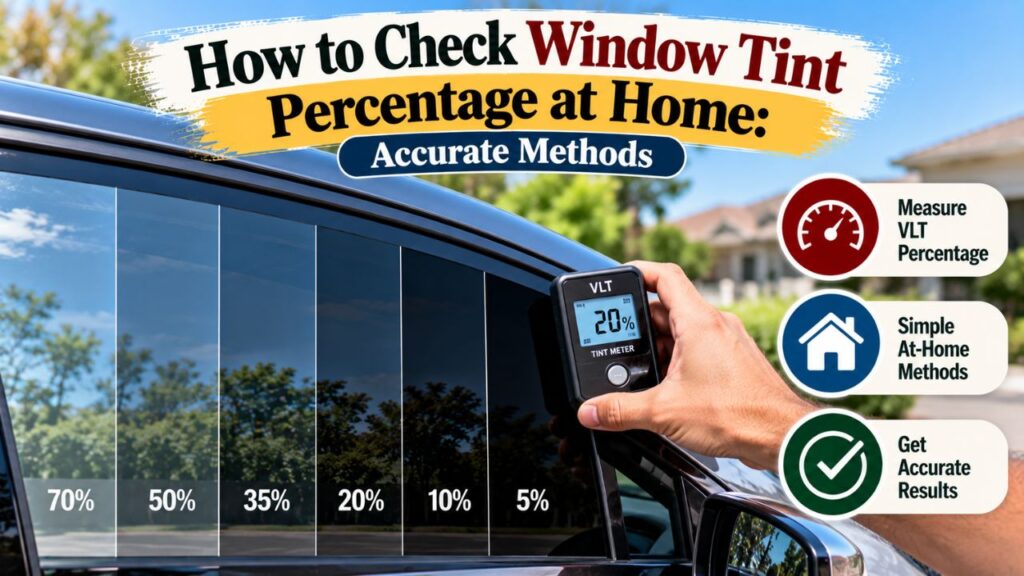
A digital tint meter is the most dependable tool for measuring how dark an automotive window actually is.
It measures the amount of visible light passing through the glass and any installed film.
Most handheld meters display the result as a percentage.
The process can be completed in a driveway or garage without removing the tint.
Step 1: Gather the Necessary Equipment
You need only a few items:
- A compatible digital window tint meter
- A clean microfiber cloth
- A suitable automotive glass cleaner
- The meter’s operating instructions
- A notepad or phone to record measurements
- Calibration or verification standards, if supplied with the meter
The meter is the only specialized measuring tool required.
Choose a device that measures Visible Light Transmission, not simply film thickness or glass reflectivity.
For roll-down side windows, a one-piece meter with an opening for the glass is often suitable.
For fixed rear windows and windshields, a compatible two-piece meter may be necessary.
Step 2: Clean the Window Before Measuring
Clean the area where you intend to test the tint.
Remove:
- Dust
- Fingerprints
- Water spots
- Grease
- Cleaning residue
- Loose dirt
Use a cleaner suitable for tinted automotive glass.
Avoid ammonia-based cleaning products unless the film manufacturer specifically approves them.
Dry the window with a clean microfiber cloth.
Dirt and residue can interfere with the amount of light reaching the meter’s sensor.
Important: Avoid measuring over damaged film, bubbles, scratches, or heavy contamination when trying to determine the normal VLT of the window.
Step 3: Prepare and Calibrate the Tint Meter
Turn on the device and follow its calibration instructions.
Many one-piece meters establish a 100% light-transmission reference when powered on with nothing between the light source and sensor.
However, the calibration method depends on the model.
Some devices use automatic calibration, while others require a specific button sequence or supplied reference standard.
According to EDTM’s official window tint measurement guidance, its Tint-Chek meters use a 100% reference during startup and include calibrated standards for checking measurement accuracy.
For an EDTM one-piece meter, the general procedure is:
- Turn on the device with its measurement slot empty.
- Allow the display to establish the 100% reference.
- Verify the meter using a supplied standard when appropriate.
- Confirm the device is ready before testing the glass.
Do not assume that every tint meter uses exactly this process.
Follow the instructions for the actual device.
Step 4: Position the Meter on the Car Window
For a one-piece slot-style meter, lower the side window enough to expose a suitable section of glass.
EDTM’s instructions for its one-piece models call for lowering the window by at least 3 inches.
Carefully slide the meter over the exposed glass edge.
Make sure the window sits fully inside the intended measurement opening.
The light source should be on one side of the glass and the receiving sensor on the other.
Keep the instrument aligned as specified by its manufacturer.
Avoid positioning the meter over an area where the tint film does not fully cover the glass.
Step 5: Read the Window Tint Percentage
Once the meter is properly positioned, read the number displayed.
For example, if the meter shows:
35% VLT
The tested window allows approximately 35% of visible light through the glass-and-film combination.
The remaining visible light is absorbed or reflected.
This does not mean that the film alone has a 35% VLT rating.
The meter is measuring the combined window assembly.
Another example:
20% VLT
The window allows approximately 20% of visible light through.
It is substantially darker than a window measuring 50% VLT.
Record the reading before moving to another location.
Step 6: Repeat the Measurement
Remove the meter and test the same window again.
Take readings at two or three suitable locations when possible.
Avoid:
- The extreme film edges
- Defroster lines
- Printed ceramic dot patterns
- Damaged film sections
- Heavily curved areas unsuitable for the meter
Readings should be reasonably consistent across a properly installed, uniformly tinted window.
Small variations may occur due to instrument accuracy and measurement conditions.
If the readings differ substantially, check calibration, alignment, and surface cleanliness.
Step 7: Check the Remaining Windows
Measure each window separately.
A vehicle may have different tint percentages on its front side windows, rear side windows, and rear glass.
For example, a car might have:
| Window | Example Meter Reading |
| Driver-side front | 35% VLT |
| Passenger-side front | 35% VLT |
| Rear passenger-side | 20% VLT |
| Rear driver-side | 20% VLT |
| Rear windshield | 20% VLT |
These are illustrative readings, not legal recommendations.
Use the correct meter for each glazing location.
A one-piece slot meter cannot normally measure a fixed windshield or rear window unless the device has been designed for that application.
How to Check Fixed Rear Windows and Windshields
Fixed windows need a different measurement arrangement because the glass cannot be lowered into an ordinary slot-style meter.
A compatible two-piece tint meter can measure VLT through installed glass without requiring an exposed edge.
Using a Two-Piece Window Tint Meter
A two-piece meter has separate components containing its light measurement system.
Depending on the design, one component is positioned on the inside of the window and the other on the outside.
For example, EDTM’s two-piece Tint-Chek system uses a reflector unit and an instrument unit aligned across the glass.
The basic process is:
- Clean both sides of the test area.
- Prepare and calibrate the meter according to its instructions.
- Position the inside component against the glass.
- Align the outside component with it.
- Activate the measurement.
- Record the displayed VLT percentage.
- Repeat to confirm the result.
Avoid rear defroster lines and other obstructions when selecting a measurement location.
Do not force magnetic or clamping components against delicate glass accessories, sensors, or coatings.
Can You Measure Windshield Tint the Same Way?
A suitable two-piece meter may measure windshield light transmission, provided it supports the glass thickness and curvature.
However, windshields require additional care.
They may contain:
- Laminated glass
- Factory solar-control coatings
- Embedded sensors
- Specialized glazing layers
- Curved surfaces
Follow the meter manufacturer’s compatibility requirements.
Also remember that windshield tint laws are often more restrictive than side-window requirements.
What Does Window Tint Percentage Actually Mean?
Window tint percentage refers to the amount of visible light passing through the window.
The measurement is called Visible Light Transmission (VLT).
A higher VLT percentage means more light passes through.
A lower VLT percentage means less light passes through.
Window Tint Percentage Chart
| VLT Percentage | General Appearance | Light Passing Through |
| 70% | Very light, nearly clear | 70% |
| 50% | Light tint | 50% |
| 35% | Moderately dark | 35% |
| 25% | Dark | 25% |
| 20% | Very dark | 20% |
| 15% | Very dark | 15% |
| 5% | Extremely dark, often called limo tint | 5% |
These descriptions are approximate because the visible appearance also depends on lighting, glass color, and viewing conditions.
A 20% tint is darker than a 35% tint.
The smaller percentage does not mean less tinting.
It means less visible light transmission.
Does 35% Tint Block 35% of Light?
No. A window measuring 35% VLT allows approximately 35% of visible light through.
The remaining 65% is not transmitted.
This is a frequent source of confusion.
Likewise, 5% tint does not mean the window is only slightly darkened.
It means approximately 5% of visible light passes through.
Does Tint Percentage Measure Heat Rejection?
No. VLT measures visible light transmission, not total solar heat rejection.
A window with 20% VLT is not necessarily better at rejecting solar heat than one with 50% VLT.
Advanced ceramic and other solar-control films can reduce substantial solar energy while remaining relatively light.
For heat performance, review the film’s Total Solar Energy Rejected (TSER) rating.
A basic VLT meter cannot determine TSER, UV rejection, or full-spectrum infrared rejection.
How to Check Window Tint Percentage at Home Without a Meter
If you don’t have a digital tint meter, you can still gather useful information about the window’s darkness.
However, there is an important limitation:
You cannot reliably determine the exact VLT percentage of an unknown installed tint by looking at it or using an ordinary phone camera.
The following methods are useful for rough comparisons and preliminary estimates.
Method 1: Compare the Window With Known Tint Samples
Some tint manufacturers and installers provide sample cards showing different darkness levels.
Common sample shades include:
- 70%
- 50%
- 35%
- 20%
- 5%
Position the samples near the vehicle window and compare their appearance under consistent lighting.
Avoid using photographs from unrelated websites because camera exposure and screen brightness can change how dark the film appears.
This method may help you identify whether the window looks closer to 35% or 20% tint.
However, it cannot establish a reliable exact percentage.
The original vehicle glass may already have a tint or solar-control coating.
Method 2: Check the Original Tint Installation Records
If the vehicle was tinted professionally, look for the original invoice or product information.
The paperwork may identify:
- Film manufacturer
- Product series
- Installed shade
- Window locations
- Installation date
For example, the invoice might identify a film sold as 35% VLT.
This is useful information, but it does not necessarily mean the complete installed window measures 35%.
The film and existing glass work together to determine the final transmission.
Also, product names may use rounded shade numbers rather than exact laboratory values.
Method 3: Estimate the Final VLT With a Formula
If you know the original glass VLT and the film’s actual rated VLT, you can estimate the combined transmission.
Use:
Estimated final VLT (%) = (Glass VLT (%) × Film VLT (%)) ÷ 100
Suppose the original car window has 80% VLT.
You install a film rated at 35% VLT.
The calculation becomes:
(80 × 35) ÷ 100 = 28%
The estimated final window VLT is approximately 28%, not 35%.
This calculation is useful for planning, but it is an approximation.
Real measurements can differ because of the optical properties of the glass, film, coatings, and measurement system.
If you don’t know the original glass transmission, do not substitute an assumed value and treat the result as verified.
Method 4: Compare Similar Windows on the Same Vehicle
You can visually compare windows to determine whether one appears substantially darker than another.
For example, the rear passenger glass may look much darker than the front side glass.
This observation can suggest different tint levels.
However, it cannot determine an accurate numerical VLT.
Factory privacy glass can also create a darker appearance without aftermarket film.
Use this method only for a general visual comparison.
Can You Use a Smartphone to Measure Window Tint Percentage?
A regular smartphone is not a dependable substitute for a calibrated tint meter.
Some apps claim to estimate tint darkness through the phone’s camera or light sensor.
However, their results can vary considerably.
Why Phone Camera Measurements Are Inaccurate
A smartphone camera automatically adjusts image exposure and other processing settings.
Factors that influence its output include:
- Automatic exposure
- Image brightness processing
- White balance
- Camera sensor characteristics
- Reflections on the glass
- Ambient lighting
- Viewing angle
- Background brightness
Two photos of the same window can look different even when the tint has not changed.
A phone camera is primarily designed to produce usable images, not standardized VLT measurements.
Can a Phone Light Sensor Measure Tint?
Some smartphones contain ambient light sensors.
In theory, comparing light intensity before and after passing through glass may provide a rough indication of transmission.
However, an ordinary phone light sensor does not necessarily measure the visible spectrum in the same way as a calibrated VLT meter.
The sensor’s location, spectral response, and exposure conditions can affect the result.
Without an appropriate controlled measurement setup and calibration, the calculated percentage should not be considered reliable.
Does the Flashlight Method Work?
Shining a flashlight through tinted glass may help compare brightness visually.
However, it is not a dependable method for determining an exact VLT percentage.
Flashlight intensity, distance, viewing angle, and surrounding light can all change the apparent result.
A flashlight may help you judge which of two windows is darker, but it cannot confirm whether an unknown window has 20%, 25%, or 35% VLT.
How to Calculate Film Tint Percentage From a Window Reading
Sometimes you know the window’s total VLT but want to estimate the transmission of the film itself.
This requires a separate measurement or reliable specification for the original glass.
The calculation reverses the combined VLT formula.
Estimated film VLT (%) = (Measured combined VLT (%) × 100) ÷ Original glass VLT (%)
For example:
- Original glass VLT: 80%
- Installed window VLT: 28%
The calculation becomes:
(28 × 100) ÷ 80 = 35%
The estimated film VLT is 35%.
However, if the original glass VLT is unknown, you cannot use the combined reading alone to identify the film’s exact transmission.
This matters for used vehicles, where the installer and film brand may be unknown.
If the original glass specification is available, the formula can help identify a likely film range.
For legal compliance, rely on the properly measured complete glass-and-film VLT rather than this estimated film value.
How Accurate Are Home Window Tint Meters?
A suitable, calibrated tint meter can provide useful measurements, but no instrument is perfectly accurate.
Every device has a stated measurement tolerance.
EDTM specifies an accuracy of ±2 percentage points for its Tint-Chek models.
For example, a display reading of 35% with that tolerance could correspond to an actual value from approximately 33% to 37% under the specified conditions.
The tolerance does not mean the meter will always be wrong by two points.
It describes the stated accuracy range.
Why Two Meters May Show Different Results
Different meters may use different sensors, calibration methods, and measurement systems.
Small differences can also occur because of:
- Glass cleanliness
- Meter positioning
- Measurement location
- Instrument calibration
- Optical properties of the glass
- Ambient lighting effects on susceptible devices
For a meaningful comparison, use properly maintained equipment according to its instructions.
What if the Meter Shows Different Numbers Each Time?
If readings change significantly, inspect the measuring conditions.
Start by cleaning the glass and checking the meter’s battery.
Then:
- Verify calibration.
- Keep the sensor properly aligned.
- Avoid damaged or partially covered film areas.
- Repeat the measurement at a suitable location.
- Check the manufacturer’s stated tolerance.
If the device continues producing inconsistent readings, it may need servicing or verification against a reference standard.
Do not average obviously faulty measurements and assume the result is accurate.
How to Check Whether Your Window Tint Percentage Is Legal
After measuring the window, compare the result with the applicable legal requirement.
Tint laws differ by state and may also depend on vehicle classification and window location.
Do not assume the same VLT limit applies to every window.
Check the Complete Glass-and-Film Reading
State tint regulations commonly evaluate the final light transmission of the installed window.
This includes the original glass and any additional film.
For example, the Texas Department of Public Safety’s official window tinting standards specify a minimum of 25% light transmission for the front side windows immediately to the right and left of the driver, measured with the original glass.
Other restrictions, including reflectivity requirements, also apply.
A 25% rule in Texas does not mean 25% tint is permitted on every window in every state.
Why a Film Labeled 35% May Measure Below 35%
Suppose a film has a VLT of 35% and the original glass transmits 80% of visible light.
The theoretical installed VLT is approximately 28%.
If a state’s applicable minimum were 35%, the final window would likely be too dark despite the film being marketed as 35%.
This is why the original glass must be considered before installation.
Allow for Measurement Tolerance
Suppose a home meter reads 25% and the relevant legal minimum is also 25%.
The reading alone does not guarantee compliance because the meter has a measurement tolerance.
Official testing procedures, accepted equipment, and applicable enforcement rules may affect the legal determination.
If the measured result is close to the limit, have the window checked by a qualified tint installer or authorized inspection facility.
Check Each Window Position Separately
Different rules may apply to:
- Windshields
- Front side windows
- Rear passenger windows
- Rear windshields
- Multipurpose vehicles and passenger cars
Also check any relevant reflectivity, color, and medical-exemption provisions.
A home VLT measurement is useful for screening, but it should not be represented as an official compliance certificate.
Common Mistakes When Checking Tint Percentage at Home
Several mistakes can produce misleading readings or incorrect conclusions.
Measuring the Film Without Considering Factory Glass
The tint meter normally measures the entire glass-and-film combination.
A film sold as 35% does not necessarily produce a 35% installed window reading.
Using an Uncalibrated Meter
A meter that has not been prepared according to its instructions may provide unreliable measurements.
Use the calibration and verification procedure specified for the particular device.
Testing a Dirty Window
Dust, fingerprints, and residue can affect the light reaching the instrument.
Clean the intended test area before measuring.
Measuring Too Close to the Film Edge
Some installed films leave a narrow untinted area near the top edge of a roll-down window.
A meter positioned over this gap may not measure the intended fully tinted section.
Use an area covered completely by the film.
Ignoring Glass Curvature
Meters require proper alignment.
Highly curved surfaces may prevent certain devices from sitting correctly.
Use a compatible meter and follow its positioning instructions.
Confusing Tint Darkness With Heat Rejection
A low VLT indicates darker glass, not necessarily stronger heat rejection.
A tint meter does not determine whether a film is ceramic, dyed, carbon, or infrared-focused.
It also does not measure the complete thermal performance of the film.
Assuming a Smartphone App Gives Legal Proof
Phone apps and visual comparisons are unsuitable for establishing official tint compliance.
Use a properly calibrated VLT meter and, where needed, a recognized inspection service.
Should You Buy a Tint Meter or Visit a Tint Shop?
For most drivers who need to check their tint only once, visiting a professional automotive tint shop may be more practical than purchasing a dedicated meter.
A shop may already have suitable testing equipment for different window types.
However, buying a meter can make sense if you regularly inspect multiple vehicles.
| Method | Accuracy | Best Use |
| Digital VLT meter | High when properly calibrated and used | Actual tint measurement |
| Professional tint shop | High when suitable equipment is used | Occasional verification |
| Original film specifications | Useful for identifying the film rating | Known installed products |
| Combined VLT formula | Approximate | Pre-installation planning |
| Tint shade comparison | Low | General darkness estimate |
| Smartphone app | Unreliable for exact VLT | Informal visual comparison |
| Flashlight comparison | Low | Comparing relative darkness |
When a Home Meter Is Worth Having
A tint meter may be useful for:
- Checking multiple used vehicles
- Verifying different window tint installations
- Comparing front and rear window darkness
- Monitoring film replacements
- Screening for potential compliance problems
Choose a meter compatible with the windows you intend to measure.
A one-piece model may be adequate for roll-down side windows, while fixed glazing typically requires another design.
When Professional Testing Is Better
Professional testing is preferable when:
- The window is difficult to measure.
- The home meter gives inconsistent readings.
- The measured VLT is close to a legal threshold.
- You are preparing for an official inspection.
- You need documentation for a tint-related dispute.
Ask whether the shop uses a calibrated meter and whether its testing covers the complete installed glass.
Conclusion
Understanding how to check window tint percentage at home begins with knowing that tint darkness is measured as Visible Light Transmission.
The most reliable approach is to use a calibrated digital VLT meter, clean the window, position the device correctly, and repeat the measurement to confirm the result.
Without a meter, comparing tint samples or using known glass and film specifications can provide an estimate, but neither approach establishes the exact VLT of an unknown installed window.
Remember that the meter measures the glass and film together. A 35% film may produce a lower final VLT when applied over factory glass.
I recommend using a proper tint meter for accurate measurements and professional testing when the result is close to a legal limit. Compare the measured percentage with your state’s requirements for the specific window before deciding whether the tint needs to be changed.
FAQs About How to Check Window Tint Percentage at Home
Can I Check My Window Tint Percentage Without a Tint Meter?
You can estimate the darkness using known tint samples or the manufacturer’s film specifications.
However, these methods cannot reliably determine the exact VLT of an unknown installed window.
A calibrated tint meter is necessary for a dependable measurement.
Is There a Free App That Measures Car Window Tint Percentage?
Some smartphone apps claim to estimate tint darkness, but they are not reliable substitutes for calibrated VLT meters.
Camera processing, sensor limitations, and lighting conditions can affect the results.
Do not depend on an app for legal compliance.
How Can I Tell if My Car Has 20% or 35% Tint?
A VLT meter can distinguish between the two by measuring how much visible light passes through the window.
A 20% VLT window allows less light through and generally appears darker than a 35% window.
Visual comparison alone cannot provide a dependable exact reading.
Does a Tint Meter Read the Glass or Just the Film?
A conventional automotive tint meter reads the combined visible light transmission of the glass and any installed film.
It does not automatically separate the film’s VLT from the original glass transmission.
You need additional information to estimate the film’s individual rating.
Can You Measure Factory Window Tint?
Yes. A compatible VLT meter can measure the visible light transmission of factory automotive glass.
This applies to clear, colored, and privacy glass, provided the meter supports the glazing characteristics.
Factory glass may have a lower VLT than its appearance suggests.
Can I Check Rear Window Tint With a Regular Handheld Meter?
A one-piece slot-style meter generally requires an accessible glass edge, such as on a roll-down side window.
For fixed rear glass, use a compatible two-piece meter designed to measure through installed glazing.
Avoid defroster lines and other obstructions during testing.
Does 35% Window Tint Mean 35% of Light Is Blocked?
No. A window measuring 35% VLT allows approximately 35% of visible light through.
About 65% is not transmitted through the window.
Lower VLT percentages indicate darker glazing, not lighter tint.