
The main difference between J1772 and CCS is that J1772 supports AC Level 1 and Level 2 charging, while CCS1 combines the J1772 connection with two additional pins for DC fast charging. A J1772 connector is commonly used for charging at home, work, or public Level 2 stations. CCS1 allows compatible electric vehicles to use much faster DC charging stations during road trips.
These connectors are closely related rather than competing systems. A North American electric vehicle with a CCS1 charging port can normally accept a standard J1772 plug for AC charging without an adapter. However, a vehicle with only a J1772 port cannot automatically use a CCS fast charger.
Charging speed also depends on the vehicle’s battery, charging equipment, and supported power level. A CCS connector does not guarantee that every EV can charge at 150 or 350 kW.
In this article, I compare J1772 vs CCS in terms of connector design, charging speed, electrical operation, and vehicle compatibility. I also explain which plug to use at home or on road trips, when adapters are needed, and how the growing SAE J3400/NACS charging network affects both connector types.
J1772 vs CCS: Main Differences at a Glance
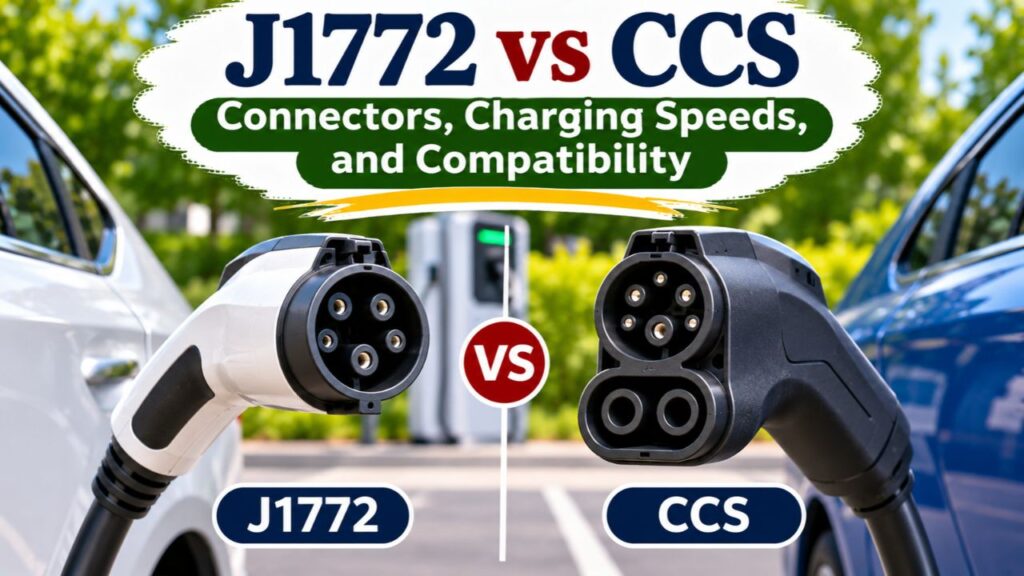
J1772 and CCS1 are both established North American EV charging interfaces.
However, they serve different charging functions.
J1772 is primarily the connector used for AC charging.
CCS1 extends the J1772 design to support high-power DC charging through two additional contacts.
J1772 vs CCS Comparison Table
| Feature | J1772 | CCS1 |
| Full name | SAE J1772 | Combined Charging System Type 1 |
| Other name | Type 1, J plug | CCS Combo 1, SAE Combo |
| Main charging function | AC charging | AC and DC charging through one vehicle inlet |
| Typical station type | Level 1 and Level 2 | DC fast charging |
| Connector contacts | 5 | 7 in the combined connector |
| Additional DC contacts | No | Yes, two large lower contacts |
| Typical voltage | 120 V or 208–240 V AC | DC fast chargers commonly use several hundred volts |
| Typical charging power | Approximately 1–19.2 kW, depending on equipment | Common DC stations offer 50–350 kW |
| Home charging | Common | DC fast charging rarely installed at homes |
| Road-trip charging | Useful but relatively slow | Designed for faster stops |
| Built-in compatibility | Fits the AC portion of a CCS1 vehicle inlet | Full CCS1 plug needs a CCS1-compatible inlet |
| Main region | North America and some other markets | North America and selected other markets |
The U.S. Department of Transportation’s EV charging guide identifies J1772 as the connector for AC Level 1 and Level 2 charging and CCS as a common DC fast-charging connector.
Which Connector Is Better?
Neither connector is universally better.
J1772 is usually the practical option for everyday charging, while CCS1 is useful for high-speed charging away from home.
Most drivers do not need DC fast charging for every charging session.
If an EV can recharge overnight using a home Level 2 charger, J1772 may meet most daily needs.
For longer trips, CCS1 can significantly reduce charging stops compared with ordinary AC charging.
However, CCS1 offers an additional advantage: its vehicle inlet also accepts the J1772 connector.
That means a CCS1-equipped EV can generally use both charging methods.
What Is a J1772 Charging Connector?
SAE J1772 is an EV charging standard commonly used for AC charging in North America.
It is often called the J1772 plug, Type 1 connector, or J plug.
The connector has five electrical contacts and is designed for compatible electric vehicles and plug-in hybrids.
What Does J1772 Look Like?
A J1772 connector has a generally rounded shape with five contact openings.
Its contacts provide:
- AC power connections
- Protective grounding
- Control signaling
- Connection detection
The control and proximity functions help the vehicle and charging equipment establish a safe charging connection.
J1772 charging equipment does not simply energize exposed connector contacts whenever it is plugged into an electrical outlet.
The charging process includes communication and safety checks.
Is J1772 Level 1 or Level 2?
J1772 supports both.
The charging level depends on the power supply and charging equipment, not on a different plug design.
Level 1 charging typically uses 120-volt AC power in the United States.
It is commonly associated with portable charging equipment connected to an appropriate household receptacle.
Level 2 charging generally uses 208-volt or 240-volt AC power.
It is commonly used for home charging installations, workplace chargers, and public charging stations.
The same J1772 connector design can serve both applications.
How Fast Is J1772 Charging?
Charging power varies with voltage, current, and the vehicle’s onboard charging capability.
Typical examples include:
| Charging Setup | Approximate Power |
| 120 V × 12 A | 1.4 kW |
| 240 V × 16 A | 3.8 kW |
| 240 V × 32 A | 7.7 kW |
| 240 V × 40 A | 9.6 kW |
| 240 V × 48 A | 11.5 kW |
| 240 V × 80 A | 19.2 kW |
These are electrical power calculations.
They do not mean every EV can accept every listed level.
For example, an EV with a 7.2-kW onboard AC charger cannot charge at 11.5 kW simply because it is connected to a more powerful Level 2 station.
The vehicle’s onboard charger limits how much AC charging power it can use.
What Is J1772 Best For?
J1772 is particularly useful for:
- Overnight home charging
- Workplace charging
- Public Level 2 charging
- Charging plug-in hybrid vehicles
- Daily commuting
- Long-duration parking
It is not designed to deliver the high-power DC charging normally used for short highway charging stops.
What Is a CCS Charging Connector?
CCS stands for Combined Charging System, a charging interface that allows compatible vehicles to receive AC and DC charging through a combined vehicle inlet.
In North America, the commonly used version is CCS1.
CCS1 incorporates the J1772 connection and adds two large DC power contacts beneath it.
This creates a larger connector and inlet.
What Does CCS1 Look Like?
A CCS1 charging connector has two main sections.
The upper section follows the J1772 contact arrangement.
The lower section contains two large contacts for DC fast charging.
This design explains the name Combined Charging System.
A single CCS1 vehicle inlet can accept:
- A J1772 connector for AC charging
- A full CCS1 connector for DC fast charging
The Joint Office of Energy and Transportation describes CCS1 as the J1772 five-contact layout with two additional lower DC contacts.
Is CCS1 Only for Fast Charging?
The full CCS1 plug is used for DC fast charging.
However, a CCS1 vehicle inlet supports both AC and DC charging.
This distinction is important.
If your EV has a CCS1 inlet, you do not need to use a DC fast charger every time you charge.
You can plug in an ordinary J1772 Level 2 connector for everyday charging.
How Fast Is CCS Charging?
Public CCS1 DC fast chargers commonly offer rated outputs such as:
- 50 kW
- 100 kW
- 150 kW
- 180 kW
- 350 kW
Some DC charging equipment supports other power levels, including higher outputs.
However, the station’s advertised maximum is not necessarily the power your vehicle will receive.
Actual charging power depends on the battery, temperature, state of charge, cable limits, and charging equipment.
Does Every CCS Vehicle Support 350 kW?
No.
An EV may have a CCS1 inlet but support a maximum DC charging rate considerably below 350 kW.
For example, if a vehicle can accept only 100 kW of DC charging power, plugging into a 350-kW station will not make it charge at 350 kW.
The vehicle and charging station must agree on an appropriate power level.
In practice, battery conditions often reduce the charging rate further.
What Is CCS Best For?
CCS1 is particularly useful for:
- Highway charging stations
- Long-distance travel
- Public DC fast-charging networks
- Rapid battery replenishment during trips
- EVs designed for regular DC fast charging
DC fast charging can be convenient when time matters more than maintaining a simple overnight charging routine.
J1772 vs CCS: AC Charging vs DC Charging
One of the biggest technical differences is how electrical power reaches the battery.
J1772 uses AC charging.
A full CCS1 connector enables DC fast charging.
How J1772 AC Charging Works
Electricity supplied through a J1772 Level 1 or Level 2 connector is alternating current.
However, an EV battery stores electrical energy as direct current.
Therefore, the vehicle uses an onboard charger to convert AC power into DC power suitable for charging the battery.
The basic process is:
AC charging equipment → J1772 connector → Vehicle’s onboard charger → Battery
The onboard charger’s capacity limits the maximum AC charging rate.
For example, a vehicle with a 7.2-kW onboard charger cannot draw 19.2 kW through J1772 simply because the charging equipment can provide that much power.
How CCS DC Fast Charging Works
With DC fast charging, the power conversion occurs primarily in the external charging equipment.
The charging station supplies regulated DC power to the vehicle.
The vehicle’s battery-management system controls the charging process and communicates its requirements.
The simplified process is:
DC fast charger → CCS1 connector → Vehicle’s controlled high-voltage battery charging path
This bypasses the vehicle’s normal onboard AC charging conversion function.
That is one reason DC fast-charging stations can provide substantially higher charging power than typical home AC equipment.
Why Does DC Charging Work Faster?
DC fast chargers use much larger external power-conversion equipment.
They can deliver high power without relying on the vehicle’s relatively small onboard AC charger.
However, the vehicle’s battery-management system determines how much power it can safely accept.
Charging does not remain at the highest advertised rate throughout the session.
Can a J1772 Plug Fit Into a CCS Charging Port?
Yes. A standard J1772 plug normally fits directly into the upper portion of a North American CCS1 vehicle inlet.
An adapter is not required for this connection.
The CCS1 inlet was designed to maintain compatibility with J1772 AC charging equipment.
J1772 and CCS1 Compatibility Table
| Charging Plug | Vehicle Charging Inlet | Compatible? | Charging Method |
| J1772 | J1772 | Yes | AC Level 1 or Level 2 |
| J1772 | CCS1 | Yes | AC Level 1 or Level 2 |
| CCS1 | CCS1 | Yes | DC fast charging |
| CCS1 | J1772-only inlet | No | Not supported |
| J1772 | J3400/NACS | With suitable approved adapter | AC charging |
| CCS1 | J3400/NACS | With compatible approved adapter and vehicle support | DC fast charging |
These connections also depend on the vehicle and charging equipment being operational and compatible.
Why J1772 Fits Into CCS1
The upper portion of the CCS1 inlet uses the J1772 contact arrangement.
A J1772 plug uses that portion without occupying the lower DC contacts.
The car recognizes the AC connection and uses its onboard charger.
Why CCS1 Does Not Fit Into a J1772-Only Port
The CCS1 plug includes two additional lower DC contacts.
A J1772-only inlet does not have the corresponding connection.
The full CCS1 plug therefore cannot mate normally with that inlet.
More importantly, a J1772-only inlet is not designed to receive CCS DC fast-charging power.
Can a Simple Adapter Make J1772 Support CCS Fast Charging?
No.
A passive adapter cannot give a J1772-only vehicle inlet the internal high-voltage hardware, communication support, and battery charging capability needed for CCS fast charging.
If your vehicle supports only J1772 AC charging, you cannot turn it into a CCS DC-fast-charging vehicle by buying a basic plug adapter.
Some vehicles may have a separate DC charging inlet using another standard, but that is a different configuration.
J1772 vs CCS Charging Speed Comparison
CCS DC fast charging can be much faster than J1772 AC charging.
However, the difference depends on actual power output.
Typical Charging Power
| Charging Method | Connector | Common Power Range | Main Use |
| AC Level 1 | J1772 | Approximately 1–2 kW | Standard household charging |
| AC Level 2 | J1772 | Approximately 3–19.2 kW | Home, workplace, public AC charging |
| DC fast charging | CCS1 | Commonly 50–350 kW | Highway and rapid public charging |
The U.S. Department of Transportation lists approximately 7–19 kW for typical Level 2 equipment and 50–350 kW for DC fast charging.
These are equipment ranges, not guaranteed vehicle charging rates.
Example: Charging a 60-kWh EV Battery
Suppose an EV has a usable battery capacity of 60 kWh.
You want to charge it from 20% to 80%.
The battery energy required is:
60 × (0.80 − 0.20) = 36 kWh
Now compare different charging power levels.
| Charging Power | Ideal Time to Add 36 kWh |
| 1.4 kW | 25.7 hours |
| 3.8 kW | 9.5 hours |
| 7.2 kW | 5 hours |
| 11.5 kW | 3.1 hours |
| 50 kW average | 43 minutes |
| 100 kW average | 22 minutes |
| 150 kW average | 14 minutes |
These are simplified calculations.
They assume the stated power remains constant and ignore charging losses.
Real-world AC charging takes longer because of conversion losses and other electrical loads.
Real-world DC charging depends heavily on the vehicle’s charging curve.
For the DC rows, the power figures represent average power across the charging session, not necessarily the station’s advertised maximum.
Why Does CCS Charging Slow Down Near 80%?
As a battery approaches a high state of charge, the vehicle generally reduces charging power.
This helps manage battery voltage, temperature, and other operating limits.
For many EVs, charging from 80% to 100% takes disproportionately longer than charging through the middle portion of the battery’s capacity.
The exact charging curve depends on the vehicle.
Does CCS Always Charge Faster Than J1772?
CCS1 supports much faster DC charging in general.
However, a CCS1 connector alone does not guarantee high speed.
If the vehicle limits charging to a low power level because of battery temperature or another condition, its actual DC charging rate may be much lower than the station’s rating.
Nevertheless, DC fast charging usually offers a significant time advantage over typical residential AC charging when the vehicle and station support it.
Is J1772 or CCS Better for Home Charging?
J1772 Level 2 charging is generally the more practical choice for a North American home with a J1772- or CCS1-equipped EV.
Most homes do not require a dedicated DC fast charger.
Why Level 2 Charging Works Well at Home
A suitable 240-volt Level 2 charging setup can replenish a substantial amount of energy while the vehicle is parked overnight.
Benefits include:
- Convenient daily charging
- Lower equipment complexity than DC fast charging
- Less need for frequent public charging stops
- Compatibility with many J1772 and CCS1 vehicles
- Potential access to residential electricity rates
The charging rate still depends on the car and electrical installation.
Do You Need a CCS Charger at Home?
No.
Even if your vehicle has a CCS1 inlet, it can use a compatible J1772 AC charger.
The DC contacts in the CCS1 inlet are not required for ordinary Level 2 charging.
A home CCS DC charger would generally be far more complex and costly to install than conventional residential AC equipment.
What Size Home Charger Should You Choose?
Common Level 2 charging configurations include:
- 16 A
- 24 A
- 32 A
- 40 A
- 48 A
Higher-power equipment may also be available.
However, your home’s electrical capacity and the vehicle’s onboard charger must support the selected charging level.
EV charging is treated as a continuous electrical load under applicable U.S. electrical codes.
Circuit and wiring requirements must be determined accordingly.
Use a qualified electrician familiar with local code requirements and EV charging equipment.
Is a 48-Amp J1772 Charger Faster Than a 32-Amp Charger?
At 240 volts:
- 32 A provides approximately 7.7 kW.
- 48 A provides approximately 11.5 kW.
The 48-amp setup can charge faster if the vehicle supports the higher AC input and the electrical installation is suitable.
If the vehicle’s onboard charger is limited to around 7 kW, the higher-rated equipment may not provide a meaningful speed advantage.
Is J1772 or CCS Better for Road Trips?
CCS1 is generally more practical for long-distance travel because DC fast charging can add substantial battery energy in a relatively short time.
J1772 is useful when the car will remain parked for several hours.
Using J1772 During Travel
J1772 Level 2 charging works well at locations such as:
- Hotels
- Workplaces
- Long-duration parking facilities
- Certain shopping destinations
- Public parking garages
- Overnight accommodations
For example, a Level 2 charger may be sufficient when the vehicle will be parked for six or eight hours.
However, it is generally less convenient for a short highway stop.
Using CCS1 During Travel
CCS1 DC fast charging is designed for shorter charging stops.
A compatible EV may add a substantial amount of range while the driver takes a break.
The actual time depends on the battery’s charging capability.
Some vehicles can charge rapidly from a low state of charge to approximately 80%.
Others take longer even when connected to a powerful station.
Does CCS Charging Always Save Time?
Not necessarily in every situation.
A DC fast-charging station may be:
- Occupied
- Out of service
- Limited in power
- Incompatible with the vehicle
- Subject to reduced output
- Located away from the intended route
For road trips, check charger availability, vehicle compatibility, and expected charging performance before arriving.
Can Plug-In Hybrid Vehicles Use CCS?
Some plug-in hybrid electric vehicles support DC fast charging, but many do not.
A plug-in hybrid may have only a J1772 AC charging inlet.
This is common because plug-in hybrid batteries are generally smaller than those in fully electric vehicles.
Can a J1772-Only Plug-In Hybrid Fast Charge?
Not through the J1772-only inlet using CCS DC charging.
The vehicle needs compatible DC charging hardware and a supported connection.
A simple adapter does not provide this capability.
Do Plug-In Hybrids Need CCS?
Not necessarily.
Many plug-in hybrids are designed to recharge through Level 1 or Level 2 AC charging.
Because they can also use a gasoline engine, their charging requirements differ from those of a battery-electric vehicle.
When choosing a plug-in hybrid, confirm whether DC fast charging is included rather than assuming every plug-in vehicle supports it.
J1772 vs CCS vs NACS: What Is Changing in North America?
As of November 2026, the North American charging market is transitioning toward SAE J3400, commonly known as NACS.
This is particularly important when buying a new EV or charging equipment.
What Is NACS?
NACS stands for North American Charging Standard.
Its connector design originated with Tesla.
It was subsequently standardized as SAE J3400.
The connector supports AC and DC charging through the same compact physical interface.
Unlike CCS1, it does not use a separate pair of large lower DC contacts.
How Is J3400 Different From J1772?
J1772 is an AC charging connector.
J3400 supports both AC and DC charging.
Although their physical connectors differ, appropriate adapters can enable compatibility in supported applications.
How Is J3400 Different From CCS1?
Both CCS1 and J3400 can support DC fast charging.
However, the connector designs are different.
CCS1 uses the J1772-style upper connection plus two additional DC contacts.
J3400 uses a more compact connector with shared power contacts for AC or DC operation.
Will CCS1 Be Replaced by NACS?
A significant industry transition toward J3400/NACS is underway.
However, that does not mean CCS1 charging infrastructure has disappeared.
Many existing EVs still have CCS1 inlets, and many public DC fast chargers continue to offer CCS1 connectors.
The Joint Office of Energy and Transportation’s connector compatibility guidance explains that both CCS1 and J3400 will remain prevalent during the transition.
Will J1772 Become Obsolete?
Not immediately.
J1772 remains useful for existing home chargers, workplace chargers, public Level 2 stations, and vehicles with compatible inlets.
Appropriate adapters can also enable J3400-equipped vehicles to use J1772 AC charging equipment.
For current buyers, the key is checking compatibility with the vehicle rather than assuming older charging equipment will become unusable.
Do You Need an Adapter for J1772, CCS, or NACS?
Adapters are useful when a charging plug does not match the vehicle’s inlet.
However, different adapters are designed for different charging functions.
J1772 to CCS1
No adapter is normally required when connecting a J1772 AC plug to a CCS1 vehicle inlet.
The J1772 plug fits directly into the inlet’s upper section.
J1772 to NACS
A suitable approved adapter can allow a J3400/NACS-equipped vehicle to charge using J1772 AC equipment.
This is an AC charging adapter.
It does not automatically support CCS1 DC fast charging.
NACS to CCS1
Some CCS1-equipped vehicles can use compatible NACS DC fast-charging equipment through an approved adapter.
However, access depends on:
- Vehicle manufacturer support
- Adapter compatibility
- Charging network authorization
- Software requirements
- Station compatibility
Not every CCS1 vehicle can use every NACS fast charger.
CCS1 to NACS
A J3400/NACS-equipped vehicle may support CCS1 fast charging through a suitable adapter.
However, compatibility depends on the specific vehicle.
For example, some Tesla vehicles require appropriate CCS communication support or a hardware retrofit.
Check the manufacturer’s instructions.
Can a J1772 Adapter Provide DC Fast Charging?
A basic J1772 AC adapter cannot provide CCS DC fast charging.
AC and DC adapters have different electrical and communication requirements.
Never assume that two adapters with similar-looking connectors have the same capabilities.
Adapter Safety
Use adapters approved or specifically supported by the vehicle manufacturer.
The Joint Office of Energy and Transportation advises drivers to use manufacturer-provided adapters for their specific vehicles and to follow the instructions carefully.
Avoid unknown adapters without appropriate safety evaluation.
Do not modify charging contacts or use improvised extensions to connect incompatible equipment.
Can a CCS1 EV Use Tesla Superchargers?
Some CCS1-equipped EVs can use compatible Tesla Superchargers.
However, access is not universal.
There are two common arrangements.
Superchargers With Magic Dock
Certain Tesla Supercharger locations provide an integrated CCS1 adapter called Magic Dock.
This allows supported non-Tesla EVs with CCS1 inlets to connect at participating stations.
The exact availability depends on the location.
Supercharger Access Through an Approved Adapter
Some vehicle manufacturers provide or approve adapters that allow their CCS1-equipped EVs to use compatible NACS Superchargers.
Access may require:
- A supported vehicle model
- Software updates
- An approved adapter
- Network authorization
- Appropriate charging-site equipment
Check the vehicle manufacturer’s guidance and the Tesla Supercharging Other EVs support page before planning a trip.
Are All Tesla Superchargers Open to CCS Vehicles?
No.
Some locations remain unavailable to certain non-Tesla vehicles.
Other sites may require specific access arrangements.
Do not assume that possessing an adapter guarantees access to every Tesla charging station.
CCS1 vs CCS2: Are They the Same?
No.
The Combined Charging System has two major connector designs.
CCS1
CCS1 is based on the SAE J1772 Type 1 connector.
It is commonly associated with North American EV charging infrastructure.
It includes the J1772 upper connection and two large lower DC contacts.
CCS2
CCS2 is based on the Type 2 connector, often called Mennekes.
It is commonly used in Europe and several other markets.
The upper connection differs from J1772, while the combined connector also includes additional DC charging contacts.
CCS1 vs CCS2 Comparison
| Feature | CCS1 | CCS2 |
| AC connector foundation | Type 1 / J1772 | Type 2 / Mennekes |
| Typical market | North America | Europe and several other regions |
| AC support | Single-phase AC | Can support single-phase or three-phase AC |
| DC fast charging | Yes | Yes |
| Directly interchangeable | No | No |
ChargePoint’s June 2026 connector guide identifies J1772 and CCS1 as North American connectors and Type 2 and CCS2 as the principal corresponding European designs.
Will J1772 Fit a CCS2 Vehicle?
Not directly.
J1772 is a Type 1 connection, while CCS2 uses the Type 2 upper connection.
Do not assume that an imported vehicle can connect to local charging equipment without checking the inlet and supported electrical specifications.
Is J1772 or CCS Charging More Expensive?
The connector itself does not determine the price of electricity.
Charging costs depend on location, electricity rates, station pricing, and any additional fees.
J1772 Home Charging Costs
At home, electricity is generally billed according to residential utility rates.
Your actual cost depends on:
- Electricity price per kWh
- Charging efficiency
- Energy consumed
- Time-of-use pricing, if applicable
For example, adding 40 kWh of energy at $0.15 per kWh costs:
40 × $0.15 = $6.00
This example excludes charging losses and other fees.
Public Level 2 Charging Costs
Public J1772 charging may be:
- Free at some locations
- Billed per kWh
- Billed by time
- Subject to parking or idle fees
Prices vary by station.
CCS DC Fast-Charging Costs
Public DC fast charging is often more expensive than residential charging.
Operators must account for higher-power equipment, electricity demand, site costs, and network expenses.
However, the exact difference depends on the station.
Some locations have competitive pricing, while others are relatively expensive.
Does Faster Charging Always Cost More?
Not necessarily.
Higher power does not automatically determine the price charged to the driver.
A charging network may use different pricing models.
Check the displayed rate before starting the session.
How to Identify J1772 and CCS Charging Ports
You can often identify the connector by its shape.
However, confirm compatibility using the vehicle’s manual.
Identifying a J1772-Only Port
A J1772-only inlet has a rounded five-contact arrangement.
There are no large additional DC contacts beneath it.
If this is the vehicle’s only charging inlet, it typically supports AC charging only.
Identifying a CCS1 Port
A CCS1 inlet has:
- A J1772-style upper section
- Two larger DC contacts underneath
- A combined housing accommodating both charging methods
Some vehicles have a separate lower cover over the DC contacts.
Identifying a J3400/NACS Port
A J3400/NACS inlet is smaller and does not have the two large lower CCS contacts.
It supports compatible AC or DC charging through the same connector geometry.
Checking Your Vehicle
Before using an unfamiliar station:
- Identify the vehicle’s charging inlet.
- Check the owner’s manual.
- Confirm the station connector type.
- Verify the vehicle supports the charging method.
- Check whether an adapter is required.
- Confirm adapter approval and network eligibility.
- Follow the charging instructions.
Do not force a plug that does not fit.
Common Mistakes When Comparing J1772 and CCS
Understanding a few common misconceptions can prevent charging problems.
Thinking J1772 and CCS1 Are Completely Incompatible
They are related.
A J1772 plug normally fits directly into a CCS1 vehicle inlet for AC charging.
Assuming a CCS1 Plug Fits a J1772-Only Port
The full CCS1 plug has two additional DC contacts and requires a compatible inlet.
It cannot be used directly with a J1772-only port.
Believing CCS Always Delivers 350 kW
A CCS1 connector does not guarantee a particular charging rate.
The vehicle, station, battery temperature, and state of charge determine actual power.
Thinking Level 2 Charging Requires CCS
Level 2 charging normally uses J1772 or another compatible AC connector such as J3400.
A full CCS1 DC plug is not required for ordinary Level 2 charging.
Assuming an Adapter Creates Fast-Charging Capability
An adapter does not add missing DC charging hardware or software support to a vehicle.
The car must already support the appropriate charging method.
Confusing CCS1 and CCS2
They use different upper connector designs.
CCS1 and CCS2 are not directly interchangeable.
Assuming Every Supercharger Accepts CCS Vehicles
Access depends on the station, vehicle, adapter, and charging network authorization.
Check compatibility before traveling.
Ignoring Charging Curves
A 350-kW station does not necessarily provide 350 kW throughout a session.
Charging power commonly decreases as the battery fills.
Using Unapproved Adapters
High-power EV charging requires properly designed electrical connections.
Use manufacturer-approved or otherwise explicitly supported equipment.
Do not improvise charging connections.
Which Charging Connector Should You Choose?
The right choice depends on your EV and how you plan to charge it.
For Daily Home Charging
Use a compatible J1772 Level 2 charger if your vehicle has a J1772 or CCS1 inlet.
If your vehicle uses J3400/NACS, choose a compatible charger or an approved AC adapter.
A suitable Level 2 setup is sufficient for many daily driving routines.
For Highway Trips
Choose DC fast-charging stations compatible with the vehicle.
For a CCS1-equipped EV, CCS1 stations are the straightforward option.
Approved J3400/NACS fast-charging access may provide additional options.
For Plug-In Hybrids
Check whether the vehicle supports DC fast charging.
If it has only a J1772 inlet, AC Level 1 or Level 2 charging may be the intended charging method.
For a New EV Purchase
Consider more than the connector type.
Check:
- Vehicle inlet design
- AC charging power
- Maximum DC charging power
- Real-world charging curve
- Supported charging networks
- Adapter availability
- Manufacturer charging support
- Local public charger coverage
A vehicle with a high advertised DC charging peak may not necessarily complete a charging session faster than another vehicle with a more consistent charging curve.
Final J1772 vs CCS Recommendation
| Your Situation | Recommended Charging Option |
| Charging overnight at home | J1772 Level 2 or compatible J3400 AC charging |
| Charging at work | J1772 Level 2 when supported |
| Charging at a hotel overnight | Compatible Level 2 charging |
| Making a short highway stop | CCS1 DC fast charging or compatible J3400 DC charging |
| Driving a CCS1-equipped EV | Use J1772 for AC and CCS1 for DC |
| Driving a J1772-only plug-in hybrid | Use supported AC charging |
| Driving a J3400-equipped EV | Use J3400 or approved adapters as appropriate |
| Buying a new EV | Check charging capability and network access, not only plug shape |
Conclusion
When comparing J1772 vs CCS, the most important difference is the type of electricity delivered and the charging speed available.
J1772 is designed for AC Level 1 and Level 2 charging. It is widely used for home, workplace, and public AC charging.
CCS1 extends the J1772 connector design with two additional DC contacts, enabling compatible vehicles to use DC fast-charging stations.
A CCS1-equipped EV can normally use J1772 charging equipment without an adapter. However, a vehicle with only a J1772 inlet cannot automatically use CCS DC fast charging.
For everyday driving, I recommend using compatible Level 2 AC charging when practical. For road trips, DC fast charging provides a major convenience when the vehicle supports it.
The ongoing transition toward SAE J3400/NACS adds another consideration, but existing J1772 and CCS1 equipment remains relevant during this transition.
Always confirm vehicle compatibility, actual charging capability, and approved adapter requirements before using unfamiliar equipment.
The best charging setup is not simply the connector with the highest advertised power. It is the one that matches your vehicle, daily driving requirements, and available charging infrastructure.
FAQs About J1772 vs CCS
Is J1772 the Same as CCS?
No. J1772 is primarily used for AC Level 1 and Level 2 charging. CCS1 combines the J1772 connection with two additional DC contacts to support fast charging. A CCS1 vehicle inlet can normally accept J1772 AC plugs, but the two connector types are not identical.
Can You Plug J1772 Into a CCS Port?
Yes. A standard J1772 plug fits into the upper portion of a North American CCS1 vehicle inlet. It provides AC charging without requiring an adapter. The lower DC contacts remain unused during that charging session.
Can a J1772 Vehicle Use a CCS Fast Charger?
Not through a J1772-only charging inlet. CCS DC fast charging requires compatible vehicle hardware, communication support, and a suitable DC inlet. A simple adapter cannot convert a J1772-only vehicle into a CCS fast-charging vehicle.
Is CCS Faster Than J1772?
Generally, yes. J1772 Level 2 charging commonly provides several kilowatts of AC power, while CCS DC fast chargers often offer 50–350 kW. However, actual charging speed depends on the vehicle’s charging capabilities, battery temperature, state of charge, and station limitations.
Do I Need CCS for Level 2 Charging?
No. Level 2 charging uses a compatible AC connector such as J1772 or J3400/NACS. If your EV has a CCS1 inlet, you can use an ordinary J1772 Level 2 plug without connecting the lower DC contacts.
What Is the Difference Between CCS1 and CCS2?
CCS1 uses the J1772 Type 1 connector design with two additional DC contacts and is common in North America. CCS2 uses the Type 2 connector design with additional DC contacts and is common in Europe. The connectors are physically different and are not directly interchangeable.
Will NACS Replace J1772 and CCS?
The North American EV market is transitioning toward SAE J3400/NACS, which supports both AC and DC charging through one compact connector. However, J1772 and CCS1 infrastructure continues to serve existing vehicles. During the transition, approved adapters and charging-network compatibility remain important.