
Tesla Level 1 charging uses a standard 120-volt household outlet and typically adds about 2–3 miles of range per hour, while Level 2 charging uses 240-volt electricity and can add up to 44 miles of range per hour with a suitable Tesla Wall Connector. Level 1 may be sufficient for drivers who travel short distances and leave their vehicles plugged in for long periods. Level 2 is generally more practical for regular commuting and faster overnight charging.
Both methods charge a Tesla using alternating current (AC), which the vehicle’s onboard charger converts into direct current (DC) for battery storage. The main differences are charging power, required electrical equipment, installation expenses, and how quickly the battery recovers energy after driving.
However, Level 2 does not always deliver its maximum advertised speed. Actual charging performance depends on the Tesla model, onboard charger capacity, circuit amperage, battery conditions, and other factors.
In this article, I compare Tesla Level 1 vs Level 2 charging by speed, voltage, amperage, charging time, installation, and electricity costs. I also explain the differences between the Mobile Connector and Wall Connector, compare charging performance across Tesla models, and help you determine which setup makes sense for your daily driving needs.
Tesla Level 1 vs Level 2 Charging: Quick Comparison
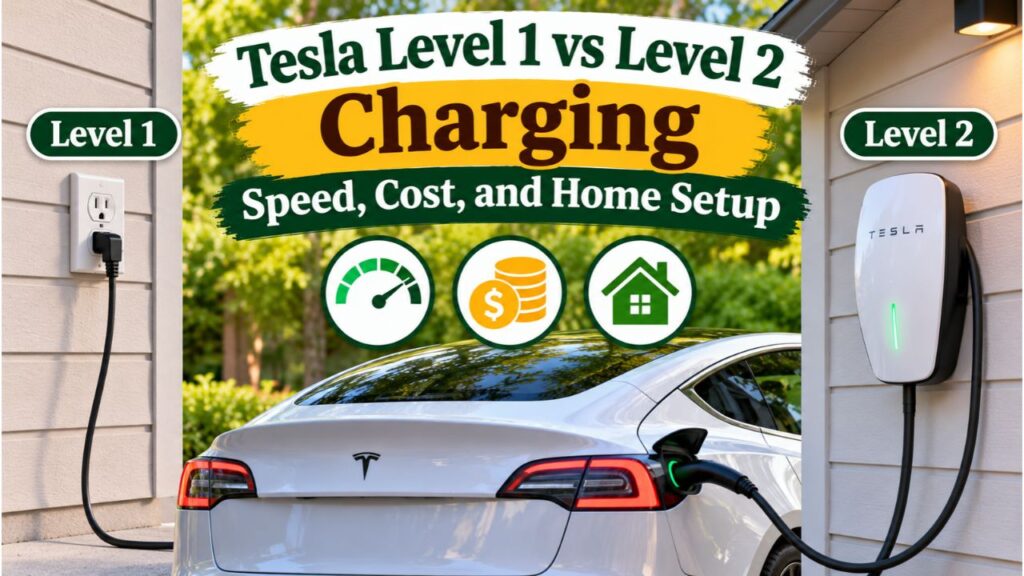
The biggest difference is the amount of electrical power delivered to the vehicle.
Level 1 uses a standard household outlet.
Level 2 uses a higher-voltage electrical circuit that can deliver substantially more power.
Tesla Level 1 vs Level 2 Comparison Table
| Feature | Level 1 Charging | Level 2 Charging |
| Standard U.S. voltage | 120V | 208V or 240V; typically 240V at home |
| Common home equipment | Tesla Mobile Connector | Tesla Mobile Connector or Wall Connector |
| Typical outlet or connection | NEMA 5-15 | Suitable 240V outlet or hardwired connection |
| Example charging current | 12A | 16A, 24A, 32A, 40A, or 48A |
| Example charging power | Approximately 1.4 kW | Approximately 3.8–11.5 kW |
| Tesla-rated range added per hour | Commonly 2–3 miles | Up to 44 miles, depending on equipment and vehicle |
| Charging speed | Slow | Moderate to fast home charging |
| Installation | May use a suitable existing outlet | Often requires a dedicated 240V circuit |
| Equipment cost | Generally lower | Varies by charging setup |
| Best for | Short daily trips and occasional charging | Regular commuting and overnight charging |
| Tesla Supercharger equivalent? | No | No |
The Tesla Home Charging guide identifies standard 120V charging as providing approximately 2–3 miles of range per hour. Its Wall Connector can provide up to 44 miles per hour of charging under suitable conditions.
The speeds represent estimated driving range added per hour of charging, not the physical speed of the vehicle.
Actual range gained varies with driving efficiency, vehicle configuration, temperature, battery conditions, and available charging power.
Key Takeaway: Level 1 is the simplest home charging option when a suitable outlet already exists. Level 2 charges much faster and is generally better suited to regular Tesla ownership.
What Is Tesla Level 1 Charging?
Tesla Level 1 charging uses a standard 120-volt household electrical outlet in North America.
It is commonly called trickle charging because the battery receives energy relatively slowly.
How Level 1 Charging Works
The standard Tesla Mobile Connector can be connected to a compatible NEMA 5-15 household outlet using the correct adapter.
Electricity flows from the outlet through the Mobile Connector to the vehicle.
The Tesla’s onboard charger converts the AC electricity into DC electricity for battery storage.
Tesla Level 1 Voltage and Amperage
A common Level 1 setup uses:
- 120 volts.
- A 15-amp electrical circuit.
- A maximum continuous charging current of 12 amps with the appropriate adapter.
- Approximately 1.4 kW of electrical input power.
The basic power formula is:
Power (watts) = Voltage × Current
For a 120V outlet operating at 12A:
120 × 12 = 1,440 watts
1,440 ÷ 1,000 = 1.44 kW
Actual usable charging power is lower after accounting for conversion losses and vehicle energy consumption.
How Fast Does Level 1 Charge a Tesla?
Tesla’s current home charging guidance describes a standard outlet as adding approximately 2–3 miles of range per charging hour.
That means a typical overnight charging session may restore enough range for a relatively short daily commute.
However, Level 1 can struggle to replace the energy used during longer trips.
Advantages of Level 1 Charging
Level 1 has several benefits:
- It may work with an existing suitable household outlet.
- It usually requires less new equipment.
- It can be sufficient for low-mileage driving.
- The Tesla Mobile Connector is portable.
- It allows charging at home without installing a full Wall Connector.
Limitations of Level 1 Charging
The main limitation is speed.
If you drive 50–80 miles a day, a standard outlet may not replace that energy during a typical overnight parking period.
Other limitations include:
- Reduced charging performance during certain cold-weather conditions.
- Less flexibility when returning home with a low battery.
- Longer recovery after road trips.
- Greater dependence on leaving the car plugged in for extended periods.
Best for: Drivers with short commutes, long parking periods, or occasional charging needs.
What Is Tesla Level 2 Charging?
Tesla Level 2 charging uses a higher-voltage AC electrical supply.
In U.S. homes, this usually means a 240-volt circuit.
Level 2 can deliver significantly more power than a standard 120V household outlet.
How Level 2 Charging Works
There are two common Tesla home charging arrangements:
Tesla Mobile Connector with a suitable 240V outlet
The Mobile Connector can use a compatible 240V adapter, such as a NEMA 14-50 adapter, to provide faster charging.
Tesla Wall Connector
The Wall Connector is a dedicated charging unit installed at a parking location.
It is hardwired into an appropriately designed electrical circuit.
Tesla Level 2 Charging Power
Depending on the equipment and circuit, Level 2 charging can operate at several power levels.
| Circuit Breaker | Charging Current | Approximate Power at 240V |
| 20A | 16A | 3.8 kW |
| 30A | 24A | 5.8 kW |
| 40A | 32A | 7.7 kW |
| 50A | 40A | 9.6 kW |
| 60A | 48A | 11.5 kW |
These are nominal calculations rounded for readability.
The Tesla Wall Connector supports the listed charging-current configurations where the installation and vehicle allow them.
However, the Mobile Connector has a maximum output of 32A.
How Fast Does Tesla Level 2 Charge?
According to the Tesla Wall Connector specifications, the Wall Connector can deliver:
- Up to 11.5 kW.
- Up to 48 amps.
- Up to 44 miles of range per hour for certain Tesla configurations.
Not every vehicle can accept the full 48A.
Some Tesla Model 3 and Model Y variants are limited to 32A for AC charging.
Advantages of Level 2 Charging
Level 2 offers several practical advantages:
- Faster overnight charging.
- More flexibility for long daily commutes.
- Quicker recovery after extended trips.
- Better ability to support multiple driving schedules.
- Convenient dedicated home charging equipment.
- Greater flexibility for scheduled off-peak charging.
Limitations of Level 2 Charging
The primary disadvantages are installation requirements and upfront expenses.
A suitable 240V circuit may not already exist near the parking location.
The electrical panel may also require evaluation.
Installation can involve a licensed electrician, permits, new wiring, and other costs.
Best for: Most regular Tesla drivers who want dependable overnight charging.
Tesla Level 1 vs Level 2 Charging Speed
Charging speed is usually the deciding factor.
A Tesla using Level 1 charging receives substantially less electricity per hour than the same vehicle connected to a suitable Level 2 charger.
Charging Speed by Equipment
| Charging Setup | Maximum Example Power | Approximate Tesla Range Added per Hour |
| Mobile Connector, 120V household outlet | 1.4 kW | Typically 2–3 miles |
| Mobile Connector, 240V/20A circuit | 3.8 kW | Up to around 15 miles |
| Mobile Connector, 240V/30A circuit | 5.8 kW | Up to around 22 miles |
| Mobile Connector, 240V/50A circuit | 7.7 kW | Up to around 30 miles |
| Wall Connector, 240V/60A circuit | 11.5 kW | Up to around 44 miles |
The figures represent maximum or approximate Tesla-published performance for supported configurations.
Actual speed varies by vehicle model and trim.
For example, a heavier Tesla may add fewer rated miles from the same electrical energy than a more efficient vehicle.
How Much Range Can You Add Overnight?
Suppose the vehicle is plugged in for eight hours.
| Charging Setup | Estimated Range Added in 8 Hours |
| Level 1 at 2 miles/hour | 16 miles |
| Level 1 at 3 miles/hour | 24 miles |
| Level 2 at 15 miles/hour | 120 miles |
| Level 2 at 30 miles/hour | Up to 240 miles |
| Level 2 at 44 miles/hour | Up to 352 miles |
These are mathematical examples based on the stated rates.
They assume the vehicle can maintain those rates for the full charging session, has enough empty battery capacity, and is not limited by its charge target.
The actual range added may be lower.
Why Level 2 Is Much Faster
At 120V and 12A, Level 1 provides roughly 1.44 kW.
At 240V and 32A, Level 2 provides approximately 7.68 kW.
7.68 ÷ 1.44 = 5.33
The 240V, 32A setup delivers about 5.3 times as much electrical input power as the 120V, 12A setup.
At 240V and 48A:
11.52 ÷ 1.44 = 8
The higher-power Wall Connector configuration delivers eight times the electrical input power.
However, that does not guarantee exactly eight times as many miles of driving range because charging losses and vehicle energy consumption vary.
Tesla Level 1 vs Level 2 Charging Time
Charging time depends on how much energy must be added to the battery.
It is also affected by charging losses, battery temperature, onboard charger capacity, and the selected charge limit.
Charging Time Formula
A basic estimate is:
Charging time (hours) = Energy needed (kWh) ÷ Charging power (kW)
For a more realistic estimate, use energy drawn from the wall rather than assuming all input electricity reaches the battery.
Example: Adding 20 kWh to the Battery
Suppose your Tesla needs 20 kWh of additional battery energy.
For illustration, assume the car draws 22 kWh from the wall to provide that energy.
This represents an illustrative loss assumption, not a guaranteed Tesla charging efficiency.
| Charging Setup | Approximate Wall Power | Estimated Charging Time |
| Level 1, 120V/12A | 1.44 kW | 15.3 hours |
| Level 2, 240V/16A | 3.84 kW | 5.7 hours |
| Level 2, 240V/24A | 5.76 kW | 3.8 hours |
| Level 2, 240V/32A | 7.68 kW | 2.9 hours |
| Level 2, 240V/48A | 11.52 kW | 1.9 hours |
The 48A example only applies when the vehicle and installation support that charging rate.
Actual charging time can differ because of temperature, power reductions, battery heating, and other conditions.
How Long Does a Tesla Take to Charge From 20% to 80%?
The answer depends on the battery’s usable capacity.
Suppose a hypothetical battery has 75 kWh of usable capacity.
Charging from 20% to 80% adds:
80% − 20% = 60%
75 × 0.60 = 45 kWh
Ignoring losses, the theoretical times would be:
- Level 1 at 1.44 kW: approximately 31.3 hours.
- Level 2 at 7.68 kW: approximately 5.9 hours.
- Level 2 at 11.52 kW: approximately 3.9 hours.
Actual times will be longer when charging losses and vehicle overhead are included.
This is a calculation example, not a claimed battery capacity for a specific Tesla trim.
Is a Full Charge Necessary Every Night?
No.
Most drivers don’t need to recharge from nearly empty to full every day.
Home charging is commonly used to replace the energy consumed during daily driving.
For example, someone who drives 25 miles a day usually needs to replace much less energy than someone recovering from a 200-mile trip.
Tesla recommends charging to the limit appropriate for the vehicle’s battery configuration.
Tesla Model 3 Level 1 vs Level 2 Charging
Tesla Model 3 charging speed depends on the vehicle’s configuration and onboard charger.
Model 3 With Level 1
Using a standard household outlet, Tesla’s current home guidance indicates approximately 2–3 miles of range added per hour.
For drivers with short daily commutes, that may be sufficient.
However, long charging sessions are required to restore larger amounts of energy.
Model 3 With Level 2
Depending on the configuration, a Model 3 may support up to 32A or 48A of AC charging.
Tesla’s Wall Connector data identifies certain Model 3 rear-wheel-drive configurations as limited to 32A, or approximately 7.7 kW.
Other supported versions can accept up to 48A.
Model 3 Charging Comparison
| Setup | Approximate Maximum AC Input | Example Range Added per Hour |
| Standard 120V outlet | 1.4 kW | Typically 2–3 miles |
| 240V Mobile Connector | 7.7 kW | Up to 30 miles |
| 240V Wall Connector, 32A-limited vehicle | 7.7 kW | Up to 30 miles |
| 240V Wall Connector, 48A-capable vehicle | 11.5 kW | Up to 44 miles |
These are supported-configuration estimates, not universal specifications for every model year.
Is a Wall Connector Worth It for a Model 3 RWD?
It may be, but not necessarily because of charging speed.
For a Model 3 limited to 32A, a suitable 240V Mobile Connector and a Wall Connector configured for 32A can provide the same maximum electrical charging power.
The Wall Connector may still offer convenience, hardwired installation, Wi-Fi features, and other charging-management capabilities.
Tesla Model Y Level 1 vs Level 2 Charging
Model Y generally follows the same basic comparison.
Level 1 can work for short-distance drivers, while Level 2 provides much faster daily energy recovery.
Model Y With Level 1
A standard outlet can typically add a few miles of range per hour.
This may be sufficient if the vehicle is parked for long periods and daily driving is limited.
However, drivers covering substantial mileage may struggle to replace all their energy overnight.
Model Y With Level 2
Some Model Y configurations support 32A charging, while others can support higher current.
Tesla’s Wall Connector guidance states that certain Model Y rear-wheel-drive and all-wheel-drive configurations are limited to 32A.
For these vehicles, increasing the Wall Connector circuit beyond what the onboard charger can use won’t increase the vehicle’s maximum AC charging rate.
Which Setup Is Better for Model Y?
For regular commuting, Level 2 is generally more convenient.
However, the ideal equipment depends on:
- Vehicle configuration.
- Maximum onboard charging current.
- Daily driving distance.
- Existing electrical circuit.
- Installation budget.
- Parking arrangements.
Before selecting a circuit, check the vehicle’s supported charging amperage.
Tesla directs owners to the lightning-bolt charging information on the vehicle touchscreen for this purpose.
Tesla Model S, Model X, and Cybertruck Charging
Different Tesla models can add different amounts of rated range from the same charging power.
Vehicle efficiency and supported charging current affect the result.
Tesla Wall Connector Charging Speeds by Model
Tesla publishes the following approximate maximum rates for supported configurations using a 240V Wall Connector:
| Tesla Model | At 32A | At 48A |
| Model S | 27 miles/hour | 41 miles/hour |
| Model 3, supported configuration | 30 miles/hour | 44 miles/hour |
| Model X | 23 miles/hour | 35 miles/hour |
| Model Y, supported configuration | 30 miles/hour | 44 miles/hour |
| Cybertruck | 20 miles/hour | 30 miles/hour |
Important: The 48A Model 3 and Model Y figures apply only to configurations capable of using that current. Some versions are limited to 32A.
Other trim-specific limitations may also apply.
Why Cybertruck Adds Fewer Miles per Hour
The amount of energy needed to drive one mile differs between vehicles.
A larger or heavier vehicle may consume more electricity per mile.
As a result, two Tesla vehicles receiving the same charging power can gain different amounts of estimated driving range per hour.
This doesn’t necessarily mean the electricity is entering one vehicle at a lower rate.
It reflects the relationship between electrical energy and driving efficiency.
Tesla Mobile Connector vs Wall Connector
Level 1 and Level 2 are charging categories.
Mobile Connector and Wall Connector are Tesla charging products.
They shouldn’t be confused with the charging levels themselves.
Tesla Mobile Connector
The Mobile Connector is portable and supports compatible electrical outlets.
Tesla’s current U.S. bundle includes:
- A 20-foot charging cable.
- A NEMA 5-15 adapter for standard 120V outlets.
- A NEMA 14-50 adapter for compatible 240V outlets.
- A storage bag.
The Mobile Connector can provide Level 1 or Level 2 charging depending on the outlet and adapter.
Its maximum current output is 32A.
Tesla Wall Connector
The Wall Connector is designed for a more permanent home installation.
It can provide up to 48A at 240V, equivalent to approximately 11.5 kW.
It also offers features such as Wi-Fi connectivity, charging management, and access controls.
Tesla recommends the Wall Connector for regular home charging.
Mobile Connector vs Wall Connector Comparison
| Feature | Mobile Connector | Wall Connector |
| Portable | Yes | No |
| Standard 120V outlet | Yes, with correct adapter | No |
| Compatible 240V outlet | Yes | Hardwired installation |
| Maximum current | 32A | 48A |
| Maximum nominal AC power at 240V | 7.7 kW | 11.5 kW |
| Maximum Tesla-rated range added per hour | Up to 30 miles | Up to 44 miles |
| Wi-Fi charging management | Primarily through vehicle/app controls | Additional Wall Connector features |
| Best use | Portable charging or suitable existing outlet | Regular dedicated home charging |
The Tesla Mobile Connector guide provides the current adapter and charging-speed information.
Do You Need a Wall Connector for Level 2?
No.
A Tesla Mobile Connector connected to an appropriate 240V outlet can provide Level 2 charging.
For a vehicle limited to 32A, this may match its maximum AC charging rate.
However, a Wall Connector can provide additional convenience and may support higher rates for compatible vehicles.
Tesla Level 1 vs Level 2 Charging Installation Cost
Installation cost is one of the most important differences.
Level 1 may use an existing household outlet, while Level 2 often requires new electrical work.
Level 1 Installation
If a suitable, properly grounded outlet already exists near your parking space, additional installation may be unnecessary.
However, the outlet and circuit must be appropriate for sustained EV charging.
An old or damaged receptacle should not be used simply because the connector fits.
Level 2 Installation
Level 2 may require:
- A dedicated 240V electrical circuit.
- A compatible receptacle or hardwired charging unit.
- Circuit breakers and wiring.
- Evaluation of electrical panel capacity.
- Proper grounding and required electrical protection.
- Permits and inspection where applicable.
Installation requirements depend on the property and local electrical code.
Current Tesla Hardware Prices
Tesla’s U.S. home-charging support page lists the following published hardware prices:
| Tesla Charging Equipment | Published Price |
| Mobile Connector | $300 |
| Wall Connector | $585 |
| Universal Wall Connector | $660 |
These are Tesla-listed U.S. prices at the time of this article and may change.
Taxes and installation charges are separate.
Tesla lists estimated installation costs of approximately 750–1,500 for a Wall Connector and 0–1,500 for a Mobile Connector setup, depending on whether an appropriate outlet already exists.
Actual electrician quotes may be higher or lower.
What Can Increase Level 2 Installation Cost?
Potential cost factors include:
- Distance from the electrical panel.
- Panel capacity limitations.
- Required service upgrades.
- Outdoor installation.
- Difficult cable routing.
- Permit fees.
- Local labor rates.
- Existing circuit condition.
A licensed electrician should assess the installation.
Is Level 2 Worth the Higher Upfront Cost?
For drivers who regularly travel moderate or long distances, the convenience can justify the installation expense.
For someone driving only a few miles a day, Level 1 may be sufficient without major electrical work.
The best choice depends on daily energy consumption and the amount of time available for charging.
Tesla Level 1 vs Level 2 Charging Electricity Cost
Level 2 charging isn’t automatically more expensive per mile simply because it supplies electricity faster.
Both methods generally use the same household electricity supply.
Your utility typically charges for electrical energy consumed, measured in kilowatt-hours.
Electricity Cost Formula
Charging cost = Electricity used (kWh) × Electricity rate ($/kWh)
For example, suppose a charging session draws 30 kWh from your household electrical supply.
At an illustrative electricity rate of $0.18 per kWh:
30 × $0.18 = $5.40
The cost would be $5.40 regardless of charging level if both sessions drew the same total amount of electricity at the same utility rate.
However, charging losses can differ.
Is Level 2 More Energy-Efficient?
Often, Level 2 can reduce some of the fixed energy overhead associated with a longer charging session.
For example, the vehicle’s electronics and battery-management systems may consume electricity while charging.
When a charging session takes much longer, these overhead loads can remain active for longer.
However, the actual efficiency difference depends on:
- Charging power.
- Ambient temperature.
- Battery temperature.
- Vehicle systems operating during charging.
- Charging equipment.
- Battery state of charge.
Don’t assume a fixed efficiency percentage for every Tesla.
Example: Monthly Tesla Charging Cost
Suppose you drive 30 miles per day.
Assume:
- 30 days of driving.
- An illustrative energy consumption of 0.30 kWh per mile.
- An illustrative 90% charging efficiency.
- An electricity rate of $0.18 per kWh.
Monthly driving:
30 × 30 = 900 miles
Battery energy used:
900 × 0.30 = 270 kWh
Estimated grid energy:
270 ÷ 0.90 = 300 kWh
Monthly electricity cost:
300 × $0.18 = $54
This is a hypothetical calculation, not a Tesla model-specific electricity estimate.
The actual energy consumption and charging efficiency can differ.
Can Off-Peak Charging Save Money?
Yes, if your electricity utility offers lower rates during particular hours.
Tesla allows owners to schedule home charging.
Depending on the available electricity plan, overnight charging may cost less than charging during peak demand hours.
Level 2 makes it easier to move a substantial amount of charging into a shorter off-peak window.
However, the benefit depends on your utility’s rate structure.
Level 1 vs Level 2: Which Is Better for Daily Driving?
The best charging setup depends more on your daily mileage than your vehicle’s advertised maximum range.
Daily Mileage Comparison
Using Tesla’s approximate Level 1 rate of 2–3 miles of added range per hour:
| Daily Driving | Level 1 Time Needed to Replace Rated Range |
| 10 miles | About 3.3–5 hours |
| 20 miles | About 6.7–10 hours |
| 30 miles | About 10–15 hours |
| 40 miles | About 13.3–20 hours |
| 60 miles | About 20–30 hours |
| 80 miles | About 26.7–40 hours |
These estimates use the published range-added rates and aren’t guaranteed charging times.
If You Drive 10–20 Miles a Day
Level 1 may be enough.
For example, replacing 20 miles of rated range could take approximately 7–10 hours with typical Level 1 charging.
If the car is parked overnight for 10–12 hours, that may fit your routine.
If You Drive 30–40 Miles a Day
Level 1 becomes less convenient.
A 40-mile commute may require more than 13 hours of charging.
If you arrive home late and leave early, the battery may gradually lose charge over several days.
Level 2 provides more flexibility.
If You Drive 60–80 Miles a Day
Level 2 is generally the more practical choice.
A suitable 240V setup can restore much more energy during an overnight charging session.
This is especially valuable when your driving schedule changes unexpectedly.
What About Occasional Long Trips?
Even drivers with short commutes may find Level 2 useful after a long road trip.
Level 1 may require several nights to restore a substantial amount of battery energy.
Level 2 can reduce that recovery period considerably.
Key Takeaway: Level 1 can work for low daily mileage. Level 2 becomes increasingly valuable as daily driving distance increases or overnight charging time decreases.
Is Tesla Level 1 or Level 2 Charging Better for Battery Health?
Both Level 1 and Level 2 are normal AC charging methods supported by Tesla.
Neither should be assumed to damage the battery simply because one charges faster.
How Tesla Controls Charging
Tesla vehicles contain an onboard charger and battery-management system.
These systems manage charging based on vehicle capabilities and battery conditions.
A Wall Connector doesn’t force the battery to accept more current than the vehicle allows.
If the onboard charger is limited to 32A, connecting it to an appropriately configured higher-capacity Wall Connector doesn’t make the vehicle draw 48A.
What Matters More Than Charging Level?
Battery-care practices include:
- Following the vehicle’s recommended daily charge limit.
- Avoiding prolonged storage at very low or high states of charge.
- Charging regularly rather than repeatedly running the battery extremely low.
- Managing charging during very hot or cold conditions.
- Following vehicle-specific instructions.
Tesla’s Range Tips and Battery Health guidance recommends checking the charge limit shown for the installed battery configuration.
Should Every Tesla Be Charged to 80%?
No universal charge target applies to every Tesla.
For vehicles with a recommended daily limit of 80%, Tesla advises following that setting during regular use.
Other battery configurations may have different instructions.
Use the recommendation displayed by your specific vehicle.
Is Level 2 Better Than Supercharging for Daily Use?
Level 2 is generally a practical choice for regular home charging.
Supercharging is DC fast charging, designed to deliver substantially more power when traveling or when rapid charging is needed.
Tesla recommends home charging when practical and using Superchargers for road trips and longer drives.
Tesla Level 1 vs Level 2 Charging in Cold Weather
Cold temperatures can affect charging performance.
This is especially noticeable with low-power Level 1 charging.
Why Cold Weather Matters
A cold battery may need heating before or during charging.
Some electricity entering the vehicle can be used for thermal management instead of immediately increasing stored battery energy.
This can reduce the net energy added to the battery.
Level 1 in Winter
Because Level 1 provides limited electrical power, battery heating and other vehicle loads can consume a significant portion of the available energy.
Charging may become very slow under some cold-weather conditions.
Level 2 in Winter
Level 2 generally has more electrical power available.
This can make it better suited to restoring energy while also supporting battery thermal management.
However, actual charging rates still depend on the vehicle and temperature.
Practical Cold-Weather Tips
Park in a suitable sheltered location when possible.
Plug in regularly.
Use charging schedules and battery preconditioning features according to Tesla’s instructions.
Avoid relying on last-minute Level 1 charging before a long winter drive.
Tesla Level 1 vs Level 2 Charging Safety
Both charging levels can be used safely when the electrical system and equipment are appropriate.
However, EV charging creates a sustained electrical load.
A standard household outlet shouldn’t automatically be considered suitable simply because it works for other appliances.
Use Properly Rated Electrical Equipment
The outlet, wiring, circuit breaker, and charging equipment must be compatible.
For example, a standard 15A household circuit with a suitable Tesla adapter normally supports 12A continuous charging.
Tesla’s 48A Wall Connector configuration requires a properly designed higher-capacity circuit.
Don’t Use Extension Cords or Power Strips
Tesla’s Mobile Connector Owner’s Manual warns against using:
- Extension cords.
- Multi-outlet adapters.
- Power strips.
- Conversion plugs.
- Improvised plug arrangements.
These devices can introduce overheating and electrical hazards.
Check the Outlet Condition
Don’t charge from a damaged, loose, or visibly worn receptacle.
A properly grounded outlet is required.
If the outlet becomes unusually hot, shows discoloration, or causes repeated charging interruptions, stop using it and have the electrical installation inspected.
Use a Qualified Electrician
New 240V wiring and Wall Connector installation should be handled by a qualified electrician familiar with EV charging.
The installation should comply with applicable local electrical regulations.
A professional can evaluate circuit capacity, wiring, grounding, electrical protection, and installation location.
Don’t Assume a 240V Outlet Is Automatically Suitable
Not every existing 240V outlet is appropriate for repeated EV charging.
A plug that physically matches an adapter doesn’t establish that the wiring, receptacle, breaker, and electrical connections are suitable.
Have the circuit evaluated before relying on it.
Follow Charging Equipment Instructions
Use the correct Tesla-approved adapters and manufacturer instructions.
Don’t modify charging connectors or bypass electrical protection.
Important: Electrical safety is more important than maximizing charging speed. Never increase charging current beyond the rating of the installation.
Is a Tesla Wall Connector Worth Installing?
For many regular Tesla drivers, yes.
However, the Wall Connector isn’t the only practical Level 2 option.
When the Wall Connector Makes Sense
Consider a Wall Connector when:
- You drive moderate or long distances regularly.
- You want a dedicated home charging station.
- You own a Tesla that can use higher AC charging current.
- You want convenient cable management.
- You want Wi-Fi charging features and management options.
- Your household may eventually have multiple EVs.
- You have a suitable location for permanent installation.
When the Mobile Connector May Be Enough
A Mobile Connector may be sufficient when:
- Your daily mileage is low.
- You already have a suitable 240V outlet.
- Your Tesla is limited to 32A.
- You want portable charging equipment.
- You don’t need additional Wall Connector functionality.
Does a 60A Circuit Always Make Sense?
No.
Some Tesla configurations accept only 32A of AC charging.
For those vehicles, a 60A circuit doesn’t provide additional charging speed.
A suitable 40A circuit can support 32A charging with appropriately installed and configured equipment.
Future vehicle needs and electrical capacity may still influence the installation decision.
How to Choose the Right Tesla Home Charging Setup
Before buying equipment, evaluate four factors.
1. Check Your Daily Mileage
Estimate how far you drive on a typical day.
A short commute may be compatible with Level 1.
Longer daily driving usually favors Level 2.
2. Check Overnight Parking Time
Determine how many hours the vehicle will normally remain plugged in.
If you have only six or seven hours each night, Level 1 may not replace enough energy.
A longer parking period gives Level 1 more opportunity to recover range.
3. Check Your Tesla’s Maximum AC Charging Current
Consult the Tesla charging screen and vehicle-specific documentation.
Different configurations can have different onboard charging limits.
Don’t assume that every Tesla can charge at 48A.
4. Evaluate the Home Electrical System
A licensed electrician can determine whether the property supports a suitable 240V outlet or Wall Connector.
The assessment should consider panel capacity, wiring, existing circuits, and local electrical requirements.
Tesla Charging Setup Recommendations
| Situation | Practical Choice |
| Short daily commute, suitable 120V outlet | Level 1 may be sufficient |
| Moderate commute, existing suitable 240V outlet | Mobile Connector Level 2 |
| Long daily commute | Level 2 |
| Tesla limited to 32A | 32A-capable Level 2 setup |
| Tesla capable of 48A | Wall Connector may provide faster charging |
| Multiple EV household | Evaluate Wall Connector power management and capacity |
| Renting with limited electrical access | Level 1 if approved and suitable, or available shared Level 2 |
| Frequent long-distance driving | Dedicated home Level 2 generally offers greater convenience |
For most homeowners planning to keep an EV long-term, Level 2 is a strong general-purpose solution.
However, using an existing suitable 120V outlet isn’t automatically inadequate for someone who drives very little.
Common Mistakes When Comparing Tesla Level 1 and Level 2 Charging
Assuming Every Tesla Charges at 44 Miles per Hour on Level 2
Charging speed depends on the vehicle configuration and available current.
Some Tesla vehicles cannot use the maximum Wall Connector output.
Confusing Level 2 With Supercharging
Level 2 is AC charging.
Tesla Superchargers provide DC fast charging.
They serve different purposes.
Assuming a 240V Outlet Automatically Provides 48A
The available current depends on the circuit and charging equipment.
The Tesla Mobile Connector is limited to 32A.
Buying a Wall Connector Without Checking Panel Capacity
The home’s electrical system may need evaluation before installation.
A larger circuit isn’t always available or necessary.
Using an Extension Cord for Level 1
Tesla warns against extension cords and power strips with the Mobile Connector.
Use an appropriate direct electrical connection.
Assuming Level 2 Costs More per kWh
Both charging levels use electricity measured in kilowatt-hours.
The total cost depends on electricity rates, energy consumption, and charging losses.
Assuming Level 1 Is Always Enough for Overnight Charging
Level 1 may not replace the electricity consumed during a long commute.
Compare daily driving needs with actual overnight charging time.
Ignoring Cold-Weather Performance
Battery heating and temperature management can reduce net charging speed.
Low-power charging may be particularly affected.
Using the Wrong Battery Charge Limit
Tesla battery configurations can have different recommendations.
Follow the limit displayed for the specific vehicle.
Paying for More Charging Power Than the Vehicle Can Accept
A 48A-capable Wall Connector won’t increase AC charging speed for a Tesla limited to 32A.
Choose the installation according to the vehicle and future needs.
Which Is Better: Tesla Level 1 or Level 2 Charging?
Level 2 is generally better for daily convenience, while Level 1 can be enough for low-mileage driving.
Neither option is universally best.
The decision depends on how much energy you need to replace and how much time the vehicle can remain connected.
Choose Level 1 If:
- You drive relatively short distances.
- You have long overnight parking periods.
- A suitable household outlet already exists.
- You want to minimize initial electrical work.
- Your vehicle can remain plugged in regularly.
Choose Level 2 If:
- You drive moderate or long distances daily.
- You want to restore substantial range overnight.
- You need quicker recovery after road trips.
- You want a dedicated charging installation.
- Your household has multiple charging needs.
- You want greater flexibility for electricity-rate schedules.
Best Overall Home Charging Choice
For regular Tesla ownership, I generally recommend a properly installed Level 2 charging setup when the budget and electrical system allow it.
A suitable 240V Mobile Connector arrangement may be enough for a 32A-limited vehicle.
A Wall Connector is especially useful when you want permanent equipment, additional features, or higher AC charging power for a compatible Tesla.
However, Level 1 remains a reasonable solution for some drivers who cover fewer miles and have sufficient parking time.
Conclusion
In the comparison of Tesla Level 1 vs Level 2 charging, the most important difference is charging speed.
Level 1 uses a standard 120V outlet and typically adds about 2–3 miles of range per hour.
Level 2 uses 240V power and can add up to 30 miles per hour with Tesla’s Mobile Connector or up to 44 miles per hour with a Wall Connector and compatible vehicle.
For short daily commutes, Level 1 may be sufficient, especially if the vehicle remains plugged in for long periods.
For regular commuting, longer trips, or more predictable overnight charging, Level 2 offers substantially greater convenience.
I recommend checking your Tesla’s maximum AC charging current, typical daily mileage, available overnight charging hours, and existing electrical system before selecting equipment.
A Wall Connector isn’t automatically necessary for every Tesla. Some configurations reach their maximum AC charging speed with an appropriate 240V Mobile Connector setup.
Ultimately, the best Tesla home charger is the one that safely replaces your daily energy use, fits your schedule, and matches your vehicle’s actual charging capabilities.
FAQs About Tesla Level 1 vs Level 2 Charging
How Much Faster Is Tesla Level 2 Charging Than Level 1?
It depends on the specific electrical setup.
A 120V, 12A Level 1 connection provides about 1.44 kW of input power.
A 240V, 32A Level 2 connection provides approximately 7.68 kW, or about 5.3 times as much.
A compatible 48A Wall Connector setup delivers approximately 11.5 kW.
Actual range-added differences vary with the vehicle and charging conditions.
Can You Charge a Tesla With a Regular 120V Outlet?
Yes.
A Tesla Mobile Connector with the correct NEMA 5-15 adapter can use a suitable standard 120V household outlet.
Tesla generally estimates approximately 2–3 miles of range added per hour under typical home charging conditions.
The outlet and circuit must be properly grounded, in good condition, and suitable for sustained EV charging.
Is Tesla Level 1 Charging Enough for Daily Driving?
It can be.
For drivers traveling approximately 10–20 miles per day, Level 1 may replace enough range during overnight charging.
For 40 miles or more per day, it may be insufficient without unusually long charging periods.
How Many Miles Does Tesla Level 2 Add per Hour?
A Tesla Mobile Connector using a suitable 240V outlet can add up to approximately 30 miles per hour.
A Wall Connector can add up to approximately 44 miles per hour for supported vehicle configurations.
Actual performance depends on the Tesla model, onboard charger, current limit, and battery conditions.
Is a Tesla Wall Connector Level 2?
Yes.
The Tesla Wall Connector provides AC Level 2 charging in a typical U.S. residential installation.
It can provide up to 48A at 240V, equivalent to approximately 11.5 kW, when the installation and vehicle support that rate.
Is Tesla Mobile Connector Level 1 or Level 2?
It can provide either.
With a standard 120V NEMA 5-15 outlet, it provides Level 1 charging.
With a compatible 240V outlet and adapter, it provides Level 2 charging.
The Mobile Connector has a maximum output of 32A.
Does Tesla Level 2 Charging Cost More Than Level 1?
Level 2 equipment and installation may have higher upfront costs.
However, the electricity price per kilowatt-hour is generally determined by your utility tariff, not the charging level.
Total charging cost can differ because of charging losses and electricity-rate schedules.
Is Level 1 or Level 2 Charging Better for Tesla Battery Health?
Both are supported AC charging methods.
Neither is inherently unsuitable for regular battery charging when used correctly.
Following Tesla’s recommended charge limit, avoiding prolonged extreme states of charge, and managing temperature are generally more important than choosing between Level 1 and Level 2.
Can You Charge a Tesla at 240V Without a Wall Connector?
Yes.
A Tesla Mobile Connector with a compatible 240V adapter can provide Level 2 charging.
An existing outlet should be evaluated to confirm it is suitable for EV charging.
Do You Need a 60-Amp Circuit for a Tesla Wall Connector?
No.
A Tesla Wall Connector can be configured for lower circuit ratings.
A 60A circuit supports its maximum 48A output.
However, a vehicle limited to 32A doesn’t benefit from the additional available current.
Have a qualified electrician determine the appropriate installation.
Will a Tesla Model 3 Charge Faster With a Wall Connector?
It depends on the vehicle configuration.
A Model 3 capable of 48A can charge faster with a suitably installed Wall Connector than with a 32A Mobile Connector.
For a Model 3 limited to 32A, both setups can offer the same maximum AC charging power.
How Long Does Tesla Level 1 Take to Charge Overnight?
An eight-hour charging period at Tesla’s typical 2–3 miles-per-hour Level 1 rate may restore approximately 16–24 miles of estimated range.
Actual results depend on the vehicle, temperature, and charging conditions.
Can Tesla Level 1 Charging Work in Winter?
Yes, but charging may be slower.
Battery heating and other vehicle energy demands can consume a meaningful share of the available power.
Level 2 is often more convenient in cold conditions because substantially more electrical power is available.
Is Tesla Level 2 Charging the Same as Supercharging?
No.
Level 2 uses AC electricity, typically from a 240V source at home or work.
Superchargers provide much higher-power DC fast charging.
The vehicle’s onboard AC charger is used for Level 1 and Level 2 but isn’t responsible for converting incoming Supercharger DC power in the same way.
Should I Install Level 2 Charging if I Drive Only 20 Miles a Day?
Not necessarily.
If Level 1 can replace your daily energy use during the hours you’re parked, a new Level 2 installation may not be essential.
However, Level 2 can offer more flexibility for occasional longer drives, cold weather, and changing schedules.
Can You Use an Extension Cord for Tesla Level 1 Charging?
No.
Tesla’s Mobile Connector manual warns against using extension cords, power strips, and conversion plugs.
Use a suitable electrical outlet with the correct adapter and have the installation inspected if its condition or capacity is uncertain.