
The main difference between Level 1, Level 2, and Level 3 EV charging is charging speed and electrical power. Level 1 uses a standard 120-volt household outlet, Level 2 uses a higher-powered 240-volt connection, and Level 3—commonly called DC fast charging—uses specialized equipment to recharge an electric vehicle much faster.
Level 1 charging typically adds 2–5 miles of driving range per hour, while Level 2 adds approximately 10–30 miles per hour. DC fast charging can add around 100–200 or more miles in 30 minutes, depending on the vehicle, charging station, battery temperature, and charge level.
However, faster charging isn’t always necessary. Many EV drivers can meet their daily needs with home charging, while DC fast chargers are particularly valuable during highway trips or when a quick recharge is needed.
Choosing the right charging method affects installation costs, convenience, charging expenses, and how quickly your vehicle is ready to drive.
In this article, I compare Level 1 vs Level 2 vs Level 3 charging by speed, voltage, power output, charging time, and cost. You’ll also learn about charging connectors, battery compatibility, home installation requirements, and which charging level is most practical for daily driving and road trips.
Level 1 vs Level 2 vs Level 3 Charging: Quick Comparison
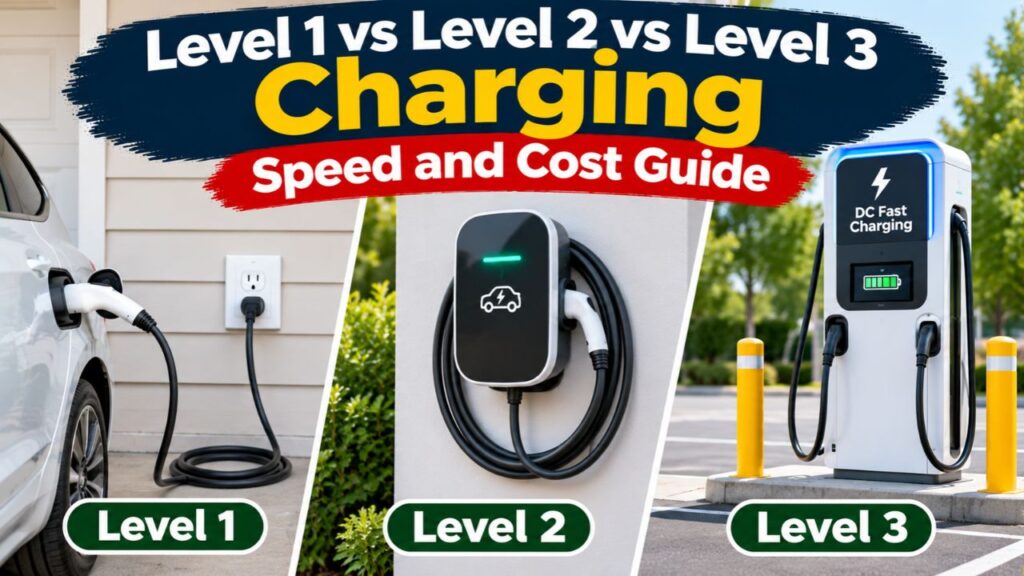
Level 1 is the slowest and simplest charging option, Level 2 provides faster AC charging for everyday use, and Level 3 delivers high-powered DC charging primarily at public stations.
The U.S. Department of Energy’s Alternative Fuels Data Center identifies three common EV charging categories: AC Level 1, AC Level 2, and DC fast charging.
Although DC fast charging is frequently called Level 3, DC fast charging is the more precise term because Level 3 does not describe one standardized power output.
EV Charging Levels Comparison Chart
| Feature | Level 1 | Level 2 | Level 3 / DC Fast |
| Power supply | AC | AC | DC delivered to vehicle |
| Typical U.S. supply | 120V | 208–240V | Commercial high-power electrical infrastructure |
| Charging power | About 1.4–1.9 kW | About 2.9–19.2 kW | Commonly 50–350 kW; some stations higher |
| Typical range added | 2–5 miles/hour | 10–30 miles/hour | 100–200+ miles/30 minutes |
| Charging location | Home, limited workplaces | Home, work, public parking | Highways and public charging hubs |
| Installation | Suitable existing outlet | Dedicated circuit and charging equipment | Specialized commercial installation |
| Common connectors | J1772, J3400/NACS | J1772, J3400/NACS | CCS1, J3400/NACS, CHAdeMO |
| Typical use | Short daily trips | Daily EV charging | Road trips and quick recharging |
| Home installation | Usually straightforward | Commonly practical | Generally impractical |
| Relative equipment cost | Lowest | Moderate | Highest |
Charging speeds are broad estimates for compatible vehicles. Actual results depend on charging power, battery capacity, vehicle efficiency, temperature, and other conditions.
Which Charging Level Is Best?
For most drivers:
- Level 1: Suitable for short daily commutes, plug-in hybrids, and drivers who can leave their vehicles plugged in for long periods.
- Level 2: Usually the most convenient option for routine home charging, larger batteries, and longer commutes.
- Level 3: Best for long-distance travel, charging stops, and situations requiring substantial range in a short time.
Level 3 is the fastest option, but that doesn’t make it the most practical or economical choice for every charging session.
What Is Level 1 EV Charging?
Level 1 charging uses a standard 120-volt AC household electrical supply in the United States.
It is the slowest common EV charging method.
Many vehicles support Level 1 charging through a compatible portable charging cable.
However, a portable cordset isn’t included with every new EV, so check the vehicle’s supplied equipment.
How Does Level 1 Charging Work?
A compatible charging cord connects a suitable household electrical outlet to the vehicle.
Electricity flows from the outlet as alternating current.
The vehicle’s onboard charger converts the AC electricity into DC electricity that can charge the battery.
The charging equipment also communicates with the vehicle and provides important electrical safety functions.
Level 1 Charging Voltage and Power
Typical Level 1 charging characteristics include:
- Voltage: 120V AC.
- Common charging current: 12 amps on a suitable 15-amp circuit.
- Charging power at 12 amps: approximately 1.44 kW.
- Higher-power Level 1 equipment: up to approximately 1.9 kW where supported.
Actual charging current must match the circuit, charging equipment, and vehicle requirements.
How Fast Is Level 1 Charging?
Level 1 charging commonly adds approximately 2–5 miles of driving range per hour.
For illustration:
| Charging time | Approximate range added |
| 4 hours | 8–20 miles |
| 6 hours | 12–30 miles |
| 8 hours | 16–40 miles |
| 10 hours | 20–50 miles |
| 12 hours | 24–60 miles |
These estimates depend on the vehicle’s efficiency and charging conditions.
A cold battery, large vehicle, or use of battery heating may reduce the net range added.
Advantages of Level 1 Charging
Level 1 is appealing because it often requires no dedicated 240V charging installation.
It can work well for:
- Drivers with short commutes.
- Plug-in hybrid electric vehicles.
- Households with limited charging budgets.
- Vehicles parked for long periods.
- Drivers who don’t use much battery energy each day.
Limitations of Level 1 Charging
The major limitation is speed.
A driver who routinely travels 70–100 miles per day may struggle to replace that energy overnight using Level 1.
It can also take more than a day to recover a large amount of battery capacity.
Is Level 1 Charging Good Enough?
Yes, for some drivers.
If you drive approximately 20 miles daily and can charge overnight for 10 hours, Level 1 may replenish the energy used during a typical day.
However, you must consider your particular EV’s efficiency, charging losses, climate, and available charging hours.
Key Takeaway: Level 1 charging is slow but practical for low-mileage driving, small batteries, and situations where charging time isn’t a major concern.
What Is Level 2 EV Charging?
Level 2 charging uses a higher-voltage AC electrical supply.
In U.S. residential installations, it generally operates at 240 volts.
Commercial locations may provide 208 volts.
Level 2 is widely used for home, workplace, and public destination charging.
How Does Level 2 Charging Work?
A Level 2 charging unit supplies AC electricity to the vehicle.
The onboard charger converts the incoming AC electricity into DC electricity for the battery.
Compared with Level 1, the higher voltage and available current allow much greater charging power.
Level 2 Charging Voltage and Power
Level 2 equipment can operate at different current ratings.
Common residential examples include:
| Charging current | Voltage | Approximate charging power |
| 16 amps | 240V | 3.84 kW |
| 24 amps | 240V | 5.76 kW |
| 32 amps | 240V | 7.68 kW |
| 40 amps | 240V | 9.60 kW |
| 48 amps | 240V | 11.52 kW |
These figures represent electrical power supplied by the equipment under the stated conditions.
They don’t guarantee the same power reaches the battery.
The vehicle’s onboard charger may limit the charging rate.
How Fast Is Level 2 Charging?
The Department of Energy commonly estimates approximately 10–30 miles of range per hour, although some higher-powered setups can provide more.
For illustration, at 25 miles of range per hour:
| Charging time | Approximate range added |
| 1 hour | 25 miles |
| 2 hours | 50 miles |
| 4 hours | 100 miles |
| 6 hours | 150 miles |
| 8 hours | 200 miles |
These are example range estimates, not guaranteed results.
Is Level 2 Charging Good for Home Use?
Yes.
Level 2 is generally the most practical home-charging option for drivers who need substantially more energy than Level 1 can provide overnight.
The U.S. Environmental Protection Agency’s home charging guide identifies Level 2 as particularly useful for longer commutes, charging multiple EVs, and faster daily charging.
Advantages of Level 2 Charging
Level 2 provides several benefits:
- Faster overnight charging.
- More flexibility for longer daily commutes.
- Convenient home charging.
- Compatibility with many EVs.
- Workplace and public destination charging options.
- Smart charging and scheduling features on some units.
Limitations of Level 2 Charging
Level 2 usually requires a suitable dedicated circuit and charging equipment.
Installation costs vary with:
- Electrical panel capacity.
- Distance from the panel to the parking area.
- Existing wiring.
- Required permits.
- Charging current.
- Outlet or hardwired installation.
- Possible electrical service upgrades.
A qualified electrician should assess these requirements.
Is Level 2 Worth Installing?
For many EV owners, yes.
If Level 1 can comfortably replace your daily driving energy, an upgrade may not be necessary.
However, Level 2 provides more charging flexibility and can be especially useful for larger battery packs.
Key Takeaway: Level 2 charging offers a practical balance of charging speed, home installation feasibility, and everyday convenience.
What Is Level 3 EV Charging?
Level 3 charging generally refers to DC fast charging (DCFC).
It is designed to transfer substantially more power to an EV battery than typical AC charging equipment.
Unlike Level 1 and Level 2, DC fast chargers convert electrical power outside the vehicle and deliver controlled DC electricity through a compatible charging connection.
How Does DC Fast Charging Work?
A DC fast charging station receives electricity from the grid.
Its power electronics convert and regulate that electricity for delivery to the EV battery.
The charging station and vehicle communicate to determine the power the battery can safely accept.
The vehicle’s battery management system monitors conditions such as battery temperature and state of charge.
Level 3 Charging Power
Public DC fast chargers have different power ratings.
Common examples include:
- 50 kW.
- 100 kW.
- 150 kW.
- 250 kW.
- 350 kW.
Some newer infrastructure supports higher power outputs.
However, a charger rated at 350 kW does not mean every vehicle will charge at 350 kW.
How Fast Is Level 3 Charging?
The Department of Energy estimates that compatible DC fast charging can add approximately 100–200 or more miles of range in 30 minutes.
However, charging performance varies significantly among EVs.
Some vehicles can charge from 10% or 20% to 80% in approximately 20–30 minutes under favorable conditions.
Others need substantially longer.
Advantages of Level 3 Charging
DC fast charging is particularly valuable for:
- Highway road trips.
- Quick charging stops.
- Long-distance drivers.
- Public charging hubs.
- Drivers without reliable home charging.
- Situations requiring rapid energy replenishment.
Limitations of Level 3 Charging
DC fast charging has several disadvantages compared with typical home charging:
- Public charging may cost more per kWh.
- Charging speed depends heavily on the vehicle.
- Charging slows as the battery approaches full.
- Station compatibility must be confirmed.
- High-powered infrastructure is expensive.
- Charging queues or unavailable stations can delay travel.
Can You Install Level 3 Charging at Home?
For a typical residential property, DC fast charging is generally impractical.
High-power DC charging stations require specialized electrical infrastructure and substantial installation costs.
Level 1 or Level 2 charging is normally the appropriate residential solution.
Key Takeaway: Level 3 charging is designed for fast energy replenishment, especially during travel. It is not usually necessary for routine overnight home charging.
Level 1 vs Level 2 vs Level 3 Charging Speed
The charging-level differences become clearer when comparing how much electrical energy each method can deliver.
Typical Charging Speed Comparison
| Charging type | Illustrative power | Primary charging purpose |
| Level 1 | 1.44 kW | Slow household charging |
| Level 2 | 7.68 kW | Routine home charging |
| DC fast | 150 kW rated station | Rapid public charging |
The numbers describe equipment power, not necessarily the rate the battery accepts throughout a session.
How Much Faster Is Level 2 Than Level 1?
Using the example power ratings:
7.68 ÷ 1.44 = 5.33
A 7.68-kW Level 2 unit can deliver approximately 5.3 times the electrical power of a 1.44-kW Level 1 setup.
That doesn’t guarantee an identical ratio in actual battery charging time.
Charging losses and vehicle limits affect the result.
How Much Faster Is Level 3 Than Level 2?
A 150-kW DC fast charger has a much higher rated output than a 7.68-kW Level 2 unit.
However, DC charging power changes throughout a session.
The vehicle may accept its highest charging rate only over part of the battery’s charge range.
Therefore, dividing the two equipment ratings doesn’t accurately predict real-world time savings.
How Long Does It Take to Charge an EV at Each Level?
Charging time depends on how much energy the battery needs, not just the charger rating.
A vehicle with a large battery generally takes longer to charge than one with a small battery at the same effective power.
Example: Charging a 60-kWh Battery From 20% to 80%
Suppose an EV has a usable battery capacity of 60 kWh.
You want to charge from 20% to 80%.
Energy required:
60 × (0.80 − 0.20) = 36 kWh
The battery must receive approximately 36 kWh.
Charging Time Comparison
| Charging method | Assumed power | Ideal mathematical time |
| Level 1 | 1.44 kW | 25 hours |
| Level 2 | 7.68 kW | 4.69 hours |
| DC fast | Average 72 kW | 30 minutes |
These are idealized energy calculations.
Actual Level 1 and Level 2 charging takes longer because some electricity is lost in the charging process.
The DC example assumes an average delivered power of 72 kW, not a 72-kW peak charger rating.
DC fast charging time is especially sensitive to the vehicle’s charging curve.
Why Is Actual Charging Time Different?
Several factors affect charging duration:
- Battery size.
- Starting state of charge.
- Target state of charge.
- Battery temperature.
- Vehicle maximum charging rate.
- Station power rating.
- Charging losses.
- Battery management limits.
- Shared station power.
Use the manufacturer’s estimated charging time for the vehicle and charging setup whenever available.
What Is the Difference Between kW and kWh?
Understanding kilowatts and kilowatt-hours helps explain EV charging speed.
Kilowatts (kW)
Kilowatts measure electrical power.
A higher kW rating generally means electricity can be delivered faster, assuming the vehicle can accept it.
For example:
- A 7.7-kW home charger provides approximately 7.7 kW of electrical power.
- A 150-kW DC charger has a maximum rated power of 150 kW.
Kilowatt-Hours (kWh)
Kilowatt-hours measure energy.
EV battery capacity is commonly expressed in kWh.
For example, a 60-kWh battery can store approximately 60 kWh of usable energy if that is its stated usable capacity.
EV Charging Time Formula
A simple estimate is:
Charging time (hours) = Energy needed (kWh) ÷ Average charging power (kW)
Suppose your EV needs 24 kWh.
At a constant 6-kW battery charging rate:
24 ÷ 6 = 4 hours
Real charging takes longer when the average power is lower than expected or charging losses must be considered.
EV Charging Power Formula
For a simple single-phase AC example:
Power (kW) = Voltage × Current ÷ 1,000
At 240 volts and 32 amps:
240 × 32 ÷ 1,000 = 7.68 kW
This formula helps explain home charging ratings.
Commercial three-phase and DC systems require calculations appropriate to their electrical characteristics.
Level 1 vs Level 2 vs Level 3 Charging Cost
Charging cost depends on electricity prices, the energy added, and the provider’s pricing structure.
Charging faster does not automatically mean consuming more battery energy. However, charging efficiency and the price per kWh can differ.
Level 1 Charging Cost
Level 1 charging at home generally uses the household electricity rate.
If your utility charges $0.15 per kWh, using 20 kWh from the electrical outlet costs:
20 × $0.15 = $3.00
This example does not include any additional fixed utility charges.
Level 2 Charging Cost
Home Level 2 charging generally uses the same residential electricity tariff as Level 1.
A 7.7-kW charger does not automatically cost more per kWh simply because it charges faster.
However, electricity losses may differ, and some utilities use time-of-use pricing.
Level 3 Charging Cost
Public DC fast charging often costs more than home charging.
Prices may include:
- Per-kWh energy charges.
- Per-minute charges where applicable.
- Session fees.
- Idle fees.
- Membership discounts.
- Time-dependent pricing.
The actual price varies by network, station, and location.
Charging Cost Example
Assume you purchase 30 kWh of electricity.
| Charging location | Example electricity rate | Cost for 30 kWh |
| Home Level 1 | $0.15/kWh | $4.50 |
| Home Level 2 | $0.15/kWh | $4.50 |
| Public DC fast | $0.45/kWh | $13.50 |
These are illustrative rates, not current national averages or guaranteed station prices.
The same amount of metered electricity costs three times as much at $0.45/kWh as at $0.15/kWh.
However, the actual battery energy gained may differ because charging losses and station billing methods vary.
Is Level 2 Cheaper Than Level 1?
Not necessarily per kWh.
Both generally use residential electricity when charged at home.
Level 2 may offer better charging efficiency in some conditions, but the result depends on the vehicle and equipment.
The larger financial difference is often between residential charging and public DC fast charging.
How to Reduce EV Charging Costs
Consider:
- Charging at home when practical.
- Checking utility off-peak rates.
- Scheduling charging during cheaper periods.
- Comparing public charging prices.
- Avoiding idle fees.
- Installing equipment sized to your actual driving requirements.
The DOE Alternative Fuels Data Center home charging guide explains that some utilities offer time-of-use rates and charging incentives.
Level 1 vs Level 2 Home Charging Installation
Level 1 and Level 2 are the two normal choices for residential EV charging.
The correct setup depends on your vehicle, driving habits, parking location, and electrical service.
Level 1 Installation Requirements
Level 1 uses a suitable 120V outlet.
However, not every outlet is automatically appropriate for prolonged EV charging.
The outlet and circuit must support the equipment’s continuous electrical load.
Check:
- Receptacle condition.
- Grounding.
- Circuit capacity.
- Other connected loads.
- Charging equipment instructions.
- Outdoor weather protection where applicable.
Avoid using damaged outlets or improvised adapters.
Level 2 Installation Requirements
Level 2 usually requires a dedicated 240V circuit.
Depending on the equipment, the installation may use a suitable receptacle or hardwired connection.
A qualified electrician should determine:
- Available panel capacity.
- Appropriate circuit rating.
- Wire size.
- Breaker requirements.
- Ground-fault protection.
- Equipment location.
- Local permitting requirements.
What Size Breaker Does a Level 2 Charger Need?
EV charging is generally treated as a continuous electrical load under the National Electrical Code.
The EPA’s EV charging guidance explains that a 40-amp charging load generally requires a dedicated 50-amp circuit.
Examples include:
| Charging current | Typical minimum circuit rating* |
| 16 amps | 20 amps |
| 24 amps | 30 amps |
| 32 amps | 40 amps |
| 40 amps | 50 amps |
| 48 amps | 60 amps |
These examples reflect the common 125% continuous-load sizing principle. Actual installations must comply with applicable electrical codes, equipment listing requirements, conductor ratings, and other site-specific conditions.
Never change a breaker or increase charging current without confirming that the entire electrical installation supports it.
Is a 50-Amp Outlet Enough for Level 2 Charging?
A properly installed 50-amp circuit may support a compatible EV charging unit operating at up to 40 amps.
However, the receptacle, wiring, installation method, and EVSE must all be suitable for continuous charging.
A NEMA 14-50 receptacle should not be assumed safe merely because it physically accepts the charger’s plug.
A qualified electrician should verify the installation.
Do You Need a 200-Amp Electrical Panel?
Not necessarily.
Some homes with 100-amp service can support appropriately sized Level 2 charging, depending on their total electrical loads.
Lower-current charging or approved load-management equipment may be alternatives to a service upgrade.
A professional electrical load calculation is more useful than judging capacity from the main breaker rating alone.
AC vs DC Charging: What’s the Difference?
Level 1 and Level 2 supply alternating current to the EV.
DC fast charging delivers direct current through specialized charging equipment.
AC Charging
With Level 1 or Level 2 charging:
- AC electricity comes from the electrical supply.
- The charging equipment provides controlled access to that power.
- The vehicle’s onboard charger converts AC into DC.
- The battery receives DC energy.
The onboard charger limits how much AC charging power the vehicle can accept.
DC Fast Charging
With DC fast charging:
- The station receives electrical power.
- Station equipment converts and regulates it.
- The station communicates with the vehicle.
- DC electricity is delivered through the compatible charging connection.
- The battery management system controls allowable charging power.
This arrangement allows much higher charging rates without relying on the vehicle’s onboard AC charger’s power rating.
Why Does This Matter?
Suppose an EV has an 11-kW onboard AC charging limit.
Connecting it to a 19.2-kW Level 2 station will not make it charge at 19.2 kW.
However, the same vehicle might accept much higher power from a compatible DC fast charger because DC charging uses a different power-conversion arrangement.
The EV must still support the required DC charging standard and power level.
EV Charging Connectors: J1772 vs CCS vs NACS
Charging compatibility depends on more than charging speed.
The connector must match the vehicle or be used with an approved compatible adapter.
J1772 Connector
SAE J1772 is widely used for Level 1 and Level 2 AC charging in North America.
Many EVs have J1772-compatible AC charging ports.
CCS1 Connector
The Combined Charging System Type 1, commonly called CCS1, supports DC fast charging in North America.
It incorporates the J1772-style AC connection with additional DC contacts.
J3400 / NACS Connector
The North American Charging Standard, or NACS, is identified by SAE J3400.
It supports both AC and DC charging through the same vehicle inlet design.
Tesla originally developed this connector, and other automakers have increasingly adopted it.
The SAE J3400 standard covers its electrical, physical, safety, and performance requirements.
CHAdeMO Connector
CHAdeMO is another DC fast charging connector used on certain vehicles, particularly some older models.
Its availability and compatibility should be checked before traveling.
Can You Use an Adapter?
Sometimes.
However, AC charging adapters and DC fast charging adapters are not necessarily interchangeable.
DC fast charging access may depend on:
- Vehicle hardware.
- Software compatibility.
- Charging-network authorization.
- Approved adapter type.
- Station support.
Use manufacturer-approved or appropriately qualified adapters and follow the vehicle manufacturer’s instructions.
Key Takeaway: A charging station’s power rating doesn’t guarantee compatibility. Confirm the plug type, vehicle charging capability, and any required network access.
Why Does Level 3 Charging Slow Down After 80%?
DC fast charging does not deliver maximum power continuously from empty to full.
Battery management systems adjust charging power based on battery conditions.
Understanding State of Charge
State of charge, or SOC, describes the battery’s current charge level as a percentage.
For example:
- 10% SOC means the battery is approximately 10% charged.
- 50% SOC means approximately half the usable capacity remains.
- 80% SOC means approximately 80% of usable capacity is charged.
What Is a Charging Curve?
A charging curve shows how charging power changes as the battery fills.
A vehicle may accept high power during part of the session.
Later, the charging rate often decreases.
Battery temperature and other protection systems can also reduce charging speed.
Why Is 80% Commonly Mentioned?
For many EVs, charging beyond approximately 80% on a DC fast charger becomes significantly slower.
The EPA’s EV charging guidance notes that stopping around 80% can save time on road trips when additional range isn’t necessary.
However, the exact slowdown point varies by vehicle.
Should You Always Stop at 80%?
Not necessarily.
You may need more charge to reach the next suitable station.
Some vehicle batteries and charging systems also have different charging recommendations.
Follow the manufacturer’s guidance.
Does Level 2 Charging Slow Down at 80%?
Level 2 charging can also vary in power near full charge.
However, the pronounced charging-curve behavior commonly discussed for DC fast charging is often less noticeable during ordinary AC charging.
The exact behavior depends on the EV.
Does Level 3 Charging Damage EV Batteries?
DC fast charging is a supported charging method for vehicles designed to use it.
However, charging conditions can influence long-term battery aging.
How Charging Affects Battery Health
Lithium-ion battery aging depends on multiple factors, including:
- Battery temperature.
- Charging current.
- State of charge.
- Time spent at high charge levels.
- Battery chemistry.
- Battery management.
- Vehicle design.
High charging power can create additional heat.
The vehicle’s thermal management system helps control battery temperature and charging rates.
Is Level 1 Better for Battery Health?
Low-power charging is generally less demanding on the battery, but that doesn’t mean Level 1 is required for healthy battery operation.
Level 2 is designed for routine EV charging.
For many drivers, it provides an appropriate balance of charging speed and convenience.
Can You Use DC Fast Charging Every Day?
Some vehicles and driving patterns involve frequent DC fast charging.
However, the effect on battery aging depends on the vehicle and operating conditions.
Avoid assuming either that frequent fast charging is always harmless or that every DC fast charging session causes meaningful damage.
Follow the manufacturer’s battery-care recommendations.
What Is the Best Everyday Charging Level?
For most home-charging situations, Level 1 or Level 2 is practical.
Level 2 is particularly convenient when daily driving requires more energy.
DC fast charging is most useful when rapid charging is necessary.
Which Charging Level Is Best for Different Drivers?
The ideal charging method depends on how much energy you need to replace and how long the vehicle remains parked.
Short Daily Commutes
If you drive approximately 15–30 miles per day and can plug in overnight, Level 1 may be sufficient.
The main question is whether the vehicle can replace your typical daily energy use during the available charging hours.
Long Daily Commutes
If you regularly drive 60–100 miles daily, Level 2 may be more practical.
It offers substantially more energy during an overnight charging session.
Plug-In Hybrid Owners
Many plug-in hybrid vehicles have smaller batteries than fully electric vehicles.
Level 1 can be adequate for some PHEVs.
Level 2 may be useful when faster charging is needed.
Most plug-in hybrids do not support DC fast charging, although vehicle capabilities vary.
Apartment Residents
If home charging isn’t available, workplace Level 2 or public charging may be necessary.
The best option depends on where you can park and how long the car can remain connected.
Road Trip Drivers
DC fast charging is usually the preferred option for long-distance travel.
It can reduce stops from several hours to a more manageable duration.
However, route planning should account for station availability, compatibility, weather, and actual charging speeds.
Households With Two EVs
A suitable Level 2 installation may support both vehicles, depending on daily mileage and scheduling.
Some charging systems support load sharing between multiple units.
An electrician should assess electrical capacity before installation.
How to Choose the Right EV Charging Level
Before investing in charging equipment, consider your actual charging requirements.
Step 1: Calculate Daily Driving Distance
Determine how many miles you typically drive.
Consider both normal days and occasional longer trips.
Step 2: Estimate Energy Consumption
EV efficiency is commonly measured in kWh per 100 miles or miles per kWh.
Suppose an EV uses 30 kWh per 100 miles.
For 40 miles:
30 × 40 ÷ 100 = 12 kWh
The vehicle must recover approximately 12 kWh of battery energy.
Step 3: Estimate Available Charging Hours
If the vehicle is parked for 10 hours overnight, compare the energy requirement with the power available.
Level 1 may be enough for lower daily energy use.
Level 2 provides much greater flexibility.
Step 4: Check Vehicle Charging Limits
Review the owner’s manual for:
- Maximum Level 2 AC charging power.
- DC fast charging capability.
- Charging connector.
- Approved adapters.
- Battery charging recommendations.
A higher-powered charger won’t overcome the vehicle’s built-in limits.
Step 5: Evaluate Electrical Capacity
For home Level 2, consult a qualified electrician.
Ask about dedicated circuits, load management, equipment ratings, and installation permits.
Step 6: Compare Operating Costs
Compare:
- Home electricity rates.
- Public charging prices.
- Time-of-use tariffs.
- Installation expenses.
- Expected charging frequency.
Avoid purchasing equipment solely because it has the highest maximum power rating.
Step 7: Consider Your Travel Patterns
If most charging occurs at home, Level 2 may provide everything needed.
If you frequently travel beyond your vehicle’s range, access to reliable DC fast charging becomes more important.
Common Mistakes When Comparing EV Charging Levels
Assuming Level 3 Always Charges at 350 kW
A 350-kW station doesn’t guarantee 350-kW charging.
The vehicle may accept considerably less power.
Battery temperature and state of charge also matter.
Confusing kW and kWh
Kilowatts measure power.
Kilowatt-hours measure energy.
A 60-kWh battery isn’t a 60-kW charger.
Assuming Level 2 Requires a 200-Amp Panel
Not every home needs a service upgrade.
A qualified electrician can evaluate lower-current charging or suitable load-management systems.
Thinking Level 1 Is Useless
Level 1 can be adequate for short commutes and plug-in hybrids.
Its usefulness depends on driving requirements.
Buying a Charger Without Checking the EV’s Limit
A vehicle with a 7.2-kW onboard AC charger won’t charge at 19.2 kW just because the station supports it.
Ignoring Connector Compatibility
Not every DC fast charger works with every EV.
Check the connector, adapter approval, and network access before traveling.
Assuming DC Fast Charging Is Always Cheapest
Home charging is often less expensive per kWh.
Public DC fast charging prices can vary substantially.
Charging to 100% at Every DC Fast Stop
For many vehicles, the final portion of a fast-charging session is considerably slower.
Charging only as much as necessary to reach the next stop may save time.
Using Unsafe Household Charging Equipment
Don’t use damaged receptacles, improvised wiring, or unapproved adapters.
EV charging is a sustained electrical load.
Use properly rated equipment and professional electrical installation where required.
Conclusion
In the comparison of Level 1 vs Level 2 vs Level 3 charging, the biggest differences are electrical power, charging speed, installation requirements, and intended use.
Level 1 uses a standard 120V outlet and commonly adds 2–5 miles of range per hour. It is often sufficient for short commutes and plug-in hybrids.
Level 2 uses 208–240V AC power and typically adds around 10–30 miles of range per hour. It is generally the most convenient option for routine home charging.
Level 3, or DC fast charging, can add approximately 100–200 or more miles in 30 minutes under suitable conditions. It is primarily designed for public charging and long-distance travel.
I recommend choosing a charging level based on your daily mileage, available charging hours, vehicle capabilities, and budget. Consider the cost of electricity and installation rather than focusing only on maximum charging speed.
For most EV owners, Level 2 offers the best balance for home use, Level 1 can be enough for lighter driving, and DC fast charging provides the convenience needed for long trips.
FAQs About Level 1 vs Level 2 vs Level 3 Charging
What Is the Main Difference Between Level 1, Level 2, and Level 3 Charging?
Level 1 uses 120V AC power and charges slowly.
Level 2 uses higher-powered AC charging, usually 240V in U.S. homes.
Level 3 refers to DC fast charging, which delivers much higher power through specialized stations.
How Fast Is Level 1 vs Level 2 vs Level 3 Charging?
Level 1 typically adds approximately 2–5 miles of range per hour.
Level 2 generally adds around 10–30 miles per hour.
DC fast charging can add approximately 100–200 or more miles in 30 minutes, depending on the vehicle and station.
Is Level 2 Charging Better Than Level 1?
Level 2 is faster and more convenient for drivers with longer commutes or larger batteries.
However, Level 1 may be sufficient for short daily trips.
The better choice depends on how much energy you need to replace and how long the EV can remain plugged in.
Is Level 3 Charging the Same as DC Fast Charging?
In common EV terminology, yes.
Level 3 is frequently used as another name for DC fast charging.
However, DC fast charging is the more precise term because it encompasses equipment with different DC power ratings.
Can All Electric Cars Use Level 3 Charging?
No.
Not every plug-in electric vehicle supports DC fast charging.
Most modern fully electric cars support some form of DC fast charging, but capabilities vary.
Many plug-in hybrids do not support it.
Check the vehicle’s charging specifications.
Can You Install a Level 3 EV Charger at Home?
Generally, not in a typical residential setting.
DC fast charging equipment requires specialized high-power electrical infrastructure and is usually installed at commercial or public locations.
Level 1 and Level 2 are the standard residential charging options.
Is Level 2 Charging Cheaper Than Level 3?
Home Level 2 charging is often less expensive per kWh than public DC fast charging.
However, actual prices depend on utility tariffs, charging networks, and fees.
Level 2 also requires an initial equipment and installation investment if a suitable setup isn’t already available.
Does Level 3 Charging Damage the Battery?
DC fast charging is supported by EVs designed for it.
However, battery temperature, charging power, chemistry, and usage patterns can affect long-term battery aging.
Follow the vehicle manufacturer’s charging recommendations.
Why Does Level 3 Charging Slow Down After 80%?
Many EVs reduce DC charging power as the battery approaches a high state of charge.
This helps manage battery conditions.
The exact slowdown point depends on the vehicle, so 80% isn’t a universal charging limit.
Can You Use a Level 2 Charger With a Normal Outlet?
A Level 2 charger requires an appropriate 208–240V electrical supply.
A typical U.S. 120V household outlet provides Level 1 charging, not Level 2.
A qualified electrician should evaluate the correct circuit and equipment.
What Size Breaker Is Needed for a 40-Amp Level 2 Charger?
A 40-amp continuous EV charging load generally requires a dedicated 50-amp circuit under the common NEC 125% sizing requirement.
The full electrical installation must meet applicable codes and equipment specifications.
Is Level 1 Charging Enough for a Tesla or Other Long-Range EV?
It can be enough if daily driving is relatively limited.
However, a large battery may take a long time to recover substantial range through a 120V outlet.
Level 2 is generally more convenient for regular long-distance commuting.
Which Charging Level Is Best for an EV Road Trip?
DC fast charging is usually the most practical option.
It allows substantial range to be added during a relatively short stop.
Check station compatibility, charging speed, availability, and the vehicle’s actual DC charging capability.
Do Level 1 and Level 2 Use the Same Connector?
Many North American EVs use the SAE J1772 connector for both Level 1 and Level 2 charging.
Vehicles equipped with J3400/NACS use that connector for compatible AC charging.
Adapters may be available, but compatibility must be verified.
Is a 350-kW Charger Faster Than a 150-kW Charger?
Only when the vehicle and charging conditions allow it to use more than 150 kW.
An EV limited to 100 kW will not charge faster merely because it connects to a 350-kW station.
Actual charging curves and battery conditions determine the result.