
Level 2 charging uses alternating current (AC), usually from a 240-volt connection, while Level 3 charging—more accurately called DC fast charging—delivers much higher power directly to an electric vehicle’s battery. Level 2 typically adds about 10–30 miles of range per hour; compatible DC fast charging can add roughly 100–200 or more miles in 30 minutes, depending on the car and station.
For most EV owners, Level 2 is practical for overnight charging and usually costs less than public fast charging. DC fast charging is intended for road trips, quick stops, and situations where waiting several hours is impractical. But a station’s advertised power does not guarantee your vehicle will accept that rate.
These systems also differ electrically. During Level 2 charging, the vehicle’s onboard charger converts AC into DC. During DC fast charging, the station supplies controlled DC power through the vehicle’s fast-charging connection. Connector compatibility, battery temperature, and state of charge also influence performance.
In this guide, I compare charging speeds, prices, installation requirements, battery health, and connectors. You’ll learn how to estimate time and cost, why charging slows near 80%, and which option fits daily driving or long trips.
Level 2 vs Level 3 Charging: Main Differences
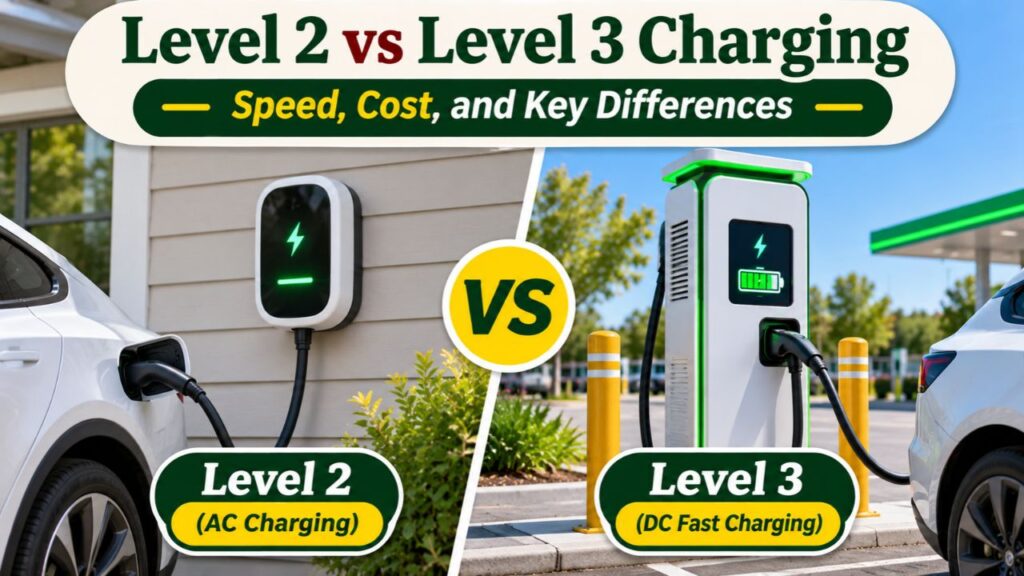
The biggest difference is charging speed and how electrical power reaches the battery. Level 2 uses AC power that the car converts internally, while Level 3 uses an external DC fast charger to deliver higher-power electricity to the battery.
The two technologies serve different purposes.
Level 2 vs Level 3 Charging Comparison Chart
| Feature | Level 2 Charging | Level 3 / DC Fast Charging |
| Electricity supplied to vehicle | Alternating current (AC) | Direct current (DC) |
| Typical electrical source | 240V residential or 208V commercial | High-capacity commercial electrical service |
| Charging power | Approximately 2.9–19.2 kW | Approximately 50–350+ kW at many public stations |
| Range added | About 10–30 miles per hour | About 100–200+ miles in 30 minutes |
| Charging time | Usually several hours | Often tens of minutes for a substantial recharge |
| Common locations | Homes, workplaces, hotels, parking lots | Highways, travel centers, public fast-charging hubs |
| Onboard AC charger used? | Yes | No; external station performs AC-to-DC conversion |
| Common connectors | J1772 and J3400/NACS | CCS1, J3400/NACS, and CHAdeMO |
| Home installation | Commonly practical | Generally impractical for ordinary residences |
| Typical electricity cost | Usually lower at home | Usually higher at public fast chargers |
| Battery impact | Generally lower charging stress | Frequent high-power use may increase degradation |
| Best use | Daily charging | Road trips and quick recharging |
These are representative U.S. figures, not guaranteed charging rates.
The U.S. Department of Energy’s Alternative Fuels Data Center identifies Level 2 charging as approximately 2.9–19.2 kW and notes that current DC fast chargers can offer substantially higher power.
Charging speed depends on the vehicle, equipment, and battery conditions.
Is Level 3 the Correct Name?
The term Level 3 charging is widely used to describe DC fast charging.
However, DC fast charging (DCFC) is the more precise term used in many technical and government resources.
Level 1 and Level 2 describe AC charging categories. DC fast charging is a separate high-power charging approach.
In this article, Level 3 and DC fast charging refer to the same general technology.
Key Takeaway: Level 2 is intended mainly for charging while parked for several hours, while Level 3 is designed to restore driving range quickly.
What Is Level 2 EV Charging?
Level 2 charging uses alternating current from a higher-voltage electrical supply than a standard U.S. household outlet.
In residential settings, it typically operates at 240 volts.
Commercial Level 2 installations often use 208 volts.
The charging equipment delivers AC power to the vehicle, where its onboard charger converts that electricity into DC for battery storage.
How Fast Is Level 2 Charging?
Level 2 charging commonly adds approximately 10–30 miles of driving range per hour.
The exact rate depends on the charger’s power, vehicle efficiency, and onboard charging capacity.
For example:
- A 3.3 kW connection charges more slowly than a 7.2 kW connection.
- A 7.2 kW charger is sufficient for many overnight charging needs.
- A compatible 11.5 kW connection can provide faster AC charging.
- Some vehicles and commercial Level 2 equipment support higher rates.
However, connecting an EV to a more powerful Level 2 station doesn’t guarantee faster charging.
The vehicle’s onboard charger determines the maximum AC power it can accept.
How Does Level 2 Charging Work?
The process is straightforward:
- A Level 2 charging unit connects to suitable electrical service.
- The connector plugs into the EV’s charging port.
- The charging equipment and vehicle establish a safe charging connection.
- AC power reaches the vehicle.
- The onboard charger converts AC into DC.
- The battery management system regulates charging.
- Charging slows or stops when the requested limit is reached.
The battery stores DC electricity, even when charging begins with an AC power source.
Where Is Level 2 Charging Used?
Level 2 equipment is common at:
- Private homes
- Apartment buildings
- Workplaces
- Shopping centers
- Hotels
- Parking garages
- Public parking lots
These locations are suitable because vehicles often remain parked for several hours.
Is Level 2 Charging Good for Everyday Use?
Yes.
For most EV owners with access to home charging, Level 2 provides enough power to replenish daily driving energy overnight.
The U.S. Department of Energy notes that Level 2 typically adds about 25 miles of range per hour under representative conditions.
That can replace many drivers’ daily mileage during a relatively short evening charging session.
Key Takeaway: Level 2 charging is a practical solution for regular home, workplace, and destination charging where the vehicle can remain connected for several hours.
What Is Level 3 EV Charging?
Level 3 charging, or DC fast charging, supplies high-power direct current to the vehicle’s battery through a compatible DC charging connection.
Unlike Level 2 charging, the station performs the major AC-to-DC conversion externally.
This allows much higher charging power than the vehicle’s normal onboard AC charger supports.
How Fast Is Level 3 Charging?
DC fast-charging stations commonly have advertised power ratings such as:
- 50 kW
- 100 kW
- 150 kW
- 250 kW
- 350 kW
Some newer equipment supports even higher outputs.
However, station power and the actual power received by the vehicle are not the same thing.
For example, a car with a maximum DC charging rate of 100 kW cannot receive 350 kW simply because it connects to a 350 kW station.
The vehicle controls how much power it can safely accept.
How Does Level 3 Charging Work?
During DC fast charging:
- The driver connects a compatible fast-charging connector.
- The station and vehicle communicate charging requirements.
- The station converts electrical supply power into controlled DC output.
- DC electricity passes through the vehicle’s fast-charging system.
- The battery management system monitors temperature, voltage, and charging current.
- Charging power changes according to battery conditions.
- The session ends when stopped by the driver, station, or vehicle.
This system supports rapid charging without relying on the vehicle’s relatively low-power onboard AC charger.
Where Are Level 3 Chargers Located?
DC fast chargers are commonly installed at:
- Highway rest stops
- Travel centers
- Public charging hubs
- Shopping areas
- Urban fast-charging stations
- Commercial fleet facilities
These locations are designed for vehicles that need a substantial amount of energy within a short period.
Are All Level 3 Chargers Equally Fast?
No.
A 50 kW DC charger is considerably less powerful than a 350 kW charger.
However, the vehicle’s charging capability determines whether it can benefit from the faster station.
A newer EV capable of accepting high charging power may recharge much faster than an older model at the same station.
Key Takeaway: Level 3 charging is designed for rapid energy delivery, but actual speed depends on both the station and the EV.
Level 2 vs Level 3 Charging Speed: How Much Faster Is DC Charging?
DC fast charging can deliver several times more energy per minute than ordinary Level 2 charging.
However, comparing the advertised maximum power alone can be misleading.
Level 2 charging usually operates at a relatively consistent rate until the battery becomes highly charged.
DC fast charging often changes power substantially during a session.
Typical Charging Speed Comparison
| Charging Equipment | Representative Power | Charging Experience |
| Level 2 AC charger | 3.3 kW | Slower home or destination charging |
| Level 2 AC charger | 7.2 kW | Common overnight charging |
| Level 2 AC charger | 11.5 kW | Faster AC charging for compatible EVs |
| DC fast charger | 50 kW | Moderate-speed highway charging |
| DC fast charger | 150 kW | High-power public charging |
| DC fast charger | 250 kW | Faster charging for compatible vehicles |
| DC fast charger | 350 kW | High-power charging for compatible vehicles |
These are equipment ratings, not guarantees of sustained charging power.
Example: Charging a 60 kWh Battery From 20% to 80%
Suppose an electric car has a usable battery capacity of 60 kWh.
Charging from 20% to 80% means replenishing 60% of the battery.
Calculate:
60 kWh × 0.60 = 36 kWh
The battery needs approximately 36 kWh of additional stored energy.
Using a 7.2 kW Level 2 Charger
The ideal calculation is:
36 ÷ 7.2 = 5 hours
Real charging may take longer because of conversion losses, thermal management, and other limitations.
Using DC Fast Charging
Suppose the car averages 90 kW of delivered battery charging power during that same session.
36 ÷ 90 = 0.4 hour, or 24 minutes
This is a simplified energy calculation.
An actual session depends on the charging curve, temperature, station limitations, and battery management.
A station advertised at 150 kW does not necessarily deliver 150 kW throughout the session.
Charging Time Comparison
| Example | Level 2 at 7.2 kW | DC Fast at 90 kW Average |
| Energy added to battery | 36 kWh | 36 kWh |
| Ideal time | 5 hours | 24 minutes |
| Charging losses included? | No | No |
| Constant power assumed? | Yes | Average power assumed |
The example illustrates the speed difference, not a promise for a specific vehicle.
Why Do Some EVs Charge Slower Than Others?
Important factors include:
- Battery capacity
- Maximum AC charging power
- Maximum DC charging power
- Battery temperature
- Starting state of charge
- Battery chemistry
- Charging curve
- Station availability
- Power sharing between charging stalls
Two EVs connected to the same charger may have very different charging times.
Key Takeaway: Level 3 charging is substantially faster when a vehicle supports it, but actual session time depends on average charging power rather than the charger’s advertised peak alone.
Why Does Level 3 Charging Slow Down After 80%?
Most EV batteries do not charge at one constant power level from empty to full.
DC fast charging usually follows a charging curve.
The battery may accept high power when its state of charge is relatively low and its temperature is suitable.
As charging progresses, the battery management system generally reduces charging power to manage cell voltage, heat, and other limits.
What Happens Between 10% and 80%?
Many EVs can accept their highest DC charging rates during part of this range.
However, the exact point where maximum power occurs depends on the vehicle.
Some batteries reach peak charging power briefly.
Others maintain a flatter charging curve.
What Happens Above 80%?
Charging often becomes significantly slower.
This is why many road-trip plans recommend charging to approximately 80% and continuing to the next station when practical.
The U.S. Environmental Protection Agency’s EV charging guide explains that DC charging power generally decreases as batteries become fuller, and charging beyond about 80% can add considerable time.
Should You Never Charge Above 80%?
No.
Charging to 100% can be appropriate when you need additional driving range.
Some vehicles with certain battery chemistries also have manufacturer-specific recommendations for periodically charging fully.
The correct charging limit depends on your battery, vehicle, and travel needs.
Follow the manufacturer’s instructions.
Does Level 2 Charging Slow Down at 80%?
Level 2 charging can also slow near full charge, depending on the vehicle.
However, because AC charging already operates at comparatively low power, the dramatic taper commonly associated with DC fast charging is usually less important for routine overnight charging.
Key Takeaway: For road trips, charging from a low battery percentage to about 80% is often more time-efficient than waiting for 100%.
Level 2 vs Level 3 Charging Cost: Which Is Cheaper?
Level 2 charging at home is usually cheaper than public DC fast charging because residential electricity often costs less than the rates charged by public fast-charging networks.
However, the cost per kilowatt-hour depends on location, electricity rates, charging network, and any additional fees.
Public Level 2 charging isn’t always cheaper than public DC charging.
Typical EV Charging Price Comparison
A U.S. Department of Energy infrastructure report using 2024 electricity and charging-price data provided the following approximate figures:
| Charging Location | Illustrative Electricity Cost |
| Home Level 2 | About $0.17 per kWh |
| Public Level 2 | About 0.20–0.25 per kWh |
| Public DC fast charging | About 0.40–0.60 per kWh |
These are historical planning benchmarks, not guaranteed current prices.
Actual rates vary considerably by state, utility, network, location, and time.
Some stations charge by the minute, session, or parking duration rather than solely by energy.
Example: Cost to Purchase 40 kWh
Suppose two stations each bill for 40 kWh of electricity.
At a home electricity rate of $0.17 per kWh:
40 × $0.17 = $6.80
At a public DC fast-charging rate of $0.50 per kWh:
40 × $0.50 = $20.00
Cost Comparison
| Charging Type | Example Rate | Cost for 40 kWh |
| Home Level 2 | $0.17/kWh | $6.80 |
| Public Level 2 | $0.25/kWh | $10.00 |
| Public DC fast | $0.50/kWh | $20.00 |
These calculations exclude session fees, parking charges, and other possible costs.
They compare the same billed energy quantity, not necessarily the same energy added to the battery, because charging efficiency may differ.
Why Is DC Fast Charging More Expensive?
High-power charging stations require expensive electrical and charging infrastructure.
Costs may include:
- High-capacity power connections
- DC power conversion equipment
- Utility infrastructure upgrades
- Demand charges
- Equipment maintenance
- Network management
- Land and parking costs
Commercial charging providers must also recover operating expenses.
Is Public Level 2 Charging Always Cheap?
No.
Some public Level 2 stations are free, while others have relatively high electricity or parking fees.
A hotel may include charging for guests.
A parking garage may bill by time or charge separately for parking.
Always check the displayed rate before starting.
How to Calculate EV Charging Cost
Use:
Charging cost = Billed electricity (kWh) × Price per kWh
Add any session, parking, idle, or other applicable fees.
If calculating from the desired increase in battery energy, remember that charging losses can make the billed electricity higher than the energy actually stored.
Key Takeaway: Home Level 2 charging usually offers lower operating costs, while public Level 3 charging costs more in exchange for faster energy delivery.
Level 2 vs Level 3 Charging Installation Cost
Installation cost is another major difference between the two technologies.
Level 2 equipment is commonly installed at residential properties.
DC fast chargers require substantially more infrastructure and are generally installed commercially.
How Much Does a Home Level 2 Charger Cost?
Equipment costs vary by brand, charging power, cable length, and features.
The DOE Alternative Fuels Data Center’s infrastructure development guide cites approximately 380–690 for certain residential Level 2 equipment.
Installation is additional and may vary widely.
A simple installation close to an existing electrical panel may cost less than one requiring long wiring runs or major electrical upgrades.
What Affects Level 2 Installation Cost?
Common factors include:
- Electrical panel capacity
- Available circuit space
- Distance from the electrical panel
- Wiring requirements
- Charger amperage
- Permit and inspection requirements
- Hardwired versus plug-in equipment
- Indoor or outdoor installation
- Utility upgrades
A qualified electrician should assess the property’s electrical capacity and applicable installation requirements.
Can You Install Level 3 Charging at Home?
For most homeowners, no practical residential DC fast-charging installation is available.
High-power DC charging often needs commercial-grade electrical infrastructure, utility coordination, and expensive equipment.
DOE infrastructure estimates place many public DC fast-charging units at tens of thousands of dollars per connector before installation.
High-capacity installations can cost substantially more when utility infrastructure upgrades are needed.
This makes Level 3 charging impractical for most residential properties.
Is Level 2 Installation Worth It?
For a driver who can charge at home and regularly needs more energy than Level 1 provides overnight, a Level 2 charger can be useful.
However, not everyone needs one.
Some low-mileage drivers can meet their needs using a dedicated, suitable 120V Level 1 charging connection.
Compare your daily driving requirements, overnight charging window, installation costs, and electricity rates before investing.
Key Takeaway: Level 2 is the practical home-charging choice for many EV owners. Level 3 infrastructure is intended mainly for commercial and public use.
Level 2 vs Level 3 Charging Connectors: Are the Plugs Different?
Yes, although some charging connector systems support both AC and DC.
In North America, several connector types are used.
EV Charging Connector Comparison
| Connector | Level 2 AC | DC Fast Charging | Common Application |
| SAE J1772 | Yes | No | AC charging for compatible vehicles |
| CCS1 | Yes, through its J1772 portion | Yes | AC and DC charging for CCS1 vehicles |
| J3400 / NACS | Yes | Yes | AC and DC charging for compatible vehicles |
| CHAdeMO | No; DC-only connector | Yes | Certain older or selected EV models |
What Is a J1772 Connector?
SAE J1772 is a common North American AC charging connector.
It is used for Level 1 and Level 2 charging.
Many vehicles equipped with a CCS1 charging port accept J1772 AC connectors through the upper portion of the CCS1 inlet.
What Is CCS1?
The Combined Charging System Type 1 connector supports DC fast charging and incorporates the J1772 AC connection.
Its DC fast-charging connector adds larger DC contacts below the AC connector section.
It has been widely used by U.S.-market EVs.
What Is NACS or J3400?
NACS stands for North American Charging Standard.
The connector design originally associated with Tesla is being standardized through SAE J3400.
A J3400/NACS connection can support both AC and DC charging.
However, the vehicle, charging station, and communication systems must all be compatible.
The Joint Office of Energy and Transportation’s J3400 connector guide explains this standard and its relationship to other charging connectors.
Can Non-Tesla EVs Use Tesla Superchargers?
Some can.
Access depends on vehicle eligibility, the charging site, network support, and any required adapter.
Not every Supercharger is available to every non-Tesla EV.
Check your vehicle manufacturer’s instructions and supported charging-network information.
Can You Use an Adapter for Level 3 Charging?
Sometimes.
However, an AC-only adapter does not automatically support DC fast charging.
Use only a suitable, properly rated adapter authorized or recommended for your vehicle and intended charging connection.
The Joint Office’s adapter compatibility guidance emphasizes using appropriate adapters and following manufacturer instructions.
Key Takeaway: Check connector type, network access, vehicle support, and adapter requirements before planning a DC fast-charging stop.
Is Level 3 Charging Bad for EV Battery Health?
Occasional DC fast charging is a normal part of using a compatible EV, but frequent high-power charging may increase long-term battery degradation compared with lower-power charging.
The impact varies considerably with battery chemistry, temperature, charging behavior, and vehicle design.
Modern EV batteries have management systems that control charging power and temperature to help protect the battery.
However, these controls cannot eliminate all effects of aging.
Why Can Fast Charging Increase Battery Stress?
High-power charging can increase electrical current and heat generation.
Battery temperature and electrochemical conditions influence how quickly cells age.
The battery management system may reduce power when conditions are unfavorable.
This is one reason fast charging can slow during hot or cold weather.
What Does Recent Battery Research Show?
A 2026 Geotab EV battery health study examined data from more than 22,700 electric vehicles across 21 makes and models.
It found that vehicles relying heavily on high-power DC fast charging above 100 kW showed higher average battery degradation than vehicles primarily using AC or lower-power charging.
The reported rates were approximately 3.0% per year for the high-power group versus 1.5% for the lower-power group.
These are observational group averages, not predictions for every vehicle.
Battery age, climate, vehicle model, and use patterns also matter.
Is Level 2 Better for Battery Longevity?
For routine charging, Level 2 generally places less charging-power stress on the battery than high-power DC charging.
It is therefore a sensible default when the vehicle can remain parked long enough.
However, battery longevity depends on more than charging level.
Long-term exposure to extreme temperatures and extended periods at very high or low charge can also influence degradation.
Should You Avoid Level 3 Charging Entirely?
No.
DC fast charging is useful and often necessary for long-distance travel.
Modern EVs are designed to support compatible charging equipment.
Use DC fast charging when convenient or needed, and follow the vehicle manufacturer’s charging guidance.
What About Charging to 100%?
Some manufacturers recommend particular daily charge limits.
Others provide different instructions for certain battery chemistries.
Follow your vehicle’s recommended charging settings rather than applying a universal 80% rule.
Key Takeaway: Level 2 is generally the gentler choice for routine charging, but occasional DC fast charging is an expected part of EV ownership.
What Affects Level 2 and Level 3 Charging Speed?
Charging power is not determined by the station rating alone.
Several factors influence the rate.
1. Battery State of Charge
A battery at 15% may accept more DC charging power than the same battery at 90%.
Charging generally slows as the battery approaches full charge.
2. Battery Temperature
Very cold or hot batteries may be unable to accept maximum charging power.
Some EVs precondition the battery before reaching a fast charger.
This can improve charging performance under appropriate conditions.
3. Vehicle Charging Limits
Every EV has specific AC and DC charging capabilities.
For example, an EV with a 7.2 kW onboard AC charger will not receive 19.2 kW simply because it connects to a higher-powered Level 2 station.
Similarly, a 350 kW DC station cannot force an EV to accept more power than its supported charging system allows.
4. Charging Station Capability
A lower-powered charger takes longer to deliver the same energy when all other factors are equal.
However, a higher station rating only helps if the vehicle can use the additional power.
5. Power Sharing
Some charging stations share electrical capacity between multiple connectors or vehicles.
The available power may decrease when neighboring stalls are occupied.
6. Battery Capacity
A larger battery generally requires more energy to achieve the same percentage increase.
However, a larger battery may also support higher charging power.
Battery size alone does not determine the charging time.
7. Charging Efficiency
Some electrical energy is lost during conversion, cable transfer, and thermal management.
These losses affect the energy purchased and, in some circumstances, the charging time.
Key Takeaway: Always consider the car’s maximum charging rate, charging curve, battery temperature, and station capability when estimating charging time.
Is Level 2 or Level 3 Better for Road Trips?
Level 3 charging is generally the better choice for long-distance EV travel when minimizing charging stops and downtime matters.
DC fast charging can restore substantial driving range while the driver takes a short break.
Level 2 is more appropriate when the vehicle will remain parked for several hours.
Best Charging Options for Different Trips
| Driving Situation | Better Charging Option |
| Daily commuting | Home Level 2 |
| Charging overnight | Level 2 |
| Workplace parking for several hours | Level 2 |
| Hotel overnight stay | Level 2, when available |
| Long highway trip | DC fast charging |
| Quick recharge during a stop | DC fast charging |
| Extended shopping or parking | Level 2 or DCFC depending on available time |
| No home charging access | Public Level 2 and DCFC combination |
| Vehicle with no DC fast-charge capability | Level 1 or Level 2 |
Why Is Level 3 Better on Highways?
Long-distance travel requires adding energy relatively quickly.
Waiting several hours at every stop may be impractical.
A compatible DC fast charger can often provide enough range to continue driving after a comparatively short session.
Why Can Level 2 Still Be Useful on Road Trips?
Level 2 is particularly useful at overnight destinations.
For example, a hotel with a Level 2 charger may allow an EV to recharge while the driver sleeps.
This can reduce the need for an additional DC fast-charging stop the following morning.
Should You Charge to 100% Before Leaving?
It depends on your vehicle, battery, and planned route.
For some trips, starting with a fuller battery is useful.
During the trip, charging to approximately 80% may be faster overall than waiting for the battery to reach 100%.
Use the vehicle’s route planner and charging recommendations to determine an appropriate strategy.
Key Takeaway: Use DC fast charging to reduce highway downtime and Level 2 charging when the car can recharge during an extended stop.
Level 2 vs Level 3 Charging for Daily Driving: Which Should You Choose?
For most drivers with reliable home charging access, Level 2 is the more practical everyday option.
It combines convenient charging with relatively low electricity costs.
However, the best choice depends on driving habits and access to charging infrastructure.
Choose Level 2 Charging If:
- You have suitable parking at home.
- You can charge overnight.
- Your commute is relatively predictable.
- You want lower regular charging costs.
- You prefer to minimize frequent high-power charging.
- You can use charging at work or another long-duration destination.
Choose Level 3 Charging If:
- You frequently take long road trips.
- You need substantial range within a short stop.
- You drive more miles than you can replenish during normal parking time.
- You lack regular home charging access.
- You need to recharge during commercial or fleet operations.
- Fast charging is more convenient than remaining at a Level 2 station for hours.
What if You Live in an Apartment?
Public Level 2 charging may be useful when parking at work, shopping, or another destination.
However, some apartment residents rely heavily on DC fast charging when dedicated residential charging is unavailable.
This can increase operating costs compared with charging at home.
Check local charger reliability, network access, pricing, and your vehicle’s compatibility before depending on public charging exclusively.
Do Plug-In Hybrids Need Level 3 Charging?
Usually not.
Many plug-in hybrid electric vehicles support AC Level 1 and Level 2 charging but do not support DC fast charging.
Check the specific vehicle’s capabilities.
A faster public station cannot provide DC charging to a vehicle without compatible DC charging hardware.
Key Takeaway: Level 2 is usually best for regular charging, while Level 3 provides flexibility when charging time is limited.
Common Misconceptions About Level 2 vs Level 3 Charging
Understanding a few common misconceptions can help EV owners make better charging decisions.
Misconception 1: Level 3 Always Charges an EV in 20 Minutes
Some vehicles can complete a substantial DC charging session very quickly.
Others need much longer.
Charging performance depends on the EV’s battery and charging curve as well as station power.
Misconception 2: A 350 kW Charger Delivers 350 kW to Every EV
The vehicle determines how much charging power it can accept.
A high-powered station does not override the EV’s battery management limits.
Misconception 3: Level 3 Is Always the Cheapest Choice Because It’s Faster
Faster charging usually saves time, not necessarily money.
Public DC fast charging commonly costs more per kWh than home electricity.
Misconception 4: Level 2 Charging Requires Charging Every Night
Not necessarily.
Charging frequency depends on daily driving distance, battery size, vehicle efficiency, and available charging time.
Some drivers charge every day, while others charge less frequently.
Misconception 5: DC Fast Charging Immediately Damages the Battery
Modern EVs are designed for compatible DC fast charging.
However, frequent high-power charging may increase battery aging over time compared with slower charging.
Occasional fast charging is not the same as immediate battery damage.
Misconception 6: Every EV Can Use Every DC Fast Charger
Connector compatibility, vehicle capability, network authorization, and adapter requirements all matter.
Some charging stations are unavailable to certain vehicles.
Misconception 7: A More Powerful Home Charger Always Reduces Charging Time
The vehicle’s onboard AC charger and the home’s electrical supply can limit charging power.
Installing equipment rated for more power than the car can accept may provide no immediate speed benefit.
Key Takeaway: Charging performance and cost depend on the entire system—not just the level printed on the station.
How to Choose the Right EV Charging Setup
Before choosing charging equipment or relying on a public network, evaluate your driving needs.
Step 1: Estimate Daily Driving Distance
Determine approximately how many miles you normally drive.
Then compare that requirement with the range your vehicle can regain during its regular parking window.
Step 2: Check the Vehicle’s Charging Specifications
Review:
- Maximum AC charging power
- Maximum DC fast-charging power
- Battery capacity
- Supported charging connectors
- Charging curve or published charging times
- Manufacturer charging recommendations
Step 3: Evaluate Home Electrical Capacity
If considering Level 2 charging, have a qualified electrician assess the electrical system.
Installation must meet applicable electrical code, equipment requirements, and local permits.
Do not assume an existing household outlet can safely support continuous EV charging merely because an adapter fits.
Step 4: Compare Charging Costs
Estimate home electricity costs.
Compare them with nearby public charging rates and any additional fees.
For a driver who uses public DC fast charging frequently, the cost difference can become significant over time.
Step 5: Check Public Charging Access
Use the DOE Alternative Fueling Station Locator or compatible charging-network tools to identify stations.
Confirm connector types, vehicle access, charging speed, and current availability through the appropriate network.
Step 6: Plan Around Charging Time
If the vehicle can charge overnight, Level 2 may be sufficient for most driving.
If you routinely require rapid recharging, DC fast charging becomes more important.
Step 7: Follow Battery Care Recommendations
Use charging limits, battery preconditioning, and other features according to the vehicle manufacturer’s instructions.
Routine Level 2 charging can reduce dependence on high-power public charging.
Key Takeaway: The right charging setup depends on your daily energy requirements, parking access, vehicle capabilities, and total charging cost.
Conclusion
The main difference in Level 2 vs Level 3 charging is how quickly electricity reaches an EV battery and whether the charging system uses AC or DC power.
Level 2 charging typically uses 240V electrical service at home and provides approximately 10–30 miles of additional range per hour.
It is generally more affordable for everyday charging and convenient when the vehicle can remain parked for several hours.
Level 3 charging, more precisely called DC fast charging, provides much higher power and can add approximately 100–200 or more miles in 30 minutes for compatible vehicles.
It is especially useful for road trips and quick charging stops.
However, the fastest station doesn’t automatically deliver its advertised maximum power to every car.
Charging time depends on vehicle limits, battery temperature, state of charge, and the charging curve.
Public DC fast charging also generally costs more than home electricity, and frequent high-power use may contribute to faster battery degradation.
For most EV owners with home charging access, Level 2 is the sensible primary charging method.
Level 3 is the convenient option when faster charging is needed.
Using both appropriately provides a practical balance of charging speed, convenience, cost, and battery care.
FAQs About Level 2 vs Level 3 Charging
Is Level 3 Charging Faster Than Level 2?
Yes. Level 3 charging, also called DC fast charging, delivers substantially higher power than Level 2 AC charging. Level 2 typically adds about 10–30 miles of range per hour, while compatible DC fast charging may add 100–200 or more miles in 30 minutes. Actual performance varies by vehicle and station.
How Long Does Level 2 vs Level 3 Charging Take?
Level 2 usually takes several hours to recharge a substantially depleted EV battery, making it suitable for overnight use. DC fast charging can restore a large portion of battery capacity in tens of minutes for compatible vehicles. Charging slows as the battery fills, particularly near and above 80%.
Is Level 3 Charging Bad for Your Battery?
Occasional DC fast charging is normal for compatible EVs. However, frequent high-power charging can increase battery stress and may accelerate long-term degradation compared with lower-power charging. The actual impact depends on battery chemistry, temperature, vehicle design, and charging habits.
Can You Install a Level 3 EV Charger at Home?
For most homeowners, Level 3 installation is impractical. DC fast chargers require expensive high-power equipment and substantial electrical infrastructure. Level 2 charging is the common residential option because it operates using suitable 240V electrical service and can usually recharge an EV overnight.
Is Level 2 Charging Cheaper Than Level 3?
Home Level 2 charging is generally cheaper per kWh than public DC fast charging. Public fast chargers often charge higher rates to cover expensive equipment, infrastructure, and operation. However, actual costs vary by location, network, electricity tariff, and additional fees.
Can Every Electric Car Use Level 3 Charging?
No. Many battery-electric vehicles support DC fast charging, but maximum power and connector compatibility vary. Many plug-in hybrids do not support DC fast charging. Check the vehicle’s specifications and charging-port compatibility before using a fast-charging station.
Can You Use Level 2 Charging Every Day?
Yes. Level 2 is designed for regular EV charging and is commonly used at homes and workplaces. It provides a practical balance of speed and convenience. Follow the vehicle manufacturer’s battery charging and charge-limit recommendations for routine use.
Why Does Level 3 Charging Slow Down After 80%?
As an EV battery approaches a high state of charge, its battery management system generally reduces charging power to maintain appropriate cell voltage, temperature, and operating conditions. This can make the final 20% significantly slower than the earlier portion of a DC fast-charging session.