
Level 1 charging usually costs less to set up, while Level 2 charging costs more upfront but delivers energy much faster. Both use household electricity, so their cost per mile is often similar; Level 2 can be slightly cheaper when charging losses are lower, especially if faster charging lets you use cheaper off-peak rates. For many U.S. homeowners, an existing suitable 120-volt outlet makes Level 1 nearly free to start, whereas a Level 2 charger and electrical installation can add hundreds or thousands of dollars.
That price difference does not automatically make Level 1 the better deal. If you drive a long commute, arrive home with a low battery, or share one charger between two vehicles, Level 1 might not restore enough range overnight. Conversely, paying for a new 240-volt circuit solely to save a few dollars in monthly charging losses can produce a very long payback period.
In this guide, I compare Level 1 vs Level 2 charging cost using current U.S. electricity prices, equipment and installation expenses, per-hour and per-mile calculations, and a realistic monthly driving example. You’ll also learn how efficiency, time-of-use rates, electrical upgrades, rebates, and charging speed affect the decision.
Level 1 vs Level 2 Charging Cost: Quick Comparison
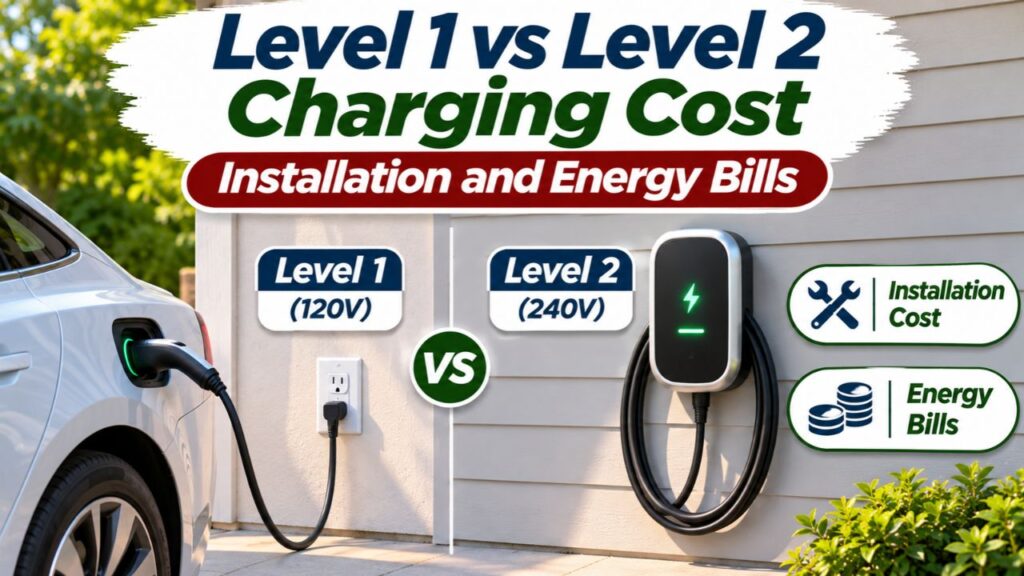
The biggest cost difference is the initial setup.
Level 1 commonly uses an existing household outlet, while Level 2 usually requires a dedicated 240-volt charging circuit.
Once installed, both chargers purchase electricity from the same utility.
Level 1 vs Level 2 Charging Cost Chart
| Feature | Level 1 charging | Level 2 charging |
| Voltage | 120V | 240V at most U.S. homes |
| Typical charging power | About 1–1.9 kW | Commonly 3.8–11.5 kW |
| Range added per hour | Approximately 3–5 miles | Often 20–40 miles |
| Equipment cost | $0 if a compatible cordset is included | Commonly 400–1,000 for typical home equipment |
| Installation cost | $0 with a suitable existing outlet | Approximately 300–2,000 for many installations |
| Typical combined setup cost | Often $0 with existing equipment and outlet | Roughly 700–3,000 before unusual upgrades |
| Electricity rate | Household utility rate | Household utility rate |
| Energy efficiency | May be somewhat lower | Often somewhat higher |
| Overnight charging | Best for lower daily mileage | Suitable for longer commutes and larger battery replenishment |
| Electrical requirements | Suitable 120V circuit | Suitable 240V circuit |
| Best for | PHEVs and short daily commutes | Full EVs, longer commutes, and multiple EVs |
These are broad U.S. planning ranges, not guaranteed prices.
Installation costs vary with electrical-panel capacity, charger location, permitting, and regional labor rates.
The U.S. Environmental Protection Agency’s home EV charging guide identifies equipment costs of approximately 400–1,000 and installation costs of approximately 300–2,000 for Level 2 home charging.
It also notes that Level 1 typically adds around 3–5 miles of range per hour, while Level 2 can add approximately 25–40 miles under suitable conditions.
Key Takeaway: Level 1 has the lowest initial cost. Level 2 offers substantially faster charging and may reduce electricity losses, but the operating savings alone may not justify the installation expense.
What Is Level 1 EV Charging?
Level 1 charging uses a standard 120-volt household electrical supply.
It commonly operates through a portable charging cord that connects the vehicle to an appropriate wall outlet.
Some EVs include a portable charging cord with the vehicle.
Others require purchasing one separately.
How Fast Is Level 1 Charging?
Level 1 charging commonly provides approximately 3–5 miles of driving range per hour.
Actual performance depends on:
- Outlet voltage.
- Charging amperage.
- Vehicle efficiency.
- Battery temperature.
- Vehicle charging losses.
- Electrical settings.
For example, a charger drawing 12 amps at 120 volts uses approximately:
120 × 12 = 1,440 watts
That equals 1.44 kW.
In 10 hours, it draws approximately:
1.44 × 10 = 14.4 kWh from the outlet
Not all that energy reaches the battery because some is lost during charging.
How Much Does Level 1 Charging Equipment Cost?
Level 1 can have almost no additional setup cost if:
- The vehicle includes a compatible charging cord.
- A suitable electrical outlet is available.
- The circuit can safely support sustained EV charging.
- No electrical modifications are required.
If a charging cord must be purchased separately, the price depends on the manufacturer, safety certification, and features.
Avoid assuming that the lowest-priced cordset is safe or compatible.
Who Should Use Level 1 Charging?
Level 1 can be suitable for:
- Drivers with short commutes.
- Plug-in hybrid electric vehicles.
- EVs parked at home for long periods.
- Households with low daily mileage.
- Drivers who do not need rapid overnight charging.
For example, a driver traveling 20 miles per day may be able to restore that range with several hours of Level 1 charging.
However, a driver covering 80 miles daily may struggle to replenish the battery every night.
What Is Level 2 EV Charging?
Level 2 charging uses a higher-voltage AC electrical supply.
At most U.S. homes, it operates at 240 volts.
Level 2 charging equipment may be hardwired or connected through an appropriately installed outlet, depending on the charger’s design and electrical requirements.
How Fast Is Level 2 Charging?
Level 2 charging commonly adds around 20–40 miles of range per hour, although vehicle capabilities and charging power vary.
Some lower-powered Level 2 setups provide less.
For example, a charger operating at 240 volts and 32 amps supplies:
240 × 32 = 7,680 watts
That equals 7.68 kW.
In one hour, it draws approximately 7.68 kWh from the electrical supply while operating at full power.
This is much faster than a typical 1.44-kW Level 1 setup.
Why Does Level 2 Need Additional Electrical Work?
A Level 2 charger usually needs a suitable 240-volt circuit.
The installation may require:
- A dedicated branch circuit.
- Correctly sized wiring.
- A suitable circuit breaker.
- Charger mounting.
- Approved electrical connections.
- Permits and inspections.
- Electrical load calculations.
Some homes already have a suitable circuit near the parking location.
Others require new wiring or electrical-service modifications.
Does Every Home Need a Panel Upgrade?
No.
Some homes have enough electrical capacity for a Level 2 charger without upgrading the main panel.
Others may need load management, a lower-amperage charging setup, or additional electrical work.
A qualified electrician should evaluate the home’s electrical capacity.
Do not assume that a 200-amp service is always required.
A properly assessed 100-amp service may support EV charging in some homes.
Level 1 vs Level 2 Charger Installation Cost
Installation is often the largest financial difference between the two charging methods.
Level 1 Installation Cost
If you already have a suitable dedicated 120-volt outlet near your parking space, installation may cost nothing.
However, some homes need a new outlet or circuit.
An electrician may need to:
- Inspect the existing outlet.
- Verify circuit capacity.
- Check grounding and protection.
- Install a suitable receptacle.
- Add a dedicated circuit if necessary.
These services create additional costs.
Level 1 is not automatically free if the existing electrical system is unsuitable.
Level 2 Installation Cost
For many home installations, a useful initial budget is approximately 700–3,000 for equipment and installation combined.
This range follows the EPA’s published equipment and installation estimates.
More complicated projects can exceed it substantially.
Example Level 2 Installation Budget
| Expense | Example cost |
| Level 2 charging unit | $600 |
| Electrician labor | $550 |
| Wiring, breaker, and materials | $300 |
| Permit and inspection | $150 |
| Estimated total | $1,600 |
This is an illustrative budget.
It is not a quote or a national average.
Actual contractor pricing may be higher or lower.
What Makes Level 2 Installation Expensive?
Several factors affect the final cost.
Distance from the electrical panel: A charger installed near the panel generally requires less wiring than one mounted far away.
Electrical-panel capacity: Homes without sufficient available capacity may need load management or more extensive upgrades.
Garage location: Detached garages may require longer wiring runs or underground conduit.
Wall construction: Routing wires through finished walls can increase labor.
Permitting: Local authorities may require permits and inspections.
Charger output: Higher-amperage equipment can require larger conductors and electrical components.
Outdoor installation: Weather-rated equipment and additional protection may be necessary.
How Much Does a Panel Upgrade Add?
A panel or electrical-service upgrade can add thousands of dollars to a project.
However, the cost depends on the existing equipment and the work required.
Before paying for a major upgrade, ask a qualified electrician whether a lower-powered Level 2 charger or approved load-management system can meet your needs.
A 16-amp or 24-amp Level 2 setup may provide sufficient overnight charging without requiring the highest available charging power.
Level 1 vs Level 2 Charging Electricity Cost
Both Level 1 and Level 2 charging generally use residential electricity.
The utility normally charges for energy consumed in kilowatt-hours.
A faster charger does not automatically increase the cost per kilowatt-hour.
The electricity rate is usually determined by the utility’s tariff and the time when charging occurs.
Average U.S. Residential Electricity Price in 2026
According to the U.S. Energy Information Administration’s Electricity Monthly Update, the average U.S. residential electricity price was 18.16 cents per kWh in August 2026.
The report was released on October 23, 2026.
This is a national average, not the rate every household pays.
Actual prices differ substantially among states, utilities, and billing plans.
For the calculations below, I use $0.1816 per kWh unless otherwise stated.
Formula for Charging Cost
The basic formula is:
Charging cost = Electricity used from the outlet (kWh) × Electricity rate ($/kWh)
For example, charging at 1.44 kW for 10 hours uses:
1.44 × 10 = 14.4 kWh
At $0.1816 per kWh:
14.4 × $0.1816 = $2.62
That is the estimated electricity cost for the 10-hour session.
It does not mean all 14.4 kWh enters the EV battery.
Charging Cost Per Hour
At the same electricity rate:
| Charging setup | Power draw | Electricity cost per hour |
| Level 1, 120V/12A | 1.44 kW | $0.26 |
| Level 2, 240V/16A | 3.84 kW | $0.70 |
| Level 2, 240V/32A | 7.68 kW | $1.39 |
| Level 2, 240V/40A | 9.60 kW | $1.74 |
| Level 2, 240V/48A | 11.52 kW | $2.09 |
These values assume continuous charging at the stated power.
Actual power can decrease because of vehicle limits, battery temperature, or charging controls.
Why Does Level 2 Cost More Per Hour?
Level 2 transfers more electricity each hour.
For example, a 7.68-kW setup draws over five times as much power as a 1.44-kW setup.
Therefore, its electricity cost per charging hour is higher.
However, it also replenishes the battery much faster.
Cost per hour and cost per mile are different measurements.
For most EV owners, cost per mile is more useful when comparing operating expenses.
Is Level 2 Charging Cheaper per Mile Than Level 1?
Level 2 can be slightly more energy-efficient than Level 1.
The difference depends on the vehicle and charging conditions.
Both charging methods experience losses.
These may include:
- AC-to-DC conversion losses.
- Battery heating or cooling.
- Electronic control systems.
- Cable and electrical resistance losses.
- Other vehicle energy use during charging.
A slower charging session can sometimes result in greater total overhead energy consumption.
However, there is no universal efficiency percentage that applies to every EV.
Example Efficiency Assumptions
To illustrate the difference, suppose:
- Level 1 charging efficiency is 85%.
- Level 2 charging efficiency is 92%.
- The EV needs 30 kWh stored in its battery to travel 100 miles.
- Electricity costs $0.1816 per kWh.
The efficiencies are hypothetical example values, not certified averages.
Level 1 Cost for 100 Miles
Battery energy required:
30 kWh
Electricity drawn from the wall:
30 ÷ 0.85 = 35.29 kWh
Electricity cost:
35.29 × $0.1816 = $6.41
Level 2 Cost for 100 Miles
Battery energy required:
30 kWh
Electricity drawn from the wall:
30 ÷ 0.92 = 32.61 kWh
Electricity cost:
32.61 × $0.1816 = $5.92
Cost Per 100 Miles Comparison
| Measurement | Level 1 | Level 2 |
| Battery energy needed | 30 kWh | 30 kWh |
| Assumed charging efficiency | 85% | 92% |
| Electricity drawn from outlet | 35.29 kWh | 32.61 kWh |
| Electricity rate | $0.1816/kWh | $0.1816/kWh |
| Cost per 100 miles | $6.41 | $5.92 |
In this example, Level 2 saves approximately $0.49 per 100 miles.
That is a modest operating difference.
Your actual results may be different.
If both charging setups have nearly identical efficiency, their electricity costs will also be nearly identical when using the same utility rate.
Level 1 vs Level 2 Charging Cost Per Month
Monthly charging cost depends on driving distance, vehicle efficiency, local electricity prices, and charging losses.
The following comparison uses the same assumptions as the previous example.
- Battery energy consumption: 30 kWh per 100 miles.
- Level 1 efficiency: 85%.
- Level 2 efficiency: 92%.
- Electricity rate: $0.1816/kWh.
Monthly Charging Cost Chart
| Monthly driving | Level 1 cost | Level 2 cost | Level 2 savings |
| 500 miles | $32.05 | $29.61 | $2.44 |
| 1,000 miles | $64.09 | $59.22 | $4.87 |
| 1,500 miles | $96.14 | $88.83 | $7.31 |
| 2,000 miles | $128.19 | $118.43 | $9.76 |
These are modeled electricity expenses, not actual bills for a particular vehicle.
Example: Driving 1,000 Miles Per Month
Suppose you drive approximately 1,000 miles per month.
Your EV uses 300 kWh of battery energy to travel that distance.
With Level 1:
300 ÷ 0.85 = 352.94 kWh from the outlet
352.94 × $0.1816 = $64.09 per month
With Level 2:
300 ÷ 0.92 = 326.09 kWh from the outlet
326.09 × $0.1816 = $59.22 per month
The difference is approximately $4.87 per month.
Annual Cost Comparison
For 1,000 miles of driving per month:
| Annual expense | Level 1 | Level 2 |
| Electricity | $769.13 | $710.61 |
| Annual operating difference | — | $58.52 less |
In this example, Level 2 saves approximately $59 per year in electricity.
That is useful, but the savings alone may not repay an expensive installation quickly.
How Much Does It Cost to Charge a Full EV Battery?
A full charge costs depend on battery capacity and the amount of energy needed.
Battery size alone does not determine the actual electricity bill because charging losses must also be considered.
Example: 60-kWh Battery
Assume the battery needs 60 kWh of energy from empty to full.
Using the illustrative efficiencies:
Level 1:
60 ÷ 0.85 = 70.59 kWh from the outlet
70.59 × $0.1816 = $12.82
Level 2:
60 ÷ 0.92 = 65.22 kWh from the outlet
65.22 × $0.1816 = $11.84
Full Battery Cost Comparison
| Battery energy added | Level 1 cost | Level 2 cost |
| 20 kWh | $4.27 | $3.95 |
| 40 kWh | $8.55 | $7.90 |
| 60 kWh | $12.82 | $11.84 |
| 80 kWh | $17.09 | $15.79 |
These examples assume the same electricity rate and the hypothetical 85% and 92% charging efficiencies.
They also assume the stated energy is added to the battery.
Actual EVs have usable battery capacities, charging limits, and thermal-management requirements that affect the result.
Is Charging From 0% to 100% Recommended?
Not necessarily.
Many EV manufacturers recommend specific everyday charging limits, which can vary with battery chemistry.
Some vehicles are commonly charged to approximately 80% for daily driving.
Others may have different manufacturer guidance.
Follow the vehicle’s instructions rather than assuming every EV needs the same charging limit.
Level 1 vs Level 2 Charging Time and Cost
Charging speed is often the strongest reason to upgrade from Level 1 to Level 2.
A faster charger does not necessarily use more total electricity to replenish the same battery energy.
Example: Replenishing 40 Miles of Range
Assume:
- The EV needs 0.30 kWh of battery energy per mile.
- Forty miles therefore require 12 kWh in the battery.
- Level 1 delivers 1.44 kW from the outlet.
- Level 2 delivers 7.68 kW from the outlet.
- Charging efficiencies are 85% and 92%, respectively.
Charging Time Calculation
Level 1:
12 ÷ (1.44 × 0.85) = 9.8 hours
Level 2:
12 ÷ (7.68 × 0.92) = 1.7 hours
Charging Time Comparison
| Measurement | Level 1 | Level 2 |
| Power draw | 1.44 kW | 7.68 kW |
| Battery energy added | 12 kWh | 12 kWh |
| Estimated time | 9.8 hours | 1.7 hours |
| Electricity cost | $2.56 | $2.37 |
In this example, both methods replenish the same amount of battery energy.
Level 2 completes the session about eight hours sooner.
The electricity cost difference is small.
Example: Charging From 20% to 80%
Suppose an EV has a 60-kWh usable battery.
Charging from 20% to 80% adds:
60 × 0.60 = 36 kWh
At the example charging rates:
- Level 1 takes approximately 29.4 hours.
- Level 2 takes approximately 5.1 hours.
These are simplified calculations.
Real charging times may change because the vehicle limits charging power or uses energy for battery conditioning.
Key Takeaway: Level 2 is primarily a speed and convenience upgrade. It is not necessarily a dramatic electricity-cost reduction.
Does Level 2 Charging Use More Electricity Than Level 1?
Level 2 draws electricity faster, but that does not mean it necessarily uses more total electricity to replenish a given battery charge.
Power vs. Energy
Power is measured in kilowatts (kW).
Energy is measured in kilowatt-hours (kWh).
Kilowatts describe how quickly energy is transferred. Kilowatt-hours describe how much energy is consumed.
For example:
- A 1-kW charger operating for 10 hours uses 10 kWh.
- A 5-kW charger operating for 2 hours also uses 10 kWh.
Both use the same amount of electrical energy in this simplified example.
Why Charging Losses Matter
A vehicle does not store every kilowatt-hour drawn from the outlet.
Some electricity is lost through charging electronics and other systems.
At low charging power, certain fixed vehicle loads operate for longer.
This can increase energy consumption.
However, higher charging power also has electrical resistance losses.
The most efficient rate depends on the vehicle and charging conditions.
Can Level 1 Ever Be More Efficient?
Charging efficiency is vehicle- and condition-dependent.
Level 2 often has an advantage, but it should not be treated as universally more efficient by a fixed percentage.
A particular EV’s charging electronics, temperature, and operating settings determine the real result.
If efficiency is important to your buying decision, look for vehicle-specific measurements.
Does Off-Peak Electricity Make Level 2 Cheaper?
It can.
Some electric utilities offer time-of-use plans with lower electricity prices during certain hours.
A faster charger may be able to replenish more energy within those cheaper periods.
This can create larger savings than efficiency differences alone.
Example Time-of-Use Rates
Suppose your utility charges:
- Off-peak electricity: $0.12/kWh.
- Peak electricity: $0.30/kWh.
These are hypothetical rates for illustration.
They are not national averages.
Cost of 100 Miles at Different Electricity Rates
Using the same 30-kWh battery-energy requirement and efficiency assumptions:
| Electricity rate | Level 1 cost per 100 miles | Level 2 cost per 100 miles |
| $0.12/kWh | $4.24 | $3.91 |
| $0.18/kWh | $6.35 | $5.87 |
| $0.30/kWh | $10.59 | $9.78 |
The price difference between electricity-rate periods can be much larger than the charging-efficiency difference.
Why Level 2 Can Benefit More
Suppose the utility offers a six-hour off-peak window.
A 1.44-kW Level 1 setup can draw approximately:
1.44 × 6 = 8.64 kWh
A 7.68-kW Level 2 setup can draw approximately:
7.68 × 6 = 46.08 kWh
This assumes the vehicle can accept full power and has enough battery capacity available.
Level 2 can potentially complete a much larger charging session during the discounted period.
Does Level 1 Also Work With Off-Peak Charging?
Yes.
Many EVs allow charging schedules to be set through the vehicle.
Level 1 may be able to use cheaper off-peak hours if your driving needs are low enough.
A Level 2 charger does not automatically qualify for a lower electricity rate.
The benefit depends on your utility’s tariff and charging schedule.
Check Your Utility Rate Structure
Before upgrading, ask:
- Does the utility offer an EV charging plan?
- Are lower off-peak rates available?
- What hours qualify?
- Does the plan require a separate meter?
- Are there additional fixed charges?
- Does a smart charger need to be enrolled?
- Are demand charges or other billing conditions involved?
Compare your entire household bill under any proposed rate plan.
An EV-specific plan with cheaper overnight energy may have higher rates during other hours.
Does Level 2 Charging Pay for Itself?
Sometimes, but not always through electricity savings alone.
The financial value depends on installation cost, charging efficiency, energy prices, and how often the equipment is used.
Simple Payback Formula
Payback period (months) = Additional installation cost ÷ Monthly savings
This calculation assumes constant savings and ignores financing, future price changes, and maintenance.
Example: Paying Back a $1,500 Upgrade
Suppose:
- Level 1 works with your existing outlet.
- Upgrading to Level 2 costs $1,500.
- Level 2 saves $4.87 per month through better charging efficiency.
Payback:
$1,500 ÷ $4.87 = approximately 308 months
That equals roughly 26 years.
Under those assumptions, the efficiency savings alone do not provide a compelling financial reason to upgrade.
What Changes the Payback Period?
A Level 2 installation may be more valuable when it:
- Avoids expensive public charging.
- Allows more charging during cheaper electricity periods.
- Supports longer daily commutes.
- Serves multiple EVs.
- Qualifies for a local utility rebate.
- Avoids the inconvenience of insufficient overnight range.
These benefits can matter more than small differences in energy efficiency.
Example: Avoiding Public Charging
Suppose your Level 1 setup cannot replenish enough range for your regular driving.
As a result, you purchase electricity at a more expensive public charger.
Level 2 home charging could reduce that expense.
However, public charging rates vary considerably.
Some stations charge per kWh.
Others may impose session, parking, or idle fees.
Calculate the savings using the actual public charging prices you would otherwise pay.
Is a Level 2 Charger Worth It for Short Commutes?
If you drive only 15–25 miles per day and have a suitable overnight outlet, Level 1 may be sufficient.
A Level 2 installation might still be worthwhile for convenience.
However, its value may not be primarily financial.
Level 1 vs Level 2 Charging Cost for Different Drivers
The best choice depends on daily mileage and how long the vehicle can remain plugged in.
Driver 1: Short Commute
Daily driving: 20 miles
At approximately 3–5 miles of range per hour, Level 1 may restore 20 miles in roughly 4–7 hours.
For a vehicle parked overnight, this can be sufficient.
Level 2 provides faster charging but may not be necessary.
Likely better value: Level 1, assuming a safe, suitable outlet is available.
Driver 2: Moderate Commute
Daily driving: 40 miles
Level 1 may require approximately 8–13 hours to replenish the day’s driving, depending on the EV.
That could work if the car remains parked overnight for a long period.
However, winter conditions or unexpected trips may create a shortfall.
Level 2 offers greater flexibility.
Likely better choice: Depends on overnight parking time and vehicle efficiency.
Driver 3: Long Commute
Daily driving: 80 miles
Level 1 may need more than a typical overnight parking period to restore the range used.
Repeated charging shortfalls can accumulate over several days.
Level 2 is generally more practical.
Likely better choice: Level 2.
Driver 4: Plug-In Hybrid Owner
PHEVs typically have smaller batteries than full battery-electric vehicles.
Many can replenish their electric range using Level 1 charging overnight.
However, this depends on battery capacity and the vehicle’s charging capability.
Likely better value: Level 1 for many PHEV owners.
Driver 5: Two-EV Household
A household with two full EVs may need to replenish substantial battery energy every night.
Level 2 can make scheduling easier.
Some charging systems support approved load sharing between vehicles.
Likely better choice: Level 2, with an appropriate electrical design.
Quick Recommendation Chart
| Driving situation | Recommended starting choice |
| Under 25 miles daily | Level 1 |
| Approximately 25–50 miles daily | Compare both |
| Over 50 miles daily | Level 2 often more practical |
| Plug-in hybrid | Level 1 may be enough |
| Two full EVs | Level 2 generally more convenient |
| Limited electrical-panel capacity | Level 1 or lower-power Level 2 |
| Existing suitable 240V circuit | Level 2 may offer good value |
| High installation quote and short commute | Level 1 may be more economical |
These are general decision guidelines, not absolute charging requirements.
Level 1 vs Level 2 Charging Safety and Electrical Costs
Electrical safety matters because home EV charging can place a continuous load on a circuit for many hours.
Use a Suitable Electrical Circuit
Level 1 charging should use a suitable outlet and circuit capable of supporting the charging load.
A typical 120-volt, 15-amp circuit may support a 12-amp continuous EV charging load when properly designed and approved for that use.
Do not assume every garage outlet is suitable.
An electrician can inspect an outlet and evaluate the circuit.
Hire a Qualified Electrician for Level 2
New Level 2 circuits should be installed according to applicable electrical codes and permitting requirements.
For example, a 40-amp charging load commonly requires a properly designed 50-amp circuit.
A 48-amp charging load commonly requires a suitable 60-amp circuit.
Actual installation requirements depend on the equipment, wiring method, local code, and electrical system.
Do not install or modify a high-current circuit without the appropriate qualifications.
Avoid Ordinary Extension Cords
EV charging equipment should generally be connected according to the manufacturer’s instructions.
Ordinary extension cords, power strips, and improvised adapters can overheat or create electrical hazards.
Use properly certified charging equipment.
Choose Safety-Certified Equipment
Look for equipment with appropriate safety certification from a recognized testing laboratory.
Examples include UL- or ETL-listed products.
For outdoor installations, choose equipment rated for the installation environment.
Check Connector Compatibility
North American EVs may use J1772 or J3400/NACS charging connections.
Confirm that the selected equipment or approved adapter is compatible with the vehicle.
A connector difference does not by itself determine Level 1 or Level 2 operating cost.
How to Reduce Home EV Charging Costs
Several strategies can lower overall charging expenses regardless of the charging level.
1. Check Your Electricity Rate
Review your utility bill.
Find the price charged per kilowatt-hour.
If your plan has time-of-use pricing, identify the cheaper periods.
Use the rate that applies to additional EV electricity consumption rather than assuming the national average is your exact cost.
2. Schedule Charging During Cheaper Hours
If your utility offers lower overnight rates, use the vehicle’s charging schedule or a compatible charger feature.
Make sure the schedule still restores enough range for your daily needs.
3. Avoid Buying More Charging Power Than You Need
A 48-amp charger is not necessary for every household.
A lower-powered Level 2 unit may replenish your normal driving range overnight.
Your EV’s onboard AC charging limit also determines how much power it can accept.
Buying equipment rated above that limit will not make the vehicle charge faster.
4. Keep Installation Simple
Installing the charger near the electrical panel may reduce wiring and labor costs.
However, the location must also be safe, accessible, and appropriate for parking.
Have an electrician evaluate the options.
5. Compare Installation Quotes
Request written estimates from qualified installers.
Ask whether the quote includes:
- Charging equipment.
- Electrical wiring.
- Circuit breaker.
- Labor.
- Permits.
- Inspection.
- Any required load management.
- Panel or service upgrades.
Compare complete project totals rather than equipment prices alone.
6. Check Utility Rebates and Incentives
Some utilities or local programs may provide rebates for eligible EV charging equipment or installations.
Requirements vary by jurisdiction and may include:
- Approved charger models.
- Qualified installation.
- Enrollment in a managed charging program.
- Specific utility rate plans.
- Installation deadlines.
Tax-credit rules also change. Do not assume an incentive is available without verifying the current requirements and eligibility dates.
7. Measure Actual Charging Electricity
Some EVs and smart chargers report charging energy.
However, vehicle displays may show battery energy added rather than total electricity drawn from the wall.
A compatible energy monitor or utility meter can help estimate charging losses and actual costs.
Use appropriately installed measurement equipment.
8. Avoid Unnecessary Public Charging
When home charging is less expensive than public charging, maximizing suitable home charging may lower total costs.
However, public charging may still be necessary during trips or when home charging cannot restore enough range.
9. Keep the EV Within Recommended Charging Conditions
Follow the vehicle manufacturer’s charging and battery-care instructions.
Battery heating and cooling can affect charging energy use, particularly in extreme temperatures.
Do not disable safety-related battery management features to reduce electricity consumption.
10. Review the Total Cost, Not Just Electricity
A charger that saves a few dollars per month may not justify a major electrical upgrade.
Consider installation, convenience, time saved, and future vehicle needs together.
Common Mistakes When Comparing Level 1 and Level 2 Charging Costs
Avoid these errors when choosing home EV charging equipment.
Assuming Level 2 Uses More Electricity Per Mile
Level 2 draws electricity faster.
However, that does not automatically mean it uses more electricity to replenish the same battery energy.
Charging efficiency and utility rates determine the actual difference.
Comparing Charging Cost Per Hour Only
Level 2 costs more per hour because it transfers more energy.
Compare cost per mile or per kWh delivered to the battery instead.
Ignoring Installation Expenses
Level 1 may work with existing equipment.
Level 2 may require a new circuit and professional installation.
Include all initial costs.
Assuming Level 2 Always Pays for Itself
Energy-efficiency savings may be small.
A long payback period is possible when installation is expensive and driving mileage is low.
Ignoring Time-of-Use Electricity Rates
A faster charger may allow more charging during low-cost periods.
This can materially affect monthly expenses.
Buying the Highest-Amperage Charger
A vehicle cannot charge faster than its onboard AC charging system permits.
A high-output charger also may require more expensive electrical infrastructure.
Choose power based on actual needs.
Assuming Any Outlet Is Safe for EV Charging
An outlet should be suitable for sustained charging.
Damaged, overloaded, or improperly installed wiring creates hazards.
Using Unapproved Adapters or Extension Cords
Improvised connections can create overheating and electrical risks.
Use approved equipment according to manufacturer instructions.
Forgetting Charging Losses
The electricity measured at the wall is usually higher than the energy stored in the battery.
Include charging losses when estimating real electricity costs.
Treating National Average Electricity Prices as Local Rates
The U.S. average is useful for examples.
Your actual household rate may be much higher or lower.
Use your current utility tariff when making a buying decision.
Conclusion
In the Level 1 vs Level 2 charging cost comparison, Level 1 usually wins on initial expense, while Level 2 wins on charging speed and flexibility.
Level 1 can cost almost nothing to set up when a suitable 120-volt outlet and compatible charging cord are already available.
Level 2 typically requires more expensive equipment and electrical installation, with a reasonable basic U.S. planning range of approximately 700–3,000 before unusual upgrades.
However, both charging levels generally use the same household electricity supply.
At a fixed electricity rate, their operating costs per mile can be similar, although charging-efficiency differences may favor Level 2.
Using illustrative efficiencies and the August 2026 U.S. residential electricity average, 1,000 miles of monthly driving costs approximately $64.09 with Level 1 or $59.22 with Level 2.
That difference alone may not repay an expensive installation quickly.
Level 2 becomes more valuable when faster charging helps support long commutes, multiple vehicles, cheaper off-peak electricity, or reduced reliance on expensive public charging.
My recommendation is to choose Level 1 if it safely meets your daily driving needs, and upgrade to an appropriately sized Level 2 setup when charging speed, scheduling flexibility, or avoiding public charging provides a meaningful benefit.
Compare the complete installation cost and your actual electricity tariff before deciding.
FAQs About Level 1 vs Level 2 Charging Cost
Is Level 2 Charging More Expensive Than Level 1?
Level 2 usually costs more to purchase and install. However, the electricity cost per mile can be similar or slightly lower because Level 2 may have better charging efficiency. The utility’s electricity rate and charging schedule often matter more than the charging level itself.
How Much Does Level 1 Charging Cost Per Month?
Using an illustrative EV consumption of 30 kWh per 100 miles, 85% charging efficiency, and electricity at $0.1816 per kWh, Level 1 costs approximately $64 per month for 1,000 miles of driving. Actual costs depend on the vehicle and local utility rates.
How Much Does Level 2 Charging Cost Per Month?
At 1,000 miles per month, an illustrative 92% charging efficiency, and electricity costing $0.1816 per kWh, Level 2 costs approximately $59 per month for an EV requiring 30 kWh of battery energy per 100 miles. Installation expenses are separate.
Is It Cheaper to Charge an EV With 120V or 240V?
When both use the same electricity rate, the cost per mile is usually similar. A 240-volt Level 2 setup can be somewhat more efficient, depending on the vehicle and charging conditions. A 120-volt Level 1 setup often has the lowest initial equipment cost.
Is Installing a Level 2 Charger Worth the Money?
It can be worthwhile if you drive long distances, need faster overnight charging, manage multiple EVs, or can save money through off-peak charging. For a short commute with an adequate Level 1 setup, the convenience benefits may not justify the installation expense.
Does Level 2 Charging Save Electricity?
Sometimes. Level 2 can reduce charging losses compared with Level 1 because some vehicle systems operate for less time. However, the efficiency difference varies by vehicle, temperature, and charging conditions. It should not be assumed that every Level 2 setup saves a fixed percentage.
How Long Does It Take for Level 2 Charging to Pay for Itself?
The payback period depends on installation cost and actual savings. For example, a $1,500 installation saving approximately $4.87 per month through electricity efficiency would take about 26 years to repay. Savings from cheaper off-peak rates or avoiding public charging could shorten that period substantially.