
The main difference between Level 1 and Level 2 EV charging is charging speed. Level 1 charging uses a standard 120-volt household outlet and typically adds about 2–5 miles of driving range per hour, while Level 2 charging uses a 240-volt supply at home and commonly adds 10–30 miles per hour, sometimes more. Level 1 is generally cheaper to set up, while Level 2 is faster and more convenient for drivers with larger batteries or longer daily commutes.
Both methods use alternating current (AC), which the vehicle converts into direct current (DC) to recharge its battery. They differ primarily in available electrical power, installation requirements, charging time, and upfront cost.
For a plug-in hybrid or an electric vehicle driven only short distances, Level 1 charging may be sufficient overnight. For someone who drives 60 miles daily, owns multiple EVs, or frequently needs a quick recharge at home, Level 2 is usually more practical.
In this article, I compare Level 1 vs Level 2 charging by voltage, amperage, charging speed, battery size, cost, installation, and energy efficiency. I also explain how to calculate charging time, choose a suitable home charger, understand connector compatibility, and decide whether upgrading to Level 2 is worth the expense.
Level 1 vs Level 2 Charging: Key Differences
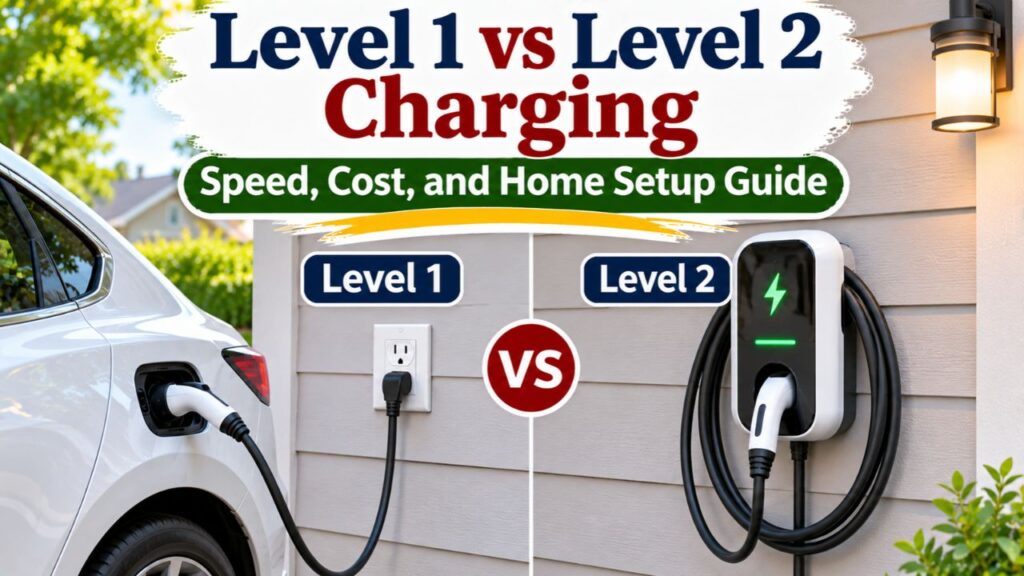
Level 1 charging prioritizes affordability and simplicity, while Level 2 charging provides substantially more electrical power for faster battery recharging.
Both are commonly used for home EV charging, but they are suited to different driving needs.
Side-by-Side Comparison
| Feature | Level 1 Charging | Level 2 Charging |
| Electrical supply | 120V AC | 240V AC at home; often 208V commercially |
| Typical current | 8–16 amps | 16–48 amps for many home installations |
| Common power range | About 1.0–1.9 kW | About 3.8–11.5 kW for common residential setups |
| Range added per hour | About 2–5 miles | Commonly 10–30 miles; some setups deliver more |
| Charging speed | Slow | Moderate to fast for home charging |
| Typical equipment | Portable charging cord | Wall-mounted or portable EVSE |
| Electrical outlet | Suitable 120V receptacle | Dedicated 240V circuit or receptacle |
| Installation | May use an existing suitable circuit | Often requires professional installation |
| Upfront cost | Usually lower | Usually higher |
| Electricity cost per kWh | Based on utility rate | Based on utility rate |
| Best for | Short commutes and plug-in hybrids | Longer commutes and battery-electric vehicles |
| Overnight charging | Adds a limited amount of range | Can replenish substantial range overnight |
| Public availability | Limited | Common at workplaces and destinations |
The U.S. Environmental Protection Agency’s home EV charging guide identifies Level 1 as the slower, lower-cost charging option and Level 2 as a faster alternative for longer daily travel.
Actual charging speed depends on the vehicle, charger, available circuit power, battery temperature, and other conditions.
Which One Is Better?
Choose Level 1 when your daily driving is short enough to replace the energy used during your available charging hours.
Choose Level 2 when you need to restore more driving range within a shorter period.
Neither option is automatically necessary for every EV owner.
Key Takeaway: Level 1 is the simplest home charging option. Level 2 provides faster charging but usually requires additional electrical equipment and installation.
What Is Level 1 EV Charging?
Level 1 charging uses a standard 120V electrical supply to recharge an electric vehicle through a compatible charging cord.
It is the slowest common form of AC EV charging in the United States.
How Does Level 1 Charging Work?
A typical Level 1 setup includes:
- A suitable household electrical outlet
- A portable EV charging cord or charging unit
- A compatible vehicle connector
- The vehicle’s onboard AC charger
- The EV battery
Electricity flows from the household circuit through the charging equipment to the vehicle.
The vehicle’s onboard charger converts AC electricity into DC electricity for the battery.
The charging equipment also communicates allowable current and provides important safety functions.
What Voltage Does Level 1 Use?
Level 1 charging uses approximately 120 volts in the United States.
Common charging currents include:
- 8 amps
- 12 amps
- 16 amps when a suitable 20-amp circuit and compatible equipment are available
The selected current must be appropriate for the electrical circuit and equipment.
How Fast Is Level 1 Charging?
Level 1 typically adds approximately 2–5 miles of estimated driving range per charging hour.
The U.S. Department of Energy’s Alternative Fuels Data Center identifies this range for typical Level 1 charging.
However, a large electric SUV may recover fewer miles per hour than a highly efficient compact EV.
Does Every EV Include a Level 1 Charger?
Not necessarily.
Some manufacturers supply a portable charging cord with the vehicle.
Others sell it separately.
Check the vehicle’s included equipment before assuming you already have everything necessary.
Advantages of Level 1 Charging
Level 1 offers several benefits:
- Low upfront cost when a suitable outlet already exists
- No dedicated 240V charger required
- Simple operation
- Useful for overnight parking
- Good for many plug-in hybrids
- Practical for some low-mileage EV drivers
Disadvantages of Level 1 Charging
Limitations include:
- Slow battery replenishment
- Longer charging sessions for large batteries
- Limited ability to recover from long drives overnight
- Potential difficulty supporting multiple vehicles
- Need for a safe, appropriately rated electrical circuit
A nearly empty long-range battery-electric vehicle may take several days to recharge using Level 1.
Key Takeaway: Level 1 charging is affordable and practical for many low-mileage drivers, but its limited power makes large battery recharges slow.
What Is Level 2 EV Charging?
Level 2 charging uses a higher-voltage AC supply, typically 240V in U.S. homes, to deliver more electrical power to an electric vehicle.
It is widely used in residential garages, workplaces, apartment complexes, and public destination charging locations.
How Does Level 2 Charging Work?
Level 2 charging uses an EV charging station or portable charging unit connected to an appropriate electrical circuit.
The equipment supplies AC electricity to the vehicle.
The onboard charger converts that electricity into DC for battery storage.
Because Level 2 can supply greater power than Level 1, the battery generally recharges much faster.
What Voltage Does Level 2 Use?
Common supply voltages include:
- 240V in residential applications
- 208V in many commercial buildings
Level 2 charging is not the same as DC fast charging.
It still depends on the vehicle’s onboard AC charger.
What Amperage Does Level 2 Use?
Common residential charging outputs include:
- 16 amps
- 24 amps
- 32 amps
- 40 amps
- 48 amps
Higher-powered equipment is available for suitable vehicles and electrical installations.
However, a higher current rating does not guarantee that every vehicle can accept that power.
How Fast Is Level 2 Charging?
Level 2 commonly adds approximately 10–30 miles of range per hour.
Higher-output installations and efficient vehicles may add around 40 miles or more per hour under suitable conditions.
The EPA describes approximately 25–40 miles per hour for many higher-powered Level 2 setups, while the Department of Energy provides a broader typical range of 10–30 miles.
These are estimates, not universal charging rates.
Advantages of Level 2 Charging
Benefits include:
- Faster overnight charging
- More flexibility for longer commutes
- Easier recovery after road trips
- Better support for multiple EVs
- Compatibility with many smart charging features
- Convenient scheduled charging
- Less charging-time pressure
Disadvantages of Level 2 Charging
Potential drawbacks include:
- Higher equipment cost
- Electrical installation expense
- Possible permitting requirements
- Electrical panel capacity limitations
- Potential need for circuit upgrades
- More involved installation
Key Takeaway: Level 2 is generally the more convenient option for frequent EV driving, provided the installation cost is justified by the charging speed you need.
How Much Faster Is Level 2 Than Level 1 Charging?
Level 2 charging can deliver several times more electrical power than Level 1.
However, the exact speed difference depends on voltage, current, and the vehicle’s onboard charging limit.
Charging Power Formula
Charging Power (kW) = Voltage × Current (Amps) ÷ 1,000
This calculates approximate electrical input power.
Example: Level 1 at 120V and 12 Amps
120 × 12 ÷ 1,000 = 1.44 kW
Example: Level 2 at 240V and 32 Amps
240 × 32 ÷ 1,000 = 7.68 kW
Comparing the two:
7.68 ÷ 1.44 = 5.33
The 32-amp Level 2 setup can supply approximately 5.3 times the electrical power of the 12-amp Level 1 setup.
This does not guarantee exactly 5.3 times faster battery charging because charging losses and vehicle limitations also matter.
Common Home Charging Power Levels
| Charging Setup | Supply Voltage | Charging Current | Nominal Power |
| Level 1 | 120V | 8A | 0.96 kW |
| Level 1 | 120V | 12A | 1.44 kW |
| Level 1 | 120V | 16A | 1.92 kW |
| Level 2 | 240V | 16A | 3.84 kW |
| Level 2 | 240V | 24A | 5.76 kW |
| Level 2 | 240V | 32A | 7.68 kW |
| Level 2 | 240V | 40A | 9.60 kW |
| Level 2 | 240V | 48A | 11.52 kW |
These are nominal electrical input values.
The power actually accepted by the vehicle may be lower.
Does a Higher-Amp Charger Always Charge Faster?
No.
Suppose an EV can accept a maximum AC charging power of 6.6 kW.
Connecting that vehicle to an 11.5-kW Level 2 station will not make it accept the full 11.5 kW.
The vehicle limits charging to its supported power.
Other factors, including battery conditions, may reduce the rate further.
Key Takeaway: A common 32-amp Level 2 setup can supply more than five times the power of a 12-amp Level 1 setup, but the vehicle ultimately controls how much power it accepts.
Level 1 vs Level 2 Charging Time: How Long Does Each Take?
Charging time depends on how much energy must be added to the battery.
The battery’s total capacity alone is not enough to determine charging duration.
Basic Charging Time Formula
Charging Time (Hours) = Energy Needed From the Wall (kWh) ÷ Charging Power (kW)
For a simplified estimate:
Energy Needed From the Wall = Battery Energy Needed ÷ Charging Efficiency
The calculation should account for the fact that some electricity is lost during charging.
Example: Charging a 60-kWh Battery From 20% to 80%
Assume:
- Battery capacity: 60 kWh
- Starting charge: 20%
- Target charge: 80%
- Charging efficiency: 90% for this example
Battery energy needed:
60 × (0.80 − 0.20) = 36 kWh
Approximate energy needed from the electrical supply:
36 ÷ 0.90 = 40 kWh
Now compare two charging setups.
Level 1 at 1.44 kW:
40 ÷ 1.44 = 27.8 hours
Level 2 at 7.68 kW:
40 ÷ 7.68 = 5.2 hours
Estimated Charging Time Comparison
<text>Illustrative 60-kWh battery, charging from 20% to 80%, assuming 90% overall charging efficiency and constant nominal charging power.</text>
| Charging Setup | Nominal Power | Approximate Time |
| Level 1, 8A | 0.96 kW | 41.7 hours |
| Level 1, 12A | 1.44 kW | 27.8 hours |
| Level 1, 16A | 1.92 kW | 20.8 hours |
| Level 2, 16A | 3.84 kW | 10.4 hours |
| Level 2, 24A | 5.76 kW | 6.9 hours |
| Level 2, 32A | 7.68 kW | 5.2 hours |
| Level 2, 40A | 9.60 kW | 4.2 hours |
| Level 2, 48A | 11.52 kW | 3.5 hours |
These examples assume the vehicle supports the listed AC power.
Actual results may differ because of battery temperature, vehicle limits, charging losses, and changes in charging power.
How Long Does a Full Charge Take?
A completely empty-to-full charge takes longer than a partial recharge.
However, most owners do not routinely arrive home with an empty battery.
They replenish the energy used during daily driving.
According to the U.S. Department of Transportation’s charging speed guide, Level 1 charging can take 40–50 hours or more to bring some battery-electric vehicles from empty to 80%, while Level 2 may take roughly 4–10 hours.
Those are broad estimates that vary by vehicle.
Key Takeaway: Level 2 dramatically reduces charging time for larger batteries. A 60-kWh EV may take more than a day to charge from 20% to 80% on Level 1 but only several hours on a sufficiently powerful Level 2 setup.
Is Level 1 Charging Enough for Daily Driving?
Level 1 charging can be sufficient when your daily energy use is lower than the amount you can replenish while the vehicle is parked.
You do not necessarily need a full battery every morning.
You need enough available range for your next trip.
Example: Driving 30 Miles per Day
Assume your EV uses approximately 0.30 kWh per mile.
Daily battery energy used:
30 × 0.30 = 9 kWh
If the overall charging efficiency is 90%:
9 ÷ 0.90 = 10 kWh from the wall
At 1.44 kW Level 1 charging:
10 ÷ 1.44 = 6.9 hours
If the car remains plugged in for 9–10 hours overnight, Level 1 may easily replace the day’s energy use.
Example: Driving 60 Miles per Day
Energy used:
60 × 0.30 = 18 kWh
Energy from the wall at 90% efficiency:
18 ÷ 0.90 = 20 kWh
Level 1 at 1.44 kW:
20 ÷ 1.44 = 13.9 hours
This could exceed the available overnight charging time.
Level 2 at 7.68 kW:
20 ÷ 7.68 = 2.6 hours
In this situation, Level 2 offers considerably more flexibility.
Daily Driving Comparison
<text>Illustrative assumptions: 0.30 kWh/mile vehicle consumption, 90% charging efficiency, 120V/12A Level 1, and 240V/32A Level 2.</text>
| Daily Driving | Energy From Wall | Level 1 Time | Level 2 Time |
| 15 miles | 5 kWh | 3.5 hr | 0.7 hr |
| 30 miles | 10 kWh | 6.9 hr | 1.3 hr |
| 45 miles | 15 kWh | 10.4 hr | 2.0 hr |
| 60 miles | 20 kWh | 13.9 hr | 2.6 hr |
| 90 miles | 30 kWh | 20.8 hr | 3.9 hr |
These are examples, not guarantees for every EV.
An efficient compact vehicle may need less energy, while a large electric truck may need more.
Who Can Rely on Level 1?
Level 1 may work well for drivers who:
- Travel short distances
- Park at home for long periods
- Have a plug-in hybrid
- Work from home
- Have access to charging at work
- Rarely make long trips
- Can gradually replenish the battery over several nights
When Does Level 1 Become Inconvenient?
It can become inconvenient when:
- Daily mileage is consistently high.
- The vehicle has a large battery.
- Charging time at home is limited.
- Several drivers share one charger.
- The battery frequently needs a major recharge.
- Cold-weather energy consumption increases.
Key Takeaway: Compare your daily driving energy needs with your available parking hours. If Level 1 can consistently replenish that energy, an upgrade may be unnecessary.
Level 1 vs Level 2 Charging Cost: Which Is Cheaper?
There are two different costs to consider:
- Equipment and installation
- Electricity consumed while charging
Level 1 is generally cheaper to set up.
However, Level 2 does not automatically cost more to charge the same amount of battery energy.
Level 1 Equipment and Installation Cost
If you already have a suitable dedicated 120V outlet near your parking location and compatible charging equipment, Level 1 may require little or no electrical installation.
However, you may still need to purchase a portable charging cord.
An older, damaged, overloaded, or unsuitable outlet may need replacement or a new dedicated circuit.
Level 2 Equipment and Installation Cost
Level 2 normally requires:
- Appropriate EV charging equipment
- A suitable 240V electrical circuit
- Compatible wiring and circuit protection
- Professional electrical evaluation
- Permits or inspections where required
According to the U.S. Department of Energy’s consumer guidance, Level 2 equipment can cost approximately 500–4,000 before installation and incentives, depending on the product.
The installation cost varies considerably.
A nearby electrical panel with sufficient capacity may allow a relatively straightforward installation.
A long wiring run, difficult access, or required panel upgrade can make it much more expensive.
Does Level 2 Charging Use More Electricity?
A Level 2 setup generally draws more power at any given moment.
However, power and energy are different measurements.
Power, measured in kilowatts (kW), describes the rate of electricity use.
Energy, measured in kilowatt-hours (kWh), describes how much electricity is consumed over time.
Level 2 may draw more power but operate for fewer hours.
Electricity Cost Formula
Charging Cost = Electricity Used From the Wall (kWh) × Electricity Rate ($/kWh)
Example: Adding 40 kWh From the Wall
Assume a hypothetical electricity rate of $0.16 per kWh.
40 × $0.16 = $6.40
The cost would be approximately $6.40 whether the energy was delivered through Level 1 or Level 2, assuming identical wall energy use and electricity rates.
Actual charging efficiency and utility pricing may make the totals slightly different.
Can Level 2 Be More Efficient?
Sometimes.
Slow AC charging may spend more time running vehicle electronics, battery management systems, and other electrical components.
Those fixed loads can make low-power charging less efficient under some conditions.
However, efficiency varies by vehicle, temperature, and equipment.
Level 2 is not guaranteed to consume less electricity in every situation.
Can Level 2 Reduce Electricity Bills?
It may help when the electricity utility offers time-of-use rates.
Faster charging can make it easier to complete a session during lower-priced off-peak hours.
However, the savings depend on the utility’s actual rates and your charging schedule.
Are Charging Incentives Available?
Some utilities, states, and local programs offer rebates or incentives for eligible home charging equipment or installations.
Program availability, tax rules, and eligibility can change.
Check current utility and government programs before budgeting an installation.
Key Takeaway: Level 1 usually has lower upfront costs. Level 2 costs more to install but may offer scheduling flexibility and, in some cases, energy or rate-related savings.
Level 1 vs Level 2 Home Installation Requirements
The installation process is one of the most important differences between charging levels.
Level 1 Electrical Requirements
A typical Level 1 charging setup uses a suitable 120V circuit.
However, charging an EV places a continuous electrical load on the circuit for hours.
The outlet, wiring, circuit protection, and charging equipment must all be appropriate.
For example, a Level 1 charging current of 12 amps commonly corresponds to a 15-amp circuit when the applicable continuous-load requirements are satisfied.
Do not assume every existing garage outlet is suitable for sustained EV charging.
Level 2 Electrical Requirements
A Level 2 charging installation generally requires a properly sized 240V circuit.
The circuit may terminate at a suitable receptacle or a permanently hardwired charging unit.
The EPA recommends using a qualified electrician to determine electrical capacity and ensure safe installation.
Circuit Size vs. Charging Amperage
EV charging is generally treated as a continuous electrical load under applicable U.S. electrical requirements.
The EPA explains that the circuit rating commonly needs to be at least 125% of the charging current.
Common Level 2 Circuit Sizes
| Charging Output | Typical Minimum Circuit Rating |
| 16A | 20A |
| 24A | 30A |
| 32A | 40A |
| 40A | 50A |
| 48A | 60A |
These examples illustrate typical continuous-load sizing.
Actual installation must follow the applicable electrical code, equipment listing, conductor sizing, and manufacturer instructions.
Does Level 2 Require a Dedicated Circuit?
Usually, yes.
A properly designed EV charging circuit should comply with applicable electrical code requirements.
Shared circuits and load-management arrangements require careful evaluation and appropriate listed equipment.
Does Your Electrical Panel Need an Upgrade?
Not always.
An electrician can perform a load calculation to evaluate available electrical capacity.
Some homes can support a 16A, 24A, or 32A Level 2 setup without upgrading the main electrical service.
Higher charging output is not always necessary.
Can You Install Level 2 Yourself?
Electrical installation should be handled by a qualified electrician unless you are legally qualified and permitted to perform the work yourself.
Local permitting and inspection rules vary.
Incorrect wiring or circuit protection can create fire and electric-shock hazards.
Key Takeaway: Level 1 can sometimes use an existing suitable circuit. Level 2 usually requires a dedicated 240V installation, and charging current must match the electrical system’s safe capacity.
Level 2 Charger: Hardwired vs. Plug-In Installation
Level 2 equipment is commonly available in two installation styles.
Plug-In Level 2 Charging
A plug-in charger uses a properly installed, compatible 240V receptacle.
Common examples include equipment designed for NEMA 14-50 outlets.
However, not every 240V outlet has the same configuration or electrical rating.
Advantages may include:
- Easier charger replacement
- Flexibility when using certain portable units
- Convenient installation in suitable locations
Potential limitations include:
- Receptacle quality and installation requirements
- Plug and outlet wear
- Equipment current restrictions
- Additional code requirements for receptacle protection
Hardwired Level 2 Charging
Hardwired equipment connects directly to the electrical circuit through a permanent installation.
Potential advantages include:
- Fewer plug-and-receptacle connection points
- Suitability for many higher-output chargers
- A clean, permanent setup
- Less concern about repeated plug insertion and removal
The EPA notes that chargers rated at 48 amps or more are generally hardwired rather than connected through a receptacle.
Which Is Safer?
Both can be safe when equipment is properly listed and installed according to the applicable electrical code.
However, the EPA identifies hardwiring as a preferable safety option in many circumstances.
Should You Choose a 48A Charger?
Only when the vehicle supports the charging rate, the electrical system can safely supply it, and the additional speed is useful.
A 32A or even 16A Level 2 setup may be entirely adequate for overnight charging.
Key Takeaway: Plug-in Level 2 is convenient when correctly installed. Hardwired Level 2 is often a good choice for a permanent, higher-output home charging setup.
Is Level 1 or Level 2 Charging Safer?
Both charging levels can be safe when used with properly rated, maintained, and installed equipment.
The risk is not determined by voltage alone.
Outlet condition, wiring, circuit protection, equipment certification, and installation quality matter.
Level 1 Charging Safety
Level 1 charging can run for many consecutive hours.
Before using an outlet, check for:
- Physical damage
- Loose plug connections
- Signs of overheating
- Burn marks
- Unusual odors
- Inappropriate shared electrical loads
Have an electrician inspect a questionable outlet.
Level 2 Charging Safety
Level 2 requires greater electrical power.
An electrician should verify:
- Circuit capacity
- Conductor sizing
- Breaker protection
- Grounding
- Equipment compatibility
- Required GFCI or other protection
- Applicable permits and inspections
Should You Use Extension Cords?
Avoid ordinary extension cords, power strips, and improvised outlet adapters for EV charging.
Use only the connections and equipment permitted by the vehicle and charging-equipment manufacturer.
If the charging cord cannot safely reach the vehicle, consider installing a suitable outlet or charging station closer to the parking location.
What Safety Certification Should You Look For?
Choose properly listed charging equipment evaluated by an appropriate nationally recognized testing laboratory.
Examples of recognized certification marks include UL and ETL, when applicable to the product.
The ENERGY STAR EV charger guidance explains the value of independently evaluated charging equipment and energy-efficient standby operation.
Can You Charge an EV in the Rain?
Properly rated EV charging equipment can be used outdoors in rain under the conditions permitted by its manufacturer.
However, damaged connectors, flooded outlets, submerged equipment, or unsafe electrical installations should never be used.
Outdoor installations require equipment suitable for environmental exposure.
Key Takeaway: Both charging levels can be safe. The most important requirements are suitable electrical infrastructure, certified equipment, correct installation, and avoiding damaged or improvised connections.
Level 1 vs Level 2 Charging Efficiency: Which Uses Less Energy?
Charging efficiency describes how much electricity drawn from the supply reaches the battery as stored energy.
Not all electricity from the wall becomes stored battery energy.
Where Does Charging Energy Go?
Some energy is used or lost through:
- AC-to-DC conversion
- Battery heating
- Cooling systems
- Vehicle electronics
- Charging equipment
- Electrical resistance
The amount varies.
Does Faster Charging Waste More Energy?
Not necessarily.
A faster charging session may reduce the total time that auxiliary systems remain active.
This can improve efficiency in some conditions.
However, conversion losses and thermal-management requirements also change with charging power.
Can Level 1 Be Less Efficient?
Yes, depending on the vehicle and environment.
For example, a vehicle consuming a relatively constant amount of power for its electronics may have a greater percentage of energy overhead during a low-power session.
However, the difference is not identical across EV models.
Which Level Has Lower Standby Consumption?
This depends on the charging equipment.
Some smart Level 2 chargers consume electricity while idle for networking and monitoring functions.
ENERGY STAR-certified equipment can reduce standby energy consumption compared with less efficient alternatives.
Does Level 2 Reduce Battery Life?
Level 2 AC charging is not inherently harmful to an EV battery compared with Level 1 charging.
Both use the vehicle’s onboard charger and battery-management system.
Battery aging depends on many factors, including:
- Temperature
- State of charge
- Battery chemistry
- Charging patterns
- Time spent at extreme charge levels
- Vehicle-specific battery management
Follow the manufacturer’s charging recommendations.
Do not assume every battery chemistry requires the same daily charging limit.
Key Takeaway: Level 2 may be more energy-efficient in some situations, but the difference depends on the vehicle and charging conditions. Battery health depends on more than the AC charging level.
Level 1 vs Level 2 Charging for Plug-In Hybrids
Plug-in hybrid electric vehicles, or PHEVs, have smaller batteries than many fully electric vehicles.
They can use an electric motor and a gasoline engine.
This makes Level 1 especially practical for many PHEV owners.
Why Level 1 Often Works for PHEVs
A PHEV typically needs less energy to recharge its battery.
For example, suppose a plug-in hybrid needs 12 kWh added to its battery.
At an illustrative 90% charging efficiency, that requires:
12 ÷ 0.90 = 13.33 kWh from the wall
At 1.44 kW Level 1:
13.33 ÷ 1.44 = 9.3 hours
That may fit within an overnight charging session.
Is Level 2 Faster for a PHEV?
Yes, when supported.
However, some PHEVs have relatively low maximum AC charging power.
A high-output Level 2 station may not provide as much additional speed as expected.
Is Level 2 Worth Installing for a Plug-In Hybrid?
It depends on how frequently you need to recharge.
Level 2 may be worthwhile when:
- You regularly take multiple electric trips each day.
- You need to recharge between trips.
- The PHEV has a relatively large battery.
- You plan to buy a full battery-electric vehicle later.
For a short daily commute and overnight parking, Level 1 may be entirely sufficient.
Key Takeaway: Level 1 often meets a plug-in hybrid’s needs. Level 2 provides convenience but may not justify a new installation for every PHEV owner.
Level 1 vs Level 2 Charging for Battery-Electric Vehicles
Battery-electric vehicles, or BEVs, rely entirely on electricity for driving.
They generally have larger batteries than plug-in hybrids.
When Level 1 Works for a BEV
Level 1 may still be practical when:
- Daily mileage is low.
- The vehicle is energy-efficient.
- Overnight parking lasts long enough.
- Work charging is available.
- The driver can replenish energy over multiple days.
You do not need to recharge a battery from empty to full every night.
When Level 2 Works Better
Level 2 is usually more convenient when:
- Daily mileage is high.
- The vehicle has a large battery.
- Long road trips are frequent.
- Several drivers share one vehicle.
- Charging opportunities are limited.
- A full or substantial recharge is frequently needed overnight.
Does Battery Size Determine the Best Charging Level?
Battery size matters, but daily energy consumption is more important for routine charging.
A large-battery EV driven only 15 miles per day may be manageable with Level 1.
A smaller-battery EV driven 90 miles daily may benefit substantially from Level 2.
What About Electric Trucks and SUVs?
Large EVs often consume more energy per mile than smaller, more efficient cars.
Consequently, the same 120V outlet may replenish fewer driving miles per hour.
Level 2 can be especially useful for high-consumption vehicles.
Key Takeaway: Battery-electric vehicles often benefit from Level 2, but Level 1 remains viable for drivers whose daily energy use is modest.
Level 1 vs Level 2 Charging Connectors: J1772 and NACS
Charging level and connector type are different concepts.
The charging level describes the electrical power category.
The connector determines how charging equipment physically connects to the vehicle.
SAE J1772
J1772 is a common North American connector for AC charging.
It supports both Level 1 and Level 2 charging.
Many EVs use J1772 for their AC charging connection.
NACS / SAE J3400
The North American Charging Standard, standardized as SAE J3400, uses a different connector design.
It supports both AC charging and compatible DC fast charging.
Vehicles and charging equipment using J3400 are increasingly available.
Can You Use an Adapter?
Compatible adapters can allow some vehicles to use a different AC connector type.
However, do not assume every adapter works with every vehicle or charger.
Use equipment and adapters approved for the intended vehicle and charging application.
Does J1772 vs. NACS Change Level 1 or Level 2 Speed?
Not automatically.
The charging speed depends primarily on available electrical power and the vehicle’s charging capability.
A J3400 connector does not automatically make a 120V Level 1 session as fast as Level 2.
Is DC Fast Charging the Same as Level 2?
No.
DC fast charging supplies DC electricity more directly to the vehicle battery, bypassing the normal onboard AC charging conversion.
It typically delivers substantially higher power than residential Level 1 or Level 2 charging.
Key Takeaway: J1772 and J3400/NACS describe connector types, not charging levels. Both Level 1 and Level 2 are AC charging methods.
Can You Upgrade From Level 1 to Level 2 Charging at Home?
Yes, in many cases.
However, the work may require new electrical wiring, a dedicated circuit, and an appropriate charging station.
Step 1: Check Your Vehicle’s AC Charging Limit
Find the maximum AC charging power or current in the vehicle specifications.
For example, a car rated for 6.6-kW AC charging will not use the full power of an 11.5-kW station.
Step 2: Evaluate Your Driving Habits
Consider:
- Average daily miles
- Longest regular driving days
- Hours parked at home
- Number of EVs
- Workplace charging availability
- Future vehicle plans
This helps determine how much charging power is actually useful.
Step 3: Check Electrical Capacity
Hire a qualified electrician to evaluate the electrical panel and available service capacity.
An electrician can determine whether the home supports a suitable 240V circuit.
Step 4: Choose the Charging Output
Common options include:
- 16A Level 2
- 24A Level 2
- 32A Level 2
- 40A Level 2
- 48A Level 2
Do not automatically select the highest amperage.
A lower-power Level 2 setup may be adequate for overnight charging.
Step 5: Choose Plug-In or Hardwired Equipment
Consider the parking location, charging current, electrical code, and manufacturer requirements.
Choose certified equipment suitable for indoor or outdoor use.
Step 6: Obtain Installation Quotes
Ask about:
- Charger equipment
- Wiring distance
- Dedicated circuit installation
- Electrical panel capacity
- Required load-management equipment
- Permits
- Inspection
- Possible service upgrades
Get estimates based on the actual home rather than relying on a universal installation price.
Step 7: Arrange Professional Installation
Have the electrical work completed by a qualified installer.
Follow required permits and inspections.
Step 8: Configure Charging Settings
Set the correct charging current and preferred schedule.
Use vehicle or charger scheduling features when appropriate.
Follow manufacturer guidance for daily charging limits.
Key Takeaway: Upgrading is straightforward in some homes but more involved in others. Evaluate the vehicle, driving needs, and electrical capacity before purchasing equipment.
Is a 16A Level 2 Charger Enough?
A 16-amp Level 2 charger can be sufficient for many households because it delivers substantially more power than ordinary Level 1 charging.
At 240V:
240 × 16 ÷ 1,000 = 3.84 kW
This is approximately 2.7 times the nominal power of a 120V/12A Level 1 setup.
How Much Range Can 16A Level 2 Add?
Suppose an EV averages 3 miles per battery kWh.
At an illustrative 90% charging efficiency:
3.84 × 0.90 × 3 = 10.4 miles per hour
Over 10 hours:
10.4 × 10 = approximately 104 miles
The result depends on vehicle efficiency and charging conditions.
Why Choose Low-Power Level 2?
Advantages may include:
- Lower electrical capacity requirement
- Faster charging than Level 1
- Potentially lower installation expense
- Suitable overnight replenishment for many drivers
The U.S. Department of Energy Building America guidance describes low-power Level 2 charging as a practical middle ground when household electrical capacity is limited.
When Should You Choose More Power?
Higher-output Level 2 may be useful when:
- Multiple EVs share equipment.
- Daily mileage is very high.
- Available charging time is short.
- The vehicle supports higher AC charging rates.
- Frequent large recharges are necessary.
However, higher output should not come at the expense of safe electrical installation.
Key Takeaway: A 16A Level 2 setup can offer a meaningful speed improvement over Level 1 without requiring the electrical capacity of a 40A or 48A charger.
Common Mistakes When Choosing Level 1 or Level 2 Charging
1. Assuming Every EV Needs Level 2
Some low-mileage drivers can charge successfully with Level 1.
Evaluate actual energy needs first.
2. Comparing Speed Without Considering Vehicle Efficiency
The same charger may add different driving range to different EVs.
A large electric SUV may gain fewer miles per hour than a compact EV.
3. Ignoring the Onboard Charger Limit
A powerful charging station cannot exceed the vehicle’s supported AC charging rate.
4. Using an Unsuitable Household Outlet
EV charging is a sustained electrical load.
Have questionable circuits inspected before using them.
5. Using Extension Cords or Improvised Adapters
Avoid unsafe charging connections.
Use only approved equipment and appropriate electrical outlets.
6. Assuming a 50A Circuit Means 50A Charging
Charging current must comply with applicable continuous-load sizing.
For example, a 40A charger commonly requires a 50A circuit.
7. Choosing the Highest-Amperage Charger Automatically
A lower-output Level 2 setup may be sufficient and less expensive to install.
8. Ignoring Installation Expenses
The charger price is only part of the cost.
Wiring, permits, inspections, and potential electrical upgrades also matter.
9. Confusing kW and kWh
Kilowatts measure charging power.
Kilowatt-hours measure energy consumed or stored.
10. Assuming Faster Charging Always Costs More in Electricity
A faster charger draws more power for a shorter time.
Total energy use and electricity rates determine cost.
11. Ignoring Off-Peak Electricity Rates
A compatible charging schedule may reduce costs when lower nighttime rates are available.
12. Assuming All Connectors Are Compatible
Check whether the vehicle uses J1772, J3400/NACS, or requires an approved adapter.
13. Ignoring Outdoor Equipment Ratings
Outdoor charging equipment must be suitable for exposure to weather.
14. Choosing Based Only on Battery Capacity
Daily driving distance and available charging hours often matter more for routine home charging.
Key Takeaway: The right charging setup depends on electrical safety, vehicle capability, and everyday driving needs—not simply maximum advertised speed.
Level 1 vs Level 2 Charging: Which Should You Choose?
The best home charging level depends on how you drive, where you park, and what your electrical system can safely support.
Recommended Choice by Situation
| Your Situation | Better Starting Choice | Reason |
| Plug-in hybrid with a small battery | Level 1 | Often recharges overnight |
| EV driven 10–20 miles per day | Level 1 may be enough | Modest daily energy use |
| EV driven 25–40 miles per day | Level 1 or Level 2 | Depends on efficiency and parking hours |
| EV driven 50–70 miles per day | Level 2 usually preferable | Faster overnight recovery |
| EV driven more than 80 miles daily | Level 2 | Higher energy requirement |
| Large electric truck or SUV | Level 2 often preferable | Greater electricity consumption per mile |
| Multiple EV household | Level 2 with appropriate power management | More charging flexibility |
| Rental home without electrical upgrades | Level 1 if a suitable outlet is available | Lower installation complexity |
| Older home with limited panel capacity | Level 1 or low-power Level 2 | Capacity may restrict higher-output charging |
| Driver making frequent long trips | Level 2 | Faster replenishment after travel |
| Vehicle parked at home most of the day | Level 1 may work | Long charging window |
| Driver with off-peak electricity rates | Level 2 may help | More energy can be delivered in a shorter low-rate period |
When I Would Choose Level 1
I would consider Level 1 when:
- Daily driving is relatively short.
- Overnight parking is consistently available.
- The electrical outlet is suitable.
- The vehicle has modest energy requirements.
- Installation cost is a priority.
Level 1 may provide everything needed without an expensive upgrade.
When I Would Choose Level 2
I would generally favor Level 2 when:
- Daily mileage is substantial.
- A battery-electric vehicle is the primary household car.
- Charging time is limited.
- More than one EV needs charging.
- Frequent longer trips make quick home recharging useful.
My Recommended Starting Point for Home Level 2
For many households, a 240V/32A Level 2 setup delivering approximately 7.7 kW provides a useful balance of charging speed and electrical demand.
However, a 16A or 24A Level 2 installation may be completely sufficient.
A 48A charger is not necessary unless the vehicle, electrical system, and driving requirements justify it.
Before installing anything, have an electrician assess the home’s available capacity.
Key Takeaway: Level 1 is often sufficient for short commutes. Level 2 is more convenient for higher-mileage households, but the optimal amperage depends on real charging needs.
Conclusion
Level 1 and Level 2 charging both provide convenient AC charging for electric vehicles, but Level 2 is substantially faster. Level 1 typically uses a 120V outlet and adds approximately 2–5 miles of range per hour, while Level 2 uses a 240V residential supply and commonly adds 10–30 miles per hour, sometimes more.
Level 1 is attractive because it may require little additional installation expense when a suitable circuit and compatible charging cord are available.
It can be sufficient for many plug-in hybrids, low-mileage drivers, and vehicles parked at home for long periods.
Level 2 offers greater flexibility for longer commutes, larger batteries, frequent road trips, and households with multiple EVs.
However, the additional speed comes with equipment and installation expenses.
Charging cost depends primarily on the amount of electricity consumed and the utility rate, not simply which charging level is used.
For the best decision, calculate how much energy your vehicle uses daily and how many hours it can remain plugged in.
If Level 1 consistently replaces your daily driving energy, an upgrade may not be necessary.
If you frequently need more range than Level 1 can provide overnight, Level 2 is usually worth considering.
I recommend choosing the lowest-cost, properly installed charging setup that reliably meets your driving needs, rather than automatically purchasing the highest-powered equipment available.
FAQs About Level 1 vs Level 2 Charging
Is Level 2 charging better than Level 1?
Level 2 charging is faster and generally more convenient for longer commutes, larger batteries, and multiple EV households. However, Level 1 may be the better value for short daily driving because it can use an existing suitable 120V circuit. The better choice depends on your energy needs and available charging time.
How much faster is Level 2 charging than Level 1?
A common 240V/32A Level 2 setup delivers approximately 7.68 kW, compared with 1.44 kW from a 120V/12A Level 1 setup. That is about 5.3 times the nominal electrical power. Actual charging-time differences depend on the vehicle’s onboard charger, battery condition, and charging losses.
Is Level 1 charging enough for an electric car?
Yes, for many drivers. If you drive relatively few miles per day and park at home for 8–12 hours, Level 1 may replenish enough energy overnight. Drivers with longer commutes, less parking time, or less efficient EVs may benefit from Level 2.
Does Level 2 charging cost more in electricity?
Not necessarily. Level 2 draws more power but generally operates for fewer hours to deliver the same amount of energy. Electricity cost depends on total kilowatt-hours consumed, charging efficiency, and utility rates. Level 2 may also make it easier to charge during discounted off-peak periods.
Can Level 2 charging damage an EV battery?
Normal Level 2 AC charging is not inherently damaging compared with Level 1 charging. The vehicle’s onboard charger and battery-management system control the charging process. Battery longevity depends on temperature, chemistry, state of charge, and manufacturer-specific operating recommendations.
Do you need a 240V outlet for Level 2 charging?
Level 2 charging requires a suitable higher-voltage AC supply, typically 240V in U.S. homes. Some units plug into properly installed 240V receptacles, while others are hardwired. A qualified electrician should evaluate circuit capacity, equipment requirements, and applicable code provisions before installation.
Is a 32A Level 2 charger enough for home charging?
Yes, for many households. A 32A charger operating at 240V can supply approximately 7.68 kW, enough to replenish substantial driving range during an overnight charging session. However, the vehicle must support that AC charging power, and the electrical circuit must be sized and installed appropriately.