
CCS Combo 1 (CCS1) and Combo 2 (CCS2) are two versions of the Combined Charging System for electric vehicles. Both support DC fast charging, but CCS1 uses the North American Type 1/J1772-style upper connector, while CCS2 uses the European Type 2 connector. Their plugs and vehicle inlets have different shapes, so they cannot connect directly to each other.
CCS1 has historically been used mainly in the United States and Canada. CCS2 is standard across Europe and common in several other markets. The Type 2 design can also accommodate three-phase AC charging, whereas Type 1 is designed for single-phase AC. That difference does not make CCS2 inherently faster for DC charging: actual charging power depends on the vehicle, station, cable, and battery conditions.
Compatibility matters most when buying an imported EV, planning international travel, or choosing a charging adapter. North America’s adoption of the SAE J3400/NACS connector adds another factor to consider.
In this article, I compare CCS Combo 1 vs 2 by plug design, pins, AC and DC charging, speed, and regional availability. You’ll also learn how to identify your car’s inlet, what adapters can and cannot do, and how both standards relate to NACS.
CCS Combo 1 vs 2: Key Differences at a Glance
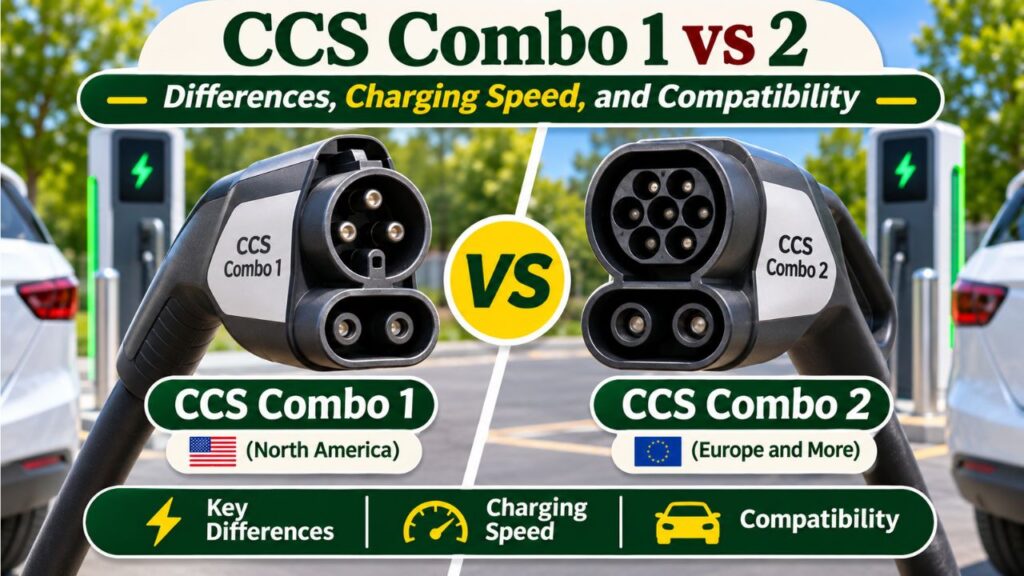
The main difference between CCS1 and CCS2 is the AC connector design incorporated into the combined charging inlet.
CCS1 is based on the SAE J1772 Type 1 connector, while CCS2 is based on the IEC Type 2 connector.
Both add two larger contacts for DC fast charging.
CCS1 vs CCS2 Comparison Chart
| Feature | CCS Combo 1 (CCS1) | CCS Combo 2 (CCS2) |
| Full name | Combined Charging System Combo 1 | Combined Charging System Combo 2 |
| AC connector foundation | SAE J1772 / Type 1 | IEC Type 2 / Mennekes |
| Upper AC interface | Five-contact layout | Seven-contact layout |
| Additional DC contacts | Two large DC contacts | Two large DC contacts |
| Overall connector shape | J1772-style top with DC section below | Type 2-style top with DC section below |
| AC phase support | Single-phase | Single-phase or three-phase |
| DC fast charging | Yes | Yes |
| Typical historical region | United States and Canada | Europe and many other markets |
| Direct plug compatibility | CCS1 inlet | CCS2 inlet |
| Can CCS1 plug into CCS2? | No, not directly | No, not directly |
| DC charging communications | CCS protocols | CCS protocols |
| Automatically faster for DC charging | No | No |
| Related AC connector | J1772 | Type 2 |
| North American market context | Coexists with growing J3400/NACS adoption | Not the dominant North American interface |
The Charging Interface Initiative (CharIN), the international association supporting CCS, identifies Combo 1 as the North American configuration and Combo 2 as the European configuration.
Both belong to the same overall charging system.
Which Is Better: CCS1 or CCS2?
Neither is universally better.
CCS1 is more practical for a vehicle using North American CCS1 charging infrastructure, while CCS2 is more practical where CCS2 charging stations dominate.
CCS2 has an advantage in AC connection flexibility because Type 2 supports three-phase AC charging.
However, that doesn’t make CCS2 inherently more powerful during DC fast charging.
A vehicle’s supported connector and the charging infrastructure available locally are more important than the connector’s name.
Are CCS Combo 1 and Combo 2 Different Charging Levels?
No.
The numbers 1 and 2 identify two connector configurations.
They do not mean:
- Level 1 versus Level 2 charging
- First-generation versus second-generation fast charging
- Slow charging versus fast charging
- A 100 kW versus 200 kW connector
Both CCS1 and CCS2 are designed for DC fast charging.
Their upper AC portions are associated with different AC connector families.
Key Takeaway: CCS1 and CCS2 share the Combined Charging System approach. Their main difference is the connector shape, regional standard, and AC phase capability—not an automatic difference in DC charging speed.
What Is CCS Combo 1?
CCS Combo 1, commonly called CCS1, is an electric vehicle charging connector primarily associated with North American EV charging infrastructure.
It combines the SAE J1772 AC charging interface with two larger DC power contacts.
This allows one vehicle inlet to support both AC charging and compatible DC fast charging.
What Does CCS1 Look Like?
A CCS1 vehicle charging port has two main sections.
Upper section: A rounded, five-contact SAE J1772-style interface.
Lower section: Two large DC power contacts.
When charging on AC, a regular J1772 connector uses the upper section.
When using a CCS1 DC fast charger, the larger combined connector engages the required control contacts and the lower DC contacts.
What Does CCS1 Stand For?
CCS means Combined Charging System.
The term Combo 1 identifies the Type 1-based version of the connector.
It is sometimes called:
- CCS1
- CCS Combo 1
- SAE Combo
- J1772 Combo
- CCS Type 1
These names generally refer to the same Type 1-based DC fast charging interface.
Where Is CCS1 Used?
CCS1 has historically been common in:
- The United States
- Canada
- Certain other markets using North American charging standards
However, the North American market is transitioning toward broader use of the SAE J3400/NACS connector.
CCS1 remains relevant to many existing vehicles and public charging stations.
Can CCS1 Charge With AC?
A CCS1 vehicle inlet can accept a compatible SAE J1772 AC charging connector.
This allows Level 1 or Level 2 AC charging, subject to the vehicle and electrical equipment.
A full CCS1 DC connector is used for DC fast charging.
Can CCS1 Support Fast DC Charging?
Yes.
CCS1 can support high-power DC charging.
However, the actual charging rate depends on the vehicle, station, cable, and operating conditions.
A CCS1 vehicle with a relatively modest DC charging capability won’t automatically charge faster just because it is connected to a high-power station.
What Is CCS Combo 2?
CCS Combo 2, commonly called CCS2, is the Type 2-based version of the Combined Charging System.
It is the widely adopted DC fast charging connector across Europe and several other markets.
Like CCS1, it combines an AC connector interface with two additional DC power contacts.
What Does CCS2 Look Like?
A CCS2 inlet has a distinctive combined shape.
Upper section: A Type 2-style connector interface.
Lower section: Two large DC power contacts.
The upper Type 2 section can accommodate compatible AC charging connections.
The combined CCS2 interface supports DC fast charging.
What Does CCS2 Stand For?
CCS2 means Combined Charging System Combo 2.
Other commonly used descriptions include:
- CCS Combo 2
- CCS Type 2
- CCS2
- Type 2 Combo
It is based on the Type 2 AC interface, sometimes associated with the Mennekes connector design.
Where Is CCS2 Used?
CCS2 is widely used in:
- European Union countries
- The United Kingdom
- Australia
- New Zealand
- India
- Several other regions
However, charging standards can vary between countries and vehicle models.
China, for example, has traditionally used its separate GB/T charging standards.
Japan has historically relied heavily on CHAdeMO for DC charging.
Therefore, it’s important to check the specific market rather than assuming every country outside North America uses CCS2.
Why Is CCS2 Common in Europe?
European charging standards support Type 2 AC charging and CCS Combo 2 DC charging.
The European Alternative Fuels Observatory identifies Type 2 and CCS2 as the relevant standard interfaces for interoperable public AC and DC charging infrastructure.
European charging regulations also establish connector requirements for public charging points.
Can CCS2 Support Three-Phase Charging?
Yes.
The Type 2 interface can support single-phase and three-phase AC charging.
However, an EV must have a compatible onboard charger to use three-phase AC power.
A CCS2 inlet doesn’t guarantee that the vehicle itself supports three-phase charging.
CCS1 vs CCS2 Plug Design and Pin Differences
The physical design of the connector is the easiest way to distinguish CCS1 from CCS2.
Both have a smaller upper connector section and two larger DC contacts below.
However, the upper sections are different.
CCS1 Pin Configuration
The Type 1-based AC interface uses five contact positions.
These include:
- Two AC power contacts
- Protective earth
- Control pilot
- Proximity-related contact
The complete CCS1 combined inlet adds two large DC power contacts.
This is why CCS1 is commonly described as a 5+2 configuration.
The two additional contacts carry DC power during fast charging.
CCS2 Pin Configuration
The Type 2 AC interface uses seven contact positions.
These include:
- L1
- L2
- L3
- Neutral
- Protective earth
- Control pilot
- Proximity pilot
The combined CCS2 inlet adds two larger DC contacts.
This is commonly described as a 7+2 configuration.
However, the exact contacts present or engaged on a DC charging plug are not necessarily identical to the full set used for AC charging.
The 7+2 description is a convenient way to explain the combined inlet architecture.
Pin Layout Comparison
| Contact Function | CCS1 | CCS2 |
| AC interface type | Type 1 | Type 2 |
| Single-phase AC | Supported | Supported |
| Three-phase AC | Not provided by Type 1 | Supported by Type 2 |
| Protective earth | Yes | Yes |
| Control pilot | Yes | Yes |
| Proximity function | Yes | Yes |
| Two large DC contacts | Yes | Yes |
| DC power transfer | Supported | Supported |
Are the Two DC Pins the Same Size?
Both connector types use two large DC contacts, but the complete connector geometries are different.
They are not physically interchangeable.
Even though both belong to the CCS family, connector dimensions and mating arrangements are defined for their respective configurations.
Can You Force a CCS1 Plug Into a CCS2 Port?
No.
Never attempt to force a charging connector into an incompatible vehicle inlet.
Doing so can damage the contacts, locking mechanism, or vehicle charging port.
Charging equipment must establish appropriate electrical and communication compatibility before transferring power.
Key Takeaway: CCS1 uses a Type 1-based upper interface, while CCS2 uses a Type 2-based upper interface. Both have two additional DC contacts, but the plugs cannot mate directly.
CCS Combo 1 vs 2: AC Charging Differences
The most significant technical distinction between CCS1 and CCS2 appears in the AC connector design.
Type 1 supports single-phase AC charging.
Type 2 can support single-phase or three-phase AC charging.
CCS1 AC Charging
In North America, SAE J1772 charging commonly operates using:
- 120 V AC for Level 1 charging
- Approximately 208–240 V AC for Level 2 charging
The actual charging power depends on the available current and the vehicle’s onboard charger.
For example:
At 240 V and 32 A:
240 × 32 ÷ 1,000 = 7.68 kW
This is an electrical power calculation before accounting for system losses.
The actual power drawn by the vehicle may vary.
CCS2 AC Charging
The Type 2 connector can support single-phase and three-phase AC arrangements.
Common European AC charging configurations include:
| AC Supply | Current | Approximate Power |
| Single-phase 230 V | 16 A | 3.7 kW |
| Single-phase 230 V | 32 A | 7.4 kW |
| Three-phase 400 V | 16 A per phase | 11 kW |
| Three-phase 400 V | 32 A per phase | 22 kW |
These are approximate power levels.
The actual output depends on the station and vehicle.
For example, a vehicle with an 11 kW three-phase onboard charger may not draw 22 kW from a 22 kW AC charging station.
Does CCS2 Charge Faster on AC?
It can, in certain circumstances.
A vehicle equipped for three-phase charging may take advantage of a three-phase AC supply using the Type 2 interface.
However, not every CCS2-equipped car has a three-phase onboard charger.
Similarly, some North American J1772-equipped vehicles can accept relatively high single-phase AC charging power when supported by the vehicle and equipment.
Therefore, CCS2’s three-phase capability is an advantage in flexibility, not a guarantee of faster AC charging for every car.
Does the AC Difference Affect DC Fast Charging?
Not directly.
During CCS DC fast charging, the two large DC contacts transfer power from the station to the vehicle’s battery system.
The station performs the main AC-to-DC conversion.
The vehicle’s onboard AC charger isn’t the main power converter for this process.
Consequently, the availability of three-phase AC charging through Type 2 doesn’t automatically make CCS2 DC charging faster.
CCS1 vs CCS2 DC Fast Charging Speed
Neither CCS1 nor CCS2 is inherently faster simply because of its connector type.
Both can support high-power DC charging.
Charging performance depends on multiple electrical and battery-management limitations.
How Fast Can CCS1 Charge?
CCS1 is used at DC fast charging stations with a wide range of power outputs.
Examples include:
- 50 kW
- 100 kW
- 150 kW
- 250 kW
- 350 kW
These are station power ratings, not guaranteed charging rates for every connected vehicle.
A CCS1 vehicle may support only a fraction of the station’s maximum output.
How Fast Can CCS2 Charge?
CCS2 is also used at DC fast charging stations with different power ratings.
Examples include:
- 50 kW
- 100 kW
- 150 kW
- 250 kW
- 350 kW
Both connector families are used in systems capable of high-power DC charging.
The CharIN organization describes CCS as a system designed to accommodate high charging power and a broad range of EV battery voltages.
Is CCS2 Faster Than CCS1 at 350 kW?
No, not automatically.
A 350 kW CCS2 charging station does not guarantee faster charging than a 350 kW CCS1 station.
Consider two different EVs:
One car may accept up to 100 kW.
Another may accept more than 200 kW under favorable conditions.
Even at equally rated chargers, the second vehicle may charge faster.
This difference comes from the vehicles, not necessarily the connector types.
What Determines DC Charging Speed?
Important factors include:
- Vehicle maximum DC charging capability
- Battery voltage
- Battery temperature
- Battery state of charge
- Charging station power output
- Charging cable current rating
- Thermal limits
- Battery management system
- Station power sharing
- Charging software and communication compatibility
The connector is only one part of the system.
Why Does Charging Slow Down Near 80%?
Many EVs reduce charging power as the battery approaches a higher state of charge.
The battery management system controls charging to protect the cells and operate within their limits.
This reduction is commonly called a charging taper.
A car may charge relatively quickly from 10% to 60% but much more slowly from 80% to 100%.
The exact charging curve depends on the vehicle and battery conditions.
Example: Charging Time at Different Power Levels
Suppose an EV needs to receive 45 kWh of energy.
Ignoring conversion losses and power variation:
| Average Charging Power | Approximate Time |
| 50 kW | 54 minutes |
| 75 kW | 36 minutes |
| 100 kW | 27 minutes |
| 150 kW | 18 minutes |
| 200 kW | 13.5 minutes |
These are simplified calculations using average power.
Actual charging time is affected by the charging curve, battery temperature, and other conditions.
Neither CCS1 nor CCS2 guarantees any of these times.
Key Takeaway: Compare the vehicle’s charging curve and the station’s real capabilities rather than assuming CCS2 is faster than CCS1.
CCS Combo 1 vs 2: Regional Availability
Regional adoption is one of the most important practical differences.
Charging equipment is designed around the connector standards used in its market.
United States
CCS1 has historically been the common non-Tesla DC fast charging interface.
Many public stations continue to support it.
However, the SAE J3400/NACS connector is expanding across vehicles and charging infrastructure.
Drivers should check their specific vehicle inlet and available charging networks.
Canada
Canada uses the North American family of EV charging standards.
CCS1 and SAE J3400/NACS are important DC fast charging interfaces.
J1772 is also widely used for AC charging.
European Union
CCS2 is the established interoperable public DC fast charging connector.
Type 2 is the corresponding standard AC interface.
European regulations require specified Type 2 and Combo 2 interoperability at applicable public charging points.
United Kingdom
CCS2 is widely used for DC fast charging.
Type 2 is commonly used for AC charging.
However, older vehicles or particular charging networks may use other interfaces.
Australia and New Zealand
CCS2 is widely adopted for modern DC fast charging.
Type 2 is the common AC charging interface.
India
CCS2 is an important connector for modern passenger EV fast charging.
However, some vehicles and charging infrastructure use other standards.
Compatibility should be checked by vehicle model and charging station.
China
China has traditionally used GB/T charging standards for AC and DC charging.
A Chinese-market vehicle shouldn’t be assumed to have CCS1 or CCS2.
Japan
CHAdeMO has historically been an important DC fast charging system in Japan.
Some vehicles or stations may support other charging interfaces.
Check the specific car and station rather than relying only on the country.
Regional Connector Comparison
| Region | Common Relevant DC Connector |
| United States | CCS1 and increasingly J3400/NACS |
| Canada | CCS1 and J3400/NACS |
| European Union | CCS2 |
| United Kingdom | CCS2 |
| Australia | CCS2 |
| New Zealand | CCS2 |
| India | CCS2 among modern passenger EV systems |
| China | GB/T DC |
| Japan | CHAdeMO historically prominent; other interfaces vary |
These are broad market patterns, not guarantees that every public station or vehicle uses the listed connector.
Can CCS1 Plug Into CCS2?
No.
CCS1 and CCS2 connectors have different physical configurations.
A CCS1 charging plug cannot directly mate with a CCS2 vehicle inlet.
Likewise, a CCS2 charging plug cannot directly mate with a CCS1 vehicle inlet.
Why Are They Incompatible?
The upper connector geometry differs.
CCS1 is based on Type 1.
CCS2 is based on Type 2.
The complete charging interface includes mechanical, electrical, and communication requirements.
Matching only the two large DC contacts isn’t enough.
Can a CCS1 Car Use a CCS2 Charger?
It may be possible using a suitable, approved adapter in a supported charging system.
However, compatibility isn’t guaranteed.
The adapter must be appropriate for the vehicle, charging station, and electrical requirements.
Can a CCS2 Car Use a CCS1 Charger?
A compatible adapter may exist for certain vehicle and charger combinations.
However, it must be specifically approved for the intended use.
Do not assume any third-party adapter will work safely.
Do CCS1 and CCS2 Use the Same Charging Protocol?
They belong to the same CCS system and share important communication standards.
However, a common protocol family doesn’t automatically guarantee compatibility when an adapter is installed.
Vehicle software, charger implementation, authentication, communication behavior, and electrical limits can affect whether charging succeeds.
The Transport Canada guidance on charging connector compatibility explains that physically connecting an adapter does not by itself resolve every potential communication incompatibility.
CCS1 to CCS2 Adapter: What You Need to Know
Adapters can sometimes help a vehicle use charging equipment with a different physical connector.
However, DC fast charging involves high voltage and substantial current.
Adapter compatibility and safety are essential.
What Does a CCS1 to CCS2 Adapter Do?
A properly designed adapter creates a physical electrical interface between two otherwise incompatible connector shapes.
Depending on its design and the vehicle’s requirements, it may also need to accommodate control or proximity signaling arrangements.
However, an adapter doesn’t necessarily translate every communication or charging standard.
Can an Adapter Convert Any CCS1 Charger to CCS2?
No.
Compatibility depends on the specific hardware and software.
A product advertised as universally compatible may still fail with certain vehicles or stations.
Does an Adapter Reduce Charging Speed?
It can.
An adapter has its own voltage, current, and temperature limits.
The actual charging power must remain within the limits of every part of the system.
For example, if a station and vehicle support higher current than the adapter is rated for, the adapter may become a limiting component.
However, not every approved adapter necessarily causes a measurable reduction in charging performance.
Are CCS1 to CCS2 Adapters Safe?
Safety depends on product design, testing, certification, vehicle approval, and correct use.
Transport Canada cautions that using unsupported or uncertified EV charging adapters can create electrical faults, equipment damage, and safety hazards.
For that reason, use only adapters approved by the vehicle manufacturer for the specific vehicle and charging application, with appropriate certification where applicable.
What Should You Check Before Buying an Adapter?
Confirm:
- Vehicle make and model
- Vehicle model year
- Vehicle charging inlet type
- Charger connector type
- Supported DC voltage
- Maximum current
- Approved charging protocols
- Applicable safety certification
- Vehicle manufacturer authorization
- Any software or firmware requirements
Do not modify a charging adapter or use improvised wiring.
Can You Use an AC Adapter for DC Fast Charging?
No.
An ordinary Type 1-to-Type 2 AC charging adapter is not automatically suitable for CCS DC fast charging.
AC and DC charging use different power-transfer arrangements.
Use an adapter specifically designed and approved for the intended charging mode.
Important: Never modify EV charging plugs, bypass connector locking mechanisms, or attempt to fabricate a high-power CCS adapter.
CCS1 vs CCS2 vs J1772 vs Type 2
These terms are related but not interchangeable.
Understanding their functions can prevent confusion when selecting charging equipment.
J1772
SAE J1772 is the familiar Type 1-based AC charging interface used extensively in North America.
A standard J1772 connector does not include the two larger DC contacts found on CCS1.
Type 2
Type 2 is an AC charging connector widely used in Europe and other regions.
It supports single-phase and, where equipped, three-phase AC charging.
A standard Type 2 AC connector does not include the lower CCS2 DC section.
CCS1
CCS1 adds two DC contacts beneath the J1772-based interface.
It allows compatible DC fast charging through the combined inlet.
CCS2
CCS2 adds two DC contacts beneath the Type 2-based interface.
It serves a similar function for vehicles designed around Type 2 AC charging.
Connector Comparison
| Connector | Main Charging Application | Common Region |
| J1772 / Type 1 | AC charging | North America |
| Type 2 / Mennekes | AC charging | Europe and other markets |
| CCS1 / Combo 1 | DC fast charging; combined inlet supports AC | North America |
| CCS2 / Combo 2 | DC fast charging; combined inlet supports AC | Europe and other markets |
| SAE J3400 / NACS | AC and DC charging | North America |
| CHAdeMO | DC fast charging | Historically important in Japan |
| GB/T DC | DC fast charging | China |
Can a J1772 Plug Fit a CCS1 Port?
Yes.
The AC portion of a CCS1 vehicle inlet is designed to work with a compatible J1772 AC connector.
Can a Type 2 Plug Fit a CCS2 Port?
Yes.
The Type 2 AC portion of the CCS2 vehicle inlet supports compatible Type 2 AC charging.
Can a J1772 Plug Fit a CCS2 Port?
Not directly.
The connector geometries are different.
A suitable approved adapter may be necessary where supported.
CCS Combo 1 vs 2 vs NACS: What Is Changing in North America?
The North American EV market has been adopting the SAE J3400 connector, commonly associated with NACS.
This development is important for existing CCS1 vehicle owners.
What Is NACS?
NACS stands for North American Charging Standard.
It originated from Tesla’s connector design.
SAE International standardized the connector family under J3400.
Unlike CCS1 and CCS2, which have separate large DC contacts, the J3400/NACS interface uses its main power contacts for either AC or DC charging, as appropriate for the charging mode.
How Is NACS Different From CCS1?
CCS1 uses a J1772-based upper interface and two additional DC contacts.
NACS uses a more compact connector design for both AC and DC charging.
Both can support DC fast charging.
However, the connector shapes and mating arrangements differ.
Is NACS Replacing CCS1?
North American automakers and charging networks have been moving toward broader use of J3400/NACS.
However, CCS1 remains relevant to many existing vehicles.
The transition is not an instantaneous replacement.
Charging networks may provide both connector types or offer access through approved adapters.
The U.S. Joint Office of Energy and Transportation’s SAE J3400 guide explains the standardization effort and its relationship to existing CCS1 infrastructure.
What About CCS2 in Europe?
CCS2 remains the established interoperable DC fast charging interface across Europe.
The adoption of NACS in North America doesn’t automatically change European CCS2 infrastructure.
Should You Avoid Buying a CCS1 EV?
Not necessarily.
The correct decision depends on the particular vehicle, charging networks, and supported adapter arrangements.
A CCS1 vehicle may remain practical when compatible DC charging stations are accessible.
However, buyers should confirm the manufacturer’s current plans for charging-network support and approved adapters.
Should You Buy a CCS2 EV in the United States?
Be careful with imported vehicles.
A CCS2 vehicle may not directly connect to North American CCS1 or J3400 charging equipment.
Beyond connector shape, imported vehicles may have differences involving AC electrical compatibility, communication, software, navigation, and charging-network support.
Verify all of these before purchasing.
How to Identify Whether Your EV Has CCS1 or CCS2
The easiest method is to inspect the vehicle’s charging inlet and confirm the specification in the owner’s manual.
Step 1: Open the Charging Port
Locate the vehicle’s charging inlet.
Some models place the port on a front fender.
Others position it near the rear of the vehicle or behind a front grille panel.
Step 2: Look at the Upper Connector Shape
If the upper section resembles a North American J1772 port, the vehicle may have CCS1.
If it resembles a European Type 2 port, the vehicle may have CCS2.
Step 3: Look for the Two Large Lower Contacts
A combined CCS inlet has two additional larger DC contact positions beneath the upper AC interface.
Some vehicles use protective covers over the lower section.
Step 4: Check the Owner’s Manual
The manual should identify the supported charging connectors.
Look for terms such as:
- CCS1
- CCS Combo 1
- CCS2
- CCS Combo 2
- SAE J1772
- Type 2
- J3400
- NACS
Step 5: Confirm the Vehicle’s Market Specification
Two visually similar models sold in different countries may use different charging interfaces.
Don’t assume that a vehicle has CCS1 or CCS2 solely because of its brand.
Step 6: Check the Charging Station
Charging-network applications often identify connector types.
Filter stations according to your vehicle’s inlet and approved adapters.
Also confirm the station’s actual power output and availability.
Which Connector Is Better for Home EV Charging?
For most home charging situations, the relevant comparison is between the AC connector interfaces, not the full CCS DC fast charging plugs.
Home charging typically uses AC equipment.
Home Charging With a CCS1 Vehicle
A CCS1-equipped vehicle can commonly use compatible SAE J1772 AC charging equipment.
In North America, Level 2 charging usually operates at 208–240 V.
The power available depends on electrical capacity, charging equipment, and the vehicle’s onboard charger.
Home Charging With a CCS2 Vehicle
A CCS2-equipped vehicle can commonly use a compatible Type 2 AC charging connection.
Where available, some vehicles can use three-phase AC charging.
This can be useful in markets with widespread three-phase electrical infrastructure.
Is CCS2 Better for Three-Phase Home Charging?
The Type 2 interface provides a technical advantage because it can support three-phase AC charging.
However, the home’s electrical supply and the vehicle’s onboard charger must both support it.
A CCS2 port alone doesn’t guarantee an 11 kW or 22 kW AC charging rate.
Do You Need a DC Fast Charger at Home?
Most households do not.
Home Level 2 AC charging is generally more practical for overnight charging.
DC fast chargers require substantially more specialized electrical infrastructure and are primarily used in commercial or public charging applications.
CCS1 vs CCS2 Charging Cost
The connector type does not independently determine the price of electricity.
Charging costs depend on electricity rates, station pricing, vehicle efficiency, and the amount of energy delivered.
Does CCS2 Cost More to Use?
Not automatically.
A CCS2 charger in Europe may have a different price from a CCS1 charger in the United States because they operate in different markets.
That doesn’t mean the CCS2 connector itself causes the price difference.
What Determines Public Charging Cost?
Charging networks may charge based on:
- Energy delivered
- Charging duration
- Session fees
- Membership plans
- Idle fees
- Location
- Time of day
Pricing varies by network and region.
Does Faster Charging Cost More?
Some networks charge different rates for different charging services or power categories.
However, the pricing structure depends on the operator.
Neither CCS1 nor CCS2 guarantees a lower charging bill.
Charging Cost Formula
Charging cost = Energy purchased (kWh) × Electricity price per kWh
For example:
40 kWh × $0.40/kWh = $16
This simplified example excludes session fees, idle charges, and other possible costs.
The formula works regardless of whether the vehicle uses CCS1 or CCS2.
Common Problems With CCS1 and CCS2 Charging
Both connector types can experience charging failures.
Many problems involve compatibility, communication, thermal limits, or equipment condition rather than the basic connector design.
Charger Does Not Start
Possible causes include:
- Charging session not authorized
- Connector not fully seated
- Vehicle communication error
- Station software problem
- Vehicle charging restrictions
- Damaged equipment
Check the vehicle and station messages.
Follow the manufacturer’s troubleshooting instructions.
Charging Is Slower Than Expected
Possible causes include:
- Cold battery
- Hot battery
- High state of charge
- Vehicle charging-power limits
- Station power sharing
- Cable temperature limits
- Charging station output restrictions
A charger advertised at 350 kW does not guarantee a 350 kW charging session.
Connector Will Not Fit
Check whether the vehicle and charger use CCS1, CCS2, or another interface.
Never force the plug.
Connector Will Not Unlock
The vehicle may keep the connector locked during an active charging session.
End charging through the vehicle or charger interface.
Follow the vehicle’s manual for unlocking procedures.
Never pull a locked connector forcibly.
Adapter Causes an Error
The adapter may not be compatible with the vehicle or charger.
Check manufacturer approval, firmware requirements, and electrical ratings.
Discontinue use if the equipment overheats, becomes damaged, or behaves abnormally.
Charging Stops Unexpectedly
Possible causes include thermal protection, station faults, communication interruptions, or vehicle battery-management limits.
Use another compatible charging station if necessary.
For recurring problems, contact the vehicle manufacturer or charging-network support.
CCS1 vs CCS2: Which Should You Choose?
For most EV owners, the connector isn’t a feature that can be selected independently.
It is determined by the vehicle’s market specification and charging design.
Choose a CCS1-Compatible Vehicle When:
- You primarily use established North American CCS1 infrastructure.
- The vehicle is designed for the local market.
- Compatible charging stations are available.
- The manufacturer provides suitable support and approved adapter options where needed.
Choose a CCS2-Compatible Vehicle When:
- You live in a market where CCS2 is the dominant DC connector.
- You regularly use compatible CCS2 public fast chargers.
- The vehicle supports the local AC charging infrastructure.
- You want the flexibility of the Type 2 AC interface where three-phase charging is available.
Consider J3400/NACS When:
- You are purchasing a North American EV.
- The vehicle manufacturer supports J3400 charging.
- You want to use compatible NACS infrastructure.
- The vehicle’s approved charging-network access fits your travel needs.
Quick Decision Guide
| Situation | Practical Choice |
| Existing CCS1 EV in the United States | Use CCS1 stations or approved adapter-supported networks |
| Existing CCS2 EV in Europe | Use CCS2 DC and compatible Type 2 AC charging |
| Buying an EV in North America | Check CCS1/J3400 inlet and network access |
| Buying an EV in Europe | Confirm Type 2 and CCS2 support |
| Importing a US-market EV into Europe | Verify approved CCS1-to-CCS2 solutions and electrical compatibility |
| Importing a European EV into the US | Verify charging, electrical, and software compatibility before purchase |
| Using three-phase AC charging | Type 2-capable vehicle and onboard charger |
| Choosing the fastest DC charging EV | Compare vehicle charging curves, not connector names |
The most useful connector is the one supported by your vehicle and the charging stations you actually use.
Common Mistakes When Comparing CCS Combo 1 vs 2
Several misunderstandings can lead to incorrect purchasing or charging decisions.
Assuming CCS2 Is a Newer Version of CCS1
The numbers identify regional connector configurations, not a simple upgrade sequence.
CCS2 is not automatically more advanced or faster.
Assuming CCS2 Always Charges Faster
The Type 2 interface supports three-phase AC charging.
However, that does not automatically increase DC fast charging speed.
Confusing J1772 With CCS1
J1772 is primarily an AC charging connector.
CCS1 combines the J1772-style interface with additional DC contacts.
Confusing Type 2 With CCS2
Type 2 is an AC connector.
CCS2 adds a dedicated lower DC contact section.
Assuming Every CCS Car Supports 350 kW
The vehicle’s battery and charging system determine its maximum supported power.
Many CCS-equipped vehicles accept considerably less than 350 kW.
Buying an Adapter Based Only on Connector Shape
A physically compatible shape isn’t enough.
Communication, voltage, current, locking, and vehicle approval also matter.
Assuming All Countries Use CCS
China, Japan, North America, and Europe have different charging-standard histories.
Check the specific regional infrastructure.
Ignoring NACS in North America
J3400/NACS adoption affects charging-network access and future vehicle options.
Include it when evaluating a North American EV.
Ignoring the Vehicle’s AC Charger
A CCS2 car may have a Type 2 interface but support only single-phase AC charging.
Check the actual onboard charger specification.
Assuming the Charging Station Rating Equals Actual Power
A 150 kW or 350 kW station provides a maximum advertised capability under appropriate conditions.
The vehicle may draw significantly less.
Conclusion
The main difference between CCS Combo 1 vs 2 is the charging connector design and the regions where each standard is used.
CCS1 is based on the SAE J1772 Type 1 interface and has historically been common in North America.
CCS2 is based on the Type 2 interface and is widely used in Europe and several other markets.
Both support DC fast charging through two additional high-power DC contacts.
The Type 2 interface can also support three-phase AC charging, which provides greater AC flexibility where the vehicle and electrical infrastructure support it.
However, CCS2 isn’t inherently faster for DC charging.
Real charging performance depends on the vehicle’s battery system, charging curve, station output, and operating conditions.
CCS1 and CCS2 plugs aren’t directly interchangeable. Adapters may be available for certain applications, but they must be approved and compatible with the vehicle and charger.
In North America, SAE J3400/NACS adoption is an additional consideration for EV owners and buyers.
Ultimately, choose charging equipment based on your vehicle’s actual inlet, supported charging standards, and the infrastructure available in your region—not the assumption that Combo 2 is automatically better than Combo 1.
FAQs About CCS Combo 1 vs 2
What Is the Main Difference Between CCS Combo 1 and Combo 2?
CCS1 uses a Type 1/J1772-based upper connector, while CCS2 uses a Type 2-based upper connector.
Both add two large DC contacts for fast charging.
The connectors have different physical designs and are not directly interchangeable.
Is CCS2 Better Than CCS1?
Not universally.
CCS2 supports a Type 2 AC interface capable of three-phase charging, which can be beneficial where the vehicle and infrastructure support it.
However, CCS2 isn’t automatically faster for DC charging.
The better option depends on the vehicle and regional charging network.
Is CCS2 Faster Than CCS1?
Not inherently.
Both support high-power DC charging.
Actual speed depends on the EV’s battery system, charging curve, charger output, cable limits, and temperature.
Can CCS1 Plug Into CCS2?
No.
Their physical connector shapes are different.
A suitable approved adapter may be available for certain applications, but direct connection isn’t possible.
Can a CCS2 Car Use a CCS1 Charger?
Possibly, with an appropriate, vehicle-approved adapter and compatible charging equipment.
However, not every adapter works with every vehicle or charging station.
Verify compatibility before use.
Is CCS1 the Same as J1772?
No.
CCS1 incorporates the J1772 AC interface but adds two large DC contacts.
J1772 alone is an AC charging connector.
Is CCS2 the Same as Type 2?
No.
Type 2 is the AC charging connector.
CCS2 combines the Type 2-based interface with two additional contacts for DC fast charging.
How Many Pins Does CCS1 Have?
The combined CCS1 inlet uses a five-contact Type 1-based upper arrangement with two additional large DC contacts.
This is commonly described as a 5+2 configuration.
How Many Pins Does CCS2 Have?
The combined CCS2 inlet uses a seven-contact Type 2-based upper arrangement with two additional large DC contacts.
This is commonly described as a 7+2 configuration.
The exact contacts used by a DC charging plug differ from those used for full Type 2 AC charging.
Does CCS1 Support Three-Phase AC Charging?
No.
The Type 1 AC interface is designed for single-phase charging.
CCS2’s Type 2-based interface can support three-phase AC, provided the vehicle and equipment are compatible.
Can CCS1 and CCS2 Both Support 350 kW Charging?
Yes.
Both connector families are used in high-power DC charging systems, including stations advertised at 350 kW.
However, actual power depends on the vehicle, cable, station, and operating conditions.
Which Countries Use CCS1?
CCS1 has historically been used mainly in the United States and Canada, along with some other markets.
However, North America is also adopting SAE J3400/NACS.
Which Countries Use CCS2?
CCS2 is widely used across Europe, the United Kingdom, Australia, New Zealand, India, and various other markets.
However, individual countries and vehicle models may support additional charging standards.
Is CCS2 Used in the United States?
CCS2 isn’t the predominant North American DC fast charging connector.
CCS1 and SAE J3400/NACS are more relevant to the U.S. market.
Imported vehicles with CCS2 may require specially approved charging arrangements.
Will NACS Replace CCS1?
North American automakers and charging networks have been expanding J3400/NACS adoption.
However, CCS1 remains important for many existing vehicles and charging stations.
The transition varies by automaker, model, and network.
Can I Change My Car From CCS1 to CCS2?
Changing the vehicle’s charging inlet is not a simple plug replacement.
The charging system includes high-voltage wiring, control electronics, communication software, locking systems, and safety requirements.
Do not attempt a DIY connector conversion. Consult the vehicle manufacturer about approved compatibility solutions.
Which Is Better for Home Charging, CCS1 or CCS2?
For home charging, the relevant difference is generally the AC connector interface.
CCS1 vehicles commonly use J1772 AC charging in North America.
CCS2 vehicles use Type 2 AC charging, which may support three-phase power where available.
The best option depends on your vehicle and electrical infrastructure.
Why Does My CCS Charger Slow Down Near 80%?
Many EVs reduce charging power as the battery reaches a higher state of charge.
Battery temperature, cell chemistry, and management-system limits also affect charging speed.
This behavior isn’t unique to CCS1 or CCS2.
Do CCS1 and CCS2 Have Different Charging Costs?
Not inherently.
Charging cost depends on energy prices, station fees, location, and charging-network policies.
Connector type alone doesn’t determine the price per kilowatt-hour.