
Type 1 and Type 2 EV chargers mainly differ in their AC charging connectors: Type 1 (SAE J1772) has five contacts and supports single-phase AC charging, while Type 2 (Mennekes/IEC 62196-2) has seven contacts and supports single-phase or three-phase AC charging. Type 1 has been common in North America and Japan, while Type 2 is the standard public AC connector across Europe.
Type 2 can offer higher AC power where three-phase electricity and a compatible vehicle are available. However, a Type 2 plug does not automatically charge faster than Type 1. Actual speed also depends on the charging station, cable, electrical supply, and vehicle’s onboard charger. The connectors cannot plug directly into each other’s vehicle inlets.
The terminology is easy to confuse with Level 1 and Level 2 charging. Those levels describe charging arrangements, not whether a car has a Type 1 or Type 2 connector.
In this article, I compare both connectors by design, charging speed, power ratings, regional standards, and compatibility. I also explain adapters, charging-time calculations, home charging considerations, and how these connectors relate to CCS fast charging and North America’s J3400/NACS standard.
Type 1 vs Type 2 EV Charger: Key Differences
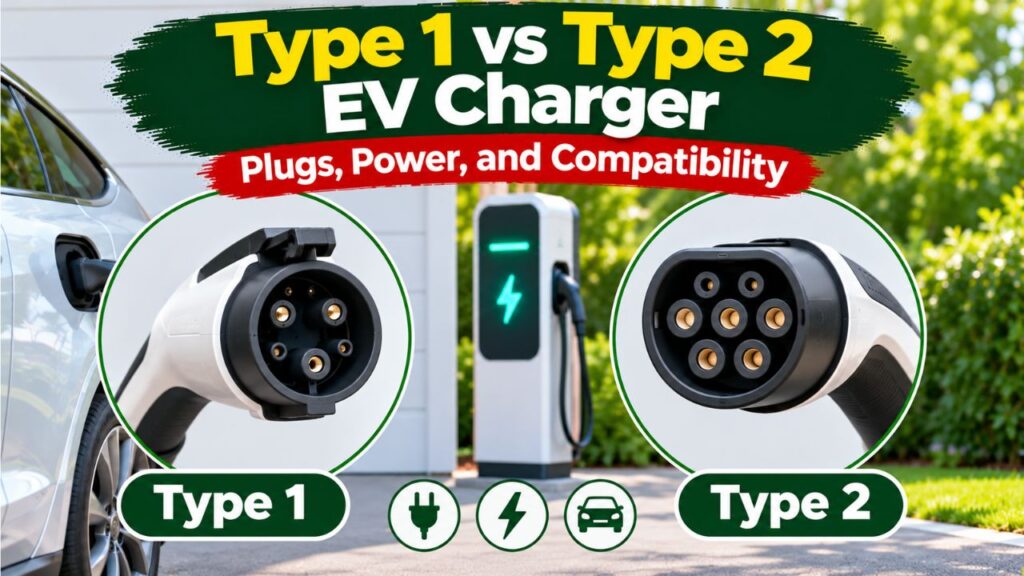
Type 1 is a five-contact, single-phase AC connector. Type 2 is a seven-contact AC connector that can also handle three-phase power.
This makes Type 2 particularly useful in regions where three-phase electrical service is available.
However, connector capability should not be confused with the actual power delivered to a vehicle.
Type 1 vs Type 2 Comparison Chart
| Feature | Type 1 EV connector | Type 2 EV connector |
| Common name | SAE J1772 or J-plug | Mennekes |
| Main standard | SAE J1772 | IEC 62196-2 |
| Number of contacts | 5 | 7 |
| AC charging | Yes | Yes |
| Single-phase charging | Yes | Yes |
| Three-phase charging | No | Yes |
| Typical European AC power | Up to approximately 7.4 kW | Approximately 3.7–22 kW |
| Higher-power configurations | North American J1772 systems can reach 19.2 kW | Some specialized systems support around 43 kW AC |
| Common regions | North America and Japan; some older European EVs | Europe and various other markets |
| Retention mechanism | Mechanical latch on connector | Vehicle or socket-side locking mechanism |
| Direct plug compatibility | Type 1 vehicle inlet | Type 2 vehicle inlet |
| CCS DC charging relationship | CCS1 uses the Type 1-derived AC interface | CCS2 uses the Type 2-derived AC interface |
| Suitable for home charging | Yes | Yes |
The power figures describe representative charging configurations rather than the guaranteed speed of every connector.
According to the European Alternative Fuels Observatory, Type 2 is the standard connector for public AC charging infrastructure in Europe.
Meanwhile, the U.S. Department of Transportation identifies SAE J1772 as a connector used for AC Level 1 and Level 2 charging.
Key Takeaway: Type 2 has the advantage of three-phase AC support, but the correct connector is the one compatible with your vehicle and local charging infrastructure.
What Is a Type 1 EV Charger?
A Type 1 EV charger uses the SAE J1772 AC connector, commonly called the J-plug.
Technically, the external charging unit is electric vehicle supply equipment (EVSE), while the vehicle contains the onboard charger that converts AC electricity into DC electricity for the battery.
However, the term Type 1 charger is commonly used to describe EV charging equipment with a Type 1 connector.
Type 1 Connector Design
Type 1 has five electrical contacts.
These include:
- Two AC power contacts
- One protective earth or ground contact
- One control pilot contact
- One proximity or connection-detection contact
The signaling contacts help the vehicle and charging equipment coordinate the charging process.
The connector also has a mechanical latch.
Where Is Type 1 Used?
Type 1 has historically been common in:
- United States
- Canada
- Japan
- Some other markets using imported Japanese or North American vehicles
It also appears on certain older European-market EVs.
For example, some earlier European-market Nissan Leaf and Mitsubishi electric vehicles use Type 1 AC charging ports.
However, charging ports can differ by model year and regional specification.
Do not identify an EV’s connector from its manufacturer alone.
How Fast Can Type 1 Charge?
Type 1 supports single-phase AC charging.
In European-style 230-volt installations, a common upper configuration is:
230 V × 32 A ÷ 1,000 = approximately 7.4 kW.
However, the SAE J1772 ecosystem in North America also supports higher-power configurations.
For example, a suitable 240-volt, 80-amp system can provide:
240 V × 80 A ÷ 1,000 = 19.2 kW.
Not every Type 1 cable, charger, or vehicle supports that power.
The actual charging rate must remain within the ratings of the complete system.
Is Type 1 Still Used in North America?
Yes.
Many existing North American EVs and charging stations use J1772 for AC charging.
However, newer vehicles and charging equipment are increasingly adopting the SAE J3400 connector, also known as NACS.
Therefore, J1772 remains important for compatibility, but buyers should also consider J3400 support when selecting new charging equipment.
What Is a Type 2 EV Charger?
A Type 2 EV charger uses the seven-contact Mennekes connector standardized under IEC 62196-2.
Type 2 is widely used for AC charging across Europe.
Its main technical advantage over Type 1 is the ability to support three-phase AC electricity.
Type 2 Connector Design
A Type 2 connector has seven contacts:
- L1: First AC phase
- L2: Second AC phase
- L3: Third AC phase
- N: Neutral
- PE: Protective earth
- CP: Control pilot
- PP: Proximity pilot
The three phase contacts allow compatible vehicles to receive power from a three-phase electrical supply.
However, a Type 2 connector can also operate with single-phase AC.
Not every Type 2 charging session uses all three phases.
Where Is Type 2 Used?
Type 2 is the standard public AC charging connector across the European Union.
It is also commonly used in the United Kingdom and numerous other markets.
The European Alternative Fuels Observatory’s infrastructure guidance explains that European public AC charging points must provide Type 2 compatibility under the applicable infrastructure requirements.
How Fast Can Type 2 Charge?
Common Type 2 charging configurations include:
| Electrical supply | Current | Approximate AC power |
| 230 V single-phase | 16 A | 3.7 kW |
| 230 V single-phase | 32 A | 7.4 kW |
| 400 V three-phase | 16 A per phase | 11 kW |
| 400 V three-phase | 32 A per phase | 22 kW |
Some less-common high-current Type 2 installations provide approximately 43 kW AC.
However, 7.4, 11, and 22 kW are more relevant comparisons for many modern home and public AC charging installations.
Does Every Type 2 Car Support 22 kW?
No.
The Type 2 connector may be physically capable of supporting a 22 kW station, but the vehicle’s onboard AC charger may have a lower limit.
For example, an EV with an 11 kW onboard charger will generally charge at no more than approximately 11 kW AC, even when connected to a 22 kW Type 2 station.
The connector does not override the vehicle’s charging hardware.
Type 1 vs Type 2: Connector Pins and Physical Design
The connectors have different shapes and electrical contact layouts.
They are not directly interchangeable.
Type 1: Five Contacts
The Type 1 connector has a relatively rounded design.
Its electrical layout supports single-phase AC power and charging-control signals.
A mechanical latch helps retain the connector.
Type 2: Seven Contacts
Type 2 has a different connector shape and seven electrical contacts.
The additional power connections allow three-phase charging.
A Type 2 vehicle inlet commonly incorporates a locking mechanism that secures the connector during charging.
Why the Contacts Matter
The additional contacts on Type 2 provide a practical electrical capability: three-phase power transfer.
However, more contacts do not automatically improve charging efficiency or increase battery capacity.
The charging speed depends on the entire electrical system.
Can You Plug Type 1 Into Type 2?
Not directly.
The physical shapes and contact arrangements are different.
Appropriate charging cables or manufacturer-approved adapters may enable certain AC charging combinations.
Forcing an incompatible connector or modifying its pins is unsafe.
Type 1 vs Type 2 Charging Speed: Which Is Faster?
Type 2 can be faster when it uses three-phase AC and the vehicle supports the additional power. However, Type 1 is not inherently slower in every charging situation.
For example, a 7.4 kW single-phase Type 1 setup and a 7.4 kW single-phase Type 2 setup can deliver similar charging power.
The meaningful difference appears when three-phase charging becomes available.
Single-Phase Charging
Single-phase AC charging is commonly used in residential settings.
At 230 volts and 32 amps:
230 × 32 ÷ 1,000 = 7.36 kW.
This is commonly rounded to 7.4 kW.
Both Type 1 and Type 2 can support that general arrangement when properly rated.
Three-Phase Charging
Type 2 can support three-phase AC.
For balanced three-phase charging, approximate power is calculated using:
Power (kW) = √3 × Line voltage (V) × Current (A) ÷ 1,000
At 400 volts and 16 amps:
√3 × 400 × 16 ÷ 1,000 ≈ 11.1 kW.
At 400 volts and 32 amps:
√3 × 400 × 32 ÷ 1,000 ≈ 22.2 kW.
These are nominal electrical calculations.
Actual charging power can be lower.
Why Type 2 Can Have an Advantage
Three-phase power allows more AC power to be delivered without requiring the same high current through one phase.
This can be useful at:
- Workplaces
- Commercial buildings
- Public AC charging stations
- Properties with suitable three-phase service
However, installing a Type 2 station does not create three-phase electricity where it is unavailable.
Does a Type 2 Charger Charge an EV Faster Than Type 1?
The answer depends on the vehicle.
Consider two examples.
Example 1: Both Cars Charge at 7.4 kW
Suppose a Type 1 EV and a Type 2 EV both support 7.4 kW AC charging.
Both connect to compatible 7.4 kW equipment.
Their charging times may be similar for the same amount of energy.
Type 2 provides no automatic speed advantage in this scenario.
Example 2: Type 2 Uses Three-Phase Power
Suppose another Type 2 EV has an 11 kW onboard charger.
It connects to a suitable 11 kW three-phase station.
This vehicle may charge faster than an EV limited to 7.4 kW AC.
However, the advantage comes from the supported electrical power, not simply the connector’s shape.
What Limits Actual Charging Speed?
The maximum charging rate is determined by the lowest compatible limit among:
- The electrical supply
- The charging station
- The cable and connector ratings
- The vehicle’s onboard AC charger
- Any vehicle or station charging limits
Battery temperature, charge level, charging losses, and other conditions can also affect performance.
The ChargePoint guide to charging speeds, updated in January 2026, confirms that AC charging equipment supplies power to the vehicle’s onboard charger, which converts it for battery storage.
Type 1 vs Type 2 EV Charging Time Comparison
Charging time depends on the amount of energy being added to the battery.
A simple estimating formula is:
Charging time (hours) = Energy added (kWh) ÷ Charging power (kW)
This calculation gives an ideal result before accounting for charging losses or changing power levels.
Example: Adding 40 kWh to an EV Battery
| Charging power | Theoretical time to add 40 kWh |
| 3.7 kW | 10.8 hours |
| 6.6 kW | 6.1 hours |
| 7.4 kW | 5.4 hours |
| 11 kW | 3.6 hours |
| 19.2 kW | 2.1 hours |
| 22 kW | 1.8 hours |
These calculations assume the vehicle, cable, and charging equipment support the specified power continuously.
They are not promises of real-world charging time.
Why Actual Charging Takes Longer
Real charging involves energy losses from:
- AC-to-DC conversion
- Battery management
- Cooling or heating systems
- Other vehicle electrical loads
Charging power may also vary throughout a session.
For a more realistic estimate, allow additional time and consult the vehicle manufacturer’s charging specifications.
Example: Charging a 60 kWh Battery From 20% to 80%
The energy to be added is approximately:
60 × (0.80 − 0.20) = 36 kWh.
At 7.4 kW:
36 ÷ 7.4 ≈ 4.9 hours.
At 11 kW:
36 ÷ 11 ≈ 3.3 hours.
These are theoretical minimum-style estimates before losses.
A vehicle that accepts only 7.4 kW AC cannot use the full 11 kW output simply because the station has a Type 2 connector.
Can a Type 1 EV Use a Type 2 Charging Station?
Yes, certain Type 1 EVs can charge at Type 2 AC stations using the correct cable or an approved compatible adapter.
However, the charging station’s connector arrangement matters.
Using an Untethered Type 2 Charging Station
Many European public AC charging stations have a Type 2 socket without a permanently attached cable.
For a compatible Type 1 vehicle, an appropriate charging cable has:
- A Type 2 connection for the station
- A Type 1 connection for the vehicle
This is commonly called a Type 2-to-Type 1 AC charging cable.
The cable must be correctly rated and intended for that charging arrangement.
Using a Tethered Type 2 Charger
A tethered charger has a permanently attached cable.
If it ends in a Type 2 vehicle connector, it will not directly fit a Type 1 vehicle inlet.
Some manufacturer-approved adapters may be available for particular installations.
However, compatibility, locking, signaling, current limits, and local safety requirements must be confirmed.
Do not assume a generic adapter is suitable.
Does an Adapter Increase Charging Power?
No.
A Type 2-to-Type 1 AC connection does not give a Type 1 vehicle three-phase charging capability.
The vehicle remains limited to its supported single-phase charging arrangement.
Can a Type 2 EV Use a Type 1 Charger?
Potentially, with compatible approved equipment.
However, the electrical ratings, signaling, and connector arrangements must be supported.
Using the correct native connector is generally preferable where suitable equipment is readily available.
Important: Type 1-to-Type 2 AC adapters are not the same as DC fast-charging adapters. Do not use an AC adapter to connect incompatible CCS or CHAdeMO fast-charging equipment.
Type 1 vs Type 2: Single-Phase and Three-Phase Charging
The difference between single-phase and three-phase AC is one of the most important technical distinctions.
What Is Single-Phase Charging?
Single-phase charging uses one AC supply phase.
It is commonly used in residential electrical systems.
Type 1 supports single-phase AC charging.
Type 2 can also operate on single-phase electricity.
What Is Three-Phase Charging?
Three-phase charging uses three AC phases.
It can supply greater power through appropriately rated equipment.
Type 2 supports three-phase charging.
However, the vehicle must also have an onboard charger that can use three-phase AC.
Is Three-Phase Charging Available at Home?
It depends on the property and country.
In many European homes, single-phase service is common, while three-phase service may be available in some residential and commercial buildings.
In the United States, conventional residential EV charging generally uses 120-volt or 240-volt arrangements rather than European-style 400-volt three-phase charging.
Never assume a home’s electrical supply can support a particular station just because the connector can handle it.
Does a Three-Phase Type 2 Charger Always Deliver 22 kW?
No.
An 11 kW Type 2 charger is also a three-phase configuration.
A 22 kW station may supply less power when:
- The vehicle supports only 11 kW AC.
- The vehicle charges using one phase.
- The cable is rated for lower current.
- The station is power-limited.
- The electrical installation restricts available power.
The maximum station rating is not necessarily the power delivered during every charging session.
Type 1 vs Type 2 EV Charger: Which Is Used in the USA?
In the United States, SAE J1772 has been a major AC charging connector for years.
However, the North American market is transitioning toward SAE J3400/NACS for many new vehicles and charging products.
Type 1 and J1772 in North America
J1772 supports AC Level 1 and Level 2 charging.
The same vehicle connector can be used with equipment operating at different voltages and power levels.
For example:
- AC Level 1 commonly uses 120 V.
- AC Level 2 commonly uses 208–240 V.
The charging equipment and vehicle determine the usable power.
What About SAE J3400/NACS?
SAE J3400 is the standardized connector based on Tesla’s North American Charging Standard.
Unlike traditional J1772, it supports both AC charging and compatible DC fast charging through its connector interface.
The Joint Office of Energy and Transportation explains that J3400/NACS can support AC Level 1 and Level 2 charging and can be compatible with J1772 AC equipment through an appropriate adapter.
Is Type 2 Common in the United States?
European Type 2 is not the standard connector for mainstream U.S. public AC charging.
U.S. buyers should normally prioritize the connector supported by their North American vehicle—typically J1772 or J3400/NACS, depending on the model.
A Type 2 charger intended for Europe should not be assumed compatible with U.S. electrical installations or vehicles.
Type 1 vs Type 2 EV Charger: Which Is Used in Europe?
Type 2 is the standard for public AC charging throughout the European Union.
It is widely used for home, workplace, and public charging.
Older vehicles with Type 1 inlets may still be encountered.
These vehicles may require a suitable Type 2-to-Type 1 cable when charging from Type 2 AC socket stations.
Why Europe Uses Type 2
Type 2 supports:
- Single-phase AC
- Three-phase AC
- Different charging current ratings
- Charging-control communication
- Connector locking arrangements
Its ability to support three-phase power suits many European electrical installations.
What About the United Kingdom?
Type 2 is also common in UK EV charging infrastructure.
The Coventry City Council EV charging guide identifies Type 1 as an older AC connector used by some vehicles and Type 2 as the current European standard.
Is Type 2 Used Outside Europe?
Yes.
Type 2 charging is used in various countries outside Europe.
However, standards vary internationally.
Some countries use other connector systems, including GB/T, J1772, or J3400.
If buying an imported EV, check the actual charging inlet rather than assuming its connector matches the country where it was manufactured.
Type 1 vs Type 2 Is Not the Same as Level 1 vs Level 2
Type 1 and Type 2 identify connector designs. Level 1 and Level 2 identify charging-power arrangements, particularly in North American terminology.
The terms refer to different things.
Connector Type vs Charging Level
| Term | Meaning |
| Type 1 | SAE J1772 AC connector design |
| Type 2 | IEC 62196-2 AC connector design |
| Level 1 | North American low-power AC charging, typically 120 V |
| Level 2 | North American higher-power AC charging, typically 208–240 V |
| DC fast charging | Charging that delivers DC electricity directly through compatible equipment |
Can a Type 1 Connector Support Level 2 Charging?
Yes.
A J1772/Type 1 connector can be used for both AC Level 1 and AC Level 2 charging.
Therefore, Type 1 does not mean Level 1.
Does Type 2 Mean Level 2?
No.
Type 2 describes the connector.
It can be used for different AC power levels, including low-power single-phase charging and higher-power three-phase charging.
European charging terminology also uses concepts such as Mode 2 and Mode 3.
These should not be confused with connector Type 1 and Type 2.
Type 1 vs Type 2 vs CCS1 vs CCS2
Type 1 and Type 2 are primarily AC charging connector designs.
CCS1 and CCS2 are used for compatible DC fast charging.
What Is CCS1?
CCS1, or Combo 1, combines the Type 1-derived AC connector arrangement with two additional large DC contacts.
It has been widely used for DC fast charging in North America.
A CCS1 vehicle inlet can typically accept the appropriate J1772 connector for AC charging.
However, a vehicle having a Type 1 inlet alone does not mean it supports CCS1 DC fast charging.
What Is CCS2?
CCS2, or Combo 2, combines the Type 2-derived AC arrangement with additional DC contacts.
It is the standard public DC fast-charging connector in Europe.
A vehicle with a CCS2 inlet can typically accept a Type 2 connector for AC charging.
Connector Comparison
| Connector | Main charging use | Relationship |
| Type 1 / J1772 | Single-phase AC | Standalone AC connector |
| Type 2 | Single- or three-phase AC | Standalone AC connector |
| CCS1 | DC fast charging | Type 1-derived combined interface |
| CCS2 | DC fast charging | Type 2-derived combined interface |
| CHAdeMO | DC fast charging | Separate DC connector system |
| J3400/NACS | AC and compatible DC charging | North American standardized connector |
Can Type 1 or Type 2 Alone Perform DC Fast Charging?
No, not through an ordinary standalone Type 1 or Type 2 AC connection.
DC fast charging requires the appropriate DC connector system and compatible vehicle hardware.
For example, a 150 kW CCS2 station is not equivalent to a 22 kW Type 2 AC station.
The two use different charging methods.
How to Identify Whether Your EV Uses Type 1 or Type 2
Before buying a charging cable or installing a home charger, confirm the vehicle’s actual charging inlet.
Step 1: Check the Vehicle Manual
Find the EV charging section.
Look for terms such as:
- SAE J1772
- Type 1
- IEC 62196-2
- Type 2
- CCS1
- CCS2
- J3400
- NACS
The manual should identify compatible charging equipment.
Step 2: Inspect the Charging Port
A standalone Type 1 inlet has a five-contact arrangement.
A Type 2 inlet has a seven-contact arrangement.
However, CCS charging inlets include additional DC contacts below the AC portion.
Check the complete port configuration.
Step 3: Confirm the Vehicle’s Market Specification
A vehicle sold in Europe may have a different charging connector from a version of the same model sold in North America or Japan.
This is particularly important for imported vehicles.
Step 4: Check the Onboard AC Charger Rating
Find the vehicle’s maximum supported AC charging power.
Possible ratings include:
- 3.3 kW
- 6.6 kW
- 7.2 or 7.4 kW
- 11 kW
- 19.2 kW
- 22 kW
Not every rating is available with every connector or vehicle.
Step 5: Match the Station and Cable
Confirm that:
- The station supports the intended supply voltage.
- The cable has the correct connector at each end.
- The current rating is adequate.
- The vehicle supports the charging arrangement.
- Required safety protections are present.
If compatibility is unclear, ask the vehicle manufacturer or a qualified EV charging installer.
Which Is Better for Home EV Charging: Type 1 or Type 2?
Neither connector is universally better for every home.
Choose based on the vehicle’s inlet, local electrical system, and available infrastructure.
For a North American J1772 Vehicle
A compatible J1772 AC charging station can provide convenient home charging.
A suitable J3400 station with an approved J1772-compatible AC adapter may also be an option.
However, check the vehicle and charging-equipment manufacturer requirements.
For a European Type 2 Vehicle
A compatible Type 2 wallbox is generally the practical choice.
In a typical single-phase home installation, approximately 7.4 kW may be available with suitable electrical capacity.
Three-phase installations may support 11 or 22 kW when the car and electrical supply allow it.
For an Older Type 1 Vehicle in Europe
An appropriate Type 1-compatible home charging unit can work.
Alternatively, a suitable Type 2 socket charging arrangement with a Type 2-to-Type 1 AC cable may be practical.
Check cable ratings and manufacturer compatibility.
Do You Need Three-Phase Power for Type 2?
No.
Type 2 can operate on single-phase electricity.
Three-phase power is only required if you want to use a three-phase charging arrangement.
Should You Install the Highest-Power Charger Available?
Not necessarily.
For example, if your EV’s onboard charger is limited to 7.4 kW, installing a 22 kW Type 2 station will not make that vehicle charge at 22 kW.
A higher-rated station may provide flexibility for other compatible vehicles, but installation costs and electrical capacity should be evaluated.
My recommendation: Match the home charger to your existing vehicle and electrical installation first. Consider future connector compatibility only after confirming that the setup is safe and practical.
Are Type 1 and Type 2 EV Chargers Safe?
Both connector systems are designed for controlled EV charging.
However, safe operation depends on using properly designed and installed equipment.
Built-In Charging Communication
Type 1 and Type 2 charging systems use control signaling between the vehicle and the charging equipment.
This helps determine whether charging can begin and what current is available.
The equipment is designed to manage power transfer rather than operating like an ordinary unprotected electrical extension cord.
Connector Retention
Type 1 commonly uses a mechanical latch.
Type 2 commonly uses a locking mechanism associated with the vehicle or socket.
Both arrangements are intended to help maintain an appropriate electrical connection.
Electrical Protection
EV charging installations require suitable electrical protection.
Depending on the country, equipment, and applicable code, requirements may include:
- Proper grounding or earthing
- Overcurrent protection
- Residual-current or ground-fault protection
- DC leakage detection
- Suitable cable ratings
- Appropriate disconnecting arrangements
Do not assume every product provides the same protective functions.
Avoid Unsafe Adapters
Use only adapters and cables intended and approved for the charging arrangement.
Do not:
- Force mismatched plugs.
- Modify connector contacts.
- Bypass locking mechanisms.
- Defeat charging-control signaling.
- Use damaged or overheating cables.
- Exceed equipment current ratings.
- Use an AC connector adapter as a substitute for a DC fast-charging system.
Permanent home charging installations should be evaluated and installed by a qualified electrician according to applicable local electrical requirements.
Common Mistakes When Comparing Type 1 and Type 2 Chargers
| Mistake | Why it is incorrect | Better approach |
| Assuming Type 1 means Level 1 | Type 1 describes a connector | Separate connector type from charging level |
| Assuming Type 2 always charges faster | The vehicle may have a low AC limit | Check onboard charging power |
| Assuming every Type 1 charger is limited to 7.4 kW | Higher-power North American J1772 systems exist | Check the region and equipment rating |
| Assuming every Type 2 station provides 22 kW | Many deliver 7.4 or 11 kW | Check the station specification |
| Treating CCS2 as ordinary Type 2 AC charging | CCS2 includes DC fast-charging contacts | Identify the complete connector |
| Buying a cable based only on the vehicle brand | Model-year and regional ports differ | Inspect the vehicle inlet |
| Using an unapproved adapter | May create electrical or connection hazards | Confirm manufacturer compatibility |
| Assuming three-phase power is present at home | Electrical service varies | Ask a qualified installer |
| Expecting an adapter to add three-phase support | Type 1 vehicles remain single-phase | Respect vehicle capabilities |
| Ignoring J3400/NACS in North America | Connector adoption is changing | Consider the exact vehicle and future equipment needs |
The most reliable comparison considers the complete charging system rather than only the connector.
Conclusion
The difference between Type 1 vs Type 2 EV charger systems is primarily the AC connector design and supported electrical phases.
Type 1 uses five contacts and supports single-phase AC charging. It has been widely used in North America and Japan.
Type 2 uses seven contacts and supports both single-phase and three-phase AC charging. It is the standard public AC connector throughout Europe.
Type 2 can deliver higher AC power through suitable three-phase installations, commonly 11 or 22 kW. However, Type 1 can also support substantial charging power, including higher-current North American J1772 configurations.
Neither connector guarantees a particular charging speed.
I recommend checking the vehicle’s actual inlet, onboard AC charging limit, local electrical supply, and cable compatibility before selecting charging equipment.
For North American EV owners, J1772 and the growing use of J3400/NACS are important considerations. For European EV owners, Type 2 is generally the standard AC charging choice.
If you have an older Type 1 vehicle in a Type 2 region, the correct approved AC cable or adapter may allow compatible charging without changing the vehicle’s inlet.
Ultimately, the better charging setup is the one that safely matches your vehicle and provides the power it can actually use.
FAQs About Type 1 vs Type 2 EV Charger
What Is the Main Difference Between Type 1 and Type 2 EV Chargers?
Type 1 has five contacts and supports single-phase AC charging.
Type 2 has seven contacts and supports single-phase or three-phase AC charging.
Type 1 has been common in North America and Japan, while Type 2 is standard for public AC charging in Europe.
Is Type 2 EV Charging Faster Than Type 1?
It can be when three-phase AC power is available and the vehicle supports it.
However, a 7.4 kW Type 1 connection and a 7.4 kW Type 2 connection provide similar nominal charging power.
Actual charging speed depends on the electrical supply, station, cable, and onboard charger.
Can I Use a Type 2 Charger With a Type 1 Car?
Yes, in certain AC charging arrangements.
For example, a Type 1 vehicle may use an untethered Type 2 AC station with an appropriately rated Type 2-to-Type 1 charging cable.
Compatibility must be confirmed.
The arrangement does not give the vehicle three-phase charging capability.
Is Type 1 the Same as Level 1 Charging?
No.
Type 1 is a connector standard.
Level 1 describes a lower-power AC charging arrangement, typically using 120 volts in North America.
A J1772/Type 1 connector can support both Level 1 and Level 2 AC charging.
Can Type 2 EV Chargers Use Single-Phase Electricity?
Yes.
Type 2 supports both single-phase and three-phase AC charging.
A 230-volt, 32-amp single-phase configuration provides approximately 7.4 kW of nominal power.
Three-phase configurations can provide higher power when the vehicle and installation support them.
Can a Type 1 EV Charge at 22 kW?
Not through a typical European 22 kW three-phase Type 2 AC arrangement.
Type 1 supports single-phase AC only.
Some North American J1772 configurations can deliver up to 19.2 kW with suitable equipment and a compatible vehicle.
Actual charging power depends on the complete system.
What Is the Difference Between Type 2 and CCS2?
Type 2 is primarily an AC charging connector.
CCS2 combines the Type 2-derived AC interface with additional DC contacts for compatible DC fast charging.
A vehicle with a CCS2 inlet can generally use a suitable Type 2 AC cable, but a standalone Type 2 AC connector cannot provide CCS2 DC fast charging.
Are Type 1 EV Chargers Being Replaced?
In North America, many newer EVs and charging products are adopting SAE J3400/NACS.
However, J1772 charging remains important because many existing EVs and stations use it.
In Europe, Type 2 is the standard public AC charging connector, while Type 1 is mainly associated with certain older or imported vehicles.
Which EV Charger Connector Is Best for Home Use?
Choose the connector that matches your vehicle and local electrical system.
J1772 or J3400/NACS is relevant for many North American vehicles.
Type 2 is generally the appropriate choice for European-market vehicles.
Check the onboard charger rating and have the electrical installation evaluated before selecting a station.
Can a Type 1 to Type 2 Adapter Support DC Fast Charging?
No. An ordinary Type 1-to-Type 2 AC adapter does not provide CCS fast-charging compatibility.
DC fast charging requires the appropriate DC connector, vehicle hardware, communication protocol, and approved equipment.
Always use a charging solution specifically supported by the vehicle manufacturer.