
AC charging uses alternating current that an electric vehicle converts into direct current through its onboard charger, while DC charging delivers direct current from an external charger to the vehicle’s battery system. AC charging is generally better for everyday home charging, while DC fast charging is better for road trips and situations requiring a quick recharge.
The biggest practical difference is charging speed. AC Level 2 charging commonly operates at several kilowatts and can replenish an electric vehicle overnight. Public DC fast chargers may deliver 50–350 kW or more, although the vehicle’s battery determines how much power it can actually accept.
Charging cost and battery health are also important. Home AC charging is typically cheaper than public DC fast charging. Frequent high-power DC charging can also increase battery degradation under certain conditions, although modern battery management systems help control charging stress.
In this article, I explain how AC and DC EV charging work, how their speeds compare, and why charging time changes with battery percentage and temperature. I also cover Level 1, Level 2, and DC fast charging, electricity costs, battery longevity, connector compatibility, and when each charging method makes the most sense.
AC vs DC Charging EV: Main Differences
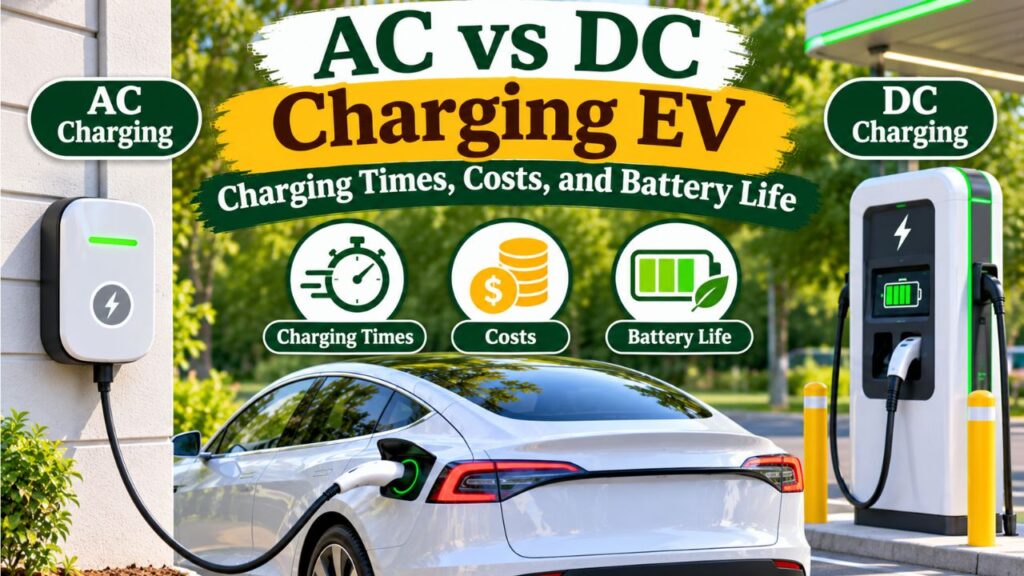
Both AC and DC charging deliver energy that ultimately becomes stored in an electric vehicle’s traction battery.
The main difference is where the electricity is converted from AC to DC.
In AC charging, the conversion occurs inside the vehicle.
In DC fast charging, the conversion occurs in the external charging equipment.
This difference allows DC charging stations to supply much higher power than the onboard AC chargers installed in most passenger vehicles.
AC vs DC EV Charging Comparison Table
| Feature | AC charging | DC charging |
| Full name | Alternating current charging | Direct current charging |
| Electrical conversion | Inside the vehicle | Inside the external charging station |
| Uses onboard AC charger | Yes | Bypasses onboard AC power-conversion stage |
| Main charging types | Level 1 and Level 2 | DC fast charging |
| Common power | About 1.2–19.2 kW, depending on level and vehicle | Often 50–350 kW; some equipment is rated higher |
| Charging speed | Slow to moderate | Usually much faster |
| Typical location | Home, workplace, destination charging | Highways, public charging hubs, fleet depots |
| Equipment cost | Generally lower | Generally higher |
| Cost per kWh to driver | Usually cheaper at home | Often more expensive at public stations |
| Battery stress | Generally lower at modest charging power | Can be higher during frequent high-power charging |
| Best use | Daily charging and overnight parking | Long trips and quick charging stops |
| Plug types in North America | J1772 and J3400/NACS | CCS1, J3400/NACS, and CHAdeMO |
The U.S. Department of Energy’s Alternative Fuels Data Center identifies AC Level 1, AC Level 2, and DC fast charging as the main EV charging options used in the United States.
Key Takeaway: AC charging prioritizes practical, lower-power charging over longer parking periods. DC charging prioritizes high-power energy delivery when time matters.
What Is AC Charging in an Electric Vehicle?
AC charging supplies alternating current to an electric vehicle, where the onboard charger converts it into direct current for battery storage.
Alternating current is the electricity commonly delivered through residential and commercial electrical systems.
In the United States, ordinary household outlets typically supply 120-volt AC power, while many larger household electrical circuits supply 240 volts.
EVs use this electricity through compatible charging equipment.
How AC EV Charging Works
The basic process involves five steps.
- Electricity flows from the utility grid to the building.
- AC charging equipment establishes a safe connection with the vehicle.
- AC electricity passes through the charging cable and vehicle inlet.
- The onboard charger converts AC electricity into DC electricity.
- The battery management system controls charging according to battery conditions.
The vehicle battery stores energy in DC form.
The external AC charging equipment doesn’t normally perform the main AC-to-DC conversion.
That function belongs to the vehicle’s onboard charger.
What Is an Onboard Charger?
The onboard charger (OBC) is a power-electronics component installed inside the vehicle.
Its main role during AC charging is converting incoming AC power into suitable DC power for the battery.
It also participates in communication and charging control.
The U.S. Department of Energy’s explanation of electric vehicle components confirms that the onboard charger converts incoming AC electricity to DC power and monitors charging conditions.
Advantages of AC Charging
AC charging offers several practical benefits:
- It is suitable for overnight charging.
- Residential electricity is often relatively inexpensive.
- Level 2 equipment is generally less costly to install than DC fast charging.
- Lower charging power is often adequate for daily driving.
- It works well at workplaces and destinations where cars remain parked.
- It can be scheduled around off-peak electricity rates.
Limitations of AC Charging
The main limitation is charging speed.
An EV’s onboard charger can process only a certain amount of AC power.
Even if the charging equipment supports a higher output, the vehicle may not accept it.
For example, a vehicle with a 6.6 kW onboard AC charger generally cannot use the full 11 kW available from an AC charging station.
Actual charging power is limited by the vehicle, equipment, electrical supply, and charging conditions.
What Is DC Fast Charging in an Electric Vehicle?
DC fast charging supplies direct current from a powerful external charging system to an electric vehicle’s battery through a controlled DC charging path.
Unlike AC charging, the external equipment performs the main AC-to-DC conversion.
This allows the station to use power-conversion hardware larger than the onboard AC charger in a typical passenger vehicle.
How DC Fast Charging Works
The process generally involves:
- Electrical power reaches the charging facility.
- The DC charger converts incoming AC electricity into controlled DC electricity.
- The charger and vehicle establish communication.
- The vehicle’s battery management system determines acceptable charging conditions.
- DC power flows through the vehicle’s DC charging path into the battery system.
The charging system continuously adjusts power according to the battery’s requirements.
DC charging bypasses the onboard AC charger, but it does not bypass battery safety controls.
The battery management system still regulates charging based on battery voltage, temperature, state of charge, and other conditions.
Why Is DC Charging Faster?
Most DC fast chargers use high-power equipment that can supply substantially more electricity than the vehicle’s onboard AC charger.
For example:
- A home AC charger might deliver 7.7 kW.
- A public DC charger might be rated at 150 kW.
- Some high-power stations are rated at 350 kW or more.
However, a 350 kW station doesn’t automatically charge every vehicle at 350 kW.
The car must support the power, and actual delivery changes throughout the session.
Advantages of DC Fast Charging
DC charging is useful because it can:
- Add substantial driving range in a relatively short stop.
- Reduce waiting time during long trips.
- Support commercial vehicles with limited downtime.
- Help drivers without reliable home charging.
- Provide quick charging during unexpected travel.
Limitations of DC Fast Charging
Compared with ordinary home AC charging, public DC fast charging may involve:
- Higher electricity prices.
- Additional charging or idle fees.
- Greater equipment and infrastructure costs.
- Charging-power reductions at high battery percentages.
- More sensitivity to battery temperature and charging conditions.
- Potentially greater long-term battery stress when used frequently at high power.
Key Takeaway: DC fast charging is especially valuable when charging time is limited, but the charger rating alone doesn’t determine how quickly the battery will recharge.
Level 1 vs Level 2 vs DC Fast Charging
EV charging levels describe different methods and power ranges.
In the United States, Level 1 and Level 2 are AC charging methods.
DC fast charging is often informally called Level 3 charging.
However, DC fast charging is generally the more precise term.
EV Charging Levels Comparison
| Charging type | Electrical supply | Approximate power | Typical application |
| AC Level 1 | 120 V AC | About 1.2–1.9 kW | Basic home charging |
| AC Level 2 | 208–240 V AC | About 2.9–19.2 kW | Home, workplace, public destinations |
| DC fast charging | DC output from external charger | Commonly 50–350 kW, with higher-power equipment available | Highways and public charging hubs |
These are equipment ranges, not guarantees for every vehicle.
Level 1 AC Charging
Level 1 uses a compatible 120-volt electrical outlet.
A common charging setup operating at 120 volts and 12 amperes supplies:
120 × 12 = 1,440 watts
That equals 1.44 kW before charging losses.
Level 1 is the slowest common EV charging method.
According to the Alternative Fuels Data Center, it may add approximately 2–5 miles of driving range per hour, depending on vehicle efficiency and charging conditions.
It may be sufficient for drivers with short daily commutes and long overnight parking periods.
Level 2 AC Charging
Level 2 uses 240-volt residential electrical service or 208-volt service commonly found in some commercial buildings.
For example, a 240-volt unit operating at 32 amperes delivers:
240 × 32 = 7,680 watts
That equals 7.68 kW before losses.
Level 2 may add approximately 10–30 miles of driving range per hour for many vehicles.
Actual range gain depends on power, vehicle efficiency, and charging conditions.
A typical battery-electric vehicle can often recharge overnight using Level 2 equipment.
DC Fast Charging
DC fast charging uses much higher charging power.
Public chargers may be rated at:
- 50 kW.
- 100 kW.
- 150 kW.
- 250 kW.
- 350 kW.
- Higher power levels in certain installations.
The U.S. Department of Energy describes modern DC charging equipment capable of delivering up to 500 kW, although passenger vehicles may accept considerably less.
For compatible vehicles, DC fast charging can replenish substantial range during a short stop.
According to the U.S. Department of Transportation’s charging-speed guide, DC fast charging may bring a battery-electric vehicle to approximately 80% from empty in about 20 minutes to one hour, depending on the system.
AC vs DC Charging Speed: Which Is Faster?
DC fast charging is usually much faster than AC charging when the vehicle supports it and battery conditions permit high-power charging.
However, charging time is not determined by charger power alone.
Battery capacity, current state of charge, temperature, charging limits, and power tapering all influence the result.
Example: Charging a 60 kWh Battery From 20% to 80%
Suppose an EV has a usable battery capacity of 60 kWh.
The energy required to increase its state of charge from 20% to 80% is:
60 × (0.80 − 0.20) = 36 kWh
This is the approximate energy that must be added to the battery.
Now compare different charging methods.
| Method | Example power | Estimated battery-energy time |
| Level 1 AC | 1.44 kW input | Approximately 29 hours at 85% efficiency |
| Level 2 AC | 7.68 kW input | Approximately 5.2 hours at 90% efficiency |
| DC fast charging | 60 kW average to battery | Approximately 36 minutes |
| DC fast charging | 90 kW average to battery | Approximately 24 minutes |
| DC fast charging | 120 kW average to battery | Approximately 18 minutes |
These are illustrative calculations, not real-world charging claims for a specific vehicle.
For the AC examples, the stated efficiencies account for assumed energy losses.
For the DC examples, power is the assumed average power reaching the battery, not the charger’s advertised peak output.
Real charging sessions include changing power, temperature limits, and other losses.
Why a 150 kW Charger Doesn’t Always Deliver 150 kW
Suppose a vehicle’s maximum DC charging capability is 100 kW.
Connecting it to a 150 kW station won’t automatically increase its battery charging limit.
The vehicle may accept 100 kW or less.
Likewise, a car rated for 200 kW fast charging may receive much less when:
- The battery is cold.
- The battery is nearly full.
- The station shares power with another port.
- The station is derated.
- Battery management limits current.
- Vehicle and station voltage or current limits restrict output.
What Is a Charging Curve?
A charging curve describes how charging power changes as battery state of charge increases.
A vehicle might accept high power during the lower or middle part of a charging session.
As the battery approaches a higher state of charge, the power generally decreases.
This is called charging taper.
Therefore, a vehicle’s peak charging rate isn’t the same as its average charging rate.
For comparing EVs, the manufacturer’s verified 10–80% charging time can be more useful than peak kW alone.
Why Does DC Fast Charging Slow Down After 80%?
Battery charging power generally decreases as the battery approaches full charge.
This helps the vehicle manage battery voltage, temperature, and cell conditions.
What Happens Above 80%?
At a high state of charge, the battery management system may request lower charging current.
This means each additional percentage point can take longer to add.
The exact point where charging begins to taper varies by vehicle.
Some EVs reduce power significantly before 80%.
Others maintain relatively strong charging performance farther into the session.
Is 80% a Universal Charging Limit?
No.
Eighty percent is a common practical charging target, not a physical maximum.
EVs can usually be charged beyond 80% when additional range is needed.
However, charging from 80% to 100% at a DC fast charger may take disproportionately longer.
The U.S. Department of Transportation notes that charging slows as battery charge approaches full, making an approximately 80% highway stop convenient for many vehicles.
Should You Charge to 100% Before a Road Trip?
Sometimes.
If your route requires the additional range, charging to 100% may be appropriate.
However, follow the vehicle manufacturer’s battery guidance.
Battery chemistry, thermal management, and recommended charge limits vary.
For everyday charging, some vehicles recommend an upper limit below 100%, while certain battery types have different manufacturer recommendations.
AC vs DC EV Charging Cost: Which Is Cheaper?
Home AC charging is generally cheaper than public DC fast charging in the United States.
However, the difference comes primarily from electricity pricing and charging-network fees rather than AC electricity inherently costing less than DC electricity.
A public AC Level 2 charger can sometimes be expensive.
Likewise, some public charging locations offer discounted or free charging.
The U.S. Department of Energy’s EV charging cost guidance explains that charging at home is typically less expensive than public charging, especially when off-peak electricity rates are available.
Example: Home AC vs Public DC Charging
Assume an EV needs 36 kWh added to its battery.
For a simplified comparison, assume 90% overall charging efficiency for both charging scenarios.
Energy purchased:
36 ÷ 0.90 = 40 kWh
Now suppose:
- Home AC electricity costs $0.18 per kWh.
- Public DC charging costs $0.50 per kWh.
The resulting costs are:
| Charging location | Illustrative price | Energy purchased | Total |
| Home AC | $0.18/kWh | 40 kWh | $7.20 |
| Public DC | $0.50/kWh | 40 kWh | $20.00 |
In this hypothetical example, the public DC session costs $12.80 more.
These are illustrative rates, not verified national averages or current local charging quotes.
Actual bills depend on utility tariffs, metering, station policies, fees, and real energy losses.
Why Does DC Fast Charging Often Cost More?
Public DC charging operators must recover costs associated with:
- High-power charging equipment.
- Electrical infrastructure.
- Site installation.
- Utility service.
- Maintenance.
- Networking and payment systems.
- Property access.
- Other operational expenses.
Some sites also face utility demand charges.
These costs can influence the price paid by drivers.
Can AC Charging Be Expensive?
Yes.
A public Level 2 station may charge parking fees, session fees, or high energy rates.
The cost depends on the operator.
For this reason, AC versus DC is not by itself a reliable comparison of electricity prices.
Always check the posted rate and applicable fees.
Which Is Best for Saving Money?
For drivers with suitable home charging access, off-peak AC charging is often the most economical routine.
For drivers relying on public charging, compare local AC and DC pricing and the time required.
The cheapest station may not be the best option if charging there takes much longer than your schedule permits.
AC vs DC Charging Efficiency: Which Wastes Less Electricity?
Both AC and DC charging involve energy losses.
Some electricity is lost through power electronics, cables, battery heating, cooling systems, and other vehicle functions.
AC Charging Losses
During AC charging, electricity passes through the vehicle’s onboard AC-to-DC converter.
That conversion isn’t perfectly efficient.
Additional energy may be used by:
- Battery management electronics.
- Cooling or heating equipment.
- Vehicle control systems.
- Other supporting components.
Low-power charging can sometimes be less efficient because certain vehicle systems remain active for a longer period.
However, this varies by vehicle.
DC Charging Losses
During DC charging, power conversion occurs mainly in the external charger.
Losses occur in the charging station and its electrical components.
The vehicle also consumes energy for battery and thermal management.
DC charging bypasses the onboard AC conversion stage, but that doesn’t mean it has zero conversion losses.
Is DC Charging More Efficient Than AC?
Not universally.
Efficiency depends on the vehicle, charger design, temperature, charging power, and measurement boundary.
For example, measuring power at the DC charger’s output is different from measuring electricity entering the facility from the grid.
A charger may appear highly efficient when external conversion losses are excluded from the calculation.
The important comparison is grid-to-battery efficiency, with the same measurement boundaries used for both methods.
For ordinary EV owners, charging price and available time often matter more than a small difference in efficiency.
AC vs DC Charging EV Battery Health: Which Is Better?
Lower-power AC charging is generally a gentler routine for EV batteries than frequent high-power DC fast charging. However, occasional DC fast charging is a normal use case for modern electric vehicles and doesn’t automatically cause significant battery damage.
Battery longevity depends on several factors.
These include:
- Battery chemistry.
- Charging power.
- Temperature.
- State of charge.
- Depth of discharge.
- Battery management.
- Vehicle design.
- Charging frequency.
Does Frequent DC Fast Charging Degrade EV Batteries?
Real-world data suggests that frequent use of high-power DC charging can be associated with faster battery degradation.
In a study published January 13, 2026, Geotab analyzed battery health data from more than 22,700 electric vehicles across 21 makes and models.
The study found that vehicles relying heavily on high-power DC fast charging above 100 kW had average degradation rates reaching approximately 3.0% annually, compared with around 1.5% for vehicles primarily using lower-power charging.
The full study is available in Geotab’s updated EV battery health analysis.
These are observational results across different vehicles and usage patterns.
They don’t mean an individual battery will necessarily degrade at those rates, or that charger power alone explains every difference.
Why Can High-Power Charging Increase Battery Stress?
High charging currents can contribute to greater heat generation and electrochemical stress.
Under unfavorable conditions, particularly at low battery temperatures, rapid charging may increase risks such as lithium plating in certain lithium-ion chemistries.
Modern EVs use battery management and thermal systems to reduce these risks.
Charging power may be restricted when conditions aren’t suitable.
Does AC Charging Extend Battery Life?
Regular AC charging may reduce exposure to the high charging currents associated with frequent DC fast charging.
However, AC charging doesn’t prevent normal battery aging.
Other conditions still matter.
For example, keeping a battery at an unsuitable temperature or very high state of charge for prolonged periods can contribute to aging.
How to Protect Battery Health
Practical habits include:
- Follow the manufacturer’s recommended daily charge limit.
- Use AC charging for routine needs when convenient.
- Use DC fast charging when travel or time requires it.
- Avoid leaving the battery near completely empty for extended periods.
- Avoid prolonged high states of charge when the manufacturer advises against them.
- Use battery preconditioning when supported.
- Avoid unnecessary exposure to extreme battery temperatures.
Battery chemistry matters.
Some lithium iron phosphate (LFP) battery vehicles have charging recommendations that differ from those for nickel-rich lithium-ion batteries.
Follow the guidance for the specific vehicle.
Key Takeaway: AC charging is a sensible default for everyday use, while DC fast charging remains valuable for travel. Battery longevity depends on overall use rather than a single charging session.
AC vs DC Charging Connectors: J1772, CCS, NACS, and CHAdeMO
Charging compatibility depends on the vehicle’s inlet, charger connector, supported charging protocol, and sometimes an approved adapter.
The connector landscape in North America has been changing as automakers adopt SAE J3400/NACS.
SAE J1772
J1772 is commonly associated with AC Level 1 and Level 2 charging.
It is used on many vehicles with CCS1 charging inlets.
J1772 itself doesn’t provide the additional DC contacts needed for CCS1 fast charging.
CCS1
CCS stands for Combined Charging System.
CCS1 combines the J1772-style AC connector area with two additional DC power contacts.
This allows one vehicle inlet to support compatible AC and DC charging.
However, the external connector differs between AC Level 2 and CCS1 DC fast charging.
NACS / SAE J3400
The North American Charging Standard, commonly called NACS, is standardized through SAE J3400.
It is designed to support both AC and DC charging using the same main power contacts.
The Joint Office of Energy and Transportation’s J3400 guide explains the connector’s AC and DC compatibility.
SAE published its J3400 Recommended Practice in September 2024, and related connector and inlet standards continued developing in 2025.
CHAdeMO
CHAdeMO is a DC fast-charging connector standard used on certain older and existing EV models, particularly some Japanese vehicles.
It remains relevant for compatible vehicles.
However, North American charging infrastructure is increasingly centered on CCS1 and J3400/NACS.
Connector Comparison
| Connector | AC charging | DC charging | Main consideration |
| J1772 | Yes | No, not by itself | Common Level 1 and Level 2 connector |
| CCS1 | Yes, through J1772 portion | Yes | Combined AC/DC vehicle inlet |
| J3400/NACS | Yes | Yes | Supports both charging methods |
| CHAdeMO | Not commonly used for AC | Yes | Used by certain existing EVs |
Can You Use an Adapter Between CCS and NACS?
Sometimes.
However, compatibility depends on the vehicle, charging station, and adapter.
An AC adapter and a DC fast-charging adapter are not necessarily interchangeable.
Some automakers require approved adapters and supported vehicle software.
Certain charging networks also restrict access by model or manufacturer.
Never assume that a connector fitting physically means the charging combination is approved.
Can Every EV Use DC Fast Charging?
No.
Not every electric vehicle supports DC fast charging.
Most modern battery-electric passenger vehicles offer DC fast-charging capability, but specifications vary.
Many plug-in hybrid electric vehicles support AC charging only.
Why Don’t All PHEVs Have DC Fast Charging?
Plug-in hybrids typically have smaller batteries than full battery-electric vehicles.
Manufacturers may decide that high-power DC charging isn’t necessary for their intended use.
Adding DC charging capability also requires compatible hardware, battery controls, and charging-system design.
The U.S. Department of Energy notes that most plug-in hybrid vehicles do not support DC fast charging.
What if an EV Has a Lower DC Charging Limit?
An EV rated to accept a maximum of 50 kW can connect to a compatible higher-power station, but it generally won’t receive more power than its approved limit.
Actual charging power may be lower still.
Always check the vehicle specifications.
AC vs DC Charging at Home: Which Makes Sense?
For most residential EV owners, AC charging is the practical choice.
Level 1 Home Charging
Level 1 may work for drivers with:
- Short daily commutes.
- Long overnight parking periods.
- Modest daily energy needs.
- A suitable, properly maintained electrical outlet.
However, charging can take a long time after a heavily depleted battery.
The outlet and circuit must be appropriate for continuous EV charging.
Level 2 Home Charging
Level 2 is often the preferred setup for drivers who need faster overnight charging.
A 240-volt home charger can replenish more energy in a shorter period.
However, the installation must match the home’s electrical capacity and applicable codes.
For example, a typical 32-amp continuous Level 2 charging load is commonly supplied by an appropriately installed 40-amp branch circuit.
Actual installation requirements depend on the equipment and locally adopted electrical code.
Use a qualified electrician to assess circuit sizing, panel capacity, protection requirements, and installation conditions.
Can You Install DC Fast Charging at Home?
Technically, DC charging equipment can be installed in private settings.
However, high-power DC fast chargers are generally impractical for an ordinary residence because of their power requirements, cost, and infrastructure needs.
Most residential EV drivers don’t require that level of charging power.
Level 2 AC charging is usually sufficient for overnight charging.
Is It Safe to Charge in Rain?
Properly installed and rated EV charging equipment is designed with safety protections.
The U.S. Department of Energy confirms that suitable residential EV charging equipment can be used outdoors, including in rain, when equipment is appropriately rated and installed.
Avoid damaged cables, connectors, or electrical outlets.
Do not use unapproved adapters or ordinary extension cords as substitutes for properly installed charging infrastructure.
When Should You Choose AC Charging Instead of DC?
AC charging is usually the better choice when the vehicle will remain parked long enough to replenish the energy needed.
Choose AC Charging for Daily Commuting
Suppose you drive 35 miles daily.
If your EV consumes approximately 0.30 kWh per mile:
35 × 0.30 = 10.5 kWh
A suitable 7.7 kW AC charger could replenish roughly that amount in well under two hours under favorable conditions, after accounting for typical charging losses.
You don’t need DC fast charging for such a modest daily energy requirement if convenient AC charging is available.
Choose AC Charging at Work
Workplace Level 2 charging is useful because vehicles are often parked for several hours.
Drivers can replenish energy without making a separate charging stop.
Choose AC Charging Overnight
Overnight parking gives slower charging methods enough time to replenish substantial energy.
Scheduled charging can also take advantage of lower electricity prices when available.
Choose AC Charging for Plug-In Hybrids
Many plug-in hybrids don’t support DC fast charging.
Their relatively small batteries can often recharge through Level 1 or Level 2 equipment.
When Should You Choose DC Fast Charging?
DC fast charging makes more sense when your time is limited and the vehicle supports fast charging.
Choose DC for Highway Road Trips
A long journey may require charging during short rest stops.
DC fast charging can provide substantial range without several hours of waiting.
Plan stops according to:
- Vehicle range.
- Charger availability.
- Charging speed.
- Connector compatibility.
- Weather conditions.
- Battery state of charge.
Choose DC When You Need a Quick Recharge
Suppose your battery is at 15% and you need additional range for an unexpected trip.
A compatible DC fast charger may be more practical than waiting several hours on Level 2 charging.
Choose DC for Commercial Fleet Operations
Some delivery vehicles, taxis, and other commercial EVs have limited downtime.
DC charging can help support higher daily mileage.
However, fleets may also use scheduled overnight AC charging when vehicle parking periods permit.
The most economical solution depends on operating schedules and electrical infrastructure.
Choose DC When Home Charging Isn’t Available
Some EV owners depend on public charging because they live in apartments or lack dedicated parking.
DC charging may be useful, although public Level 2 charging can also work when the vehicle will remain parked long enough.
Compare local availability and cost.
Common Mistakes When Comparing AC and DC EV Charging
Assuming AC Charging Does Not Charge the Battery With DC
EV traction batteries store DC electricity.
During AC charging, the onboard charger converts AC to DC before the energy is stored.
Assuming a 350 kW Charger Always Delivers 350 kW
The vehicle, battery, charger, and charging conditions determine actual power.
A station’s advertised maximum is not a guaranteed charging rate.
Confusing Peak Power With Average Power
Charging time depends on the average power over the session.
Peak kW alone doesn’t determine a 10–80% charging time.
Assuming DC Charging Always Costs More
Public DC fast charging is usually more expensive than home AC charging.
However, tariffs, network fees, and local conditions matter.
Some public AC chargers can also be expensive.
Assuming Fast Charging Immediately Damages Batteries
Modern EVs include battery management protections.
Occasional DC fast charging is a normal part of EV operation.
However, repeated high-power charging may increase long-term degradation under some conditions.
Ignoring Battery Temperature
Cold or hot battery conditions can limit charging power.
Some vehicles support preconditioning to prepare the battery before arriving at a fast charger.
Charging to 100% at Every Highway Stop
Charging slows at high states of charge on many EVs.
Stopping around 80% may save time when sufficient range is available.
However, the ideal target depends on the route and vehicle.
Using the Wrong Adapter
AC and DC adapter requirements differ.
Use only compatible, approved equipment.
Assuming Level 2 Is Always 11 kW
Level 2 charging operates at different power levels.
The actual rate depends on electrical supply, EVSE limits, and the vehicle’s onboard charger.
Ignoring Charging Losses
The battery may receive less energy than the amount purchased from the electricity supply.
Account for efficiency when estimating charging costs and times.
Which Is Better: AC or DC Charging for an EV?
Neither charging method is universally better.
Each solves a different practical problem.
Best Choice by Situation
| Situation | Recommended charging method | Reason |
| Daily home charging | AC Level 2 | Convenient overnight replenishment |
| Short commute with long parking time | AC Level 1 or Level 2 | Lower power may be sufficient |
| Workplace parking | AC Level 2 | Multiple hours available |
| Hotel destination charging | AC Level 2 | Vehicle remains parked overnight |
| Long-distance highway travel | DC fast charging | Shorter stops |
| Emergency range top-up | DC fast charging | Faster energy replenishment |
| Plug-in hybrid without DC support | AC charging | Vehicle compatibility |
| Maximizing battery longevity | Primarily lower-power charging when practical | Reduces frequent high-power exposure |
| Minimizing typical home charging cost | AC with favorable residential tariff | Often lower electricity price |
| Fleet with short turnaround | DC fast charging | Helps reduce vehicle downtime |
My Recommendation for Everyday EV Drivers
For most battery-electric vehicle owners with home charging access, AC Level 2 is the most useful everyday solution.
It usually provides enough power to replenish daily driving energy overnight.
For long trips, DC fast charging provides the speed needed to travel efficiently.
Using both methods according to their strengths is generally better than treating one as the universally superior technology.
Conclusion
The key difference in AC vs DC charging EV is where electricity conversion takes place.
AC charging uses the vehicle’s onboard charger to convert alternating current into DC power for the battery. DC fast charging performs the main conversion outside the vehicle and supplies controlled DC power directly through its DC charging system.
AC Level 1 and Level 2 charging are ideal for daily driving, workplace parking, and overnight charging. They are generally more affordable to use at home and provide sufficient energy for many drivers.
DC fast charging is much faster and is especially valuable for highway travel, quick top-ups, and commercial vehicles with limited downtime.
However, actual charging performance depends on battery capacity, temperature, state of charge, charger output, and vehicle limits.
For battery longevity, I recommend using lower-power AC charging for routine needs when convenient and DC fast charging when time or travel requires it. Follow the vehicle manufacturer’s charge-limit and preconditioning recommendations.
The best charging strategy combines AC charging for everyday convenience and DC charging for situations where speed matters most.
FAQs About AC vs DC Charging EV
Is AC or DC Charging Better for Electric Cars?
AC charging is generally better for everyday home and workplace use because it is convenient and often less expensive.
DC fast charging is better for road trips and quick recharging.
The right choice depends on how much energy you need and how long the vehicle can remain parked.
Is DC Charging Faster Than AC Charging?
Yes, DC fast charging is generally much faster.
AC Level 2 equipment commonly operates at several kilowatts, while DC fast chargers may deliver 50–350 kW or more.
However, a vehicle’s battery and charging system determine the actual charging power.
Does DC Fast Charging Damage EV Batteries?
Occasional DC fast charging is part of normal EV use.
However, frequent high-power DC charging may be associated with faster long-term battery degradation, especially under unfavorable temperature or charging conditions.
Modern battery management systems help limit charging stress.
Why Do Electric Vehicles Use Both AC and DC Charging?
AC charging is practical where vehicles remain parked for longer periods.
DC fast charging allows rapid energy delivery during shorter stops.
EV traction batteries store DC electricity, so the vehicle or external charger must convert incoming AC electricity into DC.
Is Level 2 Charging AC or DC?
Level 2 charging is AC charging.
In the United States, Level 2 commonly uses 240-volt residential electrical service or 208-volt commercial service.
The vehicle’s onboard charger converts incoming AC electricity into DC for the battery.
Can You Charge an EV With DC Power at Home?
Technically, some private installations can use DC charging equipment.
However, high-power DC charging is generally expensive and impractical for an ordinary home.
Most residential EV owners use Level 1 or Level 2 AC charging.
Does DC Charging Cost More Than AC Charging?
Public DC fast charging usually costs more than home AC charging.
However, prices depend on electricity tariffs, charging networks, session fees, and location.
AC charging isn’t inherently cheaper in every situation.
For an accurate comparison, calculate the full cost per kWh, including applicable fees.