
A single-phase EV charger uses one AC phase or, in typical U.S. homes, a 120/240-volt split-phase supply; a true three-phase AC charger uses three phases to deliver more power where the electrical service and car support it. In markets using 230/400-volt systems, common ratings are about 7.4 kW on single phase and 11 or 22 kW on three phase. But a 22 kW wallbox does not make a car with an 11 kW onboard charger charge at 22 kW.
For most U.S. homeowners, a 240-volt Level 2 charger is the practical choice. Commercial U.S. buildings may have three-phase utility service, yet their ordinary Level 2 charging ports often deliver single-phase 208-volt AC to each vehicle. Three-phase supply can also power DC fast-charging equipment, which is a different system.
The right choice depends on your location, available electrical capacity, vehicle specifications, daily mileage, and installation costs—not just the wallbox’s advertised rating.
In this article, I compare the wiring, charging power, speed, connectors, costs, and compatibility of single-phase and three-phase EV charging. I also explain U.S. split-phase service, 11 versus 22 kW charging, onboard limits, and how to select a safe setup for home or workplace use.
Single Phase vs Three Phase EV Charger: Key Differences
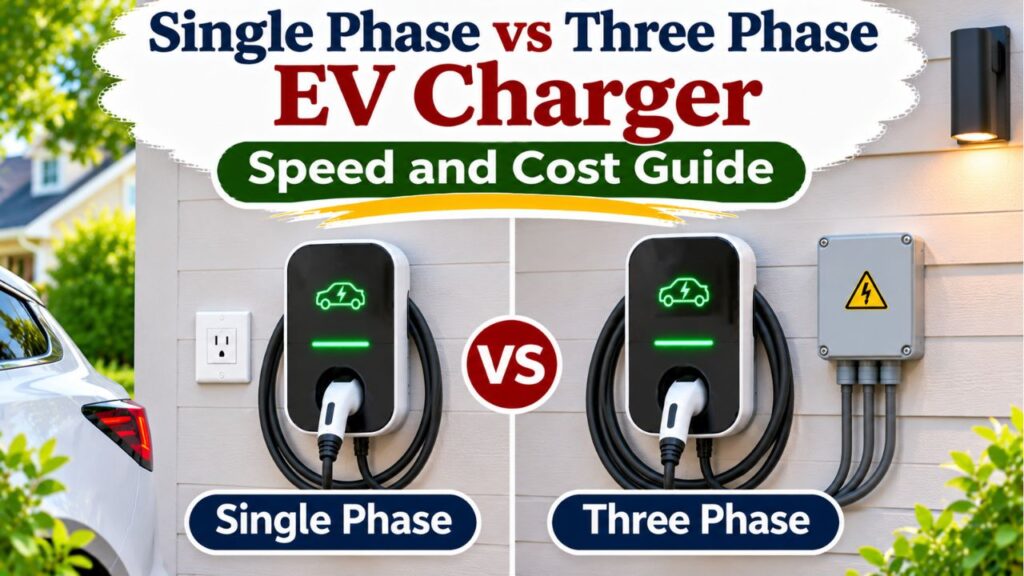
The main difference is how electrical power is supplied to the charging equipment and, for AC charging, how much power the vehicle can accept.
Single-phase charging uses one AC supply phase.
Three-phase charging uses three AC phases separated by 120 electrical degrees.
A compatible three-phase system can deliver more total power without requiring the same high current on a single phase.
However, three-phase charging is not automatically faster.
The vehicle must support the available AC power, and the installation must supply it.
Single-Phase vs. Three-Phase EV Charger Comparison
| Feature | Single-Phase AC Charging | Three-Phase AC Charging |
| Electrical supply | Single-phase AC | Three-phase AC |
| Typical European voltage | 230 V | 400 V line-to-line |
| Common AC charging ratings | 3.7 or 7.4 kW | 11 or 22 kW |
| Typical current examples | 16 or 32 A | 16 or 32 A per phase |
| Electrical phases used | One | Three |
| Home availability | Common | Depends on country and utility service |
| Installation complexity | Usually simpler with suitable existing service | Requires compatible three-phase infrastructure |
| Vehicle requirement | Compatible AC onboard charger | Onboard charger that supports three-phase AC |
| Common applications | Homes and smaller charging installations | Homes with three-phase service, workplaces, and commercial sites |
| Connector example | European Type 2 or North American J1772/J3400 | European Type 2 for true three-phase AC |
| Main limitation | Available voltage and current | Supply availability and vehicle onboard-charger capability |
| Best choice | Most North American homes | Suitable three-phase installations with compatible vehicles |
These are typical comparisons, not universal equipment ratings.
North American electrical systems differ from European systems, so the same charger terminology does not always refer to the same wiring.
Key Takeaway: Three-phase AC charging can provide higher power, but it only offers a speed advantage when the building and vehicle support three-phase charging.
What Is a Single-Phase EV Charger?
A single-phase EV charger uses single-phase AC power to supply electricity to an electric vehicle.
It is commonly used for residential charging.
In countries with 230 V household electricity, single-phase charging typically operates between a live conductor and neutral.
In the United States, ordinary residential Level 2 charging typically uses 240 V supplied by a split-phase electrical service.
How Single-Phase EV Charging Works
During AC charging:
- Electricity is supplied by the building’s electrical system.
- The EV charging equipment provides a controlled connection to the vehicle.
- The vehicle’s onboard charger receives AC electricity.
- The onboard charger converts AC electricity into DC electricity.
- The battery management system controls charging according to battery conditions.
Technically, a typical AC charging wallbox is called electric vehicle supply equipment (EVSE).
The actual AC-to-DC battery charger is inside the vehicle.
However, EVSE is commonly referred to as an EV charger in everyday language.
Typical Single-Phase Charging Power
In a nominal 230 V single-phase system:
- 230 V × 16 A = 3,680 W, or approximately 3.7 kW
- 230 V × 32 A = 7,360 W, or approximately 7.4 kW
These figures describe approximate electrical input power.
They do not include charging losses.
Benefits of Single-Phase Charging
Single-phase charging can be practical because it:
- Uses commonly available residential electrical service.
- Usually requires less infrastructure than installing a new three-phase utility supply.
- Provides adequate overnight charging for many drivers.
- Supports a wide range of compatible vehicles.
- Can be installed at different current ratings.
- May work with load-management equipment where electrical capacity is limited.
For many homeowners, a properly sized single-phase Level 2 system is sufficient.
When Single-Phase Charging Is Most Suitable
Single-phase charging is especially useful when:
- You charge mainly overnight.
- Your daily driving distance is moderate.
- Your building does not have three-phase service.
- Your vehicle has a single-phase onboard charger.
- You want to avoid unnecessary infrastructure upgrades.
A three-phase installation is not required simply because you own a battery electric vehicle.
What Is a Three-Phase EV Charger?
A three-phase EV charger is equipment designed to use three-phase electrical power.
For true three-phase AC charging, the equipment supplies power through three AC phases to a compatible vehicle.
Three-phase electrical systems are common in industrial and commercial buildings.
They are also available in some residential properties, particularly outside North America.
How Three-Phase EV Charging Works
A three-phase supply contains three alternating voltage waveforms separated by 120 electrical degrees.
This arrangement allows electrical power to be distributed across three phases.
In a compatible AC charging installation:
- The building provides three-phase electrical service.
- The charging equipment controls the available power.
- The connector carries the required AC conductors.
- The vehicle’s three-phase onboard charger converts the incoming AC electricity into DC.
- The battery receives DC energy under the control of the vehicle’s battery management system.
The vehicle must support three-phase AC charging.
A three-phase wallbox cannot override the electrical limits of the onboard charger.
Typical Three-Phase Charging Power
In a nominal European 400 V three-phase system, common charging ratings include:
- 11 kW: Approximately 16 A per phase
- 22 kW: Approximately 32 A per phase
These are widely used AC charging power levels.
However, not every EV can accept 22 kW AC.
Some models support only 11 kW, and others are limited to single-phase charging.
Benefits of Three-Phase Charging
Three-phase charging can provide:
- Higher total AC charging power
- Lower current per phase for a given total power compared with some single-phase arrangements
- Better distribution of electrical load across available phases
- Faster charging for compatible vehicles
- Practical options for workplaces and multi-vehicle facilities
- More flexibility when suitable three-phase infrastructure already exists
These benefits depend on electrical design and vehicle compatibility.
Three-phase power is not automatically cheaper or more efficient in every charging installation.
How Much Faster Is a Three-Phase EV Charger?
A three-phase charger can be faster because it may deliver more electrical power.
However, charging speed depends on more than the number of phases.
The main limiting factors include:
- Electrical supply voltage
- Available current
- EVSE rating
- Vehicle onboard-charger capacity
- Number of phases supported by the car
- Battery temperature
- Battery state of charge
- Vehicle charging controls
- Site load-management settings
Charging Power Comparison
| Charging Configuration | Nominal Voltage | Current | Approximate Power |
| European single-phase | 230 V | 16 A | 3.7 kW |
| European single-phase | 230 V | 32 A | 7.4 kW |
| European three-phase | 400 V | 16 A per phase | 11.1 kW |
| European three-phase | 400 V | 32 A per phase | 22.2 kW |
| U.S. split-phase Level 2 | 240 V | 32 A | 7.7 kW |
| U.S. split-phase Level 2 | 240 V | 48 A | 11.5 kW |
| U.S. commercial single-phase Level 2 | 208 V | 32 A | 6.7 kW |
These are calculated nominal electrical power values.
Actual charging power may be lower because of vehicle limits, voltage variations, charging controls, and other conditions.
Notice that a U.S. 240 V split-phase Level 2 installation can deliver approximately 11.5 kW at 48 A.
That is comparable in power to a typical European 11 kW three-phase installation.
Three-phase charging does not automatically mean a higher charging rate than every single-phase installation.
Example: Single-Phase 7.4 kW vs. Three-Phase 11 kW
Suppose two compatible vehicles need the same amount of energy.
The first charges at approximately 7.4 kW.
The second charges at approximately 11 kW.
The 11 kW system provides roughly 49% more nominal charging power.
Under suitable conditions, it can therefore replenish the same amount of energy in less time.
However, the exact time saving depends on vehicle efficiency and charging behavior.
Example: Single-Phase 7.4 kW vs. Three-Phase 22 kW
A 22 kW charger offers almost three times the nominal power of a 7.4 kW charger.
But that benefit is available only when:
- The vehicle supports approximately 22 kW AC charging.
- The charger can supply the full rated output.
- The electrical installation has sufficient available capacity.
- The vehicle does not reduce charging power for another reason.
A vehicle limited to 11 kW AC will not charge at 22 kW simply because the wallbox is rated for 22 kW.
Single-Phase vs. Three-Phase EV Charging Time
Charging time can be estimated using the amount of energy you need to add and the available charging power.
Use the formula:
Estimated charging time (hours) = Energy needed (kWh) ÷ Charging power (kW)
This provides an ideal estimate before accounting for charging losses and power reductions.
Example: Charging a 60 kWh Battery From 20% to 80%
Assume an electric vehicle has a usable battery capacity of 60 kWh.
Charging from 20% to 80% means adding approximately 60% of its capacity.
Energy required:
60 × 0.60 = 36 kWh
The following table compares ideal charging times.
| Available AC Charging Power | Ideal Time to Add 36 kWh |
| 3.7 kW | 9.7 hours |
| 7.4 kW | 4.9 hours |
| 11 kW | 3.3 hours |
| 22 kW | 1.6 hours |
These estimates assume the vehicle can sustain the listed electrical power and do not account for energy lost during charging.
Actual charging may take longer.
A 22 kW result is only realistic for a vehicle capable of accepting that level of AC power.
Why Actual Charging Takes Longer
Charging losses occur during the conversion of AC electricity into DC electricity.
Other vehicle systems may also consume energy.
Charging power can be reduced because of:
- Battery temperature
- Vehicle charging limits
- High battery state of charge
- Site power management
- Electrical supply constraints
Therefore, the calculated time is a useful planning estimate rather than a guaranteed charging duration.
How to Calculate Single-Phase and Three-Phase Charging Power
The electrical formulas explain why three-phase charging can deliver more power at the same current rating.
Single-Phase Power Formula
For an approximate AC charging calculation:
Power (kW) = Voltage (V) × Current (A) ÷ 1,000
This assumes a power factor close to one.
For a general AC load, real power also depends on power factor.
For example:
230 × 32 ÷ 1,000 = 7.36 kW
This is commonly rounded to 7.4 kW.
Three-Phase Power Formula
For a balanced three-phase system:
Power (kW) = √3 × Line Voltage (V) × Line Current (A) × Power Factor ÷ 1,000
For an approximate calculation with a power factor close to one:
Power ≈ 1.732 × Line Voltage × Current ÷ 1,000
For a nominal 400 V system at 16 A per phase:
1.732 × 400 × 16 ÷ 1,000 = 11.08 kW
That is approximately 11 kW.
For the same system at 32 A per phase:
1.732 × 400 × 32 ÷ 1,000 = 22.17 kW
That is approximately 22 kW.
Why Voltage Matters
In a European 230/400 V three-phase system:
- Voltage from one phase to neutral is approximately 230 V.
- Voltage between two phases is approximately 400 V.
The three-phase formula uses the line-to-line voltage.
Do not multiply 400 V by three and then by the current.
That would produce an incorrect result.
Does Three-Phase Always Use Less Electricity?
No.
The amount of energy required to charge a battery depends primarily on the energy added and charging losses.
A three-phase installation can distribute power differently, but it does not reduce the battery’s energy requirement.
A vehicle needing 36 kWh of battery energy still needs approximately that much energy added to the battery, regardless of the number of AC phases.
Why U.S. Home EV Charging Is Different
The distinction between single-phase and three-phase charging is especially important in the United States.
Typical U.S. residential electrical service is 120/240 V split-phase, not European-style 230/400 V three-phase.
Most U.S. homes receive two 120 V line conductors with approximately 240 V between them.
These are two opposite legs of a single-phase supply.
They are not the same as two phases of a three-phase system.
How 240 V Home EV Charging Works
A typical U.S. Level 2 charger uses 240 V supplied between the two hot conductors.
Common charging configurations include:
- 240 V at 16 A: approximately 3.8 kW
- 240 V at 24 A: approximately 5.8 kW
- 240 V at 32 A: approximately 7.7 kW
- 240 V at 40 A: approximately 9.6 kW
- 240 V at 48 A: approximately 11.5 kW
These are nominal charging power figures.
Actual output depends on the electrical installation and vehicle.
The U.S. Department of Energy’s Alternative Fuels Data Center explains that AC Level 2 charging commonly operates at 240 V in residential installations or 208 V in commercial installations.
What About U.S. Commercial Three-Phase Power?
Many commercial buildings use 208Y/120 V three-phase electrical service.
However, that does not mean every vehicle receives three-phase AC.
A common U.S. Level 2 installation draws 208 V between two of the building’s phase conductors.
The vehicle receives single-phase AC power.
For example:
208 V × 32 A = 6.66 kW
This is commonly described as approximately 6.7 kW Level 2 charging.
The building may have three-phase utility service, but the individual charging port is using a single-phase connection.
Why Phase Balancing Matters at Commercial Sites
When multiple Level 2 chargers are installed, an electrician may distribute their connections across different phase pairs.
For example:
- Charger A uses phases A and B.
- Charger B uses phases B and C.
- Charger C uses phases C and A.
This can help balance the electrical loading across a three-phase service.
However, each vehicle may still be receiving single-phase AC.
The DOE Alternative Fuels Data Center’s charging infrastructure training explains the distinction between 240 V residential service and 208 V commercial charging supplied from three-phase systems.
Can You Install a True Three-Phase Charger at a U.S. Home?
Only if the property has suitable three-phase service, compatible equipment, and a vehicle that supports the intended charging configuration.
Most U.S. single-family homes do not have three-phase electrical service.
Obtaining three-phase utility service can require substantial infrastructure work and may not be available at a reasonable cost.
Even if three-phase electricity is available, many North American EVs do not support true three-phase AC charging through their normal vehicle charging connector.
For most homeowners, upgrading to an appropriately sized 240 V Level 2 installation is more practical.
Single-Phase vs. Three-Phase EV Charging in Europe
European EV charging commonly uses a different electrical arrangement from North America.
Many European residential buildings have 230 V single-phase service.
Others have access to 230/400 V three-phase service.
This makes true three-phase AC charging more relevant to residential installations in some European countries.
Typical European AC Charging Options
| Installation | Charging Configuration | Nominal Power |
| Single-phase | 230 V, 16 A | 3.7 kW |
| Single-phase | 230 V, 32 A | 7.4 kW |
| Three-phase | 400 V, 16 A | 11 kW |
| Three-phase | 400 V, 32 A | 22 kW |
Actual available current may be limited by national regulations, utility rules, building capacity, or the equipment configuration.
For example, a building may have three-phase service but insufficient spare capacity for a 22 kW EV charger.
Why 11 kW Is a Common Three-Phase Rating
An 11 kW system can deliver substantial overnight charging power using approximately 16 A per phase.
That makes it attractive when the building already has a suitable three-phase supply.
However, the vehicle must accept three-phase charging.
If the onboard charger is limited to a lower power, the charging rate will be reduced accordingly.
Is 22 kW Better Than 11 kW?
A 22 kW AC charger has twice the nominal power of an 11 kW unit.
However, it is only faster when the vehicle supports the higher AC charging rate.
Some vehicles are limited to 11 kW even when connected to a 22 kW wallbox.
The additional installation capacity may provide no immediate charging-time benefit for those vehicles.
For home charging, the difference should be evaluated against the actual driving and charging schedule.
Does Every EV Support Three-Phase Charging?
No.
The vehicle’s onboard charger determines whether it can accept single-phase or three-phase AC and at what maximum power.
A vehicle may support:
- Single-phase AC only
- Three-phase AC up to approximately 11 kW
- Three-phase AC up to approximately 22 kW
- A different maximum AC charging rate
Capabilities vary by model, market, model year, and equipment specification.
What Is an Onboard Charger?
An onboard charger converts incoming AC power into DC power for the battery.
It has a maximum rated input or charging power.
A wallbox cannot force more AC power through the onboard charger than the vehicle supports.
For example, if a vehicle has an 11 kW three-phase onboard charger, connecting it to a 22 kW wallbox does not make it charge at 22 kW.
Example: Tesla Three-Phase Charging
Tesla’s United Kingdom onboard charging specifications list approximately:
- 7.4 kW at 230 V single-phase, 32 A
- 11 kW at 400 V three-phase, 16 A per phase
These figures apply to the vehicles and regional specifications covered by that page.
They should not automatically be applied to every North American Tesla model.
U.S. Tesla vehicles can have different onboard charging limits.
What Happens if a Single-Phase Vehicle Uses a Three-Phase Charger?
If the charging system and connector are compatible, the vehicle may charge using only one phase.
The actual power depends on the vehicle’s onboard charger and the current made available on that phase.
For example, a single-phase vehicle connected to a three-phase wallbox capable of 32 A per phase might charge at approximately 7.4 kW if its onboard charger and the installation permit it.
However, it will not automatically receive the full 22 kW.
Can a Three-Phase Vehicle Charge From Single-Phase Power?
Yes, many vehicles with three-phase onboard charging support single-phase AC charging as well.
However, their charging power will be limited by the available single-phase supply and vehicle specifications.
Check the manufacturer’s instructions for the exact model.
Does the EV Charging Connector Matter?
Yes.
The connector must be compatible with the vehicle and the charging system.
However, connector shape alone does not guarantee that the car can accept a particular charging power.
Type 1: SAE J1772
The SAE J1772 Type 1 connector is widely associated with North American AC charging.
It supports conventional single-phase AC Level 1 and Level 2 charging.
It does not provide the three separate AC power conductors needed for European-style three-phase Type 2 charging.
Type 2: Mennekes
The Type 2 connector is commonly used for AC EV charging in Europe.
It supports both single-phase and three-phase AC charging.
However, the vehicle’s onboard charger determines how many phases are used and the maximum accepted power.
A Type 2 connector does not guarantee 22 kW charging.
NACS / SAE J3400
The North American Charging Standard, standardized as SAE J3400, is used for AC charging and compatible DC fast charging.
In typical North American Level 2 use, it supplies single-phase AC.
The availability of three-phase electricity at a building does not mean a North American J3400-equipped vehicle can accept three-phase AC directly.
CCS Connectors
The Combined Charging System supports AC charging through its AC connector portion and DC charging through additional DC contacts.
CCS1 and CCS2 have different connector arrangements.
CCS2 is associated with the Type 2 AC connector used in Europe.
However, three-phase AC capability still depends on the vehicle and electrical system.
Connector Comparison
| Connector | Common Market | AC Three-Phase Capability |
| SAE J1772 Type 1 | North America | Not for true three-phase AC |
| Type 2 | Europe and other regions | Supports three-phase AC |
| SAE J3400 / NACS | North America | Typical North American AC charging is single-phase |
| CCS1 | North America | AC portion follows Type 1 characteristics |
| CCS2 | Europe and other regions | AC portion can support Type 2 three-phase charging |
Compatibility should always be confirmed using the exact vehicle and charging-equipment specifications.
Is a Three-Phase EV Charger the Same as a DC Fast Charger?
No.
This is one of the most important distinctions.
A three-phase AC charger and a DC fast charger perform different functions.
Three-Phase AC Charging
Three-phase AC charging supplies alternating current to the vehicle.
The onboard charger converts the incoming AC into DC for the battery.
Charging power is therefore limited by the vehicle’s onboard AC charger.
Common three-phase AC ratings include 11 and 22 kW.
DC Fast Charging
A DC fast charger converts AC power into DC power inside the charging station.
The resulting DC electricity is supplied through the vehicle’s compatible DC charging system.
This bypasses the vehicle’s normal onboard AC charger.
DC charging stations may operate at much higher power levels, depending on the equipment and vehicle.
Many DC fast chargers use three-phase AC electricity as their input supply.
However, the vehicle receives DC electricity rather than three-phase AC.
AC vs. DC Charging Comparison
| Feature | Three-Phase AC Charging | DC Fast Charging |
| Electricity supplied to vehicle | AC | DC |
| AC-to-DC conversion | Vehicle onboard charger | Charging station |
| Common power examples | 11 or 22 kW | 50, 150, or 350 kW, depending on equipment |
| Vehicle onboard AC charger limits power | Yes | No, DC charging has separate vehicle limits |
| Typical location | Homes, workplaces, parking facilities | Public fast-charging hubs, fleet facilities |
| Main compatibility requirement | Three-phase AC onboard capability | Compatible DC charging system |
A three-phase EV charger is not automatically a Level 3 or DC fast charger.
Single-Phase vs. Three-Phase EV Charger Installation
The installation requirements depend on the building’s electrical supply, charger rating, and local electrical regulations.
A licensed electrician should evaluate the electrical system before installing fixed high-power charging equipment.
Single-Phase Installation Requirements
A typical U.S. residential Level 2 installation may require:
- Available electrical panel capacity
- An appropriately rated branch circuit
- Correct wiring and overcurrent protection
- A suitable EVSE installation location
- Required ground-fault protection
- Appropriate equipment listing
- Permits and inspection where required
The installation may use a suitable receptacle or a hardwired connection, depending on the EVSE and project requirements.
Three-Phase Installation Requirements
A true three-phase charging installation may require:
- Suitable three-phase utility service
- Adequate available electrical capacity
- Compatible three-phase charging equipment
- Appropriate circuit protection
- Proper conductor sizing
- Electrical load calculations
- Vehicle compatibility verification
- Local permits and inspections
A 22 kW three-phase system generally requires more electrical capacity than an 11 kW system.
The actual requirements depend on voltage, current, equipment, and local rules.
What About Circuit Breaker Size?
In typical U.S. EVSE installations, EV charging is treated as a continuous electrical load.
As a common example:
| EVSE Charging Current | Typical Circuit Rating |
| 16 A | 20 A |
| 24 A | 30 A |
| 32 A | 40 A |
| 40 A | 50 A |
| 48 A | 60 A |
These examples reflect the common requirement to size a circuit for 125% of the continuous charging load.
However, actual installation requirements depend on the applicable electrical code edition, equipment listing, circuit design, and local amendments.
Load-management systems and equipment with restricted adjustable current settings may be subject to additional rules.
Do not select a breaker or change charger current settings without verifying that the wiring and installation are properly rated.
Is Three-Phase Installation More Difficult?
It can be.
If a building already has sufficient three-phase electrical service, installing a suitable charger may be straightforward for a qualified contractor.
If three-phase service is unavailable, obtaining it can involve significant utility infrastructure work.
A typical U.S. homeowner should not assume that three-phase power can be added simply by replacing a circuit breaker.
Single-Phase vs. Three-Phase EV Charger Cost
The total cost includes more than the purchase price of the charging equipment.
It may involve electrical work, utility upgrades, permitting, and ongoing electricity charges.
Equipment Cost
Single-phase charging equipment is widely available for residential use.
Three-phase AC equipment may be more expensive, especially when designed for higher current, networking, or commercial applications.
However, actual prices vary by brand, rating, market, and features.
A basic three-phase wallbox is not necessarily more expensive than a premium single-phase smart charger.
Installation Cost
A single-phase installation may be relatively simple when the building has adequate spare electrical capacity.
Costs increase when the project needs:
- A new dedicated circuit
- Long cable runs
- Panel upgrades
- Electrical service upgrades
- Trenching
- Special mounting arrangements
A three-phase installation may add costs if suitable service is not already available.
For a property without three-phase supply, utility upgrades could be a major expense.
Electricity Cost
Charging costs generally depend on the electricity consumed and the applicable tariff.
A three-phase charger does not automatically make each kWh cheaper.
For example, suppose an EV charging session uses 40 kWh of electricity from the grid.
At a hypothetical electricity price of $0.20 per kWh:
40 × $0.20 = $8
The basic energy charge is the same whether the energy is supplied through a suitable single-phase or three-phase system at the same tariff.
However, charging equipment efficiency and utility pricing may differ.
Commercial electricity tariffs can also include demand charges.
Faster charging may increase peak electrical demand.
Therefore, site operators should consider the complete electricity tariff rather than only the energy rate.
Is Three-Phase Charging More Efficient?
Not necessarily in every application.
Three-phase power can provide advantages in electrical distribution and load balancing.
However, overall charging efficiency depends on the equipment, onboard charger, charging power, and operating conditions.
A three-phase connection alone does not guarantee lower energy losses.
For an accurate comparison, use measured charging efficiency for the specific equipment and vehicle.
Which Charger Is Better for Home Use?
For most homes in the United States, a properly sized 240 V Level 2 charger is the practical choice.
Three-phase charging is more relevant in markets where homes commonly have compatible three-phase service and vehicles support it.
Choose Single-Phase Charging When
Single-phase charging is a strong choice when:
- You have typical U.S. residential electrical service.
- You mainly charge overnight.
- Your vehicle supports a suitable Level 2 charging rate.
- Your daily energy needs are moderate.
- You want to minimize unnecessary electrical upgrades.
- Your available service capacity can support the installation.
A 240 V Level 2 charger can provide a substantial amount of energy during an overnight session.
For many drivers, that is sufficient to replace daily driving consumption.
Consider Three-Phase Charging When
Three-phase AC charging may be useful when:
- Your building already has three-phase service.
- Your vehicle supports three-phase AC input.
- You need to replenish substantial energy in a shorter period.
- You have sufficient electrical capacity.
- The additional charging speed justifies the installation cost.
In Europe, an 11 kW three-phase home charger can be an attractive choice where the building and vehicle support it.
A 22 kW system should be considered only when the additional capability will provide a meaningful benefit.
What if Your Car Supports Only 11 kW?
If your vehicle is limited to 11 kW AC, a 22 kW wallbox will not automatically improve charging speed.
For a home charging installation, an 11 kW system may be sufficient.
However, other considerations, such as future vehicle compatibility or charging multiple vehicles, may influence equipment selection.
Which Charger Is Better for Workplaces and Commercial Sites?
Commercial charging has different priorities from residential charging.
A workplace may need to serve several vehicles with limited electrical capacity.
The best solution depends on how long vehicles remain parked, daily energy needs, and available infrastructure.
Workplace Level 2 Charging
Many workplaces use AC Level 2 equipment because vehicles remain parked for several hours.
In the United States, commercial charging often operates at 208 V.
Several charging ports may be connected to different phase pairs of a three-phase electrical service.
This allows the electrical designer to balance the load.
Three-Phase Charging at Commercial Facilities
True three-phase AC charging may be practical in countries where vehicles support that standard.
An 11 kW or 22 kW charger can serve compatible vehicles at relatively high AC charging rates.
However, increasing charger power is not always the best solution.
A workplace with long parking durations may be able to serve more vehicles by distributing available power across several lower-power ports.
Load Sharing and Smart Charging
Load-sharing systems can allocate available electrical capacity among multiple vehicles.
For example, two chargers may reduce their individual charging currents when both are in use.
This can reduce peak demand and avoid unnecessary electrical upgrades.
The tradeoff is that individual vehicles may charge more slowly when power is shared.
For commercial projects, overall vehicle throughput and electrical demand often matter more than the maximum rating of a single charger.
Does Three-Phase Charging Affect EV Battery Life?
The number of AC phases is not, by itself, the main factor affecting battery degradation.
Battery aging depends on several factors, including:
- Battery temperature
- State of charge
- Time spent at high states of charge
- Charging power relative to the battery system
- Battery chemistry
- Vehicle thermal management
- Long-term usage patterns
An 11 kW or 22 kW AC charging system is generally much lower in power than high-output DC fast charging.
However, the actual impact depends on the vehicle and battery.
Is Three-Phase Charging Safer for the Battery?
Not inherently.
A compatible vehicle’s charging system controls how much power is accepted.
A properly designed single-phase or three-phase charging installation can operate safely when used according to manufacturer instructions.
The vehicle’s charging controls and thermal management remain important.
Is Slower AC Charging Always Better?
Not necessarily.
Slower charging may produce less heat under some conditions, but battery aging is influenced by many variables.
For normal home use, follow the vehicle manufacturer’s charging recommendations.
Do not assume that switching from single-phase to three-phase AC charging will automatically damage or protect the battery.
Common Mistakes When Comparing Single-Phase and Three-Phase EV Chargers
Several misunderstandings lead to incorrect expectations or unnecessary installation costs.
1. Assuming Three-Phase Is Always Faster
A charger may support three-phase power, but the vehicle might not.
Check the onboard charger.
2. Confusing Three-Phase AC With DC Fast Charging
A three-phase AC charger and a DC fast charger are different systems.
DC fast charging uses an external charger to supply DC power to the vehicle.
3. Ignoring Vehicle Charging Limits
An EV limited to 11 kW AC cannot charge at 22 kW from a wallbox rated for that output.
4. Assuming U.S. Homes Have Three-Phase Power
Most U.S. single-family homes use 120/240 V split-phase service.
That is not the same as true three-phase service.
5. Assuming Three-Phase Commercial Service Means Three-Phase Vehicle Charging
A U.S. commercial building may have three-phase service while its Level 2 EVSE delivers single-phase 208 V AC.
6. Choosing Equipment by Power Rating Alone
A larger charger may provide no benefit if the vehicle or electrical installation cannot use the extra power.
7. Ignoring Electrical Panel Capacity
Even a single-phase Level 2 charger can require substantial electrical capacity.
A proper load calculation is essential.
8. Assuming Three-Phase Electricity Is Always Cheaper
Energy tariffs depend on the utility and customer class.
Three-phase charging may also influence commercial demand charges.
9. Confusing Connector Compatibility With Charging Capability
A compatible connector does not guarantee a specific charging power.
The vehicle and installation must support the required electrical configuration.
10. Attempting Electrical Modifications Without Professional Guidance
EV charging can impose sustained electrical loads.
Incorrect wiring, protection, or current settings can create serious hazards.
Use appropriately rated equipment and qualified installation professionals.
How to Choose Between Single-Phase and Three-Phase Charging
The right choice becomes clearer when you evaluate a few practical factors.
Step 1: Identify Your Electrical Supply
Determine whether the property has:
- 120/240 V split-phase service
- 230 V single-phase service
- 230/400 V three-phase service
- A commercial three-phase service such as 208Y/120 V
A qualified electrician can verify the supply and available capacity.
Step 2: Check the Vehicle’s AC Charging Specifications
Look for:
- Maximum AC charging power
- Supported AC phase configuration
- Maximum AC current
- Compatible connector
- Manufacturer charging recommendations
Do not rely only on the car’s battery size.
Two vehicles with similar battery capacities may have different onboard AC charging limits.
Step 3: Calculate Your Daily Energy Needs
Estimate how much energy you normally need to replace.
For example, if a vehicle uses approximately 0.30 kWh per mile and travels 40 miles per day:
40 × 0.30 = 12 kWh
At approximately 7.4 kW of AC input power, that amount of battery energy could theoretically be replenished in less than two hours before accounting for charging losses.
If the car remains parked overnight, a substantially higher-power charger may provide little practical benefit.
Step 4: Consider Parking Time
A driver with an 8–10-hour overnight charging window may not need the same power as a fleet vehicle that must return to service quickly.
Choose charging capacity based on the available charging window.
Step 5: Compare Installation Costs
Ask for quotes based on the actual building and vehicle requirements.
Include:
- Equipment
- Wiring
- Circuit protection
- Panel capacity
- Permits
- Installation labor
- Potential utility work
- Load-management options
Compare the total project cost, not just the wallbox price.
Step 6: Consider Future Needs
If you expect to add another EV, smart load sharing may be useful.
If your property already has three-phase service, a compatible three-phase system may offer flexibility.
However, future-proofing should not automatically justify an expensive electrical service upgrade.
Final Selection Guide
| Situation | Recommended Starting Point |
| Typical U.S. home | 240 V Level 2 charging |
| Home with limited panel capacity | Lower-current Level 2 or suitable load management |
| European home with single-phase service | Compatible single-phase AC charger |
| European home with three-phase service and an 11 kW-capable EV | 11 kW three-phase charger |
| Home with a 22 kW-capable EV and adequate three-phase supply | Consider 22 kW if faster charging is useful |
| U.S. workplace | Properly designed 208/240 V Level 2 system |
| Multi-vehicle parking facility | Load-managed charging with balanced electrical distribution |
| Fleet requiring short turnaround times | Evaluate higher-power AC or DC fast charging based on vehicle needs |
The best choice is the installation that reliably provides the energy you need within your available charging time.
Conclusion
The main difference in single phase vs three phase EV charger systems is how electrical power is supplied and how much AC charging power the vehicle can accept.
Single-phase charging is widely used for residential EV charging. In the United States, most home Level 2 chargers operate from 240 V split-phase service.
True three-phase AC charging is more common in markets where compatible three-phase residential or commercial electricity is available. Common European three-phase ratings include 11 and 22 kW.
Three-phase charging can provide faster charging, but only when the vehicle’s onboard charger supports the higher power.
For most U.S. homeowners, I recommend starting with an appropriately sized 240 V Level 2 charger rather than pursuing three-phase service.
For a property with existing three-phase electricity, an 11 kW or 22 kW system may be worth considering if the vehicle and charging schedule justify it.
Before purchasing equipment, verify the vehicle’s onboard charging specifications, available electrical capacity, connector compatibility, and installation requirements.
Ultimately, the better charger is not necessarily the one with more phases or the highest advertised power. It is the one that safely and efficiently meets your real charging needs.
FAQs About Single Phase vs Three Phase EV Charger
Is a Three-Phase EV Charger Faster Than a Single-Phase Charger?
It can be.
In a typical European system, a 7.4 kW single-phase charger delivers less nominal power than an 11 kW or 22 kW three-phase charger.
However, charging speed depends on the vehicle’s onboard charger and the available electrical capacity.
A three-phase charger does not guarantee faster charging for every EV.
Can I Use a Three-Phase EV Charger at Home?
Yes, if your property has suitable three-phase electrical service, your vehicle supports the intended charging configuration, and the installation meets applicable requirements.
Three-phase home charging is more common in some countries outside North America.
Most U.S. homes use 120/240 V split-phase service.
Is 11 kW Charging Single-Phase or Three-Phase?
An 11 kW AC charger is commonly a three-phase system operating at approximately 400 V and 16 A per phase in Europe.
However, approximately 11.5 kW can also be delivered from a U.S. 240 V split-phase Level 2 installation at 48 A.
The charging power alone does not uniquely identify the electrical phase configuration.
Can an 11 kW EV Charge at 22 kW?
Not if its maximum onboard AC charging capability is 11 kW.
A 22 kW wallbox cannot override that limit.
The vehicle may charge at approximately 11 kW or less, depending on the available electrical supply and charging conditions.
Is Three-Phase EV Charging More Expensive?
Three-phase installation can cost more when additional electrical infrastructure is required.
However, a property that already has suitable three-phase service may have lower incremental installation costs.
Electricity prices depend on the applicable tariff, not simply on whether the installation is single-phase or three-phase.
Can a Single-Phase EV Charge From a Three-Phase Charger?
Yes, in many compatible Type 2 AC charging systems.
The vehicle may use only one phase and charge at a lower power than the three-phase charger’s maximum rating.
Actual performance depends on the vehicle, equipment, and available current.
Do U.S. EV Chargers Use Three-Phase Power?
Many U.S. commercial charging locations have three-phase electrical service, but ordinary Level 2 charging ports typically deliver single-phase 208 V or 240 V AC to the vehicle.
DC fast chargers commonly use three-phase electricity as their input supply and convert it into DC power before delivering it to the vehicle.
Do I Need a Three-Phase Charger for Overnight EV Charging?
Usually not.
A properly sized single-phase Level 2 charger can replenish substantial battery energy during an overnight charging window.
Three-phase charging becomes more useful when the building and vehicle support it and the higher charging rate provides a meaningful benefit.