
A 400-volt EV uses a lower-voltage battery system than an 800-volt EV; at the same electrical power, an 800V system can operate with roughly half the current. That helps reduce heat in conductors and makes very high-power DC fast charging easier. However, an 800V car does not automatically charge twice as quickly, travel twice as far, or use half as much electricity.
These numbers describe voltage classes, not fixed battery readings. Actual pack voltage varies with battery design and state of charge. A vehicle sold as an 800V EV may have a nominal pack voltage well below 800 volts, and a 400V vehicle may still achieve impressive charging speeds.
For buyers, the biggest practical differences appear at public DC fast chargers. The charging station must support the vehicle’s voltage and current needs, and the vehicle must sustain high power through its charging curve. At home, both architectures generally use the same 120V or 240V AC charging infrastructure.
In this guide, I compare 400 vs 800 volt EV technology, explain the power and heat calculations, and examine charging time, range, efficiency, cost, and station compatibility. You’ll also learn which specifications matter more than nominal battery voltage when choosing an electric vehicle.
400 vs 800 Volt EV: Key Differences at a Glance
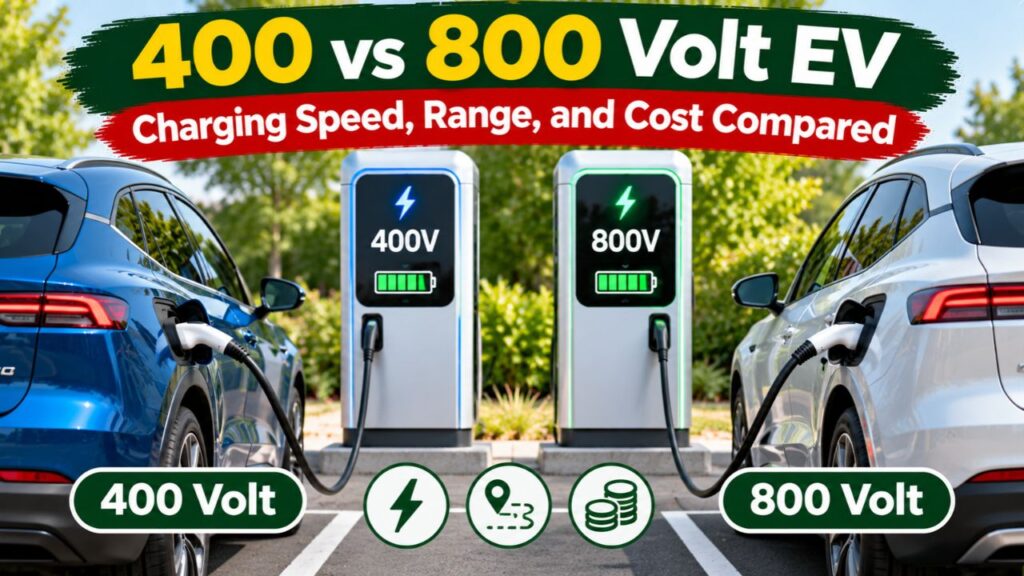
The main advantage of an 800V EV is its ability to transfer high electrical power with less current than a comparable 400V system.
This can improve DC fast-charging capability, reduce wiring losses, and allow lighter high-voltage components in some designs.
However, a higher-voltage architecture also requires appropriately rated components and more complex electrical engineering.
400V vs. 800V EV Comparison Chart
| Feature | 400-Volt EV | 800-Volt EV |
| Electrical architecture | Approximately 400V class | Approximately 800V class |
| Current at equal power | Higher | Roughly half as much |
| DC fast-charging potential | High | Generally supports higher power more easily |
| Charging time | Depends on vehicle and charger | Can be shorter with compatible equipment |
| Wiring losses | Higher at equal power and resistance | Lower at equal power and resistance |
| Cable requirements | May require heavier conductors for high power | Can use smaller conductors for equivalent power |
| Battery capacity | Independent of voltage class | Independent of voltage class |
| Driving range | Depends on overall vehicle efficiency | Not automatically greater |
| Home Level 2 charging | Supported | Supported |
| DC charger compatibility | Depends on charger output and connector | May need voltage conversion at 400V stations |
| Component complexity | More established designs | Additional high-voltage engineering requirements |
| Vehicle price | Often more cost-effective to manufacture | Can cost more, depending on design |
| Best suited for | Everyday EV use and many performance applications | High-power charging and demanding electrical systems |
The table describes general engineering differences, not guaranteed outcomes for every model.
A well-engineered 400V EV may charge faster than a poorly optimized 800V EV.
Key Takeaway: Higher voltage increases electrical design flexibility, but the entire charging system determines the actual benefit.
What Do 400V and 800V Mean in an Electric Vehicle?
The terms 400V and 800V refer to the approximate voltage classes of the vehicle’s high-voltage electrical system.
An EV battery consists of many individual cells connected into modules and packs.
The arrangement of these cells determines the pack’s voltage and capacity.
How a 400-Volt EV Battery Works
A 400V-class battery uses a cell arrangement that produces an operating voltage broadly around 400 volts.
However, the exact voltage changes as the battery charges and discharges.
A pack may operate at a significantly lower or higher voltage than its nominal rating.
The system delivers DC electricity to the vehicle’s inverter, which controls the electric motor.
How an 800-Volt EV Battery Works
An 800V-class system operates at a higher electrical voltage.
One way to achieve this is by connecting more battery cells in series.
For a comparable battery energy capacity, the design can use higher voltage and lower current.
This makes it easier to transfer substantial electrical power without relying on extremely high current.
Are All 800V Batteries Exactly 800 Volts?
No.
An EV advertised as using an 800V architecture may operate across a range of actual voltages.
For example, Hyundai lists a 697V battery voltage for the 2026 IONIQ 5 N, even though the vehicle supports 800V-class ultra-fast charging.
The Porsche Taycan has also used an 800V-class architecture with an operating voltage that varies according to battery conditions.
This is normal.
The terms 400V and 800V describe general system architecture rather than one constant battery measurement.
Does 800V Mean a Bigger Battery?
No.
Battery voltage and battery capacity measure different things.
Voltage describes electrical potential.
Battery capacity describes how much energy the battery can store, usually in kilowatt-hours (kWh).
An 800V battery does not automatically contain more energy than a 400V battery.
For example, two differently designed batteries may both store 80 kWh even though one uses a 400V architecture and the other uses an 800V architecture.
Key Takeaway: Battery voltage identifies an electrical architecture, not battery size, driving range, or total stored energy.
Why Does an 800V EV Support Faster Charging?
The advantage comes from the relationship between voltage, current, and electrical power.
The basic DC power formula is:
Power (watts) = Voltage (volts) × Current (amps)
Or:
Power (kW) = Voltage × Current ÷ 1,000
Increasing voltage allows the same power to be transferred using less current.
Example: Delivering 200 kW to a Battery
Consider two simplified electrical systems delivering 200 kW.
400V system:
200,000 ÷ 400 = 500 amps
800V system:
200,000 ÷ 800 = 250 amps
Both deliver the same electrical power.
However, the 800V system uses half the current.
400V vs. 800V Power Comparison
| Charging Power | Current at 400V | Current at 800V |
| 50 kW | 125A | 62.5A |
| 100 kW | 250A | 125A |
| 150 kW | 375A | 187.5A |
| 200 kW | 500A | 250A |
| 250 kW | 625A | 312.5A |
| 300 kW | 750A | 375A |
| 350 kW | 875A | 437.5A |
These figures assume fixed DC voltages for illustration. Actual battery voltages and charging currents vary.
Why Does Lower Current Matter?
High current produces heat in conductors and electrical connections.
A simplified formula for resistive power loss is:
Power loss = Current² × Resistance
If current is reduced by half while resistance remains unchanged, resistive loss becomes one-quarter of its original value.
For example:
- 500A at a given resistance produces a certain amount of heat.
- 250A at the same resistance produces 75% less resistive heat.
This comparison applies to the same electrical resistance and power-transfer conditions.
It does not mean an entire 800V vehicle wastes 75% less energy.
Actual efficiency depends on cable sizes, electronic components, conversion losses, and cooling systems.
Can Higher Voltage Reduce Cable Weight?
Yes.
Because lower current can be used for the same power, engineers may be able to use smaller conductor cross-sections.
This can reduce cable weight and installation space.
Porsche’s explanation of 800-volt technology identifies reduced cabling weight, lower electrical losses, and improved high-power charging capability as major advantages of the Taycan’s electrical architecture.
However, the actual weight savings depend on the design.
Key Takeaway: The primary electrical advantage of 800V is transferring high power at lower current, reducing resistive losses and easing conductor requirements.
400V vs. 800V EV Charging Speed: Which Is Faster?
An 800V EV can charge faster when it has a battery capable of accepting high power and connects to compatible DC fast-charging equipment.
However, battery voltage alone does not determine charging time.
The vehicle’s actual charging curve matters just as much.
Real-World Example: Porsche Taycan
Porsche provides a useful comparison because the same EV supports charging on both voltage classes.
For a suitably equipped updated Taycan under ideal conditions:
| Charging Specification | 400V DC Station | 800V DC Station |
| Maximum advertised charging power | Up to 150 kW | Up to 320 kW |
| 10–80% charging time | Approximately 33 minutes | Approximately 18 minutes |
| Requirements | Compatible 400V DC infrastructure | High-power 800V DC infrastructure |
Source: Porsche — Why Some Charging Stations Don’t Reach Maximum Speed.
These figures are manufacturer-reported estimates under specified conditions.
Older Taycan models and different equipment configurations can have different charging limits.
The comparison demonstrates that charging-station voltage can materially affect the performance of an 800V vehicle.
Real-World Example: Hyundai IONIQ 5 N
Hyundai also publishes separate charging specifications for the 2026 IONIQ 5 N.
| Charging Configuration | Advertised 10–80% Time |
| 150 kW, 400V NACS Supercharger | Approximately 30 minutes |
| 350 kW, 800V DC fast charger | Approximately 18 minutes |
The vehicle’s actual charging speed depends on temperature, state of charge, station power, and other conditions.
These examples show the difference between a compatible high-voltage charging station and lower-voltage equipment.
Can a 400V EV Charge at 250 kW?
Yes.
Some modern 400V-class vehicles support impressive charging power.
For example, certain Tesla Model 3 configurations advertise DC Supercharging capability up to 250 kW.
This illustrates why 400V should not be equated with slow charging.
However, achieving extremely high power at 400V requires more current than at 800V.
That can increase demands on charging cables, connectors, and cooling.
Does an 800V EV Always Charge Twice as Fast?
No.
Even when voltage doubles, charging time does not automatically fall by half.
Other limitations include:
- Battery chemistry
- Battery temperature
- Charging current limits
- Station voltage range
- Vehicle charging curve
- Battery state of charge
- Thermal management
- Power sharing at charging stations
An 800V design makes high-power charging easier to achieve, but it doesn’t guarantee a particular charging time.
Key Takeaway: Look for the vehicle’s published 10–80% charging time and charging curve rather than using nominal battery voltage alone.
How Much Time Can 800V Charging Save?
Charging time depends on the energy added to the battery and the average charging power.
A useful simplified formula is:
Charging time (hours) = Energy added (kWh) ÷ Average charging power (kW)
Example: Charging an 80 kWh Battery
Suppose an EV has an 80 kWh usable battery.
You want to charge from 10% to 80%.
Energy needed:
80 × 0.70 = 56 kWh
Now compare two average charging powers.
At 100 kW Average Power
56 ÷ 100 = 0.56 hour
0.56 × 60 = 33.6 minutes
At 200 kW Average Power
56 ÷ 200 = 0.28 hour
0.28 × 60 = 16.8 minutes
Charging Time at Different Average Powers
| Average Charging Power | Ideal Time to Add 56 kWh |
| 75 kW | 44.8 minutes |
| 100 kW | 33.6 minutes |
| 125 kW | 26.9 minutes |
| 150 kW | 22.4 minutes |
| 175 kW | 19.2 minutes |
| 200 kW | 16.8 minutes |
| 225 kW | 14.9 minutes |
These figures illustrate the relationship between energy and average power.
They do not imply that every 400V car averages 100 kW or every 800V car averages 200 kW.
Real charging time may include overhead and charging losses, and average power varies throughout a session.
Why Average Charging Power Matters
Peak charging power is the highest power a vehicle reaches, sometimes only briefly.
Average charging power reflects performance across the charging session.
A vehicle that peaks at 300 kW for two minutes may finish charging more slowly than one that holds a lower but more consistent rate.
For road-trip comparisons, the 10–80% charging time is often more useful than the peak kilowatt rating.
Key Takeaway: The biggest practical benefit of high-voltage charging is a shorter charging stop when the vehicle sustains higher average power.
Can an 800V EV Use a 400V Charging Station?
Yes, many 800V EVs can charge at compatible 400V DC fast chargers, but they need a supported method of matching the lower station voltage to the battery’s requirements.
Not every 800V vehicle supports the same charging power on lower-voltage equipment.
Why Is Voltage Conversion Necessary?
A high-voltage battery may require a charging voltage greater than the maximum output of a 400V-class station.
If the station cannot provide the required voltage directly, the vehicle needs a compatible internal conversion system.
Without suitable hardware, software, and charging-network compatibility, charging may be limited or unavailable.
How Hyundai Handles 400V Charging
Hyundai’s E-GMP platform supports 800V-class charging and compatibility with 400V DC infrastructure.
Its system can use the traction motor and inverter to boost lower DC input voltage to a level suitable for the high-voltage battery.
According to Hyundai Motor Group’s E-GMP technical announcement, this multi-charging technology enables operation with both voltage classes.
That flexibility helps drivers use a broader range of DC fast chargers.
How Porsche Handles 400V Charging
Porsche uses onboard voltage-conversion hardware to support lower-voltage DC charging infrastructure.
The updated Taycan can reach higher charging power at suitable 800V stations than at 400V stations.
This does not prevent the vehicle from using compatible lower-voltage equipment, but it changes the achievable charging performance.
Does a Charging Adapter Convert 400V Into 800V?
Generally, no.
A connector adapter primarily provides a compatible physical and electrical interface where approved.
It does not automatically perform high-power battery-voltage conversion.
If an 800V vehicle requires voltage boosting, that function must be provided by an appropriate supported system.
Do All 800V EVs Work With Every Fast Charger?
No.
Compatibility can depend on:
- Charging connector
- Station voltage range
- Station current limit
- Vehicle voltage-conversion capability
- Charging communication protocol
- Network authorization
- Approved adapters
- Vehicle software and hardware
Key Takeaway: Many 800V EVs support 400V DC charging, but charging performance and compatibility vary by vehicle and station.
Do 800V EVs Charge Faster at Home?
Not necessarily. An 800V battery architecture does not automatically make Level 1 or Level 2 home charging faster.
Home EV charging usually begins with AC electricity.
In the United States:
- Level 1 commonly uses 120V AC.
- Level 2 commonly uses 240V AC.
The vehicle’s onboard charger converts AC electricity into DC at the voltage required by the battery.
What Determines Home Charging Speed?
Important factors include:
- Available electrical circuit capacity
- EV charging equipment rating
- Vehicle onboard AC charger capacity
- Charging efficiency
- Battery energy needed
- Charging conditions
Example: Two EVs With 11 kW AC Charging
Suppose a 400V EV and an 800V EV both support 11 kW AC charging.
If each needs 44 kWh of additional battery energy, the ideal charging time is:
44 ÷ 11 = 4 hours
Both have approximately the same ideal charging time.
Real charging may take longer because of losses and charging limitations.
The 800V architecture does not turn an 11 kW AC charger into a 22 kW charger.
Do You Need an 800V Home Charger?
No special 800V residential AC supply is required simply because the EV has an 800V battery system.
Use Level 1 or Level 2 equipment approved for the vehicle and correctly installed for the home’s electrical service.
The onboard charging system handles the necessary conversion.
Which Is Better for Overnight Charging?
Both 400V and 800V vehicles can be excellent for overnight charging.
Compare their onboard AC charging limits and battery capacities rather than their high-voltage architecture.
Key Takeaway: At home, AC charger capacity and vehicle onboard charging limits matter more than whether the battery is 400V or 800V.
400 vs. 800 Volt EV: Which Is More Energy-Efficient?
An 800V architecture can reduce certain electrical losses, especially when transferring large amounts of power.
However, this does not automatically produce a dramatic improvement in whole-vehicle efficiency.
Why Higher Voltage Can Improve Efficiency
At a given power level, higher voltage reduces current.
Lower current can reduce heat produced in cables and electrical connections.
This may improve the efficiency of high-power charging and propulsion systems.
However, the total energy savings depend on component design and operating conditions.
Does 800V Reduce Energy Consumption per Mile?
It may contribute to lower electrical losses, but the effect on total energy consumption is only one part of a much larger system.
EV efficiency also depends on:
- Vehicle weight
- Aerodynamics
- Motor design
- Inverter efficiency
- Tire rolling resistance
- Driving speed
- Battery temperature
- Climate-control use
- Powertrain management
A well-designed 400V vehicle can consume less electricity per mile than an 800V vehicle with less favorable aerodynamics or greater weight.
Does 800V Improve Driving Range?
Not automatically.
An EV’s range depends primarily on usable battery energy and energy consumption per mile.
A simple estimate is:
Range (miles) = Usable battery energy (kWh) ÷ Energy consumption (kWh per mile)
For example, suppose two EVs each have 80 kWh of usable capacity.
Vehicle A consumes 0.25 kWh per mile:
80 ÷ 0.25 = 320 miles
Vehicle B consumes 0.30 kWh per mile:
80 ÷ 0.30 = 267 miles
Those differences could result from many vehicle characteristics.
Voltage class alone does not establish which vehicle is more efficient.
Can 800V Improve Regenerative Braking?
Higher-voltage electrical systems can help engineers manage high power during acceleration and energy recovery.
However, actual regenerative braking capability depends on the battery’s ability to accept power, motor design, inverter limits, and battery temperature.
An 800V badge does not guarantee stronger regenerative braking.
Key Takeaway: An 800V architecture can improve electrical efficiency in certain components, but driving range depends on the overall vehicle design.
Is an 800V EV Better for Performance?
An 800V architecture can be useful for vehicles that require sustained high power.
Lower current for a given power level can reduce demands on certain cables and electrical components.
However, acceleration and motor performance depend on more than system voltage.
Potential Performance Advantages
Higher-voltage systems may support:
- High motor power
- Reduced current at a given output
- Improved management of high-power electrical loads
- Lighter high-voltage cabling
- High-power regenerative braking
- Greater flexibility in powertrain design
Does 800V Mean More Horsepower?
No.
Electric motor power depends on motor design, inverter capability, current limits, cooling, and other factors.
An 800V system can make certain high-power designs easier to implement.
However, a 400V EV can still produce substantial horsepower and acceleration.
Are 800V EVs Always Lighter?
No.
Some wiring and components may be lighter.
However, high-voltage insulation, electronics, cooling systems, and additional conversion hardware can also affect weight.
The final vehicle weight depends on the entire design.
Is 400V Enough for a High-Performance EV?
Yes.
A 400V system can support powerful electric motors and rapid acceleration.
An 800V design becomes especially attractive when the manufacturer wants to manage very high power without requiring extremely large currents.
Key Takeaway: Higher voltage offers engineering advantages for demanding powertrains, but it does not guarantee greater performance.
400V vs. 800V EV Battery Life: Which Lasts Longer?
Neither voltage architecture guarantees a longer battery lifespan.
Battery aging depends on battery chemistry, temperature, charging behavior, depth of discharge, manufacturing quality, and thermal management.
Does an 800V Battery Degrade Faster?
Not simply because it uses higher voltage.
The voltage class describes how battery cells are arranged electrically.
Individual cell aging depends on conditions such as cell voltage, temperature, charging current, and electrochemical design.
An 800V pack is not automatically operating each individual cell at twice the voltage.
Does Faster Charging Affect Battery Health?
High-power DC fast charging can increase battery stress under some conditions.
However, the relationship between charging speed and aging depends on the battery design.
Modern battery management systems monitor temperature, voltage, and current to protect the pack.
A properly managed high-voltage system may support rapid charging while remaining within its intended operating limits.
What Helps Preserve EV Battery Health?
General practices include:
- Following the manufacturer’s charging recommendations
- Using supported charging equipment
- Avoiding unnecessary exposure to extreme battery temperatures
- Using battery preconditioning when recommended
- Following recommended charge limits for the battery chemistry
- Maintaining the vehicle’s thermal management system
There is no universal requirement that every EV must remain below 80% charge.
Follow the specific vehicle manufacturer’s instructions.
Key Takeaway: Battery chemistry, thermal management, and charging habits influence longevity more directly than the 400V or 800V designation.
Is an 800V EV More Expensive Than a 400V EV?
An 800V architecture can require more advanced electrical components and engineering.
However, the purchase-price difference cannot be determined from voltage alone.
Why Can 800V Systems Cost More?
Potential cost factors include:
- High-voltage-rated power electronics
- Suitable insulation and electrical protection
- Voltage-conversion hardware
- Specialized thermal management
- Component validation
- More complex electrical architecture
These requirements can increase development and production costs.
However, an 800V design may also reduce costs or weight in certain parts of the system.
Why Are 400V Systems Common?
400V-class electrical architectures have been widely used in passenger EVs.
They offer established components, manufacturing experience, and sufficient capability for many everyday driving applications.
For manufacturers producing affordable or moderate-performance EVs, a 400V system can remain a practical engineering choice.
Does 800V Charging Cost More per kWh?
Not inherently.
Electricity is usually billed by energy consumed, not by the nominal battery voltage.
For example, at $0.20 per kWh, purchasing 50 kWh costs:
50 × $0.20 = $10
The same billed quantity of electricity costs $10 whether the vehicle uses a 400V or 800V battery.
However, an 800V EV may have access to different charging stations, rates, or charging efficiencies.
Those factors can affect the real cost of a session.
Are 800V EV Repairs More Expensive?
Some specialized high-voltage components may be expensive to replace.
However, repair cost depends on the manufacturer, parts availability, warranty, and specific failure.
It is not accurate to assume every 800V repair costs more than every 400V repair.
Both systems contain potentially lethal high voltage and require trained personnel and appropriate safety procedures.
Never attempt to inspect, modify, or repair EV high-voltage battery wiring without the required professional qualifications.
Key Takeaway: 800V designs may introduce additional engineering costs, but vehicle purchase price and ownership costs depend on far more than battery voltage.
Which Electric Cars Use 400V and 800V Systems?
Both architectures are used in modern EVs.
Some manufacturers also use battery systems that can change configurations or operate at voltages outside the two common classes.
Examples of 400V-Class EVs
Examples include:
- Tesla Model 3
- Many Tesla Model Y versions
- Several established EV models using conventional 400V-class platforms
Specific battery pack voltages can vary by model year, chemistry, and configuration.
Examples of 800V-Class EVs
Examples include:
- Porsche Taycan
- Porsche Macan Electric
- Hyundai IONIQ 5
- Hyundai IONIQ 6
- Kia EV6
- Kia EV9
- Tesla Cybertruck
Some newer EVs also use architectures above the nominal 800V class.
Does Every 800V EV Have the Same Charging Performance?
No.
For example, one 800V EV might reach a higher peak charging power but taper quickly.
Another may reach a lower peak yet sustain substantial power longer.
They may also use different battery capacities, cooling systems, and voltage-conversion designs.
What About Tesla’s 400V and 800V Vehicles?
Tesla has used 400V-class architectures in vehicles such as the Model 3.
The Cybertruck introduced an 800V-class battery architecture.
This illustrates that manufacturers can use different voltage systems across their vehicle lineups.
The best architecture depends on the vehicle’s design goals.
Key Takeaway: EV voltage architecture varies by model and generation. Verify the exact vehicle rather than relying on the brand alone.
What Happens When a 400V EV Uses an 800V Fast Charger?
A charging station capable of delivering 800V can often also support lower-voltage vehicles.
However, compatibility depends on the station’s specified output voltage range, current capabilities, connector, and communications.
Can an 800V Charger Charge a 400V Car?
Yes, if the charger supports the vehicle’s required lower charging voltage and electrical connection.
The station does not necessarily deliver 800V simply because it is advertised as an 800V-capable charger.
A properly compatible DC charger regulates its output according to the vehicle’s charging requirements.
Will a 400V EV Charge Faster on a 350 kW Station?
Only if the station can supply additional usable power and the vehicle supports it.
For example, an EV limited to 150 kW will not receive 350 kW from a higher-rated station.
A 350 kW label indicates station capability under suitable conditions, not the guaranteed charging rate of every connected car.
Does NACS or CCS Determine Battery Voltage?
No.
CCS1 and J3400/NACS are charging connector systems.
They do not, by themselves, define whether a vehicle has a 400V or 800V battery.
Compatibility also depends on electrical specifications, charging communications, adapters where applicable, and network access.
Why Do Some 800V EVs Charge Slowly at Certain Superchargers?
Some DC charging sites have lower voltage output limits.
An 800V-class EV that needs onboard voltage boosting may charge more slowly at these sites than at high-voltage DC infrastructure.
The effect varies by vehicle.
Before a road trip, check the car’s charging compatibility and the station’s output capabilities.
Key Takeaway: Charger voltage capability and vehicle compatibility matter more than the connector shape or advertised station kilowatt rating alone.
400V vs. 800V EV: Which Should You Buy?
The best choice depends on your driving habits and charging access.
An 800V system is particularly attractive to drivers who frequently use high-power public DC charging.
A 400V EV may be equally practical for daily commuting and overnight charging.
Choose a 400V EV When:
- Most charging happens at home.
- You regularly park for several hours.
- Purchase price is a higher priority than minimum DC charging time.
- You rarely take long highway trips.
- The vehicle’s actual range and features meet your requirements.
- Public fast charging is only occasionally necessary.
A well-designed 400V EV can still charge quickly enough for many road trips.
Choose an 800V EV When:
- You frequently travel long distances.
- Short charging stops are important.
- Compatible high-voltage fast chargers are available along your routes.
- You value high-power charging capability.
- The vehicle offers a strong charging curve.
- You want the advantages of a high-voltage electrical architecture.
What Matters More Than Battery Voltage?
Before buying, compare these specifications:
| Specification | Why It Matters |
| Usable battery capacity | Determines stored energy |
| EPA-estimated range | Helps estimate driving distance |
| Energy consumption | Affects efficiency and charging costs |
| 10–80% charging time | Shows practical fast-charging performance |
| Charging curve | Indicates how long high charging power is sustained |
| Maximum AC charging rate | Determines potential home charging speed |
| DC charging compatibility | Determines usable public charging options |
| Battery preconditioning | Helps achieve charging performance in different temperatures |
| Charging-network access | Affects convenience on road trips |
| Vehicle price and warranty | Affect overall ownership value |
The actual vehicle and charging experience matter more than whether the specification sheet says 400V or 800V.
Common Misconceptions About 400V and 800V EVs
An 800V EV Charges Twice as Fast
Not automatically.
Charging speed depends on average power, battery conditions, and station compatibility.
Doubling voltage can help deliver more power with lower current, but does not guarantee half the charging time.
An 800V EV Has Twice the Driving Range
False.
Range depends on usable battery capacity and vehicle efficiency.
Higher voltage does not automatically mean greater stored energy.
A 400V EV Cannot Fast Charge
False.
Many 400V EVs support high-power DC charging.
Some can reach charging rates around 250 kW under suitable conditions.
An 800V EV Requires an 800V Home Outlet
False.
Both architectures can use supported Level 1 and Level 2 AC charging equipment.
The vehicle’s onboard charger converts power appropriately.
An 800V Car Cannot Use a 400V Fast Charger
Not always true.
Many 800V EVs support 400V DC charging through onboard conversion or other compatible designs.
However, performance and compatibility vary.
An 800V Battery Is Automatically More Efficient
Not necessarily.
The architecture can reduce certain electrical losses, but whole-vehicle efficiency depends on numerous factors.
An 800V EV Always Has Better Battery Life
False.
Battery longevity depends on chemistry, temperature, charge management, and usage conditions.
Nominal voltage alone cannot predict battery lifespan.
Conclusion
The biggest difference in 400 vs 800 volt EV technology is the relationship between voltage, current, and electrical power.
A 400V system is a proven architecture that can support efficient everyday driving, strong performance, and fast charging.
An 800V system can transfer the same power using approximately half the current, reducing certain electrical losses and making very high-power DC charging easier.
This can allow shorter charging stops and lighter high-voltage wiring in appropriately designed vehicles.
However, higher voltage does not automatically provide greater battery capacity, longer driving range, or twice the charging speed.
The actual benefits depend on battery chemistry, charging curves, station compatibility, thermal management, and the overall electrical design.
For most drivers who charge at home overnight, either system can be practical.
For frequent highway travel, a well-designed 800V EV paired with compatible high-voltage DC chargers may provide a meaningful convenience advantage.
Before buying, compare the vehicle’s 10–80% charging time, energy consumption, usable battery capacity, and real charging-network access.
These specifications provide a more useful picture of daily ownership than voltage alone.
FAQs About 400 vs 800 Volt EV
Is an 800-Volt EV Better Than a 400-Volt EV?
An 800V EV can offer advantages in high-power charging, reduced current, and certain electrical-efficiency characteristics. However, it is not automatically better for every driver. A well-designed 400V EV may provide excellent range, performance, and fast charging at a lower vehicle price. The best choice depends on the complete vehicle.
Does an 800V EV Charge Twice as Fast as a 400V EV?
No. An 800V architecture allows the same electrical power to be transferred at approximately half the current, but charging time depends on the vehicle’s battery and average charging power. Some 800V EVs charge substantially faster, while certain 400V EVs also support impressive DC fast-charging speeds.
Can an 800V EV Charge at a 400V Charging Station?
Many can, but compatibility depends on the vehicle. Some 800V systems use onboard voltage conversion to charge from lower-voltage DC stations. Others have different charging limitations. The charging connector alone does not guarantee compatibility or full charging performance.
Does an 800-Volt EV Have More Range?
Not necessarily. Battery voltage does not directly determine driving range. Range depends primarily on usable battery energy and energy consumption per mile. A lighter, more efficient 400V vehicle may travel farther than a heavier 800V vehicle with similar battery capacity.
Is 800V Charging Better for Battery Health?
Higher voltage by itself does not guarantee better battery health. Battery lifespan depends on chemistry, temperature, charging current, thermal management, and usage. Frequent high-power DC charging can increase stress under certain conditions, but modern battery systems regulate charging to remain within their operating limits.
Do You Need a Special Home Charger for an 800V EV?
No. Most 800V EVs can use compatible residential Level 1 or Level 2 AC charging equipment. The vehicle converts the incoming AC electricity to the required battery charging voltage. Home charging speed depends mainly on the equipment, electrical circuit, and vehicle’s onboard AC charging capability.
Why Are 800V EVs Faster at DC Charging Stations?
An 800V system can transfer high power using less current than a 400V system. This can reduce resistive heat and make very high charging power easier to manage. However, the vehicle must support that power, and the charging station must provide the necessary voltage and current.
Is 400V EV Technology Becoming Obsolete?
No. 400V architectures remain practical for many electric vehicles, particularly those designed around everyday driving, affordability, and conventional charging requirements. Higher-voltage systems are increasingly attractive for high-power applications, but the two approaches can coexist because they serve different engineering and market needs.