
The main difference between EV capable and EV ready is how much electrical infrastructure has already been installed for electric vehicle charging. An EV-capable parking space has provisions for future charging, such as electrical capacity and necessary conduit, while an EV-ready space generally has an installed electrical circuit terminating at an outlet, junction box, or charging connection.
However, neither designation automatically guarantees that a usable EV charger is installed. An EV-ready space may still require compatible charging equipment before an electric vehicle can be charged.
These terms frequently appear in new-home listings, construction plans, building codes, and apartment parking requirements. Understanding them can help homeowners estimate installation costs and avoid buying a property that requires more electrical work than expected.
An EV-ready garage is generally more convenient for future charger installation, while an EV-capable garage may require additional wiring and electrical components.
In this article, I explain EV capable vs EV ready, including their electrical requirements, wiring differences, installation costs, and charging capabilities. You’ll also learn how these terms differ from EVSE-installed spaces, what building codes may require, and what to inspect before buying a home or installing a Level 2 charger.
EV Capable vs EV Ready: Main Differences
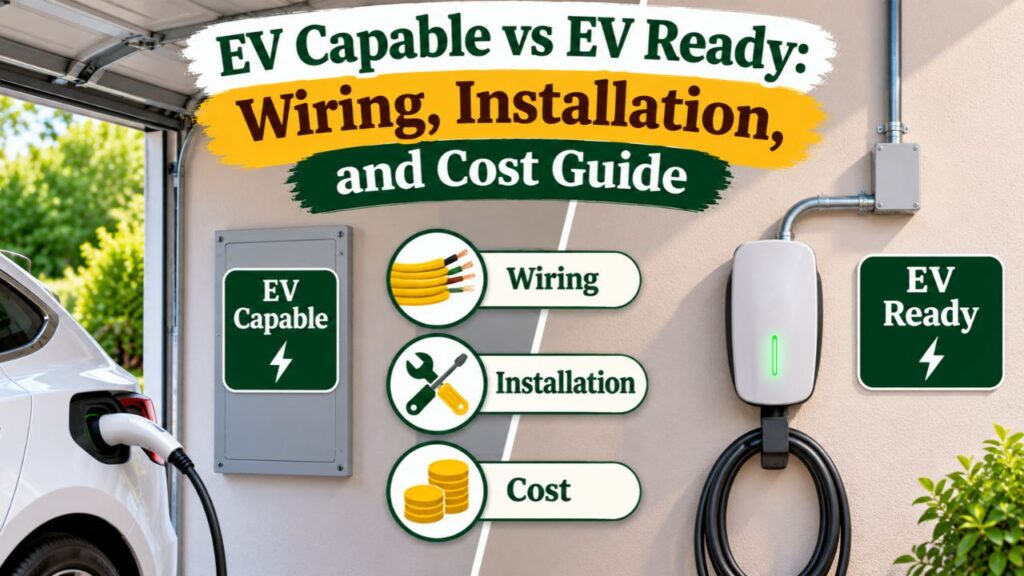
EV capable means the electrical infrastructure is planned or partially prepared for future charging. EV ready means the required branch circuit and electrical termination are generally installed.
The precise requirements vary by building code and jurisdiction.
For example, the City of Elk Grove’s EV infrastructure guide, which references the 2025 California Green Building Standards Code, distinguishes between EV-capable, EV-ready, and EVSE-installed parking spaces.
EV Capable vs EV Ready Comparison Chart
| Feature | EV capable | EV ready |
| Main meaning | Prepared for future EV charging infrastructure | Electrical circuit installed for a charging connection |
| Panel capacity | Generally reserved or accounted for | Generally provided for the installed circuit |
| Breaker space | Usually planned | Breaker generally installed as part of the circuit |
| Conduit or raceway | Installed or provided as required | Required raceways and wiring generally complete |
| Electrical conductors | May not be installed | Installed |
| Dedicated charging circuit | May need completion | Generally installed |
| Outlet or junction box | May not be installed | Generally installed |
| EV charging equipment | Usually not included | Not necessarily included |
| Can charge an EV immediately? | Generally no | Sometimes, with compatible charging equipment |
| Future electrical work | Usually more | Usually less |
| Upfront construction cost | Generally lower | Generally higher |
| Convenience for EV owners | Requires more preparation | Closer to usable charging |
This table describes the common distinction. Some building codes define specific exceptions, circuit ratings, or additional requirements.
Which One Is Better?
For someone who already owns an EV or plans to purchase one soon, EV ready is generally preferable because much of the electrical installation has already been completed.
EV capable may be sufficient for someone who wants to prepare for possible future EV ownership without paying for all the wiring immediately.
However, the better choice depends on the actual infrastructure provided—not just the label used in a real estate listing.
What Does EV Capable Mean?
An EV-capable parking space has provisions intended to simplify the future installation of EV charging equipment.
The space is not necessarily ready for immediate use.
What Is Included in an EV-Capable Garage?
Depending on the applicable building code, an EV-capable installation may include:
- Electrical panel space reserved for a future EV charging circuit.
- Sufficient electrical capacity allocated for future charging.
- Necessary raceways or conduit.
- A planned route between the panel and parking space.
- Appropriate labeling or documentation.
However, the electrical conductors, breaker, receptacle, and EV charger may not yet be installed.
What Is an Electrical Raceway?
A raceway is an enclosed pathway designed to contain electrical conductors.
Conduit is a common type of raceway.
For EV charging, conduit can create a route between the electrical panel and the future charger location.
This is especially useful when wiring must pass through:
- Finished walls.
- Concrete slabs.
- Underground areas.
- Garages.
- Parking structures.
- Difficult-to-access building sections.
Installing necessary raceways during construction can reduce the need for disruptive work later.
Does EV Capable Mean the Wiring Is Installed?
Not necessarily.
Under many building-code definitions, EV capable does not require the full branch-circuit conductors to be installed.
The space may be prepared with panel capacity and conduit, but an electrician must still complete the circuit.
Some jurisdictions have additional requirements.
Therefore, do not assume that an EV-capable home already contains a complete 240V circuit.
Can You Charge an EV in an EV-Capable Space?
Not from the EV-capable infrastructure alone.
Additional electrical installation is usually required.
If a separate suitable household outlet is present, Level 1 charging might be possible, but that outlet is not proof that the EV-capable infrastructure is complete.
The existing outlet and electrical circuit must be evaluated for safe EV charging.
Example of an EV-Capable Garage
Imagine a newly constructed home with:
- A garage parking space.
- An electrical panel with capacity reserved for future charging.
- Conduit routed through difficult-to-access portions of the building.
- No EV charging branch-circuit conductors installed.
- No dedicated charging receptacle.
- No EV charger.
This is an example of an EV-capable configuration.
To install a Level 2 charger, a qualified electrician may still need to install wiring, a breaker, and the appropriate charging connection.
What Does EV Ready Mean?
An EV-ready parking space generally has the electrical infrastructure needed to connect EV charging equipment.
This typically includes a completed branch circuit.
What Is Included in an EV-Ready Garage?
Depending on the applicable code, EV-ready infrastructure generally includes:
- Electrical capacity for EV charging.
- An installed branch circuit.
- Appropriate wiring.
- Required overcurrent protection.
- Necessary raceways.
- A receptacle, outlet box, or other permitted termination.
- Required labeling.
Some jurisdictions allow the circuit to terminate in a junction box for a future hardwired charger.
Others require a suitable receptacle.
Does EV Ready Mean a Charger Is Installed?
No, not necessarily.
This is one of the most important distinctions.
EV ready describes the electrical installation.
The charging equipment may still need to be purchased and connected.
For example, a garage may contain a completed 240V circuit terminating at a junction box.
The garage is prepared for a compatible hardwired charger, but the charger isn’t installed.
In that situation, you cannot simply plug an EV into the junction box.
Can You Charge an EV Immediately in an EV-Ready Garage?
Sometimes.
If the installation includes an appropriate, energized receptacle and you have compatible, properly rated portable EV charging equipment, you may be able to charge the vehicle.
However, a space terminating at a junction box may require a hardwired EVSE before charging is possible.
The exact meaning of EV ready therefore depends on the code definition and the physical installation.
Example of an EV-Ready Garage
Suppose a new home includes:
- An appropriately sized electrical circuit.
- Installed conductors.
- The required circuit breaker.
- A suitable 240V charging receptacle.
- No wall-mounted EV charger.
This is a common EV-ready arrangement.
A compatible plug-in EVSE may be used after confirming that the outlet, circuit, and equipment meet the required specifications.
EV Capable vs EV Ready vs EVSE Installed
Building codes often distinguish between three stages of charging infrastructure.
Understanding the third stage is particularly important when buying a new home.
1. EV Capable
The property has infrastructure planned or partially installed for future EV charging.
Additional electrical work is generally needed.
2. EV Ready
The electrical circuit is generally installed and terminated at an appropriate location.
Charging equipment may still need installation.
3. EVSE Installed
The charging equipment has been installed.
EVSE stands for Electric Vehicle Supply Equipment.
This is the equipment that provides the controlled electrical connection between the electrical installation and the vehicle.
Three EV Infrastructure Stages
| Stage | What is provided | What may still be required? |
| EV capable | Reserved electrical capacity and necessary infrastructure | Circuit wiring, breaker, termination, and EVSE |
| EV ready | Completed electrical circuit and appropriate termination | Compatible EVSE or other charging equipment |
| EVSE installed | Electrical infrastructure and installed charging equipment | Vehicle compatibility, activation, or access authorization |
The City of Elk Grove specifically identifies these three categories in its EV compliance guidance.
However, terminology can differ between jurisdictions.
What Does Charger Installed Mean in a Home Listing?
A listing that says EV charger installed generally suggests that actual charging equipment is present.
However, verify:
- The charger’s manufacturer and model.
- Its rated output.
- Whether it is functioning.
- The electrical circuit rating.
- Whether it is included in the property sale.
- Any app or network requirements.
A charger being physically attached to a wall doesn’t guarantee that the installation is operational or code-compliant.
Key Takeaway: EV capable prepares for future installation, EV ready generally completes the electrical circuit, and EVSE installed means the charging equipment is already present.
EV Capable vs EV Ready: Electrical Requirements
The electrical requirements are one of the most important differences between the two designations.
However, not every jurisdiction requires the same charging capacity.
Electrical Panel Capacity
An EV charger adds a significant electrical load.
For that reason, building codes may require sufficient panel or service capacity for future charging.
But two different concepts matter:
- Physical space for a breaker.
- Electrical capacity to support the additional load.
An empty breaker position does not automatically mean that the electrical service can safely supply another large load.
A qualified electrician must evaluate the total electrical demand.
Conduit and Raceway
EV-capable designs commonly include provisions for a future wiring route.
Some codes require conduit through locations that would be difficult or expensive to access later.
Other requirements may call for a more complete conduit pathway.
EV-ready installations generally include the raceways necessary to complete the branch circuit.
Wiring and Conductors
This is often the clearest distinction.
For EV capable, branch-circuit conductors may not be installed.
For EV ready, the necessary conductors are generally already present.
Their size and type must match the circuit requirements and applicable electrical code.
Circuit Breaker
An EV-ready installation generally includes appropriate overcurrent protection as part of the completed circuit.
An EV-capable configuration may only reserve space for a future breaker.
Actual requirements depend on the code and electrical design.
Outlet or Junction Box
EV-ready circuits commonly terminate at:
- A suitable electrical receptacle.
- A junction box for future hardwiring.
- A charger connection permitted by the applicable code.
An EV-capable installation may not have these components.
Electrical Requirements Comparison
| Electrical component | EV capable | EV ready |
| Panel space | Generally planned or reserved | Provided for installed circuit |
| Load capacity | Generally planned | Provided |
| Necessary raceway | Required according to applicable code | Completed as needed |
| Circuit wiring | Not always installed | Installed |
| Circuit breaker | May be absent | Generally installed |
| Receptacle or junction box | May be absent | Generally provided |
| Installed charging equipment | Not required | Not necessarily required |
Important: EV charging electrical work must comply with the locally adopted electrical code, applicable equipment instructions, and permitting requirements. A qualified electrician should design and verify the installation.
Is EV Ready the Same as Level 2 Charging?
No.
EV ready and Level 2 describe different aspects of electric vehicle charging.
EV ready describes infrastructure preparation. Level 2 describes a type of electrical charging.
Level 1 Charging
Level 1 uses a 120V AC electrical supply in the United States.
It is commonly used for slow home charging.
Many vehicles can charge using a suitable portable charging cordset and appropriately rated outlet.
Level 2 Charging
Level 2 generally uses 208V or 240V AC power.
It supports faster home, workplace, and destination charging.
A Level 2 installation may use:
- A compatible 240V receptacle.
- A hardwired EVSE.
- An appropriate dedicated branch circuit.
Can an EV-Ready Space Support Level 1?
Yes, under some code definitions.
Certain EV-ready requirements allow 120V charging infrastructure.
Others specifically require 208/240V capacity.
Therefore, the term EV ready does not universally guarantee a particular voltage or charging speed.
Can EV-Capable Infrastructure Support Level 2?
Yes, if it is designed for Level 2.
Many building-code provisions focus on preparing parking spaces for future 208/240V charging.
However, the actual power available depends on the circuit and installation.
Does EV Ready Guarantee Fast Charging?
No.
EV ready doesn’t mean DC fast charging is installed.
In residential buildings, EV-ready infrastructure generally relates to Level 1 or Level 2 AC charging.
DC fast charging requires substantially different equipment and electrical infrastructure.
EV Capable vs EV Ready: Circuit Size and Charging Power
An EV-ready circuit’s electrical rating determines the maximum charging load it can support.
For many U.S. home installations, EV charging is treated as a continuous electrical load.
The U.S. Department of Energy’s home charging guidance directs installers to comply with the applicable electrical code and identifies NEC Article 625 as an important source of EV charging requirements.
Common Level 2 Charging Circuit Examples
| Circuit rating | Common maximum EV charging current | Approximate power at 240V |
| 20 amps | 16 amps | 3.84 kW |
| 30 amps | 24 amps | 5.76 kW |
| 40 amps | 32 amps | 7.68 kW |
| 50 amps | 40 amps | 9.60 kW |
| 60 amps | 48 amps | 11.52 kW |
These examples reflect the common requirement to size circuits for continuous loads at 125% of the charging current, or equivalently to limit charging current to 80% of the applicable circuit rating.
Actual installations may be subject to additional code provisions and equipment limitations.
Does EV Ready Mean a 50-Amp Outlet?
No.
An EV-ready space may contain a lower-rated circuit, a higher-rated circuit, or a junction box instead of a receptacle.
The applicable building code determines the minimum infrastructure requirements.
Do not assume a NEMA 14-50 receptacle is present.
Is a 40-Amp Circuit Enough for Level 2?
A properly designed 40-amp circuit commonly supports 32-amp continuous charging.
At 240V:
240 × 32 ÷ 1,000 = 7.68 kW
That can provide practical home-charging power for many EVs.
However, the vehicle’s onboard charger may limit its actual charging rate.
Can an EV-Ready Garage Charge at 48 Amps?
Only if the complete electrical installation supports that current.
A 48-amp continuous charging load commonly requires a suitably designed 60-amp circuit.
A garage labeled EV ready with a 40-amp circuit cannot automatically support 48-amp charging.
Upgrading may require new wiring, different equipment, and an electrical load assessment.
EV Capable vs EV Ready: Installation Cost
EV-ready infrastructure generally requires more electrical work during construction than an EV-capable installation.
However, it may reduce the cost and complexity of installing a charger later.
Why EV Capable Can Cost Less Initially
An EV-capable installation may postpone the cost of:
- Branch-circuit conductors.
- Circuit breaker installation.
- Receptacle or junction box installation.
- Final electrical connections.
- Charging equipment.
This reduces the amount of work completed during initial construction.
However, the remaining work will still need to be performed when charging is required.
Why EV Ready Can Save Money Later
EV-ready infrastructure can reduce the need for future electrical installation work.
The wiring and circuit termination are generally already present.
That may eliminate work such as:
- Pulling new conductors.
- Installing a long circuit run.
- Opening finished walls.
- Routing conduit through completed construction.
- Installing a new receptacle.
However, these savings depend on what was installed and whether it matches the future charger’s requirements.
Installation Cost Comparison
| Cost component | EV capable | EV ready |
| Planning electrical capacity | Usually included | Included |
| Necessary conduit | Usually included as required | Included |
| Full branch-circuit wiring | May require later expense | Generally already installed |
| Circuit breaker | May require later installation | Generally installed |
| Charging receptacle | May require later installation | Often already installed |
| Wall-mounted EVSE | Additional purchase if desired | Additional purchase if not included |
| Installation labor later | Usually more | Usually less |
| Possible electrical upgrade | Depends on actual design | Depends on actual design |
How Much Does It Cost to Upgrade EV Capable to EV Ready?
There is no universal fixed price.
The cost depends on:
- Distance between the panel and garage.
- Whether conduit is already complete.
- Wire size and circuit rating.
- Electrical panel capacity.
- Accessibility.
- Permitting requirements.
- Labor rates.
- Receptacle versus hardwired termination.
A short, accessible circuit may be relatively straightforward.
A long route requiring wall repairs, trenching, or electrical service changes can be significantly more expensive.
Get a written electrician’s quote based on the actual property.
How Much Does It Cost to Install a Charger in an EV-Ready Garage?
Costs may include:
- The EVSE itself.
- Mounting hardware.
- Final electrical connections.
- Required permits and inspection.
- Adjustments needed for the selected charger.
If the existing EV-ready circuit is suitable, the remaining electrical work may be limited.
However, installation isn’t guaranteed to be plug-and-play.
Is EV Ready Worth the Extra Cost During Construction?
Often, especially if EV ownership is likely.
Installing wiring while a home is being constructed may be simpler than opening finished walls later.
However, the value depends on the builder’s price, the planned electrical capacity, and the likelihood that the infrastructure will be used.
Rather than comparing the labels alone, ask the builder what work is included and what remains unfinished.
How to Upgrade an EV-Capable Garage to EV Ready
If your home is already classified as EV capable, a qualified electrician can determine the remaining work.
Step 1: Verify the Existing Infrastructure
Start by identifying what is actually installed.
Check the builder’s electrical plans, panel schedule, and any charging-infrastructure documentation.
Determine whether the garage has:
- Reserved circuit capacity.
- Spare breaker space.
- Conduit.
- Existing wiring.
- A receptacle.
- A junction box.
Do not assume a visible conduit means the electrical circuit is complete.
Step 2: Determine the Desired Charging Power
Consider your vehicle and daily driving needs.
A 32-amp Level 2 setup may be sufficient for many drivers.
A higher-current charger may provide additional flexibility, but only if the vehicle and electrical installation can support it.
Step 3: Have an Electrician Perform a Load Assessment
A qualified electrician should evaluate the home’s existing loads and available electrical capacity.
The main breaker rating or the number of empty panel spaces alone cannot confirm capacity.
An approved load-management system may be an option in some installations.
Step 4: Inspect the Conduit Path
The electrician should confirm whether the existing raceway is suitable.
Important factors include:
- Conduit size.
- Route length.
- Number and type of bends.
- Accessibility.
- Fill limitations.
- Suitability for the planned conductors.
If the conduit is incomplete, additional raceway installation may be required.
Step 5: Install the Required Branch Circuit
The electrician can install suitable conductors, overcurrent protection, and any required equipment.
The installation must meet the applicable electrical code and charger specifications.
Step 6: Choose a Receptacle or Hardwired Connection
Two common Level 2 arrangements are:
- Plug-in charging equipment connected to a suitable receptacle.
- Hardwired charging equipment connected directly to the electrical circuit.
Each approach has installation and equipment requirements.
A hardwired installation may be preferable for certain higher-current charging units.
Step 7: Complete Permits and Inspection
Follow local requirements for electrical permits and inspections.
The Department of Energy advises homeowners to comply with state and local codes and consult qualified electrical contractors.
Step 8: Install and Test the Charger
After the electrical work is complete, install compatible charging equipment.
Confirm:
- Correct current settings.
- Proper electrical connection.
- Appropriate ground-fault protection.
- Charger operation.
- Vehicle compatibility.
Charging should not begin until the installation is confirmed safe and properly completed.
Can You Upgrade EV Ready to a Higher-Power Charger?
Yes, sometimes.
However, an EV-ready designation doesn’t guarantee that the existing circuit can support every Level 2 charger.
Example: Upgrading From 32A to 48A Charging
Suppose a garage has:
- A 240V supply.
- A 40-amp EV charging circuit.
- Wiring suitable for that circuit.
A compatible EVSE may charge at 32 amps.
However, upgrading to 48-amp charging generally requires a properly sized 60-amp circuit.
The existing wiring, breaker, and electrical capacity may need to be changed.
Does the Existing Conduit Help?
It may.
If the conduit is suitable for larger conductors, it could simplify an upgrade.
However, an electrician must evaluate conductor sizing, raceway fill, installation conditions, and other code requirements.
Do not assume that every EV-ready circuit can be upgraded without additional construction.
Is a Faster Charger Necessary?
Not always.
For illustration, an EV using 30 kWh per 100 miles consumes approximately 12 kWh over a 40-mile commute.
A 7.68-kW charging setup could theoretically provide 12 kWh in about 1.6 hours at constant power before accounting for losses.
For a vehicle parked overnight, that may be more than sufficient.
The right charging power depends on how much energy must be replenished before the next trip.
EV Capable vs EV Ready in New Home Construction
New homebuyers often encounter these terms in property descriptions.
However, marketing language may not reveal the exact electrical installation.
What Does an EV-Capable New Home Include?
It may include provisions for future charging, such as conduit and reserved electrical capacity.
The homeowner may need to pay for final circuit wiring and charging equipment.
What Does an EV-Ready New Home Include?
It generally includes a completed circuit at the parking location.
Depending on the installation, it may terminate at a receptacle or junction box.
A charging station is not necessarily installed.
What Does Prewired for EV Charging Mean?
Prewired is a less precise term.
It may mean:
- Conduit is installed.
- Conductors have been installed.
- A complete electrical circuit is present.
- A charging receptacle is installed.
Do not treat the word prewired as proof that the garage is EV ready under a particular building code.
Ask for the actual electrical specifications.
What Should You Ask the Builder?
Before buying a home advertised as EV capable or EV ready, ask:
- Is the dedicated EV charging circuit fully installed?
- What voltage and circuit rating are provided?
- Are conductors installed all the way to the parking space?
- Does the circuit terminate at a receptacle or junction box?
- Is charging equipment included?
- Was the installation permitted and inspected?
- Is the electrical panel capacity sufficient for the intended charger?
- Are there any restrictions on charger type or mounting location?
Request written documentation rather than relying only on verbal descriptions.
EV Capable vs EV Ready in Building Codes
The distinction between EV capable and EV ready appears in several U.S. building codes and local regulations.
However, there is no single EV-capable or EV-ready requirement that applies identically to every U.S. building.
Requirements vary by state, city, construction type, occupancy, and locally adopted code edition.
California CALGreen
California’s Green Building Standards Code, commonly called CALGreen, includes EV charging infrastructure provisions.
The California Building Standards Commission identifies the 2025 CALGreen code as effective January 1, 2026.
Its requirements differ depending on the building and parking facility.
Cities may also adopt local amendments.
For example, Elk Grove distinguishes EV-capable, EV-ready, and EVSE-installed spaces.
International Energy Conservation Code
The International Energy Conservation Code, or IECC, includes provisions addressing charging infrastructure.
However, a model code does not automatically become enforceable nationwide.
State and local governments determine whether and how particular code editions and provisions are adopted.
Are All New Homes Required to Be EV Ready?
No.
Some jurisdictions require EV-ready or EV-capable infrastructure for certain new homes.
Others impose different requirements or do not mandate those provisions for the same building type.
Check the applicable local building code.
Are EV-Capable and EV-Ready Requirements Always 240V?
No.
Many codes focus on Level 2 charging infrastructure, but the required voltage and circuit capacity can vary.
Some regulations distinguish between low-power Level 2 infrastructure and higher-capacity EV charging circuits.
Other local requirements may include Level 1 readiness.
What About Apartments and Condominiums?
Multifamily developments may have separate requirements for:
- EV-capable spaces.
- EV-ready spaces.
- Installed EV charging stations.
- Electrical load management.
- Accessible charging facilities.
- Shared parking areas.
Property ownership and electrical metering also affect implementation.
Do not assume that a code requirement for a detached single-family garage also applies to an apartment parking garage.
Key Takeaway: EV infrastructure labels have technical meanings, but the enforceable electrical requirements depend on the jurisdiction and adopted building code.
EV Capable vs EV Ready for Apartments and Condos
The distinction can be particularly important in multifamily housing.
EV-Capable Apartment Parking
An EV-capable parking space may have reserved capacity and conduit provisions for future charging.
However, the resident may not have a usable charging connection.
Additional work and building approval may be required.
EV-Ready Apartment Parking
An EV-ready space generally has more complete electrical infrastructure.
However, the resident may still need compatible charging equipment, authorization, or other installation work.
Can a Tenant Install an EV Charger?
It depends on the property and applicable laws.
Possible considerations include:
- Landlord permission.
- Homeowners association rules.
- Building electrical capacity.
- Metering arrangements.
- Parking-space ownership.
- Insurance requirements.
- Electrical permits.
State and local laws may establish additional rights or procedures for EV charging installations.
Who Pays for the Charger?
There is no universal arrangement.
Depending on the building, expenses may be paid by:
- The property owner.
- The tenant.
- The homeowners association.
- A charging-network operator.
- Another approved party.
Confirm responsibilities before purchasing equipment or hiring an electrician.
What About Shared Electrical Capacity?
Some multifamily buildings use automatic load management.
These systems can distribute available charging power among multiple EV charging spaces.
However, the installation must meet the applicable electrical code and the system’s approved design.
Is EV Ready Better Than EV Capable for Homebuyers?
Generally, yes, if the buyer expects to use home EV charging.
EV ready usually reduces the amount of remaining electrical installation work.
However, it isn’t always the better financial choice at any price.
When EV Capable May Be Enough
EV capable can be a reasonable option when:
- You don’t currently own an EV.
- You may purchase an EV several years later.
- The builder provides suitable future charging provisions.
- The upgrade path is straightforward.
- You prefer to defer some installation costs.
However, verify that the reserved electrical capacity is meaningful and the conduit route is usable.
When EV Ready Is Preferable
EV ready is often better when:
- You already own an EV.
- You expect to purchase one soon.
- You need routine Level 2 charging.
- You want to minimize future electrical work.
- The builder’s upgrade price is reasonable.
When EVSE Installed Is the Best Choice
A fully installed charger may be preferable when you want home charging available immediately.
However, verify the installed charger’s output, compatibility, operation, and ownership.
Does EV Ready Increase Home Value?
It may make the property more appealing to certain EV-owning buyers.
However, the effect on resale value depends on local demand, housing-market conditions, installation quality, and other factors.
There is no universal percentage increase in property value that can be attributed to EV-ready wiring.
Common Mistakes When Comparing EV Capable and EV Ready
Assuming EV Capable Means an Outlet Is Installed
EV-capable infrastructure may provide only the provisions needed for future wiring.
An outlet isn’t necessarily present.
Assuming EV Ready Means a Charger Is Installed
EV ready generally refers to a completed electrical circuit.
The EVSE may still need to be purchased and connected.
Confusing EV Ready With Level 2
EV ready is an infrastructure classification.
Level 2 is an electrical charging category.
The required voltage and current depend on the code and installation.
Assuming an Empty Breaker Space Means Sufficient Capacity
Panel space and electrical service capacity are different.
A load assessment may be necessary.
Using a Higher-Current Charger Than the Circuit Supports
A 40-amp branch circuit cannot automatically support 40-amp continuous charging.
Charging equipment must be configured for the installed circuit and meet applicable continuous-load requirements.
Assuming Any 240V Outlet Is Suitable
Not all 240V receptacles, circuits, or installations are suitable for EV charging.
The circuit must be properly designed and rated.
Ignoring Charger Compatibility
EVSE connector types, vehicle limits, and approved adapters matter.
Choose equipment compatible with the EV.
Skipping Permits and Inspections
Electrical work must meet local code requirements.
Improper installation can create overheating, fire, or shock hazards.
Believing a Builder’s Marketing Label Without Verification
Terms such as EV capable, EV ready, and prewired should be supported by documentation.
Verify the electrical installation before making assumptions.
EV Capable vs EV Ready: Homebuyer Inspection Checklist
Use this checklist before buying a property or commissioning an EV charger installation.
- Confirm whether the garage is EV capable, EV ready, or EVSE installed.
- Obtain the electrical plans or installation documentation.
- Check the electrical panel schedule.
- Confirm the planned or installed circuit rating.
- Verify the available electrical load capacity.
- Determine whether conduit is installed and usable.
- Determine whether conductors are installed.
- Check for a breaker, receptacle, or junction box.
- Confirm whether EV charging equipment is included.
- Check the proposed charger location.
- Ask whether the installation was inspected.
- Confirm vehicle and connector compatibility.
- Obtain a written quote for any remaining work.
- Check local permitting and building-code requirements.
A qualified electrician can help verify these items safely.
Conclusion
The difference between EV capable and EV ready comes down to how much electrical preparation has been completed for future EV charging.
An EV-capable parking space generally provides reserved electrical capacity and necessary infrastructure for a future charging circuit. However, wiring and electrical terminations may still need to be installed.
An EV-ready parking space generally has an installed branch circuit terminating at an appropriate outlet, junction box, or charging connection. It may still lack the actual EV charging equipment.
A third category, EVSE installed, indicates that the charger is already present.
For homeowners who expect to charge an EV soon, EV ready is generally more convenient because it can reduce future electrical installation work. EV capable may be sufficient when EV ownership is uncertain or several years away.
I recommend reviewing the electrical plans, circuit rating, panel capacity, and exact termination before relying on either designation. A qualified electrician can determine whether the existing infrastructure supports the charging power you need.
EV capable means prepared for future charging, EV ready means the electrical connection is largely prepared, and EVSE installed means the charging equipment is in place.
FAQs About EV Capable vs EV Ready
What Is the Difference Between EV Capable and EV Ready?
EV capable generally means electrical capacity and necessary infrastructure are provided for future EV charging.
EV ready generally means the electrical circuit is already installed and terminates at a suitable receptacle, junction box, or charging connection.
Exact definitions vary by jurisdiction.
Does EV Capable Mean a 240V Outlet Is Installed?
No.
An EV-capable garage may have reserved electrical capacity and conduit but no completed branch circuit or outlet.
Additional electrical work may be required.
Does EV Ready Mean You Can Charge an EV Immediately?
Not always.
An EV-ready space with a compatible energized receptacle may support charging using suitable portable equipment.
However, a space terminating at a junction box may require a hardwired charger before charging can begin.
Does EV Ready Include a Level 2 Charger?
Not necessarily.
EV ready generally describes installed electrical infrastructure rather than a supplied charging unit.
A home advertised as EV ready may still require the EVSE to be purchased.
Is EV Ready the Same as a NEMA 14-50 Outlet?
No.
An EV-ready installation may use a suitable receptacle, junction box, or another code-permitted termination.
A NEMA 14-50 receptacle is only one possible configuration.
How Much Does It Cost to Upgrade EV Capable to EV Ready?
Costs depend on the existing conduit, wiring distance, circuit rating, labor, permits, and available electrical capacity.
A straightforward installation may require relatively little work, while a complex project can be substantially more expensive.
Obtain a property-specific electrician’s estimate.
Is EV Ready Better Than EV Capable?
Generally, yes, for someone planning to use home EV charging soon.
EV ready usually requires less additional electrical work.
However, the better value depends on the builder’s price and the actual infrastructure provided.
Can EV-Capable Wiring Support Level 2 Charging?
Yes, if the electrical infrastructure is designed for Level 2 and the necessary circuit is completed.
However, the term EV capable doesn’t automatically establish the final circuit rating or available charging power.
What Breaker Size Does an EV-Ready Garage Need?
The breaker size depends on the charging equipment and electrical design.
For example, a 32-amp continuous Level 2 charging load commonly requires a suitably designed 40-amp circuit.
Other installations may use different circuit ratings.
Can You Install a Tesla Wall Connector in an EV-Ready Garage?
Usually, if the electrical installation supports the Wall Connector’s requirements.
However, a hardwired Wall Connector may need an appropriate connection even if the garage currently has a receptacle.
A qualified electrician should confirm circuit capacity, wiring, and installation requirements.
Do All New Homes Have to Be EV Capable or EV Ready?
No.
Requirements vary by state, municipality, building type, and applicable code edition.
Some jurisdictions require EV charging infrastructure in certain new residential developments, while others have different rules.
Can You Upgrade EV Ready to 48-Amp Charging?
Sometimes.
A 48-amp continuous charging load commonly requires a properly designed 60-amp circuit.
If the existing EV-ready installation has a smaller circuit, an electrical upgrade may be needed.
What Does EV Prewired Mean?
EV prewired is a general term that may describe conduit, installed wiring, a completed branch circuit, or a charging receptacle.
It isn’t precise enough to establish what infrastructure is actually installed.
Ask the builder or seller for the electrical specifications.
Is EVSE Installed the Same as EV Ready?
Not exactly.
EVSE installed generally means the actual charging equipment is present.
EV ready usually means the electrical infrastructure is prepared for the charging equipment, although the precise terminology depends on the applicable code.