
EVSE (Electric Vehicle Supply Equipment) is the equipment that safely supplies electricity to an electric vehicle, while a charger is technically the device that manages and converts electrical power into the form needed to charge the battery. During Level 1 and Level 2 AC charging, the actual AC-to-DC charger is usually built into the vehicle. During DC fast charging, the power-conversion equipment is outside the vehicle.
Although these components perform different functions, the terms EVSE and EV charger are frequently used interchangeably. Manufacturers, retailers, charging networks, and government agencies commonly call wall-mounted EVSE units home EV chargers because they are the external equipment drivers use to recharge their cars.
Understanding the distinction is useful when choosing home charging equipment, comparing Level 1 and Level 2 charging, evaluating charging speed, or investigating charging problems. It also explains why an expensive 48-amp charging station may not charge every electric vehicle faster than a 32-amp unit.
In this article, I explain EVSE vs charger terminology, how electricity travels from an outlet to an EV battery, and the differences between onboard chargers and DC fast chargers. I also cover charging levels, connectors, safety systems, power ratings, installation requirements, electricity costs, and what to look for when choosing home charging equipment.
EVSE vs Charger: What’s the Difference?
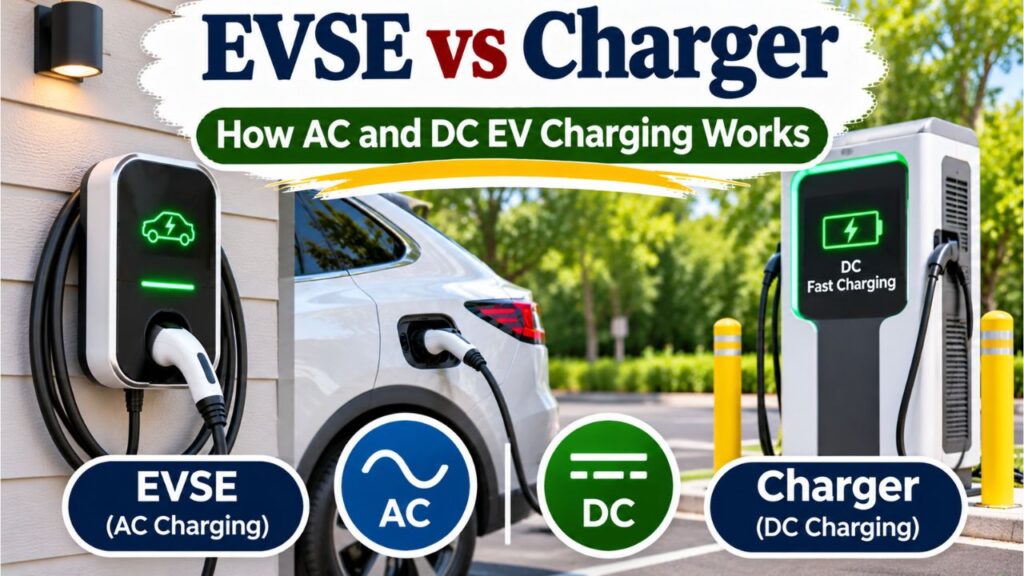
The main difference is the function each component performs during charging.
EVSE primarily provides a safe, controlled electrical connection. A charger performs the power conversion and regulation required to charge the battery.
However, the distinction depends on whether you’re discussing AC or DC charging.
EVSE vs Charger Comparison Table
| Feature | EVSE | Charger |
| Full meaning | Electric Vehicle Supply Equipment | Battery charging equipment |
| Primary role | Safely delivers and controls the electrical connection | Converts or regulates power for battery charging |
| Typical location | Outside the vehicle | Inside the vehicle for AC; outside for DC fast charging |
| AC-to-DC conversion | Generally not performed by AC EVSE | Performed by the onboard charger |
| Safety controls | Connection monitoring, electrical protection, current signaling | Battery charging control and electrical protection |
| Communication | Communicates available charging conditions | Works with charging and battery-management systems |
| Level 1 charging | External AC EVSE | Vehicle’s onboard charger |
| Level 2 charging | External AC EVSE | Vehicle’s onboard charger |
| DC fast charging | External DC charging equipment is also broadly classified as EVSE | Offboard power-conversion equipment |
| Common consumer name | EV charger | EV charger |
The U.S. Department of Energy’s Alternative Fuels Data Center identifies the onboard charger as the component that converts incoming AC electricity into DC electricity for charging an EV’s traction battery.
Why Are Both Called EV Chargers?
In everyday language, an EV charger means the device a driver plugs into the vehicle.
For example, a homeowner might say:
“I installed a Level 2 charger in my garage.”
Technically, that wall-mounted unit is generally AC EVSE.
The actual AC-to-DC conversion happens inside the car.
However, calling the external unit an EV charger is widely accepted in consumer and industry terminology.
Even the U.S. Environmental Protection Agency uses the term EV chargers for products categorized as electric vehicle supply equipment.
Key Takeaway: EVSE and charger are often interchangeable in everyday conversation, but the technical distinction matters when explaining how AC and DC charging work.
What Is EVSE?
EVSE stands for Electric Vehicle Supply Equipment.
It refers to the external equipment used to connect an electric vehicle safely to an electrical power source.
EVSE can include electrical conductors, connectors, protective devices, control electronics, and other equipment designed for transferring power to a vehicle.
What Does EVSE Do?
An AC EVSE typically performs several functions:
- Detects when a compatible vehicle is connected.
- Provides an appropriately controlled electrical connection.
- Communicates available charging current.
- Monitors relevant electrical safety conditions.
- Connects or disconnects power using internal switching equipment.
- Helps protect against certain electrical faults.
- Supports charging authorization or scheduling when equipped with those features.
It does not normally convert household AC electricity directly into the DC electricity stored by the vehicle’s traction battery.
What Does EVSE Look Like?
EVSE is available in several forms.
Portable charging cord
A portable EVSE has a charging cable, control unit, and compatible electrical connector.
Some portable units operate at both 120V and 240V when used with suitable adapters and electrical circuits.
Wall-mounted charging station
A residential Level 2 EVSE is typically mounted in a garage or near a parking space.
It may be hardwired or connected through an appropriate receptacle, depending on its design and local electrical requirements.
Commercial charging pedestal
Public and workplace EVSE may include displays, payment systems, network connectivity, and one or more charging ports.
DC charging equipment
The broader definition of EVSE also includes equipment associated with DC fast charging.
Unlike ordinary AC EVSE, a DC fast charging system incorporates offboard power conversion and charging control.
Is EVSE Only Used for Level 1 and Level 2?
No.
Although the term EVSE is frequently associated with AC charging, it can also describe DC charging infrastructure.
The ENERGY STAR EVSE product criteria cover AC Level 1, AC Level 2, and applicable DC-output charging equipment.
The more accurate distinction is between AC EVSE, which normally supplies AC power to an onboard charger, and DC charging equipment, which provides regulated DC power from an offboard charger.
What Is an EV Charger?
An EV charger is equipment that provides the electrical conversion and control required to recharge a vehicle’s battery.
In technical discussions, the word charger often refers specifically to the power-conversion unit.
However, the term can also refer to an entire external charging station.
What Is an Onboard Charger?
An onboard charger, sometimes abbreviated OBC, is installed inside an electric vehicle.
Its main functions include:
- Accepting AC electricity through the vehicle’s charge port.
- Converting AC electricity into DC electricity.
- Regulating power delivery within the vehicle’s supported limits.
- Communicating with relevant charging and vehicle-control systems.
- Supporting battery charging under the vehicle’s management system.
The onboard charger is used during AC Level 1 and Level 2 charging.
What Is an Offboard Charger?
An offboard charger is located outside the vehicle.
DC fast charging systems use offboard power-conversion equipment to deliver DC electricity to the vehicle.
This arrangement allows much higher charging power than the onboard AC charger typically supports.
However, the vehicle’s battery-management system still determines what charging conditions it can safely accept.
Onboard vs. Offboard Charger
| Feature | Onboard Charger | Offboard DC Charger |
| Location | Inside the EV | At the charging site |
| Typical use | Level 1 and Level 2 AC charging | DC fast charging |
| Receives | AC electricity | Usually utility AC, converted within the charging system |
| Provides | Regulated DC for the battery | Regulated DC to the vehicle |
| Power capacity | Limited by vehicle design | Can be substantially higher |
| Common setting | Home and workplace charging | Highway and public fast charging |
| Ownership | Part of the vehicle | Charging station owner or operator |
Not all offboard charging systems are housed in a single pedestal.
Some high-power DC installations use a separate power cabinet connected to one or more charging dispensers.
How Does EVSE Work With the Onboard Charger?
EVSE and the onboard charger work together during AC charging.
The external equipment supplies a controlled connection, while the onboard charger converts electrical energy into the form required by the battery.
AC Charging Process
<box border radius=”lg” padding={3} gap={2}>
<text weight=”medium” size=”sm”>AC Charging Power Flow</text>
<box background=”surface-secondary” radius=”md” padding={3} align=”center” gap={1}>
**Electrical supply**
<text size=”xs” color=”secondary”>120V or 208/240V AC</text>
</box>
<row justify=”center”>
<icon name=”arrow-down” color=”secondary”/>
</row>
<box border radius=”md” padding={3} align=”center” gap={1}>
EVSE
<text color=”secondary” size=”xs”>Safety checks, connection control, current signaling</text>
</box>
<row justify=”center”>
<icon name=”arrow-down” color=”secondary”/>
</row>
<box border radius=”md” padding={3} align=”center” gap={1}>
Vehicle onboard charger
<text color=”secondary” size=”xs”>Converts AC electricity to regulated DC electricity</text>
</box>
<row justify=”center”>
<icon name=”arrow-down” color=”secondary”/>
</row>
<box background=”surface-secondary” radius=”md” padding={3} align=”center” gap={1}>
EV battery
<text color=”secondary” size=”xs”>Stores electrical energy as DC</text>
</box>
</box>
Step 1: Connect the Vehicle
The driver inserts the charging connector into the EV’s charge port.
The EVSE and vehicle establish the necessary electrical and control connections.
Step 2: Check Charging Conditions
The EVSE and vehicle establish whether charging can begin.
The external equipment communicates relevant limits, including available current.
Step 3: Enable Electrical Power
Once the required connection and safety conditions are satisfied, the EVSE allows power delivery.
It can interrupt the connection when necessary.
Step 4: Convert AC to DC
The onboard charger receives AC electricity and converts it into DC electricity.
The vehicle controls charging according to its design and operating conditions.
Step 5: Store Energy in the Battery
The battery receives regulated electrical energy.
The vehicle’s battery-management system monitors parameters such as cell voltage, temperature, and state of charge.
Step 6: Stop Charging
Charging can stop when the selected charge limit is reached, the driver disconnects, or the charging system detects conditions requiring interruption.
Key Takeaway: During AC charging, the EVSE supplies and controls the electrical connection, while the onboard charger performs the AC-to-DC conversion.
EVSE vs Charger in Level 1, Level 2, and DC Fast Charging
Charging level determines how electricity reaches the vehicle and which equipment performs power conversion.
EV Charging Level Comparison
| Charging Type | Typical U.S. Supply | Power Example | Where AC-to-DC Conversion Happens |
| Level 1 AC | 120V | 1.4–1.9 kW | Inside the vehicle |
| Level 2 AC | 208V or 240V | 3.8–11.5 kW common examples; up to 19.2 kW under supported configurations | Inside the vehicle |
| DC fast charging | Higher-power electrical supply | 50–350 kW and other ratings | At the charging site |
These are representative ratings, not universal minimums or maximums for every product.
Actual charging power depends on equipment, electrical infrastructure, vehicle compatibility, and operating conditions.
Level 1 EVSE
Level 1 uses 120V AC electricity.
A common household setup operates at 12A on a suitable 15A circuit.
Electrical input power is:
120 × 12 = 1,440 watts
That equals 1.44 kW.
Level 1 can be appropriate for low-mileage drivers.
However, restoring a large amount of energy can require many hours.
The portable charging cord includes EVSE control and safety functions even though the vehicle’s onboard charger performs the AC-to-DC conversion.
Level 2 EVSE
Level 2 commonly uses 240V at home or 208V in certain commercial electrical systems.
It provides substantially more power than Level 1.
For example, a 240V, 32A connection provides:
240 × 32 = 7,680 watts
That equals 7.68 kW.
A supported 48A setup at 240V provides approximately 11.52 kW.
Some AC Level 2 systems support up to 80A, equivalent to 19.2 kW at 240V, although the vehicle must also support that power level.
The Department of Energy’s charging infrastructure guide identifies AC Level 1, AC Level 2, and DC fast charging as the primary charging categories.
DC Fast Charging
DC fast charging uses offboard power-conversion equipment.
Instead of sending AC electricity to the onboard charger, the charging system supplies regulated DC electricity to the vehicle through its supported DC charging interface.
The battery-management system and charging equipment coordinate the charging process.
This allows charging powers that can be substantially higher than those provided by ordinary residential AC EVSE.
However, a station advertised at 350 kW doesn’t guarantee that every EV will charge at 350 kW.
Vehicle limits, battery temperature, charge level, cable capacity, and station conditions affect actual power.
Is DC Fast Charging Technically EVSE?
Yes, under broad equipment terminology.
DC fast charging equipment is included within the EVSE category in government and industry specifications.
However, the DC fast charger also contains or is connected to the equipment that performs AC-to-DC power conversion.
This is why the technical distinction between EVSE and charger is clearest when discussing AC charging equipment.
Is a Home EV Charger Actually EVSE?
In most cases, yes.
A typical wall-mounted Level 2 home charger is technically AC EVSE.
The unit provides a safe electrical connection and controls the charging session.
The onboard charger inside the vehicle handles AC-to-DC conversion.
Examples of Home EVSE
Common examples include:
- A portable 120V charging cord with EVSE electronics.
- A portable 240V charging unit.
- A hardwired Level 2 wall-mounted charging station.
- A network-connected residential EVSE.
- A load-managed home charging unit.
All provide external charging equipment.
Why Manufacturers Call Them Chargers
Manufacturers use the term charger because it describes the equipment’s purpose in language that consumers recognize.
The distinction doesn’t mean the product is incorrectly designed or falsely advertised.
It is primarily a difference between consumer terminology and electrical-system terminology.
Should You Search for EVSE or EV Charger When Shopping?
Both terms are useful.
Searching for home EV charger generally produces consumer charging products.
Searching for Level 2 EVSE may produce more technical information about current ratings, installation requirements, safety certifications, and load management.
When comparing specifications, focus on electrical capabilities rather than the product name.
Does EVSE Control Charging Speed?
EVSE influences charging speed by communicating the available current and providing the electrical connection.
However, it doesn’t independently determine how much power the vehicle will accept.
What Limits AC Charging Power?
The actual charging rate depends on several factors:
- EVSE maximum current.
- Circuit capacity.
- Available supply voltage.
- Vehicle onboard charger capacity.
- Vehicle charging settings.
- Battery temperature and state of charge.
- Power management or load-sharing settings.
The available charging power is constrained by the relevant limits.
Example: 48A EVSE With a 32A Onboard Charger
Suppose a Level 2 EVSE can supply 48A at 240V.
Its nominal maximum power is:
240 × 48 ÷ 1,000 = 11.52 kW
However, the vehicle’s onboard charger supports only 32A.
The vehicle is therefore limited to approximately:
240 × 32 ÷ 1,000 = 7.68 kW
Installing 48A-capable EVSE doesn’t make that vehicle charge at 11.52 kW.
Example: 32A EVSE With a 48A-Capable Vehicle
Now consider the opposite situation.
The vehicle supports 48A, but the EVSE is configured for 32A.
The charging session is limited to the lower available current.
At 240V, the nominal input is approximately 7.68 kW.
Why This Matters
Buying a higher-current EVSE doesn’t guarantee faster charging.
Before selecting equipment, check the vehicle’s onboard AC charging limit and the home’s electrical capacity.
EVSE Amperage vs Charger Amperage
Amperage describes electrical current.
For AC charging, the EVSE’s current rating and the vehicle’s onboard charging limit both matter.
EVSE Current and Circuit Size
EV charging is generally treated as a continuous electrical load for circuit-sizing purposes.
Under typical U.S. National Electrical Code requirements, a charging circuit must be sized for 125% of the continuous charging load.
This is often expressed as limiting charging current to 80% of the circuit rating.
Common Level 2 Circuit Configurations
| Circuit Rating | Typical Maximum Continuous EVSE Current | Nominal Power at 240V |
| 20A | 16A | 3.84 kW |
| 30A | 24A | 5.76 kW |
| 40A | 32A | 7.68 kW |
| 50A | 40A | 9.60 kW |
| 60A | 48A | 11.52 kW |
| 100A | 80A | 19.20 kW |
These are standard continuous-load examples.
The actual installation must follow the equipment listing, manufacturer instructions, adopted local electrical code, and any applicable energy-management provisions.
A licensed electrician should determine the correct circuit design.
Does a 50A Circuit Mean the Car Charges at 50A?
Generally, no.
Under the common 125% continuous-load sizing method, a 50A circuit supports a maximum continuous charging current of 40A.
The vehicle may draw less if its onboard charger or charging settings impose a lower limit.
Can You Lower the Charging Current?
Many EVSE products and vehicles support adjustable current limits.
For example, a charging unit may be configured for 24A instead of 32A when installed on a compatible, appropriately protected circuit.
However, charging settings must not be used as a substitute for proper wiring, circuit protection, or equipment installation.
EVSE vs Charger Connectors: J1772, J3400, CCS, and CHAdeMO
Connector compatibility is separate from the distinction between EVSE and charger.
A connector determines how the vehicle physically and electrically connects to charging equipment.
SAE J1772
SAE J1772 is a widely used North American connector for AC charging.
It supports Level 1 and Level 2 charging.
It does not independently provide the additional DC connections used in CCS fast charging.
SAE J3400 (NACS)
SAE J3400 standardizes the Tesla-developed North American Charging Standard, commonly called NACS.
It supports both AC and DC charging through a compact connector design.
A J3400-compatible vehicle may use appropriate AC EVSE or supported DC fast charging equipment.
However, network access and vehicle compatibility still matter.
Combined Charging System (CCS1)
CCS1 combines the J1772 AC charging interface with additional connections for DC fast charging.
It allows compatible vehicles to receive AC charging or DC fast charging through the vehicle’s combined charge-port design.
CHAdeMO
CHAdeMO is a DC fast charging connector and communication system used by certain vehicles.
It is not an ordinary Level 1 or Level 2 AC charging connector.
Connector Comparison
| Connector | AC Level 1/2 | DC Fast Charging | Main Consideration |
| J1772 | Yes | No | AC charging |
| J3400 / NACS | Yes | Yes | Vehicle and charging-network compatibility |
| CCS1 | Yes, through its J1772 portion | Yes | Combined AC/DC vehicle inlet |
| CHAdeMO | No | Yes | Select DC-compatible vehicles |
The Alternative Fuels Data Center’s charging equipment guide explains these charging connectors and their intended uses.
Can an Adapter Turn Level 2 EVSE Into a DC Fast Charger?
No.
A connector adapter doesn’t ordinarily change an AC EVSE into a DC fast charger.
AC-to-DC conversion requires suitable charging power electronics and compatible vehicle control systems.
Adapters can provide physical and electrical compatibility between supported charging interfaces, but they don’t automatically increase the charging level.
EVSE Safety Features vs Charger Safety Features
Safety is one of the main reasons EVSE is more than an ordinary extension cord.
Proper EV charging equipment includes controls intended to reduce electrical hazards.
EVSE Safety Functions
Depending on the design, EVSE may include:
Ground-fault protection
The equipment can detect certain unintended current paths and interrupt power.
Connection monitoring
The system checks relevant connection conditions before and during charging.
Current signaling
The EVSE communicates the available charging current so the vehicle can remain within supported electrical limits.
Contactor control
Internal switching equipment can enable or interrupt the supply connection.
Temperature monitoring
Some systems monitor connector, plug, or internal equipment temperatures and may reduce or stop charging when necessary.
Electrical fault detection
Suitable equipment can detect specified abnormal conditions and respond according to its design.
Not every EVSE contains identical features, so check the product’s certifications and documentation.
Onboard Charger Protection
The onboard charger works with the vehicle’s electrical and battery-management systems.
Relevant protections may include:
- Voltage monitoring.
- Current regulation.
- Temperature monitoring.
- Charging-power limitations.
- Fault detection.
- Controlled charging termination.
The battery-management system also monitors the battery’s operating conditions.
Are All EV Chargers Safety-Certified?
No.
Not every product sold online has verified safety certification.
The ENERGY STAR EV charger guidance advises choosing equipment with appropriate safety certification.
ENERGY STAR-certified EVSE must also satisfy its applicable product safety-listing requirements.
What Certifications Should You Check?
For a U.S. installation, look for appropriate listing by a recognized testing laboratory, such as UL or another qualified Nationally Recognized Testing Laboratory.
Verify the listing for the specific product model.
Also confirm that the equipment is suitable for its intended installation environment.
Can You Use an Ordinary Extension Cord Instead of EVSE?
No.
An ordinary extension cord does not replace the control and protection functions provided by EVSE.
It may also introduce overheating and electrical hazards.
Follow the EVSE manufacturer’s instructions and avoid unauthorized extension cords, plug adapters, or improvised electrical connections.
Key Takeaway: EVSE protects and controls the external charging connection, while the onboard charger and vehicle systems manage the battery-charging process.
Smart EVSE vs Regular EVSE
Some EVSE products include network connectivity and charging-management features.
These are commonly called smart EV chargers.
What Is Smart EVSE?
Smart EVSE may include features such as:
- Wi-Fi or cellular connectivity.
- Charging schedules.
- Energy monitoring.
- Remote start and stop controls.
- Load management.
- Multiple-vehicle power sharing.
- User authentication.
- Utility demand-response integration.
Features vary by manufacturer and model.
What Is Basic EVSE?
Basic EVSE provides the necessary electrical connection and safety controls without extensive network functionality.
It may operate without Wi-Fi or a smartphone application.
Smart EVSE vs Basic EVSE
| Feature | Basic EVSE | Smart EVSE |
| Supplies charging electricity | Yes | Yes |
| Safety controls | Yes | Yes |
| AC-to-DC conversion | No, for ordinary AC EVSE | No, for ordinary AC EVSE |
| Charging schedule | May be managed by vehicle | Often available through equipment or app |
| Energy monitoring | Limited or unavailable | Often included |
| Internet connection | Usually unnecessary | Optional or required for certain features |
| Load sharing | Product-dependent | Available on some models |
| Remote controls | Usually limited | Often available |
| Charging speed | Based on electrical and vehicle limits | Based on electrical and vehicle limits |
Does Smart EVSE Charge Faster?
Not inherently.
A 32A smart EVSE and a 32A basic EVSE provide the same nominal maximum AC power when connected to identical electrical supplies.
Smart features may improve charging convenience or manage available capacity, but they do not bypass the vehicle’s onboard charging limits.
Is Smart EVSE Worth It?
It can be useful when:
- Your utility offers time-of-use electricity rates.
- You want to monitor charging consumption.
- Multiple EVs share electrical capacity.
- Your home uses dynamic load management.
- You need remote charging controls.
For a simple home installation, basic certified EVSE may be sufficient.
EVSE vs Charger Installation Requirements
A typical residential AC EVSE is installed outside the vehicle.
Its installation requirements depend on voltage, amperage, connection type, and the home’s electrical system.
Level 1 Installation
Level 1 EVSE commonly uses a suitable 120V household circuit.
Although it may not require new wiring, the outlet must be properly grounded, in good condition, and suitable for sustained EV charging.
A worn or improperly installed receptacle can overheat during prolonged charging.
Level 2 Installation
Level 2 EVSE commonly requires a dedicated 208V or 240V supply.
A qualified electrician may need to evaluate:
- Electrical service capacity.
- Panel and circuit availability.
- Breaker sizing.
- Wire size and installation method.
- Grounding and protective devices.
- Receptacle or hardwired connections.
- Outdoor environmental protection.
- Local permit and inspection requirements.
Hardwired vs Plug-In EVSE
Hardwired EVSE connects directly to the branch circuit through a fixed electrical installation.
Plug-in EVSE uses a compatible receptacle and attachment plug.
Neither option is automatically superior for every property.
A hardwired installation may avoid some receptacle-related concerns and support particular equipment configurations.
A plug-in installation may allow easier removal or relocation of compatible equipment.
However, the receptacle, wiring, and installation still need to meet applicable requirements.
Do You Need a Licensed Electrician?
For new electrical circuits, higher-power charging equipment, or uncertain existing wiring, a qualified electrician is strongly recommended.
Electrical work must comply with locally adopted regulations.
Do not assume that an unused breaker space means the home has sufficient electrical capacity for an EV charging circuit.
Does the Onboard Charger Need Installation?
The onboard charger is already built into the vehicle.
Homeowners normally select and install external EVSE, not the vehicle’s onboard charger.
If the onboard charger fails, diagnosing or replacing it is a vehicle-service task rather than a residential electrical installation.
EVSE vs Charger Cost: What Are You Actually Paying For?
The terms can make prices confusing because they describe different parts of the charging system.
Cost of Residential EVSE
When purchasing a Level 2 home EV charger, you’re generally purchasing external EVSE.
The total cost may include:
- Charging equipment.
- Cable and connector.
- Circuit installation.
- Electrical panel work.
- Permits.
- Professional labor.
- Optional charging-management features.
The final amount varies considerably by property and equipment.
Cost of an Onboard Charger
The onboard charger is part of the EV.
Its cost is included in the vehicle purchase.
It is not normally purchased as a separate home charging accessory.
If the onboard charger requires replacement, the expense depends on the vehicle, warranty coverage, labor, and replacement components.
Cost of DC Fast Charging Equipment
DC fast charging infrastructure can be substantially more complex.
A commercial installation may require:
- Power-conversion modules.
- Charging dispensers.
- High-power electrical service.
- Transformers or switchgear.
- Cooling systems.
- Network and payment equipment.
- Site construction.
- Utility coordination.
The cost is therefore not directly comparable with a residential Level 2 EVSE.
Does EVSE Affect Electricity Cost?
Yes, but primarily through charging efficiency, standby consumption, and the ability to manage charging schedules.
A smart EVSE may help use lower electricity rates when the utility offers time-of-use pricing.
However, buying a higher-rated EVSE doesn’t automatically reduce the price per kilowatt-hour.
Electricity Cost Example
Suppose charging draws 25 kWh from the grid.
At an illustrative electricity rate of $0.18 per kWh:
25 × $0.18 = $4.50
This is the electricity cost before any additional fees.
The battery receives somewhat less energy because of charging losses and vehicle overhead.
Actual efficiency depends on the charging conditions.
Is EVSE More Efficient Than a Charger?
This isn’t a direct comparison because EVSE and the onboard charger perform different functions.
Where Charging Losses Occur
During AC charging, some energy is lost through:
- Electrical wiring.
- EVSE components.
- AC-to-DC conversion.
- Vehicle electronics.
- Battery heating or cooling.
- Other vehicle systems operating during the session.
The external EVSE and the onboard charger therefore contribute to different parts of the total energy-consumption process.
Does Level 2 Improve Efficiency?
Level 2 may improve total charging efficiency in some conditions because the charging session is shorter and fixed overhead loads may operate for less time.
However, the exact advantage depends on the vehicle, power level, battery temperature, and other conditions.
Don’t assume a universal efficiency percentage for all EVs.
Does ENERGY STAR Matter?
ENERGY STAR evaluates applicable EV charging equipment for efficiency and safety-related requirements.
Its criteria address energy use in different operating states, including periods when no vehicle is connected.
For homeowners, certified equipment can help reduce unnecessary standby electricity consumption.
However, ENERGY STAR certification doesn’t automatically make a charger faster.
EVSE vs Charging Station vs Charging Port
These terms are closely related but describe different parts of charging infrastructure.
EVSE
EVSE refers to equipment used for the controlled transfer of electricity to an EV.
It can describe an individual charging unit or a broader set of charging components.
Charging Station
A charging station can refer to a physical location containing one or more charging ports.
For example, a parking garage may contain several charging units.
Charging Port
In public infrastructure terminology, a charging port generally refers to an individual charging position capable of charging one vehicle at a time.
However, the phrase charge port can also mean the inlet on the vehicle itself.
Context matters.
Charging Connector
The connector is the part of the charging cable inserted into the vehicle.
Common North American connectors include J1772, J3400, CCS1, and CHAdeMO.
Why This Distinction Matters
Suppose a public charging location has four charging ports.
It may be described as one charging station with four ports.
Depending on the design, each port may have its own EVSE components or share power-conversion equipment with other ports.
The Alternative Fuels Data Center uses separate definitions for station locations, charging ports, and connectors to improve the accuracy of charging infrastructure information.
Common EVSE vs Charger Misconceptions
Misconception 1: EVSE and Chargers Are Completely Different Products
Not always.
In consumer terminology, a product marketed as a home EV charger is usually EVSE.
The distinction is primarily about technical function.
Misconception 2: The Wall-Mounted EV Charger Converts AC to DC
Most residential AC EVSE does not.
The vehicle’s onboard charger performs that conversion.
Misconception 3: EVSE Is Only Used for AC Charging
The broader EVSE category can also include DC charging equipment.
However, DC fast chargers contain or use offboard power-conversion systems.
Misconception 4: A Higher-Amp EVSE Always Charges Faster
The vehicle’s onboard charger and electrical installation can limit the charging rate.
A 48A EVSE cannot force a 32A-limited vehicle to accept 48A.
Misconception 5: A Connector Adapter Increases Charging Power
An adapter doesn’t automatically increase available power or convert ordinary AC EVSE into DC fast charging equipment.
Misconception 6: Smart EVSE Is Always Faster
Smart features may support scheduling and load management.
Charging speed still depends on the available electrical power and vehicle limits.
Misconception 7: Any Household Outlet Is Safe for EV Charging
A receptacle must be appropriately installed, grounded, rated, and maintained.
An old or damaged outlet may overheat under sustained charging loads.
Misconception 8: Level 2 EVSE Is the Same as a DC Fast Charger
Level 2 generally supplies AC electricity to the onboard charger.
DC fast charging uses offboard conversion equipment and supplies DC electricity.
Misconception 9: An EVSE’s Maximum kW Rating Is Guaranteed Charging Speed
Advertised maximum power doesn’t mean every vehicle will accept that power.
Actual charging rates depend on multiple electrical and battery-related limits.
Misconception 10: EVSE Replaces the Vehicle’s Battery-Management System
EVSE does not replace the vehicle’s battery-management system.
The vehicle continues to manage battery operating conditions and charging limits.
How to Choose the Right EVSE for Home Charging
For a typical EV owner, the practical purchase decision is usually between different AC EVSE products—not between buying EVSE and buying an onboard charger.
1. Check Your Vehicle’s AC Charging Limit
Find the maximum AC charging current or power supported by your vehicle.
For example, a vehicle with a 7.7 kW onboard charging limit cannot use the full 11.5 kW output of a higher-power home EVSE.
2. Determine Your Daily Charging Needs
Estimate how much electricity you need to replace after daily driving.
A driver covering 15 miles per day has different requirements from someone driving 80 miles.
Level 1 may be adequate for short trips.
Level 2 is generally more convenient for higher daily mileage.
3. Check Electrical Capacity
Have the available electrical system evaluated before choosing a high-current EVSE.
A 48A charging installation may not be necessary or practical for every home.
4. Choose the Correct Connector
Check whether the vehicle uses J1772 or J3400 for AC charging.
Some vehicles can use a compatible adapter, but verify manufacturer support.
5. Look for Safety Certification
Choose equipment with appropriate, verifiable safety listing.
ENERGY STAR-certified equipment is one way to identify products that meet specific safety and efficiency requirements.
6. Decide Between Hardwired and Plug-In
Consider installation convenience, location, electrical requirements, and the manufacturer’s instructions.
A qualified electrician can help determine the appropriate connection.
7. Evaluate Smart Features
Decide whether you need:
- Charging schedules.
- Energy monitoring.
- Remote controls.
- Load sharing.
- Utility integration.
- Multiple-vehicle support.
Basic EVSE may be sufficient when these features aren’t necessary.
8. Consider Future Vehicles
A household planning to purchase another EV may benefit from equipment with suitable charging-management capabilities.
However, higher current isn’t always necessary.
Proper load management may be more valuable than simply installing the highest-amperage unit available.
EVSE Selection Guide
| Situation | Practical EVSE Choice |
| Short daily commute | Suitable Level 1 or lower-power Level 2 |
| Regular daily commuting | Level 2 |
| Vehicle limited to 32A AC charging | Properly installed 32A-capable EVSE |
| Vehicle supports 48A AC charging | 48A EVSE where electrical capacity permits |
| Multiple EV household | EVSE with appropriate load sharing |
| Existing suitable 240V receptacle | Compatible plug-in Level 2 EVSE |
| New permanent installation | Consider hardwired Level 2 EVSE |
| Time-of-use electricity rates | EVSE or vehicle with charging schedules |
| Public commercial installation | Network, payment, reliability, and maintenance requirements matter |
Key Takeaway: Choose EVSE according to vehicle compatibility, available electrical capacity, safety certification, and daily charging requirements—not simply the highest advertised kW rating.
Conclusion
The main difference in EVSE vs charger is the role each component performs during electric vehicle charging.
EVSE provides a controlled, safety-monitored electrical connection between the power supply and vehicle.
During Level 1 and Level 2 AC charging, the vehicle’s onboard charger converts AC electricity into the DC electricity needed by the battery.
During DC fast charging, offboard charging equipment performs the power conversion and supplies regulated DC electricity to the vehicle. This external system is also broadly categorized as EVSE.
For everyday use, calling a wall-mounted EVSE an EV charger is perfectly understandable. The distinction matters most when comparing specifications, diagnosing charging limitations, or planning an electrical installation.
I recommend focusing on the vehicle’s maximum AC charging capacity, EVSE current rating, electrical circuit requirements, connector compatibility, and product safety certification when selecting home equipment.
The simplest distinction to remember is that AC EVSE safely supplies electricity, while the onboard charger converts it for battery storage. A DC fast charger performs that conversion outside the vehicle.
FAQs About EVSE vs Charger
What Is the Difference Between EVSE and an EV Charger?
EVSE is the external equipment that safely supplies electrical power to an electric vehicle.
During AC charging, the onboard charger converts the electricity from AC to DC.
However, the terms EVSE and EV charger are commonly used interchangeably when referring to home charging equipment.
What Does EVSE Stand For?
EVSE stands for Electric Vehicle Supply Equipment.
It describes equipment used to transfer electricity safely between an electrical supply and an electric vehicle.
Is EVSE the Same as a Level 2 Charger?
A Level 2 charger sold for home use is generally AC EVSE.
It supplies controlled AC electricity to the vehicle.
The onboard charger inside the EV converts that electricity into DC for the battery.
Is a Tesla Wall Connector EVSE or a Charger?
The Tesla Wall Connector is technically AC EVSE.
It provides a controlled electrical connection between the home’s electrical system and a compatible EV.
The vehicle’s onboard charger performs the AC-to-DC conversion.
However, calling it a home Tesla charger is common and accepted.
Does EVSE Convert AC Electricity to DC?
Ordinary Level 1 and Level 2 AC EVSE generally does not.
The vehicle’s onboard charger performs the conversion.
DC fast charging systems use offboard power-conversion equipment to supply regulated DC electricity.
Does Every Electric Car Have an Onboard Charger?
Electric vehicles designed for conventional AC charging have an onboard charger or equivalent integrated charging system.
It allows them to accept AC electricity from compatible Level 1 or Level 2 equipment.
The maximum supported AC charging power varies by vehicle.
Is a DC Fast Charger Also EVSE?
Yes.
DC fast charging equipment falls within the broad category of electric vehicle supply equipment.
However, unlike ordinary AC EVSE, a DC fast charging system includes or is connected to offboard power-conversion hardware.
Is EVSE Safer Than a Regular Electrical Outlet?
EVSE provides electrical controls and protection functions specifically intended for EV charging.
A regular outlet alone does not replace those functions.
A portable EVSE connected to a suitable outlet can provide the necessary vehicle interface, but the outlet and wiring must also be appropriate for the sustained load.
Does a 48-Amp EVSE Charge Faster Than a 32-Amp EVSE?
Only when the electrical installation and vehicle can support the higher current.
At 240V, 32A provides approximately 7.7 kW, while 48A provides approximately 11.5 kW.
A vehicle limited to 32A cannot use the additional output of a 48A charging unit.
Is a Charging Cable the Same as EVSE?
Not always.
A plain charging cable or connector is only part of the charging system.
A portable charging cordset containing the necessary EVSE electronics and protective controls is considered EVSE.
An extension cable alone does not provide the same functionality.
Do I Need EVSE to Charge an Electric Car at Home?
Yes, you need compatible charging equipment that provides the required vehicle connection and safety controls.
That equipment may be a portable charging cordset or a permanently installed wall-mounted unit.
A standard household outlet alone isn’t a substitute for the EVSE electronics required by the vehicle.
Is Smart EVSE Better Than a Regular EV Charger?
Smart EVSE can offer useful features such as charging schedules, energy monitoring, and load management.
However, it doesn’t automatically charge faster than basic EVSE with the same electrical rating.
The better choice depends on your charging requirements and preferred features.
Does EVSE Affect Battery Health?
EVSE helps establish appropriate external electrical conditions, but battery charging is managed through the vehicle’s charging and battery-management systems.
Battery health also depends on temperature, state of charge, battery chemistry, and charging practices.
Using properly installed, compatible EVSE is part of normal EV operation.
Is EVSE Different From an EV Charging Station?
EVSE refers to the charging equipment.
A charging station can refer to a physical location containing one or more charging ports.
The terms may overlap in everyday usage, but infrastructure planning often uses more specific definitions.
Can EVSE Charge Two Electric Vehicles?
Some EVSE units have multiple charging ports or support coordinated charging.
Power-sharing systems can divide available electrical capacity between vehicles.
However, a dual-connector product doesn’t necessarily provide full rated power to both vehicles simultaneously.
Check the equipment specifications.
Does EVSE Need Wi-Fi to Charge a Vehicle?
Not necessarily.
Many basic EVSE units operate without an internet connection.
Smart EVSE may use Wi-Fi or cellular connectivity for remote monitoring, scheduling, authentication, or other features.
Some network-dependent functions may be unavailable offline.
What Is the Best EVSE for Home Charging?
For most regular EV drivers, a properly installed Level 2 EVSE with the correct connector and appropriate current rating is a practical choice.
However, Level 1 may be sufficient for low-mileage driving.
Check the vehicle’s onboard charging limit, electrical capacity, safety certification, and desired features before selecting equipment.