
A charging point is the part of an EV charging system that can charge one vehicle at a time, while a charging station is often the physical charger or the location containing one or more charging points. The exact meaning changes by region: under EU rules, a station is one physical installation containing one or more points, whereas U.S. drivers often say charging station to mean an entire site, such as a parking lot with multiple charging ports.
This distinction explains why a public charger may display two cables yet serve only one vehicle, or why a location listing “eight chargers” does not necessarily have eight separate physical cabinets. A charging site can offer AC or DC power, multiple connector types, shared power, payment options, and network access. The name alone does not tell you which vehicles it supports or how quickly each one can charge.
In this article, I explain charging points, stations, connectors, ports, EVSE, and charging sites with practical examples. I also compare how the United States, United Kingdom, and European Union define and count charging equipment, then show what to check when selecting public or home charging.
Charging Point vs Charging Station: Main Differences
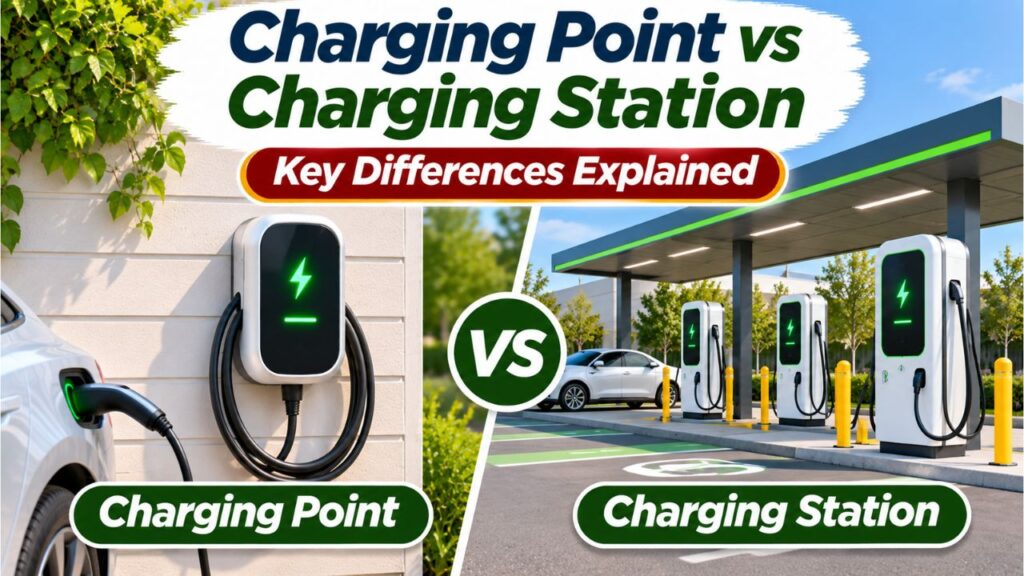
The most useful distinction is between a single vehicle-charging connection and the equipment or location providing charging services.
In everyday conversation, these terms are sometimes interchangeable. In technical specifications, government statistics, and charging-network databases, their meanings are more precise.
Quick Comparison Table
| Feature | Charging Point | Charging Station |
| Basic meaning | A functional charging connection serving one EV at a time | A physical charger installation or charging location, depending on context |
| Main purpose | Deliver electrical energy to an EV | Provide or organize charging facilities |
| Number of vehicles | Generally one at a time under technical counting conventions | One or multiple vehicles |
| Physical equipment | May be part of a larger charger cabinet | May contain one or more charging points |
| Connectors | Can have one or more connector options | Can provide several connectors across multiple points |
| AC charging | Yes | Yes |
| DC fast charging | Yes | Yes |
| Typical location | Home, workplace, parking space, public charging area | Home, parking lot, highway service area, charging hub |
| Power rating | Associated with the individual charging connection | May describe an individual installation or combined capacity |
| Public availability | Can be public or private | Can be public or private |
| Number of units | Represents individual charging capability in technical usage | May represent one physical unit or an entire site |
The U.S. Department of Energy’s Alternative Fuels Data Center uses three main categories when describing charging infrastructure:
- Station location
- EV charging port
- Connector
The European Union uses a related, but slightly different, hierarchy:
- Recharging pool
- Recharging station
- Recharging point
- Connector
These differences explain why charging infrastructure statistics from different organizations sometimes appear inconsistent.
Key Takeaway: One charging station can contain multiple charging points, and one charging point can sometimes have multiple connectors. The number of connectors does not necessarily equal the number of EVs that can charge simultaneously.
What Is an EV Charging Point?
An EV charging point generally refers to an individual facility or interface through which an electric vehicle receives electricity.
In a technical European context, it represents charging capability for one vehicle at a time.
A charging point may be installed:
- At a private residence
- In an apartment parking area
- At a workplace
- In a shopping center
- At a public parking facility
- At a highway charging location
- In a commercial fleet depot
The point can provide AC or DC charging, depending on the equipment.
How Does a Charging Point Work?
The charging point connects an electric vehicle to an electrical supply through compatible charging equipment.
A typical charging process includes:
- Connecting a compatible plug to the vehicle.
- Establishing the necessary control and safety communication.
- Confirming that charging can begin.
- Delivering electricity at a supported power level.
- Monitoring the charging session.
- Ending energy delivery when charging stops.
- Disconnecting the vehicle safely.
At a public location, additional functions may include user authentication, billing, status monitoring, and remote network communication.
Does One Charging Point Always Have One Plug?
No.
Some charging points provide multiple connector types.
For example, a DC fast-charging unit might have both CCS1 and CHAdeMO cables.
However, those connectors may be alternatives rather than independently usable charging connections.
The European Alternative Fuels Observatory explains that a recharging point may have several connectors but is capable of charging only one vehicle at a time.
Can One Charging Point Charge Two Cars?
Under the technical definition used by European charging regulations, no.
If equipment can independently charge two vehicles simultaneously, it generally contains two charging points, even when both are housed inside one physical cabinet.
This distinction matters when counting available charging capacity.
A dual-connector charger is not necessarily a dual-vehicle charger.
What Is an EV Charging Station?
An EV charging station is a term used for equipment or a location that provides electric vehicle charging.
However, its exact meaning depends on who is using the term.
In everyday American English, charging station often refers to the destination where drivers go to charge their vehicles.
In formal European terminology, a recharging station is a physical installation containing one or more charging points.
What Does a Charging Station Include?
A charging station or charging location may include:
- One or more charging units
- Charging points or EVSE ports
- Connector cables
- Electrical protection equipment
- Control and communication systems
- Displays or payment interfaces
- Dedicated parking spaces
- Grid connections
- Power distribution equipment
- Network connectivity
Larger public charging locations may also contain transformers, electrical cabinets, and energy-management equipment.
Not every station includes all these components.
A simple home charger can be much less complex than a highway fast-charging installation.
Can a Charging Station Have Just One Charging Point?
Yes.
A small charging installation may contain only one charging point.
For example, a single home wall charger serving one vehicle can be described as a charging station in everyday language.
Under formal EU terminology, a single physical charging unit with one recharging point is also a recharging station.
Can a Charging Station Have Multiple Charging Points?
Yes.
A physical charging unit may contain two or more independent charging points.
For example, a dual-port charging installation could serve two vehicles simultaneously if its hardware supports that function.
A larger public charging location might have many such units.
Is a Charging Station Always Public?
No.
Charging stations can be private, restricted-access, or publicly accessible.
Examples include:
- A private garage charger
- An employee-only workplace installation
- An apartment complex charging facility
- A fleet depot
- A publicly accessible highway charging hub
The term station does not automatically mean that anyone can use the equipment.
Charging Point vs Charging Station vs Connector vs EVSE
The terminology becomes clearer when each infrastructure component is considered separately.
Charging Location
A charging location is the physical site where charging equipment is installed.
Examples include a parking garage, shopping center, or highway rest area.
A location can contain one or more charging devices.
Charging Station or Charging Device
This refers to the physical installation that houses charging equipment.
Depending on the design, one cabinet or charging post may support multiple vehicle-charging connections.
Charging Point or EVSE Port
A charging point, in the technical vehicle-capacity sense, provides charging capability for one EV at a time.
EVSE stands for Electric Vehicle Supply Equipment.
In charging-network data, an EVSE port is commonly the independently controlled charging connection.
Connector
A connector is the physical plug or socket used to connect an EV.
Examples include:
- J1772
- J3400/NACS
- CCS1
- CCS2
- CHAdeMO
- Type 2
The connector determines physical and electrical compatibility with a vehicle.
However, multiple connectors on the same charging point do not necessarily allow multiple vehicles to charge simultaneously.
Charging Network
A charging network is a system of charging locations connected through an operator’s platform or services.
It may provide:
- Charger discovery
- Availability information
- User authentication
- Payment processing
- Session monitoring
- Customer support
The charging network is not the same thing as the physical charging station.
Charging Infrastructure Hierarchy
| Level | What It Represents | Example |
| Charging network | Service or system connecting charging locations | An operator’s network |
| Charging location | Physical site | Shopping-center parking lot |
| Charging station/device | Physical equipment | Dual-port charging cabinet |
| Charging point/EVSE port | One independently controlled charging connection | One car charging at a time |
| Connector | Plug or socket | CCS1 or J1772 |
The exact labels differ by regional standards, but this hierarchy is useful for understanding physical charging capacity.
Charging Point vs Charging Station: A Real-World Example
Consider a hypothetical shopping-center parking lot.
The site contains three physical charging cabinets.
Each cabinet has two independently controlled charging points.
Some of the charging points provide more than one connector type.
Example Charging Setup
| Component | Quantity |
| Charging locations | 1 |
| Physical charging cabinets | 3 |
| Independent charging points | 6 |
| Physical connectors | 8 |
| Maximum simultaneous vehicle connections | 6 |
Assuming all equipment is operational and supports simultaneous use, up to six EVs can charge at once.
The site has eight connectors but only six independently controlled charging points.
The extra connectors provide compatibility options rather than extra simultaneous charging capacity.
How Would This Be Counted in the United States?
Under the U.S. Department of Energy’s Alternative Fuels Data Center terminology, the installation could be described as:
- 1 station location
- 6 EV charging ports
- 8 connectors
The three physical cabinets could be described separately as charging posts or devices.
How Would This Be Counted in the European Union?
Under the formal EU infrastructure hierarchy, assuming each cabinet constitutes a separate recharging station, it would be:
- 1 recharging pool
- 3 recharging stations
- 6 recharging points
- 8 connectors
The charging capacity remains six vehicles at a time.
Only the terminology and grouping change.
Why This Matters
If a charging app displays eight connectors, that does not necessarily mean eight cars can charge simultaneously.
If another database reports one charging station, it may be referring to the whole location rather than one physical unit.
Always check what is being counted.
Charging Point vs Charging Station in the United States
In the United States, charging station commonly refers to a location offering EV charging.
However, the Department of Energy uses more specific terminology when recording public charging infrastructure.
Station Location
A station location represents a physical place containing one or more EV charging ports.
For example, a shopping-center parking lot may be listed as one station location.
EV Charging Port
An EV charging port provides power to charge one vehicle at a time.
Even when the port has multiple connectors, it generally serves only one EV during a charging session.
Connector
A connector is the physical plug used to charge the vehicle.
A port can offer several connector types without necessarily increasing the number of cars that can charge at once.
The Alternative Fuels Data Center’s charging station definitions explain this hierarchy and the distinction between ports and connectors.
Why Do U.S. Charging Statistics Count Ports?
Counting EV charging ports provides a clearer indication of how many vehicles can potentially charge simultaneously.
A location count alone does not show capacity.
For example, a charging location with 20 usable ports can serve more vehicles simultaneously than a location with just two ports.
However, even port counts do not guarantee immediate availability.
Some ports may be occupied, unavailable, or affected by operational limitations.
Is an EV Charging Port the Same as a Vehicle’s Charge Port?
Not exactly.
In everyday speech, drivers sometimes call the socket on the car a charging port.
However, in U.S. charging infrastructure datasets, an EV charging port refers to the charging equipment’s ability to charge one vehicle.
The physical inlet on the vehicle is a different component.
This distinction helps avoid confusion when reading charging statistics.
Charging Point vs Charging Station in the UK
In the United Kingdom, the word chargepoint is widely used.
It may refer to a home wall charger, a public charging unit, or more broadly to EV charging equipment.
However, terminology in official statistics has become more specific.
What Does Chargepoint Mean in the UK?
In everyday usage, a chargepoint usually means the physical equipment used to charge an EV.
For example, someone may say:
“I installed a chargepoint at home.”
They are generally referring to a wall-mounted charging unit.
However, a physical charging device may contain more than one independently controlled charging connection.
UK Charging Infrastructure Terminology
The UK Department for Transport distinguishes between:
- Charging location
- Charging device
- EV charger or EVSE
- Connector
Its official EV charging infrastructure statistics FAQ explains why these measurements are not interchangeable.
A charging device is a physical unit.
An EV charger or EVSE is an independently controlled part that can charge one vehicle at a time.
A connector is the plug or socket.
What Changed in UK Charging Statistics in 2026?
From 2026, the UK Department for Transport changed its baseline public-charging infrastructure metric from charging devices to EV chargers (EVSEs).
The change is important because a physical device can contain more than one independently usable charging connection.
Counting devices alone may understate simultaneous charging capacity.
Counting connectors can overstate capacity when several plugs share one EVSE.
Why Does the UK Avoid the Term Chargepoint in Some Statistics?
The Department for Transport explains that chargepoint is used in different ways by consumers, operators, and industry participants.
One person may mean the physical cabinet.
Another may mean a connector.
Another may mean an independently usable charging connection.
To avoid ambiguity, official statistical reporting uses more specific labels.
For everyday UK conversations, chargepoint remains normal terminology. For comparing charging infrastructure, device and EVSE counts are more precise.
Charging Point vs Charging Station in Europe
The European Union uses formal definitions under the Alternative Fuels Infrastructure Regulation, known as AFIR.
This regulation establishes a hierarchy of charging infrastructure components.
Recharging Point
A recharging point is an interface capable of charging one EV at a time.
It may have multiple connectors, but it serves only one vehicle simultaneously.
Recharging Station
A recharging station is a physical installation containing one or more recharging points.
For example, a charging cabinet with two independently controlled outputs can represent one recharging station containing two recharging points.
Recharging Pool
A recharging pool is one or more recharging stations at a specific location.
A highway service area with several charging cabinets may be considered one recharging pool.
EU Charging Hierarchy
Recharging pool → Recharging station → Recharging point → Connector
The European Commission’s AFIR explanatory guidance explains these definitions and their relationship.
Why Is This Distinction Important?
The EU tracks charging infrastructure using several metrics.
A location with many charging stations may provide substantially more simultaneous charging capacity than a site with a single charging point.
Separating pools, stations, and points helps distinguish geographic coverage from the amount of available equipment.
It also helps clarify the power capacity of charging installations.
Does a Charging Point Mean AC or DC Charging?
No.
A charging point can provide either AC or DC electricity.
The term describes charging capability rather than a specific speed or current type.
AC Charging Points
AC charging points supply alternating current to a vehicle.
The vehicle’s onboard charger converts that electricity into DC power suitable for charging the battery.
AC charging is commonly used for:
- Home charging
- Workplace charging
- Public parking
- Overnight charging
- Long-duration destination charging
In North America, AC Level 1 and Level 2 charging are commonly distinguished.
In Europe, AC charging is often classified by its power output and whether single-phase or three-phase charging is supported.
DC Charging Points
DC charging points supply regulated direct current through compatible DC charging equipment.
They are commonly installed at:
- Highway service areas
- Public fast-charging locations
- Commercial charging hubs
- Fleet charging facilities
DC charging equipment can provide substantially higher power than typical home AC charging.
However, the actual charging rate depends on the EV and charging equipment.
AC vs DC Charging Point Comparison
| Feature | AC Charging Point | DC Charging Point |
| Electricity delivered | Alternating current | Direct current |
| Main conversion | Vehicle’s onboard charger | External charging equipment |
| Typical setting | Homes, offices, public parking | Highway stops, fast-charging hubs |
| Charging power | Usually lower | Often substantially higher |
| Equipment size | Usually smaller | Often larger and more complex |
| Installation cost | Usually lower | Usually higher |
| Typical charging duration | Several hours | Shorter sessions when supported |
The U.S. Department of Energy’s EV charging information explains charging levels, equipment types, and the factors affecting charging time.
Is Every Charging Station a Fast-Charging Station?
No.
A station may contain only ordinary AC charging equipment.
Another location may contain several DC fast chargers.
Some sites offer both.
The term charging station does not automatically indicate charging speed.
Can One Charging Station Charge Multiple EVs at Once?
Yes, if the equipment contains multiple independently usable charging points or EVSEs.
However, several limitations can affect how many vehicles can charge simultaneously.
Number of Independent Charging Points
A station with two independent charging points may be able to charge two EVs simultaneously.
A station with only one charging point normally serves one EV at a time, even when two connector cables are present.
Available Parking Spaces
A site may have enough electrical equipment to charge several vehicles but fewer usable parking spaces.
Vehicles blocking charging bays can reduce practical availability.
Equipment Status
Some charging points may be out of service.
A location with eight installed points may have fewer available for immediate use.
Shared Electrical Capacity
Several charging points can share a limited electrical power supply.
In that situation, vehicles may charge simultaneously but at reduced power.
Network or Operator Restrictions
A charging operator may impose temporary restrictions for maintenance, electrical management, or other operational reasons.
Therefore, the number of installed charging points is not always the same as the number of charging sessions that can be started immediately.
Charging Point vs Charging Station: Power Sharing Explained
Power sharing is one of the most important differences between the power rating of an individual charging point and the total capacity of a charging station.
A station can support multiple vehicles without delivering each point’s maximum advertised power simultaneously.
Example: A 200-kW Charging Station
Suppose a DC charging station contains two charging points.
Each point is capable of delivering up to 150 kW.
However, the physical station has a combined maximum output of 200 kW.
If only one vehicle is charging, it may receive up to 150 kW, depending on vehicle limitations.
If two vehicles are charging, the station must distribute its available power between them.
For example:
| Charging Situation | Point A | Point B | Combined Power |
| One compatible vehicle | 150 kW | 0 kW | 150 kW |
| Two vehicles | 100 kW | 100 kW | 200 kW |
| Two vehicles | 150 kW | 50 kW | 200 kW |
These are illustrative power-sharing allocations.
Actual output depends on equipment design, vehicle requests, battery conditions, and station controls.
Does a 150-kW Charging Point Always Deliver 150 kW?
No.
The advertised rating generally represents a maximum capability.
The vehicle may request less power because of:
- Battery temperature
- State of charge
- Battery voltage
- Battery-management limits
- Charging cable restrictions
- Shared station capacity
The European Commission’s AFIR guidance specifically discusses installations where two 150-kW charging points share a lower total station power limit.
Why Does Power Sharing Matter?
When planning a charging stop, the number of available points tells you how many cars might connect.
The power rating tells you how much electricity the equipment may deliver.
However, neither number alone guarantees charging speed.
For businesses installing multiple points, available electrical capacity and load-management design are critical considerations.
Is a Home EV Charger a Charging Point or a Charging Station?
A home EV charger can be described using either term, depending on the context.
In everyday language, people commonly say home charging station or home charging point.
Single-Port Home Charger
A typical single-port home charger includes:
- One physical charging device
- One independently controlled EV charging connection
- One connector or charging outlet
In an everyday description, this can reasonably be called either a charging point or a home charging station.
Dual-Port Home Charger
Some residential chargers support two EVs.
A physical unit that can charge two cars simultaneously effectively provides two independent charging connections.
However, a device with two plugs may still have shared power or other operational limitations.
Check the manufacturer’s specifications.
Is a Charging Station Necessary at Home?
A dedicated AC Level 2 charging installation is convenient but not always essential.
Some EVs can use compatible portable Level 1 charging equipment connected to an appropriate electrical receptacle.
The choice depends on:
- Daily driving distance
- Available charging time
- Vehicle charging capability
- Electrical service capacity
- Installation cost
- Local electrical requirements
For permanent Level 2 installations, have the electrical system evaluated by a qualified electrician.
Is a Wallbox the Same as a Charging Point?
A wallbox is a common name for wall-mounted EV charging equipment.
It may provide one or more charging points, depending on its design.
Therefore, wallbox describes the physical equipment rather than necessarily indicating the number of simultaneous charging connections.
Charging Point vs Charging Station for Businesses
For commercial installations, the distinction affects budgeting, electrical planning, and capacity calculations.
A business should specify both the number of physical charging units and the number of vehicles that can charge simultaneously.
Workplace Charging
A workplace may install two dual-port Level 2 chargers.
This could provide four independently usable charging points while requiring only two physical charger housings.
However, the site may use power sharing to limit the combined electrical load.
Apartment Parking
Apartment buildings often need several charging connections distributed across parking spaces.
The design may prioritize:
- Available electrical capacity
- Load management
- User authentication
- Individual billing
- Installation access
- Long-term maintenance
Counting physical cabinets alone may not describe the number of residents who can charge simultaneously.
Retail Charging
A shopping center may provide several public AC charging points.
It may also install DC fast-charging equipment for shorter visits.
The number of charging points, connector types, pricing, and operating policies determine the service available to drivers.
Fleet Depots
Fleet charging installations may have many charging points connected through centralized power-management systems.
Some vehicles may charge at low power overnight.
Others may require higher-power charging between operating shifts.
For fleet operators, the total simultaneous charging capacity matters more than the number of visible charging cabinets.
Questions Businesses Should Ask
Before purchasing equipment, confirm:
- How many independent charging points are included?
- How many vehicles can charge simultaneously?
- What is the maximum power per point?
- What is the combined station power limit?
- Does the system support load balancing?
- Which connectors are provided?
- Are payment and user-management functions available?
- What maintenance and network requirements apply?
These details provide a more useful specification than simply ordering a certain number of charging stations.
Charging Point vs Charging Station: Installation Cost Differences
There is no universal price difference between a charging point and a charging station because the terms do not consistently describe separate product categories.
A single home charging point may be inexpensive compared with a multi-unit public DC charging location.
However, installation cost depends on the actual equipment and site.
Costs Associated With a Charging Point
Potential expenses include:
- Charging hardware
- Electrical wiring
- Circuit protection
- Installation labor
- Mounting equipment
- Network connectivity
- Software subscriptions
For a simple home installation, many of these costs are relatively limited compared with a public DC charging project.
Costs Associated With a Public Charging Station
A larger commercial installation may require:
- Multiple charging cabinets
- Power distribution equipment
- Electrical service upgrades
- Transformers
- Trenching
- Concrete foundations
- Bollards and protective structures
- Parking modifications
- Communication systems
- Payment equipment
- Network services
- Maintenance contracts
DC fast-charging installations may have particularly substantial electrical infrastructure requirements.
Does Adding More Charging Points Always Double the Cost?
No.
Some installation expenses are shared across the site.
For example, trenching or electrical service work may support multiple charging points.
However, more simultaneous charging capacity can require additional hardware and greater electrical power availability.
The cost depends on the site design.
Can Power Sharing Reduce Installation Requirements?
In some cases, yes.
Load management can distribute available power among several vehicles.
This may reduce the need to provide each charging point with its maximum output simultaneously.
However, the tradeoff may be slower charging when many vehicles are connected.
Electrical design must follow applicable safety standards and local requirements.
How to Identify a Charging Point on an EV Charging App
Public charging apps commonly display several types of information.
Understanding the terminology can help you avoid arriving at an incompatible or unavailable charger.
Station Location
This tells you where to go.
The map may show a single marker for a location containing multiple charging points.
Number of Available Chargers or Ports
This helps indicate how many vehicles may be able to charge.
However, verify whether the app counts physical devices, independently usable ports, or connectors.
Connector Type
Check whether the connector matches your EV.
Common examples include:
- J1772 for North American AC charging
- J3400/NACS for compatible AC or DC charging
- CCS1 for North American DC fast charging
- CCS2 for DC fast charging in many European markets
- CHAdeMO for supported vehicles
Do not assume a location supports your vehicle because the app lists it as an EV charging station.
Charging Power
Look for the rated output in kilowatts.
A 7-kW AC point and a 150-kW DC point provide very different charging capabilities.
However, the vehicle’s charging limits still apply.
Availability
Check whether the charging point is:
- Available
- Occupied
- Reserved
- Temporarily unavailable
- Out of service
Real-time information may be delayed or incomplete.
Access and Payment
Some charging locations require:
- A mobile application
- A payment card
- An RFID card
- Network membership
- A parking fee
- Access during certain hours
A station marked as public may still have practical access restrictions.
Check the Site, Not Just the Map Pin
A single charging-location marker can represent many physical charging points.
Inspect the station details to understand how many compatible ports are actually available.
Common Mistakes When Comparing Charging Points and Stations
Several misconceptions can lead to incorrect comparisons.
Assuming One Station Means One Charger
A charging station may contain several independently controlled charging points.
The word station does not always identify the number of vehicles that can charge.
Counting Every Connector as a Charging Point
Some charging units offer several connectors but can use only one at a time.
Connector count can therefore overstate simultaneous charging capacity.
Assuming All Charging Points Deliver the Same Power
Charging points may provide AC or DC charging at very different power levels.
Always check the equipment rating.
Confusing Power With Energy
Charging power is measured in kilowatts (kW).
Energy delivered is measured in kilowatt-hours (kWh).
A 100-kW charger does not necessarily deliver 100 kWh during every charging session.
Assuming a Station’s Total Power Is Available at Every Point
Several charging points may share a limited station power supply.
When multiple vehicles connect, available power may be divided.
Treating U.S. and EU Station Counts as Identical
The United States and European Union use different terminology and counting hierarchies.
A U.S. station location may correspond more closely to an EU recharging pool than to one EU recharging station.
Assuming All Charging Stations Are Public
Home chargers, workplace equipment, and fleet charging facilities may be private or restricted.
Check access conditions.
Confusing Charging Networks With Physical Stations
A charging network may operate hundreds or thousands of physical locations.
The network is the operating system or service, not a single charging installation.
Assuming More Points Always Means Faster Charging
More points generally increase potential simultaneous charging capacity.
However, individual charging speeds may decrease when equipment shares power.
Ignoring Vehicle Compatibility
A charging point may be available but use an incompatible connector.
Always check the connector standard and the vehicle’s supported charging methods.
How to Choose Between Charging Points and Charging Stations
If you are an EV driver, the choice is less about terminology and more about finding compatible, usable charging equipment.
If you are planning a charging installation, the number of independently usable points is a crucial design requirement.
For Homeowners
Focus on:
- Vehicle connector compatibility
- Available electrical capacity
- Charging power
- One-car or two-car operation
- Installation safety
- Equipment reliability
A single home charging point may meet most daily requirements.
For Public EV Charging
Focus on:
- Number of available charging ports
- Connector compatibility
- AC or DC charging
- Actual charging power
- Pricing
- Site accessibility
- Reliability
The number of station locations alone does not tell you whether charging will be convenient.
For Workplace and Commercial Installations
Focus on:
- Number of vehicles needing simultaneous charging
- Total electrical load
- Power sharing
- Physical equipment count
- Billing and access control
- Maintenance arrangements
- Future expansion
A site with fewer physical cabinets may still support several independently controlled charging points.
Final Selection Table
| Your Goal | What Matters Most |
| Charge one EV at home | One compatible, safely installed charging point |
| Charge two EVs at home | Two independently usable connections or suitable managed dual-port equipment |
| Find public charging | Location plus available compatible ports |
| Plan a highway stop | DC charging power, compatibility, and availability |
| Equip an office parking lot | Simultaneous charging capacity and load management |
| Install apartment charging | EVSE count, billing, and electrical capacity |
| Compare national charging networks | Consistent location, port, and connector definitions |
| Evaluate a commercial charging hub | Installed capacity, simultaneous sessions, and site reliability |
Conclusion
When comparing charging point vs charging station, the main distinction is between individual charging capability and the physical equipment or location that provides it.
A charging point generally represents a connection capable of charging one EV at a time under formal technical definitions.
A charging station may refer to a physical charger installation or an entire charging location, depending on the region and context.
In the United States, the Department of Energy distinguishes station locations, EV charging ports, and connectors. In the European Union, the formal hierarchy separates recharging pools, stations, points, and connectors. The United Kingdom also distinguishes charging devices from independently controlled EV chargers in its charging statistics.
I recommend checking the number of independently usable charging points instead of relying only on the number of physical devices or connector cables.
For everyday EV drivers, connector compatibility, availability, and charging power are more important than whether the equipment is described as a point or station.
For businesses and infrastructure planners, precise definitions help avoid mistakes when estimating charging capacity and equipment costs.
The simplest rule is that a charging point describes one vehicle-charging capability, while a charging station describes the equipment or site that may contain one or several of those capabilities.
FAQs About Charging Point vs Charging Station
Is a Charging Point the Same as a Charging Station?
Not exactly. A charging point generally represents the ability to charge one vehicle at a time under technical definitions. A charging station can refer to a physical installation containing one or more points or, in everyday U.S. usage, an entire charging location. The terms are sometimes used interchangeably in casual conversation.
Can One Charging Station Have Multiple Charging Points?
Yes. One physical charging station can contain multiple independently controlled charging points. For example, a dual-port charging unit may serve two vehicles simultaneously. A larger site can contain several such units, increasing its total charging capacity.
What Is the Difference Between a Charging Point and a Charging Connector?
A charging point is an independently usable charging connection, while a connector is the physical plug or socket. One charging point may provide multiple connectors, such as CCS and CHAdeMO, without allowing both to be used simultaneously. Therefore, connector count does not always equal charging capacity.
What Is the Difference Between a Charging Point and EVSE?
EVSE stands for Electric Vehicle Supply Equipment. In charging-network terminology, an EVSE port commonly represents independently controlled charging capability for one vehicle. However, some industry and regulatory contexts use EVSE more broadly for charging equipment, so the precise meaning depends on the documentation.
Is a Home EV Charger a Charging Station?
Yes. A wall-mounted home EV charger can be called a home charging station or a charging point in everyday language. A typical single-port home charger serves one vehicle at a time. Some dual-port equipment can serve two vehicles, potentially sharing the available electrical power.
Does a Charging Station Charge Faster Than a Charging Point?
Not inherently. The terms describe infrastructure rather than speed. A charging point may provide slow AC charging or high-power DC fast charging. Actual charging speed depends on the equipment’s power rating, vehicle capabilities, battery conditions, and any station-level power-sharing limits.
Why Are Charging Station Counts Different From Charging Point Counts?
Charging station counts may represent physical devices or locations, while charging point counts represent individual charging capability. One location can contain several stations or charging points. Different countries and data providers may also use different definitions, so their totals should not be compared without checking the counting method.