
Home charging is generally cheaper and more convenient for everyday electric vehicle use, while public charging is better for road trips, quick charging stops, and drivers without reliable access to a home charger. Home Level 1 and Level 2 charging typically takes several hours, whereas a compatible public DC fast charger can add substantial driving range in approximately 20–60 minutes.
The biggest difference is how charging fits into your schedule. At home, you can plug in when you park and let the battery charge overnight. At a public station, you may need to find an available charger, check connector compatibility, and pay the network’s current rate.
Cost also matters. Residential electricity usually costs less than public DC fast charging, but installing a Level 2 charger can require an upfront investment. Public charging avoids that installation expense, although frequent use may increase long-term operating costs.
Neither method is automatically better for everyone. Your driving distance, living arrangement, electricity rates, and vehicle charging capability all influence the decision.
In this article, I compare home charging vs public charging by electricity cost, charging speed, convenience, battery health, equipment, and installation requirements. I also explain how to calculate charging expenses, choose between Level 1 and Level 2 at home, plan public charging stops, and decide whether using both methods makes sense.
Home Charging vs Public Charging: Key Differences
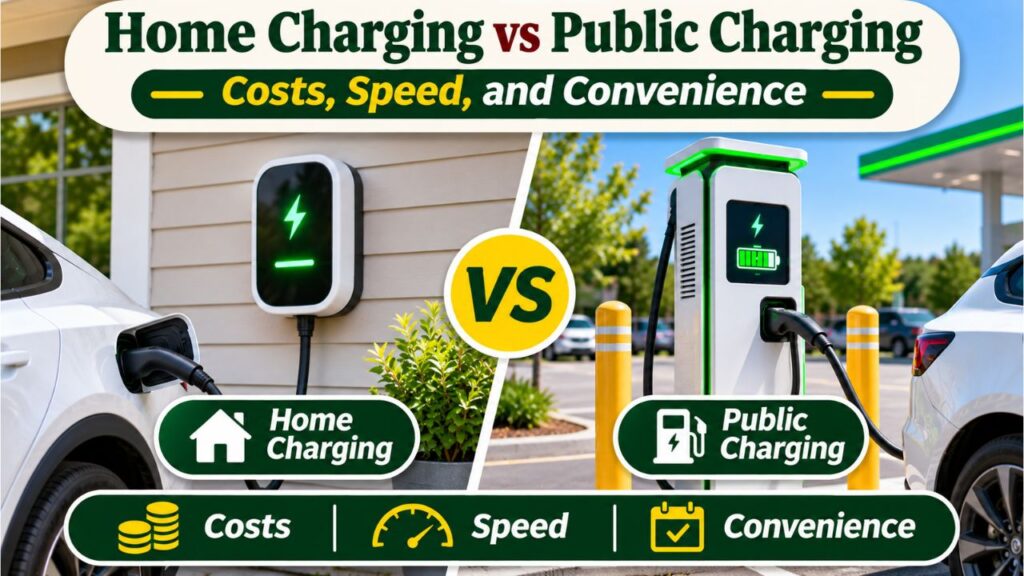
Home charging and public charging use electricity to replenish an electric vehicle’s battery, but they differ in equipment, power levels, access, and cost.
The most practical distinction is that home charging usually happens while the vehicle is parked for several hours, while public charging may be a planned stop during a journey or an activity.
Home Charging vs Public Charging Comparison Chart
| Feature | Home Charging | Public Charging |
| Typical location | Garage, driveway, private parking space | Highway stations, parking lots, shopping centers, workplaces |
| Common charging levels | Level 1 and Level 2 AC | Level 2 AC and DC fast charging |
| Electrical supply | Usually 120 V or 240 V in the U.S. | Depends on charger type |
| Charging speed | Usually slower | Can be much faster with DC charging |
| Electricity cost | Usually residential utility rate | Network-specific rate, sometimes free |
| Equipment cost | May require purchasing and installing EVSE | No private installation needed |
| Convenience | Charge while parked at home | Requires access to an available station |
| Overnight charging | Excellent | Depends on nearby facilities and rules |
| Road-trip charging | Limited to the home location | Essential for many long-distance trips |
| Connector requirements | Compatible AC connector or approved adapter | Compatible AC or DC connector |
| Charging availability | Usually reserved for your household | May involve queues or outages |
| Payment | Household electricity bill | App, payment card, membership, or other method |
| Best suited to | Daily commuting and routine charging | Travel and supplementary charging |
According to the U.S. Department of Energy’s Alternative Fuels Data Center, most EV charging takes place at home, while public charging supplements residential charging for longer trips and other needs.
Which Option Is Better?
For a homeowner with off-street parking and affordable electricity, home charging is usually the most economical and convenient primary solution.
For someone living in an apartment without assigned charging, public or workplace charging may be necessary.
For long-distance travel, public DC fast charging is generally the practical choice, regardless of whether you have a charger at home.
Key Takeaway: Home charging wins on routine convenience and typically lower electricity cost. Public charging provides flexibility and access to much higher charging speeds.
What Is Home EV Charging?
Home EV charging means replenishing an electric vehicle’s battery using charging equipment connected to a residential electrical supply.
In the United States, the two common options are Level 1 and Level 2 AC charging.
How Home EV Charging Works
When you connect an EV to home charging equipment, alternating-current electricity flows from the electrical supply through the vehicle’s charging connection.
The vehicle’s onboard charger converts that AC electricity into DC electricity suitable for the battery.
The vehicle and charging equipment communicate to establish safe operating conditions.
The onboard charger and the charging equipment’s current limits determine the maximum AC charging power.
Level 1 Home Charging
Level 1 charging typically uses a 120-volt household electrical supply.
It usually provides approximately 2–5 miles of additional driving range per hour, depending on the vehicle and available power.
Level 1 charging may be sufficient for:
- Short daily commutes.
- Plug-in hybrid vehicles.
- Households that drive relatively few miles.
- Vehicles parked for long periods.
- Drivers who do not need rapid overnight replenishment.
However, it may be too slow for EVs with large batteries or high daily mileage.
A suitable dedicated outlet and manufacturer-approved charging equipment are important for safety.
Level 2 Home Charging
Level 2 charging generally uses a 240-volt residential electrical supply.
It commonly provides approximately 10–30 miles of range per hour, although actual performance depends on charging power and vehicle efficiency.
Level 2 is particularly useful for:
- Daily commuting.
- Larger EV batteries.
- Households with multiple electric vehicles.
- Drivers with irregular schedules.
- Replenishing substantial driving range overnight.
A typical home installation may use a wall-mounted charging unit or suitable portable equipment connected to an appropriate electrical circuit.
The U.S. Department of Energy’s home EV charging guide explains that many EV owners can meet their needs using Level 1, while Level 2 is useful when faster overnight charging is necessary.
Is a Home EV Charger Actually a Charger?
Technically, the equipment installed on a wall or connected to a household outlet is commonly called electric vehicle supply equipment (EVSE).
For AC charging, the vehicle usually contains the onboard charger that converts AC to DC.
However, the term home EV charger is widely used to describe the external charging equipment.
Both terms appear in manufacturer instructions and everyday discussions.
What Is Public EV Charging?
Public EV charging involves using charging equipment at a location available to eligible drivers rather than relying exclusively on a private home installation.
Public chargers may be located at:
- Highway service areas.
- Shopping centers.
- Grocery stores.
- Hotels.
- Parking garages.
- Office buildings.
- Municipal parking areas.
- Dedicated charging hubs.
- Other accessible destinations.
Not every public station provides the same charging speed or connector.
Public Level 2 Charging
Public Level 2 equipment uses AC electricity.
It is common at destinations where vehicles may remain parked for several hours.
Examples include workplaces, hotels, public parking garages, and shopping areas.
Its charging speed may be similar to Level 2 charging at home.
Therefore, public charging does not always mean fast charging.
A public Level 2 station may add a useful amount of range while you work or shop, but it may not be practical for a short highway stop.
Public DC Fast Charging
DC fast charging, or DCFC, delivers direct current from the charging equipment to the vehicle’s battery system.
It bypasses the onboard AC charger.
Compatible stations may provide 50, 100, 150, 250, or 350 kW, with some newer systems offering higher power.
However, the vehicle controls how much power it can accept.
The U.S. Department of Transportation’s charging speed guide indicates that DC fast charging can bring many compatible battery-electric vehicles to approximately 80% from a low charge in about 20–60 minutes.
Real charging times vary substantially by model and battery conditions.
Destination Charging vs Highway Fast Charging
Destination charging is designed around activities that already require parking.
Highway fast charging is designed to replenish range relatively quickly so drivers can continue traveling.
For example, charging at a hotel overnight can be convenient even when the equipment is slow.
A highway station is more useful when it can deliver enough energy during a short stop.
Key Takeaway: Public charging includes both slower AC stations and rapid DC charging. Always verify the charger type before estimating how long a stop will take.
Home Charging vs Public Charging Speed
Charging speed is one of the clearest differences between home and public EV charging.
Charging Speed Comparison
| Charging Type | Typical Electrical Power | Approximate Range Added |
| Home Level 1 | About 1.2–1.9 kW | 2–5 miles per hour |
| Home Level 2 | Often approximately 3–11 kW | Commonly 10–30 miles per hour |
| Public Level 2 | Approximately 3–19.2 kW, depending on equipment | Depends on vehicle and station |
| Public DC fast charging | Often 50–350 kW | Approximately 100–200+ miles in 30 minutes for capable vehicles |
These are broad examples, not guaranteed charging rates.
The U.S. Environmental Protection Agency’s EV charging guide describes Level 1 charging at roughly 5 miles per hour, Level 2 at approximately 25 miles per hour, and DC fast charging at approximately 100–200 or more miles in 30 minutes under suitable conditions.
Why Home Level 2 Is Often Fast Enough
Most vehicles remain parked at home for several hours overnight.
If your daily driving uses only a fraction of the battery, you generally don’t need to charge from nearly empty to full every night.
For example, consider a driver who uses approximately 12 kWh of battery energy during the day.
At a 7.2 kW Level 2 charging rate:
12 ÷ 7.2 = approximately 1.67 hours.
Allowing for charging losses, replenishing that energy might take around two hours under suitable conditions.
That means the vehicle can easily recover a typical day’s energy use during an overnight parking period.
Why Public DC Charging Is Faster
DC fast charging can deliver much higher power than ordinary residential AC equipment.
However, peak power is not maintained throughout every session.
Charging often slows as the battery approaches a high state of charge.
Battery temperature, vehicle restrictions, and charger limitations can also reduce power.
Does a 350 kW Public Charger Always Charge at 350 kW?
No.
A charger rated at 350 kW can supply up to its supported output under appropriate conditions.
The vehicle determines how much power it can accept.
For example, a vehicle rated for a maximum of 100 kW DC charging will not automatically charge at 350 kW when connected to a 350 kW station.
Which Is Faster Overall?
For replenishing substantial range in a short stop, public DC fast charging wins.
For routine daily driving, home Level 2 may be more convenient because the charging happens while you sleep.
Key Takeaway: Public DC fast charging is faster at the connector. Home charging often requires less active time from the driver.
Home Charging vs Public Charging Cost
Home charging is usually less expensive per kilowatt-hour than public DC fast charging.
However, actual savings depend on residential electricity rates, charging-network prices, charging losses, and any installation costs.
How Much Does Electricity Cost at Home?
The U.S. Energy Information Administration reported an average residential electricity price of 18.16 cents per kWh in August 2026.
This was the latest published monthly national figure available as of November 5, 2026.
Source: EIA Electric Power Monthly, August 2026 data.
Your actual residential rate may be substantially higher or lower.
Some utilities also offer:
- Time-of-use rates.
- EV-specific electricity plans.
- Off-peak charging discounts.
- Different seasonal rates.
- Demand-based charges under certain tariffs.
Check your electricity bill and utility tariff to estimate the true incremental cost of charging.
How Much Does Public Charging Cost?
Public charging prices vary by location, network, power level, and payment arrangement.
Common pricing methods include:
- Dollars per kWh.
- Dollars per minute.
- Flat session fees.
- Membership-based rates.
- Parking fees.
- Idle or overstay fees.
Some Level 2 charging stations are free or included with parking.
Public DC fast charging is often more expensive than charging at home.
A U.S. National Renewable Energy Laboratory report has used approximate public DC charging costs around 0.40–0.60 per kWh for comparative modeling, but these are not universal or guaranteed current rates.
Home vs Public Charging Cost Example
Suppose an EV needs 30 kWh of energy added to its battery.
For illustration, assume:
- Home electricity: $0.18 per kWh.
- Public Level 2 electricity: $0.30 per kWh.
- Public DC fast charging: $0.45 per kWh.
- Home AC charging efficiency: 90%.
The public rates are hypothetical examples, not current quotes from a particular station.
| Charging Method | Example Electricity Calculation | Approximate Cost |
| Home Level 2 | 30 ÷ 0.90 × $0.18 | $6.00 |
| Public Level 2 | 30 kWh × $0.30 | $9.00 before applicable losses and fees |
| Public DC fast charging | 30 kWh × $0.45 | $13.50 before applicable losses and fees |
The home calculation explicitly allows for AC charging losses.
The public figures use a simplified billed-energy assumption, so they should not be treated as exact comparisons of energy delivered to the battery.
What Does This Mean?
In this example, charging at home costs substantially less than relying on public DC fast charging.
However, someone with a free workplace charger could spend less than either example.
Similarly, a household with very high electricity rates may find that some public charging stations are competitively priced.
Key Takeaway: Home charging usually offers lower energy costs, but compare your actual utility tariff with local charging-network prices.
How to Calculate Home EV Charging Cost
You can estimate home EV charging costs using electricity consumption and your utility rate.
Basic Formula
Charging Cost = Electricity Used (kWh) × Electricity Rate ($/kWh)
For a more accurate battery-energy calculation, include charging efficiency:
Electricity From Wall = Energy Added to Battery ÷ Charging Efficiency
Example: Charging a 60 kWh Battery From 20% to 80%
Suppose an EV has 60 kWh of usable battery capacity.
The battery increases from 20% to 80%.
Energy added:
60 × (0.80 − 0.20) = 36 kWh
Assume 90% AC charging efficiency.
Electricity drawn from the wall:
36 ÷ 0.90 = 40 kWh
At an electricity price of $0.18 per kWh:
40 × $0.18 = $7.20
Therefore, the estimated electricity cost for that charging session is approximately $7.20.
The actual result depends on the car, charger, charging temperature, and utility rate.
Monthly Home Charging Cost
Suppose your EV uses 300 kWh of battery energy during a month.
At 90% charging efficiency:
300 ÷ 0.90 = approximately 333.3 kWh from the wall.
At $0.18 per kWh:
333.3 × $0.18 = approximately $60 per month.
This excludes costs such as charger installation and any applicable utility tariff changes.
Cost at Different Residential Electricity Rates
Assume a charging session draws 40 kWh from the household supply.
| Residential Electricity Rate | Cost for 40 kWh |
| $0.10/kWh | $4.00 |
| $0.15/kWh | $6.00 |
| $0.18/kWh | $7.20 |
| $0.20/kWh | $8.00 |
| $0.25/kWh | $10.00 |
| $0.30/kWh | $12.00 |
The difference between local electricity rates can be substantial.
Key Takeaway: Multiply the electricity drawn from the wall by your actual residential rate to estimate home charging cost.
How Much Can You Save by Charging at Home?
Savings depend on how often you drive and where you would otherwise charge.
Annual Charging Cost Example
Consider an EV driven 12,000 miles per year.
Assume it uses an average of 30 kWh of battery energy per 100 miles.
Annual battery energy consumption:
12,000 ÷ 100 × 30 = 3,600 kWh
For simplicity, compare two illustrative charging arrangements.
Home charging:
At 90% AC charging efficiency:
3,600 ÷ 0.90 = 4,000 kWh drawn from the wall.
At $0.18 per kWh:
4,000 × $0.18 = $720 per year.
Public DC fast charging:
At a hypothetical $0.45 per billed kWh:
3,600 × $0.45 = $1,620 per year, before additional delivered-energy differences and fees.
Estimated Annual Cost Comparison
| Charging Arrangement | Illustrative Annual Electricity Cost |
| Primarily home charging | Approximately $720 |
| Primarily public DC fast charging | Approximately $1,620 |
| Illustrative difference | Approximately $900 |
This is a simplified comparison using assumed electricity prices and energy consumption.
It is not a prediction for every EV owner.
Actual results depend on local tariffs, charger efficiency, network rates, and driving conditions.
Does Home Charger Installation Cancel the Savings?
It can affect the financial calculation.
For example, suppose a homeowner spends $1,200 installing a suitable Level 2 charging system.
If the alternative is frequent high-priced public DC fast charging, lower home electricity costs may offset the installation expense over time.
However, the payback period could be much longer if the driver:
- Uses little electricity.
- Has access to free workplace charging.
- Already has adequate Level 1 charging.
- Pays unusually high residential electricity rates.
- Uses inexpensive public Level 2 equipment.
Don’t assume a home Level 2 charger always pays for itself within a particular number of months.
Key Takeaway: Home charging can produce meaningful annual savings, especially for high-mileage drivers who would otherwise rely on paid public DC fast charging.
Home EV Charger Installation Costs
Home Level 1 and Level 2 charging have different installation requirements.
Level 1 Installation
Level 1 charging may not require a new electrical circuit if a suitable dedicated outlet and electrical capacity are already available.
However, the outlet must be in good condition and compatible with the manufacturer’s charging equipment.
A regular household receptacle is not automatically safe for prolonged EV charging simply because the plug fits.
An electrician may need to inspect the circuit.
Level 2 Installation
A Level 2 charging system commonly requires:
- Suitable 240-volt electrical service.
- A dedicated branch circuit.
- Proper overcurrent protection.
- Appropriate wiring and equipment.
- A compatible EV charging unit.
- Permits and inspections when required.
- A qualified electrical installer.
Installation costs vary substantially.
Important factors include the distance from the electrical panel, existing capacity, mounting location, local labor rates, and whether electrical upgrades are needed.
Does Every Home Need a Panel Upgrade?
No.
Some homes have sufficient electrical capacity for Level 2 charging without major upgrades.
Others may require load management, a lower-current charging installation, or additional electrical work.
The EPA’s home EV charging guide recommends assessing home electrical capacity before choosing charging equipment.
Can You Install a Charger Outdoors?
Yes, when the equipment is rated and installed for outdoor use.
The charger, wiring, enclosure, and mounting location must satisfy applicable safety requirements.
Use certified equipment and follow the manufacturer’s instructions.
Does Public Charging Avoid Installation Costs?
Yes, public charging does not require you to install charging equipment at your residence.
However, you may pay higher energy rates or spend more time accessing stations.
Key Takeaway: Level 1 may be enough without substantial new installation. Level 2 offers greater charging speed but requires checking electrical capacity and installation costs.
Home Charging vs Public Charging Convenience
Convenience depends on when and where you normally park.
Why Home Charging Is Convenient
A major advantage is that charging occurs during time the vehicle would already be parked.
For example:
- Arrive home after work.
- Connect the charging cable.
- Allow the car to charge during the evening or overnight.
- Disconnect before leaving the next day.
The process requires little active involvement.
Drivers can often schedule charging through the vehicle or charging equipment.
Why Public Charging Can Be Convenient
Public charging is useful when the station is already part of your routine.
Examples include:
- Charging while working.
- Plugging in at a hotel.
- Charging during grocery shopping.
- Using a highway station during a planned rest stop.
If public charging aligns with activities you already perform, it can be convenient even when you lack home charging.
Potential Public Charging Challenges
Public stations may involve:
- Waiting for an available stall.
- Inoperative equipment.
- Payment problems.
- Incompatible connectors.
- Unexpected pricing.
- Parking restrictions.
- Charging-power limitations.
- Idle fees.
- Poor station placement.
These problems are not inevitable, but they increase the value of checking station information before traveling.
Which Requires Less Time?
Public DC fast charging provides more energy per minute at the station.
Home charging usually requires less dedicated travel or waiting time because the charging session happens while the car is parked.
Key Takeaway: Home charging often feels more convenient for everyday use, while public charging is useful when it fits naturally into a trip or scheduled activity.
Does Home Charging or Public Charging Affect Battery Health?
Routine home Level 1 or Level 2 charging is generally a lower-power charging method than public DC fast charging, but battery health depends on more than charging location or speed alone.
The battery’s chemistry, temperature, charging system, and state of charge all matter.
How AC Charging Affects the Battery
Home AC charging normally delivers lower power than DC fast charging.
This can make charging easier to manage thermally under ordinary conditions.
However, lower charging power does not mean the battery is immune to aging.
High temperatures, long periods at very high state of charge, and other factors may still affect battery life.
How DC Fast Charging Affects the Battery
DC fast charging delivers high power directly to the battery.
The vehicle’s battery management system regulates charging current to maintain safe operating conditions.
Frequent high-power charging can contribute to additional battery stress under some conditions.
However, the impact varies by:
- Battery chemistry.
- Thermal management.
- Battery temperature.
- Charging power.
- State of charge.
- Vehicle design.
- Manufacturer charging controls.
It would be inaccurate to say that occasional public fast charging automatically damages an EV battery.
Should You Charge to 80% or 100%?
Follow the vehicle manufacturer’s guidance.
Some EVs recommend a lower daily charge target, such as 80%.
Others, including certain vehicles with lithium iron phosphate batteries, may recommend occasional or regular charging to 100% for battery-management calibration.
The appropriate setting depends on the specific model and battery system.
Why DC Fast Charging Often Slows Above 80%
Many EVs reduce charging power as the battery approaches a high state of charge.
This helps manage battery conditions and charging limits.
The EPA’s EV charging recommendations explain why stopping around 80% can save time at public fast chargers unless additional range is needed.
Which Is Better for Long-Term Battery Care?
Routine AC charging is a practical default when it meets your needs.
Use public DC fast charging when its speed is valuable.
Avoid unnecessary battery stress by following the manufacturer’s charge targets and temperature-management recommendations.
Key Takeaway: Home AC charging is a sensible everyday option, but occasional DC fast charging is normal EV use. Battery-specific manufacturer guidance matters more than blanket rules.
Home Charging vs Public Charging for Road Trips
Public fast charging is essential for many long-distance EV journeys.
Even drivers who charge almost entirely at home may need public charging to travel beyond the vehicle’s available range.
Why Home Charging Alone Isn’t Enough
Home charging replenishes energy before and after a trip.
However, it does not provide access to electricity hundreds of miles from home.
Long trips may require charging at:
- Highway DC fast chargers.
- Hotels.
- Restaurants.
- Public parking locations.
- Other accessible charging facilities.
How to Plan a Road Trip
Before departure:
- Check your vehicle’s realistic highway range.
- Identify compatible public chargers along the route.
- Verify connector type and available power.
- Check charging-network access requirements.
- Plan backup locations.
- Consider cold weather, elevation, and driving speed.
- Use battery preconditioning when supported.
- Allow time for possible waiting or reduced charging speeds.
How Much Should You Charge at Each Stop?
For many EVs, stopping around 80% can reduce charging time because power often tapers above that level.
However, charging above 80% may be necessary when the next station is far away.
Use the vehicle’s route planner and battery-management guidance.
Is Public Level 2 Useful for Travel?
Yes, particularly when the vehicle can remain parked for several hours.
For example, a hotel with reliable overnight Level 2 charging may allow you to begin the following morning with substantial range.
However, public Level 2 charging may be too slow for a brief highway stop.
Where Can You Find Charging Stations?
Use the U.S. Department of Energy’s Alternative Fueling Station Locator.
Filter by charging level and compatible connectors.
Check the charging network’s current status information before relying on a station.
Key Takeaway: Home charging prepares your EV for a trip, while public charging provides the flexibility needed for longer-distance travel.
Home Charging vs Public Charging for Apartment Residents
Not every EV owner has access to private off-street parking.
For apartment residents, renters, and people who park on the street, public charging may be more important.
When Home Charging Isn’t Available
Common challenges include:
- No dedicated parking space.
- No accessible electrical outlet.
- Landlord restrictions.
- Shared parking arrangements.
- Limited building electrical capacity.
- Installation expenses.
- Parking spaces located far from the electrical supply.
In these situations, relying on public charging can still be practical, but it requires more planning.
Public Level 2 Charging Near Home
A nearby public Level 2 charger may be useful when the car can remain parked for an extended period.
However, check:
- Overnight parking rules.
- Pricing.
- Charging time limits.
- Availability.
- Idle fees.
- Safety of the location.
A charger being geographically close does not automatically make it convenient.
Workplace Charging
Workplace charging can be particularly useful for apartment residents.
A vehicle parked for several hours during the workday may recover much of its daily energy consumption.
If the employer offers free or discounted charging, it may also reduce operating costs.
Can Apartment Buildings Install Shared EV Chargers?
Yes.
Shared residential charging is possible, although installation depends on building ownership, electrical infrastructure, parking arrangements, and applicable regulations.
Potential approaches include assigned charging spaces, shared chargers, or managed charging systems.
Is an EV Practical Without Home Charging?
It can be.
The most important question is whether reliable charging is available where you regularly park.
Before purchasing an EV, investigate the actual charging options near home, work, and frequent destinations.
Key Takeaway: Reliable workplace or nearby public charging can make EV ownership practical without a private charger, but availability and pricing deserve careful consideration.
Home Charging vs Public Charging Connectors
Charging connectors determine which equipment can physically connect to a vehicle.
Compatibility depends on both the car and the charging standard.
Common AC Charging Connectors
In North America, important AC charging connections include:
- SAE J1772.
- NACS/SAE J3400.
A compatible manufacturer-approved adapter may allow certain vehicles to use equipment with a different AC connector.
Common DC Fast-Charging Connectors
Public DC charging connectors in North America include:
- CCS1.
- NACS/SAE J3400.
- CHAdeMO.
Some older vehicles use CHAdeMO.
Many existing non-Tesla EVs use CCS1.
Newer vehicles increasingly use NACS.
Connector adoption depends on vehicle model and market.
Can Every EV Use Every Public Charger?
No.
Before visiting a station, check:
- Connector type.
- Vehicle compatibility.
- Approved adapter requirements.
- Charging-network eligibility.
- Station power.
- Vehicle charging limits.
A station may have sufficient power but still be incompatible with your vehicle.
Do Plug-In Hybrid Vehicles Use DC Fast Charging?
Many plug-in hybrids support only AC Level 1 and Level 2 charging.
Some models support DC fast charging, but it should not be assumed.
Check the vehicle’s specifications.
Key Takeaway: Home charging usually requires one compatible AC connection. Public charging may involve several connector standards and network-access requirements.
Is Home Charging Safer Than Public Charging?
Both home and public EV charging can be safe when equipment is properly designed, installed, maintained, and used.
The main differences involve who owns and maintains the equipment.
Home Charging Safety
For home charging:
- Use manufacturer-approved equipment.
- Choose appropriately certified EVSE.
- Have electrical capacity evaluated.
- Use suitable dedicated circuits.
- Avoid damaged receptacles.
- Follow applicable electrical codes.
- Use outdoor-rated equipment when installed outdoors.
- Have permanent installations performed by a qualified electrician.
Do not rely on ordinary extension cords or multi-outlet power strips for EV charging unless an application is explicitly permitted by the equipment manufacturer and applicable safety requirements.
EV charging places a sustained load on electrical equipment.
Circuit Sizing
EV charging is generally treated as a continuous electrical load.
For ordinary installations, a charging current of 32 amperes commonly requires a properly sized 40-ampere circuit.
However, exact requirements depend on equipment ratings, installation design, electrical code provisions, and local regulations.
A licensed electrician should verify the installation.
Public Charging Safety
At a public station:
- Inspect the cable and connector.
- Avoid visibly damaged equipment.
- Follow the station’s instructions.
- Keep cables out of unsafe positions.
- Do not force incompatible connectors.
- Stop charging if the equipment reports a serious fault.
- Move the vehicle when the session is complete.
Outdoor public chargers are designed for appropriate environmental conditions, but damaged equipment should not be used.
Which Is Safer?
Neither location is inherently unsafe.
A properly installed home charging system and a properly maintained public station should both provide suitable electrical protection.
Key Takeaway: Safety depends on certified equipment, correct installation, and proper use—not simply whether charging happens at home or in public.
Home Charging vs Public Charging Environmental Impact
The environmental impact of charging depends on the electricity source and charging efficiency.
Does Home Charging Use Cleaner Electricity?
Not automatically.
A home charger and a public charger may both draw power from the same regional electricity grid.
However, the electricity generation mix can vary by location and time.
What About Home Solar Panels?
Homeowners with solar panels may be able to use some of their solar electricity to charge an EV.
The financial and environmental benefits depend on:
- Solar production.
- Vehicle parking schedule.
- Home electricity consumption.
- Utility rates.
- Net-metering or export arrangements.
- Charging equipment.
- Electricity supplied from the grid.
Charging directly from on-site solar generation can reduce grid electricity purchases when the system is appropriately configured.
Are Public Fast Chargers Less Efficient?
DC and AC charging systems have different sources of energy loss.
Actual overall efficiency depends on the charging equipment, vehicle, battery, temperature, and power level.
A public DC charger is not automatically less efficient under every condition.
Likewise, home charging losses vary with the onboard charger and charging power.
Is Charging at Night Better for the Environment?
Not necessarily.
Off-peak electricity may be cheaper under certain utility tariffs.
However, the carbon intensity of grid electricity depends on which generating resources are operating at that time.
Lower cost does not always mean lower emissions.
Key Takeaway: Compare electricity sources, timing, and efficiency when considering environmental impact. Home charging is not inherently cleaner than public charging.
How to Decide Between Home and Public EV Charging
The right charging arrangement depends on daily driving needs and available infrastructure.
Choose Home Charging When
Home charging is usually a strong choice if:
- You have reliable parking near an electrical supply.
- You drive regularly.
- Overnight charging meets your needs.
- Your residential electricity rate is competitive.
- You want to avoid routine charging stops.
- Electrical installation is practical.
Choose Public Charging When
Public charging may be more important when:
- You live in an apartment without charging access.
- You travel long distances.
- You need rapid charging during a trip.
- You have reliable workplace or destination charging.
- You cannot install equipment at home.
- A nearby public station offers attractive pricing.
Use Both Methods When
For many EV owners, the best approach is a combination.
Home Level 1 or Level 2 charging handles normal daily use.
Public DC fast charging provides additional range on road trips or unusually busy days.
This approach offers routine convenience without sacrificing travel flexibility.
Best Charging Choice by Driver Situation
| Driver Situation | Practical Charging Strategy |
| Short daily commute, long overnight parking | Home Level 1 may be sufficient |
| Long daily commute | Home Level 2 |
| Large EV battery | Home Level 2 for routine charging |
| Frequent highway travel | Home charging plus public DC fast charging |
| Apartment without dedicated parking | Workplace or reliable public charging |
| Free workplace charging available | Workplace charging may be economical |
| Multiple EVs in one household | Managed home Level 2 charging may help |
| Occasional long-distance trips | Home charging with public fast-charging backup |
| No reliable charger near home or work | Investigate access carefully before buying an EV |
Key Takeaway: The ideal charging method is the one that reliably supplies the energy you need at an acceptable total cost.
Common Mistakes When Comparing Home and Public Charging
Assuming Public Charging Is Always Fast
Public Level 2 chargers can operate at speeds similar to home Level 2 equipment.
Only compatible DC fast chargers offer the highest charging power.
Assuming Home Charging Requires Expensive Equipment
Many drivers can use Level 1 charging when a suitable circuit and outlet are available.
Level 2 installation is not mandatory for every EV owner.
Ignoring Charging Losses
Electricity drawn from a household supply is not always identical to energy stored in the battery.
Charging efficiency affects the final cost.
Comparing Only Electricity Rates
Home installation costs, parking fees, memberships, and idle fees can affect the total cost.
Consider all relevant expenses.
Assuming Every EV Can Charge at 350 kW
Maximum charging power depends on the vehicle.
A high-power station cannot force a car to accept more energy than its charging system allows.
Charging to 100% at Every Fast-Charging Stop
For many EVs, charging above approximately 80% is significantly slower.
Unless the extra range is necessary, a shorter charging session may save time.
Follow your vehicle’s recommended charge targets.
Ignoring Connector Compatibility
Not every DC fast charger works with every EV.
Check the connector and any approved adapter requirements before traveling.
Relying on One Public Charger
A single station can be occupied or unavailable.
Plan alternatives, especially on longer journeys.
Using an Unsafe Household Outlet
A worn outlet or unsuitable electrical circuit may overheat during sustained charging.
Have the installation checked when necessary.
Assuming DC Fast Charging Always Damages the Battery
Battery degradation depends on several factors.
Occasional fast charging is normal for compatible EVs.
Follow manufacturer guidance rather than avoiding public fast charging entirely.
Forgetting Time-of-Use Electricity Rates
Charging during expensive peak periods may increase home electricity costs.
A suitable off-peak schedule may reduce them where the utility offers time-based pricing.
Buying a Home Charger Without Checking Electrical Capacity
The car, charging equipment, and electrical supply all have limits.
Confirm the installation requirements before purchasing equipment.
Conclusion
In the home charging vs public charging comparison, home charging is generally the better choice for everyday EV ownership because it offers lower electricity costs and the convenience of charging while the vehicle is parked.
Level 1 charging may be enough for drivers with short commutes and long overnight parking periods. Level 2 provides faster charging and is often preferable for larger batteries or higher daily mileage.
Public charging remains essential for long-distance travel and for drivers who cannot reliably charge at home. Public DC fast charging can add substantial range in a short stop, but it often costs more and requires checking station availability and compatibility.
For battery care, routine AC charging is a practical default, while DC fast charging can be used when needed. Follow the manufacturer’s recommendations for charging limits and temperature management.
Before choosing a charging arrangement, compare your local electricity rate, daily energy use, home installation costs, and nearby public charging options.
For most EV owners with suitable home parking, the best overall strategy is home charging for daily driving and public charging for road trips and occasional additional range.
FAQs About Home Charging vs Public Charging
Is Home Charging Cheaper Than Public Charging?
Usually, yes.
Residential electricity typically costs less per kilowatt-hour than public DC fast charging.
However, some public Level 2 stations offer free or discounted charging, and high residential electricity rates can affect the comparison.
Include charging losses and applicable fees when calculating costs.
How Much Does It Cost to Charge an EV at Home?
The cost depends on the amount of electricity used and the residential rate.
For example, charging with 40 kWh from the household supply at $0.18 per kWh costs $7.20.
Actual electricity prices vary by location, utility, and time of day.
How Much Does Public EV Charging Cost?
Public charging prices vary by network and station.
Some locations charge per kWh, while others use time-based or session pricing.
Parking fees, memberships, and idle fees may also apply.
Check the displayed price before starting a session.
Is Level 2 Home Charging as Fast as Public Charging?
Home Level 2 and public Level 2 charging can operate at similar speeds.
However, public DC fast charging is substantially faster for compatible vehicles.
Charging time depends on the vehicle and available equipment.
Can You Own an EV Without a Home Charger?
Yes.
Some drivers use public stations, workplace chargers, or charging facilities at their apartment buildings.
However, reliability, cost, and travel time become more important when home charging is unavailable.
Is It Better to Charge an EV at Home or at a Tesla Supercharger?
For everyday charging, home AC charging is usually more economical and convenient when available.
A compatible Tesla Supercharger is useful for road trips and rapid charging stops.
Access depends on the vehicle and Supercharger equipment.
Does Public Fast Charging Damage EV Batteries?
Occasional fast charging does not automatically damage an EV battery.
However, repeated high-power charging under certain conditions may contribute to additional battery stress.
The impact depends on battery chemistry, temperature, vehicle design, and battery management.
Should I Charge My EV to 80% or 100% at Home?
Follow your vehicle manufacturer’s recommendations.
Some EVs recommend an 80% daily charge target.
Others may recommend periodic or regular charging to 100%, depending on battery chemistry and calibration requirements.
Can I Use a Regular Wall Outlet to Charge an Electric Car?
Many EVs support Level 1 charging using a suitable 120-volt electrical supply in the United States.
However, the outlet, circuit, and charging equipment must be appropriate for sustained EV charging.
A qualified electrician can verify the installation when necessary.
Is Installing a Level 2 Home Charger Worth It?
It can be, particularly for drivers with higher daily mileage, large batteries, or limited overnight parking time.
However, Level 1 may be adequate for shorter commutes.
Compare installation costs with your actual charging needs before upgrading.
What Is the Best Charging Option for Apartment Residents?
Reliable workplace charging or nearby public Level 2 charging may be practical.
Public DC fast charging can provide additional flexibility.
Before purchasing an EV, confirm compatible charger availability, pricing, parking restrictions, and reliability.
Do You Need Public Charging if You Have a Home Charger?
Not necessarily for everyday driving.
However, public charging is useful for longer trips, unexpected travel, and situations where you need more range than home charging has provided.
Is Charging at Home More Environmentally Friendly?
Not automatically.
The environmental impact depends on electricity generation, charging efficiency, and timing.
Home solar generation may reduce purchased grid electricity, but the overall result depends on the system and local electricity mix.
Which Is Better for Long Road Trips, Home or Public Charging?
Public DC fast charging is essential for many road trips.
Home charging helps you begin with sufficient range, while public chargers allow you to replenish the battery along the route.
Use compatible stations and plan backup stops where practical.