
Gas stations refuel gasoline vehicles in minutes, while EV charging stations supply electricity over a period that can range from a short fast-charging stop to several hours. Gas stations are generally easier to find and faster for highway stops, but EV charging can be more convenient for everyday driving when a car charges at home or work while parked.
These differences affect more than travel time. Fuel prices, electricity rates, charging equipment, vehicle efficiency, connector compatibility, and station reliability all influence the real experience. An electric car can cost less to power with residential electricity, yet public DC fast charging may approach or exceed the cost per mile of gasoline in some situations.
The comparison also depends on how you drive. Frequent long-distance travelers have different priorities from commuters who return home each night, and drivers without access to home charging face extra considerations.
In this article, I compare charging stations vs gas stations by cost, time, availability, convenience, and environmental impact. You’ll also learn how charging levels work, how to calculate cost per 100 miles, what changes on road trips, and which option fits different driving needs.
Charging Stations vs Gas Stations: Key Differences at a Glance
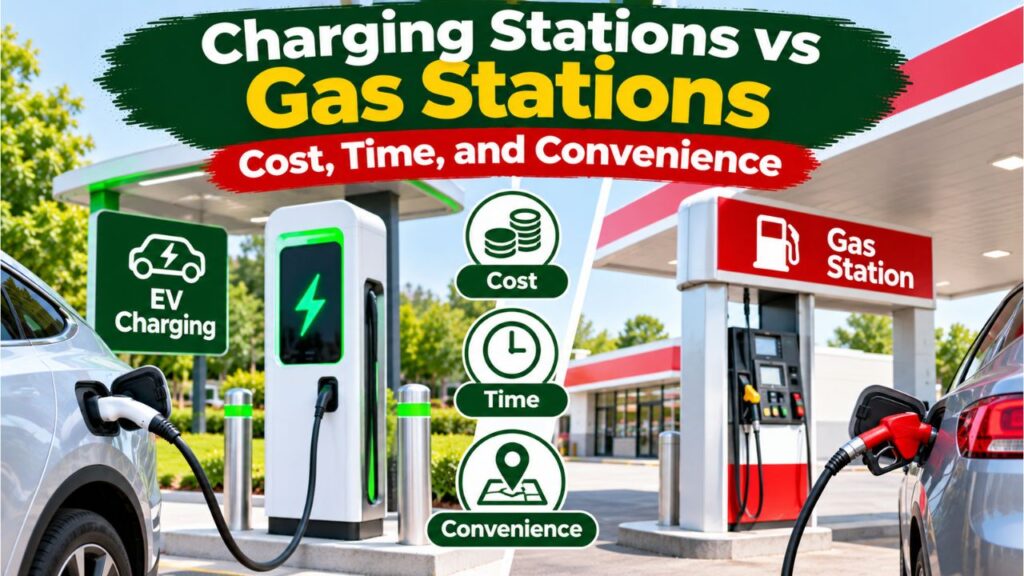
The fundamental difference is how the vehicle receives energy.
EV charging stations transfer electrical energy into a rechargeable battery, while gas stations dispense liquid fuel into a vehicle’s fuel tank.
This affects refueling speed, infrastructure, pricing, convenience, and how drivers plan trips.
EV Charging Station vs Gas Station Comparison
| Feature | EV Charging Station | Gas Station |
| Energy source | Electricity | Gasoline or diesel |
| Compatible vehicles | Electric and certain plug-in hybrid vehicles | Gasoline and diesel vehicles |
| Energy storage in vehicle | Rechargeable battery | Fuel tank |
| Energy measurement | Kilowatt-hours (kWh) | Gallons |
| Typical energy replenishment | Minutes to many hours, depending on charger | Usually a few minutes |
| Home fueling | Often possible | Not generally practical |
| Public locations | Highways, parking lots, workplaces, shopping centers | Roads, highways, neighborhoods |
| Payment | App, card, subscription, or automatic authentication | Usually card or cash |
| Cost | Depends on electricity rate and charging fees | Depends on fuel price and vehicle MPG |
| Vehicle connection | Charging cable and compatible connector | Fuel pump nozzle |
| Highway stops | Longer, depending on vehicle and charger | Usually shorter |
| Emissions during energy transfer | No vehicle tailpipe emissions | Fuel vapors may be released |
| Infrastructure needs | Electrical supply, chargers, and sometimes grid upgrades | Fuel storage tanks, pumps, and delivery systems |
| Common availability challenge | Compatible, functioning chargers | Fuel station location and fuel availability |
Which Is Better Overall?
There isn’t one universal winner.
Gas stations are generally better for quick refueling and flexible long-distance travel. EV charging stations can be more convenient for daily driving and less expensive when home electricity is available at favorable rates.
The U.S. Department of Energy’s Alternative Fuels Data Center explains that EV owners can charge at home, work, and public locations, while public charging infrastructure remains less widespread than conventional gasoline stations in many areas.
The practical choice depends on the vehicle, driving patterns, electricity prices, and local infrastructure.
What Is an EV Charging Station?
An electric vehicle charging station is a location where an EV receives electrical energy through compatible charging equipment.
Charging equipment is commonly called electric vehicle supply equipment (EVSE).
It connects the vehicle to an electrical power source and provides the control and protection functions needed for charging.
How Do EV Charging Stations Work?
The process depends on whether the station provides AC or DC power.
For AC charging:
- The station supplies alternating-current electricity.
- The vehicle’s onboard charger converts it to direct current.
- The battery management system controls charging.
- Electrical energy is stored in the battery.
For DC fast charging:
- The charging station converts AC electricity to DC.
- DC power is delivered through a compatible fast-charging interface.
- The vehicle communicates its charging limits.
- The battery management system regulates charging.
DC fast charging can deliver energy much faster than ordinary home AC charging when the vehicle supports it.
Where Are EV Charging Stations Located?
Public charging stations may be installed at:
- Highway rest stops and travel plazas
- Shopping centers
- Parking garages
- Hotels
- Restaurants
- Workplaces
- Apartment communities
- Municipal parking areas
- Dedicated charging hubs
Unlike gasoline infrastructure, EV charging equipment can also be installed at many residential parking locations.
Are All Charging Stations Public?
No.
EV charging equipment may be private, shared, or publicly accessible.
A home Level 2 charger is an example of private charging.
A workplace may provide charging only to employees.
Public charging locations generally allow eligible drivers to access the equipment, although access restrictions and payment requirements vary.
What Is a Gas Station?
A gas station is a facility that stores and dispenses gasoline, diesel, or other compatible vehicle fuels.
Gas stations use pumps to transfer liquid fuel into vehicles.
How Does a Gas Station Work?
A typical gasoline refueling process involves:
- Parking beside the appropriate fuel pump.
- Selecting the correct fuel grade.
- Authorizing payment.
- Inserting the fuel nozzle into the vehicle’s filler neck.
- Pumping fuel into the tank.
- Completing the transaction.
The vehicle stores fuel in a tank and uses an internal combustion engine to convert the fuel’s chemical energy into mechanical power.
What Do Gas Stations Typically Offer?
Many gas stations also provide:
- Convenience stores
- Restrooms
- Food and drinks
- Windshield cleaning supplies
- Air pumps
- Car washes
- Vehicle accessories
However, services vary.
Some stations are unattended fueling locations, while others are full-service travel centers.
Can Gas Stations Offer EV Charging?
Yes.
Gas stations and EV charging facilities are not mutually exclusive.
Some conventional fueling businesses have installed DC fast chargers.
A location can serve gasoline and electric vehicles at the same property.
This combined model may become increasingly useful along major travel corridors.
Charging Stations vs Gas Stations: Which Is Faster?
Gas stations are significantly faster for replenishing a large amount of driving range during a typical highway stop.
However, EV charging changes the meaning of refueling time because charging can occur while a vehicle is already parked.
How Long Does It Take to Fill a Gas Tank?
The actual time depends on:
- Fuel tank size
- Pump flow rate
- Payment process
- Queue length
- Whether the station is busy
For many passenger vehicles, pumping gasoline takes approximately 3–5 minutes.
The full stop may take longer if you need to wait for a pump, use the restroom, or purchase food.
How Long Does It Take to Charge an EV?
EV charging time depends on charging level and vehicle capabilities.
The U.S. Department of Energy provides the following general charging-rate estimates.
| Charging Method | Approximate Charging Rate |
| Level 1 AC | 2–5 miles of range per hour |
| Level 2 AC | 10–30 miles of range per hour |
| DC fast charging | 100–200+ miles of range in 30 minutes |
These figures come from the DOE’s Electric Vehicles for Consumers guide.
Actual results depend on vehicle efficiency, battery condition, charger power, and environmental conditions.
Can an EV Charge in 10 Minutes?
Some EVs can add substantial driving range in approximately 10 minutes at a compatible high-power charger.
However, not every EV can do so.
Charging speed is determined by the vehicle’s battery system and charging curve, not just the station’s advertised power.
Does Every EV Need to Charge to 100%?
No.
Drivers often use partial charging sessions during long-distance travel.
For example, a driver may charge from 15% to 70% or 10% to 80%, depending on the next destination and the vehicle’s charging characteristics.
Charging beyond 80% can take considerably longer in many EVs because charging power tapers as the battery fills.
Charging Time Example
Suppose an EV has a 70 kWh usable battery.
The driver wants to charge from 10% to 80%.
Energy added:
70 × 0.70 = 49 kWh
If the vehicle averages 100 kW throughout the session:
49 ÷ 100 = 0.49 hours
0.49 × 60 = 29.4 minutes
This is a simplified calculation based on average battery charging power.
Real charging time may be longer because power varies during the session and station operation isn’t perfectly constant.
Is Gas Faster for Road Trips?
Generally, yes.
A gasoline vehicle can typically replenish hundreds of miles of driving range in a brief stop.
An EV may require a longer charging session, especially if the driver needs to add a substantial amount of energy.
However, EV charging can overlap with meals, restroom breaks, and other activities.
Key Takeaway: Gasoline wins on raw refueling speed. EV charging can reduce dedicated fueling stops when charging happens at home or during other planned activities.
Charging Stations vs Gas Stations: Which Is Cheaper?
Charging an electric vehicle can be less expensive than buying gasoline, particularly when using reasonably priced residential electricity.
However, public fast charging can change the comparison substantially.
How EV Charging Costs Are Calculated
Electricity is generally measured in kilowatt-hours.
The basic charging cost formula is:
Charging cost = Electricity used (kWh) × Electricity price ($/kWh)
For example, suppose an EV receives 50 kWh of billed electricity.
At $0.16 per kWh:
50 × $0.16 = $8
At $0.48 per kWh:
50 × $0.48 = $24
The energy quantity is identical, but the cost is different.
Charging losses, session fees, and other charges can also affect the final bill.
How Gasoline Costs Are Calculated
Gasoline is generally sold by the gallon in the United States.
The formula is:
Fuel cost = Gallons purchased × Price per gallon
For example:
12 gallons × $3.50 = $42
The cost of driving depends on how many miles the vehicle travels per gallon.
EV Charging vs Gas: Cost per 100 Miles
Comparing total refueling bills can be misleading because an EV battery and a gasoline tank may provide different driving ranges.
Cost per 100 miles is usually more useful.
Suppose:
- The EV uses 30 kWh of billed electricity per 100 miles, including assumed charging losses.
- The gasoline vehicle gets 30 MPG.
- Home electricity costs $0.16/kWh.
- Public fast charging costs $0.48/kWh.
- Gasoline costs $3.50/gallon.
These are hypothetical rates for illustrating the math, not current national average prices.
| Energy Source | Cost per 100 Miles | Cost per Mile |
| Home EV charging | $4.80 | $0.048 |
| Public DC fast charging | $14.40 | $0.144 |
| Gasoline at 30 MPG | $11.67 | $0.117 |
In this example, home charging is considerably cheaper.
However, the public fast charging scenario is more expensive per mile than gasoline.
How Much Would 12,000 Miles Cost?
Using the same assumptions:
| Fueling Method | Annual Energy Cost |
| EV using home electricity | $576 |
| EV using public DC fast charging | $1,728 |
| Gas vehicle at 30 MPG | $1,400 |
This comparison excludes vehicle purchase price, insurance, maintenance, parking, charger installation, and other ownership costs.
It assumes all EV energy is bought at the stated rate.
In practice, many drivers use a mixture of home, workplace, and public charging.
Why Home Charging Is Often Cheaper
Residential electricity may cost less than electricity sold at public DC fast charging stations.
Public operators also need to recover expenses related to:
- Charging equipment
- Electrical infrastructure
- Property
- Maintenance
- Payment processing
- Network operations
- Utility charges
Some electricity plans offer lower rates during off-peak hours.
The DOE’s home-charging guide explains how electricity rates and vehicle efficiency determine driving costs.
Can Public Charging Be More Expensive Than Gas?
Yes.
High DC fast charging rates, session fees, and an inefficient EV can make the cost per mile comparable to or greater than that of a fuel-efficient gasoline vehicle.
However, public charging can also be inexpensive or occasionally free at certain locations.
Costs vary widely by network and region.
Which Is Cheaper for Everyday Commuting?
For a driver who charges mostly at home under favorable residential rates, an EV can offer substantial energy-cost savings.
For someone relying entirely on expensive public DC fast charging, the advantage may be smaller or nonexistent.
Key Takeaway: Home EV charging often has the lowest energy cost per mile, but public fast charging isn’t automatically cheaper than gasoline.
Charging Stations vs Gas Stations: Availability and Accessibility
Gas stations have an established nationwide network in the United States.
Public EV charging infrastructure is expanding, but access varies by region.
Are Gas Stations Easier to Find?
In many areas, yes.
Gas stations have been developed over decades around commuting routes, highways, and population centers.
Drivers can generally find gasoline without worrying about matching a specialized connector.
However, availability can still be limited in remote areas.
Are EV Charging Stations Everywhere?
No.
Public charging stations are available across the United States, but they are not evenly distributed.
Urban areas and major highway corridors may have numerous stations.
Some rural areas have fewer public fast-charging options.
The DOE’s Alternative Fueling Station Locator provides information about available charging infrastructure.
Station Locations vs Charging Ports
An important distinction is that one EV charging station location may have several charging ports.
For example:
A charging site may contain eight DC fast charging ports.
That is one charging location with eight available charging positions.
A gas station may have multiple pumps, and some pumps can serve more than one vehicle position.
Comparing the number of gas stations with the number of EV charging ports can therefore be misleading.
For a useful comparison, consider:
- Number of accessible locations
- Number of simultaneous fueling positions
- Charging or fueling speed
- Reliability
- Compatibility
- Demand during busy periods
Does Every EV Work at Every Charger?
No.
Charging connectors and vehicle charging capabilities must be compatible.
In North America, important interfaces include:
- SAE J1772 for AC charging
- CCS1 for DC fast charging
- SAE J3400/NACS for compatible AC and DC charging
- CHAdeMO for some older EVs
Adapters may provide access to additional networks when approved for the specific vehicle.
Is Gasoline More Standardized?
Gasoline vehicles still require the correct fuel type and grade.
However, conventional gasoline nozzles and fueling equipment are relatively standardized across the U.S.
EV charging requires more attention to connector compatibility and charging capabilities.
Can a Charger Be Listed but Unavailable?
Yes.
A public charging site may be temporarily unavailable because of maintenance, communication problems, power outages, or occupied charging ports.
Charging apps can help identify station status, but real-time information isn’t always perfectly accurate.
Keep a backup charging location when planning important trips.
Charging Stations vs Gas Stations for Daily Convenience
The convenience comparison changes significantly when home charging is available.
A gasoline driver generally needs to visit a fueling location when the tank runs low.
An EV driver may be able to recharge while sleeping or working.
Why Home Charging Is Convenient
A typical home-charging routine can be simple:
- Park the vehicle.
- Connect the charging cable.
- Leave the vehicle charging while parked.
- Disconnect before driving.
The driver doesn’t need to wait beside the vehicle throughout the session.
Does Slow Home Charging Matter?
Not always.
Suppose a driver travels 40 miles per day.
If Level 2 charging adds roughly 20 miles of range per hour, replacing 40 miles of driving may take approximately two hours under suitable conditions.
The vehicle can charge overnight.
Even though the charging process takes longer than pumping gasoline, the driver may spend very little active time on it.
What if You Cannot Charge at Home?
This changes the comparison.
Drivers living in apartments without dedicated charging, using street parking, or parking at workplaces without chargers may rely on public infrastructure.
They may need to:
- Find an available charger
- Drive to the location
- Wait for an open port
- Remain parked during charging
- Pay public charging rates
For these drivers, gasoline refueling may be more convenient.
Workplace Charging
Workplace charging can provide another option.
A vehicle may remain parked for several hours during the workday.
Level 2 charging can often replenish significant driving range during that time.
However, workplace access depends on the employer and available equipment.
Who Benefits Most From Home Charging?
Home charging is particularly useful for drivers with:
- A dedicated parking space
- Reliable electrical access
- Predictable daily driving
- Overnight parking availability
- Favorable residential electricity rates
The benefits are smaller when charging is difficult to access or unusually expensive.
Charging Stations vs Gas Stations for Road Trips
Long-distance travel is one of the areas where gasoline infrastructure retains important practical advantages.
However, modern EVs can also support long-distance travel when compatible fast chargers are available along the route.
Gasoline Road Trips
A gasoline driver generally plans around:
- Fuel tank range
- Gas station availability
- Fuel prices
- Rest stops
- Traffic and road conditions
Refueling usually takes only a short time.
Drivers often have considerable flexibility to change the route.
EV Road Trips
EV drivers must consider several additional factors:
- Available battery range
- Charger connector compatibility
- DC charging power
- Station reliability
- Battery state of charge
- Weather and temperature
- Terrain
- Charging-network access
- Backup charging locations
An EV charging stop may take longer than a gasoline stop.
However, some stops can overlap with planned meals or rest breaks.
Example: A 600-Mile Road Trip
Suppose a gasoline car can travel approximately 350 miles between fuel stops.
The driver may need one main refueling stop, depending on the starting fuel level and final destination.
Now suppose an EV has approximately 280 miles of usable range under the trip conditions.
The EV may need two or more charging stops, depending on its starting charge, charging strategy, and real highway efficiency.
If each charging session takes 25–35 minutes, the total charging time could exceed an hour.
These are illustrative scenarios.
Actual road-trip performance depends heavily on vehicle range and the available charging network.
Why EV Drivers Often Stop Around 80%
Many EVs charge faster at lower and intermediate battery states of charge.
Charging power commonly decreases as the battery approaches full.
Instead of waiting for 100%, a driver may find it faster to charge enough to reach the next suitable station.
However, this strategy depends on route conditions.
A longer charging session may be necessary when the next fast charger is far away.
How to Plan an EV Road Trip
Before leaving:
- Check the vehicle’s realistic highway range.
- Identify compatible DC fast charging stations.
- Review charger power and current status.
- Check recent reliability information.
- Plan charging stops with enough range reserve.
- Identify backup locations.
- Account for weather, elevation, and speed.
- Consider battery preconditioning if supported by the vehicle.
- Avoid assuming the full advertised range will always be available.
Which Is Better for Spontaneous Travel?
Gasoline vehicles generally offer greater flexibility when fuel stations are widespread and charging infrastructure is limited.
EVs can be convenient on well-served charging corridors, but route planning remains more important in many areas.
Key Takeaway: Gas stations are generally more convenient for quick, flexible highway refueling. EV road trips can work well but require more attention to charging locations, session times, and reliability.
Charging Stations vs Gas Stations: Range and Energy Efficiency
Charging and fueling infrastructure should also be compared in terms of the vehicle’s efficiency.
Electric and gasoline vehicles convert energy into motion differently.
EV Energy Efficiency
An electric motor converts a relatively large portion of supplied electrical energy into useful mechanical work.
EVs can also recover some energy during deceleration through regenerative braking.
Gasoline Vehicle Efficiency
Internal combustion engines lose substantial energy as heat.
Only part of the gasoline’s stored energy becomes useful movement.
How Much More Efficient Are EVs?
The U.S. Environmental Protection Agency’s Electric Vehicle Myths guide explains that electric vehicles generally convert a much greater share of available energy into propulsion than conventional gasoline vehicles.
However, the exact efficiency depends on drivetrain design and operating conditions.
What Is MPGe?
MPGe stands for miles per gallon equivalent.
It allows electric and other alternative-fuel vehicles to be compared using an energy-equivalent measure.
One gallon of gasoline contains approximately the same energy as 33.7 kWh of electricity for MPGe calculations.
However, MPGe doesn’t mean an EV physically uses gasoline.
Example: EV Efficiency
Suppose an EV consumes 30 kWh per 100 miles.
Efficiency:
100 ÷ 30 = 3.33 miles per kWh
This means the vehicle travels approximately 3.33 miles for each kilowatt-hour of energy consumed under the stated conditions.
Does EV Range Change in Winter?
Yes.
Cold temperatures can reduce EV range because of changes in battery performance, cabin heating needs, and other factors.
Gasoline vehicles also experience efficiency changes in cold weather.
However, EV drivers may notice cold-weather range reductions more directly because charging stops can take longer.
Does Highway Speed Affect EV Range?
Yes.
Higher speeds increase aerodynamic resistance.
This can reduce the distance an EV travels on a given amount of energy.
Gasoline vehicles are also affected by aerodynamic drag, although their efficiency characteristics differ.
Charging Stations vs Gas Stations: Environmental Impact
EVs produce no tailpipe emissions while driving.
Gasoline vehicles emit carbon dioxide and other pollutants from combustion.
However, evaluating total environmental impact requires looking beyond the vehicle itself.
Gasoline Vehicle Emissions
Burning gasoline releases carbon dioxide.
Internal combustion vehicles can also emit pollutants such as:
- Nitrogen oxides
- Carbon monoxide
- Particulate matter
- Unburned hydrocarbons
Actual emissions vary by vehicle design, maintenance, fuel, and operating conditions.
EV Emissions
Battery-electric vehicles do not produce tailpipe exhaust.
However, electricity generation may produce emissions.
An EV charged using a fossil-fuel-heavy electricity grid has a different upstream emissions profile from one charged using low-carbon electricity.
Which Has Lower Lifecycle Emissions?
The EPA explains that EVs typically have lower lifetime greenhouse gas emissions than comparable gasoline vehicles, even when accounting for battery production and electricity generation.
However, the size of the advantage depends on the vehicle, manufacturing process, electricity mix, and driving conditions.
Are EV Charging Stations Zero-Emission?
Not necessarily.
The station itself doesn’t burn gasoline to charge the car under normal grid-connected operation.
However, emissions may arise from the electricity generation and infrastructure lifecycle.
Some charging stations use solar energy, energy storage, or other energy systems.
The environmental benefit depends on the actual energy source.
What About Gas Station Environmental Risks?
Gas stations store and dispense petroleum fuels.
Their environmental management responsibilities include preventing fuel spills, leaks, and vapor releases.
Underground storage tanks and associated infrastructure require appropriate installation, inspection, and maintenance.
Are EVs Always Better for the Environment?
EVs generally have an emissions advantage over comparable gasoline vehicles under typical conditions, but the comparison is not identical in every situation.
Vehicle size, battery production, electricity generation, annual mileage, and lifespan matter.
Avoid assuming every EV has exactly the same environmental impact.
Charging Stations vs Gas Stations: Reliability and Waiting Lines
Both charging and gasoline stations can experience delays or outages.
However, the operational challenges differ.
Gas Station Reliability
Gas stations use established fuel-handling equipment and distribution networks.
Potential problems include:
- Pump malfunction
- Fuel shortages
- Payment-system failures
- Power outages
- Traffic congestion
- Temporary station closures
EV Charging Reliability
Public chargers may experience:
- Connector problems
- Cable damage
- Software faults
- Network communication failures
- Payment authorization errors
- Power restrictions
- Hardware faults
- Charging-port occupancy
The DOE’s EV charging infrastructure operation and maintenance guide emphasizes maintenance responsibilities, repair response times, and uptime requirements.
Why Can EV Charging Lines Be Longer?
A gas pump can usually serve several vehicles in an hour.
A DC fast charging port may remain occupied by one vehicle for 20–45 minutes or longer.
If several drivers arrive at the same time, queues can form.
However, a large charging hub with many fast-charging ports may handle demand better than a smaller site.
How to Reduce Waiting Time
EV drivers can:
- Use charging apps to check availability.
- Select stations with multiple compatible ports.
- Avoid heavily congested stops when possible.
- Charge during quieter periods.
- Keep an alternative station available.
- Move the vehicle when charging is complete.
Drivers should also consider whether the station charges idle fees after the session ends.
Charging Stations vs Gas Stations: Payment and Pricing
Both station types accept payment, but their pricing structures differ.
Gas Station Pricing
Gasoline is usually priced per gallon.
Customers generally see a posted fuel price.
The final cost depends on gallons purchased and any applicable taxes or discounts.
EV Charging Pricing
Public charging may be priced through:
- Dollars per kWh
- Dollars per minute
- Session fees
- Membership plans
- Parking fees
- Idle fees
- Time-of-day pricing
Pricing rules depend on the network and applicable regulations.
Do EV Chargers Require Apps?
Some do.
Others accept contactless cards, credit cards, or automatic vehicle-based authentication.
Requirements vary.
A charging station may also require the vehicle to be registered with a particular network or authorized to use the station.
What Is Plug & Charge?
Plug & Charge is a technology that can allow a compatible EV and charging station to authenticate and authorize payment automatically.
However, not every vehicle or station supports it.
Which Has Simpler Payment?
Conventional gasoline payment is generally more familiar and standardized for U.S. drivers.
EV charging payment can be equally convenient on compatible networks but may involve additional setup.
Can Gas Stations Become EV Charging Stations?
Yes.
Some gas station operators are installing EV charging equipment to serve electric drivers while continuing to sell conventional fuel.
However, the conversion isn’t as simple as replacing a gasoline pump with an electrical cable.
What Does an EV Charging Site Need?
A public charging installation may require:
- Adequate electrical service
- Chargers
- Transformers
- Electrical distribution equipment
- Utility coordination
- Permits
- Parking spaces
- Accessible routes and equipment
- Payment and network services
- Maintenance arrangements
High-power DC charging can require substantial electrical infrastructure.
What Advantages Do Gas Stations Have?
Existing gas stations may already offer:
- Convenient highway locations
- Parking areas
- Restrooms
- Food and drinks
- Lighting
- Customer facilities
- Staff or service support
These features can make them attractive charging destinations.
What Challenges Do Gas Stations Face?
Potential challenges include:
- High installation costs
- Utility capacity limitations
- Electrical upgrade requirements
- Charger maintenance
- Longer customer dwell times
- Parking layout changes
- Uneven EV traffic demand
The business model may differ because customers spend more time charging than refueling.
Will EV Charging Replace All Gas Stations?
Not necessarily.
The pace of change depends on vehicle adoption, consumer preferences, electricity infrastructure, regional policies, and the continued use of gasoline vehicles.
Some stations may become mixed-energy facilities.
Others may specialize in charging.
Conventional gas stations may continue serving combustion vehicles for many years.
Charging Stations vs Gas Stations: Safety Differences
Both facilities involve safety requirements.
The hazards differ because gasoline and electricity transfer energy in different ways.
Gas Station Safety
Gasoline is flammable.
Fuel vapors can create fire hazards.
Drivers should follow station instructions, use the correct fuel, and avoid ignition sources.
Gasoline spills should be handled according to the site’s safety procedures.
EV Charging Safety
DC fast charging involves high electrical power.
Charging equipment includes protections designed to manage electrical hazards.
However, damaged connectors, cables, or equipment may be unsafe.
Can You Charge an EV in the Rain?
Properly installed and rated EV charging equipment is generally designed for outdoor use.
The DOE explains that outdoor charging equipment can be used safely in normal rainy conditions when designed and installed appropriately.
However, do not use damaged equipment or equipment exposed to flooding beyond its rated conditions.
What if a Charging Cable Is Damaged?
Do not use it.
Report the problem to the charging operator.
Never attempt to repair a high-voltage charging connector yourself.
Is One Station Type Automatically Safer?
Not necessarily.
Safety depends on proper equipment design, installation, inspection, maintenance, and user behavior.
Both gasoline and EV charging facilities require appropriate precautions.
Are Charging Stations More Convenient Than Gas Stations for City Driving?
They can be, particularly when drivers have home or workplace charging.
However, convenience varies considerably by parking access and local infrastructure.
Drivers With Home Parking
A driver with a dedicated home charger may rarely need a public charging station during normal commuting.
This can eliminate routine gas-station visits.
Apartment Residents
Drivers without home charging may need access to:
- Shared apartment chargers
- Workplace charging
- Public Level 2 charging
- DC fast charging
Their convenience depends on location, pricing, and availability.
Short Daily Commutes
A driver traveling 20–40 miles per day may be able to replenish that range overnight.
A full battery charge isn’t necessary every day.
High-Mileage Drivers
Ride-share drivers, delivery drivers, and other high-mileage users may need more frequent charging.
Fast-charger availability and charging time become more important.
Rural Drivers
Drivers in areas with limited public charging infrastructure may find gasoline refueling more flexible.
However, a rural EV owner with reliable home charging can still find daily use convenient.
The main concern may be longer-distance travel outside the normal driving area.
Which Is Better: Charging Stations or Gas Stations?
The better option depends on the driver’s needs.
For Drivers With Home Charging
EV charging can be especially convenient and economical.
The vehicle can recover daily driving range while parked.
Public fast charging may only be needed occasionally.
For Drivers Without Home Charging
Gas stations may offer greater convenience if public EV charging is expensive, difficult to access, or frequently occupied.
However, workplace charging or reliable nearby public charging can reduce that disadvantage.
For Long-Distance Travelers
Gasoline vehicles generally provide faster refueling and more flexible route planning.
An EV can still be practical when the vehicle has good highway range and the route has reliable high-power charging.
For Budget-Conscious Drivers
Compare actual costs rather than relying on general claims.
Consider:
- Purchase price
- Home charger installation
- Electricity rates
- Gasoline prices
- Energy efficiency
- Insurance
- Maintenance
- Public charging needs
The total ownership cost matters more than one refueling bill.
For Drivers Focused on Emissions
An EV generally offers lower operating and lifetime greenhouse gas emissions than a comparable gasoline car.
However, the actual advantage depends on the electricity supply and vehicle characteristics.
Best Choice by Driving Situation
| Driving Situation | More Practical Option in Many Cases |
| Daily commuting with home charging | EV charging |
| Short urban trips with workplace charging | EV charging |
| Daily driving without reliable charging access | Gasoline may be more convenient |
| Frequent long highway trips | Gasoline often offers faster stops |
| Regular travel on reliable fast-charging corridors | Either can work |
| Lowest energy cost with cheap home electricity | EV charging |
| Dependence on expensive public DC charging | Compare actual cost per mile |
| Remote travel with limited charging infrastructure | Gasoline often has an advantage |
| Reducing vehicle tailpipe emissions | EV charging |
| Mixed urban and occasional highway driving | Depends on vehicle range and charging access |
Common Misconceptions About Charging Stations vs Gas Stations
Charging an EV Always Costs Less Than Gasoline
Not always.
Home charging is often inexpensive, but public fast charging can be costly.
Compare actual dollars per mile.
EV Charging Always Takes Several Hours
No.
Level 1 charging can take many hours, but DC fast charging can add substantial range in a short session.
Charging time depends on equipment and vehicle capability.
Every Public Charger Works With Every EV
No.
Connector compatibility, charging standards, vehicle capabilities, and network access must be considered.
Charging Stations and Gas Stations Are Direct Replacements
Not exactly.
Gas stations are primarily dedicated fueling destinations.
EV charging can take place while a vehicle is parked at home, work, or another destination.
A 350 kW Charger Always Charges at 350 kW
No.
The vehicle determines the power it can accept.
Charging power may also vary with battery temperature and state of charge.
EV Drivers Must Charge to 100% at Every Stop
No.
Drivers commonly use partial charging sessions, particularly during road trips.
Charging strategy depends on the route and vehicle.
EV Charging Is Completely Emission-Free
EVs have no tailpipe emissions while driving.
However, electricity generation and vehicle production can create emissions.
Gas Stations Are Never Delayed
Gasoline fueling is normally fast, but busy stations, payment problems, equipment failures, and fuel shortages can still cause delays.
How to Compare Charging and Gas Costs for Your Own Vehicle
Use actual vehicle efficiency and local energy prices.
Step 1: Calculate EV Energy Cost
Find the EV’s energy consumption in kWh per 100 miles.
Then multiply it by the electricity rate.
EV cost per 100 miles = (kWh per 100 miles) × ($ per kWh)
Use electricity consumption measured at the billing point, or account for charging losses if starting with battery-only consumption.
Step 2: Calculate Gasoline Cost
Find the gasoline vehicle’s MPG.
Divide the price per gallon by MPG, then multiply by 100.
Gas cost per 100 miles = (Gas price per gallon ÷ MPG) × 100
Step 3: Compare Your Actual Driving
Consider how much of your EV charging would occur:
- At home
- At work
- At public Level 2 stations
- At DC fast chargers
A weighted average is more informative than assuming all charging happens at one price.
Step 4: Include Additional Ownership Costs
Energy isn’t the only vehicle expense.
A complete comparison should also account for purchase price, depreciation, insurance, maintenance, taxes, and charging-equipment installation.
Example: Mixed EV Charging
Suppose an EV uses 30 kWh of billed electricity per 100 miles.
You expect to charge:
- 80% at home for $0.16/kWh
- 20% at public chargers for $0.48/kWh
Weighted electricity rate:
(0.80 × $0.16) + (0.20 × $0.48) = $0.224/kWh
EV cost per 100 miles:
30 × $0.224 = $6.72
Compared with the illustrative gasoline cost of $11.67 per 100 miles, this EV charging pattern is less expensive.
However, the result changes with real electricity prices and vehicle efficiency.
Conclusion
Charging stations vs gas stations is a comparison of two different ways to supply energy to vehicles, each with practical advantages and limitations.
Gas stations generally offer faster refueling, widespread availability, and convenient highway stops.
EV charging stations offer the possibility of replenishing vehicle range at home, work, and public destinations, often without requiring a separate fueling trip.
Home electricity can provide a substantial operating-cost advantage, but public DC fast charging is not guaranteed to be cheaper than gasoline.
For long-distance travel, gasoline vehicles usually require shorter stops and less charging-specific planning. EVs can also travel long distances when compatible, reliable fast chargers are available.
Environmental impacts differ as well. Battery-electric vehicles have no tailpipe emissions and typically produce lower lifecycle greenhouse gas emissions than comparable gasoline vehicles, although the electricity source and manufacturing process matter.
The most important factors are where you park, how far you drive, what energy costs locally, and which fueling infrastructure you can reliably access.
For drivers with dependable home charging, an EV can be highly convenient. For drivers who frequently travel through areas with limited charging access, gasoline may still offer greater flexibility.
FAQs About Charging Stations vs Gas Stations
What Is the Main Difference Between Charging Stations and Gas Stations?
Charging stations supply electricity to recharge an EV battery.
Gas stations dispense liquid fuel into gasoline or diesel vehicles.
The main practical differences involve fueling time, energy cost, vehicle compatibility, and the ability to charge at home.
Are EV Charging Stations Better Than Gas Stations?
They can be better for daily commuting when home or workplace charging is available.
Gas stations generally remain faster for highway refueling and may be easier to find in areas with limited charging infrastructure.
The better option depends on the driver.
Is Charging an Electric Car Cheaper Than Buying Gas?
Often, especially with lower-cost home electricity.
However, expensive public DC fast charging can approach or exceed gasoline costs per mile.
Compare actual electricity rates, vehicle efficiency, and gasoline prices.
How Long Does It Take to Charge an EV Compared With Filling a Gas Tank?
A gasoline fill-up often takes around 3–5 minutes, excluding extra waiting or shopping.
EV charging can take hours using AC equipment or much less time with DC fast charging.
The exact time depends on battery size, charging power, and state of charge.
How Much Does It Cost to Charge an EV at a Station?
The price varies by network, location, electricity rate, and charging speed.
Some public chargers bill by the kWh, while others may use time-based or session fees.
Check the station’s pricing before starting.
Are There More Gas Stations Than EV Charging Stations?
Gas stations generally have broader geographic coverage than public EV fast-charging locations in many parts of the United States.
However, numerical comparisons must distinguish between station locations, EV charging ports, and gasoline fueling positions.
EV charging infrastructure continues to expand.
Can You Charge an Electric Car at a Gas Station?
Yes, if the gas station has installed compatible EV charging equipment.
Some travel centers and conventional fueling businesses offer DC fast charging alongside gasoline and diesel pumps.
Do Electric Cars Need Charging Stations Every Day?
Not necessarily.
Many drivers recharge at home or work.
A driver with a modest daily commute may not need to visit a public charging station regularly.
Why Does EV Charging Take Longer Than Pumping Gas?
An EV battery must receive electrical energy within limits set by its cells, temperature, voltage, and battery management system.
Gasoline can be pumped into a tank relatively quickly.
These are different energy-transfer processes.
Can EVs Travel Long Distances Like Gas Cars?
Yes.
Many EVs can complete long highway trips using public fast charging.
However, charging stops and route planning may require more time and attention than gasoline refueling.
Do Charging Stations Work During Power Outages?
Generally, grid-dependent charging stations cannot operate without electrical power.
Some sites may have backup energy systems, but that isn’t universal.
Gas stations also commonly need electricity for pumps, payment systems, and other equipment, so outages can affect both.
Are Charging Stations Safe in the Rain?
Properly rated and installed outdoor EV charging equipment is designed for normal weather exposure.
However, damaged or flooded equipment should not be used.
Always follow vehicle and charging-equipment instructions.
Are Electric Charging Stations Better for the Environment?
EVs have no tailpipe emissions while driving, and they typically have lower lifetime greenhouse gas emissions than comparable gasoline vehicles.
However, electricity generation, battery production, and infrastructure still have environmental impacts.
Will EV Charging Stations Replace Gas Stations?
Some gas stations may add chargers or transition toward electric vehicle services.
However, the timing and extent of any change depend on vehicle adoption, infrastructure, economics, and regional needs.
A complete replacement isn’t inevitable on a fixed schedule.
Which Is Better for Road Trips, EV Charging or Gasoline?
Gasoline generally offers faster stops and more flexibility where gas stations are widely available.
EV charging can work well on routes with reliable DC fast charging, particularly when charging stops overlap with meals or breaks.
Can You Use a Credit Card at an EV Charging Station?
Many public chargers accept credit cards or contactless payments.
Others require a charging-network app or account.
Some compatible vehicles support automatic payment authentication.
Check the station’s accepted payment methods before arriving.
Is Home Charging More Convenient Than Visiting a Gas Station?
For many drivers, yes.
A vehicle can recharge overnight while parked.
However, the convenience advantage depends on having safe, reliable charging access at home.
Drivers who cannot charge where they park may have a different experience.
Do EV Charging Stations Have Restrooms and Convenience Stores?
Some do, particularly at highway travel plazas and dedicated charging hubs.
Others are located in parking lots without nearby services.
Check amenities before choosing a charging stop.
What Is the Cheapest Way to Fuel a Car: Electricity or Gas?
Low-cost home electricity often produces a lower energy cost per mile than gasoline for comparable vehicles.
However, the cheapest option depends on the specific EV, gas vehicle, local electricity rate, charging fees, and fuel economy.
Calculate both costs per 100 miles before deciding.