
The main difference between state of energy (SoE) and state of charge (SoC) is that SoE measures the proportion of energy remaining in a battery, while SoC measures the proportion of electrical charge remaining. SoE is based on watt-hours (Wh) or kilowatt-hours (kWh), whereas SoC is traditionally based on ampere-hours (Ah). Both are expressed as percentages, but they do not always have the same value.
For electric vehicles, state of charge is commonly represented by the battery percentage displayed on the dashboard. State of energy is especially useful for understanding how much energy remains available to power the vehicle.
The difference matters because battery voltage changes during charging and discharging. Temperature, aging, current demand, and internal energy losses can also affect how much energy a battery can deliver.
As a result, a battery at 50% SoC does not necessarily have exactly 50% of its reference energy remaining.
In this article, I explain state of energy vs state of charge using definitions, formulas, and numerical examples. I also cover how battery management systems estimate both values, why SoE matters for EV range prediction, how temperature and battery aging influence the measurements, and how SoE differs from state of health (SoH).
State of Energy vs State of Charge: Key Differences
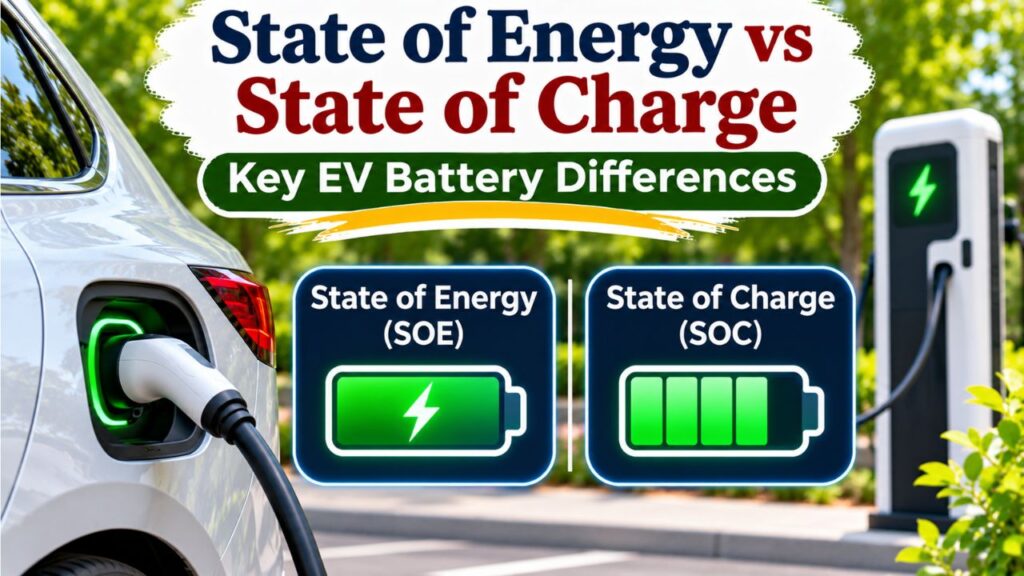
State of energy and state of charge are related battery measurements, but they describe different quantities.
SoC answers: How much electrical charge remains relative to the battery’s charge capacity?
SoE answers: How much energy remains relative to a defined reference energy capacity?
A battery’s electrical charge and energy are related through voltage.
Because voltage changes with operating conditions and battery state, equal amounts of charge do not necessarily represent equal amounts of energy.
SoE vs SoC Comparison Table
| Feature | State of Charge (SoC) | State of Energy (SoE) |
| Full name | State of Charge | State of Energy |
| Main purpose | Estimate remaining electrical charge | Estimate remaining stored or usable energy |
| Fundamental quantity | Charge capacity | Energy capacity |
| Common units before normalization | Ampere-hours (Ah) | Watt-hours (Wh) or kilowatt-hours (kWh) |
| Reported value | Percentage | Percentage |
| Basic calculation | Remaining Ah ÷ reference Ah | Remaining Wh ÷ reference Wh |
| Voltage consideration | Not directly included in basic charge ratio | Included in energy calculations |
| Effect of temperature | Influences available charge and estimation accuracy | Influences available energy and losses |
| Effect of battery aging | Changes maximum charge capacity | Changes energy capacity and usability |
| Common application | EV battery percentage | Remaining energy and range estimation |
| Estimation method | Coulomb counting and battery models | Energy integration and battery models |
| BMS importance | Charge monitoring and control | Energy management and range prediction |
A 2023 research paper published in Batteries & Supercaps, titled Understanding the Energy Potential of Lithium-Ion Batteries: Definition and Estimation of the State of Energy, explains that SoC represents remaining electrical charge, while SoE describes the remaining energy state.
The research also distinguishes between energy stored in the battery and energy that can actually be delivered under operating conditions.
Key Takeaway: SoC describes charge quantity. SoE describes energy quantity. Their numerical values can differ because battery voltage is not constant.
What Is State of Charge (SoC)?
State of charge is the remaining electrical charge expressed as a percentage of a battery’s reference charge capacity.
It is the familiar battery percentage shown on many electric vehicles, smartphones, and battery-powered devices.
For example, an EV dashboard displaying 65% battery typically presents an estimate of its state of charge or a manufacturer-defined battery-level indicator closely related to SoC.
State of Charge Formula
The basic formula is:
[
\text{SoC}=\frac{Q_{\text{remaining}}}{Q_{\text{max}}}\times100%
]
Where:
- SoC = State of charge.
- Q_remaining = Remaining charge capacity in Ah.
- Q_max = Maximum or reference charge capacity in Ah.
The reference capacity must be defined consistently.
In many battery-management applications, SoC is normalized to the battery’s current maximum charge capacity rather than the original capacity when new.
Example: Calculating SoC
Suppose a battery has:
- Maximum available charge capacity: 100 Ah.
- Remaining charge capacity: 60 Ah.
Calculate:
[
\text{SoC}=\frac{60}{100}\times100=60%
]
The battery has a 60% state of charge.
This calculation concerns electrical charge.
It does not directly calculate the energy remaining in watt-hours.
What Does 100% SoC Mean?
A 100% SoC reading generally means the battery has reached its defined full-charge condition.
However, the definition depends on the battery management system.
An aged battery may display 100% SoC even though it stores less energy than it did when new.
For example, a battery that originally had 100 Ah of capacity may eventually have only 90 Ah available.
It can still be at 100% SoC relative to its present 90 Ah capacity.
This is why state of charge should not be confused with battery health.
Can SoC Be Measured Directly?
Not in the same way that voltage or current can be measured with electrical sensors.
The battery management system estimates SoC.
Common estimation approaches include:
- Coulomb counting.
- Open-circuit voltage analysis.
- Equivalent-circuit battery models.
- Kalman filtering.
- Data-driven estimation.
- Combinations of multiple methods.
The MathWorks battery management system modeling guide explains that coulomb counting integrates current over time, while voltage-based corrections can help reduce accumulated estimation error.
What Is State of Energy (SoE)?
State of energy is the amount of energy remaining in a battery expressed as a percentage of a defined total or reference energy capacity.
Unlike SoC, SoE is based on energy rather than electrical charge alone.
Battery energy is measured in watt-hours or kilowatt-hours.
For electric vehicles, kilowatt-hours are particularly useful because battery capacities and vehicle electricity consumption are commonly expressed in kWh.
State of Energy Formula
A basic SoE equation is:
[
\text{SoE}=\frac{E_{\text{remaining}}}{E_{\text{reference}}}\times100%
]
Where:
- SoE = State of energy.
- E_remaining = Remaining battery energy in Wh or kWh.
- E_reference = Defined total or maximum energy capacity in the same units.
An important detail is that the reference energy must be specified.
Some methods normalize SoE to nominal battery energy.
Others use current maximum energy capacity.
Some calculate stored energy, while others estimate usable energy under particular operating conditions.
These definitions are not always interchangeable.
Example: Calculating SoE
Suppose an EV battery has:
- Reference energy capacity: 80 kWh.
- Remaining energy: 48 kWh.
Calculate:
[
\text{SoE}=\frac{48}{80}\times100=60%
]
The battery’s state of energy is 60% relative to the specified 80 kWh reference.
This does not establish that its charge-based SoC is also exactly 60%.
Why Does SoE Matter?
Electric vehicles use energy to produce motion, operate accessories, manage battery temperature, and power other electrical systems.
SoE helps represent the battery’s remaining energy inventory.
That information is useful for:
- EV range prediction.
- Battery energy management.
- Charging and discharging control.
- Energy consumption analysis.
- Battery diagnostics.
- Stationary battery storage.
The MathWorks SOE Estimator documentation defines SoE as remaining battery energy divided by total energy and describes methods for estimating the value.
Why Are State of Charge and State of Energy Different?
The main reason is that electrical energy depends on both charge and voltage.
State of charge primarily tracks the quantity of charge.
State of energy accounts for the energy associated with that charge.
The Relationship Between Voltage, Charge, and Energy
For a small amount of electrical charge:
[
dE=V,dQ
]
Where:
- dE = Small change in energy.
- V = Voltage.
- dQ = Small amount of electrical charge.
When voltage is constant, the energy relationship is straightforward.
For example, moving 10 Ah of charge at a constant 4 V represents:
[
10\times4=40\text{ Wh}
]
But real batteries do not maintain perfectly constant voltage throughout discharge.
Therefore, the amount of energy associated with a given number of ampere-hours varies.
Battery Voltage Changes With SoC
During discharge, battery voltage generally changes as the battery’s state of charge decreases.
The voltage behavior depends on:
- Battery chemistry.
- Temperature.
- Charge or discharge current.
- Internal resistance.
- Battery aging.
- Rest time.
- Battery state.
Some lithium-ion chemistries show relatively gradual voltage changes.
Lithium iron phosphate (LFP) batteries often have a comparatively flat voltage region across a substantial portion of their SoC range.
Even so, voltage is not perfectly constant.
Why Equal Ah Intervals Can Represent Different Energy
Suppose a battery delivers 10 Ah at an average voltage of 3.8 V.
Energy delivered:
[
10\times3.8=38\text{ Wh}
]
Now suppose it delivers another 10 Ah at an average voltage of 3.3 V.
Energy delivered:
[
10\times3.3=33\text{ Wh}
]
Both intervals deliver the same electrical charge.
However, the energy differs by 5 Wh.
That difference is why SoC and SoE are not necessarily identical.
Key Takeaway: One ampere-hour does not always represent the same number of watt-hours. Voltage determines how much energy is associated with a given amount of charge.
Can SoC Be 50% While SoE Is Different?
Yes.
A battery at 50% SoC does not necessarily have exactly 50% of its reference stored energy remaining.
The difference depends on its voltage behavior and how SoE is defined.
Example: 50% SoC vs 47.2% SoE
Consider a simplified battery with:
- Full charge capacity: 100 Ah.
- Remaining charge: 50 Ah.
- Total stored energy: 360 Wh.
- Remaining stored energy: 170 Wh.
The SoC is:
[
\text{SoC}=\frac{50}{100}\times100=50%
]
The SoE is:
[
\text{SoE}=\frac{170}{360}\times100\approx47.2%
]
The battery therefore has:
| Measurement | Result |
| Remaining charge | 50 Ah |
| Full charge capacity | 100 Ah |
| SoC | 50% |
| Remaining stored energy | 170 Wh |
| Reference stored energy | 360 Wh |
| SoE | 47.2% |
This is a hypothetical example demonstrating the mathematical difference.
The energy quantities are consistent with a simplified discharge profile in which the lower 50 Ah of charge corresponds to an average voltage of 3.4 V, while the upper 50 Ah corresponds to an average voltage of 3.8 V.
Actual battery voltage curves differ.
The example is not a specification for any particular battery chemistry or EV.
Can SoE Be Higher Than SoC?
Yes, depending on the reference definition, battery voltage profile, and operating conditions.
However, SoE is not guaranteed to be higher or lower than SoC in every application.
Some definitions use stored energy, while others use usable energy accounting for losses.
The research published in Batteries & Supercaps explains that SoE requires careful definition because different mathematical approaches can produce different results.
Does the Difference Stay Constant?
No.
The difference can change with:
- State of charge.
- Battery temperature.
- Charging or discharging current.
- Battery degradation.
- Voltage behavior.
- Reference energy definition.
Therefore, there is no universal correction such as subtracting 3% from SoC to obtain SoE.
State of Energy vs State of Charge Formulas
Although SoC and SoE can both be expressed as percentages, their calculations use different electrical quantities.
SoC Formula Using Ampere-Hours
[
\text{SoC}(%)=\frac{\text{Remaining Ah}}{\text{Reference Ah}}\times100
]
This formula calculates the charge fraction.
SoE Formula Using Kilowatt-Hours
[
\text{SoE}(%)=\frac{\text{Remaining kWh}}{\text{Reference kWh}}\times100
]
This formula calculates the energy fraction.
Coulomb Counting Formula
Coulomb counting tracks how much electrical charge enters or leaves the battery.
For a discharging battery:
[
Q_{\text{used}}=\int I(t),dt
]
When current is measured in amperes and time in hours, the result is in ampere-hours.
The remaining charge estimate is:
[
Q_{\text{remaining}}=Q_{\text{initial}}-Q_{\text{used}}
]
This expression assumes the discharge-current sign convention and simplifies additional efficiency effects.
In a real BMS, the estimate may require corrections for operating conditions and measurement uncertainty.
Energy Integration Formula
Energy is calculated by integrating electrical power over time.
[
E=\int P(t),dt
]
Since electrical power is:
[
P(t)=V(t)I(t)
]
Energy can also be written as:
[
E=\int V(t)I(t),dt
]
Where:
- V(t) = Battery terminal voltage over time.
- I(t) = Battery current over time.
- P(t) = Electrical power.
- E = Electrical energy.
When voltage is measured in volts, current in amperes, and time in hours, the resulting energy is in watt-hours.
What Is the Practical Difference?
Coulomb counting tracks the movement of charge.
Energy integration tracks the transfer of energy.
However, measuring energy already delivered is not the same as knowing precisely how much energy remains.
Estimating remaining energy requires a reference state, battery model, or other estimation method.
The MathWorks SOE Estimator implements energy counting for battery energy-state estimation.
How Does an EV Battery Management System Estimate SoC?
An electric vehicle’s battery management system (BMS) monitors the battery and estimates internal conditions that cannot be measured directly.
SoC estimation is one of its main functions.
Coulomb Counting
Coulomb counting uses current measurements over time.
For example, if a battery discharges at 20 A for 30 minutes:
[
20\times0.5=10\text{ Ah}
]
The estimated remaining charge decreases by approximately 10 Ah.
The BMS then updates SoC using the relevant charge-capacity estimate.
Why Coulomb Counting Can Become Inaccurate
Small measurement errors accumulate.
For example:
- Current sensors may have an offset.
- The initial SoC may be uncertain.
- Maximum battery capacity may change.
- Battery conditions may influence charge efficiency.
Over time, these effects can produce estimation drift.
Open-Circuit Voltage Estimation
Battery open-circuit voltage can provide information about SoC.
However, the relationship depends on battery chemistry and temperature.
Voltage under load is different from the voltage measured after the battery has rested.
This makes direct voltage-to-SoC conversion difficult during normal driving.
Model-Based Estimation
Modern battery systems may combine current, voltage, and temperature measurements with mathematical battery models.
These can include equivalent-circuit models and Kalman filters.
The goal is to produce a more reliable estimate than any single measurement method.
Why LFP Batteries Can Be Challenging
Lithium iron phosphate batteries often have a relatively flat voltage plateau.
Across part of that range, the voltage changes only slightly even when SoC changes considerably.
That makes voltage-based SoC estimation more difficult.
Research published in Energy Storage Materials in October 2026 discusses this challenge in flat-plateau LFP battery state estimation.
This does not mean LFP batteries cannot report SoC accurately.
It means the BMS often needs more than a simple voltage measurement.
How Does a Battery Management System Estimate SoE?
SoE estimation uses information about battery energy rather than only electrical charge.
The system may consider:
- Battery voltage.
- Battery current.
- Battery temperature.
- Estimated SoC.
- Battery aging.
- Internal resistance.
- Operating conditions.
- Expected discharge behavior.
Energy Counting
The BMS can calculate energy transferred over a period using measured voltage and current.
For a short interval:
Energy transferred (Wh) ≈ Average voltage (V) × Average current (A) × Time (hours)
However, accurately estimating the energy remaining also requires knowledge of the battery’s current state and future discharge characteristics.
Battery Models
Equivalent-circuit or more detailed electrochemical models can estimate how battery voltage and energy availability change with current, temperature, and charge state.
These models help account for effects that simple energy counting cannot predict by itself.
Kalman Filters
Kalman filters combine measurements and model predictions to estimate an internal battery state.
Extended and unscented Kalman filters are used in various battery estimation systems.
The MathWorks SOE Kalman Filter documentation provides an example of this approach.
Why SoE Estimation Is Difficult
A battery may contain energy that cannot be delivered under certain conditions.
For example, cold temperatures or very high current demand may reduce usable energy because of increased losses and voltage limits.
Battery degradation can also reduce the energy available from a full charge.
Consequently, a practical SoE estimate may depend on both the battery’s internal condition and the expected operating conditions.
Stored State of Energy vs Usable State of Energy
An important technical distinction is that state of energy does not have one universally standardized definition across all research and battery systems.
A review published in Batteries & Supercaps divides SoE definitions into two major categories:
- State of stored energy.
- State of usable energy.
These concepts describe different things.
State of Stored Energy
State of stored energy describes the energy inherently stored in the battery relative to a reference.
It is based on the battery’s energy state.
In some models, it is related to the open-circuit voltage curve.
This approach may not fully represent energy losses during actual discharge.
State of Usable Energy
State of usable energy considers the energy that can be delivered under specified operating conditions.
These conditions may include:
- Temperature.
- Discharge current.
- Internal resistance.
- Battery aging.
- Voltage cutoff limits.
Usable energy can be lower than the theoretical energy stored in the battery.
Why the Distinction Matters for EVs
A driver is primarily interested in the energy that can actually propel the vehicle.
A battery may have a certain stored energy state, but some energy may be lost internally or unavailable under current conditions.
Therefore, usable SoE can be more directly relevant to practical range prediction than a purely charge-based SoC value.
However, the result depends on the model and the conditions used to define usable energy.
Stored vs Usable Energy Comparison
| Feature | Stored energy | Usable energy |
| Main concept | Energy inherently stored | Energy deliverable under specified conditions |
| Internal losses | May be excluded | Can be included |
| Temperature influence | Affects estimation and battery state | Also affects delivery losses and limits |
| Current demand | Not necessarily included directly | Can strongly influence usable energy |
| Battery aging | Can affect total stored capacity | Can affect capacity and losses |
| Main application | Battery energy-state modeling | Practical energy and range estimation |
Key Takeaway: When comparing SoE values from different research papers, batteries, or monitoring systems, check whether they refer to stored energy or usable energy.
State of Energy vs State of Charge for EV Range Prediction
SoE is especially useful for understanding how much driving energy remains.
However, neither SoC nor SoE alone provides an exact mileage prediction.
An EV’s range also depends on how efficiently the vehicle uses electricity.
Why SoC Alone Is Not Enough
Suppose an EV displays 50% SoC.
That tells the driver approximately how much charge remains relative to a defined charge capacity.
But it does not directly reveal the battery’s remaining energy in kWh.
To estimate driving range, the vehicle needs information about available energy and electricity consumption.
Simple EV Range Formula
[
\text{Range (miles)}=\frac{\text{Remaining usable energy (kWh)}}{\text{Consumption (kWh/mile)}}
]
For example, suppose an EV has:
- Remaining usable battery energy: 30 kWh.
- Estimated electricity consumption: 0.30 kWh per mile.
Then:
[
\text{Range}=\frac{30}{0.30}=100\text{ miles}
]
The estimated range is 100 miles.
This is a simplified battery-to-driving-energy calculation.
Actual range can differ because energy consumption changes.
Factors That Affect EV Range
Important factors include:
- Driving speed.
- Acceleration.
- Road elevation.
- Outside temperature.
- Cabin heating and cooling.
- Battery conditioning.
- Wind.
- Tires.
- Vehicle load.
- Road surface.
- Driving conditions.
For example, a vehicle may use more energy during high-speed highway driving than during moderate-speed city driving.
Therefore, the same remaining battery energy can provide different driving distances.
Example: Range Under Different Conditions
Assume an EV has 36 kWh of remaining usable energy.
| Electricity consumption | Estimated driving range |
| 0.25 kWh/mile | 144 miles |
| 0.30 kWh/mile | 120 miles |
| 0.35 kWh/mile | 103 miles |
| 0.40 kWh/mile | 90 miles |
These are calculated examples, not manufacturer-certified range figures.
They demonstrate that range depends on both energy availability and vehicle efficiency.
Key Takeaway: SoE helps describe the energy available for driving, while range prediction also requires an estimate of future energy consumption.
Does an EV Dashboard Show SoC or SoE?
Most EV dashboards label a battery percentage rather than explicitly displaying separate SoC and SoE measurements.
That percentage is typically described as state of charge.
However, manufacturers may use different estimation and display strategies.
Is the Displayed Battery Percentage an Exact Ah Measurement?
Not necessarily.
A dashboard percentage may be based on a BMS estimate that includes voltage, current, temperature, battery condition, and manufacturer-defined usable battery limits.
Some systems also use display buffers or mapping strategies.
Therefore, an indicated 50% on the dashboard should not automatically be interpreted as exactly half of the battery’s original ampere-hour capacity.
Does the Dashboard Show Remaining kWh?
Some EVs provide more detailed energy information than others.
A vehicle or compatible diagnostic system may display:
- Battery percentage.
- Energy consumption.
- Estimated range.
- Charging power.
- Battery capacity estimates.
- Other battery statistics.
However, the availability and accuracy of these values vary by manufacturer.
Why Can the Range Estimate Change Without a Large SoC Change?
The vehicle may update its predicted energy consumption.
For example, the range display can change after a period of faster highway driving or colder weather.
A range estimate is a prediction, not simply a second form of SoC.
Can SoC and SoE Be Converted Directly?
Not with a universally accurate fixed conversion factor.
A rough estimate may assume energy percentage and charge percentage are similar.
However, a more accurate conversion needs battery voltage behavior and a consistent definition of reference energy.
A chemistry-specific battery model may be required.
How Temperature Affects SoC and SoE
Battery temperature influences both charge-state estimation and energy availability.
However, the effects are not identical.
Temperature and SoC
Low temperatures can alter battery voltage behavior and charge-delivery capability.
They can also change the accuracy of estimation methods.
For example, a simple voltage-based SoC estimate may be misleading when temperature differs from the conditions used to calibrate the model.
The BMS attempts to account for these effects.
Temperature and SoE
Temperature also affects the energy that the battery can deliver.
In cold conditions:
- Internal resistance may increase.
- Voltage may drop more under load.
- Charging or discharging power may be restricted.
- Battery heating may consume additional energy.
These effects can reduce usable energy or practical vehicle range.
Does Cold Weather Permanently Reduce Battery Capacity?
Not necessarily.
Some cold-weather limitations are temporary and improve as the battery warms.
However, battery aging and permanent capacity loss are different processes.
Avoid assuming that lower winter range proves the battery has permanently degraded.
Does Hot Weather Affect SoE?
Yes.
High temperatures can influence battery losses, thermal management, and operating limits.
Prolonged exposure to excessive heat can also contribute to long-term degradation.
Modern EVs use thermal-management systems to maintain battery conditions within acceptable limits.
However, these systems may consume energy.
How Battery Aging Affects SoC and SoE
As batteries age, their available charge and energy capacities can decline.
Internal resistance may also increase.
This affects battery performance and the interpretation of SoC and SoE.
Can an Old Battery Still Display 100% SoC?
Yes.
An aged battery can reach 100% of its present available charge capacity.
That doesn’t mean it stores as much energy as when it was new.
Example: New vs Aged Battery
Suppose an EV battery originally had 80 kWh of usable energy capacity.
After aging, its maximum usable capacity under comparable conditions decreases to 72 kWh.
At full charge:
- SoC may display 100%.
- Available usable energy may be 72 kWh.
- Energy capacity relative to the original 80 kWh is 90%.
This illustrates why the reference matters.
If SoE is normalized to the battery’s current maximum usable energy, it may show 100%.
If the metric is normalized to the battery’s original energy capacity, the corresponding percentage may be 90%.
These percentages describe different reference quantities.
Why Battery Aging Matters for Range
If a battery stores less energy than before, the same driving efficiency produces less range.
Suppose the vehicle consumes 0.30 kWh per mile.
With 80 kWh usable:
[
80\div0.30\approx267\text{ miles}
]
With 72 kWh usable:
[
72\div0.30=240\text{ miles}
]
These are simplified calculations assuming the full stated usable energy is available and consumption remains constant.
Real-world results vary.
State of Energy vs State of Charge vs State of Health
SoE, SoC, and SoH describe different battery characteristics.
They should not be treated as interchangeable measurements.
State of Charge (SoC)
SoC describes the present charge fraction.
It changes during charging and discharging.
State of Energy (SoE)
SoE describes remaining energy relative to a defined reference.
It also changes during charging and discharging.
Its calculation may include operating conditions and losses.
State of Health (SoH)
SoH describes battery aging or degradation relative to a reference condition.
It is commonly based on capacity retention, although resistance and power capability can also be used.
Unlike SoC, SoH generally changes over much longer periods.
A March 2026 battery-state estimation commentary from UC Berkeley’s Institute of Transportation Studies explains the distinction between SoC as remaining charge fraction and SoH as battery aging relative to its initial or nominal capacity.
SoC vs SoE vs SoH Comparison
| Metric | Main question | Typical measurement |
| SoC | How much charge remains? | Percentage of charge capacity |
| SoE | How much energy remains? | Percentage of energy capacity |
| SoH | How much has the battery aged? | Percentage of capacity retention or other health indicator |
Example: One Battery With Three Different Metrics
Consider a hypothetical EV battery.
Its original usable energy capacity was 80 kWh.
Its current usable energy capacity is 72 kWh.
At the present moment, the battery has 36 kWh of usable energy remaining.
Its capacity-based SoH relative to original energy capacity is:
[
\frac{72}{80}\times100=90%
]
Its usable SoE relative to current maximum capacity is:
[
\frac{36}{72}\times100=50%
]
Its SoC must be estimated separately from the remaining charge in Ah.
It may be close to 50%, but its exact value is not established by the energy figures alone.
Key Takeaway: SoC tells you the charge level, SoE tells you the energy state, and SoH tells you about battery degradation.
Which Is More Important for Electric Vehicles: SoC or SoE?
Both are important.
They serve different purposes in battery management.
When SoC Is More Useful
SoC is useful for:
- Displaying battery charge level.
- Monitoring charging progress.
- Managing charging limits.
- Tracking charge consumption.
- Supporting battery protection.
- Coordinating energy-management decisions.
It is also an intuitive metric for drivers.
When SoE Is More Useful
SoE is useful for:
- Estimating remaining battery energy.
- Supporting vehicle range calculations.
- Evaluating battery discharge capability under defined conditions.
- Planning energy use during a trip.
- Managing battery-powered systems.
- Comparing energy consumption with available storage.
Which Is More Accurate for Range Prediction?
A well-defined, accurately estimated usable SoE is more directly related to remaining driving energy than a basic charge-based SoC.
However, SoE alone still cannot predict exact driving range.
Future vehicle consumption must also be estimated.
Why Does the BMS Need Both?
SoC helps describe battery charge state.
SoE adds information about available energy.
Together with SoH, temperature, voltage, and current limits, these measurements support safer and more effective battery operation.
Neither metric replaces the other.
Common Mistakes When Comparing SoE and SoC
1. Assuming SoE and SoC Are Always Equal
They can differ because battery voltage changes and SoE may account for operating conditions.
2. Confusing Ampere-Hours With Kilowatt-Hours
Ampere-hours measure electrical charge.
Kilowatt-hours measure electrical energy.
They are related but not interchangeable.
3. Multiplying SoC by Nominal kWh Without Qualification
This can provide a rough estimate of remaining battery energy.
However, it assumes that the percentage corresponds directly to an energy fraction and that the nominal capacity is the appropriate reference.
4. Treating SoE as a Universal Standardized Metric
Published definitions differ.
Stored SoE and usable SoE are not necessarily calculated in the same way.
Always check the reference energy and definition.
5. Assuming 100% SoC Means a New Battery
An aged battery can display 100% SoC relative to its reduced current capacity.
Battery health is a separate measurement.
6. Assuming SoE Equals Remaining Miles
SoE describes energy, not distance.
Range also depends on vehicle efficiency and driving conditions.
7. Ignoring Battery Temperature
Temperature changes battery behavior and can influence energy availability.
8. Ignoring Voltage Variation
Energy depends on voltage as well as charge.
This is why charge-based and energy-based percentages can differ.
9. Assuming SoC Can Be Read Precisely From Voltage Alone
Voltage depends on chemistry, temperature, load, and other factors.
LFP batteries are particularly challenging in flat-voltage regions.
10. Treating Battery Estimates as Exact Measurements
SoC and SoE are estimates.
Their accuracy depends on models, sensors, calibration, and operating conditions.
Practical Example: SoC and SoE During an EV Trip
Consider an EV with a current maximum usable battery energy capacity of 75 kWh.
At the start of a trip, assume:
- Remaining usable energy: 60 kWh.
- Current maximum usable energy: 75 kWh.
The starting SoE is:
[
\frac{60}{75}\times100=80%
]
Now suppose the vehicle consumes 15 kWh from the battery during a drive.
Remaining energy:
[
60-15=45\text{ kWh}
]
New SoE:
[
\frac{45}{75}\times100=60%
]
The battery’s usable energy fraction decreased from 80% to 60%.
However, this calculation does not prove that SoC also decreased by exactly 20 percentage points.
To calculate the charge-based change, the system needs information about current flow, charge capacity, and battery conditions.
What About Remaining Range?
Suppose the vehicle’s expected consumption for the rest of the trip is 0.30 kWh per mile.
Estimated remaining range:
[
45\div0.30=150\text{ miles}
]
If expected consumption rises to 0.375 kWh per mile:
[
45\div0.375=120\text{ miles}
]
The same remaining energy now corresponds to fewer miles.
This is why EV range estimates can change even when the battery’s charge percentage changes only gradually.
Conclusion
The central difference in state of energy vs state of charge is the electrical quantity being measured.
State of charge (SoC) describes remaining charge capacity in ampere-hours, expressed as a percentage.
State of energy (SoE) describes remaining energy in watt-hours or kilowatt-hours, also expressed as a percentage.
These values are related, but they are not always identical because battery voltage changes during discharge and charging.
SoE can also incorporate operating conditions and energy losses, depending on whether the calculation describes stored or usable energy.
For EV drivers, SoC is a convenient way to understand battery level, while usable SoE is more directly connected to the energy available for driving.
I recommend interpreting both metrics alongside battery health, temperature, and expected energy consumption.
For technical battery analysis, always check how the SoE and SoC reference capacities are defined.
SoC tells you how much charge is left. SoE tells you how much energy is left. SoH tells you how the battery’s capacity or performance has changed with age.
FAQs About State of Energy vs State of Charge
Is State of Energy the Same as State of Charge?
No.
State of charge measures remaining electrical charge relative to a reference charge capacity.
State of energy measures remaining energy relative to a reference energy capacity.
Because battery voltage varies, the two percentages do not always match.
Can SoC Be 50% While SoE Is 45%?
Yes, depending on the battery’s voltage behavior, operating conditions, and SoE definition.
A 50% SoC means half of the reference electrical charge remains.
It does not guarantee that exactly half of the reference energy remains.
Which Is Better for EV Range Prediction, SoC or SoE?
A suitable usable SoE estimate is more directly related to remaining driving energy.
However, range prediction also requires expected electricity consumption in kWh per mile.
Neither SoC nor SoE alone provides an exact mileage estimate.
How Do You Calculate State of Energy?
Divide the remaining battery energy by the defined reference energy capacity and multiply by 100.
For example, a battery with 40 kWh remaining out of a reference 80 kWh has an SoE of 50%.
The reference must be defined consistently.
Why Does SoE Differ From SoC?
Electrical energy depends on voltage and charge.
Battery voltage varies with charging state, temperature, load, and other conditions.
Therefore, equal amounts of charge can represent different amounts of energy.
Some SoE models also account for energy losses.
Is SoE More Accurate Than SoC?
They estimate different quantities, so one isn’t universally more accurate.
SoE is more directly relevant to remaining energy.
SoC is more directly relevant to remaining charge.
The actual estimation accuracy depends on sensor quality, algorithms, battery models, and operating conditions.
What Is the Difference Between SoC, SoE, and SoH?
SoC measures remaining charge, SoE measures remaining energy, and SoH describes battery aging or performance deterioration.
SoC and SoE normally change as the battery charges and discharges.
SoH generally changes over longer periods as the battery ages.