
Choosing the best 30 amp ev charger starts with matching the charger’s plug and current to your home circuit—not just picking the highest charging speed. Outlet type, vehicle compatibility, cable reach, and whether you can safely set a lower current all affect whether a portable charger is a practical fit.
My first choice is 24A NEMA 14-30 Plug ETL Certified Safe NEMA 4 Waterproof. Its display, 25-foot cable, and delay timer add useful everyday flexibility.
My second choice is NEMA 10-30 30A/25ft 6.6KW Portable Electric Vehicle Charging Station. My alternative is the NEMA 10-30 30A/25ft 6.6KW Portable Electric Vehicle Charging Station, which ranks second for its 25-foot cable, J1772 connector, and stated multi-layer protection. It can suit drivers with a matching NEMA 10-30 outlet, but the circuit must be able to support the chosen charging current.
My third choice is 25FT Cable. Its main trade-off is important: the charger itself cannot reduce its current.
24A NEMA 14-30 Plug ETL Certified Safe NEMA 4 Waterproof

Below, I compare five chargers by plug, current control, compatibility, and installation needs. The buying advice also covers circuit sizing, safe setup, practical ownership, and how to choose an option that matches your vehicle and home.
5 Best 30 Amp Ev Charger Comparison
I selected these options for their relevance to home charging around the 30-amp range, the practical product details provided, and differences in outlet type, current control, and installation. Customer-feedback data was not supplied, so the comparison relies on stated specifications rather than ratings; I also included brand variety where practical.
| # | Image | Product | Price on Amazon |
|---|---|---|---|
| 1 | |
24A NEMA 14-30 Plug ETL Certified Safe NEMA 4 Waterproof | Price on Amazon |
| 2 |  |
NEMA 10-30 30A/25ft 6.6KW Portable Electric Vehicle Charging Station | Price on Amazon |
| 3 | 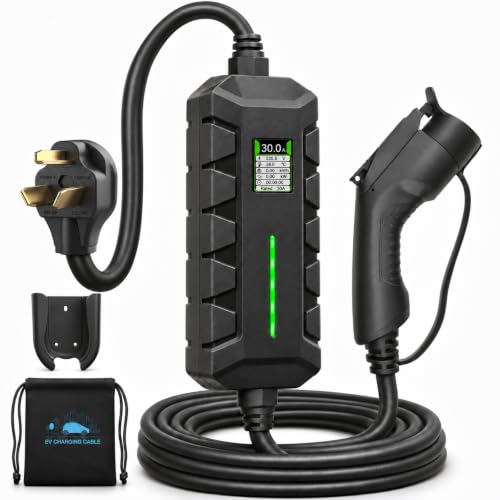 |
25FT Cable | Price on Amazon |
| 4 |  |
J1772 Charger | Price on Amazon |
| 5 |  |
240V Wifi Enabled Electric Vehicle Charging Station 25ft Cable Hardwired | Price on Amazon |
24A NEMA 14-30 Plug ETL Certified Safe NEMA 4 Waterproof
The EVDANCE is a 24-amp Level 2 charger for a NEMA 14-30 outlet, the four-prong outlet commonly used for some electric dryers. Its J1772 connector fits many North American EVs, while Tesla and vehicles with NACS ports need a suitable adapter. The plug is specific: do not assume it will fit a different dryer outlet or a 14-50 receptacle.
Current adjustment from 10A to 24A is a useful distinction for buyers who need to match charging to their circuit. The charger also displays charging information and supports a 1–12-hour delay, which can help a driver schedule charging around an off-peak utility period. The 25-foot cable provides extra reach between an outlet and a parked vehicle.
The supplied details describe the control-box housing as IP66-rated and the product as NEMA 4 waterproof, but specifically warn that the plug and socket interface is not waterproof. Use the included cap when the connector is idle, and do not charge through flooding or severe storms. A one-year warranty and stated U.S.-based support are included in the product information.
Pros
- Adjustable 10–24A current and a 1–12-hour delay setting.
- 25-foot cable, real-time display, and J1772 connector.
- Listed ETL certification and a one-year warranty.
Cons
- Requires a compatible NEMA 14-30 outlet; other plugs are not direct fits.
- Tesla and NACS vehicles need a separate adapter.
- The plug and socket connection must be kept protected from water.
My Opinion
This is the most flexible pick here for a driver with a compatible 14-30 outlet who values adjustable current and straightforward scheduling. Confirm the outlet and circuit first; its weather-resistant housing does not make an exposed electrical connection waterproof.
NEMA 10-30 30A/25ft 6.6KW Portable Electric Vehicle Charging Station
LEFANEV’s portable charger uses a NEMA 10-30 plug, a three-prong 240-volt dryer outlet found in some older homes. Its J1772 connector supports vehicles with that charge port, with an adapter required for Tesla and NACS vehicles. The 25-foot cable can help when the car cannot park right beside the outlet, and the portable design may also suit drivers who want to pack the charger for travel.
The supplied listing describes charging up to 30A and up to 7.2 kW, depending on voltage and setup. That is not a reason to plug it into any outlet that happens to fit: the circuit, receptacle, and vehicle settings must all support the selected current. A 30A circuit should not be treated as a 30A continuous EV-charging supply; check applicable electrical requirements and the vehicle’s charge limit before use.
A screen shows charging information such as current, voltage, power, energy, and elapsed time, while the control-box indicators show operating status. The product information also describes protection against issues including leakage, overcurrent, overheating, and short circuits, plus automatic shutoff when the vehicle is fully charged. Those safeguards do not replace correct outlet matching or safe electrical installation.
Pros
- 25-foot cable and portable format.
- J1772 connector for compatible vehicles.
- Display and status indicators provide charging information.
- Stated three-year replacement support.
Cons
- NEMA 10-30 plug limits direct use to a matching outlet.
- Full output requires a properly sized circuit and compatible vehicle setting.
- Tesla and NACS vehicles need an adapter.
My Opinion
LEFANEV is a reasonable alternative for someone who already has a suitable NEMA 10-30 connection and wants a portable unit with a display. Its stated 30A capability makes circuit verification especially important; buyers should not assume an older dryer outlet can deliver the charger’s maximum current.
25FT Cable
Morec’s portable Level 2 charger is built around a NEMA 10-30 plug for a three-prong dryer outlet. Its 25-foot cable, storage bag, and wall-mounting bracket offer flexibility: it can be kept in a garage installation or packed away when portability matters. The standard J1772 connector works with many EVs, while Tesla and other NACS vehicles require an adapter that is not included.
The key buying detail is that this is a fixed-30A charger. It does not let you lower output at the charger, and the product information says that on a 30A circuit the vehicle’s AC charging limit must be set and verified at 24A or less. Not every car offers a suitable setting, so check your vehicle manual and controls before buying. Do not rely on the charger to enforce a lower limit.
Its control-box housing is listed as IP66-rated, with an operating range of -22°F to 122°F and stated protections against overcurrent, overvoltage, short circuit, and overheating. Those details describe the unit, not permission to leave an outlet or connection exposed to water. Follow the instructions and keep electrical connections appropriately protected.
Pros
- 25-foot cable, storage bag, and wall-mounting bracket.
- J1772 connector for many North American EVs.
- IP66-rated control-box housing and stated built-in protections.
Cons
- Fixed at 30A; the charger cannot be manually turned down.
- Vehicle must support the appropriate lower AC-current setting on a 30A circuit.
- NEMA 10-30 plug is not a universal dryer-outlet fit.
My Opinion
Morec can make sense for a buyer who has the matching outlet and has confirmed that the vehicle can limit its charging current as needed. If you want the charger itself to adapt to different circuits, choose an adjustable-current model instead.
J1772 Charger
SEGUMA is a portable Level 2 charger with a NEMA 14-50 plug, a common 240-volt receptacle for EV charging and other high-power uses. It is not a direct replacement for a NEMA 10-30 or 14-30 dryer plug. Check the receptacle and circuit carefully before purchase, and arrange installation by a qualified electrician if the home does not already have a suitable setup.
The charger allows a choice of 10A, 16A, 20A, 24A, or 32A. That range can be useful when charging from a circuit with less capacity than the charger’s maximum, provided the selected setting is appropriate for the actual circuit and local requirements. Its 1.77-inch TFT display reports charging details, and the 25-foot cable gives useful reach around many garages and parking spaces.
The product information describes an IP66 rating, automatic shutoff when charging finishes, and protections against over- and undervoltage, overcharging, and overheating. It can be used as a portable unit or mounted with the included holder, and a carrying bag is provided. The J1772 connector works with compatible vehicles; confirm whether an adapter is needed for Tesla or a NACS-equipped car.
Pros
- Selectable current settings from 10A through 32A.
- 25-foot cable, display, holder, and carrying bag.
- Portable or wall-mounted use.
Cons
- Requires a matching NEMA 14-50 receptacle.
- Maximum 32A output is not suitable for every circuit.
- J1772 connector may require an adapter for Tesla or NACS vehicles.
My Opinion
SEGUMA stands out for buyers who want a broad choice of current settings and already have a compatible 14-50 installation. Its flexibility is useful, but the plug and circuit still determine where it can be used safely.
240V Wifi Enabled Electric Vehicle Charging Station 25ft Cable Hardwired
Emporia’s hardwired charger is a higher-output option rather than a plug-in 30A unit. Its stated output is up to 48A, with a 25-foot cable and a J1772 connector. That makes it a possible choice for a homeowner planning a dedicated installation and looking beyond the limits of a portable dryer-outlet charger—but not for someone who needs to plug directly into a NEMA 10-30 or 14-30 receptacle.
A professional installation is recommended in the supplied information. A 48A continuous charging load generally requires a branch circuit sized for that load under applicable electrical rules, so have an electrician assess the panel, wiring route, and installation requirements. The higher capacity may offer faster charging for compatible vehicles, but the vehicle’s onboard charger also affects how quickly it can accept power.
WiFi connectivity on a 2.4 GHz network enables access to energy information and mobile-device charging management, including scheduling. Emporia also lists UL and ENERGY STAR certifications and compliance with several charging-related standards. The J1772 connector is intended for vehicles using that port; the product information directs NACS and Tesla owners to a separate Emporia Tesla charger.
Pros
- Up to 48A output when properly hardwired.
- WiFi-based energy data and scheduling.
- UL listed and ENERGY STAR certified according to the supplied details.
- 25-foot cable and J1772 connector.
Cons
- Hardwired installation is not a plug-in dryer-outlet solution.
- Professional installation is recommended.
- Requires WiFi for connected features; NACS vehicles need a different option or suitable adapter.
My Opinion
Emporia is best viewed as an upgrade path for a buyer planning a dedicated, higher-capacity home charging installation. It is less suitable for someone specifically seeking a portable 30A-range charger for an existing dryer outlet.
How I Selected These Best 30 Amp EV Chargers
I compared the supplied product details that most affect everyday suitability: plug type, stated amperage, current adjustment, cable length, connector compatibility, and installation style. That approach matters because a charger’s headline current alone cannot tell you whether it will work safely with a particular outlet or vehicle.
There was no customer-rating or customer-feedback information in the supplied data, so I did not use popularity claims to order the list. The ranking instead favors the combination of relevance, practical controls, and fit for a buyer comparing portable Level 2 options, while also including an adjustable plug-in alternative and a hardwired upgrade.
Match the charger plug to the actual receptacle, then confirm the circuit rating and the vehicle’s supported charging current. A physically similar outlet is not automatically interchangeable.
I also treated details like weather resistance and built-in protection as helpful product attributes, not guarantees that make poor installation or exposed electrical connections safe. The information provided does not establish that every model fits every home or every EV.
How to Choose the Best 30 Amp EV Charger
Start with the electrical setup you already have—or the installation you are willing to arrange. Then check how much current the circuit can support, whether the vehicle can accept the charger’s output, and whether the connector fits your car. These quick takeaways can narrow the options:
- Identify the exact receptacle type, such as NEMA 10-30, 14-30, or 14-50.
- Verify circuit capacity and follow local electrical rules for continuous EV charging.
- Check the vehicle’s port and onboard AC charging limit; account for any required adapter.
- Choose adjustable current if you need flexibility across compatible circuits.
- Measure the distance from the outlet to the car’s charging port before choosing a cable length.
Match the plug and circuit
Read the outlet face and, if uncertain, have an electrician identify it. NEMA 10-30, 14-30, and 14-50 plugs differ in shape and electrical configuration. Avoid relying on a plug adapter to solve a circuit mismatch: an adapter does not increase the circuit’s capacity or make an unsuitable receptacle appropriate for continuous charging.
At 30A, the continuous-load requirements commonly mean the charging current must be limited to 24A on a 30A circuit. The Morec’s supplied instructions specifically place that responsibility on the vehicle because the charger is fixed at 30A. For any installation, verify the applicable code and equipment instructions rather than assuming the same rule or setup applies to every home.
Understand adjustable and fixed current
An adjustable charger, such as the EVDANCE or SEGUMA, lets you select a lower current at the unit. That can be convenient when the circuit supports less than the charger’s maximum, but the setting still must match the circuit and installation. A fixed-current charger may suit a known, compatible setup, but it leaves less room to adapt if you change outlets or vehicles.
Check vehicle charging compatibility
Most products here use a J1772 connector. Confirm the car’s charge port before purchase, especially if it uses NACS. An adapter may be necessary, and compatibility should be verified for the specific vehicle and charger rather than inferred from connector shape alone. The car’s onboard AC charger may also limit charging speed even when the EVSE can supply more current.
Decide between portable and hardwired
Portable chargers can be convenient for a suitable existing receptacle or occasional transport, but they are only as practical as the outlet location and circuit. A hardwired model like Emporia is a different kind of purchase: it calls for installation planning and may suit a dedicated home charging point. Compare total setup needs, not just the charger’s output rating.
Choose the right cable reach and controls
Measure the route from the outlet to the vehicle’s charge port, allowing for how the cable will hang and move. A 25-foot cable can reach across many garages, but the vehicle’s parking position still matters. A screen, delay timer, or WiFi scheduling can make everyday charging easier; prioritize those conveniences after confirming electrical compatibility.
Setting Up a Home EV Charger Safely
Before using a portable charger, inspect the outlet and verify its type and condition. If the outlet is loose, damaged, discolored, unusually warm, or of uncertain capacity, stop and ask a qualified electrician to assess it. Never assume an older dryer receptacle is ready for regular EV charging simply because its plug matches.
Use the charger’s instructions to set current where applicable, and keep the cable routed so it is not pinched, sharply bent, or in a vehicle’s path. Secure the control box as directed rather than leaving it dangling by the cable. If you are installing a new outlet or hardwired charger, have the work evaluated and completed in accordance with local requirements.
For a hardwired 48A charger, plan the electrical work before buying. The panel, branch circuit, wiring, and installation method all need to support the intended load.
First-Time Use and Charging Checks
On the first session, confirm the charger’s status indicators show normal operation and that the vehicle recognizes the connection. Check the display or connected app, if available, for charging current and status. If the charger stops unexpectedly, reports a fault, or the connection feels unusually hot, stop charging and consult the equipment instructions or a qualified electrician rather than repeatedly resetting it.
For scheduled charging, confirm the charger’s clock or delay setting and the vehicle’s own schedule. Conflicting schedules can prevent charging from starting when expected. If using an off-peak plan, verify the utility’s actual time window and check that the vehicle reaches the desired charge level before departure.
Weather, Storage, and Cable Care
Weather-resistant housing does not mean every connection can be left exposed. The EVDANCE details specifically warn that its plug and socket interface is not waterproof, and other products also require protected electrical connections. Keep connectors capped or stored as instructed, and avoid charging during flooding or severe storms.
When the charger is not in use, coil the cable loosely and store it away from sharp edges, vehicle tires, and standing water. Avoid pulling the unit by its cord or forcing a connector into the vehicle. For portable models supplied with a bag, use it for storage and transport only after the equipment is clean and dry.
Keeping an EV Charger in Good Condition
Regularly look over the cable, plug, and vehicle connector for cuts, cracks, bent contacts, or discoloration. Keep the connector clean and dry, following the manufacturer’s care instructions; do not apply unapproved cleaners or lubricants. Check the wall holder or mounting arrangement periodically so the equipment remains supported as intended.
Stop using a charger with visible damage, repeated fault indications, or signs of overheating. Do not attempt to repair electrical components yourself unless the manufacturer specifically provides an approved procedure. For a hardwired unit, have electrical concerns assessed by a qualified professional.
Common Mistakes When Buying or Using a 30 Amp EV Charger
The most avoidable problems come from treating outlet shape, charger rating, and vehicle capability as if they were interchangeable. Take time to confirm each piece before the first charge.
- Buying by amperage alone without checking the exact NEMA outlet.
- Assuming a 30A circuit can supply 30A continuously to an EV charger.
- Choosing a fixed-30A charger without confirming the vehicle can limit its AC current.
- Using an adapter as a substitute for checking circuit capacity and compatibility.
- Leaving electrical plug connections exposed to rain or standing water.
- Expecting a J1772 charger to connect to a NACS vehicle without a suitable adapter.
- Assuming a higher-rated charger guarantees faster charging regardless of the car’s onboard charging limit.
FAQS About Best 30 Amp Ev Charger
What should I check before buying the best 30 amp ev charger?
Confirm the outlet type, circuit capacity, vehicle connector, and the car’s AC charging limit. Then compare current adjustment, cable reach, installation needs, and any adapter requirements.
Can I use a 30A EV charger on a 30A circuit?
Do not assume it can run at 30A continuously. The Morec product information says to set the vehicle’s AC charging limit to 24A or lower on a 30A circuit, and the charger itself cannot enforce that limit. Verify the equipment instructions and applicable electrical requirements for your setup.
Are NEMA 10-30 and NEMA 14-30 EV chargers interchangeable?
No. They are different receptacle types, and a charger with one plug is not a direct fit for the other. Confirm the exact outlet and circuit before choosing a model; a plug adapter does not resolve an electrical-capacity mismatch.
Will a J1772 charger work with a Tesla or NACS vehicle?
It may require a compatible J1772-to-vehicle adapter, which is not included with several products listed here. Check the vehicle and adapter manufacturer’s compatibility information before relying on one.
Is a 30A portable EV charger faster than Level 1 charging?
Level 2 charging uses a 240V supply and can charge faster than a typical 120V Level 1 outlet. The actual rate depends on the charger’s current, circuit, vehicle, and charging conditions.
Should I choose a plug-in or hardwired EV charger?
A plug-in unit suits a buyer with a compatible, properly rated receptacle and a need for portability. A hardwired unit such as Emporia calls for installation planning and professional installation is recommended in the supplied product details.
Final Thoughts
The best 30 amp ev charger is the one that fits your outlet, circuit, and vehicle—not simply the one with the largest number on its label. For an adjustable portable option, I recommend the EVDANCE 24A Portable Level 2 EV Charger with NEMA 14-30 Plug; LEFANEV’s 30A NEMA 10-30 Portable Level 2 EV Charging Station is a useful alternative for a verified matching setup, while the Morec 30A NEMA 10-30 Level 2 J1772 EV Charger suits buyers whose vehicle can enforce the required current limit.