
Choosing the best 48 amp ev charger is about more than finding the highest charging number: installation type, your vehicle’s onboard charging limit, and your home’s electrical capacity all affect what you can use. A hardwired station can deliver up to 48 amps when properly installed, while a plug-in model may need to operate at a lower current.
My first choice is UL 2594 ETL Energy Star J1772 Wall EV Charger. Its adjustable output, connector temperature monitoring, and optional load balancing make it a capable fit for households that want control as well as faster home charging.
My second choice is 240V Wifi Enabled Electric Vehicle Charging Station 25ft Cable Hardwired. It offers Wi-Fi energy monitoring and broad J1772 compatibility, though its 2.4 GHz Wi-Fi requirement may matter during setup.
My third choice is 48A/11.5kW Hardwire No Plug Electric Vehicle EV Charger 25ft Cable. Its current can be reduced to suit a lower-capacity circuit, but it requires a dedicated installation rather than a standard outlet.
Below, I compare five 48-amp-class home EV chargers, explain the practical differences between hardwired and plug-in models, and cover circuit sizing, vehicle compatibility, setup, and ownership. The goal is to help you match the charger to your home and driving routine—not just its maximum amp rating.
5 Best 48 Amp Ev Charger Comparison
I selected these options for their relevance to 48-amp home charging, the practical details supplied about installation and operation, and differences in connection style and controls. No ratings or customer-feedback counts were provided for this group, so I do not use popularity claims; I prioritize verifiable specifications and clear buyer trade-offs instead.
| # | Image | Product | Price on Amazon |
|---|---|---|---|
| 1 |  |
UL 2594 ETL Energy Star J1772 Wall EV Charger | Price on Amazon |
| 2 |  |
240V Wifi Enabled Electric Vehicle Charging Station 25ft Cable Hardwired | Price on Amazon |
| 3 |  |
48A/11.5kW Hardwire No Plug Electric Vehicle EV Charger 25ft Cable | Price on Amazon |
| 4 |  |
WiFi Smart NEMA 14-50 25FT 240V Off-Peak Scheduling Saves Electricity | Price on Amazon |
| 5 | 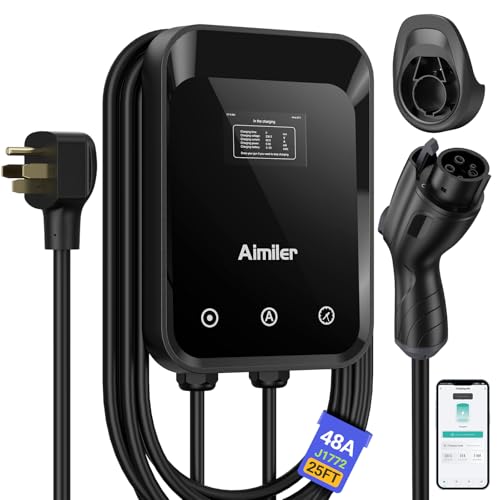 |
48A/11.5kW Nema 14-50P Plug Electric Vehicle EV Charger 25ft Cable | Price on Amazon |
UL 2594 ETL Energy Star J1772 Wall EV Charger
The IYILO is a hardwired Level 2 station rated for up to 48 amps and 11.5 kW, with a 25-foot cable and a J1772 connector. The supplied information associates full 48-amp output with a 60-amp breaker and professional installation. Current is adjustable from 6 to 48 amps in 1-amp steps, which can help match the charger to a lower limit set by an electrician or the home’s electrical plan.
Its connector temperature sensor is a notable safety-oriented detail: the charger monitors heat and stops charging if the connector rises above 221°F. That protection does not replace correct wiring or inspection, but it gives the owner another layer of monitoring. The app also supports charging schedules, energy and cost tracking, RFID access, multiple accounts, and over-the-air updates. It requires 2.4 GHz Wi-Fi, not 5 GHz.
Power sharing can coordinate two chargers on one circuit, while dynamic load balancing requires the separately available Energy Meter bundle and app configuration. The latter may help households manage charging alongside other electrical use, but buyers should confirm the appropriate bundle and installation requirements before ordering. The unit is ETL and Energy Star certified, with a stated UL 2594 test report and CSA testing information. Its J1772 plug works with North American J1772 vehicles; Tesla drivers need a separate NACS adapter.
Pros
- Adjustable from 6 to 48 amps in 1-amp increments.
- Connector temperature monitoring, power sharing, RFID, and scheduling.
- 25-foot cable, NEMA 4 rating, and stated three-year warranty.
Cons
- Requires hardwiring and a suitable circuit for full output.
- Dynamic load balancing needs the separate Energy Meter bundle.
- App setup requires 2.4 GHz Wi-Fi; Tesla adapter is not included.
My Opinion
This is the most feature-rich pick for a buyer planning a permanent installation, especially when power management or temperature monitoring is a priority. Confirm circuit capacity, meter-bundle needs, Wi-Fi availability, and connector compatibility before purchase.
240V Wifi Enabled Electric Vehicle Charging Station 25ft Cable Hardwired
Emporia’s hardwired station is rated for up to 48 amps at 240 volts, with a 25-foot cable and an installation whip. The listing states up to 46 miles of range per hour under suitable conditions, but that figure is not a promise for every vehicle: charging speed depends on the car’s onboard charger, battery state, supply voltage, and other limits. Its main appeal is a relatively direct combination of hardwired installation and app-based controls.
With a 2.4 GHz Wi-Fi connection, the app provides real-time energy information and lets an owner schedule sessions. That can be useful for coordinating charging with a utility’s off-peak period, where available. It does not mean the charger itself guarantees a lower electricity bill; savings depend on the utility plan, schedule, and how much energy the car uses.
The charger uses a standard SAE J1772 connector and is stated to be UL listed and Energy Star certified, with several additional electrical and EV charging standards named in the product details. It is compatible with North American J1772 vehicles such as the Bolt, Leaf, ID.4, and Mustang Mach-E, among others. Tesla and other NACS-port vehicles need the appropriate adapter or a compatible charger model. The supplied information recommends professional installation, an important consideration for a hardwired unit.
Pros
- Up to 48-amp hardwired output with a 25-foot cable.
- App-based energy monitoring and scheduled charging.
- UL listed and Energy Star certified, according to the supplied details.
Cons
- Hardwired installation requires a suitably sized circuit and qualified work.
- Smart functions require 2.4 GHz Wi-Fi.
- J1772 connector means NACS vehicles need an adapter.
My Opinion
Emporia is a sensible second choice for buyers who want a recognizable, smart-enabled hardwired setup without needing the IYILO’s more specialized power-management options. Check Wi-Fi coverage at the installation location and confirm your car’s connector before committing.
48A/11.5kW Hardwire No Plug Electric Vehicle EV Charger 25ft Cable
This AIMILER model is a hardwired, no-plug charger with a 25-foot cable and a J1772 connector. It is rated up to 48 amps and 11.5 kW, with the supplied information recommending a 60-amp breaker for full output. The unit can be adjusted from 24 to 48 amps, including a stated 40-amp setting for a 50-amp breaker. Those settings give an electrician options, but the correct current must be selected for the actual circuit and installation.
The display shows charging current, speed, input voltage, and delay time. That can be helpful for checking a session locally without opening an app. Charging can start automatically in plug-and-charge mode or be managed through the app, which can track cost, history, and charging status and set a charging period. App setup depends on 2.4 GHz Wi-Fi; the supplied troubleshooting guidance also calls for Bluetooth and Wi-Fi to be enabled on the phone.
AIMILER lists ETL and FCC credentials and cites multiple electrical and EV charging standards. Its J1772 connector serves vehicles with that inlet; Tesla and NACS-port cars require a J1772-to-Tesla adapter, which is not included. One limitation is especially important: this is not a plug-in 14-50 model. The listing describes a no-plug installation and refers to specific supply wiring, so it is not an option for someone who simply wants to use an existing NEMA 14-50 receptacle.
Pros
- Current adjustment from 24 to 48 amps and a clear onboard display.
- Supports plug-and-charge operation as well as app control.
- 25-foot cable and listed ETL certification.
Cons
- Hardwired installation only; it does not support a NEMA 14-50 outlet.
- Full output requires a suitably rated circuit and professional installation.
- App pairing depends on 2.4 GHz Wi-Fi; NACS adapter is not included.
My Opinion
This model suits buyers who want both screen-based status and app scheduling in a hardwired unit. Its current adjustment is useful, but the no-plug setup makes it a poor match for an outlet-only installation plan.
WiFi Smart NEMA 14-50 25FT 240V Off-Peak Scheduling Saves Electricity
HIUIORFET combines a J1772 connector, 25-foot cable, Wi-Fi controls, and a NEMA 14-50 plug. The stated output range is 8 to 48 amps, with a maximum power rating of 11.5 kW. That headline range needs careful interpretation: the supplied details do not explain how 48-amp output is reconciled with a 14-50 plug. A 14-50 installation is commonly paired with a 50-amp circuit, where continuous EV charging is typically limited to 40 amps. Verify the allowed setting and installation requirements with the manufacturer and a licensed electrician rather than assuming the plug can deliver 48 amps.
The app can adjust current, start or stop a session remotely, schedule charging, and display energy use and charging records. These features may help owners shift sessions to a lower-cost time window if their utility offers one. The charger also includes RFID access and a physical emergency stop button, plus stated overvoltage, undervoltage, overcurrent, overheating, leakage, grounding-fault, and lightning protections.
Its IP65/NEMA Type 4 weather-resistance claims and 25-foot cable make outdoor placement possible, provided the installation follows the instructions and local electrical requirements. J1772 vehicles are compatible; Tesla drivers need a separate adapter. Since the supplied specifications do not give a warranty or independent certification details, confirm both directly before purchase if they are important decision factors.
Pros
- Plug-in format with a 25-foot cable and app scheduling.
- RFID access, an emergency stop button, and multiple stated protections.
- Weather-resistant enclosure rating is stated as IP65/NEMA Type 4.
Cons
- The stated 48-amp output and NEMA 14-50 connection need clarification.
- Requires 2.4 GHz Wi-Fi for app functions.
- Warranty and certification details were not supplied.
My Opinion
The plug-in convenience and remote controls are appealing, but the output-and-plug specification deserves confirmation before buying. I would choose it only after establishing the safe current setting for the exact receptacle and circuit.
48A/11.5kW Nema 14-50P Plug Electric Vehicle EV Charger 25ft Cable
This AIMILER version differs from the hardwired model above: it comes with a NEMA 14-50 plug, a J1772 connector, and a 25-foot cable. Its supplied speed information distinguishes up to 46 miles of range per hour in a 48-amp hardwired configuration from up to 38 miles per hour when using the plug at 40 amps. For buyers using a 14-50 receptacle, that 40-amp figure is the more relevant expectation; the charger’s 48-amp label does not make a typical 50-amp outlet setup a 48-amp continuous charging circuit.
Amperage is adjustable from 24 to 48 amps, and the listing associates 40 amps with a 50-amp breaker and 48 amps with at least a 60-amp breaker. The screen displays current, voltage, charging speed, and delay information. App functions include charge history, cost tracking, session status, and schedule settings. App pairing uses 2.4 GHz Wi-Fi, and the supplied reset instructions involve pressing the unit’s screen controls with the charging connector removed.
The charger has a J1772 connector for compatible North American EVs and plug-in hybrids. Tesla or other NACS-port vehicles need an adapter. The product information lists ETL and FCC credentials and a NEMA Type 4 protection degree; it also cautions against direct sunlight and exposure to rainy conditions. That warning makes the intended mounting location worth checking even with the stated enclosure rating. Professional installation is recommended.
Pros
- NEMA 14-50 plug provides an alternative to hardwiring.
- 25-foot cable, display, adjustable current, and app scheduling.
- ETL and FCC credentials are listed in the supplied details.
Cons
- Plug-in charging is stated at up to 40 amps, not 48 amps.
- Outdoor placement should follow the stated exposure caution.
- App control requires 2.4 GHz Wi-Fi; NACS adapter is separate.
My Opinion
This AIMILER is the clearer plug-in choice of the two AIMILER models, particularly for a 14-50 outlet owner who understands the 40-amp operating expectation. Confirm the receptacle, breaker, and selected current before charging.
How I Selected These Best 48 Amp EV Chargers
I compared the five options based on how closely they match 48-amp Level 2 home charging and whether their details explain installation, current control, connector type, smart functions, and safety information. I also considered the differences between hardwired and plug-in equipment, since those affect who can install a unit and what output is practical.
A charger’s maximum amp rating is only useful when the home circuit and vehicle can support it. Installation requirements and the car’s onboard charging limit matter as much as the number on the product listing.
Where the supplied data names certifications, warranty coverage, or accessories, I have included those details without treating them as a substitute for checking the exact product documentation. Ratings and customer-feedback counts were not provided, so the ranking reflects feature fit and clarity rather than crowd sentiment.
When a specification appears difficult to reconcile with the connection type, as with a 48-amp claim alongside a NEMA 14-50 plug, verify the permitted setting before purchase.
How to Choose a Best 48 Amp EV Charger
Start with the electrical setup you already have, then check the car and the charging habits you want to support. A charger that matches all three is generally a better buy than one chosen solely for its maximum output.
- Check your circuit: Ask an electrician what current your panel and planned circuit can support.
- Choose hardwired or plug-in: Hardwired models suit permanent installations; a 14-50 unit needs a correctly installed compatible receptacle.
- Confirm the car inlet: J1772 works with many North American EVs; NACS-port vehicles may need an adapter.
- Set realistic speed expectations: The vehicle’s onboard charger can limit the rate even when the EVSE is rated higher.
- Decide whether smart features matter: Scheduling and tracking can be useful, but depend on app access and often 2.4 GHz Wi-Fi.
Match Charger Output to the Home Circuit
Home EV charging is a continuous electrical load, so the circuit must be sized for the charger’s configured current—not merely for the brief maximum an outlet or breaker might tolerate. The supplied product details commonly associate 48-amp charging with a 60-amp breaker and 40-amp charging with a 50-amp breaker. Treat those as product-specific guidance, not a substitute for local code or an electrician’s assessment.
If your panel is close to capacity, ask whether load management or a lower current setting is appropriate. The IYILO’s optional meter-based load balancing is one example of a feature intended to coordinate charger demand with household use. Any such arrangement needs correct equipment and configuration.
Understand Plug-In Versus Hardwired Installation
A hardwired charger is connected directly to a dedicated circuit. It can be a tidy permanent installation and, where the circuit and charger support it, can operate at higher current. It also means you cannot simply unplug the unit and move it to another outlet.
A NEMA 14-50 charger can be convenient if a compatible receptacle is already present, but the receptacle, wiring, breaker, and charger setting all need to be suitable. Do not assume that an existing outlet is correctly wired or rated for repeated EV charging. Have an electrician inspect it, especially if you do not know its circuit rating or installation history.
Estimate Real Charging Speed
Product descriptions may translate power into miles of range per hour, but those estimates vary with vehicle efficiency and charging conditions. A less efficient vehicle gains fewer miles from the same energy than an efficient one. Battery temperature, the car’s onboard charger, and the charge level can also change the rate.
For most owners, overnight charging is the practical measure: ask whether the charger can replace the miles you typically drive between sessions. If it can, paying more or upgrading electrical service solely to chase a higher maximum may not improve everyday convenience.
Check Vehicle and Connector Compatibility
The five products here use J1772 connectors. Many North American EVs and plug-in hybrids with J1772 inlets can connect directly, while vehicles with a NACS inlet generally require a suitable J1772-to-NACS adapter. Adapter availability, vehicle compatibility, and any charging limits should be confirmed for the specific car.
Also check the car’s maximum AC charging rate. A vehicle that cannot accept 48 amps will not charge faster simply because the home station can provide that much. If two EVs share a home, consider both connector needs and whether features such as power sharing are relevant.
Plan Installation Before Ordering
Decide where the charger will sit and where the car’s inlet usually parks. A 25-foot cable can offer useful reach, but route it so it does not cross a walkway, pinch in a garage door, or become a trip hazard. Measure the route rather than relying on the straight-line distance from the electrical panel.
Before buying, ask a licensed electrician to confirm the panel’s capacity, circuit requirements, mounting location, and any local permitting or inspection steps. For hardwired units, ask whether the included whip and installation instructions match the planned setup. For plug-in models, confirm the receptacle type and condition. Never improvise adapters or wiring to make a charger fit.
Set Up Scheduling and Wi-Fi Carefully
Smart charging can help shift charging to off-peak hours when the utility offers time-of-use pricing. First compare the utility’s actual rate periods with the charger’s schedule settings. A schedule only helps if it aligns with the billing plan and still leaves enough time to charge before the next drive.
Several units listed here require 2.4 GHz Wi-Fi. If the garage receives a weak signal or the router broadcasts separate network bands, check the manufacturer’s setup instructions before installation. Keep a record of the charger’s current limit and any scheduled departure needs. If the app is unavailable, know how the unit behaves in its default or plug-and-charge mode.
Use Safety Features as a Backup, Not a Substitute
Temperature sensors, ground-fault protection, emergency stops, and weather-resistant enclosures can improve monitoring and protection, but they do not correct an undersized circuit or poor installation. Follow the manual for mounting, cable handling, weather exposure, and current selection. Keep the connector dry and clean, and stop using the unit if the plug, cable, or receptacle shows damage, unusual heat, discoloration, or a burning smell.
Outdoor installation requires attention to the exact enclosure rating and installation instructions. A weather-resistant rating does not mean every mounting location is suitable; direct exposure, sunlight, drainage, and cable strain still matter. If a protection alert appears repeatedly, do not bypass it. Disconnect safely and contact the installer or manufacturer for guidance.
Maintain the Charger for Reliable Ownership
Periodically inspect the cable along its length for cuts, crushing, or exposed conductors. Check the connector for debris, cracked housing, or damaged pins, and keep it stored in its holder when not in use. Avoid dragging the connector across the ground or letting the cable carry the weight of the charging unit.
For plug-in models, have the receptacle inspected if it becomes loose, discolored, or unusually warm. For hardwired equipment, leave electrical checks to a qualified professional rather than opening the enclosure yourself. Clean exterior surfaces according to the manual, and install firmware or app updates only through the manufacturer’s intended process.
Common 48-Amp Charger Mistakes to Avoid
Most avoidable problems begin with assuming that a charger’s headline rating guarantees that every home and vehicle can use that output. Check the installation details before the equipment arrives.
- Do not set a 48-amp charger on a circuit that has not been approved for that load.
- Do not assume a NEMA 14-50 plug means the charger can deliver 48 amps continuously; confirm the safe setting.
- Do not overlook a vehicle’s inlet type or onboard AC charging limit.
- Do not count on app scheduling before confirming Wi-Fi coverage and setup requirements.
- Do not use an adapter, extension cord, or altered wiring unless the manufacturer and a qualified electrician confirm it is permitted.
FAQS About Best 48 Amp Ev Charger
Does a 48-amp EV charger need a 60-amp breaker?
The supplied product details for several hardwired models pair 48-amp output with a 60-amp breaker. The correct circuit depends on the specific charger, installation, and applicable electrical requirements, so have an electrician determine and install it.
Can a NEMA 14-50 charger provide 48 amps?
Do not assume so. The AIMILER plug-in model states up to 40 amps when used with its NEMA 14-50 plug, while another listing pairs a 48-amp claim with that plug type without clarifying the setup. Verify the allowed continuous current with the manufacturer and electrician.
Will a 48-amp J1772 charger work with a Tesla?
These listed chargers use J1772 connectors. A Tesla or other vehicle with a NACS inlet generally needs a compatible J1772-to-NACS adapter. Confirm adapter support and the vehicle’s charging limits before use.
Will every EV charge at 48 amps on a 48-amp charger?
No. The vehicle’s onboard AC charging equipment can limit the charging rate. The home circuit and the charger’s configured output may also impose a lower limit.
Is hardwired or plug-in better for a 48-amp EV charger?
Neither is automatically better. Hardwired models suit permanent installations and may support higher output on the right circuit. Plug-in models can be convenient with a correctly installed compatible receptacle, but their current may be limited by the outlet and charger configuration.
Do smart charging features require Wi-Fi?
App-based scheduling and energy monitoring require a network connection for the listed smart models. The IYILO, Emporia, and AIMILER details specify 2.4 GHz Wi-Fi. Check the individual manual for what the charger does when the connection is unavailable.
Final Thoughts
The best 48 amp ev charger is the one that fits the circuit, vehicle, and installation you can safely support. I’d start with the IYILO Level 2 J1772 Wall EV Charger for its power-management and monitoring options, consider the Emporia Level 2 J1772 Hardwired EV Charger for straightforward smart charging, and choose the AIMILER Level 2 Hardwired J1772 EV Charger when its display and adjustable output suit the plan. Confirm electrical requirements and connector compatibility before ordering.