A dead battery and a low tire are two of the most common problems that can leave a driver stranded, and carrying separate tools for both takes up valuable trunk space. The best battery booster with air compressor combines a portable jump starter and tire inflator in one unit, giving you a way to start a weak 12V battery, top off tire pressure, power small electronics, and often provide emergency lighting without waiting for another vehicle or roadside assistance.
The right choice depends on more than the largest peak-amp number printed on the housing. I pay close attention to real vehicle compatibility, compressor output, maximum PSI, automatic inflation shutoff, smart-clamp protection, battery type, storage size, cable quality, and how easily the unit can be kept charged between emergencies. Lithium models are much easier to carry, while traditional sealed lead-acid jump boxes remain attractive for garages, trucks, and repeated heavy-duty use.
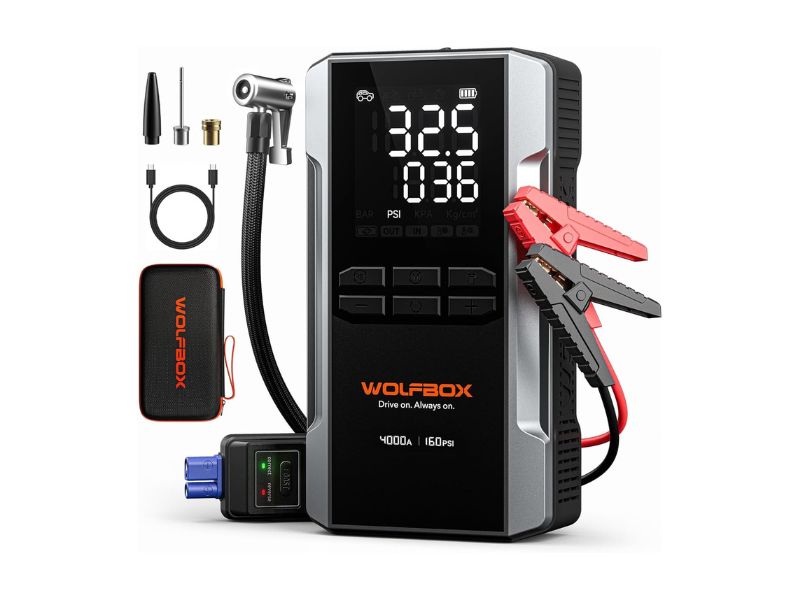
My primary recommendation is the WOLFBOX MegaVolt 24 Air 4000A Jump Starter with Air Compressor. It combines strong lithium jump-starting capability with a 160 PSI compressor, large digital display, fast USB-C charging, emergency lighting, and a compact all-in-one layout. For drivers who want a modern emergency tool that can handle both battery and tire problems without weighing as much as a traditional jump box, it offers one of the strongest overall packages.
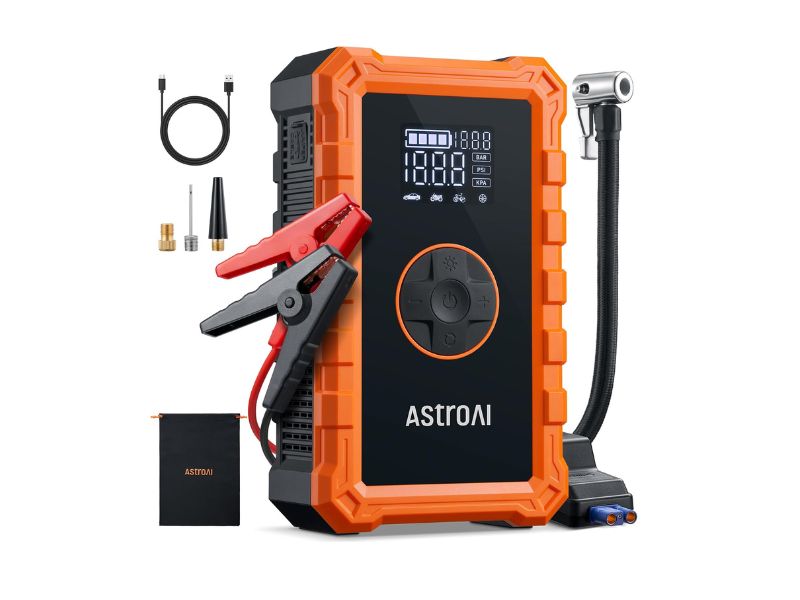
For a lighter and more affordable alternative, I like the AstroAI S8 Air 3000A Jump Starter with Air Compressor. Its 150 PSI automatic inflator, compact 2.4-pound design, smart safety system, digital pressure controls, and broad 12V vehicle compatibility make it particularly convenient for passenger cars, crossovers, SUVs, and everyday roadside kits.
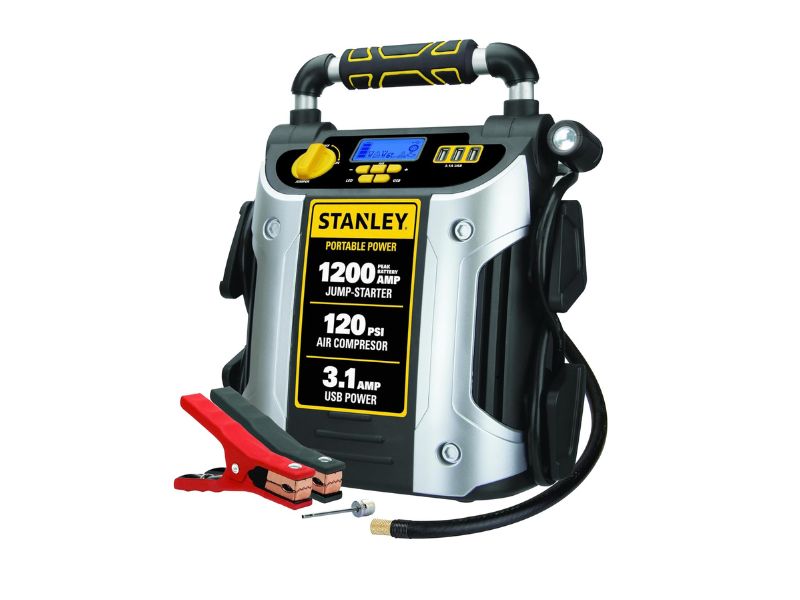
If maximum portability is less important than traditional heavy-duty construction, the STANLEY J5C09D Portable Power Station Jump Starter with Compressor deserves serious consideration. It uses a sealed lead-acid power pack, integrates a 120 PSI compressor, provides dedicated starting power and USB/DC outputs, and is well suited to garages, trucks, workshops, and drivers who prefer a substantial conventional booster.
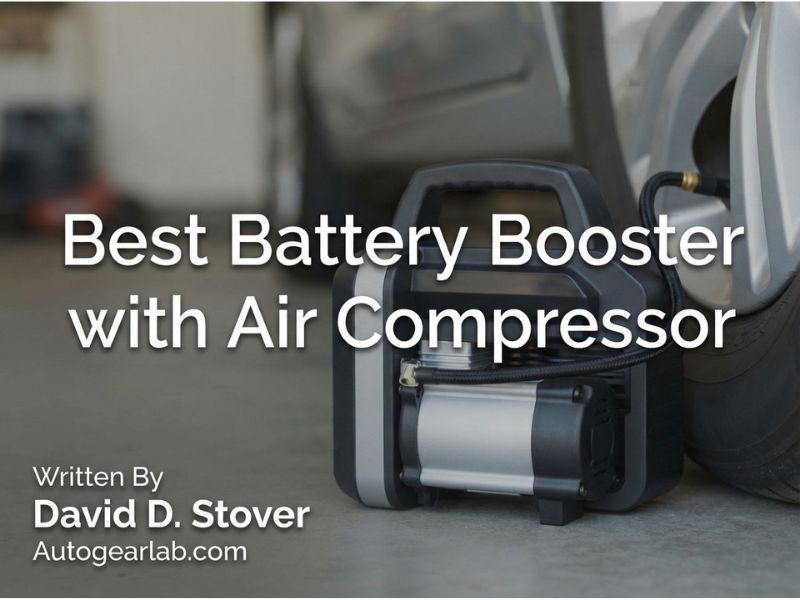
Best Battery Booster with Air Compressor
| Image | Product Name | Check Price |
|---|---|---|
Best Choice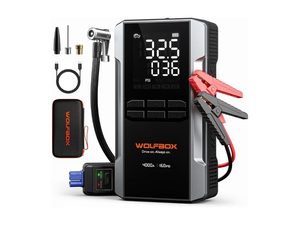 | WOLFBOX MegaVolt 24 Air 4000A Jump Starter with Air Compressor | Check Price |
Second Best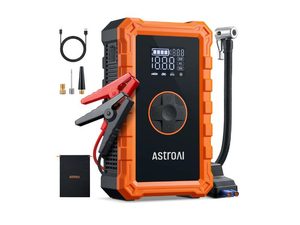 | AstroAI S8 Air 3000A Jump Starter with Air Compressor | Check Price |
Third Choice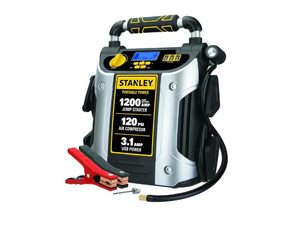 | STANLEY Portable Power Station Jump Starter with Compressor | Check Price |
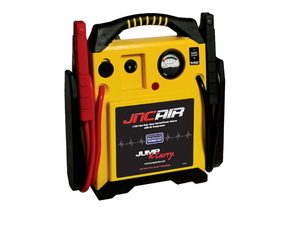 | Clore Automotive Jump-N-Carry 1700 Peak Amp Jump Starter | Check Price |
 | DEWALT 1600A Jump Starter with 120 PSI Compressor | Check Price |
1. WOLFBOX MegaVolt 24 Air 4000A Jump Starter with Air Compressor – Best Overall
Key Features
- 4000A peak jump-starting output
- 12V vehicle compatibility
- Up to approximately 10.0L gas and diesel applications
- Built-in 160 PSI air compressor
- Automatic tire-inflation control
- Large digital display
- 24,000mAh-class lithium power system
- USB-C fast charging
- USB power-bank functionality
- Emergency LED flashlight
- Manual boost function
- Smart safety protection
- Protective carrying case
The WOLFBOX MegaVolt 24 Air is my first recommendation because it brings together the two functions that matter most in this category without feeling like an oversized garage jump box.
Its lithium battery architecture allows the unit to deliver a high burst of starting current while remaining far smaller than conventional lead-acid boosters. That is particularly useful when the device will live permanently in a trunk, SUV cargo compartment, pickup storage box, or road-trip emergency kit.
The 4000A advertised peak output gives it substantial headroom for larger vehicles. As always, peak amperage should not be compared blindly across brands because test methods can differ, but WOLFBOX pairs the high current specification with broad gasoline and diesel compatibility.
For me, the built-in 160 PSI compressor is just as important as the booster function.
Many emergency compressors can top off a passenger tire but struggle with larger tires, repeated inflation, or higher target pressures. The MegaVolt 24 Air is better suited to users who may need to service SUVs, trucks, trailers, and higher-pressure applications.
The large screen is another practical advantage. During tire inflation, clear pressure information is easier to use than trying to read a tiny gauge at night or beside a busy road.
Automatic inflation control lets you choose the desired pressure and allow the compressor to stop when it reaches the selected target. That reduces the chance of accidentally overinflating a tire while you are distracted.
I also like the fast USB-C charging system. An emergency battery pack that takes an extremely long time to recharge is more likely to be placed back in the vehicle partially charged. Faster charging makes it easier to maintain the unit properly after use.
The main tradeoffs are weight and compressor duty cycle. At over five pounds, it is heavier than the AstroAI S8 Air, and like virtually every compact cordless compressor, it needs reasonable cooling periods during demanding inflation jobs.
What I Like
- Excellent all-in-one roadside capability
- Strong 4000A peak specification
- 160 PSI compressor
- Useful for larger vehicles
- Large readable display
- Automatic pressure shutoff
- Fast USB-C charging
- High-capacity power-bank functionality
- Emergency lighting
- Protective storage case
- Much lighter than traditional lead-acid boosters
What I Do Not Like
- Heavier than smaller lithium jump starters
- More expensive than basic emergency boosters
- Compressor still needs cooling during prolonged use
- High output is unnecessary for many small-car owners
Verdict
The WOLFBOX MegaVolt 24 Air is the best battery booster with air compressor for buyers who want a powerful modern all-in-one emergency tool.
Its combination of high jump-starting capacity, a capable 160 PSI inflator, digital controls, large battery capacity, and fast charging makes it particularly attractive for SUVs, pickups, road trips, and multi-vehicle households.
2. AstroAI S8 Air 3000A Jump Starter with Air Compressor – Best Compact Pick
Key Features
- 3000A peak jump-starting output
- 12V vehicle compatibility
- Broad gasoline and diesel engine support
- Built-in 150 PSI tire inflator
- Approximately 25 L/min airflow
- Automatic pressure shutoff
- Five inflation presets
- PSI, BAR, and KPA display modes
- 10,000mAh lithium battery
- Smart clamp protections
- USB power-bank function
- Emergency LED lighting
- Approximately 2.4-pound weight
The AstroAI S8 Air is my favorite choice for drivers who want a small battery booster with a real built-in compressor.
At roughly 2.4 pounds, it is dramatically lighter than traditional booster/compressor combinations. That makes it easy to keep permanently inside a sedan, crossover, motorcycle support vehicle, or family emergency kit.
The 3000A peak rating gives the unit enough stated capacity for a broad selection of common 12V cars, SUVs, vans, and trucks. It also provides a manual boost capability for batteries whose voltage has fallen below normal smart-clamp detection thresholds.
The 150 PSI compressor is well matched to ordinary roadside tire maintenance.
You can set a target pressure, connect the hose to the tire valve, and let the automatic shutoff stop inflation once the selected pressure is reached. This is much easier than constantly watching an analog gauge while crouching beside the tire.
The compressor includes multiple presets for common inflation tasks and supports several pressure units. That makes the S8 Air useful not only for automobile tires but also for motorcycles, bicycles, and compatible recreational inflatables using the appropriate adapter.
Airflow is another important consideration. Maximum PSI tells you how much pressure the compressor can theoretically produce, but airflow influences how quickly a tire fills.
At around 25 liters per minute, the S8 Air is appropriate for topping off normal passenger tires and handling emergency inflation. It is not intended to replace a large workshop compressor for continuously filling oversized off-road tires.
I particularly like the 10,000mAh internal lithium battery because it keeps the unit compact. The tradeoff is that repeated tire inflation consumes substantial energy, so you need to keep an eye on remaining battery charge if you also expect the device to jump-start a vehicle.
The smartest habit is to recharge the unit after any significant compressor or jump-start use rather than returning it to the trunk nearly empty.
What I Like
- Very compact design
- Approximately 2.4-pound weight
- Strong 3000A rating
- 150 PSI compressor
- Automatic inflation shutoff
- Digital pressure display
- Multiple inflation modes
- Smart clamp protection
- Power-bank capability
- Good everyday vehicle compatibility
- Easy trunk storage
What I Do Not Like
- Smaller internal battery than larger premium units
- Not ideal for repeatedly filling very large truck tires
- Compressor use reduces reserve energy for jump-starting
- Short booster cables require positioning the unit close to the battery
Verdict
The AstroAI S8 Air is my best compact battery booster with air compressor.
It offers an excellent balance of portability, tire-inflation convenience, jump-starting capability, and everyday usability without requiring the storage space of a traditional power station.
3. STANLEY Portable Power Station Jump Starter with Compressor – Best Traditional Power Station
Key Features
- 1200 peak amps
- Sealed lead-acid internal battery
- 12V automotive jump-starting
- Built-in 120 PSI air compressor
- Digital tire-pressure control
- Automatic compressor shutoff
- Reverse-polarity alarm
- USB charging ports
- 12V DC accessory outlet
- Pivoting LED work light
- Heavy-duty battery clamps
- Integrated handle
The STANLEY J5C09D represents the traditional approach to a battery booster with compressor.
Instead of using a small lithium battery, it relies on a sealed lead-acid internal battery. That makes the unit substantially larger and heavier, but it also gives it the solid, self-contained feel many drivers associate with conventional jump boxes.
The current J5C09D version provides up to 1200 peak amps and incorporates a 120 PSI compressor.
Its design is particularly appealing for users who expect the booster to stay in a garage, workshop, pickup truck, RV storage compartment, or service vehicle instead of being carried around frequently.
The air compressor includes a digital control system with automatic shutoff. Enter the desired tire pressure, connect the compressor, and the unit can stop when the target is reached.
That is an improvement over older compressor designs that required you to constantly monitor an analog gauge.
The unit also includes USB power and a 12V DC accessory outlet, expanding its usefulness during camping, power outages, or vehicle emergencies.
A pivoting work light is another practical addition. A dead battery or leaking tire rarely chooses a convenient time or well-lit location, and having integrated illumination reduces the number of separate tools you need to find.
One downside of sealed lead-acid emergency packs is maintenance.
They need regular charging even when unused. Leaving one discharged for a long period can shorten battery life considerably.
The STANLEY is also much heavier than lithium models. At around 15 pounds, you will notice the difference immediately compared with the 2.4-pound AstroAI.
What I Like
- Established traditional design
- Strong owner history
- 120 PSI compressor
- Automatic inflation control
- Substantial battery clamps
- Reverse-polarity warning
- USB charging
- 12V accessory outlet
- Pivoting work light
- Good garage and truck utility
What I Do Not Like
- Much heavier than lithium boosters
- Larger trunk footprint
- Sealed lead-acid battery requires regular maintenance charging
- Less convenient to carry during travel
Verdict
The STANLEY J5C09D is a strong choice if you prefer a conventional portable power station rather than a miniature lithium booster.
I especially like it for garages, pickups, RVs, workshops, and households where the unit can remain stored in one accessible location.
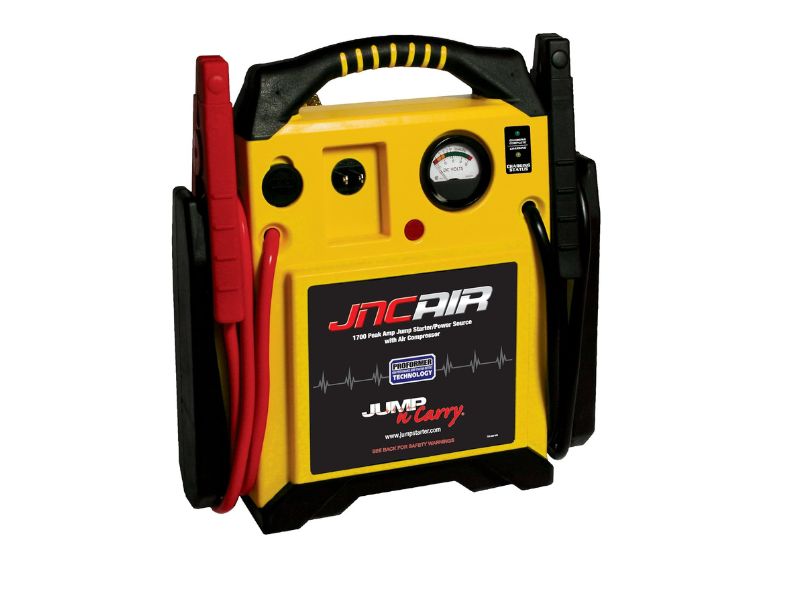
4. Clore Automotive Jump-N-Carry 1700 Peak Amp Jump Starter – Best Heavy-Duty Pick
Key Features
- 1700 peak amps
- 425 cranking amps
- 22Ah Clore PROFORMER battery
- Built-in air-delivery system
- 12-foot coiled air hose
- Heavy-duty jump-starting cables
- Industrial-grade clamps
- 12V DC accessory outlet
- Integrated automatic charger
- Professional-style construction
- 12V vehicle operation
The Clore Automotive JNCAIR is aimed at a different buyer than the compact lithium models.
This is a professional-style jump box with integrated compressed air, built around a 22Ah lead-acid battery and heavy-duty starting hardware.
The first specification I pay attention to is not its 1700 peak amps but its 425 cranking amps.
Peak current is useful for marketing comparison, but sustained cranking capability tells you more about a traditional booster pack’s ability to deliver meaningful starting current over a longer period.
The JNCAIR uses Clore’s PROFORMER battery architecture and industrial-grade clamps. Those characteristics make it more appealing for workshops, fleets, farms, service trucks, and people who frequently help start other vehicles.
The air system also differs from the tiny compressors integrated into pocket-size lithium packs.
A long coiled hose provides considerably more reach around the vehicle, which is useful when the large booster itself remains on the ground or in the bed of a truck.
The biggest disadvantage is obvious as soon as you lift it.
At roughly 25 pounds, the JNCAIR is not a casual glove-box emergency device. It is much better suited to a garage or service environment where ruggedness matters more than minimal weight.
It also lacks some modern conveniences such as high-power USB-C charging and the sleek digital interfaces found on newer lithium products.
For pure heavy-duty starting hardware, however, its traditional design still has advantages.
What I Like
- Strong professional-style starting capability
- 425 cranking amps
- 22Ah internal battery
- Heavy-duty clamps
- Substantial cable construction
- Long coiled air hose
- Excellent garage/workshop suitability
- Built-in charger
- Useful 12V accessory output
- Designed for repeated practical use
What I Do Not Like
- Very heavy
- Large storage footprint
- Less suitable for small passenger-car trunks
- Traditional lead-acid battery requires charging maintenance
- Lacks modern USB-C-oriented features
Verdict
The Clore JNCAIR is the best heavy-duty battery booster with air compressor in this group.
Choose it when rugged clamps, sustained starting capability, and professional-style construction matter more than low weight.
5. DEWALT 1600A Jump Starter with 120 PSI Compressor – Best for Garage and Truck Use

Key Features
- 1600 peak amps
- 12V vehicle jump-starting
- Sealed lead-acid battery
- Built-in 120 PSI digital compressor
- Automatic compressor shutoff
- Sure Fit tire nozzle
- 15W USB-A charging
- 25W USB-C charging
- Reverse-polarity alarm
- Alternator check
- Heavy-duty metal battery clamps
- Compressor auto-shutoff protection
The DEWALT DXAEJ14 combines a traditional sealed lead-acid jump starter with more modern electronic features.
Its 1600A peak rating provides substantial starting capacity for normal passenger cars and trucks, while the integrated 120 PSI compressor handles tire top-offs and common roadside inflation tasks.
I particularly like the digital compressor with automatic shutoff.
Instead of repeatedly stopping the pump and checking tire pressure manually, you can set the target and allow the compressor to manage the final pressure.
The compressor also includes a timed auto-shutoff feature intended to reduce the risk of heat damage if it is accidentally left running too long.
That is useful because small integrated compressors generate considerable heat during extended operation.
Another advantage is device charging.
The DXAEJ14 includes both USB-A and USB-C power outputs, making it more useful with newer phones and electronic devices than many older lead-acid power stations.
The heavy-duty powder-coated clamps also feel more substantial than the compact clamps found on small lithium packs.
An alternator-check function adds another layer of utility. It is not a substitute for full charging-system diagnostics, but it can provide basic information after the engine starts.
Like the STANLEY and Clore models, weight is the main disadvantage.
At approximately 17 pounds, the DEWALT is much better suited to a truck, garage, shop, or RV storage compartment than a compact sedan with limited cargo space.
What I Like
- 1600A peak starting output
- 120 PSI compressor
- Automatic pressure shutoff
- Compressor heat-protection timer
- Heavy-duty battery clamps
- USB-A and USB-C charging
- Alternator-check function
- Reverse-polarity warning
- Rugged garage-oriented design
What I Do Not Like
- Approximately 17-pound weight
- Much bulkier than lithium models
- Lead-acid battery requires periodic charging
- Too large for buyers prioritizing compact storage
Verdict
The DEWALT DXAEJ14 is a good choice for truck owners, home garages, contractors, and drivers who prefer substantial conventional emergency equipment.
It provides a useful middle ground between the consumer-focused STANLEY and the heavier professional Clore unit.
Best Battery Booster with Air Compressor Comparison
| Product | Jump Output | Compressor | Battery Style | Weight Class | Auto Inflation | Best For |
| WOLFBOX MegaVolt 24 Air | 4000A peak | 160 PSI | Lithium | Medium | Yes | Best overall |
| AstroAI S8 Air | 3000A peak | 150 PSI | Lithium | Lightweight | Yes | Compact roadside kit |
| STANLEY J5C09D | 1200A peak | 120 PSI | Sealed lead-acid | Heavy | Yes | Traditional power station |
| Clore JNCAIR | 1700A peak / 425 cranking | Integrated air system | Lead-acid | Very heavy | Manual | Heavy-duty use |
| DEWALT DXAEJ14 | 1600A peak | 120 PSI | Sealed lead-acid | Heavy | Yes | Garage and trucks |
For most drivers, WOLFBOX MegaVolt 24 Air provides the strongest overall balance because it delivers substantial jump-starting capability and a capable compressor while remaining much easier to transport than a traditional lead-acid jump box.
The AstroAI S8 Air is the better choice if minimizing size and weight is your priority.
STANLEY, Clore, and DEWALT make more sense when you prefer a larger conventional power station that will usually live in a garage, service truck, RV, or workshop.
How I Selected These Battery Booster and Air Compressor Combos
A combination device has to perform two completely different jobs well enough to deserve trunk space.
I evaluated the products around:
- Jump-starting capability
- 12V vehicle compatibility
- Gas and diesel suitability
- Peak and cranking-current specifications
- Air-compressor maximum pressure
- Compressor airflow
- Automatic inflation shutoff
- Digital pressure controls
- Compressor duty cycle
- Battery type
- Smart-clamp safety
- Reverse-polarity protection
- Cable and clamp quality
- Internal battery capacity
- USB charging
- Emergency lighting
- Physical size
- Weight
- Storage convenience
- Customer popularity
- Long-term practicality
I also gave extra consideration to products with substantial customer histories rather than relying only on newly launched devices advertising unusually high current ratings.
Buying Guide: How to Choose the Best Battery Booster with Air Compressor
Choose Between Lithium and Lead-Acid
This is one of the biggest decisions in this category.
Lithium Battery Boosters
Modern lithium boosters are:
- Smaller
- Lighter
- Easier to store
- Capable of very high short-duration current
- Commonly equipped with USB-C
- Usually equipped with smart clamps
- Convenient for everyday passenger vehicles
The WOLFBOX and AstroAI models are good examples.
For most drivers, lithium is the more practical choice.
Sealed Lead-Acid Boosters
Traditional power stations such as STANLEY, Clore, and DEWALT are much heavier.
Their advantages can include:
- Larger industrial clamps
- Longer cables
- Strong sustained starting performance
- Familiar controls
- Workshop durability
- Large built-in power reserves
They make more sense when the booster stays in a garage, service truck, or workshop.
Do Not Choose by Peak Amps Alone
Peak amperage is one of the most aggressively marketed specifications.
You might see:
- 1000A
- 1500A
- 2000A
- 3000A
- 4000A
- 6000A
A larger number sounds better, but manufacturers do not necessarily measure peak output using identical methods.
Actual jump-starting performance depends on:
- Battery-cell chemistry
- Battery state of charge
- Voltage under load
- Cable resistance
- Clamp contact area
- Ambient temperature
- Vehicle starter demand
- Duration of current delivery
This is why I also pay attention to engine ratings, product construction, and customer history.
Peak Amps vs. Cranking Amps
These two numbers are not the same.
Peak amps represent a short maximum-current capability.
Cranking amps represent output that can be sustained for a defined period under specific conditions.
Traditional boosters such as the Clore JNCAIR often specify both peak and cranking figures.
Lithium jump starters usually emphasize peak current.
Do not directly assume 4000 lithium peak amps equals the same type of output as a traditional booster’s cranking rating.
Match the Booster to Your Engine
A small gasoline sedan does not require the same starting power as a diesel pickup.
Always check the manufacturer’s engine-size recommendation.
Compact Cars
A reputable lithium booster designed for normal passenger vehicles is generally sufficient.
Crossovers and SUVs
Choose additional starting reserve, particularly for larger V6 or V8 engines.
Gasoline Trucks
A 2000A–4000A-class modern unit can provide useful headroom when properly rated for the engine.
Diesel Trucks
Diesel engines typically demand much more starting current.
Pay attention to the specific diesel-engine rating, not just the gasoline rating.
Why Compressor PSI Matters
Maximum PSI indicates the highest pressure the compressor is designed to reach.
Common values include:
- 120 PSI
- 150 PSI
- 160 PSI
Normal passenger-car tires often require only around 30–40 PSI, so even a 120 PSI compressor has plenty of maximum pressure.
Higher capability becomes more useful with:
- Truck tires
- Trailer tires
- Bicycle tires
- Certain recreational equipment
However, PSI alone does not determine compressor quality.
Airflow Matters Too
A compressor that reaches 150 PSI but moves very little air can still take a long time to fill a large tire.
Airflow may be expressed in liters per minute (L/min) or cubic feet per minute.
For emergency topping-off, modest airflow is acceptable.
For frequently inflating large truck or off-road tires, a dedicated high-flow compressor may be a better choice than any all-in-one booster.
Look for Automatic Inflation Shutoff
This is one of my favorite features.
You enter the target pressure—for example, 35 PSI—and start the compressor.
The unit measures pressure and stops automatically.
Benefits include:
- Less monitoring
- Reduced risk of overinflation
- Easier nighttime use
- Better convenience
- More consistent pressure
WOLFBOX, AstroAI, STANLEY, and DEWALT all provide useful automatic inflation functionality in their current designs.
Understand Compressor Duty Cycle
Compact air compressors generate heat.
They are not intended to run indefinitely.
A typical portable compressor may need to rest after several minutes of continuous use.
Ignoring the duty cycle can:
- Overheat the motor
- Damage seals
- Reduce compressor life
- Trigger thermal protection
Read the instructions and allow cooling periods when required.
This matters particularly if you are inflating several large tires from very low pressure.
Check the Hose Connection
Air-hose connection design affects everyday usability.
Common styles include:
- Screw-on valve connector
- Lever-lock chuck
- Clamp-style chuck
A screw-on connector usually provides a secure seal but takes slightly longer to attach.
Lever connectors can be faster but must fit the valve stem properly.
Whatever style you choose, make sure the hose is long enough to comfortably reach the tire valve.
Smart Clamps Are Important
Modern lithium boosters should provide protections against common connection mistakes.
Useful protections include:
- Reverse polarity
- Short circuit
- Overcurrent
- Overvoltage
- Overtemperature
- Low-voltage conditions
These features make the booster easier for occasional users, but they do not replace correct operation.
Always identify the battery terminals before connecting clamps.
Manual Boost Mode Explained
Some deeply discharged batteries have voltage so low that a smart jump starter cannot recognize them.
A manual boost or override mode allows certain units to energize the clamps even when normal detection fails.
This is useful but requires additional caution.
Before using manual override:
- Confirm the vehicle uses 12V.
- Confirm clamp polarity.
- Inspect the battery for damage.
- Follow the manufacturer procedure.
Automatic protection may be reduced when using override mode.
Battery Capacity Matters
The internal battery powers both the jump starter and compressor.
That means tire inflation consumes energy that might otherwise be available for starting the engine.
This is particularly important with smaller lithium units.
If you use the compressor extensively, check the remaining battery level before assuming the booster still has enough energy for a difficult jump start.
After any meaningful use, recharge it.
USB Power-Bank Capability
Many modern boosters include USB outputs.
That can be useful for:
- Phones
- GPS devices
- Tablets
- Small rechargeable lights
- Other emergency electronics
USB-C power delivery is particularly useful because it can provide faster charging and may also allow the booster itself to recharge faster.
Built-In Lighting Is Worth Having
Battery problems and tire problems frequently happen at night.
An integrated flashlight can help you:
- Locate battery terminals
- Read tire-pressure information
- Find dropped valve caps
- Signal other drivers
- Perform basic roadside inspection
Some models add flashing or SOS modes for emergency signaling.
How to Use a Battery Booster Safely
Always follow your vehicle and booster instructions.
A typical lithium jump-start process involves:
- Turn the vehicle off.
- Switch off unnecessary accessories.
- Confirm the booster has adequate charge.
- Identify the correct battery or remote jump points.
- Connect the positive clamp correctly.
- Connect the negative clamp to the recommended terminal or ground point.
- Confirm that the smart cable indicates a proper connection.
- Attempt to start the engine.
- Avoid prolonged continuous cranking.
- Disconnect the booster in the specified sequence after the vehicle starts.
Never allow energized clamps to touch each other.
When You Should Not Jump-Start a Battery
Do not attempt a normal jump start if the battery is:
- Cracked
- Leaking
- Severely swollen
- Physically damaged
- Obviously frozen
- Producing an unusual odor
- Showing signs of major overheating
A damaged battery can create serious hazards.
How to Use the Air Compressor
First determine the correct tire pressure from the vehicle information label or owner’s manual.
Do not use the maximum pressure printed on the tire sidewall as the normal inflation target unless explicitly appropriate.
Connect the air hose securely.
If the compressor supports automatic pressure setting:
- Select the correct pressure unit.
- Enter the desired PSI.
- Start inflation.
- Allow the compressor to shut off automatically.
- Confirm the pressure afterward if desired.
Do not exceed the compressor’s recommended continuous run time.
Should Tire Pressure Be Checked Cold?
Yes, normal recommended tire pressures generally refer to cold tires.
Tire pressure increases as tires heat during driving.
For the most consistent measurement, check pressure before driving or after the vehicle has been parked long enough for the tires to cool.
Can These Compressors Fill a Completely Flat Tire?
They can often inflate a deflated tire, but the cause of the pressure loss matters.
If the tire has:
- A major puncture
- Sidewall damage
- A separated bead
- Structural failure
adding air may not solve the problem.
A booster/compressor is primarily useful for restoring pressure after slow leakage or topping up an underinflated tire.
Can I Use the Compressor on Truck Tires?
It depends on tire size and required pressure.
A 150–160 PSI unit may have enough pressure capability, but a large truck tire contains much more air volume than a passenger-car tire.
That means inflation can take considerably longer and place more thermal stress on a compact compressor.
For regular off-road airing-down and reinflation, I would purchase a dedicated high-flow compressor.
Battery Booster with Compressor vs. Separate Tools
Advantages of a Combo Unit
- One device instead of two
- Less trunk clutter
- One battery to maintain
- Easier emergency preparation
- Often includes lighting and USB charging
- Convenient for ordinary drivers
Advantages of Separate Tools
A dedicated jump starter may be:
- Smaller
- Lighter
- Better optimized for starting
A dedicated compressor may provide:
- Higher airflow
- Longer duty cycle
- Better hose reach
- Faster large-tire inflation
For serious off-road use or professional work, separate tools can outperform a combination device.
For everyday roadside preparedness, the convenience of one device is hard to beat.
How Often Should You Recharge the Booster?
Do not leave it in the trunk indefinitely without checking it.
A good routine is to check the charge:
- Every few months
- Before long road trips
- Before winter
- Before severe-weather season
- After jump-starting
- After significant tire inflation
- After using it as a power bank
Follow the manufacturer’s storage-charge recommendations.
Lead-acid models may require even more disciplined charging to avoid battery deterioration.
Cold Weather Considerations
Cold temperatures make starting more difficult.
The vehicle battery provides less effective output while the engine requires more cranking effort.
Portable lithium batteries can also produce less output when extremely cold.
For winter driving:
- Keep the booster well charged.
- Choose extra capacity.
- Follow storage-temperature recommendations.
- Inspect the vehicle battery before severe cold arrives.
A booster is an emergency backup, not a replacement for an aging battery that routinely fails.
Common Mistakes to Avoid
Buying Only by Peak-Amperage Rating
More peak amps do not automatically mean better real-world starting performance.
Forgetting to Recharge the Unit
A discharged emergency booster is useless when the vehicle battery dies.
Using the Compressor Until It Overheats
Respect the specified duty cycle and cooling periods.
Inflating to the Tire’s Maximum Sidewall Pressure
Use the vehicle’s recommended cold inflation pressure instead.
Assuming a Jump Starter Repairs the Battery
A booster starts the engine. It does not fix an internally failed battery.
Leaving Lead-Acid Boosters Discharged
Traditional sealed lead-acid power stations need regular charging to maintain battery health.
Ignoring Repeated Dead-Battery Problems
If the vehicle repeatedly needs boosting, investigate:
- Battery age
- Alternator performance
- Terminal condition
- Parasitic electrical drain
- Starting-system faults
Frequently Asked Questions
What is the best battery booster with air compressor?
The WOLFBOX MegaVolt 24 Air is my best overall choice.
Its combination of 4000A peak output, a 160 PSI automatic compressor, large digital display, strong battery capacity, USB-C charging, smart protections, and portable lithium construction makes it unusually versatile for roadside emergencies.
What is the best compact jump starter with air compressor?
The AstroAI S8 Air is my preferred compact option.
At around 2.4 pounds, it is much easier to store than traditional lead-acid boosters while still providing a 3000A peak specification and 150 PSI automatic tire inflator.
Is a jump starter with an air compressor worth it?
Yes, especially for ordinary drivers who want one tool for the two most common roadside problems.
Combination units save trunk space and eliminate the need to maintain separate rechargeable devices.
Is a lithium booster better than a lead-acid jump box?
Lithium is better for portability, while lead-acid models can suit garages and repeated heavy-duty use.
Lithium products are dramatically lighter. Traditional units often provide larger clamps, longer cables, and substantial sustained power.
How many amps should a battery booster have?
The correct capacity depends on engine size, engine type, temperature, and the manufacturer’s vehicle rating.
Most passenger vehicles do not require the enormous peak numbers advertised by some products. Buy based on verified engine compatibility rather than peak current alone.
Is 3000A enough for a car jump starter?
A quality 3000A-class lithium booster provides substantial headroom for many passenger cars, SUVs, and trucks.
Always confirm the manufacturer’s specific gasoline and diesel engine limits.
Can I jump-start a completely dead battery?
Some boosters include a manual override mode for extremely low-voltage batteries.
This feature can help when automatic detection fails, but it requires correct polarity and careful adherence to instructions.
Can a jump starter charge my car battery?
A jump starter is primarily designed to crank the engine, not slowly recharge the battery.
Use a dedicated battery charger when the goal is restoring the battery’s state of charge.
How many PSI should a portable compressor have?
120–160 PSI is more than enough maximum pressure for most passenger-car tires.
Airflow and duty cycle often matter more than maximum PSI for normal automotive inflation.
Is 150 PSI enough for truck tires?
It provides sufficient pressure for many applications, but inflation speed depends on airflow and tire volume.
Large truck tires may take much longer than passenger tires.
Can I inflate all four tires with one charge?
Often yes for normal pressure top-offs, but not always for four completely flat large tires.
Battery capacity, tire size, target pressure, ambient temperature, and compressor efficiency all affect runtime.
Does using the air compressor drain the jump starter battery?
Yes, compressor operation uses the same stored battery energy.
After significant inflation work, check the battery indicator and recharge the unit if necessary.
Can I keep a jump starter in my car?
Yes, but follow the manufacturer’s temperature-storage limits.
Vehicle interiors can become extremely hot in summer and cold in winter, both of which affect rechargeable batteries.
How often should I charge a jump starter?
Check it every few months and recharge after meaningful use.
Also inspect the charge before long trips or severe-weather seasons.
Can I use the compressor on bicycle tires?
Yes, when the unit includes the appropriate valve adapter and pressure range.
High-pressure bicycle tires require careful pressure setting because their small volume means pressure rises quickly.
Is the WOLFBOX better than AstroAI?
WOLFBOX offers more capacity and higher compressor specifications, while AstroAI is significantly lighter and easier to store.
For a large SUV or pickup, I prefer WOLFBOX. For an everyday sedan or crossover emergency kit, AstroAI may be more convenient.
Are traditional power-station jump starters outdated?
No, but their advantages are different from lithium boosters.
Models such as STANLEY, Clore, and DEWALT remain useful when long cables, larger clamps, garage durability, and substantial lead-acid battery capacity matter more than low weight.
Why won’t my jump starter start the car?
The problem may not be the battery.
Possible causes include insufficient booster charge, poor clamp contact, an internally failed vehicle battery, starter problems, wiring faults, immobilizer issues, fuel problems, or other mechanical faults.
Why does my tire keep losing air after inflation?
Repeated pressure loss usually indicates a leak or tire problem that requires inspection.
Possible causes include a puncture, leaking valve stem, damaged wheel, bead leak, or tire damage.
Conclusion
The best battery booster with air compressor should do more than combine two tools inside one housing. It needs enough starting capability for your vehicle, a compressor that can reach normal tire pressures without excessive waiting, dependable safety protection, and a battery system you can realistically keep charged.
My primary recommendation is the WOLFBOX MegaVolt 24 Air 4000A Jump Starter with Air Compressor. Its strong starting reserve, 160 PSI compressor, automatic inflation controls, large display, high battery capacity, USB-C capability, and manageable size create the most complete overall package in this comparison.
The AstroAI S8 Air 3000A Jump Starter with Air Compressor is my preferred compact alternative. It is much lighter, easy to store, and still provides enough jump-starting and inflation capability for a wide range of everyday passenger vehicles.
For buyers who prefer traditional power stations, the STANLEY J5C09D provides a proven sealed lead-acid design with a 120 PSI compressor and useful emergency-power features.
The Clore Automotive JNCAIR is the heavy-duty choice when robust starting hardware, industrial clamps, and workshop-style construction matter most.
Finally, the DEWALT DXAEJ14 offers a useful combination of 1600A starting power, digital tire inflation, USB-C charging, heavy-duty clamps, and garage-friendly construction.
For most everyday drivers, I would choose the WOLFBOX MegaVolt 24 Air if maximum all-in-one capability is the priority, or the AstroAI S8 Air if compact storage and low weight matter more.