If you want the best car battery charger and air compressor in one portable package, the STANLEY J5C09 1000 Peak Amp Jump Starter with 120 PSI Compressor is my first choice. It has one of the most established ownership histories in this category and combines a powerful 12V jump-starting system, built-in tire compressor, USB charging, work light, and portable power capability. For drivers who want one dependable emergency box in the trunk, it offers a particularly practical balance.
For something significantly smaller and easier to carry, I recommend the HALO Bolt Air 58830 Portable Jump Starter and Air Compressor. Its compact lithium design combines 500-amp jump-start capability, a 100 PSI digital air compressor, a 58.8Wh power bank, and an emergency floodlight. It is much easier to store than traditional lead-acid jump boxes and works especially well for passenger cars and everyday road trips.
Drivers who want a more substantial all-in-one power station should consider the Schumacher SJ1332 1200 Peak Amp Portable Power Station. In addition to jump-starting and a 150 PSI compressor, it provides AC, DC, and USB power options, making it particularly useful for garages, camping, RV travel, and emergency backup.
One important distinction matters before buying: products commonly found under this search term are usually portable jump starters with built-in air compressors. They can provide the high current needed to start a vehicle with a weak battery, but they generally do not slowly recharge the car battery to full capacity like a traditional plug-in smart battery charger. If your primary goal is restoring a discharged battery overnight, a dedicated smart charger is still the better tool.
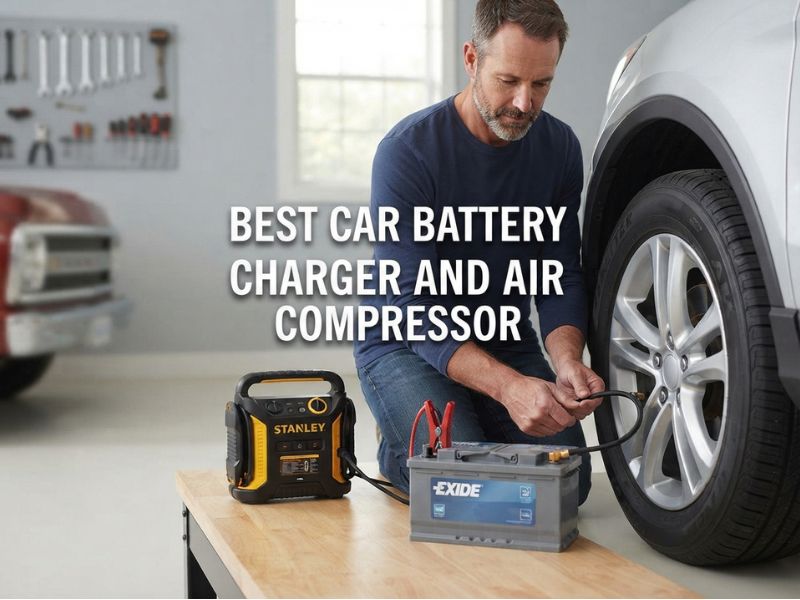
Best Car Battery Charger and Air Compressor
| Image | Product Name | Check Price |
|---|---|---|
Best Choice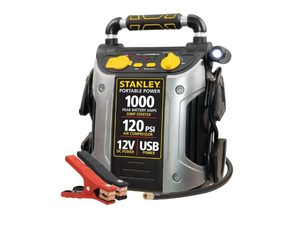 | STANLEY 1000 Peak Amp Jump Starter with 120 PSI Compressor | Check Price |
Second Best | HALO Bolt Air Portable Jump Starter and Air Compressor | Check Price |
Third Choice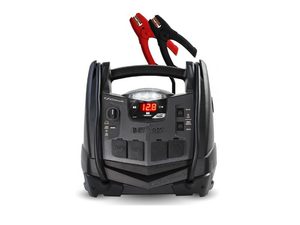 | Schumacher 1200 Peak Amp Portable Power Station | Check Price |
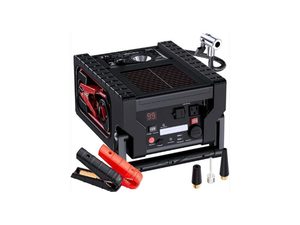 | ZunDian 2000A Jump Starter with 260 PSI Air Compressor | Check Price |
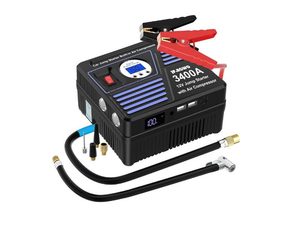 | JF.EGWO 3400A Jump Starter with 150 PSI Air Compressor | Check Price |
1. STANLEY 1000 Peak Amp Jump Starter with 120 PSI Compressor – Best Overall
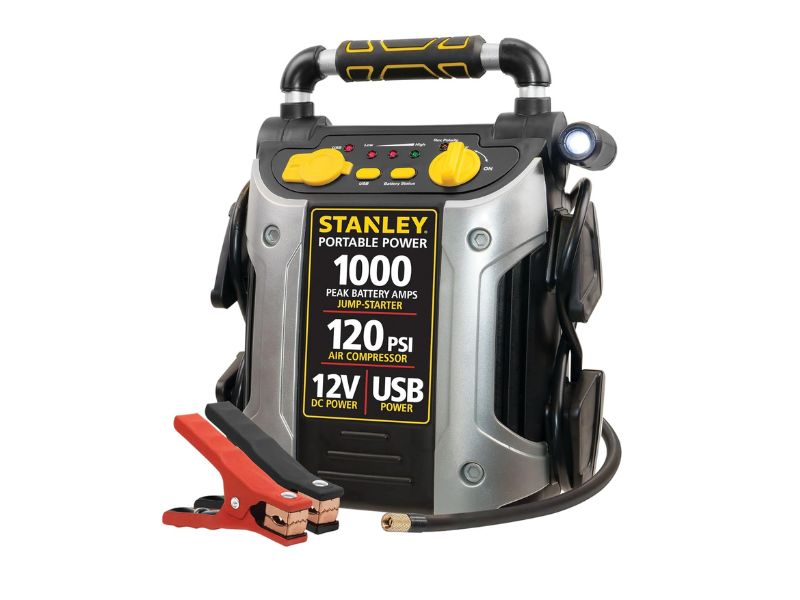
The STANLEY J5C09 earns my top position because it has an exceptionally established track record while covering the two roadside problems drivers encounter most often: a weak battery and a low tire.
Key Features
- 1000 peak battery amps
- 500 instant starting amps
- 12V sealed lead-acid internal battery
- Built-in 120 PSI air compressor
- USB charging port
- 12V accessory outlet
- Pivoting emergency work light
- Battery-status indicators
- Reverse-polarity warning
- Integrated carrying handle
The J5C09 is a traditional portable power station rather than an ultra-small lithium jump pack. That makes it larger and heavier, but it also gives the device a substantial, garage-ready feel.
Its 1000 peak amps and 500 instant starting amps provide enough starting assistance for a wide range of typical 12V passenger vehicles. The booster clamps are permanently associated with the unit, which means there is less chance of leaving a separate jumper cable harness behind.
The integrated 120 PSI compressor is one of the reasons I prefer this model over a basic jump starter. A tire that has slowly lost several PSI overnight does not necessarily require roadside service or a trip to a gas-station compressor. You can attach the air hose, monitor the pressure gauge, and restore the tire closer to the pressure specified by the vehicle manufacturer.
It is worth understanding what the 120 PSI number means. Your passenger-car tire will normally require nowhere near 120 PSI. The high maximum pressure gives the pump working headroom; you should always inflate the tire to the pressure specified on the driver’s door-jamb placard or vehicle manual, not the maximum pressure printed on the tire sidewall.
The J5C09 also functions as a basic portable power source. Its USB output can keep a phone or small USB device operating during an emergency, while the 12V outlet expands compatibility with certain automotive accessories.
The pivoting LED light is useful if a dead battery or low tire occurs after dark. It will not replace a powerful shop light, but having illumination built into the same unit simplifies roadside troubleshooting.
The main tradeoff is the internal sealed lead-acid battery. Compared with modern lithium jump starters, lead-acid power stations are substantially heavier and require more attention during storage. The unit should be periodically checked and recharged according to its instructions rather than being thrown in the trunk for two years and forgotten.
For someone who wants a jump pack, compressor, emergency light, and portable power source in a proven all-in-one design, however, the J5C09 remains difficult to overlook.
What I Like
The long ownership history is reassuring, and the combination of strong starting capability and a genuinely useful compressor gives it excellent roadside versatility. The controls are also straightforward enough that you are unlikely to need complicated menu navigation during an emergency.
What I Do Not Like
It is considerably heavier than lithium alternatives. The analog-style pressure monitoring is also less convenient than modern digital compressors with programmable auto-stop.
Verdict
The STANLEY J5C09 is my best overall car battery and air compressor combo for someone who values a proven design, useful starting power, and straightforward tire inflation more than minimum weight.
2. HALO Bolt Air Portable Jump Starter and Air Compressor – Best Compact Pick
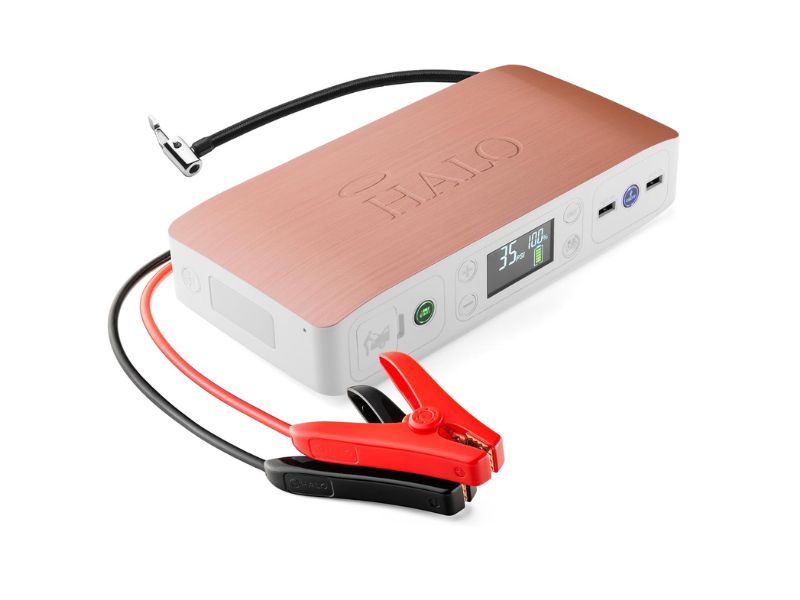
The HALO Bolt Air takes almost the opposite approach from the STANLEY. Instead of a large lead-acid power station, it packages jump-starting, inflation, device charging, and lighting into a slim lithium-powered unit.
Key Features
- 500A jump-start output
- 12V vehicle compatibility
- 100 PSI air compressor
- Adjustable digital pressure
- 58.8Wh lithium-ion battery
- USB device charging
- Emergency LED floodlight
- Multiple inflation adapters
- Approximately 2.5-pound weight
- Compact travel-friendly body
Portability is the HALO’s biggest advantage.
At roughly a few pounds, the Bolt Air is considerably easier to keep in a passenger vehicle than a conventional 15- to 20-pound jump box. It can fit comfortably in a trunk organizer, emergency kit, luggage compartment, or other relatively small storage area.
The 500A jump-start system is aimed primarily at normal passenger vehicles rather than enormous commercial diesel engines. That is fine for the intended buyer. Huge peak-current numbers are less important than reliable starting capability, good clamps, sufficient charge, and correct compatibility with the vehicle.
Its built-in compressor reaches 100 PSI and allows the desired pressure to be set digitally. This is a major usability improvement over basic compressor gauges.
Suppose your vehicle placard specifies 35 PSI and the tire has dropped to 27 PSI. Instead of repeatedly stopping the compressor and checking with a separate gauge, you can set the desired pressure and allow the system to handle inflation more conveniently.
The included adapters also make the air system useful beyond vehicle tires. Balls, bicycle equipment, and certain recreational inflatables can be serviced using the appropriate attachment.
Its 58.8Wh internal battery also works as a portable power bank. That is valuable during breakdowns because a phone becomes one of your most important emergency tools. Navigation, roadside-assistance apps, phone calls, digital insurance information, and emergency communication all depend on battery power.
A built-in floodlight further improves roadside usefulness.
The primary limitation is that the compact compressor should be treated as an emergency and top-off tool rather than a high-duty-cycle shop compressor. Inflating a completely flat large truck tire demands much more work and creates much more heat than adding five or ten PSI to a normal passenger-car tire.
What I Like
It is impressively compact considering how many functions are built in. Digital pressure adjustment, lithium construction, useful device charging, and low weight make it particularly attractive for everyday passenger cars.
What I Do Not Like
The 500A output gives it less engine-starting headroom than larger units. The small compressor also takes more time on large-volume tires than a dedicated heavy-duty inflator.
Verdict
Choose the HALO Bolt Air if your priority is a compact car emergency kit that can jump a normal vehicle, top off tires, charge devices, and provide emergency lighting without occupying a large section of the trunk.
3. Schumacher 1200 Peak Amp Portable Power Station – Best Heavy-Duty Power Station
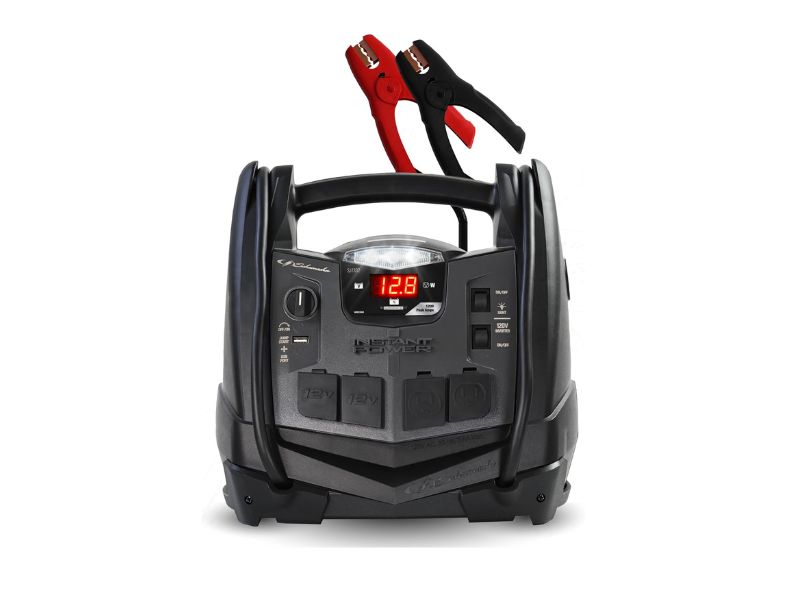
The Schumacher SJ1332 is less about ultra-light portability and more about having a broad collection of emergency functions in one substantial package.
Key Features
- 1200 peak amps
- 12V jump-start capability
- 150 PSI automatic digital air compressor
- Built-in pressure gauge
- 400 peak-watt power converter
- 120V AC outlets
- 12V DC power
- USB charging
- LED work light
- Inflator and deflator functions
- Sealed lead-acid AGM internal battery
The SJ1332 makes sense for drivers who want more than a simple trunk jump starter.
Its 1200 peak-amp starting system provides considerable output for typical passenger cars, SUVs, trucks, and other supported 12V vehicles.
The compressor reaches 150 PSI and uses digital pressure control, giving it an advantage over older analog systems when precise tire pressure matters.
Digital auto-inflation is useful because you can select a target pressure rather than continuously watching a needle. That reduces guesswork and makes topping off several tires considerably easier.
The compressor is only part of the story.
Schumacher also builds an inverter into the unit, giving you conventional 120V AC outlets for compatible low-wattage devices. That transforms the SJ1332 from a pure roadside tool into a small portable power station.
You also get USB and 12V DC connectivity for electronics and automotive accessories.
This broader feature set can be valuable during:
- Vehicle breakdowns
- Camping trips
- Tailgating
- Temporary power outages
- RV travel
- Garage work
- Outdoor events
The included high/low inflator-deflator system also broadens its usefulness for air mattresses, pool toys, and similar high-volume inflatables where a tire compressor alone is not ideal.
The major downside is size and weight. The sealed lead-acid AGM battery gives the device substantial bulk compared with modern lithium packs.
That makes the SJ1332 more suitable for a trunk, pickup bed storage compartment, garage, RV, or workshop than a small glove-box emergency kit.
The internal battery also needs maintenance. A portable power station that has been allowed to sit discharged for months may not be useful when an emergency finally occurs.
What I Like
The combination of 1200-amp starting power, 150 PSI digital inflation, AC power, USB power, 12V output, and lighting creates outstanding versatility.
What I Do Not Like
It is significantly heavier than lithium alternatives. Buyers who only need occasional passenger-car jump-starting and tire top-offs may not need such a large device.
Verdict
The Schumacher SJ1332 is my preferred heavy-duty all-in-one power station for garages, trucks, RV travel, camping, and drivers who want AC power in addition to starting and inflation capability.
4. ZunDian 2000A Jump Starter with 260 PSI Air Compressor – Best Multi-Function Emergency Station

The ZunDian takes the all-in-one concept even further by incorporating a large internal power reserve, high advertised jump-start output, compressor, inverter, lights, and several power-output options.
Key Features
- Up to 2000A peak jump-start output
- 12V operation
- Approximately 22Ah internal battery capacity
- Built-in 260 PSI compressor
- Approximately 35 L/min airflow specification
- 400W inverter
- AC power outlets
- USB outputs
- 12V DC output
- LED emergency lighting
- Integrated solar panel for supplemental charging
- Heavy-duty portable power-station format
The ZunDian is not designed around minimalist portability.
It is better viewed as a large vehicle emergency power station that happens to include jump-starting and tire inflation.
Its advertised peak current reaches 2000A, providing substantially more starting headroom than small 500A packs. The intended vehicle range includes ordinary passenger cars as well as larger SUVs, trucks, RVs, and other supported 12V equipment.
The built-in compressor is rated up to an unusually high 260 PSI. Again, maximum compressor pressure should never be confused with the pressure your tire needs. Most passenger-car and light-truck tires operate far below that number.
What matters more during normal inflation is airflow, thermal management, hose accessibility, pressure accuracy, and how easily the compressor can reach all four tires.
The ZunDian is listed around 35 L/min, which is more useful information than the maximum PSI figure when estimating tire-filling performance.
A 400W inverter increases the unit’s emergency value. Compatible low-power household electronics can be operated through the AC outlets, while phones and other electronics can use USB power.
There is also a 12V DC output for automotive accessories.
Another unusual feature is its integrated solar panel. I would treat this as supplemental or emergency charging rather than expecting a small built-in panel to replenish a large battery rapidly. Solar recharge speed is strongly affected by sunlight intensity, panel orientation, weather, and battery state.
The physical disadvantage is substantial. This is a large power station and weighs far more than compact lithium packs such as the HALO Bolt Air.
If you only drive a small sedan around town, carrying this much hardware may be unnecessary.
For an RV, pickup, remote work vehicle, camping setup, or household emergency kit, the added capabilities make more sense.
What I Like
The combination of strong jump-start capability, compressor, large internal battery, AC inverter, USB/DC outputs, lighting, and supplemental solar charging makes it exceptionally versatile.
What I Do Not Like
Size and weight significantly reduce everyday portability. The huge 260 PSI number also sounds more useful than it really is for ordinary passenger tires, where accurate moderate-pressure inflation matters more.
Verdict
The ZunDian is best for someone who wants a large emergency power station for vehicles and outdoor use, not the smallest possible jump starter.
5. JF.EGWO 3400A Jump Starter with 150 PSI Air Compressor – Best High-Power Lithium Pick

The JF.EGWO 3400A is the most performance-focused lithium unit in this list, combining a large advertised jump-start output with a 150 PSI digital compressor while remaining much lighter than traditional lead-acid power stations.
Key Features
- 3400A peak jump-start rating
- 12V vehicle operation
- Approximately 24,000mAh internal battery
- Built-in 150 PSI compressor
- Digital pressure display
- Automatic pressure control
- Multiple inflation adapters
- Dual USB outputs
- Emergency lighting
- Compact lithium-powered body
- Approximately 2.8-pound weight
The biggest advantage of the JF.EGWO is its power-to-weight ratio.
Traditional jump boxes can weigh well into the double digits. This unit packages strong advertised starting performance, a compressor, and a substantial lithium battery into roughly a few pounds.
That makes it much more convenient for regular trunk storage.
The 150 PSI digital compressor lets you preset a target pressure and monitor inflation on the integrated display.
The compressor is intended primarily for passenger-vehicle tires rather than heavy commercial tires. JF.EGWO’s guidance also places limits on tire dimensions and recommends cooling periods during extended compressor operation.
That duty-cycle information is important.
Small portable compressors generate substantial heat. Running one continuously for long periods can shorten motor life and trigger thermal protection. When filling a significantly low tire, allowing the compressor to cool according to the instructions is better than repeatedly overriding thermal protection.
The jump starter’s large internal battery also gives it power-bank capability through USB outputs.
Like the other lithium units here, it needs periodic charge checks. Lithium batteries have low self-discharge, but that does not mean a jump starter can be forgotten indefinitely.
I would check any emergency jump pack before long trips and several times per year during ordinary storage.
The JF.EGWO sits fifth primarily because the products above have larger established feedback histories, not because it lacks capabilities.
What I Like
Its combination of high starting output, a 150 PSI digital inflator, relatively low weight, large internal battery, and USB power makes it a strong modern alternative to lead-acid jump boxes.
What I Do Not Like
The compressor needs rest periods during extended operation, and its very high advertised peak-amp number should not be the primary reason to choose it.
Verdict
The JF.EGWO 3400A is best for buyers who want high lithium jump-start output and digital tire inflation without carrying a large lead-acid power station.
Car Battery Charger and Air Compressor Comparison
| Product | Starting Output | Compressor | Battery Type | Digital Pressure | AC Power | USB Power | Approx. Portability | Best For |
| STANLEY J5C09 | 1000A Peak | 120 PSI | Sealed Lead-Acid | No | No | Yes | Medium/Heavy | Best overall |
| HALO Bolt Air | 500A | 100 PSI | Lithium-Ion | Yes | No | Yes | Excellent | Compact emergency kit |
| Schumacher SJ1332 | 1200A Peak | 150 PSI | Sealed AGM | Yes | Yes | Yes | Heavy | Garage/RV power station |
| ZunDian 2000A | 2000A Peak | 260 PSI | Large rechargeable pack | Yes | Yes | Yes | Heavy | Multi-function emergency use |
| JF.EGWO 3400A | 3400A Peak | 150 PSI | Lithium | Yes | No | Yes | Very Good | High-power portable use |
The STANLEY J5C09 provides the strongest combination of established ownership history, useful starting power, practical tire inflation, and straightforward controls.
The HALO Bolt Air is dramatically easier to carry and therefore makes more sense for drivers who want a compact roadside kit.
The Schumacher SJ1332 and ZunDian are better when portable AC power and broader emergency functionality matter, while the JF.EGWO 3400A provides a more portable lithium alternative with substantially higher advertised starting output.
Car Battery Charger vs. Jump Starter: Know the Difference
This distinction is essential when shopping for the best car battery charger and air compressor.
A battery charger and a jump starter are not the same thing.
Car Battery Charger
A traditional battery charger connects to household electricity and slowly replenishes the energy stored inside your vehicle’s battery.
A smart charger might supply:
- 1 amp
- 2 amps
- 5 amps
- 10 amps
- 15 amps
Charging can take several hours.
Its purpose is to restore battery state of charge.
Jump Starter
A jump starter stores energy inside its own internal battery.
Instead of charging your vehicle battery completely, it provides a short burst of high current to help the starter motor crank the engine.
Once the engine is running, the vehicle’s charging system can begin replenishing the battery if everything is functioning correctly.
Why Combo Products Usually Use Jump Starters
An air compressor also needs portable electrical power.
Manufacturers can therefore use one internal battery to power:
- Jump-starting circuitry
- Air compressor
- USB outlets
- Emergency lights
- Inverter outlets
That creates a practical roadside emergency station.
Combining a full AC battery charger with a compressor is less useful because you would still need a wall outlet.
How I Chose These Car Battery and Air Compressor Combos
I prioritized products with substantial established buyer feedback while verifying that each one actually combines vehicle battery support and onboard air inflation.
I also considered whether the unit would realistically be useful during a roadside emergency.
The main factors included:
- Established buyer history
- 12V jump-start capability
- Compressor pressure
- Digital pressure control
- Inflation convenience
- Starting-output capability
- Battery technology
- Physical size
- Carry weight
- USB charging
- AC/DC output
- Emergency lighting
- Safety features
- Storage requirements
- Overall versatility
I did not rank products solely by advertised peak amps.
Peak-current ratings vary in methodology between manufacturers and do not tell you everything about real starting performance.
Battery condition, temperature, cable resistance, clamp quality, internal battery chemistry, and engine requirements also affect performance.
Buying Guide: How to Choose the Best Car Battery Charger and Air Compressor
Decide Whether You Need Charging or Jump-Starting
Start here.
If you need to take a partially discharged battery from 50% state of charge back to 100%, buy a smart battery charger.
If you want something you can keep in the vehicle and use when the engine will not crank, buy a jump starter.
If you also want to handle low tire pressure, a jump starter/compressor combination is highly convenient.
Many drivers benefit from owning both:
A plug-in smart charger in the garage.
A jump starter with compressor in the vehicle.
Choose the Right Starting Capacity
Higher output gives you more headroom for larger engines, cold weather, and weak batteries.
A compact 500A product can be enough for many passenger cars.
Moving toward 1000A or beyond provides greater flexibility for:
- SUVs
- Pickup trucks
- Larger gasoline engines
- Certain diesel applications
- Cold-weather starting
Do not assume a 4000A product must automatically outperform every 1000A unit.
Quality of the internal battery and power electronics matters enormously.
Check Gas and Diesel Engine Limits
Manufacturers often specify compatibility by engine displacement.
For example, a jump starter may be rated for engines up to a particular gasoline or diesel size.
Diesel engines generally demand more starting current because of their higher compression ratios.
If you drive a large diesel pickup, verify explicit diesel-engine compatibility rather than assuming a passenger-car jump starter will work.
Understand Compressor PSI
Maximum PSI is one of the most misunderstood inflator specifications.
A compressor rated at 150 PSI does not mean you should inflate a passenger-car tire to 150 PSI.
Typical passenger-car tires often require roughly 30–40 PSI, although the correct number depends on the vehicle.
Always check the driver’s door-jamb tire-pressure placard.
Do not use the maximum pressure printed on the tire sidewall as your normal inflation target.
Airflow Can Matter More Than Maximum PSI
Two compressors can both claim 150 PSI while delivering very different real-world inflation speeds.
Airflow determines how much air the pump can move.
A high-flow compressor can restore a low tire faster.
Unfortunately, airflow is not consistently published for every combo unit, making direct comparison difficult.
When inflation performance matters heavily, consider:
- Airflow
- Hose diameter
- Motor size
- Duty cycle
- Thermal protection
- Tire-size limits
rather than focusing exclusively on PSI.
Look for Digital Auto-Stop
Digital auto-stop is one of the most useful compressor features.
You set the desired pressure, start inflation, and the unit stops automatically when it reaches the selected target.
This helps prevent accidental overinflation and removes the need to repeatedly stop the compressor to read an analog gauge.
The HALO Bolt Air, Schumacher SJ1332, and JF.EGWO are particularly attractive if this convenience matters.
Lead-Acid vs. Lithium Jump Starters
Lead-Acid Power Stations
Traditional models such as the STANLEY and Schumacher use substantial internal lead-acid batteries.
Advantages include:
- Strong sustained current
- Proven technology
- Good garage usefulness
- Large power capacity
- Stable stationary design
Disadvantages include:
- High weight
- Larger physical size
- More demanding storage maintenance
- Lower energy density
Lithium Jump Starters
HALO and JF.EGWO use modern lithium batteries.
Advantages include:
- Much lower weight
- Smaller dimensions
- Higher energy density
- Easier vehicle storage
Disadvantages include:
- Greater sensitivity to extreme heat
- Internal battery degradation over time
- Less suitable for being forgotten in harsh storage conditions
- Small compressors may have shorter duty cycles
For normal passenger-car emergency use, I generally prefer lithium because portability matters.
For a garage, RV, or large vehicle, traditional power stations still make sense.
Consider Compressor Duty Cycle
Small compressors generate heat.
If a compressor needs 15 minutes to inflate a large low tire but is designed to run for only 10 minutes before cooling, you need to follow that duty cycle.
Ignoring overheating warnings can damage:
- Compressor motor
- Cylinder
- Seals
- Hose
- Electronics
- Internal battery
If you routinely air down large off-road tires and then refill all four, a dedicated heavy-duty compressor is usually better than a jump-starter combo.
Combo compressors are strongest for emergencies and routine pressure corrections.
Look for a Long Enough Air Hose
A great compressor is frustrating when the hose cannot comfortably reach the valve stem.
Consider the location of your wheels and where the device must sit while operating.
Large trucks and SUVs can be more challenging than compact cars.
Also check whether the hose:
- Stores neatly
- Uses threaded or lever-lock attachment
- Becomes excessively hot
- Includes valve adapters
Digital Gauge Accuracy Matters
A compressor gauge should be convenient, but I still recommend keeping a small independent tire-pressure gauge in your vehicle.
Built-in gauges can differ slightly from calibrated standalone tools.
For safety-critical applications, periodically comparing the built-in display against a reliable gauge is sensible.
Pay Attention to Storage Weight
The difference between a 2.5-pound lithium jump pack and a 20-pound power station is enormous.
For a compact sedan, a light unit is easier to live with.
For a pickup, work van, RV, or garage, additional size may not matter.
Ask yourself whether the device will actually stay in the vehicle.
A feature-packed emergency tool stored at home cannot help when your tire is low 40 miles away.
Look for USB Power
A USB port turns the unit into an emergency phone charger.
That may sound secondary, but a functioning smartphone can be critical during a breakdown.
You may need it for:
- Calling roadside assistance
- Navigation
- Emergency services
- Insurance information
- Vehicle manuals
- Location sharing
- Flashlight backup
A larger battery capacity provides more useful device-charging reserve.
AC Outlets Add Camping and Emergency Value
The Schumacher and ZunDian models add AC inverter capability.
This allows compatible low-power household devices to operate from the internal battery.
Do not confuse peak inverter wattage with continuous output.
Always check the wattage required by whatever device you intend to connect.
High-draw appliances such as:
- Space heaters
- Hair dryers
- Large power tools
- Microwaves
- Electric kettles
generally require far more power than compact emergency inverters can supply.
Safety Features to Look For
Reverse-Polarity Protection
This helps alert or protect you when the positive and negative clamps are connected incorrectly.
Short-Circuit Protection
A protected system can reduce damage from accidental electrical shorts.
Overtemperature Protection
Both the jump-start circuitry and compressor can produce heat.
Thermal protection helps prevent damaging operation.
Overcurrent Protection
The device should manage excessive current safely.
Pressure Auto-Stop
Automatic compressor shutoff reduces the chance of significantly overshooting the selected pressure.
How to Use a Jump Starter and Air Compressor Safely
Always read the product manual before an emergency occurs.
Trying to learn how to operate unfamiliar equipment on the shoulder of a highway at midnight is far from ideal.
For Jump-Starting
Park safely and switch off the ignition and unnecessary electrical loads.
Verify that the vehicle is a compatible 12V system.
Identify the positive and negative battery connections.
Connect the jumper clamps according to both the vehicle and jump-starter instructions.
Confirm correct polarity before activating the boost function.
Attempt to start the engine only for the recommended cranking duration.
If the engine does not start, allow the required rest period before another attempt.
Once the engine starts, disconnect the unit in the sequence specified by the manufacturer.
Do not keep repeatedly cranking an engine that refuses to start. A discharged battery may not be the underlying problem.
How to Inflate a Car Tire Correctly
The correct pressure is normally printed on the vehicle’s tire-information placard.
You will usually find it:
- Inside the driver’s door
- On the door jamb
- Occasionally inside the fuel door
- In the owner’s manual
Check tire pressure when the tires are cold whenever practical.
Remove the valve-stem cap.
Connect the compressor hose securely.
Set the correct target PSI if the unit has digital auto-stop.
Start the compressor.
Allow it to stop automatically or monitor pressure manually.
Disconnect the hose carefully because metal fittings may become hot.
Verify pressure with an accurate gauge.
Reinstall the valve cap.
Never Inflate to the Tire Sidewall Maximum Just Because It Is Printed There
This deserves emphasis.
A tire might show a maximum inflation pressure considerably higher than the pressure your vehicle actually requires.
That sidewall number relates to the tire’s limits under specified conditions.
The vehicle manufacturer determines the appropriate cold tire pressure for normal vehicle operation.
Follow the vehicle placard, not an arbitrary compressor maximum or tire-sidewall maximum.
When a Low Tire Means You Should Not Simply Add Air
An air compressor solves pressure loss, but not every tire should be reinflated and driven normally.
Inspect the tire first when possible.
Seek professional assistance if you notice:
- Sidewall bulges
- Deep cuts
- Exposed cords
- Major tread separation
- Severe cracking
- Bent or damaged wheel
- A tire repeatedly losing pressure
- Evidence that the tire was driven completely flat
A compressor cannot repair structural tire damage.
Why a Car Battery Keeps Going Dead
A jump starter gets the engine running, but repeated jump-starting is not normal battery maintenance.
Common causes include:
Aging Battery
Automotive batteries lose capacity as they age.
Eventually, charging them will no longer restore sufficient cranking performance.
Parasitic Drain
Dash cameras, alarms, modules, lights, chargers, wiring faults, and aftermarket accessories can draw excessive current while the vehicle is parked.
Alternator Problem
A failing alternator or charging-system problem may prevent the battery from being replenished while driving.
Short Trips
Repeated short journeys can consume more starting energy than the alternator has time to replace.
Loose or Corroded Connections
High resistance at the terminals can make a healthy battery behave like a weak one.
If your vehicle repeatedly needs a jump, test the battery and charging system rather than treating the jump starter as a permanent solution.
Why Tire Pressure Keeps Dropping
Repeated pressure loss also deserves diagnosis.
Possible causes include:
- Nail or screw puncture
- Leaking valve core
- Damaged valve stem
- Bead leak
- Wheel corrosion
- Bent wheel
- Temperature changes
- Tire damage
Tire pressure naturally changes with temperature, but a tire that repeatedly loses much more pressure than the others should be inspected.
Jump Starter With Compressor vs. Separate Tools
Buying separate tools provides advantages.
A dedicated lithium jump starter can be smaller.
A dedicated tire inflator can offer:
- Faster airflow
- Longer hose
- Better cooling
- Longer duty cycle
- More accurate pressure controls
However, separate tools mean:
- Two batteries to maintain
- Two chargers
- More storage
- More equipment to remember
A combination unit is ideal for people who prioritize convenience and emergency preparedness.
Who Should Buy a Combo Unit?
A car battery and compressor combo is particularly useful for:
Commuters
A compact unit covers two common roadside problems without occupying much trunk space.
Road-Trip Drivers
Long trips increase the value of self-sufficient emergency equipment.
College Students
One relatively simple device is easier to keep ready than several separate automotive tools.
Older Vehicles
An aging battery or slowly leaking tire can make emergency equipment especially valuable, although the underlying faults should still be repaired.
RV and Camping Users
Larger power stations can provide lighting, charging, tire inflation, and temporary AC power.
Pickup and Work-Van Owners
A larger unit can serve vehicles, tools, electronics, and inflatable equipment.
When You Should Buy Separate Equipment Instead
Buy a separate smart charger when you regularly need to recharge batteries fully.
Buy a dedicated high-flow compressor if you:
- Air down off-road tires
- Inflate large truck tires frequently
- Need continuous compressor operation
- Service several vehicles
- Use pneumatic accessories
Buy a dedicated jump starter if minimal weight is your highest priority.
Multi-function devices are convenient, but specialized tools usually perform their individual tasks better.
How Often Should You Recharge a Portable Jump Starter?
Follow the manufacturer’s instructions rather than relying on one universal schedule.
At minimum, check the battery:
- Before a long road trip
- Before winter
- Before severe-weather season
- After every jump-start
- After extended compressor use
- Periodically during storage
Do not wait until the device shows zero charge.
A roadside emergency unit only works if its internal battery is ready.
Hot and Cold Weather Storage
Extreme temperatures affect rechargeable batteries.
Summer
A closed vehicle can become extremely hot.
Excessive heat accelerates battery aging, particularly with lithium batteries.
Follow the manufacturer’s storage-temperature limits.
Winter
Cold temperatures reduce battery performance.
The jump starter itself can produce less usable output when extremely cold.
Keeping the device properly charged becomes especially important during winter because the vehicle battery is also under greater starting stress.
Frequently Asked Questions
What is the best car battery charger and air compressor?
The STANLEY J5C09 is my best overall choice for an established all-in-one roadside power station.
It combines 1000 peak amps, 500 instant starting amps, a 120 PSI compressor, USB output, 12V accessory power, and an emergency light. Drivers who prioritize smaller dimensions may prefer the HALO Bolt Air, while Schumacher offers more power-station functionality.
Is there a battery charger and air compressor in one?
Yes, but most portable combinations are actually jump starters rather than full battery chargers.
They provide enough stored power to help crank a vehicle and operate a tire compressor. They generally do not perform the slow multi-stage charging process of a dedicated AC smart charger.
Can a jump starter fully charge a dead car battery?
No, a jump starter is primarily designed to crank the engine rather than recharge the battery fully.
After the vehicle starts, the charging system may begin replenishing the battery. A dedicated battery charger is more appropriate for restoring a discharged battery.
What is the difference between a battery charger and jump starter?
A charger replenishes battery energy over time; a jump starter provides high current for immediate engine cranking.
A battery charger usually requires AC electricity. A portable jump starter stores its own energy, allowing it to work during roadside emergencies.
How many amps should a car jump starter have?
Around 500–1000A can be sufficient for many passenger vehicles, while larger engines may require more capability.
Engine displacement, gas versus diesel, battery condition, temperature, and manufacturer ratings all matter. Follow the jump-starter manufacturer’s stated engine compatibility rather than choosing from peak amps alone.
Is a 100 PSI compressor enough for car tires?
Yes, 100 PSI maximum capability is more than enough for normal passenger-car tire pressure.
Most passenger-car tires operate far below 100 PSI. Inflate according to the driver’s door-jamb placard rather than the compressor’s maximum rating.
Is a 150 PSI air compressor better than 100 PSI?
Not necessarily for passenger tires.
Both provide more than enough pressure for typical automotive use. Airflow, duty cycle, gauge accuracy, hose length, and auto-stop functionality can matter more than maximum PSI.
What PSI should I put in my tires?
Use the cold-tire pressure printed on your vehicle’s tire-information placard.
The placard is usually inside the driver’s door or door jamb. Front and rear pressure can differ. Do not automatically inflate to the maximum PSI molded into the tire sidewall.
Can I use these compressors on truck tires?
Some can handle light-truck tires, but large commercial tires may exceed their intended workload.
Check tire-size limits and compressor duty cycle. Heavy trucks and large off-road tires are better served by a dedicated high-flow compressor.
Can I leave a jump starter in my car?
Yes, if the manufacturer permits storage within the temperatures your vehicle will experience.
Extreme heat and cold can reduce battery performance and lifespan. Check the device periodically and keep it protected from moisture, impact, and direct sunlight.
How long does a portable air compressor take to fill a tire?
It depends on tire volume, starting pressure, compressor airflow, and battery condition.
Topping a tire from 30 to 35 PSI can be relatively quick. Inflating a completely flat SUV or truck tire requires considerably more time and can trigger thermal protection.
Can I use the compressor while the jump starter is connected to a car battery?
Follow the manufacturer’s operating instructions because requirements differ between models.
Some units isolate their functions, while others have specific restrictions regarding simultaneous operation, charging, or jump-start mode.
Can a jump starter damage my car?
Incorrect voltage, reversed connections, or improper procedures can damage electrical components.
Use a compatible 12V unit, identify polarity correctly, follow the vehicle and jump-starter manuals, and pay attention to reverse-polarity warnings.
Do lithium jump starters last longer than lead-acid models?
Lithium units usually offer lower weight and better energy density, but lifespan depends heavily on storage and charging habits.
Lead-acid models are heavier but remain effective for sustained emergency power. Neither technology benefits from being stored discharged or exposed to extreme temperatures.
Which is better for a trunk: HALO Bolt Air or STANLEY J5C09?
HALO is better for minimal weight, while STANLEY provides a more traditional heavy-duty emergency-station format.
For a compact sedan, I prefer the HALO’s lithium design. For a garage, pickup, or larger trunk where weight matters less, the STANLEY’s established design is highly practical.
Is the Schumacher SJ1332 good for camping?
Yes, its multiple power outputs make it particularly useful beyond roadside emergencies.
It offers jump-starting, a 150 PSI compressor, USB charging, DC output, AC inverter power, lighting, and high/low inflation capabilities.
Can I power household appliances with these units?
Only models with AC inverters can operate compatible household devices, and strict wattage limits apply.
The Schumacher and ZunDian provide AC power capabilities. Always check continuous inverter wattage and the appliance’s power requirement before connecting anything.
Can an air compressor repair a flat tire?
No, an air compressor only restores pressure.
It cannot repair a puncture, sidewall damage, bead leak, cracked wheel, or failed valve stem. A tire that loses pressure again needs diagnosis and repair.
Should every car carry a jump starter and tire inflator?
They are among the most useful self-service roadside tools for many drivers.
A weak battery and low tire can both leave you stranded or delayed. A combination device covers both while using less storage than separate full-size tools.
Final Verdict
The best car battery charger and air compressor for most drivers is ultimately a jump-starter/compressor combination rather than a traditional plug-in charger.
The STANLEY J5C09 1000 Peak Amp Jump Starter is my primary recommendation. Its established ownership history, 1000 peak amps, 500 instant starting amps, 120 PSI compressor, USB charging, 12V accessory outlet, and emergency lighting give it an excellent balance for typical roadside emergencies.
The HALO Bolt Air 58830 is the model I would choose when compact storage matters most. Its lithium battery keeps weight down dramatically, while the 100 PSI digital compressor, 500A starting capability, USB power, and floodlight provide the core features most passenger-car owners need.
The Schumacher SJ1332 is better for drivers who want an emergency power station rather than simply a jump starter. Its 1200A starting system, 150 PSI digital compressor, AC inverter, USB power, DC output, and inflator functions make it useful for vehicles, garages, camping, and RV travel.
The ZunDian 2000A expands the power-station concept further with a large battery, 260 PSI compressor, 400W inverter, multiple output types, emergency lights, and supplemental solar capability.
Finally, the JF.EGWO 3400A is an appealing modern option for buyers who want high advertised starting capability and a 150 PSI digital compressor while avoiding the weight of a large lead-acid jump box.
If I were buying for a normal passenger car and wanted one dependable unit to keep in the trunk, I would start with the STANLEY J5C09. If I wanted something substantially lighter that I could easily move between vehicles, the HALO Bolt Air would be my alternative.
Whichever model you choose, keep one limitation in mind: a jump starter gets a weak vehicle running, but it does not replace a proper smart battery charger when the battery needs to be slowly restored to a full state of charge. For the most complete garage and roadside setup, owning a smart charger at home and a jump-starter/compressor combination in the vehicle provides the broadest protection.