
Choosing the best monoblock car amplifier is less about chasing the biggest watt number and more about matching output, impedance, controls, and installation space to your subwoofer system. A suitable amp should deliver enough power without creating an avoidable electrical, wiring, or heat problem.
My first choice is Planet Audio AC4000.1D 4000 Output Class D Monoblock 1 Ohm Car Amplifier. Its variable bass boost, subsonic filter, and low-pass crossover give an experienced installer useful control over a demanding bass system.
My second choice is CT Sounds CT-1500.1D Compact Class D Car Audio Monoblock Amplifier. It provides 1,500 watts RMS at 1 ohm, includes a bass knob, uses a compact chassis, and adds four-way protection for buyers who want strong output without a physically large amplifier.
My third choice is AudioControl EPIC2000 Monoblock Car Audio Subwoofer Amplifier 2000W Class D. AudioControl EPIC2000 Monoblock Car Audio Subwoofer Amplifier 2000W Class D takes third place because it offers 2,000 watts RMS, flexible 1-, 2-, and 4-ohm stability, a supplied dash-mount bass controller, and a low-profile design. Its line-level input arrangement makes it especially worth considering for systems built around an aftermarket head unit.
This comparison explains what each amplifier is best suited for, where its limitations matter, and how to match it with subwoofers, wiring, and the vehicle’s electrical system. The buying guide then covers impedance, power ratings, installation, tuning, protection, maintenance, and common ownership mistakes.
5 Best Monoblock Car Amplifier Comparison
I selected these five models for their direct relevance to single-channel car audio, the amount of useful technical information supplied, and the practical differences between their power levels, controls, dimensions, and protection features. Customer-feedback evidence was also considered where available, while brand diversity helps show several legitimate approaches rather than presenting one manufacturer’s lineup.
| # | Image | Product | Price on Amazon |
|---|---|---|---|
| 1 |  |
Planet Audio AC4000.1D 4000 Output Class D Monoblock 1 Ohm Car Amplifier | Price on Amazon |
| 2 | 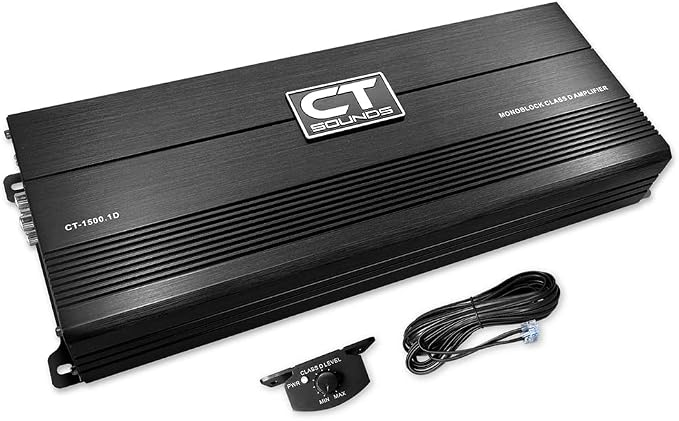 |
CT Sounds CT-1500.1D Compact Class D Car Audio Monoblock Amplifier | Price on Amazon |
| 3 |  |
AudioControl EPIC2000 Monoblock Car Audio Subwoofer Amplifier 2000W Class D | Price on Amazon |
| 4 |  |
LOWDR LF 3000.1 2 Ohm Car Audio Digital Mono Amplifier | Price on Amazon |
| 5 |  |
Skar Audio RP-1200.1D Monoblock Class D MOSFET Amplifier | Price on Amazon |
Planet Audio AC4000.1D 4000 Output Class D Monoblock 1 Ohm Car Amplifier
The Planet Audio AC4000.1D is the high-output option in this group. Its listed maximum output reaches 4,000 watts by one channel at 1 ohm, 2,000 watts at 2 ohms, and 1,000 watts at 4 ohms. Those figures make it attractive for a substantial subwoofer system, but buyers should compare the amplifier with the subwoofer’s continuous power handling rather than shopping by the maximum number alone.
Its 1-ohm stability is important for bass systems that present a heavier load, particularly when subwoofer voice coils are wired to a low final impedance. Class D operation helps reduce wasted energy and allows a more compact design than some older amplifier layouts. The strapping capability is another unusual advantage: two matching AC4000.1D units can be connected for a larger system, provided the installer also plans the correct wiring, load, and electrical support.
Control options are well suited to subwoofer tuning. Variable bass boost changes the emphasis of low bass, while the adjustable subsonic filter can remove frequencies below the safe operating range of the enclosure and driver. The variable low-pass crossover helps keep higher frequencies out of the subwoofer channel. These controls are useful, but they also reward careful adjustment rather than setting every knob to its maximum position.
Pros
- High listed maximum output across 1-, 2-, and 4-ohm loads
- 1-ohm stable and capable of strapping two matching amplifiers
- Variable bass boost, subsonic filter, and low-pass crossover
- Class D design supports a compact, efficient installation
Cons
- Maximum output figures should not be confused with continuous RMS output
- A high-power installation requires careful electrical and wiring planning
- Extra strapping capability may be unnecessary for a simple daily-driver system
My Opinion
This is the strongest fit for a buyer building around a demanding low-impedance subwoofer system and wanting room to expand. It is less appealing if the goal is a simple, modest installation where its large headline capacity and added system complexity would go unused.
CT Sounds CT-1500.1D Compact Class D Car Audio Monoblock Amplifier
The CT Sounds CT-1500.1D stands out as a practical middle ground. It delivers 1,500 watts RMS at 1 ohm, 850 watts RMS at 2 ohms, and 450 watts RMS at 4 ohms when supplied with 14.4 volts. That stepped output makes it easier to compare with a subwoofer’s rated continuous power and choose a final impedance with a clear expectation of what the amplifier can provide.
Its compact chassis is a meaningful advantage for vehicles where the cargo area, side panel, or seat area offers limited mounting room. Compact does not mean the buyer can ignore ventilation, however. The amplifier’s MOSFET pulse-width-modulated power supply and stated heat-dissipation design are intended to keep operation efficient and cool, but an open, secure mounting location remains important for any powerful car amplifier.
The included bass knob makes day-to-day adjustment convenient from the driver’s seat. Its frequency response is listed as 0 to 320 Hz, giving the installer a useful range for a subwoofer channel. Four-way protection covers high voltage, low voltage, over-current, and high-temperature conditions, which adds reassurance when the vehicle’s electrical environment or listening demands change.
Pros
- Clear RMS output ratings at 1, 2, and 4 ohms
- Compact footprint for difficult vehicle installations
- Included bass knob for convenient level adjustment
- Four-way protection against voltage, current, and heat problems
Cons
- Its 1-ohm output is much higher than its 4-ohm output
- It is primarily suited to a subwoofer channel rather than full-range use
- Buyers still need to provide suitable power, ground, and signal wiring
My Opinion
This is the easiest recommendation for a buyer who wants serious bass power in a compact package without jumping directly to the largest amplifier listed here. The combination of RMS figures, protection, and a supplied bass controller gives it a particularly sensible balance for a daily-driver system.
AudioControl EPIC2000 Monoblock Car Audio Subwoofer Amplifier 2000W Class D
AudioControl’s EPIC2000 brings a flexible load range and a relatively low-profile form factor to the comparison. It is stable at 4, 2, or 1 ohm and provides up to 2,000 watts RMS, with the supplied information also identifying up to 4,000 watts at 2 ohms when bridged. That flexibility benefits buyers who may change subwoofers later or need to work around a particular voice-coil configuration.
The chassis measures 6.1 inches wide, 12.56 inches long, and 2.01 inches high, so it can suit installations where vertical clearance is limited. Line-level inputs are intended for use with most vehicles that have aftermarket head units. That detail matters: a factory-radio installation may require a separate signal solution, so the head unit and integration method should be confirmed before purchase.
A supplied ACR-E bass control knob can be mounted with the dash bracket or flush mounted into a suitable panel. The amp also offers a variable 0–12 dB bass equalizer, 12 dB-per-octave Linkwitz-Riley subsonic and low-pass filters, and a listed 92.9 dBa signal-to-noise ratio. Ultra-efficient idle draw and multiple protection modes add useful ownership benefits, especially for a system that spends time parked or operating during long listening sessions.
Pros
- 2,000 watts RMS with 1-, 2-, and 4-ohm stability
- Low-profile dimensions and a flexible mounting controller
- Included ACR-E bass knob with dash or flush-mount options
- Protection modes cover voltage, short-circuit, and thermal hazards
Cons
- Line-level input suitability should be checked against the vehicle’s head unit
- Its advanced controls may be more than a basic system needs
- Bridged operation requires especially careful load and installation planning
My Opinion
The EPIC2000 is a strong choice when installation flexibility and control access matter as much as raw output. I would place it ahead of a simpler amp for a carefully planned aftermarket system, but a factory-radio owner should verify signal compatibility first.
LOWDR LF 3000.1 2 Ohm Car Audio Digital Mono Amplifier
The LOWDR LF 3000.1 takes a different approach by combining a listed 3,000 watts RMS at 2 ohms with a 10 Hz–20 kHz frequency response. That full-range specification separates it from the more traditionally bass-focused models in this comparison. It can therefore appeal to an installer who wants one mono channel capable of reproducing deep bass as well as a broader audio range, although the final system still needs to be planned around the single-channel layout.
An aluminum chassis measures approximately 3 by 9.16 by 7.42 inches. The compact footprint can make placement easier, while aluminum construction is intended to help dissipate heat. Class D operation also helps limit wasted energy compared with less efficient designs. Even with those advantages, a small enclosure around the amp or a blocked mounting surface could still restrict cooling, so placement should leave room for airflow.
The listed 2-ohm operating point is the key compatibility detail. Before buying, calculate the final speaker load after wiring the subwoofer or speakers, rather than assuming the nominal impedance printed on one driver will remain the final load. The product is identified with an RCA input, which suits a conventional preamp-signal installation. Customer feedback is highly positive in the supplied data, but the 12-rating sample is small, so the technical fit should carry more weight than the score alone.
Pros
- Listed 3,000 watts RMS at a 2-ohm load
- 10 Hz–20 kHz response supports full-range as well as bass use
- Compact aluminum chassis helps with placement and heat dissipation
- Class D design is intended to use vehicle power efficiently
Cons
- The stated 2-ohm operating point requires careful load matching
- Limited customer-feedback volume makes long-term conclusions less certain
- Its high output may be excessive for a small factory subwoofer upgrade
My Opinion
This is the intriguing specialist option for buyers who want substantial output and a broader frequency range than a conventional bass-only amplifier. I would choose it only after confirming the final 2-ohm load and the electrical system’s ability to support the requested power.
Skar Audio RP-1200.1D Monoblock Class D MOSFET Amplifier
The Skar Audio RP-1200.1D is the more approachable lower-power choice in this lineup. It is stable at 1 ohm and lists 1,200 watts RMS at that load, with a 1,600-watt peak figure. Because the RMS rating is clearly identified, it gives a buyer a useful starting point for matching a 1-ohm subwoofer system without automatically stepping into the much larger output levels of the first four products.
A remote subwoofer level control is included, allowing the driver to adjust bass intensity without reaching the amplifier. The onboard bass EQ provides either a 6 or 12 dB boost at 45 Hz. That can add impact when the rest of the system is tuned appropriately, but a large boost also increases demand on the subwoofer and electrical system, so it should be treated as a finishing control rather than a substitute for correct gain setting.
The 20 Hz–250 Hz frequency response keeps the amp focused on low-frequency duties. Four-way protection and a heatsink design intended for reliability add useful safeguards, while 4-gauge power and ground terminals support substantial current flow. The listed damping factor is greater than 150. Buyers should still confirm that their subwoofer’s final impedance is 1 ohm, since the supplied data does not give equivalent output figures for 2- or 4-ohm operation.
Pros
- 1,200 watts RMS at 1 ohm with 1-ohm stability
- Remote subwoofer level control is included
- Selectable 6 or 12 dB bass EQ at 45 Hz
- Four-way protection and 4-gauge power terminals
Cons
- Its stated power figures focus on a 1-ohm load
- Bass EQ can place extra demand on the system when used aggressively
- It offers less maximum output than the four higher-ranked options
My Opinion
The RP-1200.1D makes the most sense for a straightforward 1-ohm subwoofer upgrade where a remote bass control is important. It is not the top pick for a large SPL-oriented build, but its output, protection, and established customer-feedback volume make it a practical daily-use option.
How I Selected These Class D Monoblock Amplifiers
For this comparison, I weighed output information, impedance stability, control flexibility, installation size, protection features, and the intended role of each amplifier. The best monoblock car amplifier for one buyer may be a 1-ohm high-output model, while another buyer may need a compact unit with a supplied remote knob and more modest power.
I gave extra importance to clearly stated RMS figures because continuous output is more useful for matching an amplifier to a subwoofer than an attention-grabbing peak or maximum number. That is why the CT Sounds, AudioControl, LOWDR, and Skar Audio models can be compared more directly on sustained output, while the Planet Audio model requires extra care because its supplied power figures are maximum ratings.
Load flexibility also affected the order. A model that supports 1, 2, and 4 ohms can fit more future system changes, while a 2-ohm-specific model may be excellent in the right installation but unsuitable in another. Controls such as low-pass filtering, subsonic filtering, bass adjustment, and a remote level knob were considered for their practical effect, not simply counted as decorative specifications.
Match the final speaker impedance and continuous power handling before comparing amplifier size. A larger maximum number is not automatically a better match for a particular subwoofer.
Finally, I considered compact dimensions, cooling design, protection circuitry, signal-input details, and the amount of available customer feedback. These factors cannot replace proper installation, but they help separate an amplifier that fits a realistic vehicle project from one that only looks impressive on a specification sheet.
Customer ratings are useful context, not proof of universal suitability. A model with a smaller feedback sample deserves closer attention to its listed compatibility and installation requirements.
How to Choose a Monoblock Amplifier for Your Car
When choosing the best monoblock car amplifier, start with the subwoofer system already in the vehicle rather than the amplifier’s largest advertised number. Identify the final impedance, the subwoofer’s continuous power requirement, the available mounting space, and whether the head unit supplies a compatible signal.
- Match the amplifier’s RMS output to the subwoofer’s continuous power handling.
- Confirm the final wired impedance, especially with dual-voice-coil subwoofers.
- Check whether the amplifier uses line-level RCA inputs or needs a different signal path.
- Plan power, ground, fuse, and cooling requirements before selecting a high-output model.
- Choose remote bass control and filter options only when they solve a real usage need.
Understand RMS, maximum, and peak numbers
RMS output is the most useful comparison point for normal system planning because it describes sustained power rather than a brief upper limit. Maximum and peak figures can help describe the amplifier’s capability, but they should not be used alone to decide whether a model matches a subwoofer. The Planet Audio unit illustrates this distinction particularly well because the supplied data emphasizes maximum output, while several competing models provide RMS figures.
Match the final impedance
Impedance is the electrical load presented to the amplifier after the subwoofer coils and speakers are wired together. A 1-ohm-stable amplifier is not automatically the correct choice for every 1-ohm-capable subwoofer, and a 2-ohm-specific amplifier should not be connected to a lower final load simply to chase more output. Follow the subwoofer wiring diagram and amplifier specifications before applying power.
Consider controls and signal integration
A low-pass crossover helps limit the channel to bass frequencies, while a subsonic filter can remove very low content that may be unsafe for a particular enclosure. A remote bass knob is convenient when listening levels vary by song or source. Also check the input type: the AudioControl EPIC2000 specifically identifies line-level inputs for most aftermarket head units, so factory-radio integration should be confirmed rather than assumed.
Match the Subwoofer and Amplifier Load
Write down the number of subwoofers, each driver’s voice-coil configuration, and the target final impedance before ordering an amplifier. Series and parallel wiring can change the load substantially, and two drivers do not automatically create the same impedance as one driver.
The amplifier should remain within its stated stable range during normal use. If a system is wired below that range, overheating, protection shutdown, or electrical stress can result. If the load is higher than expected, the amplifier may simply deliver less power, but the subwoofer still needs to receive a suitable amount of continuous output for the planned system.
Plan the Vehicle Electrical System
A powerful amplifier draws meaningful current from the vehicle. The battery connection, ground point, fuse, and power cable should be selected according to the amplifier’s installation instructions and the length of the run. Place the main fuse close to the battery so the power cable has protection if it is damaged along the vehicle’s path.
Do not assume that a protection circuit can compensate for an undersized electrical system. Low-voltage protection may shut the amplifier down, but it does not increase alternator or battery capacity. High-output models such as the Planet Audio and LOWDR units deserve especially careful planning, while a 1,200- or 1,500-watt system may be easier to accommodate depending on the vehicle and listening habits.
Install for Cooling and Service Access
Secure the amplifier to a solid surface where it cannot move, contact loose metal, or collect moisture. Leave room around the chassis for heat to escape and keep ventilation openings unobstructed. A compact design makes placement easier, but it does not make an amplifier immune to heat buildup under carpet, inside a sealed compartment, or against an insulating panel.
Route power and signal cables so they are protected from sharp edges and moving seat hardware. Keep connections tight, use suitable terminals, and make sure the ground point is clean and secure. Before covering the installation, leave enough access to inspect fuses, terminals, and control settings later.
Set Gain, Crossover, and Bass Boost Carefully
Gain is used to match the amplifier to the signal from the head unit; it is not simply a volume control. Start with the head unit and amplifier controls at conservative settings, then raise the system gradually while listening for distortion. If the subwoofer sounds strained, reduce the level rather than trying to solve the problem with more bass boost.
Set the low-pass crossover so the subwoofer blends with the rest of the system instead of reproducing obviously higher notes. A subsonic filter should be set with the enclosure and subwoofer’s safe frequency range in mind. Bass EQ, including the Skar Audio unit’s 6 or 12 dB options and the AudioControl unit’s variable 0–12 dB control, can be useful, but substantial boost increases cone movement and power demand.
First-Use Checklist and Troubleshooting
Before the first listening session, confirm that the amplifier is firmly mounted, the final impedance is correct, the fuse is installed, and the positive and ground connections are secure. Check signal cables and speaker wiring for accidental contact with the vehicle chassis. Start at a low volume and verify that the amplifier remains out of protection mode.
- No power: Check the main fuse, remote-turn-on connection, ground, and battery voltage.
- Protection light: Turn the system off and inspect speaker wiring, impedance, ventilation, and possible short circuits.
- Weak bass: Check signal routing, phase, crossover settings, gain, and whether the subwoofer is wired to the expected load.
- Distortion: Reduce gain or bass boost and check whether the subwoofer is being pushed beyond its safe capability.
- Intermittent operation: Inspect terminals, ground points, fuse holders, and cables for looseness or heat damage.
Common Mistakes with a Monoblock Amplifier
Most avoidable problems come from treating the amplifier as an isolated product instead of one part of an electrical and acoustic system. A buyer can select a capable amp and still get poor results through incorrect impedance, excessive EQ, poor ventilation, or an unsuitable signal connection.
- Do not choose by peak or maximum watts alone.
- Do not wire below the amplifier’s stated stable impedance.
- Do not hide a powerful amp where heat cannot escape.
- Do not use bass boost to compensate for a weak signal or poor enclosure match.
- Do not skip the fuse or rely on a factory power cable for a high-output installation.
Another common error is assuming that every mono amplifier is intended only for the same type of system. The LOWDR model lists a full-range 10 Hz–20 kHz response, while the Skar Audio model is specified from 20 Hz to 250 Hz and is more clearly focused on subwoofer duty. Read the frequency information alongside the rest of the system before deciding how the amplifier will be used.
Maintenance and Long-Term Ownership Tips
Inspect the amplifier and its wiring periodically, especially after the first few weeks of driving when vibration can reveal a loose connection. Look for discolored terminals, damaged insulation, blown fuses, or signs of excessive heat. A clean mounting area helps the heatsink work as intended, but power should be disconnected before cleaning around electrical connections.
Keep dust and debris from building up around ventilation areas. Do not spray cleaner directly onto the chassis, and do not operate the amplifier when moisture may reach the terminals. If the amplifier repeatedly enters protection mode after the wiring has been checked, stop increasing the volume and identify the cause before continued use.
When changing subwoofers, recheck the final impedance instead of assuming the replacement has the same voice-coil arrangement. Also revisit the gain and filter settings after a major system change. The settings that worked for a smaller driver or different enclosure may not be appropriate for a new load.
Choosing Based on Your Real Installation
For a large low-impedance system with possible expansion, the Planet Audio AC4000.1D offers the most ambitious platform in this group. Its strapping capability is valuable only when the rest of the installation is built to support two amplifiers, so it is not automatically the best choice for a basic upgrade.
The CT Sounds CT-1500.1D is a better fit when mounting space is limited and a supplied bass knob is desirable. The AudioControl EPIC2000 suits a buyer who values a low-profile chassis, broad impedance stability, and a flexible controller. The LOWDR LF 3000.1 is aimed at a buyer who specifically wants high 2-ohm output and full-range response. The Skar Audio RP-1200.1D is the sensible lower-output option for a straightforward 1-ohm subwoofer system.
FAQS About Best Monoblock Car Amplifier
What power rating should a monoblock car amplifier have?
Choose an amplifier whose RMS output at the subwoofer’s final impedance is appropriate for the subwoofer’s continuous power handling. Do not compare a peak figure from one model with an RMS figure from another and treat them as equivalent.
Is a 1-ohm monoblock amplifier better than a 2-ohm model?
Neither is automatically better. A 1-ohm model can suit a system wired for a low final load, while a 2-ohm model may be the correct match for a particular subwoofer and vehicle electrical system. The final wired impedance is the deciding factor.
Do I need a remote bass knob?
A remote knob is useful when you want to adjust subwoofer level from the driver’s seat. It is not essential for every installation, but the included controllers on the CT Sounds, AudioControl, and Skar Audio models add practical convenience.
Can a monoblock amplifier power full-range speakers?
It depends on the amplifier’s frequency response. The LOWDR LF 3000.1 lists a 10 Hz–20 kHz response, while the Skar Audio model is listed from 20 Hz to 250 Hz and is more clearly intended for subwoofer duty. Check the specifications before using any mono amplifier beyond bass duty.
What should I check before installing a high-output mono amplifier?
Confirm the final speaker impedance, RMS power match, signal-input compatibility, mounting space, ventilation, power cable, ground, and fuse plan. High-output models also require realistic consideration of the vehicle’s battery and charging capacity.
Final Thoughts
The best monoblock car amplifier depends on the system it must support. My top three are the Planet Audio AC4000.1D for high-output expansion, the CT Sounds CT-1500.1D for balanced compact performance, and the AudioControl EPIC2000 for flexible installation and control. Match any choice to the final impedance, RMS power needs, signal source, and vehicle electrical system before buying.