Finding the best obd2 scanner that does everything is difficult because “everything” can mean very different things. Some drivers only need to read and clear a check-engine code, while others want live data, battery testing, ABS and airbag coverage, maintenance resets, or guided repair information.
My first choice is ANCEL AD310 Classic Enhanced Universal OBD II Scanner Car Engine Fault Code. It stands at the top of this 5-product list because it offers the strongest overall fit for the buying priorities covered below.
The FOXWELL NT301 OBD2 Scanner Live Data Professional Mechanic OBDII Diagnostic Code Reader is my second choice and the best alternative for more detailed engine diagnosis. Its live-data graphs, oxygen-sensor and EVAP testing, I/M readiness shortcut, color screen, and free lifetime updates provide more diagnostic depth than a basic reader.
My third choice is the Innova 5210 OBD2 Scanner & Engine Code Reader, Battery Tester, Live Data, Oil Reset, Car Diagnostic Tool. It earns that position by adding battery and alternator checks, oil-reset capability, some ABS coverage, live data, and access to the RepairSolutions2 app without a subscription.
The remaining choices cover a wider range of needs, including all-system diagnostics, service resets, wireless phone-based scanning, and enhanced codes on supported vehicles. The comparison below explains where each scanner fits, what it cannot do, how to check compatibility, and which buyer should spend more for broader coverage.
.amz-product-card:hover{transform:translateY(-3px)!important;box-shadow:0 10px 26px rgba(20,70,110,.12)!important;border-color:#bdd7ea!important;}
Best Obd2 Scanner That Does Everything
I selected these scanners according to how closely they match broad diagnostic intent, how useful their listed functions are in everyday ownership, and how clearly their compatibility limits are explained. I also considered customer-feedback volume where supplied, differences between brands and operating styles, and whether each tool offers a meaningful advantage rather than simply repeating the same basic code-reader design.
| # | Image | Product | Price on Amazon |
|---|---|---|---|
| 1 |  |
ANCEL AD310 Classic Enhanced Universal OBD II Scanner Car Engine Fault Code | Check Price |
| 2 |  |
FOXWELL NT301 OBD2 Scanner Live Data Professional Mechanic OBDII Diagnostic Code Reader | Check Price |
| 3 |  |
Innova 5210 OBD2 Scanner & Engine Code Reader | Check Price |
| 4 | 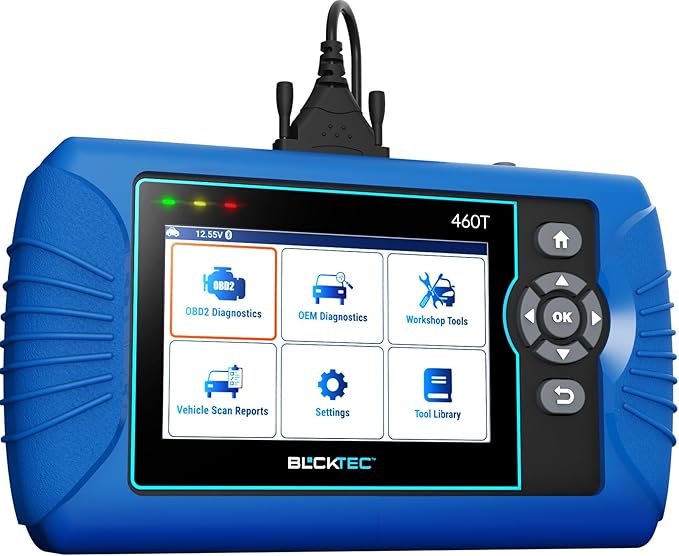 |
BLCKTEC 460T OBD2 Scanner Car Code Reader | Check Price |
| 5 |  |
BlueDriver OBD2 Scanner Bluetooth No Subscription | Check Price |
ANCEL AD310 Classic Enhanced Universal OBD II Scanner Car Engine Fault Code
The ANCEL AD310 is the straightforward choice for drivers who want to understand a check-engine light without dealing with an app, account, battery, or subscription. It reads and clears emission-related diagnostic trouble codes and can display live data after a repair. For a beginner, that simplicity matters: plug it into the vehicle’s OBDII port, follow the screen prompts, and obtain a basic explanation of why the warning light appeared.
Compatibility is one of its strongest points. The scanner supports KWP2000, J1850 VPW, ISO9141, J1850 PWM, and CAN protocols, with coverage listed for many 1996-and-newer U.S. vehicles, 2000-and-newer European and Asian vehicles, light trucks, and SUVs. Its 2.5-foot cable and compact 12-ounce body also make it convenient to keep in a glove box or travel bag.
There is an important boundary, however. The AD310 is intended for emission-related engine diagnostics and does not provide the broader ABS, SRS, transmission, or service-reset coverage that some higher-level scanners offer. It also works through an OBDII interface only; an adapter cannot turn an OBDI vehicle into a compatible one. That makes it a strong basic tool, not a universal solution for every dashboard warning.
Pros
- Supports the major listed OBDII protocols.
- Compact, lightweight design with a thick flexible cable.
- Reads and clears engine-emission codes quickly.
- Simple choice for beginners and occasional home use.
Cons
- Limited mainly to emission-related engine diagnostics.
- Does not provide ABS, SRS, transmission, or advanced reset functions.
- Compatibility still depends on the vehicle having OBDII support.
My Opinion
The AD310 is the best value-oriented starting point for someone who mainly wants check-engine information. Choose it when simplicity and portability matter more than all-system coverage, and verify that your vehicle’s warning system falls within its engine-focused limits.
FOXWELL NT301 OBD2 Scanner Live Data Professional Mechanic OBDII Diagnostic Code Reader
The FOXWELL NT301 builds on basic code reading with tools that help a driver investigate what the engine is doing in real time. Its live-data graphing can display items such as oxygen-sensor readings, fuel trims, coolant temperature, and RPM. Graphs are more useful than a single stored number when a fault appears only while the engine is warming up, accelerating, or operating under a changing load.
It also adds an I/M readiness shortcut with red, yellow, and green indicators, which can help a driver determine whether the vehicle is likely ready for an emissions inspection. EVAP and oxygen-sensor testing provide additional clues for common emissions problems. These features do not automatically identify the failed part, but they can help narrow the direction before paying for diagnostic time.
The 2.8-inch color screen, built-in speaker, plug-and-play operation, and support for all listed OBDII protocols make the NT301 approachable. It is listed for most 1996-and-newer U.S. gasoline vehicles, many 2000-and-newer European and Asian vehicles, and 12-volt diesel vehicles with OBD2. Still, this remains primarily an engine and emissions tool. It should not be confused with a scanner that automatically accesses every vehicle module.
Pros
- Shows and graphs useful live engine data.
- Includes I/M readiness, EVAP, and oxygen-sensor functions.
- Bright color screen and simple one-click code operation.
- Lifetime free updates are listed, with one-year seller assurance.
Cons
- Not a full ABS, SRS, transmission, or service-reset scanner.
- Advanced test usefulness depends on vehicle support and user interpretation.
- Diesel compatibility is limited to suitable 12-volt OBD2 vehicles.
My Opinion
The NT301 is a better fit than the ANCEL for a curious DIY owner who wants to see sensor behavior rather than only retrieve a code. It earns second place because it offers meaningful engine-diagnostic depth while remaining wired, self-contained, and relatively easy to operate.
Innova 5210 OBD2 Scanner & Engine Code Reader
The Innova 5210 is appealing because it combines several ownership tasks in one handheld device. Along with reading and clearing engine codes, it can test the vehicle battery and help assess alternator health. That extra electrical check is useful when a warning light, slow starting, or unexplained battery drain raises questions about whether the problem is the battery, charging system, or engine control system.
Live data covers practical information such as RPM, engine temperature, fuel trims, and oxygen-sensor readings. The scanner also provides drive-cycle readiness information for emissions testing and can reset an oil-maintenance light after service. Some ABS code coverage is available, but it varies by vehicle, so buyers should use Innova’s coverage checker instead of assuming every model receives the same functions.
A notable advantage is the included access to the RepairSolutions2 app. On a compatible iPhone or Android device, the app can provide verified fixes, suggested parts, cost estimates, and repair guidance based on available vehicle information. That can make a code less intimidating for a beginner, although suggestions should still be checked against the actual symptoms and vehicle service information.
Setup details matter. Innova recommends switching the ignition to ON with the engine off before connecting, and the connector should be pressed firmly into the port. Clearing codes or disconnecting the battery resets readiness monitors, so the car needs a complete drive cycle before those monitors repopulate.
Pros
- Combines engine diagnostics with battery and alternator testing.
- Offers live data, oil reset, and emissions-readiness information.
- RepairSolutions2 access adds verified repair guidance without a subscription.
- Works with many U.S., Asian, and European vehicles from 1996 onward.
Cons
- ABS coverage varies by make, model, and year.
- Not every advertised function applies to every compatible vehicle.
- Readiness monitors must be rebuilt after clearing codes or battery disconnection.
My Opinion
The 5210 is a balanced middle choice for a household vehicle owner who wants more than engine codes but does not need professional all-module service work. Its coverage checker is essential, especially if ABS access or oil reset is a deciding factor.
BLCKTEC 460T OBD2 Scanner Car Code Reader
The BLCKTEC 460T is the most ambitious handheld option in this group. It is intended to scan all vehicle systems rather than stopping at the powertrain module, with listed access to engine, transmission, ABS, and SRS codes. AutoVIN, AutoScan, and AutoReLink are meant to reduce the amount of manual setup: after connection, the tool can retrieve the vehicle identification and scan available electronic control units.
Its service functions are the main reason to consider it. Depending on vehicle support, the 460T can handle oil-maintenance reset, ABS bleeding, electronic parking-brake reset, steering-angle recalibration, diesel particulate filter reset, throttle relearn, battery initialization, TPMS relearn, transmission reset, and other maintenance procedures. These functions can be valuable for a capable home mechanic who regularly performs repairs rather than simply checking a warning light.
Live OBD2 and OEM data, freeze-frame information, detailed trouble-code information, and the RepairSolutions2 app add context to the scan. The app can connect codes with verified fixes, parts, maintenance schedules, warranty information, technical service bulletins, and recalls. That is a substantial information package, but it does not remove the need to confirm procedures before changing a safety-related setting.
The biggest limitations are compatibility and geography. The scanner and app are listed for the United States and Canada, and not every function is available on every vehicle. Buyers should check the compatibility tool for the exact make, model, year, and desired reset before ordering.
Pros
- Scans engine, transmission, ABS, SRS, and other available systems.
- Offers more than 12 useful service and reset functions.
- AutoVIN and AutoScan can simplify initial vehicle identification.
- Free lifetime updates and RepairSolutions2 access add long-term value.
Cons
- Functions vary substantially by vehicle.
- Compatibility is limited to the United States and Canada.
- Its broader capabilities may be unnecessary for a driver who only needs engine codes.
My Opinion
The 460T is the closest match here for a buyer who interprets “does everything” as all-system diagnostics plus maintenance procedures. It is the strongest choice for serious DIY work, provided the exact vehicle coverage is confirmed before purchase.
BlueDriver OBD2 Scanner Bluetooth No Subscription
BlueDriver takes a different approach by placing the display and much of the diagnostic guidance in a phone or tablet. The small Bluetooth adapter plugs into the vehicle’s OBDII port and communicates wirelessly with the app, eliminating a long cable and a separate handheld screen. That setup is convenient for someone who prefers a modern interface and wants to view data while sitting in the driver’s seat.
Compared with basic readers, BlueDriver lists enhanced access to check-engine, ABS, SRS, airbag, TPMS, transmission, and other codes on supported vehicles. Its app can show live data, freeze frames, smog readiness, and Mode 6 results. Technician-verified repair reports matched to the VIN can explain code definitions, possible causes, and confirmed fixes, giving beginners more context than a bare alphanumeric code.
Coverage is particularly focused on many current and common brands, including GM, Ford, Stellantis, Toyota, Honda, Nissan, Mazda, Subaru, Hyundai, Mercedes-Benz, BMW, and Volkswagen. It supports gas-powered vehicles from 1996 onward plus select light-duty trucks and diesels. Enhanced communication on select 2024-and-newer Nissan and Mazda vehicles is listed, but buyers should still consult the compatibility chart for the exact vehicle and module.
There is no subscription fee, no required account, and free app updates are included. The trade-off is that the experience depends on a compatible phone or tablet, Bluetooth operation, app access, and vehicle-specific coverage. It also has fewer listed dedicated reset functions than the BLCKTEC 460T.
Pros
- Wireless operation avoids a bulky cable and handheld display.
- Reads enhanced ABS, SRS, TPMS, transmission, and other codes on supported vehicles.
- Provides verified fixes, live data, freeze frames, and Mode 6 information.
- No subscription fees or required account are listed.
Cons
- Requires a compatible phone or tablet for operation.
- Advanced module coverage varies by vehicle.
- Fewer dedicated maintenance-reset functions are listed than with the BLCKTEC.
My Opinion
BlueDriver is the best fit for a smartphone-oriented owner who values guided information and wireless convenience. It is more capable than a basic code reader, but the app and vehicle coverage chart should be treated as part of the purchase decision rather than afterthoughts.
How I Selected These Best OBD2 Scanner That Does Everything Options
The phrase “does everything” can create unrealistic expectations because no consumer scanner provides identical access to every make, model, year, and control module. I therefore compared the products by the breadth of their stated functions, the type of information they provide, and the clarity of their restrictions. A simple engine reader can be the right purchase when the goal is only to investigate a check-engine light; it should not be penalized for failing to perform functions it was never intended to provide.
I gave additional weight to practical capabilities that change ownership decisions: live data, freeze-frame information, battery testing, emissions readiness, ABS or SRS access, maintenance resets, all-system scans, app-based repair information, update policies, and wireless convenience. Compatibility was treated as a deciding factor rather than a footnote because a scanner’s feature list has little value if the buyer’s vehicle cannot use those functions.
Important selection takeaway: “Universal” usually refers to support for common OBDII communication protocols, not guaranteed access to every module or service procedure on every vehicle.
Customer-feedback volume was also considered as one available confidence signal, especially for the established ANCEL and FOXWELL models. It does not prove that every owner will have the same experience, and it cannot replace checking the manufacturer’s coverage information. The final order reflects a progression from simple engine diagnosis to broader professional-style coverage, not a claim that the most capable scanner is best for every driver.
Best buying principle: Match the tool to the warning lights and repairs you actually expect to handle. Paying for unused functions can be less sensible than choosing a simpler scanner with clear compatibility.
How to Choose the Best OBD2 Scanner That Does Everything
Start with the most important warning light or task you need to handle. If the goal is a basic check-engine scan, a wired engine reader may be enough. If you need ABS, airbag, transmission, battery, TPMS, or service-reset access, move up the range and verify coverage for the exact vehicle rather than relying on a general compatibility statement.
- Identify the systems: Decide whether you need engine-only information or access to ABS, SRS, transmission, TPMS, and other modules.
- Check the model year: OBDII support and enhanced functions vary by vehicle age, market, engine, and trim.
- Choose the interface: A handheld scanner works independently, while Bluetooth tools require a compatible phone or tablet.
- Separate codes from repairs: A scanner reports data and may suggest causes, but it does not prove which part should be replaced.
- Confirm service functions: Oil resets, battery registration, ABS bleeding, DPF resets, and relearns are highly vehicle-dependent.
Engine-only versus all-system coverage
Basic OBD2 readers primarily communicate with the engine or emissions system. They are useful for check-engine lights, readiness monitors, and some live data. All-system scanners go further by communicating with modules such as ABS, SRS, and transmission controllers. That broader access is worthwhile if multiple dashboard warnings appear or if you perform brake, airbag, battery, or transmission work.
Live data and freeze-frame information
A stored trouble code identifies a monitored condition, but it rarely tells the entire story. Live data can show sensor values while the engine runs, while freeze-frame data records conditions present when a fault was stored. Look for these functions if you want to compare fuel trims, coolant temperature, oxygen-sensor behavior, RPM, or other readings instead of simply erasing the warning.
Reset functions require caution
Service functions can save a trip to a shop, but they are not harmless shortcuts. An oil reset should follow an actual oil service. Battery initialization should follow the appropriate battery replacement procedure. Steering-angle, electronic-brake, throttle, DPF, and transmission functions may require specific conditions or follow-up steps. A scanner can start a procedure without guaranteeing that the repair was completed correctly.
App-based versus standalone operation
Standalone scanners are convenient when the vehicle is in a garage, driveway, or roadside situation without a phone available. Bluetooth scanners can offer a more familiar interface, guided information, and easier data storage, but they depend on the mobile device, app compatibility, and wireless connection. Consider who will use the tool and whether that person prefers physical buttons or a touchscreen-style phone workflow.
Compatibility Checks Before You Buy
Compatibility should be checked at two levels: whether the vehicle communicates through OBDII at all, and whether the desired function works on the specific vehicle. A scanner may read engine codes on a car but lack ABS or SRS access on that same car. The same model can also support different functions across model years, engines, trims, and regional versions.
Use the brand’s coverage checker whenever one is provided. Search by year, make, model, engine, and system if the tool allows it. For the BLCKTEC 460T, remember that the supplied information limits the scanner and app to the United States and Canada. For the Innova 5210 and BlueDriver, pay particular attention to stated variations in ABS, enhanced modules, and newer-model support.
Physical port location is usually under the dashboard, but access can be tight. Do not force the connector at an angle. A poor connection can look like a scanner failure when the real issue is an incompletely seated plug, a damaged port, or a vehicle that is not switched to the correct ignition position.
How to Use an OBD2 Scanner Safely
Park securely, engage the parking brake, and keep the vehicle stationary while connecting the tool. For most code-reading tasks, switch the ignition to the ON position with the engine off unless the scanner’s instructions specify otherwise. Connect firmly, allow the device to identify the vehicle, and save the original code and freeze-frame information before clearing anything.
- Locate the vehicle’s 16-pin OBDII port under the dashboard.
- Turn the ignition on without starting the engine when instructed.
- Connect the handheld scanner or Bluetooth adapter securely.
- Record codes, descriptions, and freeze-frame data.
- Research the code alongside symptoms and service information.
- Repair the underlying issue before clearing the warning.
- Rescan and confirm whether the fault returns.
Clearing a code is not the same as repairing a vehicle. It can erase useful diagnostic evidence and reset emissions monitors. If the light returns, treat that as information that the fault remains or another related condition has appeared. Safety-system warnings such as ABS or SRS should receive extra attention because they may affect braking or occupant protection.
Getting Better Results From Live Data
Live data is most useful when you establish a normal operating condition first. Note coolant temperature, RPM, fuel trims, and oxygen-sensor behavior at startup, after warm-up, and during a controlled drive when safe. A single unusual number does not automatically identify a failed sensor; wiring, vacuum leaks, fuel pressure, exhaust problems, and other conditions can produce similar readings.
Use graphs when the value changes over time. A graph may reveal a signal that drops out, responds slowly, or changes only under acceleration. Compare related readings rather than focusing on one value in isolation. If the scanner provides Mode 6 or readiness information, use it as supporting evidence and not as a substitute for the vehicle’s service procedure.
Common Mistakes to Avoid
Many scanner problems come from choosing the wrong coverage level or clearing information too early. Avoid the following mistakes before assuming that a tool is defective.
- Buying by the word “universal” alone: Confirm the exact system and vehicle coverage.
- Assuming every code reader accesses ABS: Engine OBD2 communication does not guarantee brake or airbag access.
- Clearing codes before recording them: Save codes and freeze-frame details first.
- Expecting a code to name the failed part: A code points to a monitored condition, not always a replacement component.
- Ignoring readiness monitors: Code clearing or battery disconnection can reset emissions status.
- Using service resets without preparation: Read the procedure and confirm the repair or maintenance was completed.
- Forcing the connector: Stop if the plug does not seat normally and inspect the port.
Do not clear an ABS, SRS, or transmission code simply to turn off the light before understanding the problem. The warning may indicate a condition that affects safety or drivability.
Ownership, Updates and Storage Tips
Keep a wired scanner’s cable loosely coiled rather than sharply folded, and store the tool where it will not be crushed under other equipment. A compact case or protected glove-box space can prevent damage to the connector and screen. Bluetooth adapters should be removed after use if the vehicle’s port remains powered, especially when the car will sit for an extended period.
Install available software or firmware updates according to the brand’s instructions. Updates can improve vehicle coverage and app communication, but they do not guarantee that a previously unsupported module will become available. Keep the vehicle’s make, model, year, engine, and regional market information handy when contacting support or checking coverage.
For phone-based tools, keep the app current and allow the permissions required for Bluetooth communication. A stable phone battery is important during a scan or service procedure. If a scan fails, check ignition position, connector seating, vehicle battery voltage, phone Bluetooth settings, and app compatibility before repeating the operation.
FAQ About OBD2 Scanners That Do Everything
Can one OBD2 scanner read every warning light?
No. Basic OBD2 tools usually focus on engine and emissions faults. ABS, SRS, TPMS, transmission, and body-module access depends on the scanner, vehicle, model year, and regional coverage.
What is the best choice for only a check-engine light?
The ANCEL AD310 is the simplest fit when you only need emission-related engine codes, live data, and code clearing. The FOXWELL NT301 is a better step up if you want graphing, EVAP checks, oxygen-sensor tests, and readiness information.
Does clearing a code fix the vehicle?
No. Clearing removes the stored warning and may reset readiness monitors, but it does not repair the underlying problem. If the fault remains, the code or warning will usually return.
Do all scanners perform oil, battery, or transmission resets?
No. Reset and relearn functions are tool-specific and vehicle-specific. The BLCKTEC 460T lists the broadest group of service functions here, but buyers still need to verify support for the exact vehicle.
Is a Bluetooth OBD2 scanner better than a handheld model?
Neither style is automatically better. Bluetooth models such as BlueDriver offer wireless convenience and app-based guidance, while handheld scanners work without a phone and can be easier to use in a garage or roadside situation.
Should I buy a professional-level scanner for occasional use?
Only if you expect to use its extra systems and service functions. For occasional check-engine diagnosis, a simpler tool may be more practical. For repeated brake, battery, DPF, throttle, or transmission work, broader coverage can justify the added complexity.
Final Thoughts
The best obd2 scanner that does everything depends on what “everything” means for your vehicle. The ANCEL AD310 is my top pick for simple, dependable engine-code work; the FOXWELL NT301 is the stronger alternative for live-data and emissions analysis; and the Innova 5210 adds battery testing, oil reset, and app-guided repair information. For all-system service work, consider the BLCKTEC 460T, while BlueDriver is the wireless choice for supported vehicles and smartphone-based guidance.