
Choosing the best premium dash cam is less about chasing the highest resolution and more about balancing image quality, coverage, parking protection, storage, and easy access to evidence. The right choice should match the way you drive, the type of vehicle you own, and how much installation complexity you are willing to accept.
My first choice is Pioneer VREC-Z820DC Premium 4K Dual Dash Cam Front and Rear Car Camera. Its 4K front camera, 1080p rear camera, built-in GPS, Wi-Fi app, ADAS alerts, 128GB card, and parking mode make it a well-rounded fit for drivers who want broad protection without moving to a four-camera system.
My second choice is REDTIGER F7NP 4K Dash Cam Front Rear. The STARVIS 2 sensor, 4K front and 1080p rear recording, 5.8GHz Wi-Fi, wide viewing angles, supercapacitor, included card, and 18-month guarantee give it particularly strong appeal for commuting and long-distance driving.
My third choice is ROVE R2-4K Dual Dash Cam Front and Rear. ROVE R2-4K Dual Dash Cam Front and Rear STARVIS 2 takes my third spot because it is transparent about its upscaled front resolution while still offering a useful mix of night performance, GPS, fast wireless transfers, and included accessories. Its three-mode parking system and included 128GB card are helpful, although the required hardwire kit adds to the ownership cost for parked-vehicle monitoring.
This guide compares all 10 selections by coverage, night performance, parking protection, connectivity, storage, setup requirements, and ownership trade-offs. You will also find practical advice for choosing resolution, installing the cameras, protecting your memory card, and avoiding common mistakes that can leave important footage unavailable.
10 Best Premium Dash Cam Comparison
I selected these products by looking at how closely each one fits the best premium dash cam search, how useful its supplied specifications are in normal driving, and how clearly its limitations are presented. Customer-feedback volume, listed ratings, brand variety, coverage options, storage support, and parking features also influenced the order, but I did not treat popularity alone as proof of performance.
| # | Image | Product | Price on Amazon |
|---|---|---|---|
| 1 |  |
Pioneer VREC-Z820DC Premium 4K Dual Dash Cam Front and Rear Car Camera | Price on Amazon |
| 2 | 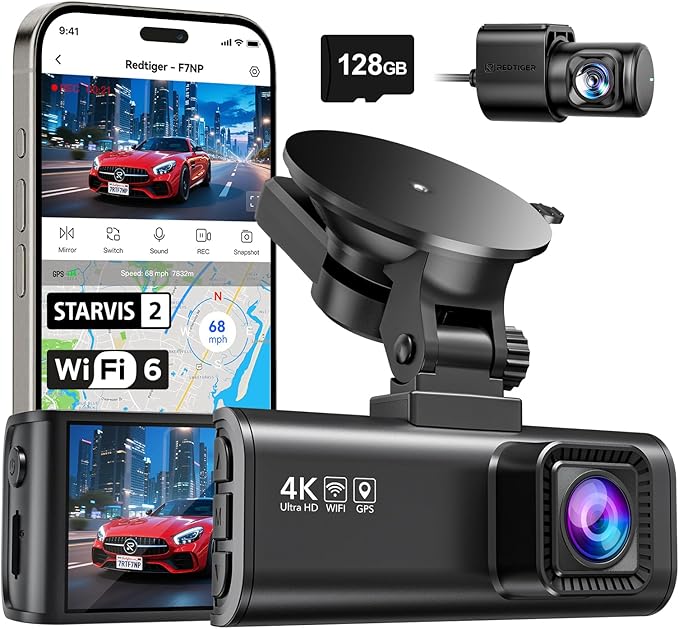 |
REDTIGER F7NP 4K Dash Cam Front Rear | Price on Amazon |
| 3 |  |
ROVE R2-4K Dual Dash Cam Front and Rear | Price on Amazon |
| 4 |  |
VANTRUE N5S 4 Channel 360 Degree Front Rear Inside Dash Cam | Price on Amazon |
| 5 |  |
galphi 4K Dash Cam Front | Price on Amazon |
| 6 |  |
ZMOPO View 4 Channel Dash Cam Front and Rear Left Right Inside | Price on Amazon |
| 7 |  |
70mai A810 Lite 4K Dash Cam Front and Rear 5ghz | Price on Amazon |
| 8 |  |
TERUNSOUl 4K+4K+1080P 3 Channel Dash Cam | Price on Amazon |
| 9 |  |
VIOFO A329S 4K+2K+2K Dash Cam Front Cabin and Rear | Price on Amazon |
| 10 |  |
Aputeta 4K+4K Dual Dash Cam Front and Rear | Price on Amazon |
Pioneer VREC-Z820DC Premium 4K Dual Dash Cam Front and Rear Car Camera
Pioneer’s VREC-Z820DC is a strong all-around option for drivers who want clear coverage in both directions without installing cameras throughout the cabin. The front unit records in 4K UHD while the rear camera records in 1080p, and the 139-degree front and 120-degree rear lenses provide broad views of nearby traffic. That combination is useful for documenting lane changes, rear-end collisions, and details such as road signs or license plates.
Night driving is a major part of its appeal. The proprietary AI-ISP Starvis night-vision system is intended to improve clarity in difficult lighting, while the front camera’s higher resolution gives recorded footage more detail to work with. Built-in GPS adds speed and location information, which can help establish where an event occurred. Wi-Fi and the Ai-Sense app also make it easier to view or download clips without removing the card.
Drivers who spend time in traffic may appreciate the ADAS alerts for front collisions, lane departures, and stop-and-go movement. These should be treated as supplemental reminders rather than replacements for attention. Loop recording prevents the card from filling permanently, while the G-sensor locks impact footage. Parking mode provides coverage while parked, but the optional hardwire kit is sold separately. Installation can use the included 3M adhesive or suction mount and USB-C vehicle power.
Pros
- 4K front and 1080p rear recording with wide viewing angles
- GPS, Wi-Fi app access, ADAS alerts, and a 128GB card included
- Loop recording, impact locking, and parking protection
Cons
- Rear camera resolution is lower than the front camera
- Hardwire kit for more permanent parking protection costs extra
- Customer rating and feedback volume are more limited than several alternatives
My Opinion
This is the best fit for a driver who values a balanced dual-camera package and useful built-in assistance features. Confirm that the optional hardwire installation suits your vehicle before relying on parking mode as a long-term security system.
REDTIGER F7NP 4K Dash Cam Front Rear
The REDTIGER F7NP earns its high position by delivering the features most buyers expect from a modern dual dash camera without making the rear channel an afterthought. It records 4K video in front and 1080p behind, with a 170-degree front lens and 140-degree rear lens. The broader angles can help capture vehicles approaching from adjacent lanes, although extremely wide views can make distant objects appear smaller.
Its STARVIS 2 sensor, F1.5 aperture, six-layer optical lens, WDR, and HDR processing are aimed at maintaining detail when lighting changes quickly. That matters when moving from bright sunlight into a tunnel or dealing with headlights after dark. The built-in 5.8GHz Wi-Fi can transfer files at speeds of up to 20MB/s according to the supplied data, and the companion app provides playback, downloads, settings, and GPS information from a phone.
Loop recording automatically replaces older unlocked files, while the G-sensor protects clips associated with sudden impacts. The included memory card makes the package easier to use immediately, though buyers should still check the card periodically because continuous 4K recording places a heavy workload on storage. Two parking options are listed: time-lapse monitoring and impact-triggered recording. A supercapacitor instead of a lithium battery improves heat resistance, and the 18-month guarantee adds useful ownership reassurance.
Pros
- 4K front and 1080p rear footage with wide lenses
- STARVIS 2, HDR, WDR, fast 5.8GHz Wi-Fi, and GPS data
- Included card, supercapacitor construction, and 18-month guarantee
Cons
- Very wide lenses may reduce the apparent size of distant details
- Parking setup and accessory requirements should be confirmed before installation
- Managing large 4K files can consume card space quickly
My Opinion
The F7NP is a sensible second choice for buyers who want strong everyday specifications and a substantial customer-feedback record. It is especially attractive for commuters who want fast phone transfers and a package that is close to ready out of the box.
ROVE R2-4K Dual Dash Cam Front and Rear
ROVE takes an unusually transparent approach with the R2-4K Dual: the front camera records at 2.5K QHD and intelligently upscales the footage to 4K for playback. That is not the same as native 4K capture, but it can still provide sharper everyday footage than a basic Full HD system. The rear camera records in 1080p, giving the setup useful front-and-back coverage for ordinary commuting and travel.
The front camera uses a Sony STARVIS 2 IMX675 sensor with a wide F1.5 aperture, while the rear aperture is F1.8. HDR and the larger front aperture are intended to improve low-light detail and reduce the effect of harsh contrast. Built-in GPS records speed, route, and location information, and the 3-inch IPS display shows live speed and compass direction. That screen is convenient during setup, though some drivers may prefer to keep it turned off while driving.
Wireless file management is another strength. Dual-band 5.8GHz and 2.4GHz Wi-Fi connect to the ROVE app, with downloads listed at up to 20MB/s. A free 128GB card, trim tool, clips, mounts, cables, and dual USB car charger are included. The three parking modes—time-lapse, motion detection, and collision detection—are more useful for parked protection, but a hardwire kit is required and is not included. Use the supplied power cable and a compliant 5V source as directed.
Pros
- Clear disclosure that the front 4K output is upscaled from 2.5K
- STARVIS 2, GPS, fast Wi-Fi, screen, and included 128GB card
- Three parking options and a generous installation accessory package
Cons
- Front recording is not native 4K
- Hardwire kit is required for the listed 24-hour parking modes
- Additional screen and settings may be more than a minimalist buyer needs
My Opinion
This is a good value-oriented choice for someone who wants extensive accessories and practical controls while understanding the difference between upscaled and native 4K. It is best purchased with the parking installation plan decided in advance.
VANTRUE N5S 4 Channel 360 Degree Front Rear Inside Dash Cam
The Vantrue N5S is aimed at drivers who need more than front-and-rear road footage. Its four-channel arrangement records the front, rear, cabin, and additional side or interior perspectives, creating a much fuller picture of what happens around the vehicle. The listed recording combination reaches 2.7K, 1080p, 1080p, and 1440p across the available channels, with flexible one-, two-, three-, or four-channel operation.
All four cameras use STARVIS 2 technology, with HDR and WDR processing intended to preserve detail in mixed lighting. The rear camera uses a 2.5K IMX675 sensor, while the rear-cabin camera uses an IMX662 sensor. A 210-degree-style interior perspective is not listed here, so buyers should think of this as a multi-camera coverage system rather than assume every angle is equally wide. The extra views are particularly useful for rideshare drivers, family vehicles, and anyone concerned about cabin incidents.
Five-gigahertz Wi-Fi, GPS, and the Vantrue app support clip transfers, settings, sharing, and mileage information. Voice control can save video, take a photo, or control audio and screen functions without reaching for the camera. Buffered parking mode records 10 seconds before a detected motion event, while the G-sensor locks collision clips. The supercapacitor and heat-resistant construction are useful for vehicles exposed to temperature changes. Storage support reaches 1TB, but four-channel recording naturally creates more files and makes careful card management important.
Pros
- Four-channel coverage for the road, cabin, and surrounding areas
- STARVIS 2 sensors, HDR/WDR, GPS, Wi-Fi, and voice control
- Buffered parking recording and support for storage up to 1TB
Cons
- More cameras mean more cables, setup decisions, and storage usage
- Not every channel records at the same resolution
- May be excessive for buyers who only need front-and-rear evidence
My Opinion
The N5S is the strongest match here for rideshare, family, and security-focused use where cabin context matters. Choose it only if you are comfortable with a more involved installation and the higher volume of multi-channel footage.
galphi 4K Dash Cam Front
galphi’s compact front-only camera focuses on discreet installation and simple operation. Its 4K recording and 160-degree lens can provide detailed evidence from the road ahead while keeping the device small enough to sit behind the rearview mirror. The lack of a built-in display reduces visual distraction and gives the camera a cleaner, less noticeable presence inside the vehicle.
The 5GHz Wi-Fi connection and app are useful when a phone is more convenient than removing the card. Listed transfer speeds reach up to 8MB/s, which should make short clips easier to retrieve, although it is slower on paper than the fastest systems in this group. Loop recording replaces old footage as storage fills, and the G-sensor locks clips after sudden movement or a collision.
Parking monitoring is available through time-lapse recording, but the Type-C hardwire kit is not included. That is an important ownership detail because the camera will need a suitable permanent power arrangement for parked protection. The listing also indicates that the included card changes to 32GB starting June 26, 2026, from a previously listed 64GB package. Since 4K files can fill smaller cards quickly, confirm the current package and consider the expected recording duration before purchase.
Pros
- Compact, screen-free design with 4K front recording
- 5GHz Wi-Fi, app access, loop recording, and impact locking
- Simple fit for drivers who do not need a rear or cabin camera
Cons
- No rear-camera coverage
- Hardwire kit for parking mode is sold separately
- Current card capacity should be verified because the listing notes a change to 32GB
My Opinion
This is the most appealing option for a first-time buyer who wants a small front-only camera and minimal visual distraction. Its limited coverage and smaller included card make it less suitable for drivers seeking long-duration or full-vehicle protection.
ZMOPO View 4 Channel Dash Cam Front and Rear Left Right Inside
ZMOPO’s four-channel system takes a different approach to all-around protection by recording the front, rear, left, and right sides at Full HD 1080p. That arrangement can help document side impacts and parking-lot incidents that a traditional front-and-rear setup may miss. Adjustable front cameras add some flexibility, and the system can also be configured to capture interior views depending on the installation angle.
Eight infrared lights support cabin visibility in darkness, while WDR helps balance bright and shaded areas in the outside footage. The result should be useful for rideshare work, family transportation, or drivers who regularly park in busy areas. It is worth remembering that four Full HD channels create broad coverage rather than the fine detail of a high-resolution 4K front camera.
The 5GHz Wi-Fi connection allows file sharing through an iOS or Android app, and loop recording deletes the oldest unlocked footage when the card fills. A 128GB card is included. Parking mode uses time-lapse recording and requires an optional ACC hardwire kit, while GPS is also optional through a separately sold logger. Those two details matter: the camera can record without them, but location stamps and permanent parked monitoring are not automatically part of the base setup. A supercapacitor, 24-month product assistance period, and stated customer support add ownership value.
Pros
- Four Full HD channels cover front, rear, left, and right views
- Infrared cabin lighting, WDR, 5GHz Wi-Fi, and included 128GB card
- Supercapacitor construction and a stated 24-month assistance period
Cons
- Optional GPS logger and ACC hardwire kit add extra cost
- All channels are Full HD rather than 4K
- Four-camera installation can require more careful cable routing
My Opinion
ZMOPO makes sense for buyers who value side coverage more than maximum front-camera resolution. Confirm the separate GPS and hardwire accessories before ordering if those functions are central to your purchase.
70mai A810 Lite 4K Dash Cam Front and Rear 5ghz
The 70mai A810 Lite combines a 4K front camera with a 1080p rear camera in a compact body that is described as roughly credit-card sized. That makes it a good candidate for mounting behind the mirror without blocking much of the driver’s view. The wide-angle lenses and dual-channel recording provide practical coverage for daily driving, while the front resolution helps preserve details such as road signs and license plates.
Night capability comes from an F1.55 aperture, HDR, and enhanced low-light processing. These features are intended to reduce glare and retain information in tunnels, rain, and dark roads. Wi-Fi 6 can transfer files at up to 25MB/s through the app, where drivers can view clips, adjust settings, check GPS data, and install updates. Three-mode GPS combines GPS, GLONASS, and BDS positioning for route and speed information.
The standout feature is support for 4G LTE remote access, live view, vehicle tracking, and alerts. Buyers should confirm exactly what equipment or service is needed for the LTE functions in their vehicle before assuming remote access will work immediately. Parking mode offers impact detection and time-lapse recording, with built-in low-voltage protection listed among its functions. Voice control, a supercapacitor, an 18-month warranty, and beginner-friendly installation round out the package.
Pros
- 4K front and 1080p rear recording in a compact design
- Wi-Fi 6, three-mode GPS, HDR night vision, and voice control
- Supports remote access and parking monitoring features
Cons
- LTE functionality may require additional setup or service confirmation
- Rear resolution is limited to 1080p
- Parking mode still requires careful power planning for long-term use
My Opinion
This is a compelling choice for connected-car owners who want fast transfers and the possibility of checking on a parked vehicle remotely. Its strongest advantage is connectivity, so verify the LTE requirements before making that feature a deciding factor.
TERUNSOUl 4K+4K+1080P 3 Channel Dash Cam
TERUNSOUl stands out with a three-channel arrangement that records 4K in front, 4K behind, and 1080p inside the cabin. The dual 4K road cameras are unusual at this price-position level and can provide more detail at both ends of the vehicle than a system with a 1080p rear camera. Its 170-degree front, 150-degree rear, and 150-degree cabin angles are intended to reduce blind areas.
Night protection is supported by AProX HD processing, WDR, and four infrared lights in the cabin camera. That combination is particularly relevant to rideshare drivers and anyone who needs interior footage after dark. The cabin channel is still 1080p, so it should be viewed as context and occupant coverage rather than equivalent detail to the road-facing cameras.
Dual-band Wi-Fi 6 connects to the TERUNSOUL app for clip transfers, settings, sharing, and OTA updates, with speeds listed up to 20MB/s. GPS records speed and location, while loop recording overwrites older material and the G-sensor locks important events. The included 128GB card can be expanded to a listed maximum of 512GB, useful for three-channel recording. Parking protection uses time-lapse monitoring and collision detection. A three-year guarantee and 24/7 support are meaningful advantages, although the more capable system demands careful cable routing and storage planning.
Pros
- 4K front, 4K rear, and 1080p cabin recording
- Wi-Fi 6, GPS, OTA updates, infrared cabin lighting, and WDR
- 128GB card included, support for up to 512GB, and three-year guarantee
Cons
- Three-channel recording uses storage quickly
- Interior footage is 1080p rather than 4K
- More cameras create a more involved installation than a dual system
My Opinion
This is one of the strongest choices for buyers who want high-resolution coverage in front and behind while still recording the cabin. It offers an impressive feature mix, provided the buyer is willing to manage larger files and a more complex installation.
VIOFO A329S 4K+2K+2K Dash Cam Front Cabin and Rear
VIOFO’s A329S is built for drivers who want detailed three-channel coverage rather than a basic front-and-rear arrangement. The front camera records in 4K at 30 frames per second, the cabin camera uses a 2K fisheye lens with a very broad 210-degree view, and the rear camera records in 2K. That mix gives the system strong road detail while maintaining a wide view inside the vehicle.
Three STARVIS 2 sensors are used across the cameras. The front IMX678 sensor is intended to reduce low-light noise and motion blur, while the rear and cabin cameras use IMX675 sensors. HDR across the channels helps balance bright and dark areas, which can be important when a vehicle moves between shade and sunlight or when headlights enter the frame.
File handling is a major strength. Wi-Fi 6 transfers data at up to 30MB/s, and the supplied information states that a one-minute 4K clip can transfer in under 10 seconds under suitable conditions. Storage support reaches up to a 512GB microSD card or a 4TB external SSD, making it attractive for long trips and high-volume recording. Parking mode uses low-power impact detection and requires an HK4 or HK6 hardwire kit. The slim coaxial cables and miniature connectors can help create a neat installation, though three cameras still require time and planning.
Pros
- 4K front, 2K cabin, and 2K rear recording
- 210-degree cabin view, three STARVIS 2 sensors, and HDR
- Very fast Wi-Fi 6 and support for large microSD or SSD storage
Cons
- Hardwire kit is needed for the listed parking protection
- External SSD or high-capacity card adds to the ownership budget
- Three-channel installation is more involved than a dual-camera setup
My Opinion
The A329S is a strong technical choice for long trips, rideshare use, or anyone who wants unusually large storage capacity. It is best for a buyer who appreciates advanced file management and is prepared to plan the installation carefully.
Aputeta 4K+4K Dual Dash Cam Front and Rear
Aputeta’s dual-camera system offers 4K recording from both the front and rear cameras, which is its clearest selling point. The front lens covers 170 degrees and the rear lens covers 160 degrees, giving the driver broad road coverage in both directions. Unlike a front-and-cabin system, it concentrates its resolution on external traffic, making it a logical choice for drivers primarily concerned with collisions, tailgating, and road incidents.
The starlight-level sensor, F1.5 aperture, five-element optical lens, and WDR are intended to preserve color and contrast in difficult lighting. This does not eliminate the limitations of nighttime glare or dirty glass, but it gives the camera a strong specification base for evening driving. Built-in 5.8GHz and 2.4GHz Wi-Fi connect to the phone app for viewing, downloads, GPS data, and settings.
Loop recording, voice guidance, emergency locking, collision detection, and GPS positioning cover the main daily-use functions. A 128GB card is included, and the listing states that the materials are designed to withstand extreme cold and heat. Time-lapse parking monitoring can record a full one-minute clip after an event, but the hardwire kit is required and sold separately. The 18-month coverage and 24/7 customer support offer useful assistance, although buyers seeking cabin or side footage will need a different layout.
Pros
- 4K recording from both front and rear cameras
- Wide lenses, starlight night vision, WDR, GPS, and app connectivity
- 128GB card included with impact locking and parking support
Cons
- No cabin or side-facing camera coverage
- Hardwire kit is required for parked monitoring
- Dual 4K files can use storage quickly
My Opinion
Aputeta is a good match for drivers who want maximum listed resolution at both ends of the car without adding interior cameras. It deserves consideration when front-and-rear detail matters more than expanded coverage or advanced remote access.
How I Selected These Premium Dash Cameras
The selection process began with relevance to the requested category, then moved to the features that make a premium camera useful in everyday ownership. I considered front and rear resolution, sensor technology, night-focused features, viewing angles, GPS, wireless transfer, parking protection, storage, included accessories, power requirements, warranty or guarantee information, and customer-feedback volume where supplied.
Ranking was not based on one specification. A native 4K front camera may be preferable for some drivers, but a four-channel system can be more valuable to a rideshare driver who needs cabin evidence. Similarly, a hardwire-dependent parking mode can be excellent in practice while still being a poor fit for someone who wants a simple plug-in installation.
Important selection takeaway: Resolution is only one part of evidence quality. Coverage, nighttime processing, correct installation, reliable storage, and the ability to retrieve a locked clip can matter just as much after an incident.
The first three positions favor balanced dual-camera packages with useful connectivity and strong everyday coverage. The remaining selections add meaningful alternatives: four-channel protection, compact front-only simplicity, connected remote access, dual 4K recording, or unusually large storage support.
A premium purchase should match the owner’s actual use. Paying for cabin cameras, LTE access, or multi-terabyte storage makes little sense if the vehicle only needs a discreet front-and-rear system.
How to Choose a Premium Dash Cam
When comparing the best premium dash cam options, start with the type of evidence you are most likely to need rather than the most impressive number on the box. A commuter may prioritize clear front footage and easy phone downloads, while a rideshare driver may need a cabin camera, and a parked vehicle owner may care most about low-power monitoring and impact alerts.
- Choose front-and-rear coverage if rear-end incidents and traffic disputes are your main concern.
- Look for STARVIS 2, HDR, WDR, or a large aperture when nighttime detail matters.
- Confirm whether parking mode needs a separate hardwire kit before purchasing.
- Match card capacity to the number of channels and resolution you plan to record.
- Prefer simple app transfers if you expect to access clips often.
Resolution: Native, Upscaled, and Channel Balance
Front-camera resolution receives the most attention, but the rear channel matters too. A 4K front and 1080p rear system can be a sensible compromise when most incidents occur ahead of the vehicle. Dual 4K systems place more detail behind you as well, but they create larger files and increase the need for reliable storage.
Pay close attention to wording around 4K. The ROVE R2-4K Dual explicitly states that its 2.5K front recording is upscaled to 4K. Upscaling can improve the appearance of playback, but it is not identical to capturing native 4K detail. Clear disclosure is useful because it lets buyers compare products honestly.
Night Driving and Glare Control
Night performance depends on more than resolution. STARVIS 2 sensors, larger apertures, HDR, WDR, and multi-element lenses can help preserve detail when the scene contains headlights, streetlights, dark roads, and reflective signs at the same time. No dash camera can guarantee perfect license-plate visibility in every situation, especially when the glass is dirty or a vehicle is moving quickly.
Keep the lens area clean and mount the camera where the windshield wipers clear the glass. A technically capable camera cannot compensate for water spots, haze, tint interference, or a lens placed behind a dirty portion of the windshield.
Coverage for Different Vehicles and Drivers
Dual front-and-rear systems are the most broadly useful configuration for private vehicles. Four-channel products add side and cabin context, which may be worthwhile for rideshare work, family transportation, or security concerns. A cabin camera can show what happened inside the vehicle, but it also raises privacy considerations for passengers.
Front-only products are not automatically poor choices. A compact camera such as the galphi can be preferable when the buyer wants a discreet installation and does not need rear coverage. The key is to understand what the camera cannot record before an incident occurs.
Parking Mode and Vehicle Power
Parking mode can work through time-lapse recording, motion detection, or impact detection. Time-lapse uses a lower recording rate to extend monitoring, while impact detection concentrates on events that trigger the G-sensor. Buffered systems can preserve moments immediately before an event, which may provide more context than a clip that begins after the impact.
Many products in this list require a hardwire kit for parked monitoring. A hardwire installation should be planned around the vehicle’s power system and the camera’s low-voltage protection. If you are not comfortable routing power or working near vehicle wiring, professional installation may be a safer choice, although no particular installer or price is guaranteed here.
Installation Tips for a Clean, Reliable Setup
A good installation improves both the camera’s view and the reliability of the system. Before attaching anything permanently, sit in the driver’s seat, check the line of sight, and make sure the camera does not create a distracting obstruction.
Mounting the Front Camera
Place the front camera high enough to preserve the driver’s view but low enough that the lens sees through the portion of windshield cleared by the wipers. Clean the glass before using an adhesive mount. A suction cup offers easier repositioning, while an adhesive mount can provide a more discreet permanent placement.
Use the live view or display during setup to confirm that the horizon is reasonably level and that the hood does not occupy too much of the frame. Avoid mounting directly over important windshield sensors or in a location that interferes with mirror adjustment.
Routing the Rear or Cabin Cable
Run the rear-camera cable along the headliner and trim rather than allowing it to hang across the windshield or doors. Leave enough slack near hinges and adjustable camera joints, but avoid tight bends that could stress the connector. Three- and four-channel systems require extra planning because every camera adds another cable path.
Before hiding all cables, power the complete system and confirm that every channel appears correctly. This simple check can prevent removing trim later because a connector was not fully seated.
Power and Accessory Checks
Use the supplied or officially recommended power cable where the product data calls for it. The REDTIGER guidance specifically warns against low-quality or non-original cables, and the ROVE instructions call for the included power cable with a compliant 5V source. For parking mode, confirm whether the required hardwire kit is included, optional, or absent.
Memory Cards, Storage, and File Management
High-resolution and multi-channel cameras can create a large amount of data. Loop recording keeps the system running by overwriting older unlocked files, but it does not eliminate the need for card care. A locked event folder can also become full if important clips are never copied elsewhere.
Choosing Capacity
Several products include a 128GB card, while the galphi package lists 32GB under the stated future package change. TERUNSOUl supports up to 512GB, and VIOFO lists support for a 512GB microSD card or an external SSD up to 4TB. These capacities are not interchangeable across products, so follow the specific camera’s supported limits rather than assuming every large card will work.
More channels and higher resolutions consume storage faster. A four-channel 1080p system may produce more total data than a single 4K camera because multiple views record simultaneously. Keep that relationship in mind when comparing a card included in the box with the capacity you may want later.
Protecting Important Footage
When an incident occurs, stop recording if it is safe to do so, lock the relevant clip using the camera’s controls or app, and copy it to another device. Avoid repeatedly opening, editing, or sharing the only copy from the card. Keep the original file with its associated metadata when possible, especially if GPS information is important.
Format or replace storage according to the camera’s instructions rather than waiting for unexplained errors. Before formatting, confirm that every needed file has been backed up.
Using Wi-Fi, GPS, and Mobile Apps Effectively
Built-in Wi-Fi is generally intended for a direct connection between the camera and phone, not for providing normal internet access. Stand near the vehicle, enable the camera’s Wi-Fi, connect through the app, and download only the clips you need when possible.
Transfer speeds vary substantially in the supplied data. Some models list up to 8MB/s, others up to 20MB/s, and the 70mai and VIOFO options list up to 25MB/s and 30MB/s respectively. Actual transfers can vary with the phone, file size, connection conditions, and app behavior. If a clip is very large, moving the card or using a supported external storage method may be more practical.
Understanding GPS Information
GPS can add speed, route, and location information to footage or make that information available through playback software. The Pioneer, ROVE, 70mai, TERUNSOUl, and Aputeta listings include GPS-related functions. ZMOPO lists GPS as an optional separate logger, so do not assume its base package provides location stamps.
GPS data can be useful for establishing where a trip or incident occurred, but it should be checked for accuracy and configured according to your preferences. Some drivers may choose to disable speed display for privacy or presentation reasons.
Parking Protection: What Owners Should Know
Parking monitoring is valuable when a vehicle spends time on the street, in public lots, or at an airport. It can help capture vandalism, a hit-and-run, or suspicious movement, but the camera must remain powered and correctly configured.
Time-lapse mode conserves storage by compressing long periods into fewer frames. Collision detection focuses on impacts and may miss an event that creates little movement. Motion detection can provide more context but may produce additional files in busy areas. Buffered recording is useful because it can preserve the seconds before the camera detects the event.
Do not assume that a camera advertised with 24-hour monitoring will operate from the standard cigarette-lighter socket after the vehicle is turned off. The supplied data identifies separate hardwire requirements for several models. Check the vehicle-specific accessory plan and low-voltage protection before leaving a camera connected for extended periods.
Maintenance and Long-Term Ownership
Dash cameras live in a difficult environment: direct sun, temperature swings, vibration, dust, and repeated writing to removable storage. A few simple habits can reduce avoidable failures.
- Clean the lens and windshield area with a suitable soft cloth.
- Inspect rear-camera and power cables after trim work or seasonal changes.
- Check the date, time, and GPS settings periodically.
- Confirm that loop recording is active and that the card still has usable space.
- Copy important clips before formatting or replacing the card.
- Use the supplied or officially recommended cables and accessories.
- Keep firmware current when the manufacturer provides a safe update method.
Supercapacitor-equipped products such as the REDTIGER, Vantrue, 70mai, and ZMOPO options are listed as having heat-resistance advantages over battery-based designs. That does not make any camera immune to extreme temperatures, so sensible placement and proper shutdown remain important.
Common Mistakes to Avoid with a Premium Dash Cam
Most ownership problems come from setup choices rather than a lack of headline features. Buyers often focus on resolution, then overlook power, storage, lens placement, or the difference between optional and included accessories.
- Buying without checking coverage: A front-only camera cannot document what happens behind or beside the vehicle.
- Assuming 4K always means native 4K: Check whether the camera records at the stated resolution or upscales from a lower source.
- Skipping the hardwire requirement: Parking mode may not work after ignition shutdown without the correct kit.
- Using an unsuitable card or cable: Follow the product’s storage and accessory guidance.
- Mounting behind dirty or tinted glass: The lens needs a clear view through the windshield.
- Ignoring locked files: Protected clips can fill the card and stop normal loop recording from working as expected.
- Failing to test every channel: Check front, rear, cabin, and side views before hiding the cables.
Caution: Do not handle the phone or adjust the camera while driving. Set up the system while parked, and pull over safely before downloading or sharing footage.
FAQS About Best Premium Dash Cam
Is a dual dash cam better than a front-only camera?
For most drivers, a dual system provides more useful evidence because it records both traffic ahead and events behind the vehicle. A front-only model can still be a sensible choice when a compact installation, lower cost, or simple operation matters more than rear coverage.
What resolution should a premium dash camera have?
4K front recording is a strong starting point for buyers who want fine detail, especially when reading signs or identifying vehicles ahead. A 1080p rear camera can still be useful, while dual 4K systems offer more detail at the expense of larger files and greater storage demand.
Do premium dash cameras need a hardwire kit for parking mode?
Many do. The listed products vary, but the Pioneer, ROVE, galphi, ZMOPO, VIOFO, and Aputeta information specifically identifies separate or optional hardwire requirements for certain parking functions. Check the exact package and vehicle power arrangement before relying on parked monitoring.
Is GPS important in a premium dash camera?
GPS is useful when you want speed, route, or location information associated with a clip. It is not essential for recording video, and some products make it optional. Confirm whether GPS is built in, requires a separate logger, or is accessed through an app.
How much storage is needed for a multi-channel dash camera?
The answer depends on resolution, the number of cameras, clip length, and how often files are copied off the card. A 128GB card is included with several selections here, while some systems support 512GB or even a large external SSD. Always follow the product’s stated compatibility limits.
Are voice controls necessary?
No, but they can be convenient for saving a clip, taking a photo, or controlling the screen without reaching toward the camera. They are most useful for drivers who want fewer physical interactions while moving, although ordinary safe driving attention remains more important.
Final Thoughts
The best premium dash cam for most drivers is the Pioneer VREC-Z820DC because it balances 4K front footage, rear coverage, GPS, Wi-Fi, ADAS, parking support, and a supplied 128GB card. The REDTIGER F7NP is my second choice for its STARVIS 2 system, fast connectivity, supercapacitor, and substantial customer-feedback record, while the ROVE R2-4K Dual remains a strong third choice for buyers who appreciate its accessories and transparent upscaled-4K design. Choose among these three according to your need for balanced coverage, connected features, or straightforward everyday value.