The AstroAI AIRUN H Tire Inflator Portable Air Compressor is my top choice for most crossover and midsize SUV owners who want a compact, straightforward inflator for routine tire-pressure maintenance. Its 12V power, digital gauge, preset pressure control, and automatic shutoff make it especially convenient for keeping in a cargo area for everyday emergencies.
For drivers who want more power-source flexibility, the DEWALT DCC020IB 20V MAX Corded/Cordless Inflator is a strong alternative. It can operate from a compatible 20V battery or a vehicle’s 12V supply, making it useful at home, on road trips, and around a garage.
Owners of larger SUVs, off-road vehicles, or models with higher-volume tires should also consider the VIAIR 88P Portable Compressor Kit. Its direct-to-battery design, long hose, and stronger compressor-oriented construction make it better suited to demanding inflation jobs than many small emergency pumps.
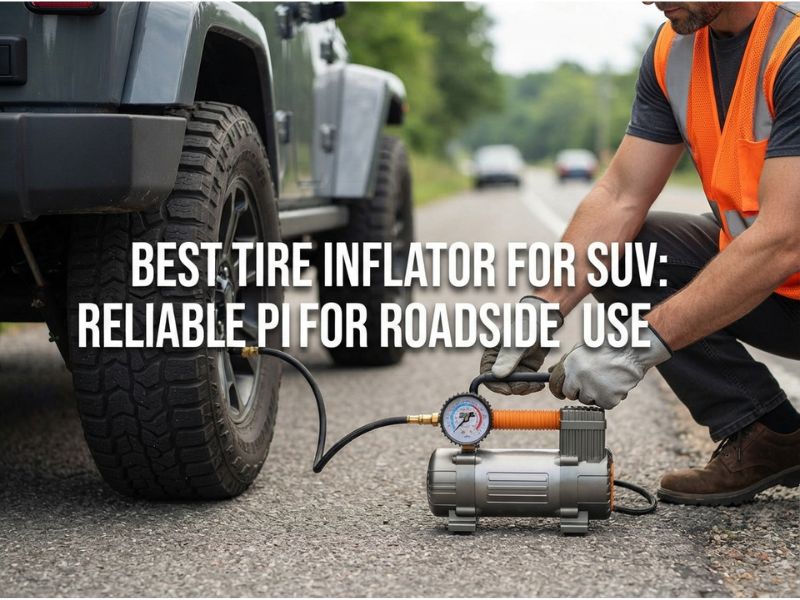
Best Tire Inflator for SUV: Quick Picks
| Image | Product Name | Check Price |
|---|---|---|
Best Choice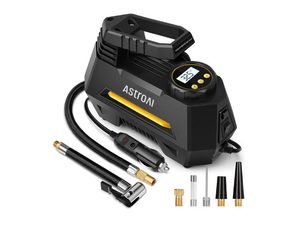 | AstroAI AIRUN H Tire Inflator Portable Air Compressor | Check Price |
Second Best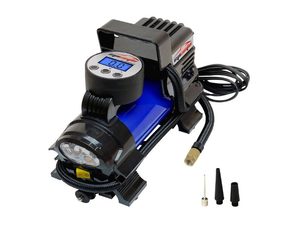 | EPAuto 12V DC Portable Air Compressor Pump | Check Price |
Third Choice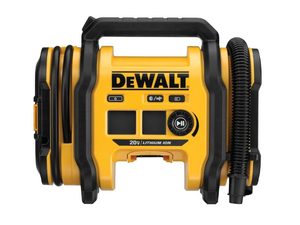 | DEWALT 20V MAX Corded/Cordless Inflator | Check Price |
 | GSPSCN 12V Heavy Duty Double Cylinder Tire Inflator | Check Price |
 | VIAIR 88P Portable Compressor Kit | Check Price |
Choosing an SUV tire inflator is slightly different from buying a pump for a compact sedan. SUV tires generally contain more air, often use taller sidewalls, and can take noticeably longer to inflate when pressure is significantly low. A small compressor may advertise a very high maximum PSI yet still move air too slowly to be convenient on a larger tire.
For that reason, I considered air delivery, power source, continuous-use capability, pressure control, reach, portability, tire-size suitability, and ease of operation rather than simply ranking pumps by their advertised PSI number.
The five products below also represent different ownership needs. Some prioritize compact trunk storage and automatic operation, while others prioritize airflow and the ability to handle larger SUV tires repeatedly.
1. AstroAI AIRUN H Tire Inflator Portable Air Compressor – Best Overall for Everyday SUV Use
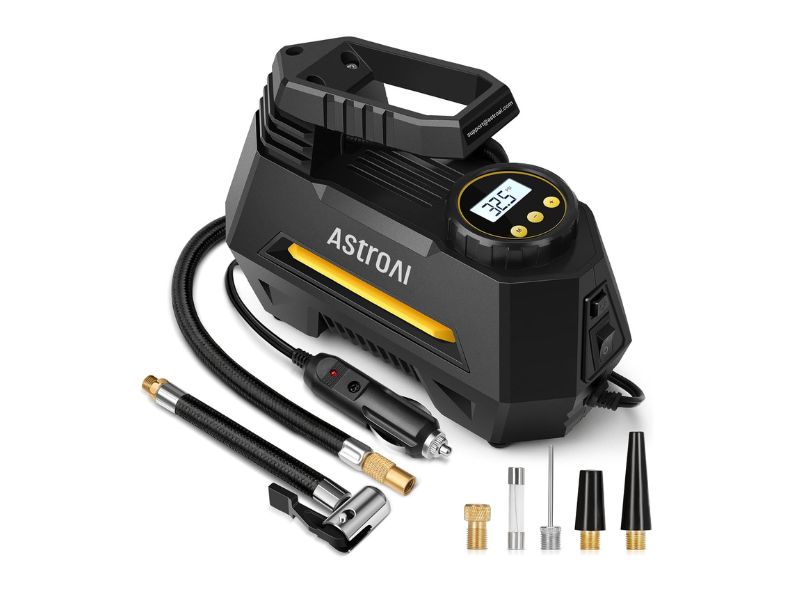
Key Features
- 12V DC vehicle power
- Maximum pressure of 100 PSI
- Digital pressure display
- Preset pressure with automatic shutoff
- Built-in LED light
- Approximately 9.8-foot power cord
- Compact body for cargo-area storage
- Multiple pressure units for easier reading
The AstroAI AIRUN H makes the most sense for SUV owners who primarily need an inflator for routine pressure correction rather than serious off-road air-up duties. It plugs into a vehicle’s 12V accessory socket, so there is no rechargeable battery to remember to maintain.
That matters more than it may sound. A cordless inflator can be extremely convenient, but an internal battery that has been sitting unused for months may not be fully charged when a roadside emergency occurs. A 12V unit draws its operating power directly from the vehicle, making it easier to leave in the cargo compartment as part of an emergency kit.
The digital controls are another major advantage for everyday drivers. You can set the desired pressure, start the compressor, and allow the automatic shutoff system to stop inflation when the target is reached. This is much more convenient than repeatedly stopping a basic analog compressor to check pressure manually.
Its compact size also works well in SUVs where cargo space is valuable. The pump can stay with a tire plug kit, pressure gauge, flashlight, reflective vest, and other roadside equipment without consuming much room.
For a crossover or midsize SUV that is simply a few PSI low, this is the type of inflator that is easy to use regularly. It is especially appropriate for maintaining pressures in the common 30-to-40-PSI range.
The limitation is airflow. A compact single-motor 12V inflator should not be expected to perform like a heavy-duty dual-cylinder compressor. If a large 31-inch or 33-inch SUV tire is nearly flat, filling it can require considerably more time and compressor heat management.
That distinction is important because maximum PSI and inflation speed are not the same thing. An inflator may be capable of producing 100 PSI while still moving less air than a larger compressor. For routine maintenance, however, compactness and automatic operation can be more useful than maximum airflow.
What I Like
The automatic shutoff is the strongest everyday feature. It reduces the need to crouch beside the tire watching a gauge and makes pressure adjustments much easier for drivers who only occasionally use an air compressor.
I also like that its operation is simple enough for an emergency kit. There is no separate battery ecosystem, charger, or complex setup. Connect it to the SUV’s 12V supply, set the pressure, and inflate.
The digital display and LED lighting are helpful after dark, and the relatively small body is easier to store than a full-size portable compressor.
What I Do Not Like
It is not the model I would choose for frequent airing down and airing back up during off-road driving. Larger SUV tires benefit from more airflow and heavier-duty compressor construction.
The 12V cord also means the vehicle must remain nearby, so it cannot provide the completely independent portability of a battery-powered inflator.
Verdict
For most crossover and midsize SUV owners, the AstroAI AIRUN H offers the best balance of simplicity, portability, automatic pressure control, and everyday usefulness. It is particularly well suited to topping off tires, correcting TPMS-related pressure loss, and handling occasional roadside inflation.
2. EPAuto 12V DC Portable Air Compressor Pump – Best Simple Automatic Inflator
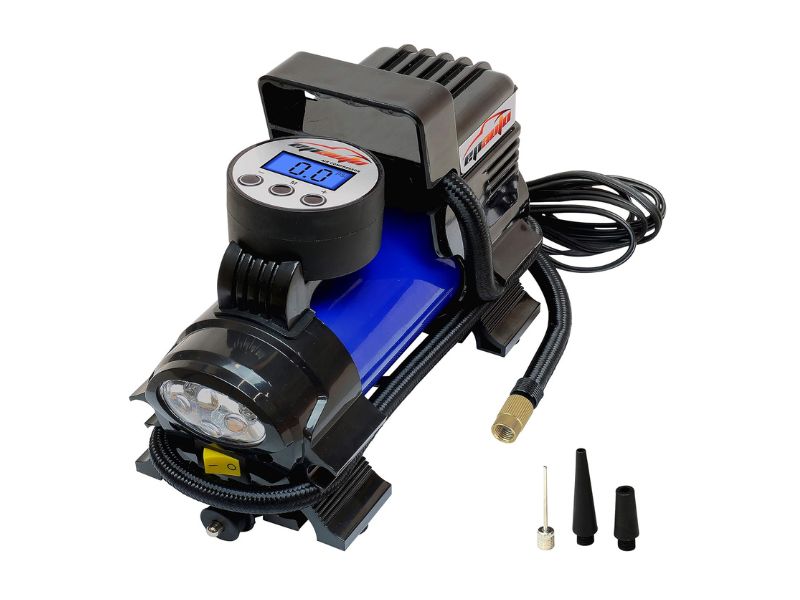
Key Features
- 12V DC plug-in operation
- Up to 100 PSI maximum pressure
- Digital pressure gauge
- Automatic shutoff
- Multiple pressure-unit selections
- Integrated flashlight
- Compact carrying size
- Accessory nozzles for additional inflation tasks
The EPAuto 12V DC Portable Air Compressor follows a similar philosophy to the AstroAI: keep operation simple, provide a digital pressure display, and make it easy for the average driver to correct low tire pressure without dealing with a larger compressor.
Its biggest strength is usability. A traditional portable compressor with an analog gauge can be perfectly effective, but it puts more responsibility on the operator. You have to monitor pressure, stop the compressor, verify the reading, and avoid overshooting the recommended specification.
An automatic inflator simplifies that process. The ability to choose a pressure target is particularly useful when adjusting all four SUV tires after a significant weather change.
Tire pressure naturally changes with temperature. During colder months, a vehicle that was properly inflated in warmer weather may display a low-pressure warning even when there is no puncture. Keeping a compact pump in the SUV means those seasonal corrections do not require a dedicated compressor at home.
The EPAuto is best viewed as an everyday maintenance and emergency unit for standard passenger-vehicle tires. It is not designed to compete directly with high-airflow compressors used for large truck tires, recreational vehicles, or repeated off-road inflation.
For a family crossover, compact SUV, or many midsize SUVs running factory-size tires, that tradeoff is reasonable. A small inflator is far easier to keep in the vehicle than a six- or seven-pound metal compressor with long hoses and battery clamps.
Its digital gauge also makes the pump easier for occasional users who are unfamiliar with analog compressor gauges. Pressure can typically be viewed in familiar units such as PSI, BAR, KPA, or KG/CM².
As with every portable inflator, users should still verify the vehicle manufacturer’s recommended tire pressure from the driver’s door-jamb placard. The large number printed on a tire sidewall is not the normal operating-pressure recommendation for the vehicle.
What I Like
The EPAuto’s strongest quality is predictability. It provides the core features most SUV owners need without making operation complicated.
The compact shape works well for permanent storage in a cargo area, and the integrated light is useful when checking pressure at night or on an unlit roadside.
Automatic shutoff is also valuable because it makes repeated pressure adjustments less tedious.
What I Do Not Like
The pump is better for topping off tires than recovering a very large SUV tire from extremely low pressure. Users with oversized all-terrain tires should look toward a higher-flow compressor.
Like other plug-in 12V models, its working radius is limited by the vehicle power connection and cord length.
Verdict
The EPAuto is a practical choice for drivers who want a straightforward digital SUV tire pump with automatic shutoff. It is especially attractive for normal highway-driven crossovers and midsize SUVs that remain on factory-size tires.
3. DEWALT DCC020IB 20V MAX Corded/Cordless Inflator – Best Multi-Power Tire Inflator
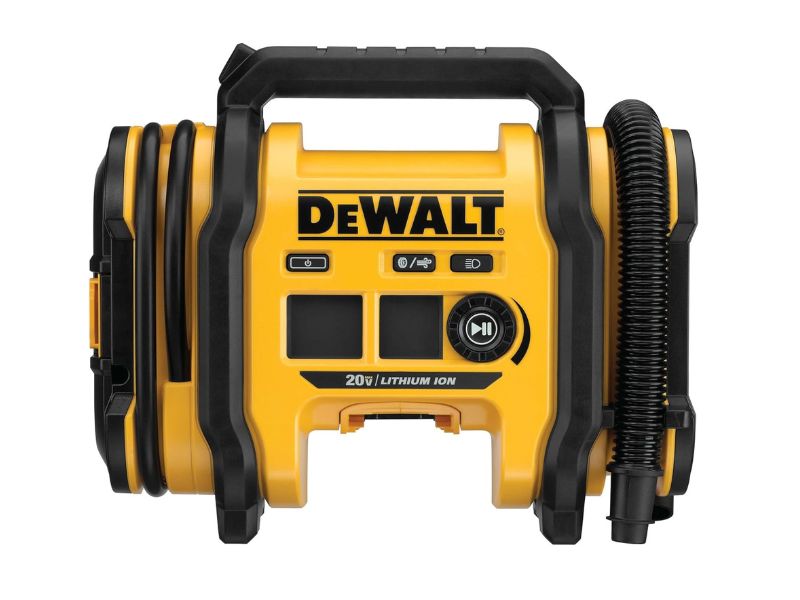
Key Features
- Compatible with DEWALT 20V MAX batteries
- 12V DC vehicle-power capability
- 110V AC capability with compatible power adapter
- Digital pressure setting
- High-pressure automatic shutoff
- High-volume inflation and deflation modes
- LED work light
- Threaded tire chuck
- Onboard accessory storage
- Rugged jobsite-oriented construction
The DEWALT DCC020IB is the most versatile option in this group. Instead of committing the user to a single power method, it can work from a compatible 20V MAX battery or a vehicle’s 12V power source, while compatible AC operation adds another option for garage use.
That flexibility is particularly useful for homeowners who already own DEWALT 20V tools. A battery that is used regularly in drills, impact drivers, saws, or other tools can also power the inflator, eliminating the need to maintain a separate proprietary inflator battery.
Cordless operation is convenient around an SUV because there is no power cable stretching through an open door or around the vehicle. Move from the front tire to the rear tire, connect the threaded chuck, set the target pressure, and let the inflator work.
The unit also includes a 12V power option. That provides an important backup if the tool battery is discharged during a road trip.
Another distinction is its combination of high-pressure and high-volume inflation modes. High-pressure mode is appropriate for vehicle tires, while the high-volume system is intended for items such as mattresses and other large inflatables. The high-volume hose can also be used for deflation.
This multifunction design makes the unit useful beyond roadside tire maintenance. Families who use their SUV for camping, recreation, sports, or travel may get more value from it than from a tire-only compressor.
The automatic shutoff system is especially helpful with SUV tires. Instead of attempting to judge pressure through a small analog gauge while the compressor vibrates, the user can select the desired PSI and allow the inflator to stop automatically.
The threaded chuck creates a secure connection to the Schrader valve, reducing the chance of accidentally knocking the hose loose while inflation is in progress. Some users prefer a lever-style chuck because it connects faster, but threaded connectors generally feel secure.
The main drawback is cost and size relative to very compact 12V pumps. It is also commonly sold as a bare tool, meaning buyers who want cordless operation need a compatible battery and charger unless they already own them.
That makes its value highly dependent on the buyer. Someone already invested in the DEWALT battery platform may see it as an obvious choice. Someone starting from zero and only needing an occasional tire pump may find a simple 12V inflator more economical and easier to justify.
What I Like
The multi-power design is the biggest advantage. Having both battery and vehicle-power options reduces the chance of being unable to use the inflator when needed.
The high-pressure automatic shutoff is convenient for tires, while the separate high-volume mode expands its usefulness for camping and recreational gear.
Construction and onboard storage also feel more like a workshop tool than an ultra-compact emergency pump.
What I Do Not Like
The tool is larger than the smallest inflators, so it takes up more space in an SUV’s storage compartment.
Cordless operation can also require an additional investment because the battery and charger may not be included. Buyers should verify exactly what comes with the package they select.
Verdict
The DEWALT DCC020IB is one of the best choices for an SUV owner who values cordless convenience without giving up a 12V backup power source. It is particularly compelling for existing DEWALT 20V MAX users.
4. GSPSCN 12V Heavy Duty Double Cylinder Tire Inflator – Best High-Flow Value for Large SUV Tires
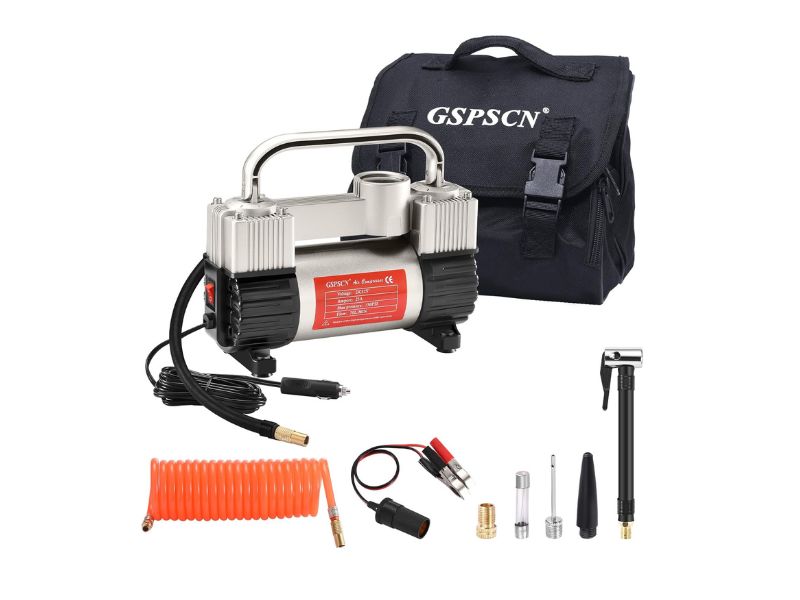
Key Features
- Dual-cylinder compressor design
- 12V DC operation
- Up to 150 PSI maximum pressure
- Approximately 70 L/min rated airflow
- Battery-clamp capability
- Long extension air hose
- Metal-oriented heavy-duty construction
- Carrying bag
- Multiple inflation adapters
- Designed for cars, SUVs, vans, trucks, and similar vehicles
The GSPSCN Heavy Duty Double Cylinder Tire Inflator shifts the focus from compact convenience to air-moving capability. That is exactly what some SUV owners need.
A larger tire contains significantly more air than a small passenger-car tire. If an SUV is equipped with wide all-terrain tires or a larger overall tire diameter, a basic single-cylinder compressor can feel painfully slow when pressure is more than a few PSI low.
The GSPSCN uses a dual-cylinder design intended to move considerably more air. Its rated airflow is a major reason it is better suited to larger tires than many small accessory-socket pumps.
This kind of compressor can be especially appealing to owners of body-on-frame SUVs, pickups, vans, campers, and off-road vehicles. Drivers who reduce tire pressure before traveling on sand, loose terrain, or rocky trails need to restore that pressure before sustained highway driving. Doing that across four large tires places a much greater workload on a compressor than simply adding two PSI to one tire.
The unit’s longer hose arrangement also helps around longer vehicles. Reach matters more with a three-row SUV than it does with a small hatchback. A pump can have excellent airflow yet still be frustrating if the power cord and hose cannot comfortably reach the rear wheels.
Unlike the automatic digital models higher on this list, the GSPSCN emphasizes mechanical simplicity and high output. That means the driver must pay more attention to pressure and manually stop the compressor when the target is reached.
For experienced users, that is not necessarily a problem. Many off-roaders already carry a separate accurate tire-pressure gauge and prefer a compressor that prioritizes airflow over electronic features.
A separate gauge can also be useful because built-in compressor gauges are exposed to vibration and heat. Checking final pressure independently helps ensure all four tires are adjusted consistently.
The heavier metal construction makes the pump less convenient for minimalist storage, but it also gives the unit a more substantial feel for repeated use.
What I Like
The combination of dual cylinders and high rated airflow is its biggest advantage for SUV owners. It is much better aligned with large tire volume than a miniature emergency inflator.
The long hose and battery-clamp capability also make it practical around larger vehicles.
I also like that it comes with a carrying bag, which helps keep the compressor, hose, clamps, and adapters together instead of scattered across the cargo area.
What I Do Not Like
There is no automatic shutoff, so the operator must monitor inflation rather than simply selecting a target pressure.
The unit is also heavier and bulkier than compact 12V pumps. For a small crossover that only needs occasional top-offs, it may be more compressor than necessary.
Verdict
The GSPSCN is a strong choice for SUV owners who value airflow and larger-tire capability over compact size and automated controls. It is particularly appropriate when normal use involves larger tires, frequent pressure changes, or heavier vehicles.
5. VIAIR 88P Portable Compressor Kit – Best for Large and Off-Road SUV Tires

Key Features
- 12V compressor
- Direct battery-clamp connection
- Up to 120 PSI working pressure
- Approximately 1.47 CFM rated airflow
- Designed for tires up to 33 inches
- 16-foot air hose
- 10-foot power cord
- Brass twist-on tire chuck
- LED work light
- Carry bag
- Inflation adapters
The VIAIR 88P is the most SUV-focused compressor in this roundup when tire size and repeated inflation matter more than automatic convenience.
Its key specification is not the 120 PSI maximum. The more useful information is its compatibility with tires up to approximately 33 inches and the amount of air it can move. That makes it a better match for large-volume tires than many small pumps marketed primarily around maximum pressure.
The direct battery connection is another clue about its intended use. Instead of drawing power through a standard cabin accessory socket, the compressor connects to the vehicle’s battery using clamps.
A direct connection can support higher current demand and avoids the limitations of lower-amperage accessory circuits. The tradeoff is that setup takes slightly longer, and users must be comfortable accessing the battery terminals.
For an SUV that spends most of its life on pavement, this may feel less convenient than a plug-in digital pump. For an off-road SUV with 31-inch or 33-inch tires, the performance-oriented design can be much more important.
The long air hose is especially useful. A compressor can sit near the battery while the hose reaches tires around the vehicle, reducing the need to repeatedly move the compressor itself.
The brass twist-on chuck provides a secure valve connection. The compressor also includes a pressure gauge, but unlike automatic preset units, it requires active monitoring.
This is a good example of why the “best” inflator changes according to the vehicle. The AstroAI is easier for occasional pressure corrections. The DEWALT offers greater power flexibility. The GSPSCN emphasizes dual-cylinder airflow. The VIAIR 88P prioritizes dependable medium-duty compression for larger tires.
For an owner who regularly drives trails and lowers tire pressure for traction, that distinction becomes significant. Re-inflating four SUV tires from a low off-road pressure can heat a small compressor quickly and take considerable time. A model designed around larger tires is a more appropriate tool.
What I Like
The 33-inch tire capability makes the 88P especially relevant to SUVs, pickups, and off-road vehicles.
Its long hose gives excellent reach, and the direct-to-battery power arrangement is appropriate for a compressor drawing more current than a basic accessory-socket unit.
The mechanical design is also straightforward, which is useful when durability and predictable operation matter more than extra electronic features.
What I Do Not Like
There is no preset automatic shutoff on this version, so pressure must be monitored manually.
Battery clamps are less convenient than plugging into a cabin 12V socket, especially for owners who rarely open their hood or who have an unusually located battery.
Verdict
For an SUV with larger tires—or for drivers who regularly air down and air back up—the VIAIR 88P is the most purpose-built option here. It sacrifices some automatic convenience in exchange for better large-tire suitability, long reach, and compressor-focused performance.
SUV Tire Inflator Comparison
| Product | Power Source | Max Pressure | Automatic Shutoff | Gauge Type | Airflow/Design | Tire-Size Focus | Best For |
| AstroAI AIRUN H | 12V DC | 100 PSI | Yes | Digital | Compact single-compressor design | Factory-size crossover and midsize SUV tires | Everyday top-offs and emergencies |
| EPAuto 12V DC | 12V DC | 100 PSI | Yes | Digital | Compact portable design | Standard passenger-vehicle and SUV tires | Simple automatic inflation |
| DEWALT DCC020IB | 20V battery / 12V DC / compatible 110V AC | High-pressure tire inflation | Yes | Digital | High-pressure plus high-volume modes | Standard SUV tires | Cordless and multi-purpose use |
| GSPSCN Double Cylinder | 12V DC / battery clamps | 150 PSI | No | Analog | Dual cylinder, about 70 L/min rated airflow | Larger SUV, truck, and van tires | Faster high-volume inflation |
| VIAIR 88P | 12V battery clamps | 120 PSI | No | Analog | About 1.47 CFM compressor | Tires up to about 33 inches | Large tires and off-road SUVs |
For most everyday SUV owners, AstroAI and EPAuto provide the simplest experience because they combine digital pressure selection with automatic shutoff.
The DEWALT is the most flexible when multiple power sources matter, particularly for drivers who already use compatible cordless-tool batteries.
The GSPSCN and VIAIR 88P are better choices when tire volume becomes the priority. Their designs are more appropriate for drivers who expect to inflate larger tires or make larger pressure changes rather than simply correcting a two- or three-PSI loss.
How to Choose the Best Tire Inflator for an SUV
Match the Inflator to Your Actual Tire Size
“SUV” covers an enormous range of vehicles. A subcompact crossover can use tires similar in volume to those on a passenger car, while a full-size SUV or modified off-road vehicle may have substantially larger tires.
Check the tire size printed on the sidewall. A size such as 225/60R18 places less demand on a compressor than a large 33-inch all-terrain tire.
Owners of standard crossovers can usually prioritize convenience, automatic shutoff, and compact size. Owners of large SUVs should place more emphasis on airflow, compressor duty cycle, power draw, and hose reach.
Do Not Choose Based on Maximum PSI Alone
One of the most common buying mistakes is assuming a 150 PSI inflator must be faster or more powerful than a 100 PSI model.
Maximum pressure only describes the highest pressure the compressor is designed to produce. It does not tell you how quickly the compressor can move a useful volume of air into a large SUV tire.
For vehicle tires, airflow and compressor efficiency often matter more than an extreme PSI rating. Most passenger SUVs operate at pressures far below 100 PSI.
A compressor with strong airflow at normal tire pressures can outperform a small pump with a higher advertised maximum PSI.
Understand CFM and LPM
Airflow may be expressed in CFM, or cubic feet per minute, or LPM, liters per minute.
Higher airflow generally means faster inflation, although real-world speed also depends on tire size, starting pressure, target pressure, compressor temperature, and how manufacturers measure their ratings.
For routine top-offs, a compact inflator can be perfectly adequate. For repeated inflation of large tires, a stronger airflow rating becomes much more valuable.
Consider 12V Accessory-Socket Power
A 12V plug-in inflator is one of the easiest types to keep in an SUV. It draws power from the vehicle and requires no separate battery charging.
This makes it particularly useful as an emergency tool. Even after sitting in the cargo area for months, it can still work as long as the vehicle’s electrical system and power outlet are functioning.
The limitation is current capacity. Vehicle accessory sockets have fuse limits, and a larger compressor may draw more current than the outlet is designed to provide.
Always check the compressor’s power requirements and the vehicle outlet rating before use.
Consider Direct Battery Clamps for Higher-Demand Compressors
More powerful 12V compressors often connect directly to the vehicle battery.
This arrangement is common on units intended for SUVs, trucks, off-road vehicles, and larger tires. Direct battery power can supply a compressor without relying on a lighter-duty cabin accessory circuit.
The disadvantages are additional setup and the need to connect the clamps correctly. Drivers who prioritize maximum simplicity may prefer a lower-powered plug-in inflator.
Decide Whether Cordless Operation Matters
A battery-powered tire inflator is very convenient. There are no cords running through the cabin, and you can move freely around the SUV.
Cordless operation makes even more sense if the inflator uses the same battery system as tools you already own. In that situation, batteries are usually charged and rotated through normal use.
A dedicated rechargeable inflator battery is different. If the pump sits untouched for months, the battery’s state of charge should be checked periodically.
For an emergency device, a dual-power inflator can provide an ideal compromise. Battery power offers convenience while 12V vehicle power provides backup.
Look for Automatic Shutoff
Automatic shutoff is one of the most useful features for everyday tire maintenance.
The user selects the target pressure, and the pump stops when that pressure is reached. This reduces the risk of accidentally overinflating a tire and makes moving from wheel to wheel much easier.
It is especially helpful for drivers who do not use compressors frequently.
Heavy-duty inflators often omit this feature in favor of simpler construction and higher airflow. In that case, a separate tire gauge becomes more important.
Check Hose and Power-Cord Reach
SUVs are longer and taller than many passenger cars, so cable and hose reach should not be overlooked.
A compressor may sit near the front of the vehicle while being required to reach a rear tire on the opposite side. Short connections can turn a simple pressure adjustment into an awkward process.
Longer hoses are especially valuable on full-size SUVs and trucks.
Consider Compressor Duty Cycle
A compressor generates heat while operating. The duty cycle describes how long it can run under specified conditions before it needs time to cool.
For adding a few PSI to one tire, this is rarely a major issue. For inflating four large SUV tires after off-road driving, it matters much more.
Frequent off-road drivers should look for a compressor designed around sustained use rather than assuming every compact emergency inflator can handle continuous operation.
Decide Whether You Need Digital or Analog Controls
A digital inflator is usually easier for routine vehicle maintenance. It can show pressure clearly, and many models include preset inflation and automatic shutoff.
An analog compressor is mechanically simpler and often paired with more heavy-duty designs. Experienced users may prefer this setup when combined with a separate high-quality tire-pressure gauge.
Neither style is inherently better. The right choice depends on whether your priority is automation or compressor performance.
Check the Tire Chuck Design
Most SUV tires use standard Schrader valves.
A threaded chuck screws onto the valve and provides a secure seal. A lever-style chuck can connect and disconnect more quickly.
Either can work well when designed properly. The important point is that the chuck seals without leaking significant air during inflation.
Look at Storage, Not Just Compressor Size
A portable inflator often comes with more than the pump itself. There may be a long power cable, air hose, battery clamps, adapters, and replacement fuses.
A carrying case or storage bag helps keep the entire system together. This is especially useful in an SUV where cargo shifts during driving.
A slightly larger compressor with organized storage can be easier to live with than a smaller one surrounded by loose cables.
What PSI Should SUV Tires Be Inflated To?
The correct pressure is determined by the vehicle manufacturer, not by the tire inflator and not simply by the largest number printed on the tire.
Look for the tire and loading information placard on the driver’s door jamb or nearby door frame. The vehicle owner’s manual may also provide the specification.
Many passenger SUVs use recommended cold pressures somewhere around the 30-to-40-PSI range, but there are many exceptions. Front and rear specifications can also differ.
The pressure shown on the tire sidewall is generally related to the tire’s maximum rated conditions. It should not automatically be treated as the recommended everyday inflation pressure for your SUV.
Pressure should ideally be checked when tires are cold, meaning the vehicle has been parked long enough for tire temperature to stabilize.
Why SUV Tire Volume Matters
A larger tire contains more air. That sounds obvious, but it has major implications for portable compressor performance.
Imagine two inflators that can both reach 120 PSI. One moves a relatively small amount of air per minute while the other uses a larger motor and compressor assembly with substantially higher airflow.
Both can advertise the same maximum PSI, but the second unit may restore a large SUV tire much faster.
This is why serious off-road compressors often look physically larger, use battery clamps, have longer hoses, and specify airflow or duty-cycle information.
For a driver who only needs to raise four tires from 32 to 35 PSI, a small pump may be ideal. For a driver trying to raise four 33-inch tires from trail pressure back to highway pressure, the same pump may feel inadequate.
Cordless vs. 12V Tire Inflators for SUVs
Cordless inflators win on convenience. There is no cord to route around open doors, no dependence on outlet location, and no need to position the vehicle in a particular way.
They are excellent for regular home maintenance, especially when powered by a battery platform that is already part of the owner’s tool collection.
A 12V inflator wins on long-term emergency readiness. It can remain in the SUV without requiring periodic charging of a dedicated battery.
For many drivers, the ideal answer is not choosing one philosophy exclusively. A multi-power unit provides cordless convenience while retaining vehicle-powered backup.
Off-road and large-tire users often move in the opposite direction. They may prefer direct battery clamps because airflow and sustained output matter more than quick setup.
Digital vs. Analog Tire Inflators
A digital display is easier to read in poor lighting and can make precise adjustments more convenient. Digital models frequently include automatic shutoff.
This combination is excellent for everyday drivers who simply want all four tires set to the correct cold pressure.
Analog gauges remain common on higher-flow compressors. They provide immediate pressure feedback without requiring complex electronic controls.
If pressure accuracy is critical, it is sensible to verify the final reading with a separate quality tire gauge regardless of which type of inflator you use.
Portable Tire Inflator vs. Garage Air Compressor
A garage air compressor remains the better tool for frequent workshop use. A tank-style compressor can power pneumatic tools, blow dust from equipment, and fill tires rapidly.
However, it is not useful when the SUV is miles away from home.
A portable inflator fills that gap. It can live in the cargo area and provide air during commuting, road trips, vacations, camping, or roadside emergencies.
Many SUV owners eventually find that the best setup is having both: a larger compressor at home and a portable unit in the vehicle.
Is a 100 PSI Tire Inflator Enough for an SUV?
For the vast majority of passenger SUVs, yes. Normal recommended tire pressures are far below 100 PSI.
A higher maximum-pressure rating does not automatically make an inflator better for an SUV.
What matters more is whether the compressor can deliver enough air efficiently at typical vehicle pressures and whether its duty cycle is appropriate for the tire volume.
If your SUV has oversized tires, focus on airflow and tire-size compatibility before chasing a high maximum PSI number.
How Fast Should an SUV Tire Inflator Be?
There is no universal inflation time because starting pressure, target pressure, tire volume, ambient temperature, and compressor output all affect the result.
A pump adding three PSI to a crossover tire may finish quickly. The same pump taking a large tire from nearly flat to full pressure may need much longer.
Instead of judging speed from one advertised time, ask what kind of inflation you expect to perform most often.
For occasional pressure maintenance, convenience usually matters more than maximum speed. For off-road air-ups, compressor output and heat management should become priorities.
Tire Inflator Safety Tips for SUV Owners
Always inflate tires to the vehicle manufacturer’s recommended specification unless you have a specific application that requires a different pressure.
Keep the vehicle in a safe location away from traffic whenever possible. Roadside tire work is dangerous when performed close to moving vehicles.
Inspect the compressor hose, power cord, and electrical connections before use. Damaged insulation, cracked hoses, or loose connectors can create problems.
Portable compressors can also become hot during operation. Avoid touching hot metal components immediately after extended inflation and follow the manufacturer’s cooling guidance.
If a tire has lost most or all of its pressure unexpectedly, do not assume inflation alone solves the problem. The tire may have a puncture, damaged valve stem, bead problem, or sidewall damage that requires professional inspection.
Common Mistakes When Buying an SUV Tire Inflator
Choosing Only by Maximum PSI
A 150 PSI label looks impressive, but it does not guarantee quick inflation of a high-volume tire. Consider airflow and tire-size suitability.
Ignoring Tire Diameter
A pump that is fine for a compact crossover may be frustrating with 33-inch all-terrain tires.
Assuming Every 12V Outlet Can Power Every Compressor
Higher-output pumps can draw substantial current. Check both the compressor requirement and the vehicle circuit rating.
Forgetting Battery Maintenance
Cordless pumps are only convenient when the battery is charged. A dedicated emergency inflator should have its battery checked periodically.
Ignoring Hose Reach
Long SUVs can expose short-hose designs quickly. Confirm that the setup can comfortably reach every wheel.
Expecting an Inflator to Repair a Tire
A tire inflator restores air pressure; it does not repair the cause of air loss. A punctured or damaged tire still needs proper repair or replacement.
Frequently Asked Questions
What is the best tire inflator for SUV use?
The best SUV inflator should match your tire size, airflow needs, and preferred power source.
For routine crossover and midsize SUV maintenance, a compact automatic 12V model such as the AstroAI AIRUN H is easy to keep in the vehicle. Larger SUVs and off-road tires benefit from stronger compressor-oriented options such as the GSPSCN dual-cylinder unit or VIAIR 88P.
Is a portable tire inflator strong enough for an SUV?
Yes, many portable inflators can handle normal SUV tires when properly matched to tire size.
Factory-size crossover and midsize SUV tires generally work well with quality portable inflators. Larger all-terrain tires require more air volume, so a higher-flow compressor is a better choice when significant pressure changes are common.
Is 150 PSI necessary for SUV tires?
No, most passenger SUVs operate at pressures far below 150 PSI.
Maximum PSI is primarily a compressor capability specification. Your SUV’s recommended pressure should come from the door-jamb placard. When comparing inflators, airflow and duty cycle can be more meaningful than the maximum pressure number.
Can I leave a tire inflator in my SUV?
Yes, a portable inflator is an excellent item to keep in an SUV emergency kit.
Keep it stored securely so it does not move around the cargo area. Protect hoses and cables from sharp objects, moisture, and extreme conditions when possible. Recharge battery-powered models periodically.
Should I buy a cordless or 12V SUV tire inflator?
Cordless models maximize convenience, while 12V models provide dependable vehicle-powered emergency use.
A cordless model is easy to carry around the vehicle, especially if you already own compatible tool batteries. A 12V pump avoids depending on a charged battery. Multi-power designs combine both advantages.
Is automatic shutoff important?
Automatic shutoff is highly useful for routine SUV tire-pressure maintenance and occasional users.
It allows you to select a target PSI and lets the inflator stop automatically. Heavy-duty compressors may omit the feature, in which case the driver should monitor pressure carefully.
Can a tire inflator fix a flat tire?
An inflator can restore air pressure, but it cannot repair structural tire damage or punctures.
If a tire has a small repairable tread puncture, a separate approved repair solution may temporarily or permanently address the leak depending on the repair method. Sidewall damage and many other failures require replacement.
What size compressor do I need for 33-inch SUV tires?
Choose a compressor specifically rated for larger tires with strong airflow and an appropriate duty cycle.
A model such as the VIAIR 88P is designed around tires up to approximately 33 inches. Large tire size makes compressor airflow and continuous-use capability more important than compact dimensions.
Why does my SUV’s TPMS light come on in cold weather?
Cold temperatures reduce tire pressure and can trigger the tire-pressure monitoring system.
Pressure typically drops as ambient temperature falls. Check all tires when cold and adjust them to the vehicle manufacturer’s specification rather than simply adding an arbitrary amount of air.
Should I trust the gauge built into a tire inflator?
Built-in gauges are convenient, but verifying final pressure with a separate gauge is sensible.
This is particularly useful with analog compressors or when maintaining exact pressures across all four tires. Consistent tire pressure supports predictable handling and even tire wear.
Final Verdict
For most drivers searching for the best tire inflator for SUV use, I recommend the AstroAI AIRUN H Tire Inflator Portable Air Compressor first. It provides the features that matter most during normal ownership: compact storage, simple 12V power, a digital display, preset pressure control, and automatic shutoff.
The EPAuto 12V DC Portable Air Compressor is another practical choice for everyday tire maintenance, while the DEWALT DCC020IB is better for buyers who value cordless operation and multiple power options.
Drivers with larger SUV tires should look more closely at compressor airflow. The GSPSCN 12V Heavy Duty Double Cylinder Tire Inflator offers stronger high-volume performance, while the VIAIR 88P Portable Compressor Kit is the most purpose-built option here for larger tires and off-road use.
The right choice ultimately depends on how your SUV is used. A commuter crossover needs convenience and easy pressure control. A full-size or trail-driven SUV benefits more from airflow, duty cycle, direct battery power, and long hose reach. Match the inflator to the tire rather than choosing solely by the biggest PSI number, and you will end up with a tool that is far more useful when you actually need it.