Yes, you can usually fly with a car jump starter if its lithium battery meets airline capacity limits and you pack it in your carry-on baggage. For U.S. flights, the key specification is the jump starter’s watt-hour (Wh) rating, not its advertised peak amps.
Portable jump starters contain high-energy rechargeable batteries, so airlines regulate them similarly to spare lithium-ion batteries and portable power banks. Whether yours can travel without approval, requires airline permission, or cannot fly at all depends primarily on its battery capacity.
Check This Number Before You Pack Your Jump Starter
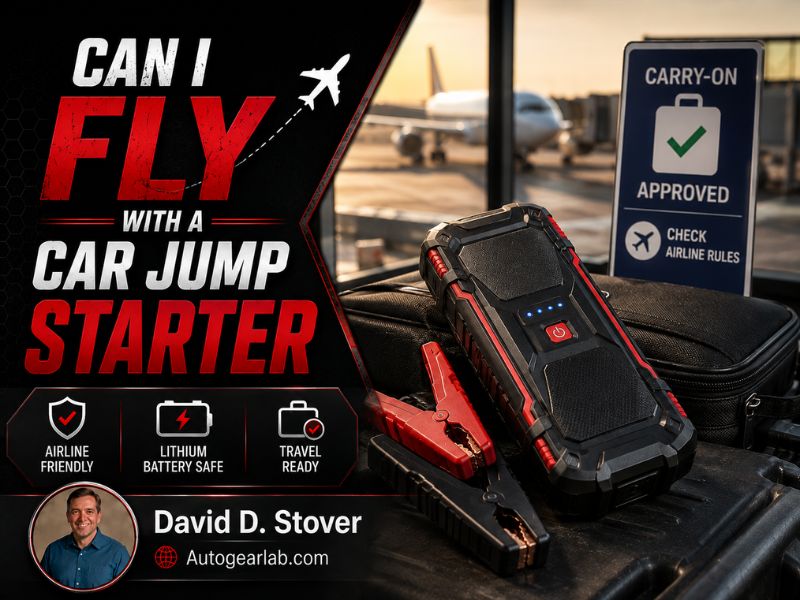
Ignore the large 1,000A, 2,000A, or 4,000A peak-current rating on the front of the jump starter for a moment.
That number matters when starting a vehicle, but it is not what aviation regulations use to determine whether you can bring the device aboard an airplane.
For air travel, find the battery’s Wh rating.
Under current FAA passenger-baggage guidance:
| Lithium Battery Capacity | U.S. Air Travel Rule |
| 0–100 Wh | Generally permitted without airline approval |
| Over 100–160 Wh | Airline approval required |
| Over 160 Wh | Not permitted on passenger aircraft as normal passenger baggage |
The FAA also limits passengers to two larger spare lithium-ion batteries in the 101–160 Wh range when the airline approves them.
For a car jump starter, the practical takeaway is simple: a unit at or below 100 Wh is usually the easiest size to fly with.
Why Watt-Hours Matter More Than Peak Amps
A jump starter might advertise 2,000 peak amps yet contain a battery below the airline’s 100 Wh threshold.
Another portable power device could advertise much less starting current but contain a battery exceeding 100 Wh.
This happens because the specifications measure different things.
Peak amps describe short-duration electrical current available for starting an engine.
Watt-hours describe the battery’s stored energy capacity.
Airline lithium-battery restrictions focus on stored energy because that measurement is more relevant to the potential consequences of a battery failure or thermal runaway.
So, when someone asks whether a 2,000-amp jump starter can go on an airplane, there is no reliable answer from the 2,000A number alone.
You need its Wh rating.
How to Find the Watt-Hour Rating
Check the:
- Product label
- Bottom or back of the jump starter
- Battery specifications
- Owner’s manual
- Manufacturer’s technical specifications
Ideally, the device should clearly show a rating such as:
74 Wh
or:
88.8 Wh
If the label provides voltage and amp-hours instead, watt-hours can be calculated:
Wh = Volts × Amp-hours
For example, a battery rated at 12V and 6Ah would theoretically equal:
12 × 6 = 72 Wh
If capacity is listed in milliamp-hours (mAh), divide that figure by 1,000 to convert it to amp-hours before multiplying by the battery’s specified voltage.
Be careful with this calculation on lithium jump starters. The advertised output voltage used for jump-starting a car is not necessarily the same voltage that should be used to calculate the internal battery pack’s energy capacity.
Whenever possible, use the manufacturer’s stated Wh specification rather than trying to calculate it from marketing numbers.
Does a Car Jump Starter Go in Carry-On or Checked Baggage?
For a lithium jump starter, carry-on baggage is the safe rule to follow.
FAA guidance requires spare lithium batteries and portable rechargers or power banks to remain in the aircraft cabin rather than checked baggage. If your carry-on is unexpectedly gate-checked, lithium spare batteries and power banks must be removed and kept with you in the cabin.
TSA guidance likewise states that spare lithium-ion batteries and power banks belong in carry-on baggage rather than checked luggage.
Many car jump starters also function as USB power banks, strengthening the case for treating them as portable rechargeable battery packs when preparing for a flight.
Why the Cabin?
The concern is not that every lithium battery is inherently dangerous.
The problem is that a defective, damaged, overheated, or short-circuited lithium battery can potentially enter thermal runaway, producing intense heat, smoke, or fire.
A battery incident is easier for the crew to detect and respond to when the device is inside the passenger cabin rather than inaccessible in the aircraft’s baggage compartment.
What If Your Jump Starter Is Between 101 and 160 Wh?
Do not simply arrive at the airport assuming it will be accepted.
Under FAA rules, a lithium-ion battery over 100 Wh but not exceeding 160 Wh requires airline approval.
Contact the airline before traveling and provide:
- Jump starter manufacturer
- Model number
- Battery chemistry
- Watt-hour rating
- Whether the battery is removable
- Any specifications the airline requests
Keep the manufacturer’s specification page or manual available on your phone in case the battery rating is difficult to read on the device.
There is another reason to contact your carrier directly: airlines can impose policies stricter than the general regulatory maximum.
International rules also deserve extra attention. Current IATA guidance requires spare batteries and power banks to travel in hand baggage and emphasizes checking the battery’s Wh rating and the individual airline’s requirements.
If your jump starter exceeds 100 Wh, verify the exact carrier policy rather than relying only on a general internet rule.
What If the Jump Starter Is Over 160 Wh?
A lithium-ion jump starter above 160 Wh falls outside the normal FAA allowance for passenger baggage.
FAA guidance states that lithium batteries exceeding this threshold are not permitted on passenger aircraft under the ordinary passenger-baggage rules.
This category is more likely to include larger portable power stations and very high-capacity battery systems than compact automotive jump packs.
Do not attempt to get around the rule by putting the unit in checked baggage.
If you genuinely need to transport a larger battery system, specialized dangerous-goods cargo shipping requirements may apply instead.
How to Pack a Car Jump Starter for a Flight
Getting below the Wh limit is only part of safe transportation.
Pack the device so it cannot accidentally activate or short-circuit.
Protect the Terminals
The positive and negative terminals or clamp connectors should not be able to contact conductive objects.
Keep the jump starter and its cables in:
- The manufacturer’s protective case
- A fitted storage pouch
- Another secure protective container
If the design leaves battery contacts exposed, protect them according to the manufacturer’s instructions.
IATA specifically recommends protecting battery terminals from short circuits, including by using suitable original packaging or covering exposed terminals where appropriate.
Prevent Accidental Activation
Make sure the power button cannot easily be pressed inside your bag.
Keep loose metal items such as:
- Keys
- Coins
- Tools
- Loose connectors
away from exposed electrical contacts.
Keep the Rating Visible
Do not remove or cover the manufacturer’s battery specification label.
A clearly visible Wh rating and model number can make it much easier to determine whether the unit falls within the applicable limit.
Keep It Accessible
Do not bury the jump starter at the very bottom of an overpacked carry-on.
Security personnel may need to inspect the device.
You should also be able to remove it quickly if your carry-on must unexpectedly be placed in the aircraft hold.
Damaged Jump Starters Are a Different Matter
A jump starter that meets the Wh limit can still be unsafe to fly with if its lithium battery is damaged.
Do not travel with a unit showing:
- Battery swelling
- Cracked or distorted housing
- Heat damage
- Burn marks
- Leaking material
- Exposed internal cells
- Unusual overheating
- Evidence of a serious impact
The FAA states that damaged or recalled lithium batteries and devices likely to create sparks or dangerous heat must not be carried aboard an aircraft unless they have been made safe under applicable requirements.
If your jump starter was recently dropped, crushed, flooded, or involved in an electrical failure, do not assume it is safe simply because it still powers on.
Does TSA Approval Mean Your Airline Must Accept It?
No.
This is an important distinction.
TSA security screening, FAA hazardous-material regulations, and individual airline baggage policies are related but not identical.
A device may fall within general federal battery limits while an airline has additional restrictions concerning:
- Number of batteries
- Battery capacity
- Power banks
- Onboard use
- Storage location
- Charging during flight
- Specific battery-powered equipment
International carriers may also apply their own interpretation of applicable aviation rules.
For that reason, checking your airline’s current dangerous goods or lithium battery policy before departure is particularly important when carrying anything unusual or over 100 Wh.
What About Non-Lithium Car Jump Starters?
Not every jump starter uses the same battery chemistry.
Some larger traditional jump packs use sealed lead-acid or AGM batteries, while most compact modern units use some form of rechargeable lithium battery.
Do not automatically apply lithium-ion rules to a completely different battery chemistry.
Non-spillable batteries have separate aviation requirements and capacity limits. FAA passenger battery guidance includes distinct rules for non-spillable wet batteries, so check the exact battery chemistry before packing an older or heavy-duty jump box.
If the device is unusually large, heavy, or uses a lead-acid battery, contact the airline before traveling.
A 30-Second Preflight Check
Before leaving for the airport, inspect five things:
1. Battery chemistry: Is it lithium-ion, lithium iron phosphate, AGM, or another type?
2. Watt-hours: Is the lithium battery 100 Wh or less?
3. Airline permission: If it is above 100 Wh, have you confirmed that your airline accepts it?
4. Physical condition: Is the battery free of swelling, cracking, or other damage?
5. Packing: Is it protected against accidental activation and short circuits and kept in your carry-on bag?
If you cannot determine the battery capacity from the jump starter or its documentation, resolve that before your flight rather than hoping the peak-amp number will be sufficient.
Frequently Asked Questions
Can I Take a Car Jump Starter Through TSA?
Generally, yes, if the battery meets applicable aviation limits and is packed correctly. Lithium jump starters should be kept in carry-on baggage, and the Wh rating should be verified before travel.
Can I Put a Jump Starter in Checked Luggage?
A lithium jump starter that functions as a portable rechargeable battery pack should be treated conservatively as carry-on only. FAA and TSA rules prohibit spare lithium batteries and power banks from checked baggage.
Can I Fly With a 2,000-Amp Jump Starter?
Possibly. The 2,000A rating does not determine airline eligibility; check the battery’s Wh rating. A 2,000-amp unit below 100 Wh may fall within the normal lithium battery allowance, while a higher-capacity unit may require approval or be prohibited.
Is a 20,000mAh Jump Starter Allowed on a Plane?
You cannot reliably determine compliance from 20,000mAh alone without knowing the battery’s nominal voltage. Check the manufacturer’s stated Wh rating. If it is 100 Wh or less and otherwise compliant, it generally falls within the normal FAA lithium-ion limit.
Can I Take a 100Wh Jump Starter on a Plane?
Under current U.S. FAA rules, rechargeable lithium batteries rated up to 100 Wh fall within the standard passenger allowance without the special approval required for larger 101–160 Wh batteries. Airline-specific restrictions can still apply.
Can I Take a 150Wh Jump Starter on a Plane?
FAA rules permit certain 101–160 Wh lithium-ion batteries only with airline approval, subject to applicable limits. Contact your carrier before arriving at the airport.
Can I Fly Internationally With a Jump Starter?
Potentially, but check both the airline and applicable international rules. IATA guidance requires careful handling of lithium batteries and keeps spare batteries and power banks in hand baggage, while individual carriers may impose stricter limits.
Do I Need to Tell TSA I Have a Jump Starter?
There is no universal rule requiring every compliant small lithium battery device to be verbally declared merely because it is a jump starter. Pack it accessibly, make sure its capacity is identifiable, and follow any instructions given by security personnel.
Can I Use the Jump Starter as a Power Bank During the Flight?
Do not assume onboard charging or power-bank use is permitted. Airlines increasingly have their own rules governing the use, charging, and storage of portable lithium power banks, so follow your carrier’s policy and cabin-crew instructions.
What If My Jump Starter Does Not Show Watt-Hours?
Check the manual or manufacturer’s official specifications before traveling. If you cannot establish the battery’s capacity, contact the manufacturer or airline rather than relying on its peak-amp rating.
Conclusion
You can usually fly with a car jump starter when its lithium battery is within the permitted watt-hour limit, is in good condition, and is packed safely in your carry-on. For U.S. passenger flights, 100 Wh or less is the simplest category, 101–160 Wh requires airline approval, and batteries over 160 Wh are generally outside normal passenger-baggage allowances.
Remember that peak amps do not determine whether a jump starter is airline-compliant. Find the actual Wh rating, protect the device against short circuits and accidental activation, and never travel with a swollen or damaged lithium battery.
If your jump starter is over 100 Wh—or your airline has specific power-bank restrictions—verify its current policy before heading to the airport. That one check is far more reliable than assuming every portable jump starter follows the same travel rules.