Yes, you can usually wash the outside of your car immediately after window tinting, including the same day, because automotive window film is normally installed on the inside of the glass. However, you should keep the windows closed, avoid directing high-pressure water into window seals, and follow any specific waiting period recommended by your installer.
Cleaning the inside of newly tinted windows is different. Fresh window film needs time for its adhesive to bond and the installation moisture to evaporate. Wiping the film too early can disturb its edges or leave marks.
Manufacturers have different aftercare requirements. Some recommend waiting at least 48 hours before cleaning tinted windows, while others advise several days depending on temperature and humidity.
The type of car wash also matters. A gentle exterior hand wash presents fewer concerns than an automatic wash that involves strong water jets, brushes, and interior detailing.
In this article, I explain when you can wash your car after window tinting, including the difference between exterior washing and cleaning the inside glass. You’ll also learn about automatic car washes, pressure washing, curing times, safe cleaning products, and common mistakes that can damage new tint.
Can You Wash Your Car After Window Tint Right Away?
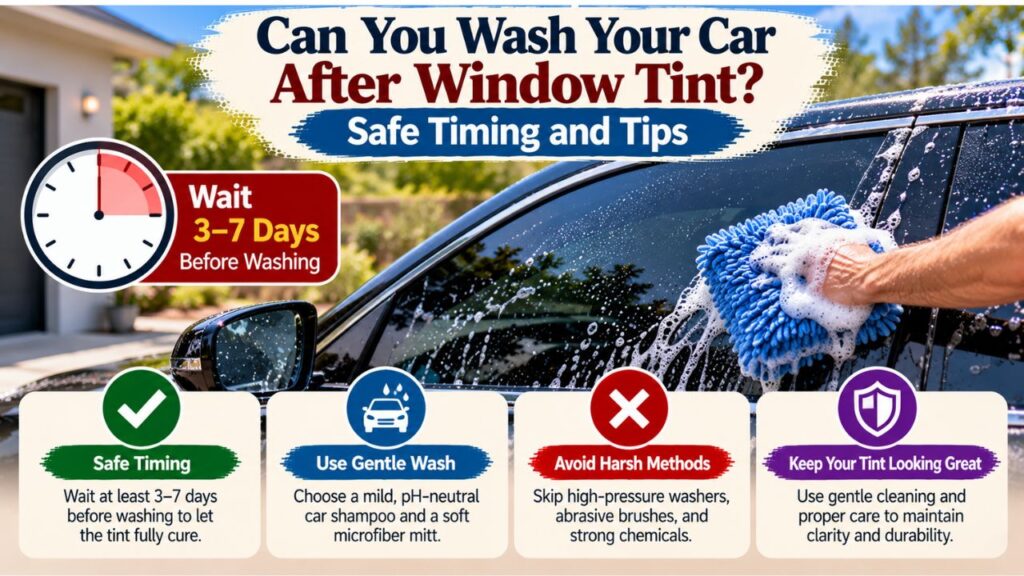
You can generally wash the exterior of your vehicle shortly after window tint installation without disturbing the film. That’s because the film is installed on the interior side of the glass, where ordinary exterior washing water doesn’t directly contact it.
However, this doesn’t mean every cleaning method is appropriate immediately after installation.
There are three different activities to consider:
- Washing the exterior body and glass
- Cleaning the interior surface of tinted windows
- Lowering and raising freshly tinted windows
Each has different precautions.
Exterior Car Washing
A gentle exterior wash is generally safe, even shortly after tinting, provided all windows are completely closed and the installer hasn’t given a specific restriction.
Water flowing over the outside of the glass normally doesn’t touch the new tint.
Use a gentle rinse and avoid forcing water into window seals.
Interior Window Cleaning
Interior cleaning requires more patience because it directly contacts the newly installed film.
The 3M Automotive Window Tint Product Care Guide advises customers not to clean or raise and lower newly tinted windows for at least 48 hours after installation.
Other film manufacturers and installers may recommend longer periods.
Always follow the instructions for your particular film.
Rolling Down the Windows
Even if you wash the exterior safely, don’t roll down the windows before the recommended waiting period ends.
Moving the glass through its seals can disturb film edges that haven’t developed sufficient adhesion.
If you need to communicate at a drive-through or parking entrance, open the door instead.
Key Takeaway: Exterior washing and cleaning newly installed window film are different activities. Gentle exterior washing is usually safe much sooner than wiping the inside tinted surface.
How Long Should You Wait to Wash Your Car After Window Tint?
The recommended waiting period depends on what you’re washing and the aftercare instructions supplied with the film.
Window Tint Washing Timeline
| Time After Tinting | Exterior Car Wash | Interior Tinted Glass |
| Same day | Gentle washing is usually acceptable if installer permits | Avoid cleaning |
| After 24 hours | Generally suitable for gentle exterior washing | Usually still avoid |
| After 48 hours | Normal exterior washing generally acceptable | Some films permit cleaning |
| After 3–5 days | Normal exterior washing generally acceptable | Many films permit cleaning |
| After 7 days | Normal exterior washing generally acceptable | Often permitted, unless instructions require longer |
| After complete curing | Normal washing | Follow regular tint-safe cleaning practices |
These are general guidelines, not universal manufacturer requirements.
For example, XPEL’s official PRIME automotive window film care instructions recommend waiting approximately 1–5 days before rolling down or cleaning tinted windows, depending on the installation climate.
If your installer recommends seven days or another specific period, follow that guidance.
Can You Wash Your Car the Same Day as Tinting?
Usually, yes, if you’re only washing the exterior and the installer permits it.
Keep the windows fully closed and use a gentle hand-washing method.
Avoid aggressive high-pressure spraying around the edges of the glass.
Don’t clean the inside of the windows or allow a detailer to wipe the new film.
If the installer instructed you not to wash the car for a particular period, follow that instruction even though the tint is on the inside.
Can You Wash Your Car After 24 Hours?
In most cases, a gentle exterior wash is acceptable 24 hours after tinting.
The new film is still bonding to the glass, so avoid activities that might disturb it.
Keep the windows closed and don’t clean the interior glass unless the manufacturer specifically permits it.
Can You Wash Your Car After 48 Hours?
Exterior washing is generally fine after 48 hours.
For some window film products, 48 hours is also the minimum waiting period before cleaning the tinted surface.
However, other products require several additional days.
Don’t assume that all films are ready for interior cleaning after exactly two days.
Can You Wash Your Car After One Week?
For most standard automotive window tint installations, a full week provides ample time before ordinary exterior washing.
Interior cleaning is also permitted by many manufacturers by this point, although some products and installation conditions require longer.
If the film still has moisture haze or small water pockets, avoid rubbing those areas or trying to accelerate curing.
Why Does Window Tint Need Time to Cure?
Automotive window tint is typically installed using a wet application process.
The installer sprays a suitable solution between the film and glass.
This allows the film to be positioned correctly before the solution is removed with a squeegee.
Even after installation, some moisture remains beneath the film.
The Adhesive Needs Time to Bond
Window film uses an adhesive designed to bond to glass.
Immediately after installation, the bond is still developing.
During this period, unnecessary movement or physical contact may disturb the film.
That’s why manufacturers recommend waiting before rolling down windows or cleaning the interior surface.
Remaining Moisture Must Evaporate
Small amounts of installation moisture remain between the film and glass.
This moisture gradually evaporates as the film cures.
During that process, you may notice:
- Slight cloudiness
- Temporary haze
- Small water pockets
- A mildly distorted appearance
These conditions can be normal shortly after installation.
However, large air pockets, dirt particles, severe wrinkles, and lifting edges may indicate installation defects rather than ordinary curing.
Temperature and Humidity Affect Curing
Warm, relatively dry conditions often allow installation moisture to evaporate more quickly.
Cold or humid weather can slow the process.
A vehicle tinted during a cold, rainy week may retain some haze longer than one tinted during warm, dry weather.
Don’t assume that the film has failed because minor moisture pockets remain for several days.
Follow the manufacturer’s expected curing period and contact the installer if the condition doesn’t improve.
How to Wash Your Car Safely After Window Tinting
The safest early washing method is a gentle exterior hand wash.
It minimizes unnecessary pressure around window seals and avoids accidental contact with the interior film.
Step 1: Check the Installer’s Aftercare Instructions
Before washing, review any aftercare card, receipt, or written instructions supplied by the tint shop.
Confirm whether there are restrictions on exterior washing.
Some instructions address only the tinted glass, while others may prohibit washing the entire vehicle temporarily.
If your vehicle received other detailing treatments during the same appointment, follow their separate care requirements.
Step 2: Keep Every Window Fully Closed
Make sure all side windows are completely raised.
Check that the sunroof and rear hatch glass are properly closed.
If your vehicle has frameless doors that automatically lower the glass slightly when opened, avoid unnecessary door operation during washing and follow the installer’s guidance.
For conventional power windows, use the window-lock function if needed to prevent passengers from lowering the glass accidentally.
Step 3: Use a Gentle Water Rinse
Rinse the exterior using normal, low-pressure water flow.
Avoid spraying a concentrated jet directly into door seals, window edges, and other openings.
The goal is to remove loose dirt without forcing water through weatherstripping.
You don’t need high pressure to clean a recently tinted vehicle.
Step 4: Wash With Suitable Car Shampoo
Use a quality automotive shampoo diluted according to its instructions.
Wash the body panels with a clean microfiber wash mitt or other suitable soft washing material.
Avoid abrasive brushes.
You can gently clean the outside of the glass if the installer permits it.
However, don’t lower the window to clean its upper edge until the film’s roll-down restriction has ended.
Step 5: Rinse Thoroughly
Rinse the shampoo from the exterior surfaces.
Keep the water stream directed away from window seals when practical.
If using a hose nozzle, choose a gentle spray pattern.
Avoid directing high-pressure water into gaps around the windows.
Step 6: Dry With a Clean Microfiber Towel
Use a clean, soft microfiber drying towel to remove exterior water.
Dry the outside of the glass normally without disturbing the interior.
Avoid opening doors unnecessarily while water is flowing over the vehicle.
If any water enters the cabin, dry the affected trim carefully without wiping the newly tinted film.
Step 7: Leave the Interior Tint Undisturbed
After washing, inspect the vehicle without touching the tinted surface.
Don’t try to remove small curing bubbles, haze, or moisture pockets.
Allow the film to dry naturally according to the manufacturer and installer’s instructions.
Key Takeaway: A gentle exterior wash with closed windows, low-pressure water, and clean microfiber materials is generally the safest approach soon after tint installation.
Can You Take Your Car Through an Automatic Car Wash After Tinting?
Yes, an automatic car wash generally won’t directly contact conventional interior window film when the windows are completely closed. However, it may be sensible to avoid automatic washing during the first day or two, particularly if the installer recommends waiting.
Automatic washing equipment can create conditions that are harder to control than a hand wash.
Touchless Automatic Car Washes
Touchless car washes use water and cleaning solutions without rotating brushes contacting the vehicle.
Because the tint is on the inside of the glass, the exterior rinse doesn’t normally touch it.
However, some systems use strong water jets.
Keep every window completely closed.
If your installer has prohibited car washes temporarily, don’t use a touchless wash until the waiting period ends.
Brush-Type Automatic Car Washes
Brush-style washes use rotating or moving cleaning equipment against exterior surfaces.
The brushes don’t normally contact film installed inside the windows.
However, they can affect exterior paint and other protective coatings.
A brush wash also provides less control over how the vehicle is handled.
For a freshly tinted vehicle, a gentle hand wash is a more cautious choice when washing is necessary during the early curing period.
Can Automatic Washing Water Reach the Tint?
Normally, properly sealed windows prevent exterior wash water from reaching the interior film.
However, worn weatherstripping, damaged seals, or concentrated water pressure can allow water into the cabin.
If your vehicle has leaking seals, correct the problem before using a high-pressure wash.
Water entering around the edges of newly installed film may create additional concerns.
Can You Pressure Wash a Car After Window Tinting?
Pressure washing the exterior isn’t automatically prohibited because of interior window tint.
However, avoid directing concentrated high-pressure water at window seals, door gaps, and glass edges immediately after installation.
Why High-Pressure Water Requires Caution
A pressure washer produces a concentrated stream that may force water through vulnerable seals.
Although ordinary exterior water doesn’t contact interior tint, water intrusion can expose interior trim and film edges to unnecessary moisture.
The problem is especially relevant when:
- Window seals are worn
- Door weatherstripping is damaged
- Glass is not fully closed
- The nozzle is held too close
- The water jet is directed into a gap
How to Reduce Pressure-Washing Risks
If using a pressure washer:
- Follow the vehicle and pressure washer manufacturers’ recommendations.
- Use an appropriate wide spray pattern.
- Maintain sufficient distance from the vehicle.
- Avoid directly blasting window seals.
- Never force water into door openings.
- Keep all windows closed.
- Follow the tint installer’s restrictions.
Don’t use a high-pressure jet to test whether newly tinted windows are sealed properly.
For the first wash, a regular garden hose is usually the simpler option.
Can You Clean the Outside of Tinted Windows Immediately?
The outside surface of the glass generally doesn’t contain the newly installed tint film.
Therefore, exterior glass cleaning doesn’t normally involve direct contact with the film.
However, the installer or manufacturer may temporarily prohibit cleaning the windows altogether.
Cleaning Exterior Glass
If permitted, use a suitable automotive glass cleaner and a clean microfiber towel.
Avoid abrasive pads or contaminated cloths.
Don’t use excessive force around loose trim or damaged weatherstripping.
For glass with exterior coatings or specialized treatments, follow the applicable product instructions.
Cleaning Interior Glass
Interior cleaning must follow the window film’s care requirements.
The inside surface is where the tint usually sits.
Cleaning it too early may disturb the adhesive bond or film edges.
Even after the minimum waiting period, clean gently.
Why Exterior and Interior Cleaning Are Different
The distinction is straightforward:
| Glass Surface | Tint Usually Present? | Main Concern |
| Outside side-window glass | No | Ordinary glass and seal care |
| Inside side-window glass | Yes | Film adhesion and scratching |
| Outside rear windshield | No | Exterior glass care |
| Inside rear windshield | Yes | Film and defroster protection |
| Outside windshield | Usually no conventional interior tint | Glass and any exterior coating care |
| Inside windshield, if filmed | Yes | Film and legal visibility requirements |
Specialty exterior-applied films are an exception.
If your vehicle has an exterior film product, follow that product’s separate washing instructions.
How Long After Window Tint Can You Clean the Inside Windows?
There isn’t one universal waiting period.
The minimum depends on the film, adhesive, weather, and manufacturer’s instructions.
For example:
- 3M’s current U.S. product care guide recommends at least 48 hours without cleaning or opening and closing tinted windows.
- XPEL recommends approximately 1–5 days before cleaning or rolling down windows, depending on the installation climate.
- Individual installers may recommend a longer interval based on their products and local conditions.
If you’re unsure which film was used, ask the installer.
Waiting about a week before cleaning the interior is a cautious general approach, but it doesn’t replace a longer product-specific requirement.
What Cleaner Is Safe for Freshly Tinted Windows?
Once the manufacturer permits cleaning, a clean microfiber towel slightly dampened with water is a simple option.
Many manufacturers also approve mild, nonabrasive glass cleaners.
An ammonia-free product labeled safe for automotive tint is a conservative choice when you don’t know the film’s exact compatibility.
Some manufacturers permit additional cleaning products after curing, so follow the product-specific instructions.
How to Clean Tinted Windows Without Scratching Them
Use this process after the approved waiting period:
- Start with a clean microfiber towel.
- Apply a small amount of suitable cleaning solution to the towel.
- Gently wipe the tinted surface.
- Avoid excessive pressure.
- Use another clean microfiber towel to remove remaining moisture.
- Keep sharp tools away from the film edges.
Spraying cleaner onto the towel rather than saturating the glass can help prevent excess liquid from collecting around edges and trim.
What Cleaning Products Should You Avoid?
Avoid products or tools that could scratch or damage the film.
Examples include:
- Abrasive scouring pads
- Steel wool
- Razor blades
- Hard scrapers
- Dirty towels containing sand or debris
- Strong solvents not approved by the manufacturer
- Unverified chemical cleaners
Don’t scrape adhesive residue, stickers, or other materials from the film with a blade.
The protective coating can be damaged even when the film has fully cured.
Can You Roll Down Your Car Windows After Washing?
Washing the exterior doesn’t determine when it’s safe to lower newly tinted windows.
The correct waiting period comes from the film manufacturer or installer.
Why Rolling Down Windows Too Soon Can Cause Problems
Side windows move through rubber and felt seals.
If the tint adhesive hasn’t developed sufficient bonding strength, the movement may disturb the film near its edges.
Possible problems include:
- Peeling along the top edge
- Film movement
- Creasing
- Edge lifting
- Damage from contact with window seals
These problems are more likely when the film is still settling.
How Long Should Windows Stay Up?
Many automotive tint aftercare instructions recommend approximately 2–5 days, although the exact interval varies.
Some installers recommend longer periods.
Keep the windows closed for the entire specified time, including during car washing.
What Happens if You Accidentally Roll Down a Tinted Window?
Don’t panic.
Raise the window carefully and leave it closed for the remainder of the required curing period.
Inspect the film from inside without rubbing it.
If the upper edge has lifted or developed a crease, contact the installer.
Don’t attempt to pull or glue the film back into place yourself.
Can Rain Damage Fresh Window Tint?
Ordinary rain generally doesn’t damage newly installed automotive tint because the film is on the inside of the glass.
Rainwater running across the exterior surface doesn’t normally touch the adhesive.
Is It Safe to Drive in Rain After Tinting?
Yes, under normal conditions.
A newly tinted vehicle doesn’t usually need to remain indoors simply to avoid rainfall.
Keep the windows closed and follow the aftercare instructions.
Rain itself doesn’t prevent the film from bonding.
However, humid and cool weather may slow the evaporation of remaining installation moisture.
Can Humidity Extend Window Tint Curing Time?
Yes.
High humidity can slow drying.
The film may retain temporary haze or moisture pockets longer than expected.
The appearance should generally improve over time.
Don’t try to remove moisture pockets by pressing on the film.
What if Water Leaks Inside the Car?
If rain or washing water enters the cabin through a damaged window seal, dry the affected interior materials and investigate the leak.
Avoid wiping the tint while it is still within the restricted cleaning period.
Contact the installer if water has reached a lifting edge or the film appears damaged.
Can You Wash Your Car After Ceramic Window Tint?
Yes. Ceramic window tint is generally installed on the inside of the glass, just like conventional dyed or carbon automotive film.
The basic distinction between exterior washing and interior film cleaning remains the same.
Does Ceramic Tint Need More Curing Time?
Not necessarily.
Curing time depends on the specific adhesive system, film construction, installation conditions, and manufacturer instructions.
The ceramic label alone doesn’t establish the required waiting period.
Some premium films may take longer to dry completely, but the relevant manufacturer’s care instructions control.
Can You Use a Car Wash With Ceramic Tint?
Yes, provided the washing method is compatible with the film’s aftercare instructions and any other treatments on the vehicle.
An ordinary exterior car wash doesn’t directly contact interior ceramic film.
However, the installer may still recommend delaying automatic washing.
Does Ceramic Tint Require Special Glass Cleaner?
Ceramic films generally benefit from the same gentle cleaning habits recommended for other quality automotive films.
Use a compatible nonabrasive cleaner and soft microfiber towel.
Don’t assume ceramic film is scratch-proof.
Its protective surface can still be damaged by abrasive tools.
Does Window Tint Type Affect When You Can Wash Your Car?
Different film products may have different curing requirements.
However, the basic exterior washing principle remains the same for conventionally installed interior window film.
| Window Tint Type | Exterior Washing | Interior Film Cleaning |
| Dyed film | Generally safe with gentle methods | Follow product curing instructions |
| Carbon film | Generally safe with gentle methods | Follow product curing instructions |
| Ceramic film | Generally safe with gentle methods | Follow product curing instructions |
| Metalized film | Generally safe with gentle methods | Follow product curing instructions |
| Hybrid film | Generally safe with gentle methods | Follow product curing instructions |
Don’t estimate curing time solely from the film category.
Two ceramic films from different manufacturers may have different instructions.
The installation environment also matters.
What if Your Car Has Window Tint and Paint Protection Film?
This is an important distinction because window tint and paint protection film are installed on different surfaces.
Automotive window tint is normally installed inside the glass.
Paint protection film (PPF) is installed on exterior painted surfaces.
Washing After Window Tint Alone
When the vehicle has only conventional interior window tint, gentle exterior washing is generally less of a concern.
The washing water doesn’t normally touch the new film.
Washing After Paint Protection Film
PPF is exposed directly to wash water, soaps, brushes, and pressure.
Therefore, PPF manufacturers often require a waiting period before washing.
For example, XPEL specifies different washing restrictions for its paint protection film products than for its automotive window tint.
Don’t apply window tint aftercare rules to exterior PPF.
Washing After Ceramic Coating
A newly applied paint ceramic coating may also have its own restrictions regarding washing, water exposure, detergents, and curing.
Those requirements are separate from window tint aftercare.
If you received window tint, PPF, and ceramic coating during the same appointment, follow the most restrictive applicable instructions for each treated surface.
What Happens if You Wash Your Car Too Soon After Tinting?
In most cases, a gentle exterior wash won’t cause problems.
However, damage may occur if the cleaning process disturbs the film or allows excessive water to reach vulnerable interior areas.
Peeling Tint Edges
Film edges may lift if they are disturbed before sufficient adhesion develops.
This is more commonly associated with rolling windows down too early, rubbing the tint, or improper installation than with water flowing over the exterior glass.
If an edge starts peeling, contact the installer.
Don’t attempt to repair it using household glue or tape.
Bubbles Under the Film
Small moisture pockets are common during the early curing period.
They don’t necessarily indicate that washing damaged the tint.
However, large persistent air bubbles may suggest an installation issue.
Don’t puncture the bubbles.
Allow the recommended curing period and have the installer inspect any defects that remain.
Hazy or Cloudy Tint
A slightly hazy appearance can be normal while installation moisture evaporates.
Exterior washing doesn’t usually create this condition because the film is on the inside.
If the haze persists beyond the manufacturer’s expected drying period, contact the installer.
Scratches on the Film
Scratches are more likely when the inside surface is cleaned with abrasive tools or contaminated materials.
A normal exterior wash generally doesn’t scratch interior tint.
However, if a detailer cleans the inside glass during the wash, unsuitable tools may cause damage.
Tell the detailer which windows have recently been tinted.
Common Window Tint Aftercare Mistakes to Avoid
Several simple mistakes can affect a new installation.
Cleaning Interior Glass Immediately
Fresh tint needs time to bond and dry.
Avoid wiping the inside surface before the approved waiting period ends.
Using a Razor Blade on Tinted Glass
Sharp tools can cut or scratch window film.
They can also damage rear defroster lines.
Use only suitable cleaning methods.
Rolling Windows Down During the First Few Days
Window movement can disturb film edges.
Keep the glass closed for the period specified by the installer.
Using Strong Pressure Around Window Seals
A concentrated water jet may force water through worn or damaged seals.
Use gentle washing methods and avoid directing high pressure into window openings.
Trying to Push Out Curing Bubbles
Small moisture pockets often disappear naturally.
Pressing them repeatedly may cause damage.
Contact the installer if the bubbles become larger or fail to improve.
Assuming Every Film Has the Same Waiting Period
Different brands have different instructions.
A product requiring two days without cleaning isn’t equivalent to one whose manufacturer recommends a week.
Follow the specific instructions for your installation.
Forgetting About Other Vehicle Treatments
Paint protection film, ceramic paint coatings, and exterior-applied window products may have stricter washing requirements.
Follow the aftercare rules for every newly installed product.
What Should You Do During the First Week After Window Tinting?
The first week is a useful period for protecting the installation while the adhesive develops.
First 24 Hours
Keep the windows closed.
Avoid touching the film or attempting to remove moisture bubbles.
If exterior washing is necessary and permitted, use a gentle hand wash.
Don’t allow interior window cleaning.
After 48 Hours
Continue following the manufacturer’s restrictions.
Some films permit window cleaning and normal operation after this point.
Others require a longer period.
Don’t assume every installation is ready for full cleaning.
After 3–5 Days
Many standard automotive films permit rolling windows down and cleaning the interior during this period.
However, follow the instructions supplied with your particular product.
Minor moisture haze may still remain.
After One Week
For many installations, normal window operation and appropriate tint-safe cleaning are permitted.
However, complete drying can take longer depending on climate and film construction.
Continue monitoring the appearance without trying to accelerate curing.
After Full Curing
Maintain the tinted surfaces using compatible cleaners and soft towels.
Inspect the edges occasionally.
Avoid stickers, abrasive cleaners, or sharp tools that may damage the film.
How to Tell if Your Window Tint Has Cured
There isn’t one visual test that confirms every film has reached complete curing.
However, several signs suggest that installation moisture is gradually disappearing.
Clearer Glass
The initial haze should decrease.
The glass should gradually develop a more uniform appearance.
Reduced Moisture Pockets
Small trapped water pockets may shrink over time.
Their disappearance indicates that moisture is leaving the film-and-glass interface.
Stable Edges
The film should remain properly attached along the perimeter.
Peeling or lifting edges are not normal signs of successful curing.
No Persistent Installation Defects
After the expected drying period, the film should appear reasonably uniform.
Trapped dirt, hard creases, and large persistent air bubbles may require professional correction.
If the film appears defective, contact the installer before attempting repairs.
Conclusion
Can you wash your car after window tint? Yes. Gentle exterior washing is generally safe shortly after tint installation because automotive tint is normally applied to the inside of the glass.
However, washing the exterior is different from cleaning the newly tinted interior glass.
Keep the windows fully closed, avoid high-pressure water directed at seals, and follow the installer’s specific washing restrictions.
For interior cleaning, manufacturers commonly require a waiting period ranging from at least 48 hours to several days or longer.
Use soft microfiber towels and compatible nonabrasive cleaners once cleaning is permitted.
If your car also received paint protection film or a ceramic coating, follow those products’ separate washing requirements.
The best approach is to protect the fresh tint during its initial curing period while continuing gentle exterior maintenance when permitted.
FAQs About Can You Wash Your Car After Window Tint
Can I Wash My Car 24 Hours After Tinting?
Yes, a gentle exterior wash is generally safe after 24 hours when the installer permits it.
Keep the windows closed and avoid high-pressure water around seals. Don’t clean the interior tint until the manufacturer-approved waiting period has ended.
Can I Go Through a Car Wash After Getting My Windows Tinted?
Usually, yes, because standard automotive tint is installed inside the glass.
However, it’s sensible to avoid automatic washes during the initial restricted period if your installer recommends waiting. Keep all windows closed, and remember that exterior PPF or ceramic coatings may have separate restrictions.
Can I Clean the Outside of My Windows After Tinting?
Usually, yes, because the outside glass doesn’t normally contain the tint film.
However, some manufacturers recommend temporarily avoiding cleaning the windows altogether. Follow the care instructions supplied with your particular tint.
Can I Roll Down My Windows Three Days After Tinting?
Possibly.
Some film manufacturers allow window operation after approximately 1–5 days, depending on climate and product.
Others recommend longer waiting periods.
Follow your installer or manufacturer’s specific instructions rather than relying only on a general three-day rule.
Can Rain Ruin Fresh Window Tint?
Ordinary rain generally doesn’t damage standard interior automotive tint because the film is on the inside of the glass.
Keep the windows closed and prevent water from entering through damaged seals.
Rainy or humid conditions may slow curing but don’t automatically ruin the film.
Can I Use Windex on Newly Tinted Car Windows?
Don’t use Windex or another glass cleaner on newly installed tint before the approved cleaning period.
After curing, product compatibility varies. Some manufacturers permit certain ammonia-containing cleaners, while others recommend mild ammonia-free products.
An ammonia-free, tint-safe cleaner and soft microfiber towel are a conservative choice.
Do You Have to Wait Seven Days to Wash a Tinted Car?
Not necessarily.
Gentle exterior washing is often permitted much sooner because the tint is installed inside the windows.
Seven days is a common precaution for interior cleaning or certain installation conditions, but the correct waiting period depends on the film and installer.
Will a Pressure Washer Damage New Window Tint?
A pressure washer normally doesn’t directly contact interior tint.
However, concentrated water pressure around window seals may cause water intrusion, particularly when seals are damaged.
Avoid directing strong jets into window gaps and follow any installation-specific washing restrictions.