Yes, many new cars come with tinted windows from the factory, but the amount of tint varies by vehicle manufacturer, model, and trim level. Most modern vehicles have some degree of factory-tinted or solar-control glass, while SUVs, pickup trucks, and minivans frequently come with darker privacy glass on their rear windows.
Factory tint isn’t always the same as aftermarket window film. Manufacturers can produce glass with color or solar-control properties built into the material, while aftermarket tint is generally a separate film applied to an existing window.
This distinction matters because factory privacy glass may provide a darker appearance without delivering the same infrared heat rejection as a premium ceramic film. The original glass can still offer UV protection, but performance varies by product.
Front windows are also typically lighter than rear privacy glass because of visibility requirements.
In this article, I cover which cars come with factory-tinted windows, how factory privacy glass differs from aftermarket tint, and how to identify the original glass. You’ll also learn about factory tint percentages, UV and heat protection, legal requirements, and whether adding aftermarket film is worthwhile.
Do Cars Come With Tinted Windows From the Factory?
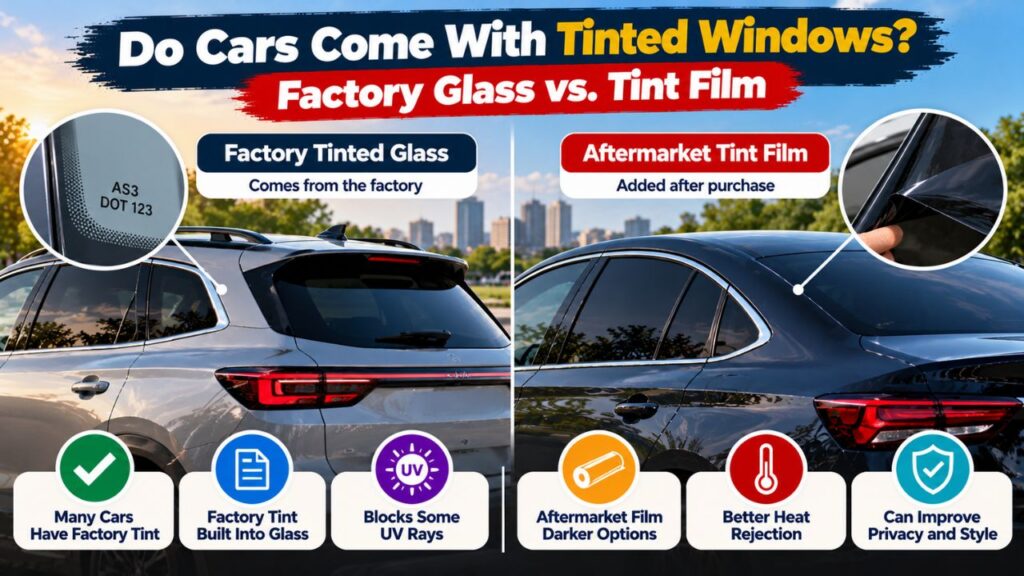
Many vehicles leave the assembly plant with some degree of tint already incorporated into their glass.
However, the term factory tint can describe two different features.
The first is lightly tinted or solar-control glass, which may look nearly clear.
The second is darker privacy glass, which is designed to reduce visibility into the vehicle.
Factory-Tinted Front Windows
Most modern passenger vehicles have front side windows that transmit a relatively high percentage of visible light.
These windows may have a slight green, blue, or gray appearance.
That color can result from the glass composition or specialized glazing technology.
However, factory front windows generally don’t look as dark as aftermarket 20% or 35% tint.
Manufacturers must satisfy applicable vehicle glazing safety standards, including visible light transmission requirements.
Factory Privacy Glass on Rear Windows
Many SUVs, minivans, and pickup trucks come with darker rear passenger windows.
This is often called privacy glass.
It reduces the amount of visible light passing through the glass, making the cabin more difficult to see from outside.
Privacy glass may be installed on:
- Second-row side windows
- Third-row side windows
- Rear quarter windows
- Rear windshields
- SUV liftgate glass
- Pickup truck rear windows
The exact arrangement depends on the vehicle.
Some models include privacy glass as standard equipment, while others offer it only with certain trim packages.
Do All New Cars Have Tinted Windows?
No.
Not every new car comes with visibly dark windows.
Some vehicles use relatively clear glass throughout the cabin.
Others have lightly tinted front glass and darker rear privacy glass.
A vehicle may also receive aftermarket film at a dealership before delivery.
Therefore, two seemingly identical vehicles can have different window appearances depending on their factory equipment and dealer-installed accessories.
Key Takeaway: Many new vehicles have factory-tinted glass, but dark rear privacy glass isn’t standard on every car. Check the exact model and trim rather than assuming all vehicles have the same tint.
What Is Factory Privacy Glass?
Factory privacy glass is automotive glass manufactured with a darker appearance.
The color is incorporated into the glass or its manufactured glazing construction rather than applied as ordinary aftermarket adhesive film.
According to Ford’s official explanation of privacy glass and tinted windows, privacy glass is produced with a darker color as part of the original glass, while aftermarket tinted windows use a separate film applied to the interior surface.
How Factory Privacy Glass Works
Privacy glass reduces visible light transmission.
Because less light passes through the glass, people outside may have more difficulty seeing into the vehicle.
However, the amount of privacy depends on lighting conditions.
During bright daylight, the glass may appear very dark.
At night, an illuminated cabin can become visible even through relatively dark privacy glass.
Factory privacy glass therefore doesn’t create complete one-way visibility.
Why Manufacturers Install Privacy Glass
Automakers use privacy glass for several reasons:
- Passenger privacy
- Exterior styling
- Reduced visible glare
- A darker rear cabin appearance
- Some degree of solar protection
- Reduced visibility of items stored behind the rear seats
Privacy glass can make SUVs and minivans look more uniform by giving their rear windows a consistent dark appearance.
However, it should not be considered a security feature that completely conceals valuables.
Is Factory Privacy Glass Permanent?
The coloring in conventional factory privacy glass is part of the manufactured glass.
It doesn’t have an ordinary aftermarket adhesive film layer that can simply be peeled off.
If you want to replace dark privacy glass with clear glass, the usual solution involves replacing the glass with a compatible lighter component.
By contrast, aftermarket tint film can often be removed without replacing the entire window, although removal requires care.
Factory Tint vs. Aftermarket Window Tint: What’s the Difference?
Factory tint and aftermarket tint can create similar appearances, but they’re manufactured and installed differently.
| Feature | Factory-Tinted Glass | Aftermarket Window Tint |
| Installation | During vehicle manufacturing | Applied after glass manufacturing |
| Material | Colored or specialized glazing | Thin adhesive film |
| Darkness | Determined by factory specification | Multiple film shades available |
| Removal | Usually requires glass replacement | Film can often be removed |
| Privacy | Depends on factory VLT | Depends on selected film VLT |
| Heat rejection | Depends on glass construction | Depends on film technology |
| UV protection | Varies by glazing | Varies by film specifications |
| Peeling or bubbling | No ordinary applied film to peel | Possible if adhesive or installation fails |
| Warranty | Generally covered under applicable vehicle/glass terms | Depends on film manufacturer and installer |
Factory Tint Is Built Into the Glass
Factory privacy glass generally obtains its darker appearance from materials incorporated during manufacturing.
This means its color isn’t dependent on a separate adhesive film bonded to the inside.
It is less susceptible to the peeling and bubbling problems sometimes associated with aftermarket film.
However, factory glass can still be scratched, chipped, or broken.
Aftermarket Tint Uses a Separate Film
Aftermarket window tint is usually installed on the interior glass surface.
Common film types include:
- Dyed window tint
- Carbon window tint
- Ceramic window tint
- Metalized window tint
- Hybrid and multilayer solar-control films
The installer cleans the glass, positions the film, removes the application solution, and allows the adhesive to cure.
Different film products offer different levels of privacy, glare reduction, UV rejection, and solar heat control.
Which Type Lasts Longer?
The color in ordinary factory privacy glass doesn’t fade or peel in the same way as an applied film.
For that reason, factory-colored glass generally requires less tint-specific maintenance.
High-quality aftermarket film can also remain effective for many years.
However, its durability depends on film construction, adhesive quality, installation, and environmental conditions.
Key Takeaway: Factory privacy glass provides built-in darkness, while aftermarket film offers more choices in shade and solar-control performance.
Which Cars Usually Come With Tinted Windows?
Factory window tint equipment varies by vehicle category.
Do Sedans Come With Factory-Tinted Windows?
Many sedans have lightly tinted or solar-control glass.
However, dark rear privacy glass is less universal on conventional passenger sedans.
Some models offer special glazing packages or other factory window treatments.
If a sedan has very dark rear windows, the darkness may come from aftermarket film installed by a dealer or previous owner.
Check the vehicle’s factory equipment information to determine what was originally installed.
Do SUVs Come With Tinted Windows?
Yes. Dark rear privacy glass is common on many modern SUVs.
Manufacturers often install it behind the front seats.
The rear side windows, quarter windows, and liftgate glass may all have a similar dark appearance.
Some SUVs include privacy glass as standard equipment, while others require a higher trim or package.
Front windows generally remain noticeably lighter.
Do Pickup Trucks Come With Tinted Windows?
Many pickup trucks have factory privacy glass on rear cabin windows.
Crew-cab and extended-cab models frequently use darker glass behind the driver.
Some trucks also have a tinted rear windshield or sliding rear window.
However, regular-cab trucks and base trim levels may use different configurations.
The vehicle’s equipment specification provides the most reliable answer.
Do Minivans Come With Tinted Windows?
Yes. Minivans commonly offer dark rear privacy glass.
This provides privacy for rear passengers and can reduce visible glare in the passenger compartment.
The second-row, third-row, and rear liftgate windows may be darker than the front side windows.
As with SUVs, the exact equipment varies by manufacturer and trim.
Do Luxury Cars Come With Factory Tint?
Luxury vehicles may use specialized glazing designed for comfort, acoustic performance, UV protection, or solar control.
Some include laminated side glass, heat-reflective technology, or factory privacy glass.
However, luxury pricing doesn’t automatically mean the car has dark windows.
A premium sedan may still have relatively clear-looking glass while offering advanced solar-control properties.
Check the manufacturer’s glass specifications instead of judging performance by appearance alone.
What Percentage Is Factory Window Tint?
There isn’t one standard factory tint percentage for every vehicle.
Manufacturers use different glazing materials, and visible light transmission can vary by window location.
Understanding Visible Light Transmission
Visible Light Transmission (VLT) measures the percentage of visible light that passes through glass or a film-and-glass system.
A higher percentage means more visible light enters.
A lower percentage means the window appears darker.
| VLT Percentage | General Appearance |
| 90% | Nearly clear |
| 80% | Very light tint |
| 70% | Light factory-style tint |
| 50% | Noticeably smoked |
| 35% | Medium-dark tint |
| 20% | Dark privacy tint |
| 15% | Very dark |
| 5% | Extremely dark |
These appearance descriptions are approximate.
Glass color, reflectivity, interior brightness, and viewing conditions can change how dark a particular window looks.
What Percentage Is Factory Front Window Tint?
Factory front side windows commonly have relatively high VLT values.
Many are designed to meet or exceed the 70% light-transmission requirement applicable to glazing needed for driving visibility in new vehicles.
However, don’t assume a specific vehicle has exactly 70%, 75%, or 80% VLT.
The actual value should be measured or confirmed through manufacturer specifications.
What Percentage Is Factory Rear Privacy Glass?
Factory rear privacy glass is often considerably darker than front side glass.
Some privacy glass measures in the general range associated with 15–35% VLT, although actual values differ widely among manufacturers.
There is no universal rear privacy-glass percentage.
A vehicle with 20% rear glass and another with 30% rear glass may look similar under certain lighting conditions.
Use a tint meter when an accurate measurement is necessary.
Does Factory Tint Mean 20%?
No.
Some factory privacy glass may measure near 20% VLT, but this isn’t a standard specification across all vehicles.
Don’t purchase 20% aftermarket film solely because someone described the original glass as factory tint.
Measure the actual glass if you’re trying to match a specific darkness.
How to Tell if Your Car Has Factory Tint or Aftermarket Film
You can often identify the difference by inspecting the glass and reviewing vehicle documentation.
However, visual inspection isn’t always conclusive.
Step 1: Check the Vehicle’s Window Sticker
If you have the original window sticker, look under the exterior equipment or window-and-glass features.
Common terms include:
- Privacy glass
- Solar-tinted glass
- Tinted glass
- Deep-tinted glass
- Acoustic laminated glass
- Solar-control glazing
These terms don’t all describe the same technology.
Privacy glass generally indicates a darker appearance, while solar-control or acoustic glazing may describe other glass properties.
Step 2: Check the Owner’s Manual or Factory Equipment List
Review the owner’s manual, vehicle build sheet, or manufacturer equipment information.
The manufacturer’s VIN-based specification or original sales documentation may identify the factory glass package.
A dealership may also be able to confirm the original configuration.
This is particularly useful when purchasing a used vehicle.
Step 3: Inspect the Window Edges
Aftermarket film often has an identifiable edge near the top of a roll-down side window.
You may notice a narrow line where the film ends before the glass edge.
Factory-colored glass normally doesn’t have a removable adhesive-film edge.
However, high-quality film can be difficult to see.
A lack of visible edges doesn’t prove that the glass has no aftermarket film.
Step 4: Look for Film Defects
Aftermarket tint may eventually develop:
- Peeling edges
- Bubbles
- Scratches in the film
- Adhesive haze
- Color changes
- Film separation
These defects can indicate an applied film.
Ordinary factory-colored glass doesn’t produce peeling film edges because the color isn’t contained in a conventional aftermarket film layer.
However, laminated glazing can develop different types of defects, so inspection should consider the glass construction.
Step 5: Use a Window Tint Meter
A tint meter measures visible light transmission.
It can tell you how dark the completed window is.
However, it usually cannot establish whether the darkness comes from factory glass or aftermarket film.
Use the reading together with physical inspection and factory equipment information.
Key Takeaway: The most reliable way to identify factory tint is to combine the vehicle’s equipment documentation with a careful inspection of the glass. A tint meter measures darkness but doesn’t identify the tint’s origin.
Does Factory-Tinted Glass Block UV Rays?
Many factory automotive glass products provide ultraviolet protection.
However, the amount depends on the glass construction and window location.
Factory Windshield UV Protection
Modern automotive windshields generally use laminated safety glass.
The plastic interlayer in laminated glass can provide substantial UV protection.
However, the exact amount depends on the glazing materials and manufacturer.
Don’t assume every windshield or side window has identical ultraviolet performance.
Factory Side Window UV Protection
Some side windows use tempered glass, while others use laminated glazing.
Their ultraviolet protection can differ.
Certain factory glass products include additional UV-absorbing materials or coatings.
For example, Ford reports that its privacy glass blocks approximately 98% of ultraviolet light.
That figure applies to the manufacturer’s stated product characteristics, not every factory-tinted window made by every brand.
Does Darker Factory Tint Block More UV?
Not necessarily.
Visible light transmission and UV rejection measure different things.
A dark privacy window can have different UV performance from a lighter laminated or UV-treated window.
A lighter glass product may provide strong ultraviolet protection even though it doesn’t look heavily tinted.
Check the glass specifications rather than assuming darkness determines UV protection.
Does Factory Privacy Glass Block Heat?
Factory privacy glass can reduce some solar energy transmission, but its heat-rejection performance depends on how the glass is manufactured.
Dark factory privacy glass doesn’t automatically offer the same infrared heat rejection as premium ceramic aftermarket film.
Why Darkness Doesn’t Equal Heat Rejection
Sunlight contains visible light, ultraviolet radiation, and infrared energy.
A darker glass reduces visible light transmission.
However, the amount of solar heat rejected depends on the glass’s full optical and thermal characteristics.
A dark window may still transmit significant solar energy.
Conversely, a relatively light solar-control glass can be engineered to reject substantial heat.
Does Factory Privacy Glass Keep a Car Cooler?
It may reduce some sunlight and solar energy entering the rear cabin.
However, the result varies.
Some factory privacy glass primarily emphasizes appearance and privacy.
Other factory glazing systems include specialized solar-control technology.
Neither should be assumed to eliminate heat buildup in a parked vehicle.
Factory Privacy Glass vs. Ceramic Tint for Heat
A quality ceramic film can provide additional infrared and total solar energy rejection.
This can make ceramic film appealing to drivers who want better heat control while retaining the existing factory privacy appearance.
However, the actual improvement depends on both the original glass and the film product.
Compare the resulting glass-and-film system’s Total Solar Energy Rejection (TSER) rather than relying only on the ceramic label.
Can You Add Window Tint Over Factory Privacy Glass?
Yes. Compatible aftermarket window film can often be installed over factory privacy glass.
However, adding film makes the completed window darker.
This can create legal and visibility concerns.
How Added Tint Changes Factory Privacy Glass
The combined light transmission can be estimated by multiplying the separate transmission values.
Estimated final VLT = Existing glass VLT × Film VLT
Convert percentages to decimal values before multiplying.
For example, if the original privacy glass transmits 25% of visible light and the added film transmits 50%:
0.25 × 0.50 = 0.125
Estimated final VLT: 12.5%
Factory Glass and Added Film Examples
| Existing Glass VLT | Added Film VLT | Estimated Final VLT |
| 80% | 70% | 56% |
| 80% | 50% | 40% |
| 70% | 50% | 35% |
| 35% | 70% | 24.5% |
| 25% | 50% | 12.5% |
| 20% | 50% | 10% |
These are simplified estimates.
Some film specifications already describe performance on a particular test glass rather than standalone film values.
Actual installed VLT should be verified with an appropriate meter.
Can You Put Ceramic Tint Over Factory Privacy Glass?
Yes, when the film is compatible with the glass and installation complies with applicable regulations.
A relatively light ceramic film may improve heat rejection without making the glass as dark as a heavier privacy-focused film.
However, even a light film reduces visible light transmission to some extent.
If your rear windows already have dark factory privacy glass, evaluate the combined darkness before choosing ceramic film.
Will Adding Tint Make the Rear Windows Too Dark?
It can.
For example, adding 50% film to existing 20% privacy glass produces an estimated combined VLT of 10%.
That is significantly darker than either 50% or 20% glass alone.
It may reduce nighttime rearward visibility.
The combined installation must also comply with applicable state tint laws.
Are Factory-Tinted Windows Legal in Every State?
Factory glazing and aftermarket film are subject to different regulatory considerations.
In the United States, new vehicles must meet applicable federal glazing safety requirements.
States also regulate the operation of vehicles with tinted windows.
Federal Factory Glass Requirements
The National Highway Traffic Safety Administration’s interpretation of Federal Motor Vehicle Safety Standard No. 205 explains that glazing required for driving visibility generally must transmit at least 70% of visible light.
For new passenger cars, that requirement covers glazing needed for driving visibility, including the ordinary windshield, side windows, and rear window.
For trucks and multipurpose passenger vehicles, federal requirements differ for certain rear windows.
This distinction helps explain why many SUVs and minivans can be manufactured with dark rear privacy glass.
State Window Tint Laws
States establish additional requirements governing vehicles operated on public roads.
Depending on the state, the rules may address:
- Front side window darkness
- Rear side window darkness
- Rear windshield darkness
- Windshield tint coverage
- Reflectivity
- Medical exemptions
- Required mirrors
Don’t assume that a vehicle modification is legal simply because the original factory glass was compliant.
Can Factory Tint Be Illegal?
Factory-installed glazing on a new U.S.-market vehicle is designed to meet applicable federal requirements for its vehicle classification.
However, state operating requirements and the distinction between factory glazing and later modifications still matter.
If you import a vehicle, buy an altered vehicle, or add aftermarket film, verify the applicable rules.
An original factory specification is useful evidence, but it doesn’t automatically settle every state-law question.
Can You Tint Front Windows Over Factory Glass?
Sometimes, but the completed glass-and-film system must meet applicable requirements.
For example, adding a relatively dark film to front glass that already transmits 75% of visible light can reduce the final VLT substantially.
A film marketed as 70% VLT does not automatically leave the finished window at 70%.
Ask the installer to measure the existing glass and calculate the expected result before proceeding.
Do Car Dealerships Add Window Tint Before Selling a Car?
Yes. Some dealerships arrange aftermarket tint installation before delivering a vehicle to a buyer.
This doesn’t necessarily make the film an original factory-installed feature.
Factory-Installed vs. Dealer-Installed Tint
Factory-installed privacy glass is part of the vehicle’s original glazing specification.
Dealer-installed tint is typically an added product applied after manufacturing.
The dealership may offer it as:
- An appearance package
- A protection package
- A window tint upgrade
- A dealer-installed accessory
- A separate tinting service
Ask whether the price includes actual aftermarket film or whether the salesperson is referring to factory privacy glass already installed on the vehicle.
Does Dealer Tint Cost Extra?
Often, yes.
A dealership may include tint in an accessory package or charge separately.
The exact cost depends on the film, vehicle, installation coverage, and dealer pricing.
Request an itemized explanation before purchasing.
Does Dealer Tint Come With a Warranty?
It may.
However, the warranty may come from the film manufacturer, tint installer, dealership, or a combination of them.
Ask for written details covering:
- Film brand and series
- Warranty duration
- Peeling
- Bubbling
- Color changes
- Adhesive failure
- Replacement labor
Don’t assume that dealer-installed tint receives the same warranty as original factory glazing.
Should You Get Aftermarket Tint if Your Car Already Has Factory Tint?
That depends on your goals.
Factory glass may already provide the appearance and privacy you want.
Aftermarket film becomes more useful when you’re seeking additional solar heat control, UV protection, or a different legally permitted appearance.
When Factory Tint May Be Enough
You may not need additional film if:
- You’re satisfied with the window darkness.
- Rear passenger privacy is adequate.
- The vehicle already has effective solar-control glazing.
- Nighttime visibility is important.
- You want to avoid additional installation costs.
Adding film simply because the vehicle has factory privacy glass isn’t necessary.
When Ceramic Tint May Be Worthwhile
Ceramic film may be worth considering when:
- You regularly drive in hot weather.
- Direct sunlight creates uncomfortable heat.
- You want stronger infrared rejection.
- The factory glass doesn’t meet your thermal comfort expectations.
- You prefer a relatively light film with improved solar control.
Choose a product with documented performance specifications.
Don’t assume every ceramic product provides the same heat rejection.
When Adding More Tint Isn’t a Good Idea
Avoid unnecessary additional darkness when:
- The factory glass is already very dark.
- You frequently drive at night.
- Rearward visibility is limited.
- The completed tint may violate local law.
- You can’t verify the existing VLT.
- The installer cannot confirm product compatibility.
In these situations, keeping the factory glass unchanged may be the better option.
Can Factory Window Tint Be Removed?
It depends on what is creating the darker appearance.
Removing Original Factory Privacy Glass
Factory privacy glass normally cannot be made clear by peeling away a film.
Its coloring is part of the manufactured glazing.
To obtain lighter glass, the window generally needs to be replaced with an appropriate compatible component.
That replacement must preserve safety glazing, defroster functions, antennas, and other original equipment.
Removing Aftermarket Tint Film
Aftermarket window film can often be removed without replacing the glass.
However, removal requires care.
Improper scraping may scratch the glass or damage rear defroster lines.
Strong adhesives can be particularly difficult to remove from older film.
If the tint is attached to a heated rear windshield, professional removal may reduce the risk of damage.
Can You Make Factory Privacy Glass Lighter Without Replacing It?
Not by removing an ordinary film layer, because factory privacy glass doesn’t typically use one.
Some specialized aftermarket treatments may alter the glass’s appearance, but they don’t restore the original glass to a clear version.
Replacing the glass with an appropriate lighter component is generally the reliable option.
How to Check Factory Tint Before Buying a Car
If window appearance and heat protection are important, examine the glass before purchasing.
Step 1: Review the Vehicle’s Equipment List
Check whether the selected trim includes privacy glass or solar-control glazing.
Don’t assume another trim has the same equipment.
Step 2: Compare Front and Rear Windows
Look at the difference in darkness between the front and rear glass.
A vehicle with substantially darker rear windows may have factory privacy glass.
However, appearance alone doesn’t establish whether film was added later.
Step 3: Ask About Dealer-Installed Film
Confirm whether the dealership added aftermarket window film.
If so, request the exact product name, tint percentage, and warranty information.
Step 4: Check the Actual VLT
If darkness matters for legal compliance or appearance, have the glass measured.
A tint meter provides a more useful comparison than estimating darkness visually.
Step 5: Evaluate Solar-Control Performance
Ask whether the glass includes additional heat-rejection technology.
Don’t assume that dark factory privacy glass provides the same performance as premium aftermarket ceramic film.
Step 6: Test Visibility in Different Lighting
If possible, evaluate the vehicle during both daylight and lower-light conditions.
Pay attention to rearward visibility, mirror checks, and the brightness of the passenger cabin.
Choose a vehicle and tint configuration that matches your driving needs.
Common Misunderstandings About Factory Window Tint
Several misconceptions can lead to unnecessary tinting expenses or incorrect expectations.
Factory Tint Is Always Dark
Not true.
Some original factory glass has only a subtle color and looks nearly clear.
Dark privacy glass is only one form of factory glazing.
Every SUV Comes With 20% Rear Tint
Not true.
Rear privacy glass darkness varies by model and manufacturer.
Some vehicles may measure close to 20% VLT, but there is no universal factory percentage.
Factory Privacy Glass Doesn’t Block UV
Not necessarily.
Some factory privacy glass provides substantial UV protection.
The exact performance depends on the glazing product.
Don’t assume that factory privacy glass has no ultraviolet protection simply because it doesn’t use aftermarket film.
Dark Factory Glass Rejects More Heat Than Ceramic
Not necessarily.
Solar heat rejection depends on glazing technology rather than appearance alone.
A lighter high-performance ceramic film may offer better infrared control than darker conventional privacy glass.
Factory Tint Can Be Peeled Off
Ordinary factory-colored privacy glass doesn’t have a removable aftermarket film layer.
Changing its darkness generally requires replacing the glass.
A New Car Cannot Have Aftermarket Tint
A vehicle can receive aftermarket film at a dealership before the buyer takes delivery.
That’s different from factory-colored glass installed during manufacturing.
Check the purchase documents and vehicle equipment records.
Conclusion
Do cars come with tinted windows? Yes, many vehicles have lightly tinted or solar-control glass from the factory, and SUVs, pickup trucks, and minivans frequently include darker rear privacy glass.
However, the darkness, glazing technology, and window coverage vary by manufacturer and trim.
Factory privacy glass differs from ordinary aftermarket tint because its color is incorporated into the glass rather than supplied by a removable film layer.
It can provide privacy and some solar protection, but it doesn’t automatically offer the same infrared heat rejection as high-performance ceramic film.
Before paying for additional tint, check the factory equipment list, inspect the window edges, measure the existing VLT, and verify the applicable legal requirements.
If the original glass already provides suitable privacy and comfort, additional film may be unnecessary. If heat rejection is your main concern, a properly selected, legally compliant ceramic film may offer a worthwhile improvement.
FAQs About Do Cars Come With Tinted Windows
Do New Cars Automatically Come With Window Tint?
Many new vehicles have some degree of factory-tinted or solar-control glass.
However, not all have visibly dark windows. Rear privacy glass is common on certain SUVs, trucks, and minivans, but equipment varies by model and trim.
Do Cars Come With 20% Tint From the Factory?
Some vehicles have rear privacy glass with VLT values near 20%, but that isn’t a standard percentage across all manufacturers.
Factory front side windows are generally much lighter because of visibility requirements.
Why Are Rear Car Windows Darker Than Front Windows?
Rear windows are often darker to improve privacy and exterior styling.
Federal glazing requirements allow darker rear glass on certain vehicle classifications, while windows needed for driving visibility have stricter light-transmission requirements.
State operating laws may impose additional restrictions.
Is Factory Tint the Same as Ceramic Tint?
No.
Factory privacy glass normally uses color or specialized glazing construction incorporated during manufacture.
Ceramic tint generally refers to an aftermarket film containing ceramic-based solar-control technology.
Some original vehicle glass may have advanced solar-control features, but it shouldn’t automatically be described as ceramic tint.
Can You Put 35% Tint Over Factory-Tinted Windows?
Sometimes, but the resulting window will be darker than the added film’s nominal rating when the existing glass also reduces light transmission.
For example, 35% film applied over separately measured 80% glass gives an estimated combined VLT of 28%.
Check state law, product compatibility, and the actual finished VLT before installation.
Do Factory-Tinted Windows Protect Against UV Rays?
Many do.
UV protection depends on the glass construction and any specialized coatings or interlayers.
Some factory glazing products block a very high percentage of ultraviolet radiation, but the exact rating varies.
How Can I Tell if My Used Car Has Factory Tint?
Check the original window sticker, equipment list, and vehicle build information.
Inspect the glass edges for an applied film layer or signs of peeling.
A tint meter can measure darkness, but it cannot independently determine whether the tint is factory-installed.
Is It Worth Tinting a Car That Already Has Privacy Glass?
It can be worthwhile when you want stronger solar heat rejection or another specific performance improvement.
However, darkening privacy glass further may reduce nighttime visibility or violate tint laws.
If the existing glass already meets your needs, additional tint may not be necessary.