A good tire inflation gun turns an ordinary shop air compressor into a much faster and more precise tire-maintenance setup. Instead of adding air, disconnecting the hose, checking pressure with another gauge, and repeating the process, an inflator gun lets you inflate, measure, and bleed pressure from one tool.
My first recommendation is the AstroAI Digital Tire Pressure Gauge with Inflator 250 PSI. It combines an easy-to-read digital gauge, wide 3–250 PSI measurement range, quick-connect compressor fitting, inflation trigger, pressure-release valve, and strong buyer history. For regular car, SUV, motorcycle, RV, and light-truck tire maintenance, it offers the best overall balance.
For drivers who prefer a simple mechanical design without relying on a digital screen, I would consider the EPAuto Heavy Duty 120 PSI Tire Inflator Gauge. Its traditional dial, flexible hose, clip-on air chuck, and straightforward trigger operation make it particularly useful in a home garage.
My premium choice is the JACO FlowPro 2.0 Digital Tire Inflator Gauge. It focuses more heavily on shop-grade usability, with an easy-reading digital gauge, strong hose and fittings, secure valve-stem connection, and an ergonomic control system designed to make small PSI adjustments easy.
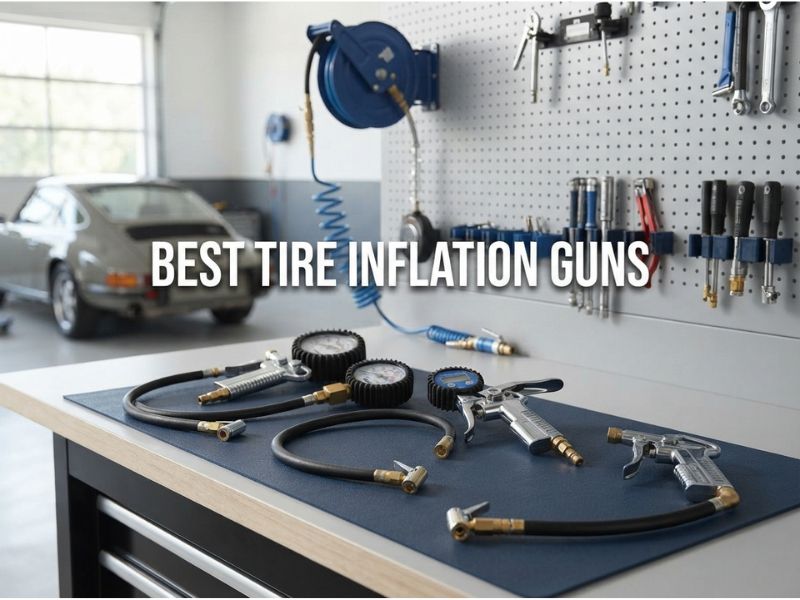
Best Tire Inflation Guns
1. AstroAI Digital Tire Pressure Gauge with Inflator 250 PSI – Best Overall
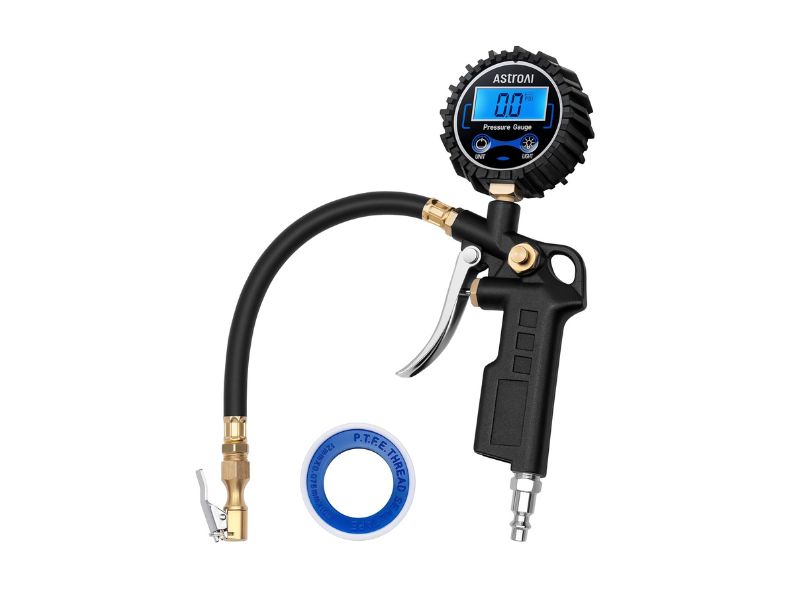
Key Features
- 3–250 PSI pressure range
- Digital backlit display
- 0.1 PSI display resolution
- Inflate, deflate, and measure functions
- Heavy-duty air chuck
- Flexible hose
- Quick-connect compressor coupler
- PSI, BAR, kPa, and kg/cm² measurement options
- Stainless-steel and brass components
- Uses replaceable AAA batteries
- Suitable for Schrader tire valves
The AstroAI is my first choice because it gives most home mechanics exactly what they need without becoming overly complicated.
Once connected to your compressor hose and tire valve, you can read the existing tire pressure directly on the digital display. If pressure is low, squeeze the inflation trigger. If you overshoot slightly, use the bleed valve to release a small amount of air.
That simple inflate-check-deflate workflow is what makes a tire inflation gun dramatically more convenient than a basic air chuck.
The digital gauge is particularly useful around normal passenger-car pressures. Most cars operate somewhere in the neighborhood of 30–40 PSI, although the exact pressure must always come from the vehicle’s tire placard.
A display that resolves pressure in small increments makes it much easier to bring all four tires to a consistent target than an inexpensive analog dial with widely spaced markings.
The wide 250 PSI range also gives the tool flexibility for higher-pressure applications. That does not mean a car tire should ever be inflated anywhere close to 250 PSI. The specification simply describes the measuring capability of the gauge.
I also like the backlit display. Tire maintenance often happens inside a dim garage or after dark, where an analog gauge can be difficult to read accurately.
Its quick-connect fitting works naturally with common shop compressor systems. Once your air hose is fitted with the appropriate female coupler, connecting and removing the inflation gun takes seconds.
The included flexible hose helps prevent the weight of the gun from hanging directly on the valve stem. That becomes particularly useful on awkward wheel designs where the valve points inward or sits between spokes.
The main limitation is electronic dependence. The pressure gauge needs batteries, whereas a purely mechanical inflator can function indefinitely without them.
For normal home-garage use, however, the easier reading is worth that small inconvenience.
What I Like
The digital display is easy to read, the pressure range covers practically every normal automotive use, and having inflation, pressure measurement, and air bleeding in one device greatly speeds up tire maintenance.
What I Do Not Like
It requires batteries, and the standard chuck may occasionally need careful positioning on certain valve stems to create a perfect seal.
Verdict
The AstroAI is the best tire inflation gun for most home garages. It is particularly suitable for drivers who regularly maintain multiple cars, SUVs, motorcycles, trailers, or recreational equipment.
2. EPAuto Heavy Duty 120 PSI Tire Inflator Gauge – Best Mechanical Pick
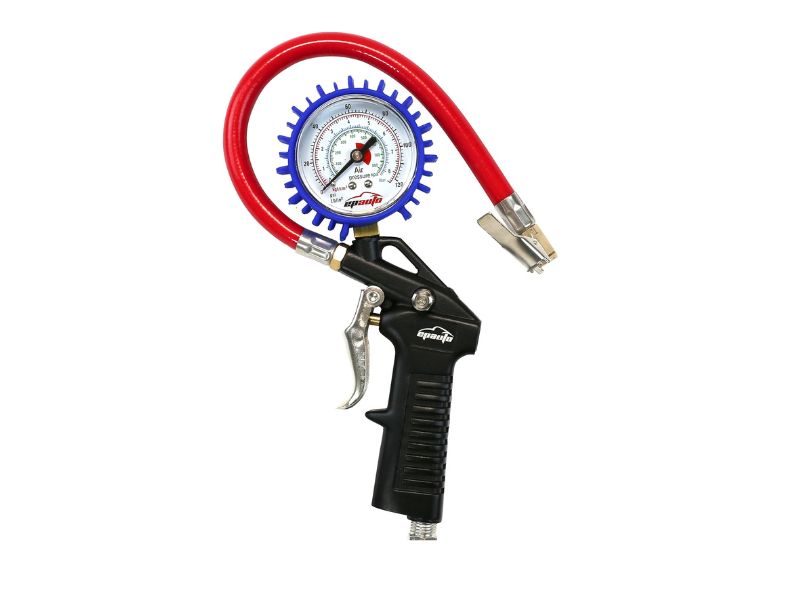
Key Features
- Up to 120 PSI measurement range
- Mechanical pressure gauge
- Flexible rubber hose
- Clip-on tire chuck
- Trigger-controlled inflation
- Pressure-release control
- Quick-connect compressor fitting
- No gauge batteries required
- Designed for common automotive tire valves
- Straightforward garage-friendly construction
The EPAuto takes a more traditional approach.
Instead of an LCD screen, it uses a mechanical pressure gauge. For buyers who dislike replacing batteries or simply prefer tools that can stay in a garage drawer for years, that design has real appeal.
The 120 PSI maximum range is more than sufficient for passenger cars, SUVs, motorcycles, trailers, lawn equipment, and many light-truck tires.
In fact, I often prefer a lower maximum range for normal passenger vehicles because it can make the part of the gauge you actually use easier to read.
If your sedan calls for 35 PSI, there is little practical benefit in having a 300 PSI analog scale where the useful passenger-car section is compressed into a tiny area.
Operation is simple.
Connect the gun to your compressor hose.
Attach the chuck to the tire’s Schrader valve.
Read the current pressure.
Squeeze the trigger when additional air is required.
Release excess pressure if necessary.
You can perform the entire adjustment without repeatedly removing the tool.
That is especially useful when checking all four tires during seasonal temperature changes.
A flexible hose gives you some freedom around wheels where the valve stem is positioned awkwardly. The clip-on chuck also lets the connection remain attached instead of requiring you to press the inflator manually against the valve during the entire process.
One advantage of the mechanical design is that the gauge does not suddenly become unreadable because AAA batteries were left installed for several years.
The tradeoff is resolution.
A good digital display makes small changes easier to see at a glance. With an analog dial, you need to interpret needle position between printed markings.
For many users, that difference is insignificant. A traditional mechanical gauge is still perfectly practical for routine inflation.
What I Like
I like the battery-free gauge, useful 120 PSI range, flexible hose, simple controls, and traditional shop-tool feel.
What I Do Not Like
The dial is not as easy to read precisely as a digital display, particularly in poor lighting. The body also deserves reasonable care rather than being repeatedly thrown onto a concrete shop floor.
Verdict
The EPAuto is my choice for anyone wanting a simple mechanical tire inflation gun that can stay permanently connected to a home compressor setup.
3. JACO FlowPro 2.0 Digital Tire Inflator Gauge – Best Premium Pick
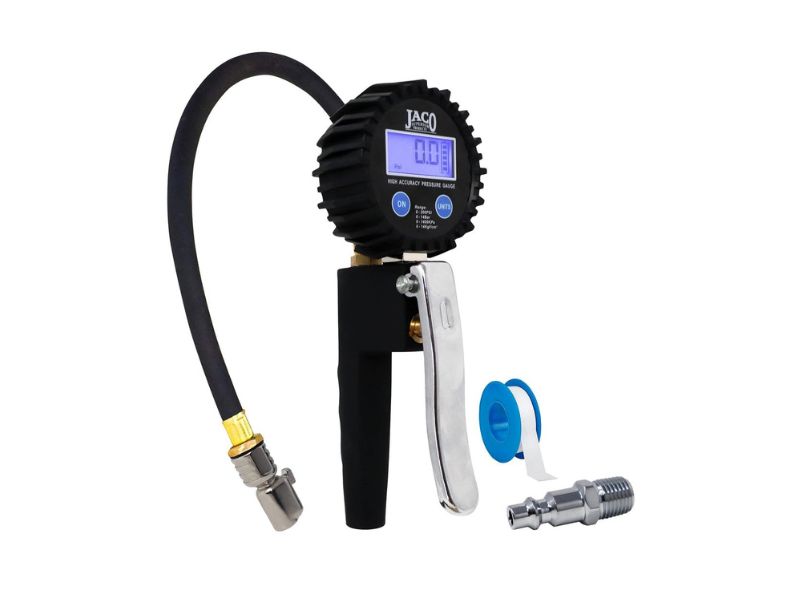
Key Features
- Up to 200 PSI pressure capability
- Digital illuminated gauge
- Inflate and bleed control
- Secure lock-on style air chuck
- Heavy-duty flexible hose
- Quick-connect air fitting
- Multiple pressure measurement units
- Replaceable AAA batteries
- Ergonomic one-handed operation
- Designed for frequent garage or shop use
The JACO FlowPro 2.0 is the model I would choose if I planned to use a tire inflation gun frequently rather than only a few times per year.
One of its strongest features is the valve-stem chuck design.
A poor tire chuck can leak enough air during connection that you spend more time fighting the fitting than adjusting pressure. A secure connection allows the gauge to stabilize and gives you more confidence that the number on the screen actually represents tire pressure rather than a partially leaking connection.
The FlowPro 2.0 also emphasizes one-handed operation.
That matters more than it sounds.
When you are kneeling beside a wheel, you may be holding the hose with one hand, stabilizing yourself with the other, and trying to make a half-PSI adjustment. A well-shaped control that lets you conveniently inflate or bleed pressure reduces frustration.
Its digital display is another advantage.
For a passenger car requiring approximately 33, 35, or 38 PSI, small differences are immediately visible.
That is especially helpful for performance cars where maintaining consistent left-to-right cold pressure can improve repeatability.
The 200 PSI range also gives the gauge enough headroom for higher-pressure tires found on some commercial, trailer, bicycle, or specialty applications, provided the valve and tool are otherwise compatible.
Build quality is the biggest reason I would consider paying more for the JACO.
For someone operating a compressor several times per week, better fittings, hose construction, grip feel, and chuck operation are generally more valuable than having ten extra accessories included in the package.
The tradeoff is value.
An occasional DIY user may get everything they need from the less expensive AstroAI or EPAuto.
What I Like
The secure chuck, readable digital gauge, one-handed control, sturdy hose, and garage-oriented construction make it particularly enjoyable for repeated use.
What I Do Not Like
It is harder to justify if you only check tire pressure a few times per year. The digital electronics also require battery maintenance.
Verdict
The JACO FlowPro 2.0 is the best premium tire inflation gun for frequent home-garage and workshop use.
Tire Inflation Gun Comparison
| Product | Gauge Type | Max Range | Inflate | Bleed Air | Flexible Hose | Quick Connect | Batteries | Best For |
| AstroAI 250 PSI | Digital | 250 PSI | Yes | Yes | Yes | Yes | AAA | Best overall |
| EPAuto Heavy Duty | Analog | 120 PSI | Yes | Yes | Yes | Yes | No | Simple garage use |
| JACO FlowPro 2.0 | Digital | 200 PSI | Yes | Yes | Yes | Yes | AAA | Frequent/premium use |
The AstroAI is the easiest recommendation for most buyers because it combines a large pressure range, digital readability, inflation and deflation controls, and broad automotive compatibility.
The EPAuto is better if you specifically want a mechanical gauge with no batteries.
The JACO FlowPro 2.0 makes the most sense if you care about chuck quality, ergonomics, and repeated shop use.
What Is a Tire Inflation Gun?
A tire inflation gun is a pneumatic tool that connects an air compressor hose to a tire valve while also providing a pressure gauge and inflation control.
A basic air chuck simply allows compressed air to enter the tire.
A proper tire inflation gun normally combines three functions:
Measure pressure.
Add compressed air.
Release excessive pressure.
This makes it one of the most convenient compressor accessories for routine automotive tire maintenance.
You may also see these products described as:
- Tire inflator with gauge
- Pneumatic tire inflator
- Air compressor tire gun
- Tire inflator gauge
- Air chuck with gauge
- Tire filler gun
- Tire pressure inflator
- Garage tire inflator
- Digital air inflator gauge
The terms refer to slightly different designs, but the buying intent is generally similar.
Tire Inflation Gun vs. Portable Tire Inflator
These tools are often confused.
A tire inflation gun does not normally contain an air compressor.
It must be connected to an external compressor.
A portable tire inflator contains its own small electric compressor and may operate from:
- A vehicle 12V outlet
- Rechargeable battery
- Power-tool battery
- AC electricity
Tire Inflation Gun Advantages
If you already own a garage compressor, a pneumatic gun offers several benefits.
It can provide:
- Faster airflow
- More comfortable repeated use
- Better gauge visibility
- Continuous operation
- No internal pump motor
- No rechargeable battery
- Easy shop-hose connection
Portable Inflator Advantages
A portable inflator can travel in the vehicle.
It does not need a large garage compressor.
For roadside emergencies, that independence makes a portable inflator more useful.
Many car owners benefit from having both: a pneumatic inflation gun in the garage and a small 12V or cordless compressor in the trunk.
How Does a Tire Inflation Gun Work?
Your shop compressor stores pressurized air inside its tank.
An air hose carries that compressed air to the inflation gun.
When the chuck is connected to the tire valve, the built-in gauge senses tire pressure.
Pressing the inflation trigger opens an internal valve and allows compressed air to flow from the compressor into the tire.
Releasing the trigger stops airflow.
A separate bleed valve—or a secondary trigger position on certain models—allows air inside the tire to escape.
This arrangement makes precise pressure adjustment much quicker than alternating between a separate air chuck and tire gauge.
What PSI Range Should a Tire Inflation Gun Have?
For ordinary passenger cars, you do not need an enormous pressure range.
Many cars specify cold tire pressures somewhere in the 30–40 PSI range.
Light trucks, trailers, motorcycles, bicycles, and specialty equipment can require considerably different pressures.
A gauge with a 100–150 PSI range is therefore sufficient for most normal vehicle maintenance.
A 200–250 PSI digital gauge offers broader compatibility.
However, higher range does not automatically mean better accuracy.
The most important characteristics are:
- Calibration
- Readability
- Resolution
- Consistency
- Appropriate range for your tires
If you only work with normal passenger cars, a good 100 PSI gauge can actually be easier to interpret than a 300 PSI analog gauge.
Digital vs. Analog Tire Inflation Gun
Both designs can work well.
Digital Gauge
A digital tire inflation gun provides numerical pressure readings.
Advantages include:
- Easy reading
- Good low-light visibility
- Small pressure increments
- Multiple measurement units
- Simple comparison between tires
Disadvantages include:
- Requires batteries
- Electronics can eventually fail
- Screens can be damaged by impact
- Extreme temperatures may affect batteries
Analog Gauge
An analog inflator uses a mechanical dial and needle.
Advantages include:
- No batteries
- Simple mechanism
- Always ready
- Traditional shop feel
- Often durable when protected
Disadvantages include:
- Small markings can be difficult to read
- Low-light visibility may be poor
- Impact can affect calibration
- Fine pressure changes are less obvious
For most homeowners, I prefer a digital tire inflation gun.
For a professional or workshop that values battery-free simplicity, a good analog gauge remains perfectly reasonable.
How Accurate Should a Tire Inflation Gun Be?
Accuracy matters because tire pressure influences:
- Tire wear
- Vehicle handling
- Braking behavior
- Ride quality
- Fuel economy
- Tire temperature
- Load capacity
For routine passenger-car maintenance, a quality gauge that stays within approximately 1 PSI of a trusted reference is generally very useful.
Professional calibration requirements can be stricter.
One good habit is to compare your inflator gauge periodically against a second trusted pressure gauge.
If three tires consistently read normally but one reading seems unusual, a second gauge can help determine whether the tire or tool deserves investigation.
What Does 0.1 PSI Resolution Mean?
Digital gauges often advertise 0.1 PSI resolution.
That means the display can show values such as:
34.1 PSI
34.2 PSI
34.3 PSI
Resolution is not the same thing as accuracy.
A display might show pressure to the nearest 0.1 PSI while the actual measurement accuracy is ±1 PSI.
This distinction is important.
More digits on the display do not automatically make a tool more accurate.
Why a Good Air Chuck Matters
The tire chuck creates the seal between the inflator hose and valve stem.
A poor chuck can:
- Leak air
- Fall off
- Damage the valve stem
- Produce unstable pressure readings
- Make inflation unnecessarily frustrating
Common designs include push-on and clip-on chucks.
A lock-on chuck is particularly convenient because it stays connected without continuous hand pressure.
For frequent tire servicing, chuck quality is one of the first things I would evaluate.
What Compressor Fitting Do You Need?
Many tire inflation guns use a 1/4-inch NPT connection and include a male quick-connect plug.
However, quick-connect plug profiles can differ.
Common pneumatic coupler standards include industrial and automotive styles.
Before buying, check what type of female quick coupler is installed on your compressor hose.
If your garage already uses one standardized quick-connect system, fitting every air tool with the same plug style makes tool changes much easier.
Thread seal tape or appropriate pneumatic thread sealant may be required on threaded connections.
Do not put sealant where it can enter the air passage or damage the tool.
What Is NPT?
NPT means National Pipe Thread.
It is a tapered thread standard commonly used on pneumatic equipment in the United States.
A 1/4-inch NPT fitting is extremely common on:
- Air hoses
- Air tools
- Tire inflators
- Blow guns
- Pneumatic nailers
- Regulators
The “1/4 inch” designation is a nominal pipe size rather than a direct measurement of the thread’s outside diameter.
Do You Need a Large Air Compressor?
Not necessarily.
Inflating tires does not normally require huge continuous airflow.
A small pancake compressor can be perfectly adequate for topping off passenger-car tires.
Tank capacity mostly affects how often the compressor motor needs to cycle.
A larger compressor becomes more helpful if you also operate air-hungry pneumatic tools such as:
- Impact wrenches
- Die grinders
- Sanders
- Paint spray guns
For simple tire inflation, compressor pressure and sufficient stored air matter more than having a massive tank.
Compressor PSI vs. Tire PSI
These numbers are different.
Your compressor may store air at 120–150 PSI.
Your tire might require only 35 PSI.
The higher compressor pressure creates the pressure difference needed to move air efficiently into the tire.
A regulator can control downstream air pressure when necessary.
Never set tire pressure based on the compressor’s maximum pressure.
Where to Find the Correct Tire Pressure
For passenger vehicles in the United States, the correct cold tire pressure is normally listed on the Tire and Loading Information label.
You can usually find it:
- On the driver’s door jamb
- Inside the driver’s door
- Occasionally elsewhere specified in the owner’s manual
The placard may list different values for front and rear tires.
Always use the pressure specified for your actual vehicle configuration.
Do Not Use the Tire Sidewall Maximum as Your Normal Pressure
This is an important safety point.
The pressure molded into the tire sidewall is not automatically the pressure your vehicle should use.
It normally relates to the tire’s maximum load and inflation specifications.
Your vehicle manufacturer determines the recommended operating pressure based on:
- Vehicle weight
- Suspension design
- Tire size
- Handling
- Load distribution
Use the vehicle placard pressure, not the tire’s maximum sidewall number.
When Should You Check Tire Pressure?
Tire pressure is best checked when tires are cold.
Cold does not necessarily mean outdoor winter temperature.
It generally means the tires have not been driven enough to generate significant internal heat.
Driving heats the tire and the air inside it, increasing pressure.
If you adjust a hot tire down to the cold specification, it may become underinflated once it cools.
Checking pressure before the day’s first drive is often easiest.
How Temperature Changes Tire Pressure
Tire pressure changes with ambient temperature.
A common practical rule is that tire pressure may change by roughly 1 PSI for every 10°F change in temperature, though actual behavior varies.
That is why the low-pressure warning often appears after the first major cold spell of fall or winter.
The tire may not suddenly have developed four punctures.
Ambient temperature simply decreased the air pressure inside all four tires.
Still, never assume a warning is caused only by weather. Inspect the tires for leaks or damage.
How to Use a Tire Inflation Gun
Connect the inflation gun to your compressor hose.
Turn on the compressor and allow it to reach normal operating pressure.
Check the vehicle tire placard for the recommended cold PSI.
Remove the tire valve cap.
Attach the tire chuck securely to the Schrader valve.
Read the pressure before adding air.
If pressure is low, gently squeeze the inflation trigger.
Release the trigger and allow the gauge to stabilize.
Continue adding air in short bursts until you approach the target.
If you add too much pressure, use the bleed valve to release a small amount.
Verify the final pressure.
Remove the chuck and replace the valve-stem cap.
Repeat the process for the remaining tires.
Why the Gauge Reading Changes While Air Is Flowing
Do not be surprised if the indicated pressure changes while the trigger is held.
While air is flowing through the hose and valve, pressure conditions inside the system differ from the tire’s stabilized static pressure.
For a reliable reading, release the inflation trigger and allow pressure to stabilize.
Then read the gauge.
This is particularly important when making fine adjustments near the final target.
Should You Use a Tire Inflation Gun With TPMS?
Yes.
TPMS, or Tire Pressure Monitoring System, does not normally interfere with external air inflation.
The tire’s pressure sensor is usually inside the wheel.
You still inflate through the normal Schrader valve.
However, some TPMS valve stems are metal and can be more vulnerable to damage from aggressive handling than ordinary rubber stems.
Do not bend or pull excessively on the valve while attaching the chuck.
Tire Inflation Gun for Trucks and RVs
Truck and RV owners should pay more attention to maximum pressure range and chuck accessibility.
Some heavy-duty tires operate at much higher pressure than passenger-car tires.
Dual rear wheels can also make inner valve stems difficult to reach.
For those applications, consider:
- Higher gauge range
- Longer hose
- Dual-head chuck
- 360-degree swivel chuck
- Good airflow
- Durable fittings
A 250 PSI digital inflator provides broader pressure capability than a 100 PSI automotive gauge.
Tire Inflation Gun for Motorcycles
Motorcycles use the same basic Schrader valve system in many cases, but wheel access can be more difficult.
Brake discs, spokes, exhaust components, and tight valve angles can interfere with large chucks.
A flexible hose and compact chuck are therefore particularly useful.
Motorcycle tire pressure is also sensitive to riding conditions and manufacturer specifications, so an easy-to-read gauge helps maintain consistent settings.
Can You Use a Tire Inflation Gun on Bicycles?
It depends on the valve.
Most automotive inflation guns are designed around Schrader valves.
Many bicycles also use Schrader valves, so compatibility can be straightforward.
Performance and road bicycles commonly use Presta valves.
A Presta-to-Schrader adapter can allow certain automotive inflators to work, but high-volume shop compressors can add air extremely quickly to small bicycle tires.
Use careful trigger control and verify the bicycle tire’s pressure requirements.
Tire Inflation Gun Maintenance
A quality inflation gun can last for years with basic care.
Keep the Chuck Clean
Dirt around the chuck can interfere with the seal and scratch valve components.
Protect the Gauge
Do not repeatedly throw the tool onto concrete.
Mechanical gauges can lose calibration, while digital displays and sensors can be damaged by impact.
Inspect the Hose
Replace the hose if you notice:
- Cracking
- Bulging
- Abrasion
- Fitting damage
- Air leaks
Check Threaded Fittings
Listen for leaks around compressor couplers and NPT connections.
A slow leak wastes compressor air and can cause the motor to cycle more often.
Remove Old Batteries
If a digital inflator will sit unused for a very long period, removing alkaline batteries can help prevent damage from battery leakage.
Common Tire Inflation Gun Problems
Chuck Leaks at the Valve
Push the chuck completely onto the valve stem.
Inspect both the tire valve and chuck seal for wear or damage.
Gauge Reads Incorrectly
Compare the reading against a known accurate gauge.
If the difference is significant and consistent, the inflator may need calibration or replacement.
Air Leaks at the Compressor Connection
Check the quick-connect coupler and threaded fittings.
Make sure the connector profile matches your air hose system.
Trigger Adds No Air
Confirm:
- Compressor tank has pressure
- Hose is not kinked
- Quick coupler is fully engaged
- Regulator is open
- Chuck is seated correctly
- Internal valve is operating
Pressure Drops Immediately
A very small drop during chuck removal can be normal.
A large or continuous loss suggests a leaking valve core, damaged valve stem, puncture, wheel leak, or defective chuck connection.
How Often Should You Check Tire Pressure?
For most drivers, checking at least once per month is a sensible routine.
Also check before:
- Long road trips
- Towing
- Carrying heavy loads
- Major seasonal temperature changes
- Extended highway driving
- Driving after the vehicle has been stored
Do not rely entirely on TPMS.
Many systems trigger a warning only after pressure has fallen significantly below the recommended level.
A tire can therefore be moderately underinflated without immediately turning on the dashboard warning.
Why Correct Tire Pressure Matters
Tire Life
Underinflation can increase shoulder wear.
Overinflation can contribute to uneven wear patterns depending on the tire and operating conditions.
Fuel Efficiency
An underinflated tire creates additional rolling resistance.
Handling
Proper inflation supports predictable steering and cornering behavior.
Braking
Tire condition and pressure influence the contact patch and vehicle response.
Heat
An underinflated tire flexes more as it rotates.
Excessive flex generates heat, which can contribute to tire damage under severe conditions.
Load Capacity
Tires need appropriate pressure to safely support vehicle loads.
This is especially important for pickups, trailers, and RVs.
Frequently Asked Questions
What is the best tire inflation gun?
The AstroAI 250 PSI Digital Tire Inflator is my best overall choice.
Its digital pressure display, broad PSI range, inflation trigger, bleed valve, flexible hose, and quick-connect compressor fitting create an excellent combination for typical home-garage tire maintenance.
Does a tire inflation gun need an air compressor?
Yes, a pneumatic inflation gun normally requires an external compressed-air source.
The gun controls and measures air but does not generate compressed air itself. For independent roadside inflation, choose a portable electric tire inflator instead.
What PSI tire inflation gun should I buy?
A 100–150 PSI gauge is enough for most passenger vehicles, while 200–250 PSI offers wider compatibility.
Choose a pressure range appropriate for your highest-pressure application rather than simply buying the largest number available.
Are digital tire inflation guns accurate?
Quality digital inflators can provide very useful automotive accuracy when properly calibrated.
Digital displays are easy to read, but display resolution does not guarantee accuracy. Periodically compare the tool against another trusted gauge.
Is an analog or digital tire inflator better?
Digital is easier to read, while analog eliminates batteries.
For most homeowners, I prefer digital. For a shop where simple battery-free reliability matters more, a quality mechanical dial is a good choice.
Can I use a tire inflation gun on any air compressor?
Usually, provided the compressor supplies sufficient pressure and the pneumatic fittings are compatible.
You may need to change the quick-connect plug to match your shop’s coupler standard.
What size fitting does a tire inflation gun use?
Many use 1/4-inch NPT pneumatic connections.
The quick-connect plug installed in that thread can follow different coupler profiles, so check your air-hose system before installation.
Do I need Teflon tape on the fitting?
Thread seal tape or an appropriate pneumatic thread sealant is often used on NPT threads.
Apply it carefully so material does not enter the airflow path. Follow the tool and fitting manufacturer’s instructions.
Why does my gauge show higher pressure while inflating?
Airflow temporarily changes pressure conditions inside the hose and valve.
Release the inflation trigger and let the pressure stabilize before taking your final reading.
Can I inflate tires with the compressor set to 150 PSI?
The compressor can store air at 150 PSI while the tire is inflated only to its specified pressure.
The inflation gun controls airflow, and you stop when the tire reaches the pressure listed on the vehicle placard.
What pressure should my car tires be?
Use the cold tire pressure on the vehicle’s Tire and Loading Information label.
It is usually found inside the driver’s door or on the door jamb. Do not automatically use the maximum pressure printed on the tire sidewall.
Can I use one tire inflation gun for cars and motorcycles?
Yes, if the pressure range and chuck fit both vehicles’ valves.
A flexible hose can make motorcycle valve access significantly easier.
Can I use a tire inflation gun for truck tires?
Yes, provided the gauge pressure range and compressor capability match the truck tires.
High-pressure commercial or heavy-duty applications may benefit from a longer hose and dual-head chuck.
Does a tire inflation gun automatically stop at the desired PSI?
Most pneumatic inflation guns do not provide automatic shutoff.
You generally watch the gauge and release the trigger at the desired pressure. Digital auto-stop is more common on electric portable compressors.
Why is my tire losing air after inflation?
The problem may be a puncture, valve leak, bead leak, wheel damage, or temperature change.
A tire inflation gun only restores pressure; it does not repair the cause of repeated air loss.
Do I still need a separate tire pressure gauge?
Not necessarily, but keeping a second trusted gauge is useful for periodic accuracy checks.
Comparing two gauges helps identify calibration drift before inaccurate pressure becomes routine.
Final Verdict
The best tire inflation gun should make routine tire maintenance faster rather than simply adding another attachment to your compressor hose.
My primary recommendation is the AstroAI Digital Tire Pressure Gauge with Inflator 250 PSI. Its huge established buyer history, easy-to-read digital display, flexible hose, quick-connect coupler, inflation trigger, bleed function, and wide pressure range make it the most versatile choice for most home garages.
The EPAuto Heavy Duty 120 PSI Tire Inflator Gauge is the better alternative if you prefer a traditional mechanical gauge. Its battery-free design is simple, dependable, and particularly well suited to ordinary passenger-car pressures.
The JACO FlowPro 2.0 Digital Tire Inflator Gauge is the model I would choose for frequent garage or workshop use. Its secure chuck, digital display, ergonomic control, and more premium construction make repeated inflation work considerably more comfortable.
For most drivers who already own an air compressor, I would start with the AstroAI. Connect it to a standardized 1/4-inch pneumatic hose setup, periodically compare its reading against a trusted reference gauge, and always inflate tires according to the cold pressure printed on the vehicle’s door-jamb placard rather than the maximum pressure molded into the tire sidewall.