Finding the best AGM car battery charger is different from choosing a basic charger for an old flooded lead-acid battery. AGM, or Absorbent Glass Mat, batteries are sealed, vibration-resistant, and increasingly common in modern cars, SUVs, trucks, performance vehicles, and start-stop systems. They also benefit from a charger that can control voltage carefully, transition into maintenance mode automatically, and avoid unnecessary overcharging during long storage periods.
My first recommendation is the NOCO GENIUS1 1A Smart Battery Charger. It is compact, easy to leave connected for battery maintenance, and provides a dedicated 12V AGM charging mode along with temperature-compensated charging. Its 1-amp output is deliberately gentle, so I particularly like it for vehicles that sit for long periods, seasonal cars, motorcycles, and AGM batteries that mainly need maintaining rather than rapid recovery from a deep discharge.
For owners who want another proven low-current option, the Battery Tender Plus 12V 1.25 Amp Battery Charger is an excellent choice. Its fully automatic charge-and-maintain operation is uncomplicated, and the 1.25-amp output works especially well when keeping a healthy AGM battery topped off through winter or during periods when a vehicle is driven infrequently.
If you regularly need to recharge a partially discharged automotive AGM battery rather than simply maintain it, I would also consider the Schumacher SC1281 Fully Automatic Battery Charger. It is much larger than the compact maintainers above, but its higher charging capability, boost function, engine-start assistance, and support for AGM batteries make it considerably more versatile for a home garage.
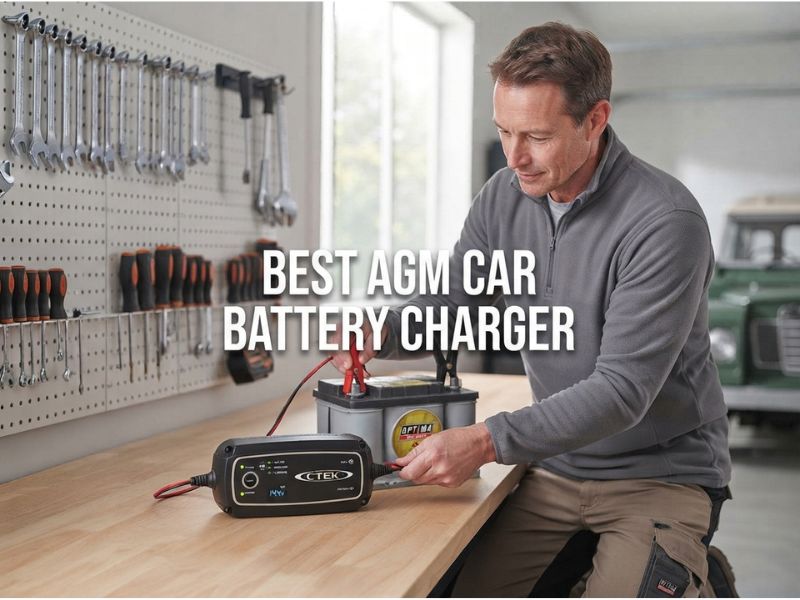
Best AGM Car Battery Charger
| Image | Product Name | Check Price |
|---|---|---|
Best Choice | NOCO GENIUS1 1A Smart Battery Charger | Check Price |
Second Best | Battery Tender Plus 12V 1.25 Amp Battery Charger | Check Price |
Third Choice | MOTOPOWER 12V 800mA Battery Charger | Check Price |
 | Schumacher Fully Automatic Battery Charger | Check Price |
 | CTEK MXS 5.0 12V Battery Charger and Maintainer | Check Price |
AGM batteries require appropriate charging voltage and a controlled charging algorithm. Using a modern smart charger is generally more convenient than relying on an old manual charger because the charger can regulate current automatically as the battery approaches full charge.
The five chargers below cover several different needs. Some are intentionally low-current maintainers for stored vehicles, while others provide enough output to recharge automotive batteries more quickly.
1. NOCO GENIUS1 1A Smart Battery Charger – Best Overall AGM Maintainer
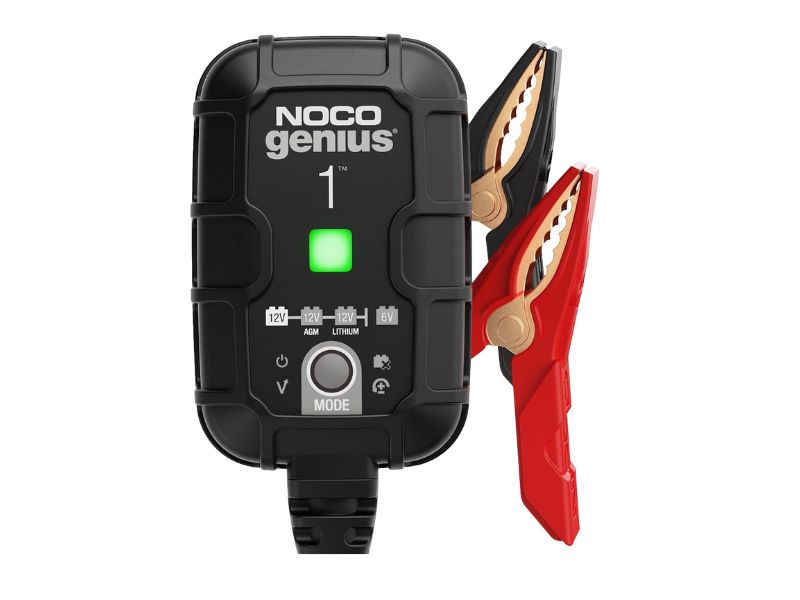
Key Features
- 1-amp charging output
- 6V and 12V charging
- Dedicated 12V AGM mode
- Supports flooded, gel, AGM, EFB, maintenance-free, and compatible lithium batteries
- Automatic temperature compensation
- Automatic maintenance charging
- Reverse-polarity protection
- Spark-proof operation
- Force Mode for extremely discharged batteries
- Compact 0.77-pound housing
The NOCO GENIUS1 is my primary recommendation for drivers who want a compact smart charger that can spend most of its life maintaining a vehicle battery.
Its most important feature for this article is the dedicated 12V AGM mode. AGM batteries can have different charging requirements from conventional flooded batteries, so being able to select the correct profile removes some guesswork from the charging process.
The charger also monitors ambient temperature and adjusts charging behavior accordingly. This is valuable because battery charging is temperature-sensitive. A fixed charging strategy that works well in mild weather may not be ideal during a very cold winter or hot summer garage.
Another useful feature is automatic maintenance. Once charging is complete, the charger can continue monitoring the battery rather than continuously applying the full charging current. This makes it suitable for vehicles that may remain parked for weeks or months.
There is also a Force Mode for extremely discharged batteries that fall below the normal automatic detection threshold. That feature should be used carefully because some normal protection logic is bypassed when manually forcing charging.
The biggest limitation is straightforward: 1 amp is slow.
A typical automotive AGM battery may have a capacity of 50Ah, 70Ah, 80Ah, or more. If that battery is deeply discharged, a 1-amp charger can require a long time to restore substantial capacity.
For long-term maintenance, however, the gentle output is exactly what many owners need.
What I Like
- Dedicated AGM mode.
- Excellent for long-term battery maintenance.
- Temperature-compensated charging.
- Compact enough for almost any garage.
- Automatic operation after setup.
- Multiple electrical safety protections.
- Can maintain batteries of many different capacities.
- Useful Force Mode for unusually low-voltage batteries.
What I Do Not Like
- 1A charging is slow for a deeply discharged car battery.
- Not intended for someone needing rapid garage charging.
- Small indicator lights provide less information than a full digital display.
Verdict: The NOCO GENIUS1 is my first choice when your primary goal is safely charging and maintaining a 12V AGM battery during storage or infrequent vehicle use. Choose a higher-output model if you frequently recharge deeply discharged automotive batteries.
2. Battery Tender Plus 12V 1.25 Amp Battery Charger – Best for Long-Term Storage

Key Features
- 12V charging
- 1.25-amp output
- AGM-compatible
- Supports standard flooded and gel lead-acid batteries
- Automatic charging and maintenance
- Float-mode operation
- Reverse-connection protection
- Alligator clips and ring-terminal connection
- Long cable reach
- 10-year limited warranty
Battery Tender became closely associated with the battery-maintainer category because its chargers are straightforward and designed around keeping stored batteries ready to use.
The Battery Tender Plus is particularly suitable for an AGM battery in a weekend car, classic vehicle, seasonal SUV, motorcycle, lawn equipment, or another machine that spends significant time parked.
Its 1.25-amp charge rate is still relatively low, but it is slightly faster than a basic 0.75A or 0.8A maintainer.
The charger automatically progresses through its charging process and then switches into a maintenance state rather than continuing to push full charging current indefinitely.
That is exactly what you want when maintaining a fully charged AGM battery through several weeks or months of storage.
The included ring-terminal harness is also useful for a vehicle you maintain regularly. Instead of repeatedly removing panels or reaching awkward battery terminals, you can install the ring connection and plug the charger into the quick connector when the vehicle is parked.
As with the NOCO GENIUS1, charging speed is the main compromise.
If you leave the headlights on overnight and substantially discharge a large automotive battery, there are faster options. The Battery Tender Plus makes more sense when preventing discharge is the goal.
What I Like
- Extremely simple operation.
- Designed for charge-and-maintain use.
- Compatible with AGM batteries.
- Ring terminals work well for frequently stored vehicles.
- Long-term maintenance is the main focus.
- Lightweight and easy to store.
- Long limited warranty.
What I Do Not Like
- 1.25A is slow for large discharged batteries.
- Fewer advanced battery-recovery controls than some competitors.
- Basic indicator system rather than a detailed LCD.
Verdict: Battery Tender Plus is an excellent AGM charger for a vehicle that spends extended periods in the garage. It is better at preventing a battery problem than quickly solving a severely discharged battery.
3. MOTOPOWER 12V 800mA Battery Charger – Best Budget AGM Maintainer

Key Features
- 12V operation
- 800mA charging output
- AGM and gel-cell support
- Flooded and sealed lead-acid compatibility
- Automatic charge-and-maintain operation
- Automatic desulfation function
- SAE quick-connect system
- Alligator clamps and ring-terminal cable
- Compact lightweight design
The MOTOPOWER MP00205A is another low-current option, but it fills an important role for drivers who primarily want inexpensive battery maintenance.
At 800mA, this charger is even slower than the NOCO GENIUS1 and Battery Tender Plus.
That means I would not choose it as my primary tool for repeatedly charging a large automotive AGM battery from a low state of charge.
For keeping an already healthy AGM battery topped up, however, the low current is perfectly reasonable.
MOTOPOWER combines charging, maintenance, and automatic desulfation into a small package. The SAE quick connector also makes permanent installation easy.
Attach the ring terminals to the battery, route the connector somewhere accessible, and connecting the maintainer becomes a simple plug-in operation.
This setup works especially well for collector vehicles, motorcycles, second cars, convertibles, boats, lawn tractors, and vehicles stored during winter.
The charger is also uncomplicated. You do not need to select from a large number of menus each time you connect it.
That simplicity will appeal to buyers who want an AGM-compatible maintainer without paying for high charging current they do not need.
What I Like
- Very compact.
- AGM-compatible.
- Straightforward automatic operation.
- SAE quick-disconnect system.
- Includes both clamps and ring terminals.
- Useful for seasonal storage.
- Automatic maintenance helps prevent overcharging.
What I Do Not Like
- 800mA output is very slow for automotive battery recovery.
- Not suitable when fast charging is important.
- Less sophisticated interface than premium smart chargers.
Verdict: The MOTOPOWER MP00205A is a sensible choice when your AGM battery is normally healthy and you mainly need an inexpensive way to prevent it from slowly discharging during storage.
4. Schumacher Fully Automatic Battery Charger – Best for Fast Charging and Garage Use
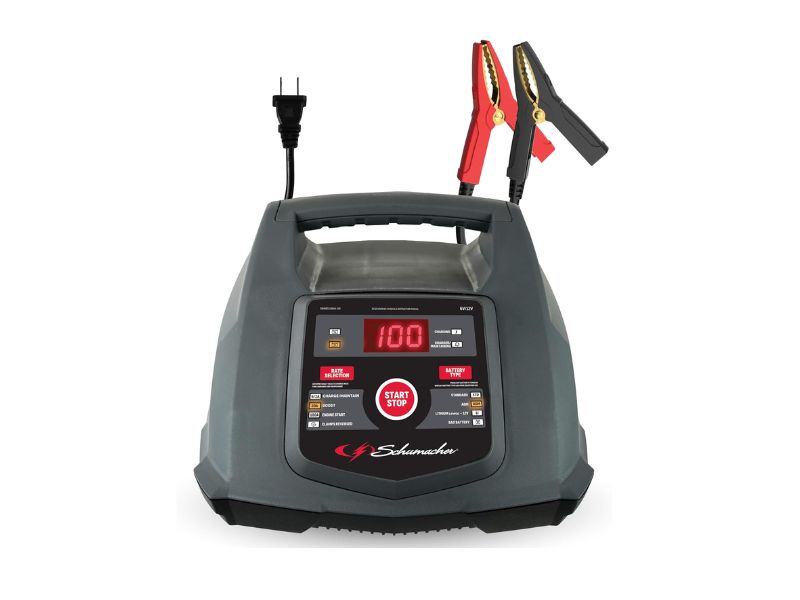
Key Features
- Supports 6V and 12V batteries
- AGM, standard, gel, and deep-cycle compatibility
- Automatic microprocessor-controlled charging
- Multiple charging rates
- 30A boost capability
- 100A engine-start function
- Battery testing
- Alternator testing
- Reverse-hookup protection
- Digital display and push-button controls
The Schumacher SC1281 is completely different from the three compact maintainers above.
This is a garage-oriented charger designed for owners who occasionally encounter batteries that are significantly discharged and want more than a trickle-maintenance solution.
Its microprocessor-controlled system automatically adjusts charging behavior, and the unit supports standard, AGM, gel, and deep-cycle lead-acid batteries.
The greater charging output makes a major difference on a normal automotive battery.
Imagine a 70Ah AGM battery that has lost a substantial portion of its capacity. Restoring that energy with an 800mA or 1A maintainer could take a very long time.
A higher-current smart charger can handle that situation much more practically.
The SC1281 also provides a 30A boost and a 100A engine-start mode. The engine-start feature is not the same thing as charging the battery; it provides temporary assistance when trying to start a vehicle.
Battery and alternator testing make the unit particularly attractive for home mechanics. If you regularly maintain multiple cars, trucks, SUVs, recreational vehicles, or equipment, those diagnostic features may be more valuable than extreme portability.
The tradeoff is size and weight.
At more than 12 pounds, this is not the type of charger you casually tuck into a small drawer.
What I Like
- Much faster charging than small maintainers.
- Supports AGM batteries.
- Useful 30A boost function.
- 100A engine-start assistance.
- Battery and alternator testing.
- Good choice for larger automotive batteries.
- Automatic charging reduces manual adjustment.
- Suitable for a serious home garage.
What I Do Not Like
- Significantly larger than compact chargers.
- Heavy compared with NOCO or MOTOPOWER.
- More complicated than a basic plug-and-maintain device.
- Excess capability for someone who only maintains one stored vehicle.
Verdict: Schumacher SC1281 is the best choice in this lineup when you need an actual garage battery charger rather than primarily a maintainer. Its additional boost, starting, and diagnostic capabilities make it especially useful for households with several vehicles.
5. CTEK MXS 5.0 12V Battery Charger and Maintainer – Best Premium AGM Charger
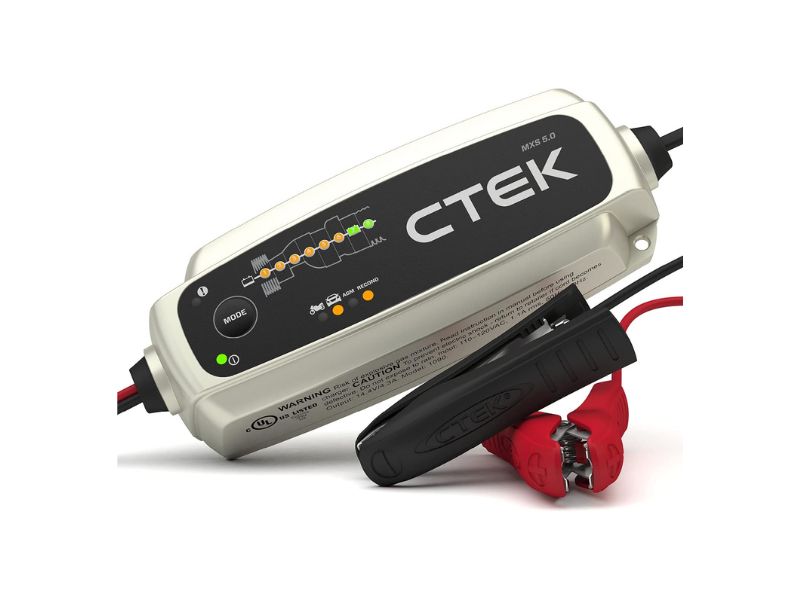
Key Features
- 12V lead-acid charging
- 4.3A output on the North American model
- Dedicated AGM charging option
- Supports batteries from 1.2Ah to 110Ah
- Maintenance capability up to 160Ah
- Eight-step charging program
- Automatic temperature compensation
- Battery diagnosis
- Desulfation stage
- Reconditioning mode
- Float/pulse maintenance
- IP65 protection
- Reverse-polarity and short-circuit protection
The CTEK MXS 5.0 is the most AGM-focused premium charger in this group.
Despite the MXS 5.0 name, the North American version is specified at approximately 4.3 amps, which is still substantially quicker than a 1A maintainer for charging an ordinary automotive battery.
Where the CTEK really stands out is its charging algorithm.
It uses an eight-step process that evaluates the battery, performs charging stages automatically, checks whether the battery can retain its charge, and transitions into long-term float/pulse maintenance once charging is complete.
There is also a dedicated AGM option that raises the charging profile appropriately for compatible AGM batteries.
Temperature compensation adjusts charging voltage as ambient conditions change, which is particularly useful in garages that experience hot summers and freezing winters.
The MXS 5.0 also includes a reconditioning function.
However, reconditioning modes should never be used indiscriminately on every sealed AGM battery. Some recovery programs use higher voltages than normal charging. Check the battery manufacturer’s instructions before applying any special recovery or reconditioning procedure.
The charger is rated to charge lead-acid batteries up to 110Ah and maintain larger batteries up to 160Ah, making it suitable for most passenger vehicles and many larger battery applications.
What I Like
- Dedicated AGM mode.
- Excellent multi-stage charging system.
- Automatic temperature compensation.
- More practical charging speed than 1A maintainers.
- Battery diagnosis built into the charge cycle.
- Excellent long-term float/pulse maintenance.
- IP65-rated enclosure.
- Five-year warranty.
- Strong option for premium AGM batteries.
What I Do Not Like
- More expensive than basic maintainers.
- No engine-start function.
- Reconditioning mode requires understanding when it is appropriate.
- LED interface is functional but not as detailed as a large digital display.
Verdict: The CTEK MXS 5.0 is my premium choice for owners who want a sophisticated charger specifically suited to AGM battery care, particularly for valuable cars, performance vehicles, and long-term storage.
AGM Car Battery Charger Comparison
| Product | Voltage | Charge Output | AGM Support | Temperature Compensation | Maintenance Mode | Recovery Feature | Engine Start | Best Use |
| NOCO GENIUS1 | 6V/12V | 1A | Dedicated AGM mode | Yes | Yes | Force Mode | No | Everyday AGM maintenance |
| Battery Tender Plus | 12V | 1.25A | Yes | Automatic charging control | Yes | Basic smart charging | No | Long-term storage |
| MOTOPOWER MP00205A | 12V | 0.8A | Yes | Automatic charging | Yes | Automatic desulfation | No | Budget maintenance |
| Schumacher SC1281 | 6V/12V | Multi-rate | Yes | Automatic control | Yes | Boost charging | 100A | Garage charging |
| CTEK MXS 5.0 | 12V | 4.3A | Dedicated AGM option | Yes | Float/pulse | Recond + desulfation | No | Premium AGM care |
Which AGM Battery Charger Should You Buy?
For an AGM battery that mainly needs maintenance, my first choice is the NOCO GENIUS1. It is compact, supports a dedicated AGM profile, and automatically adjusts charging for temperature.
The Battery Tender Plus is equally attractive for a collector car or seasonal vehicle that spends months in storage.
If minimum cost and simple maintenance are the priorities, MOTOPOWER MP00205A makes sense, although you need patience because its 800mA output is slow.
Choose Schumacher SC1281 when you frequently need to recharge discharged automotive batteries and want engine-start and diagnostic functions.
For a premium AGM-specific charging system with greater output, sophisticated multi-stage charging, temperature compensation, and float/pulse maintenance, the CTEK MXS 5.0 is my preferred upgrade.
What Is an AGM Car Battery?
AGM stands for Absorbent Glass Mat.
It is a type of valve-regulated lead-acid battery in which the electrolyte is absorbed into fiberglass mats positioned between the lead plates.
Unlike a conventional flooded lead-acid battery, there is no reservoir of freely moving liquid electrolyte that normally requires maintenance.
AGM construction provides several useful advantages:
- High starting current
- Low internal resistance
- Better vibration resistance
- Sealed construction
- Low self-discharge
- Strong cycling capability
- Good performance in modern high-electrical-demand vehicles
AGM batteries are particularly common in vehicles equipped with automatic start-stop systems, extensive electronics, regenerative charging strategies, and large accessory loads.
They are also widely used in performance vehicles, powersports equipment, RV applications, marine systems, and vehicles that require high cold-cranking output.
Why AGM Batteries Need the Right Charger
A conventional lead-acid charger may technically put energy into an AGM battery, but that does not mean it provides the ideal charging profile.
AGM batteries are sensitive to charging voltage.
Too little voltage can leave the battery chronically undercharged.
Too much voltage can increase internal pressure, cause excessive gassing, dry out the electrolyte, and shorten battery life.
Unlike a traditional flooded battery, you cannot simply remove caps and replace lost water in most automotive AGM batteries.
That makes controlled charging voltage particularly important.
A quality smart AGM charger automatically changes charging current and voltage as the battery moves through different states of charge.
How a Smart AGM Charger Works
Modern smart chargers typically use several stages rather than applying one fixed voltage continuously.
The exact terminology differs between manufacturers, but the underlying process usually includes the following phases.
Battery Detection
The charger checks voltage and determines whether a battery is connected correctly.
Some chargers also detect battery condition.
Soft Start
Charging begins conservatively to determine whether the battery can safely accept current.
This stage is especially useful for deeply discharged batteries.
Bulk Charging
The charger supplies relatively high current to restore most of the battery’s capacity.
This is where charger amperage has the greatest impact on charging time.
Absorption
As the battery approaches full charge, current gradually decreases while voltage is controlled.
This allows the battery to reach full capacity without excessive charging stress.
Analysis
Some advanced chargers check whether the battery can retain the charge it has received.
A battery that quickly loses voltage may be damaged or nearing the end of its service life.
Float Charging
Once fully charged, the charger reduces its output and maintains the battery at an appropriate voltage.
Pulse Maintenance
Some premium chargers monitor voltage and provide periodic charging pulses rather than holding the battery at one continuous float voltage.
The goal is to keep the battery ready without unnecessary overcharging.
What Charging Voltage Does an AGM Battery Need?
Many 12V AGM batteries charge at approximately 14.4 to 14.7 volts, but the exact recommended voltage depends on the battery manufacturer, temperature, and specific construction.
That is why I prefer a charger with a dedicated AGM mode.
For example, a charger may use a higher absorption voltage in AGM mode than it uses for an ordinary flooded battery.
The important rule is simple:
Follow the battery manufacturer’s charging specification whenever it is available.
Do not assume every AGM battery requires exactly the same charging voltage.
How Many Amps Should an AGM Car Battery Charger Have?
The ideal current depends on how you use the charger.
Under 1 Amp
A charger producing around 0.75A to 1A is primarily suited to:
- Maintenance
- Storage
- Small batteries
- Slow overnight charging
- Preventing self-discharge
It can recharge larger batteries, but slowly.
1 to 2 Amps
This range works well for:
- Battery maintenance
- Weekend vehicles
- Classic cars
- Motorcycles
- Gentle long-term charging
A 1.25A Battery Tender is a typical example.
4 to 6 Amps
This is a particularly useful range for home automotive charging.
A 5A-class charger can replenish a moderately discharged 50–80Ah car battery much faster than a 1A maintainer while remaining compact.
This is one reason the CTEK MXS 5.0 is attractive for AGM car batteries.
10 Amps or More
Higher current becomes useful when charging:
- Large automotive batteries
- SUVs
- Trucks
- Deep-cycle batteries
- Significantly discharged batteries
Higher current does not automatically mean better battery care. The charger must still regulate voltage and transition correctly through its charging stages.
Charger Amp Rating vs. Battery Capacity
Battery capacity is normally measured in amp-hours (Ah).
Imagine a 70Ah AGM battery that has approximately 35Ah of energy missing.
In an ideal world, a 1A charger would require approximately 35 hours to replace that energy.
Real charging is not perfectly efficient, and current falls during the later charging stages, so the actual process may take longer.
A 5A charger can replace substantial energy much faster.
This is why I divide AGM chargers into two broad categories:
Maintainers are best when the battery is normally near full charge.
Chargers with higher output are better when the battery regularly becomes substantially discharged.
Best AGM Charger for a Car That Sits
A stored vehicle normally does not require high charging current.
The battery slowly loses energy from:
- Natural self-discharge
- Alarm systems
- Keyless-entry modules
- Vehicle computers
- Telematics
- Clock memory
- Other parasitic electrical loads
A 1A-class smart maintainer can replace these small losses and keep the battery near full charge.
For this situation, I prefer the NOCO GENIUS1 or Battery Tender Plus.
Permanent ring-terminal connections make the process even easier.
Park the vehicle, connect the quick plug, and let the charger manage the battery.
Best AGM Charger for a Dead Car Battery
A completely different problem occurs when the AGM battery has become deeply discharged.
If a 70Ah battery has lost much of its capacity, a 0.8A maintainer may eventually recharge it, but the process can take a very long time.
For this situation, I would choose a higher-output model such as the CTEK MXS 5.0 or Schumacher SC1281.
There is another issue: extremely discharged batteries may fall below the charger’s automatic detection threshold.
Some smart chargers interpret an extremely low-voltage battery as though no battery is connected.
A manual Force Mode or specialized recovery function can help in certain situations.
Use these modes carefully and only after verifying battery polarity and condition.
Can an AGM Battery Be Too Dead to Charge?
Yes.
Deep discharge can cause permanent damage, particularly when the battery remains discharged for a long period.
Possible problems include:
- Severe sulfation
- Internal short circuits
- Damaged plates
- Loss of capacity
- Cell failure
A charger cannot repair every damaged battery.
If the battery repeatedly drops voltage soon after charging, fails a load test, develops physical swelling, leaks, becomes unusually hot, or produces an abnormal odor, stop charging and have it inspected.
What Is Battery Sulfation?
Lead-acid batteries naturally form lead-sulfate crystals during discharge.
Normal charging converts much of this material back into active battery chemistry.
Problems develop when a battery remains partially or fully discharged for extended periods.
The sulfate can harden into larger crystalline deposits on the battery plates, reducing the active surface area available for charging and discharging.
This is known as sulfation.
Some smart chargers use controlled pulse or elevated-voltage stages intended to reduce certain forms of sulfation.
These features may help mildly neglected batteries, but they cannot restore damaged plates or reverse every aging process.
AGM Charger vs. Trickle Charger
The terms are often used interchangeably, but technically they are not the same thing.
A traditional trickle charger delivers a small continuous charging current.
A modern smart charger or maintainer monitors battery condition and automatically changes its charging behavior.
For long-term AGM battery care, I prefer a smart maintainer.
It can reduce or stop active charging after the battery reaches full charge rather than continuously pushing current into it.
AGM Charger vs. Battery Maintainer
A battery charger is designed primarily to restore energy.
A maintainer is primarily intended to keep an already charged battery from slowly discharging.
Many modern products perform both functions.
The difference is usually output.
A 0.8A charger/maintainer can maintain a large car battery but will recharge it slowly.
A 5A or 10A smart charger can both restore significant energy and then transition into maintenance.
Can You Leave an AGM Charger Connected Overnight?
Yes, if the charger is specifically designed for automatic long-term charging and maintenance.
Modern smart chargers monitor battery condition and reduce charging after the battery reaches full capacity.
Do not assume an old manual charger can safely remain connected indefinitely.
Check the charger’s instructions before leaving any battery charger unattended for extended periods.
Can You Leave an AGM Battery Maintainer Connected All Winter?
A quality automatic maintainer is specifically designed for this use.
This is common with:
- Classic cars
- Convertibles
- Motorcycles
- Seasonal sports cars
- RVs
- Boats
- Lawn equipment
Ensure the charger and battery are installed in accordance with their operating and ventilation requirements.
Inspect cables periodically and make sure the charging environment remains dry and safe.
Temperature Compensation Matters
Battery chemistry responds to temperature.
In cold weather, a battery may require a somewhat higher charging voltage.
In high temperatures, excessive charging voltage can become more damaging.
A charger with automatic temperature compensation modifies its charging strategy based on ambient conditions.
This is one of the reasons I like the NOCO GENIUS1 and CTEK MXS 5.0 for vehicles stored in garages that experience significant seasonal temperature changes.
AGM Batteries and Start-Stop Vehicles
Automatic start-stop systems place greater cycling demands on a vehicle battery than traditional starting systems.
Many such vehicles use AGM or EFB batteries.
If your vehicle is equipped with an AGM battery, confirm that the charger supports that chemistry before connecting it.
Also remember that some modern vehicles have battery-monitoring sensors on the negative terminal.
The vehicle manufacturer may specify a particular grounding point for charging rather than attaching both charger clamps directly to the battery posts.
Check the owner’s manual.
Do You Need to Disconnect an AGM Battery Before Charging?
Not always.
Many modern smart chargers are designed to charge batteries while installed in the vehicle.
However, the correct connection method varies between vehicles.
Some manufacturers provide dedicated under-hood charging posts even when the battery is located somewhere else in the vehicle.
Luxury vehicles and cars with advanced battery-management systems may have specific instructions.
Always follow the vehicle manufacturer’s procedure.
How to Charge an AGM Car Battery Safely
1. Identify the Battery Type
Confirm that the battery is actually AGM.
Look at its label or documentation.
Do not guess based only on appearance.
2. Inspect the Battery
Do not charge a battery that is:
- Cracked
- Leaking
- Severely swollen
- Physically damaged
- Frozen
A damaged battery should be professionally evaluated.
3. Turn the Charger Off Before Connecting
Connect the charger before applying AC power unless the manufacturer’s procedure specifies otherwise.
4. Connect Positive
Attach the positive charger clamp to the positive battery terminal or approved charging point.
5. Connect Negative
Follow the vehicle manufacturer’s instructions for the negative connection.
Some vehicles specify a chassis grounding point.
6. Select AGM Mode
If the charger offers a dedicated AGM profile, select it.
7. Start Charging
Connect AC power and confirm the charger indicates a correct connection.
8. Allow the Charger to Complete Its Cycle
Do not disconnect simply because the battery reaches enough voltage to start the car.
Allowing the absorption stage to finish helps restore the battery more completely.
9. Disconnect Safely
Turn off or unplug the charger before removing connections, following the manufacturer’s specified sequence.
How Long Does It Take to Charge an AGM Car Battery?
Charging time depends on:
- Battery capacity
- Current state of charge
- Charger amperage
- Battery temperature
- Battery health
- Charging efficiency
- Charging algorithm
A 1A charger can require more than a day to substantially recharge a large depleted automotive battery.
A 5A charger may complete the same task in a fraction of that time.
The final 10–20% of charging typically takes longer because smart chargers intentionally reduce current during the absorption stage.
Can You Overcharge an AGM Battery?
Yes.
Overcharging can cause excessive internal pressure and permanent damage.
Because most automotive AGM batteries are sealed, electrolyte lost through excessive venting cannot simply be replaced.
This makes a fully automatic smart charger a much safer choice than a basic manual charger for long-term use.
Should You Use Repair Mode on an AGM Battery?
Not automatically.
Some chargers use elevated voltage during repair or reconditioning modes.
That may be suitable for certain lead-acid batteries but inappropriate for others.
AGM batteries are sealed and can be more sensitive to excessive voltage.
Before using a repair, recondition, or desulfation mode, verify that both the charger manufacturer and battery manufacturer consider the process appropriate for your specific battery.
Signs Your AGM Battery May Need Charging
Common signs include:
- Slower engine cranking
- Start-stop system becoming unavailable
- Battery warning messages
- Vehicle electronics behaving unusually
- Low resting voltage
- Vehicle sitting unused for weeks
- Repeated short-distance driving
- Cold-weather starting difficulty
A low battery does not necessarily mean the battery has failed.
Modern vehicles can consume significant power while parked, and repeated short trips may not give the alternator enough time to fully restore the energy used during starting.
Signs the AGM Battery May Need Replacement
Charging cannot fix every problem.
Consider professional testing if you notice:
- Repeated discharge soon after full charging
- Persistent slow cranking
- Very low measured capacity
- Failed battery load test
- Physical swelling
- Cracked battery case
- Excessive heat during charging
- Battery age beyond its expected service life
A failing alternator or parasitic electrical drain can also mimic battery failure.
Common AGM Charger Buying Mistakes
Buying Only by Maximum Amps
Higher current is not automatically better.
For long-term storage, a small smart charger may actually be more convenient.
Buying Too Little Charging Power
The opposite mistake also happens.
A 0.8A maintainer is frustrating if you regularly need to recharge a 70Ah battery from 50% state of charge.
Ignoring AGM Compatibility
Make sure the charger specifically supports AGM batteries.
Assuming Repair Mode Fixes Bad Batteries
A charger cannot rebuild physically damaged battery plates or repair an internal short.
Ignoring Temperature
Temperature-compensated charging can be valuable in very cold and very hot climates.
Confusing a Charger With a Jump Starter
A battery charger restores energy over time.
A jump starter provides high current for a few seconds so an engine can crank.
The Schumacher SC1281 includes engine-start assistance, but most AGM maintainers do not.
Frequently Asked Questions
1. What is the best AGM car battery charger?
The NOCO GENIUS1 is my top choice for AGM maintenance and gentle charging.
It provides a dedicated AGM mode, automatic temperature compensation, smart maintenance charging, reverse-polarity protection, and a compact design. Its main limitation is the 1A output, which makes it better for maintenance than rapid recovery. For faster charging, I would consider the CTEK MXS 5.0 or Schumacher SC1281.
2. Do AGM batteries need a special charger?
An AGM-compatible smart charger is strongly recommended.
AGM batteries can have different optimum charging voltages from conventional flooded batteries. A charger with a dedicated AGM profile can control absorption voltage and maintenance behavior appropriately. This helps achieve a full charge without exposing the sealed battery to unnecessary overcharging.
3. Can I use a normal 12V charger on an AGM battery?
Only if the charger manufacturer states that it is compatible with AGM batteries.
An old manual charger may use charging voltages or control methods that are not ideal for a modern AGM battery. A current smart charger with AGM support is safer, easier to use, and generally better suited to long-term battery health.
4. Is a 1A charger enough for an AGM car battery?
Yes for maintenance, but it can be very slow when the battery is deeply discharged.
A 1A charger is excellent for a car that sits for long periods because it can replace normal self-discharge and small parasitic loads. If you regularly recharge large depleted automotive batteries, a 4–10A smart charger is considerably more practical.
5. What amp charger is best for a 70Ah AGM battery?
A 5A-class smart charger is a practical choice for regular charging of a 70Ah AGM battery.
Lower-current chargers can still work but require significantly more time. For maintenance, even a 1A charger can be sufficient once the battery is already near full charge.
6. Can I leave an AGM battery charger connected overnight?
Yes, provided it is an automatic smart charger designed for maintenance use.
The charger should reduce current after the battery reaches full charge and move into float or maintenance operation. Do not leave an old manual charger connected indefinitely unless its instructions specifically permit it.
7. Can I leave an AGM maintainer connected for months?
A properly designed automatic battery maintainer can support long-term storage charging.
This is one of the main uses for products such as NOCO GENIUS1 and Battery Tender Plus. Follow the charger’s operating instructions and periodically inspect the battery, cables, connectors, and charging environment.
8. What voltage should a 12V AGM battery charge at?
Many AGM batteries use an absorption voltage around 14.4–14.7V, but specifications vary.
Temperature and battery design affect the correct voltage. Use the battery manufacturer’s published recommendation whenever available instead of relying on one universal number.
9. Can you charge an AGM battery from completely dead?
Sometimes, depending on how deeply discharged and damaged the battery is.
Some smart chargers can detect very low voltage, while others provide a manual force-start or recovery function. A battery that has remained deeply discharged for months may have irreversible sulfation or internal damage and may not recover successfully.
10. Does an AGM charger repair sulfation?
Some chargers may reduce certain forms of sulfation, but they cannot repair all battery damage.
Desulfation cycles can sometimes improve batteries that have suffered mild sulfation. They cannot reverse severe plate deterioration, internal shorts, physical damage, or all age-related capacity loss.
11. Is CTEK MXS 5.0 good for AGM batteries?
Yes, it includes a dedicated AGM charging option and temperature-compensated multi-stage charging.
Its higher output also makes it more practical than a 1A maintainer when a normal automotive AGM battery has become partially discharged. It is especially attractive for owners wanting sophisticated long-term battery care.
12. Is Battery Tender Plus safe for AGM batteries?
Yes, Battery Tender Plus is designed to work with AGM, gel, and standard lead-acid batteries.
Its relatively low 1.25A output and automatic maintenance operation make it particularly useful for vehicles that remain parked for long periods.
13. Can I charge an AGM battery without removing it from the car?
Usually, but you should follow the vehicle manufacturer’s charging instructions.
Some modern vehicles use dedicated under-hood charging points or require the negative lead to connect to an approved chassis ground so the battery-monitoring system can measure charging current correctly.
14. Why does my AGM battery keep going dead?
The cause may be the battery, charging system, or an electrical drain rather than a lack of charging alone.
Possible causes include battery aging, alternator problems, parasitic drain, repeated short trips, cold weather, or a vehicle sitting unused. If the problem repeatedly returns after proper charging, have the battery and vehicle electrical system tested.
15. Which AGM charger is best for winter storage?
NOCO GENIUS1 and Battery Tender Plus are excellent choices for stored vehicles.
Both are well suited to long-term maintenance. The NOCO additionally provides automatic temperature compensation and a dedicated AGM mode, making it particularly attractive when garage temperatures vary significantly through the winter.
Conclusion
The best AGM car battery charger depends primarily on whether you want to maintain a healthy battery, recharge a partially depleted battery, or recover and diagnose batteries regularly in a home garage.
The NOCO GENIUS1 is my primary recommendation for most long-term AGM maintenance situations. Its dedicated AGM profile, automatic temperature compensation, compact size, and maintenance capability make it particularly convenient for vehicles that spend extended periods parked.
The Battery Tender Plus is another excellent storage-oriented choice, particularly if you value simple operation and permanent ring-terminal installation. The MOTOPOWER MP00205A provides similar maintenance functionality at a lower charging rate and is best suited to batteries that are normally already close to full charge.
For more demanding charging jobs, the Schumacher SC1281 provides significantly greater capability, including boost charging, engine-start assistance, and battery and alternator testing. It is the strongest option here for a garage where several cars or larger batteries need attention.
Finally, the CTEK MXS 5.0 is my premium AGM charging choice. Its dedicated AGM setting, 4.3A output, eight-stage charging process, temperature compensation, battery diagnostics, and sophisticated float/pulse maintenance make it especially suitable for valuable vehicles and owners who want more advanced battery management.
For gentle everyday AGM maintenance, I would choose the NOCO GENIUS1 first. For faster routine charging of a normal automotive AGM battery, the CTEK MXS 5.0 is the upgrade I would consider.