Choosing the best professional car battery charger is different from buying a small maintainer that stays connected to a weekend car.
A professional or serious home-garage charger should be able to handle larger automotive batteries, work with modern AGM and other common battery types, recharge depleted batteries at a practical rate, and protect both the battery and vehicle electronics while it works.
For technicians, restorers, detailers, and DIY mechanics, functions such as engine-start assistance, stable DC supply, battery testing, temperature compensation, and automatic multi-stage charging can matter just as much as maximum amperage.
My first recommendation is the Schumacher SC1281 Fully Automatic Battery Charger and Engine Starter. It offers a strong combination of automatic 6V/12V charging, AGM compatibility, a 30A boost function, 100A engine-start assistance, battery testing, and alternator testing. For a home workshop that regularly deals with cars, trucks, lawn equipment, deep-cycle batteries, and occasional no-start situations, it delivers considerably more capability than a basic smart charger.
The NOCO GENIUS10 10A Smart Battery Charger is my preferred option when portability, battery-chemistry versatility, and precise smart charging matter more than engine-start output. It supports 6V and 12V systems, AGM, flooded, gel, EFB, and compatible lithium batteries, while also providing temperature compensation, Force Mode, repair charging, and a 12V supply function. Its compact design is particularly useful in smaller garages where a large wheeled or bench-style charger would be unnecessary.
For a technician who wants a charger designed more specifically around service-bay battery management, the Clore Automotive PRO-LOGIX PL2320 20A Battery Charger is especially compelling. Its selectable 2A, 10A, and 20A charging rates, seven-phase charging strategy, temperature compensation, battery reconditioning, zero-volt battery capability, and 20A power-supply mode make it one of the most professionally oriented chargers in this group.

3 Best Professional Car Battery Charger
| Image | Product Name | Check Price |
|---|---|---|
Best Choice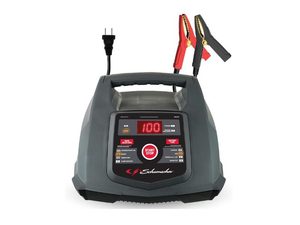 | Schumacher Fully Automatic Battery Charger and Engine Starter | Check Price |
Second Best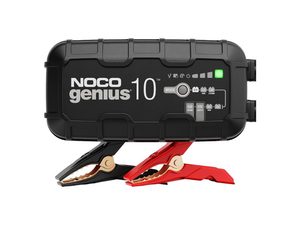 | NOCO GENIUS10 10A Smart Battery Charger | Check Price |
Third Choice | Clore Automotive PRO-LOGIX PL2320 20A Battery Charger | Check Price |
A professional charger needs to do more than make a battery voltage number rise. Modern batteries and vehicles benefit from controlled charging algorithms that adjust current and voltage throughout the charge cycle.
The three chargers below take different approaches. Schumacher emphasizes charging, boosting, testing, and engine-start support. NOCO focuses on compact multi-chemistry smart charging. Clore targets technicians who want a higher-output charger and controlled power supply in one unit.
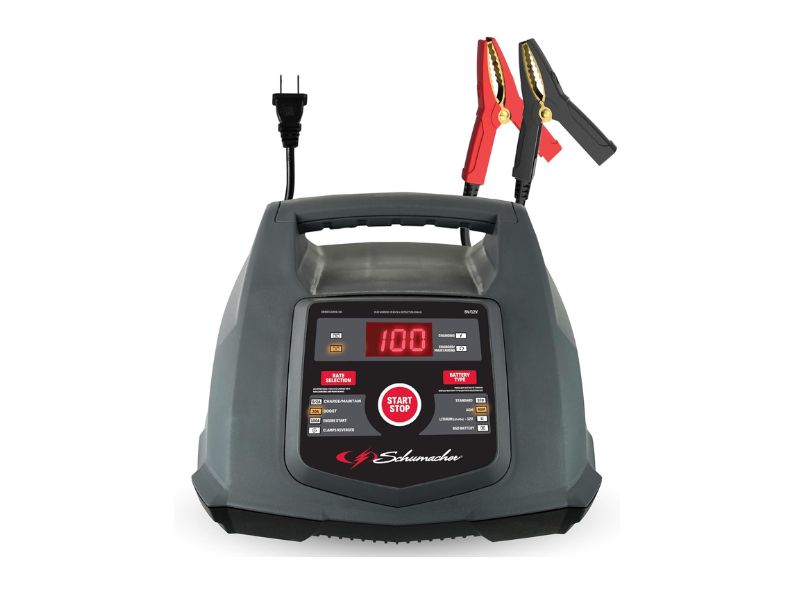
1. Schumacher Fully Automatic Battery Charger and Engine Starter – Best Overall
Key Features
- 6V and 12V battery charging
- Automatic multi-stage charging
- Standard, AGM, gel, and deep-cycle compatibility
- Multiple charging rates
- 30A boost mode
- 100A engine-start function
- Battery testing
- Alternator testing
- Reverse-hookup protection
- Digital display
- Push-button controls
- Rated for batteries up to approximately 1000 CCA
- Built-in carrying handle
The Schumacher SC1281 is my first choice because it covers more of the jobs a serious garage is likely to encounter.
Many compact chargers are excellent at gradually restoring a battery, but they cannot provide meaningful assistance when a vehicle needs to be started immediately. The SC1281 adds a 100A engine-start mode, giving it a useful advantage for garages that regularly deal with weak batteries.
The 30A boost setting is also practical when a battery needs a faster initial charge before attempting to start the vehicle.
For routine charging, the unit uses microprocessor-controlled multi-stage operation instead of continuously supplying one fixed charging voltage. That allows it to manage charging more precisely as the battery moves from a low state of charge toward full capacity.
Battery compatibility is another strong point.
The SC1281 supports conventional flooded lead-acid, AGM, gel, and deep-cycle batteries. This gives a home mechanic considerably more flexibility when working on different vehicles or equipment.
Its built-in battery and alternator testing functions are particularly relevant to the word “professional.”
A dead battery does not automatically mean the battery itself is defective. The underlying problem may be:
- A failing alternator
- Loose or corroded battery connections
- Parasitic electrical drain
- Repeated short-distance driving
- Excessive accessory use
- Normal battery aging
Being able to perform basic charging-system checks with the same equipment can help distinguish between a discharged battery and a broader vehicle electrical problem.
The digital controls are reasonably straightforward once you understand the different modes, although this unit demands more attention than a simple plug-and-charge maintainer.
It is also substantially larger and heavier than the NOCO GENIUS10.
At approximately 12.65 pounds, this is primarily a garage tool, not something designed to disappear into a small storage drawer.
For professional-style home use, that tradeoff makes sense. You gain starting assistance, higher charging capability, and diagnostic functions.
What I Like
- Combines charger, maintainer, booster, and engine-start functions.
- Works with standard, AGM, gel, and deep-cycle batteries.
- 100A engine-start assistance is useful in a garage.
- 30A boost provides faster battery recovery.
- Battery testing adds diagnostic value.
- Alternator testing helps identify charging-system problems.
- Automatic charging reduces the risk associated with manual chargers.
- Digital display provides clearer operating feedback.
- Useful across cars, SUVs, trucks, boats, and equipment.
What I Do Not Like
- Heavier than compact smart chargers.
- Requires more storage space.
- More controls create a slightly steeper learning curve.
- It is not a substitute for a high-current professional programming power supply.
- Overkill for someone who only maintains one stored vehicle.
Verdict
The Schumacher SC1281 is the best professional car battery charger for most serious home garages because it addresses charging, maintenance, diagnosis, boosting, and starting assistance in one machine.
If your work involves several vehicles and you regularly encounter discharged batteries rather than simply maintaining healthy ones, the additional capability is worth the larger size.
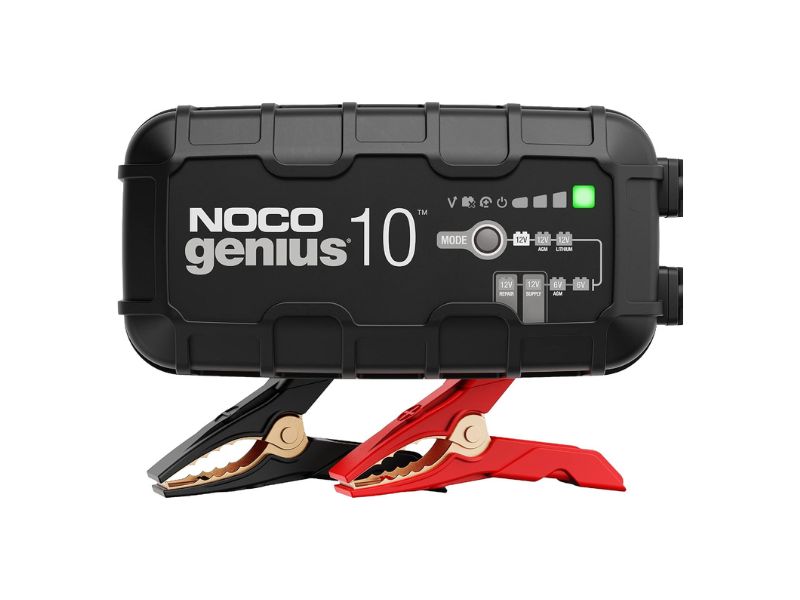
2. NOCO GENIUS10 10A Smart Battery Charger – Best Compact Professional Smart Charger
Key Features
- 10A charging output
- 6V and 12V operation
- Flooded lead-acid support
- AGM mode
- EFB compatibility
- Gel and maintenance-free battery support
- 12V lithium mode for compatible BMS-equipped batteries
- Capacity support up to approximately 230Ah
- Automatic temperature compensation
- Force Mode
- 12V Repair Mode
- 12V Supply Mode
- Automatic battery maintenance
- Reverse-polarity protection
- Spark-proof protection
- IP65-rated housing
- Compact 3.33-pound design
The NOCO GENIUS10 is a very different kind of professional charger.
Instead of providing a large engine-start function, it concentrates on precise intelligent charging, battery versatility, portability, and advanced charging modes.
Its 10A output is enough to make it a genuine automotive charger rather than merely a low-current maintainer.
Consider an 80Ah automotive battery at roughly 50% state of charge. A 1A maintainer could require well over a day to restore substantial capacity. A 10A charger can accomplish the bulk of that charging much more practically.
The GENIUS10 supports both 6V and 12V systems, which increases its usefulness for technicians working with older vehicles, motorcycles, collector cars, and modern automotive batteries.
Its chemistry support is particularly broad.
The charger has modes for conventional wet-cell lead-acid batteries, AGM, EFB, gel, maintenance-free batteries, and compatible 12V lithium-ion batteries equipped with a battery-management system.
This is important as garages increasingly encounter multiple battery technologies.
Modern start-stop vehicles often use AGM or EFB batteries, while some performance, powersports, marine, and specialty applications are moving toward lithium iron phosphate.
The built-in thermal sensor is another professional-grade feature.
Battery charging voltage requirements change with temperature. In very cold environments, inadequate voltage can lead to undercharging. In hot environments, excessive voltage can increase battery stress.
The GENIUS10 compensates automatically for ambient temperature.
Another standout feature is Force Mode.
Automatic chargers normally need to detect a minimum battery voltage before charging begins. This is a safety measure, but an extremely discharged battery may fall below that detection threshold.
Force Mode allows the GENIUS10 to begin charging batteries below its normal automatic detection level.
Because this mode bypasses some normal detection logic, it should only be used after verifying polarity and battery condition carefully.
The 12V Repair Mode is intended for certain old, sulfated, stratified, or idle lead-acid batteries.
Again, realistic expectations matter. No repair mode can restore broken plates, internal short circuits, major electrolyte loss, or every battery that has reached the end of its useful life.
The 12V Supply Mode adds another useful workshop function by turning the charger into a regulated DC supply for appropriate applications.
However, its 10A output means it should not be confused with a high-current programming support unit capable of maintaining system voltage during every module-flashing procedure.
Modern vehicles can draw considerably more than 10 amps with the ignition on and multiple modules awake.
What I Like
- Excellent 10A smart charging.
- Supports an unusually broad range of battery chemistries.
- Dedicated AGM charging profile.
- Compatible lithium mode.
- Automatic temperature compensation.
- Force Mode supports extremely discharged batteries.
- Repair Mode adds battery-recovery capability.
- Supply Mode increases workshop usefulness.
- IP65 housing provides useful environmental protection.
- Compact and easy to store.
- Excellent option for cars, trucks, motorcycles, marine batteries, and deep-cycle applications.
- Much lighter than traditional shop chargers.
What I Do Not Like
- No 100A-style engine-start mode.
- 10A supply mode is insufficient for many demanding ECU-programming procedures.
- LED charge indicators provide less detailed information than a large numerical LCD.
- Requires manual mode selection for different battery chemistries.
Verdict
The NOCO GENIUS10 is my preferred professional charger when battery technology versatility, controlled charging, portability, and modern smart functions matter more than immediate engine-start assistance.
It is particularly well suited to technicians or enthusiasts maintaining several different battery types in a relatively compact workspace.
3. Clore Automotive PRO-LOGIX PL2320 20A Battery Charger – Best for Professional Service-Bay Use

Key Features
- 6V and 12V operation
- 2A, 10A, and 20A charging rates
- Seven-phase automatic charging
- Lead-acid battery support
- AGM compatibility
- Gel battery support
- Spiral-wound battery compatibility
- Deep-cycle and marine battery support
- Compatible LiFePO4 battery charging
- 0–20A power-supply mode
- Soft Start Mode
- Recondition Mode
- Enhanced maintenance mode
- Temperature compensation
- Zero-volt battery charging capability
- Reverse-polarity protection
- Battery fault detection
- Data-rich digital display
- 72-inch output cables
- 12 AWG output wiring
The Clore PRO-LOGIX PL2320 is arguably the most genuinely technician-oriented battery charger of these three.
Its 20A maximum charging output provides a meaningful improvement over 10A chargers when working with larger batteries or when turnaround time matters.
At the same time, the selectable 10A and 2A settings allow the user to reduce charging rate when the application calls for something gentler.
The PL2320 uses a seven-phase charging process that automatically adjusts its operation rather than simply delivering a fixed voltage and current.
This is particularly important when working with AGM and other modern lead-acid batteries because excessive charging voltage can shorten battery life.
Temperature compensation further improves charging accuracy.
The feature that separates the PL2320 from most consumer chargers, however, is the 0–20A power-supply mode.
Professional automotive work increasingly requires the vehicle electrical system to remain at stable voltage while the ignition is on but the engine is not running.
Examples include:
- Diagnostics
- ADAS-related procedures
- Vehicle detailing with doors open
- Electrical troubleshooting
- Accessory installation
- Certain coding operations
- Key-on service procedures
The PL2320 can supply up to 20A as needed to help maintain system voltage.
That is genuinely useful, but it is important to understand its limits.
Some modern vehicle programming and ECU-flashing operations can demand substantially more than 20 amps. A vehicle may have multiple modules, pumps, fans, displays, lighting circuits, and communication networks awake simultaneously.
For those situations, technicians may require a dedicated high-current programming power supply capable of 50A, 70A, 100A, or more.
The PL2320 is therefore a valuable service-bay support tool, but it should not be treated as a universal replacement for every programming power supply.
Another professional feature is its ability to engage batteries that have fallen to extremely low voltage, including certain batteries measuring near zero volts.
Its Soft Start Mode gradually begins the charging process on severely depleted batteries.
Recondition Mode is intended for distressed batteries, while the enhanced maintenance system allows the unit to remain useful after full charging is complete.
The display provides considerably more charging feedback than minimalist LED-only chargers.
Combined with 72-inch, 12 AWG output cables, the PL2320 feels designed around real garage workflow rather than occasional emergency use.
What I Like
- 20A maximum charging rate.
- Selectable 20A, 10A, and 2A operation.
- Excellent professional charging flexibility.
- Seven-phase automatic charging.
- Temperature compensation.
- Power-supply mode is valuable during service work.
- Can engage extremely low-voltage batteries.
- Soft Start Mode helps with severely discharged batteries.
- Recondition function adds recovery capability.
- Enhanced maintenance mode supports storage charging.
- Data-rich display.
- Long, heavy-duty output cables.
- Excellent battery-chemistry compatibility.
What I Do Not Like
- No 100A engine-start function.
- 20A power-supply output is not sufficient for all module-programming procedures.
- Larger and heavier than compact smart chargers.
- More expensive than simple battery maintainers.
- Requires understanding of the different modes to use it properly.
Verdict
The Clore PRO-LOGIX PL2320 is my preferred choice for a technician, detailer, diagnostic specialist, or serious workshop that wants controlled high-output charging and a useful stable-voltage supply function.
It is less focused on emergency engine starting than the Schumacher, but more focused on battery management during service procedures.
Professional Car Battery Charger Comparison
| Product | Voltage | Max Normal Charge | Battery Types | Engine Start | Power Supply | Battery Test | Temperature Compensation | Best For |
| Schumacher SC1281 | 6V/12V | Multi-rate | Standard, AGM, Gel, Deep-Cycle | 100A | No dedicated programming supply | Battery + Alternator | Automatic charging control | Full-service home garage |
| NOCO GENIUS10 | 6V/12V | 10A | Flooded, AGM, Gel, EFB, MF, Lithium | No | 12V/10A | Advanced fault detection | Yes | Compact smart charging |
| Clore PRO-LOGIX PL2320 | 6V/12V | 20A | Flooded, AGM, Gel, Deep-Cycle, LiFePO4 | No | 0–20A | Battery fault detection | Yes | Professional service bay |
Which Professional Battery Charger Should You Choose?
The Schumacher SC1281 is the strongest all-around recommendation for a serious home mechanic because it combines charging, boost capability, engine-start assistance, battery testing, and alternator testing.
It makes sense if you regularly work on several vehicles and occasionally need immediate assistance starting one with a weak battery.
The NOCO GENIUS10 is better if you value compact size, sophisticated smart charging, multiple battery chemistries, temperature compensation, maintenance, and battery recovery.
The Clore PRO-LOGIX PL2320 is the most service-oriented option. Its 20A charge capability and controlled power-supply function make it particularly useful during diagnostic and maintenance work where keeping system voltage stable matters.
What Makes a Car Battery Charger “Professional”?
The word professional is frequently used loosely.
A large charger is not automatically professional, and a charger with the highest amp number is not necessarily the best workshop tool.
Several characteristics matter more.
Higher Practical Charging Output
A professional charger needs enough current to recharge ordinary automotive batteries in a reasonable amount of time.
Consider a 70Ah battery that is approximately 50% discharged.
The battery is missing roughly 35Ah of usable capacity.
A 1A maintainer could theoretically require 35 hours merely to replace that amount of energy, and real charging generally takes longer because efficiency is less than perfect and charge current decreases during later stages.
A 10A or 20A charger is considerably more practical in a working garage.
Multi-Stage Charging
Modern batteries should not simply receive maximum current indefinitely.
A quality charger normally progresses through stages such as:
- Battery analysis
- Soft start
- Bulk charging
- Absorption
- Completion analysis
- Float charging
- Maintenance
The names differ between manufacturers, but the objective is similar: restore energy quickly without overcharging the battery.
Multiple Battery Types
Professional technicians may encounter:
- Conventional flooded batteries
- AGM
- EFB
- Gel
- Deep-cycle batteries
- Marine batteries
- LiFePO4 batteries
- Specialty powersports batteries
A charger capable of correctly managing several chemistries reduces the need for multiple separate machines.
Temperature Compensation
Lead-acid charging voltage requirements change as temperature changes.
Cold batteries may require higher charging voltage, while excessive voltage becomes increasingly harmful in hot conditions.
Temperature compensation lets a smart charger alter its charging strategy automatically.
Heavy-Duty Cables and Clamps
Professional use involves repeated connection and disconnection.
Thin wires and weak clamps become frustrating quickly.
Look for:
- Strong clamp springs
- Good jaw contact
- Heavy conductor gauge
- Adequate cable length
- Flexible insulation
- Proper strain relief
Battery Fault Detection
A professional charger should help identify situations where continued charging may not be appropriate.
Examples include:
- Internal battery failure
- Reversed polarity
- Excessively high battery voltage
- Failure to accept charge
- Failure to retain charge
Maintenance Capability
Vehicles sometimes remain parked in workshops for days.
A charger that can automatically maintain a battery after completing the main charge cycle becomes more useful than one that requires constant monitoring.
Professional Charger vs. Battery Maintainer
These devices overlap, but they serve different priorities.
Battery Maintainer
A maintainer commonly outputs between approximately 0.75A and 2A.
Its primary purpose is preventing a healthy battery from slowly discharging during storage.
It is excellent for:
- Collector cars
- Motorcycles
- Seasonal vehicles
- Weekend cars
- Stored boats
It is not ideal when a large discharged battery needs to return to service quickly.
Professional Battery Charger
A professional charger commonly provides:
- Higher charging current
- Multiple charging rates
- Battery diagnosis
- AGM charging
- Temperature compensation
- Battery recovery
- Stable supply operation
- Engine-start assistance on some models
The difference becomes obvious when several vehicles need attention every week.
Charger vs. Jump Starter
A battery charger and a jump starter solve different problems.
Charger
A charger gradually restores electrical energy to the battery.
This may take:
- 30 minutes
- Several hours
- Overnight
- Longer for heavily depleted batteries
Charging is the preferable approach when you have sufficient time because it actually replenishes the battery.
Jump Starter
A jump starter delivers a very large amount of current for a few seconds so the starter motor can crank.
It does not necessarily restore meaningful battery capacity.
If a battery has been deeply discharged, the alternator then has to recover much of that missing energy after the engine starts.
Engine-Start Charger
The Schumacher SC1281 combines these concepts.
Its 100A start mode provides supplemental cranking current while the charger remains connected to AC power.
That can be useful in a garage but should not be confused with the portability of a lithium jump pack.
Understanding Charging Amps
2A Charging
A 2A rate is useful for:
- Smaller batteries
- Gentle charging
- Long charging periods
- Maintenance-oriented use
5A to 10A Charging
This is an excellent range for many passenger-car batteries.
It offers reasonable charging speed without requiring an extremely large charger.
The GENIUS10 sits here.
20A Charging
A 20A charger can replenish larger automotive batteries considerably faster.
This is especially useful when turnaround time matters in a workshop.
The PL2320 provides this capability.
30A and Higher Boost Modes
Boost charging is intended to provide a battery with a larger amount of current for a shorter period.
It can be useful before attempting an engine start.
Boost mode should not automatically be used for every battery merely because faster sounds better.
Battery condition, capacity, chemistry, temperature, and manufacturer recommendations still matter.
What Battery Types Should a Professional Charger Support?
Flooded Lead-Acid
This remains one of the most common automotive battery types.
The electrolyte is liquid, and some designs allow water maintenance.
AGM
Absorbent Glass Mat batteries use fiberglass separators to hold electrolyte.
They offer:
- High cranking capability
- Low internal resistance
- Strong vibration resistance
- Sealed construction
- Better cycling capability than many traditional starter batteries
AGM batteries are common in luxury vehicles, performance cars, trucks, and start-stop systems.
A professional charger should ideally provide an AGM-compatible charging profile.
EFB
Enhanced Flooded Batteries are used in some start-stop vehicles.
They provide improved cycling compared with ordinary flooded designs.
Gel
Gel batteries have specific voltage requirements and should be charged only with a compatible profile.
Lithium Iron Phosphate
LiFePO4 batteries are increasingly common in powersports, marine, RV, and specialty automotive applications.
Lithium charging requires an appropriate mode and a battery equipped with a suitable battery-management system.
Never use a lead-acid repair or desulfation mode on a lithium battery.
Why AGM Charging Matters in a Professional Garage
Modern shops increasingly encounter AGM batteries.
These batteries can be damaged by inappropriate charging voltages.
An old manual charger may continue applying voltage without the precise control that an AGM battery benefits from.
Smart chargers monitor battery response and adjust the charge process automatically.
The GENIUS10 and PL2320 are particularly strong for this application.
The Schumacher SC1281 also provides AGM compatibility while adding engine-start assistance.
What Is a Stable Power-Supply Mode?
This feature has become increasingly important as vehicles have become computers on wheels.
When the engine is off but the ignition is on, modern vehicles can draw substantial current.
Modules may include:
- Engine control module
- Transmission control module
- Body control module
- Infotainment system
- Instrument cluster
- ADAS controllers
- Electric power steering
- Security system
- Telematics
- Gateway modules
During diagnosis or programming, battery voltage can gradually fall.
Low voltage during sensitive electronic operations may cause:
- Communication errors
- Interrupted programming
- Module reset
- Diagnostic trouble codes
- Failed calibrations
- Potential module corruption
A regulated power supply supports vehicle voltage during this work.
Is a 20A Power Supply Enough for ECU Programming?
Sometimes, but not universally.
This is an important professional distinction.
A vehicle with relatively low ignition-on current draw may remain stable on a 20A supply.
Other modern vehicles can demand:
- 30A
- 50A
- 70A
- 100A or more
during certain service or programming procedures.
A 20A charger cannot provide 70A merely because battery voltage begins falling.
Before flashing an ECU, programming modules, or performing a long coding session, check the vehicle manufacturer’s required support-current specification.
For high-current programming work, use a dedicated programming power supply rated appropriately for the vehicle.
Can a Professional Battery Charger Start a Completely Dead Car?
It depends on the charger and battery condition.
The Schumacher SC1281 provides engine-start assistance.
The GENIUS10 and PL2320 are chargers rather than high-current cranking devices.
An extremely discharged battery may first require charging before the vehicle can start normally.
Remember that “dead battery” can describe several different conditions.
Discharged but Healthy
The battery has simply lost charge and can usually be restored.
Sulfated Battery
The battery has remained undercharged or discharged long enough for sulfation to reduce performance.
Recovery may or may not be possible.
Shorted Cell
Charging will not repair an internal short.
Physically Damaged Battery
A swollen, cracked, leaking, frozen, or excessively hot battery should not be charged.
Can a Smart Charger Repair a Bad Battery?
Sometimes it can improve a neglected battery, but repair modes have limits.
A charger may help reduce certain types of sulfation or restore a battery that has been left partially discharged.
It cannot rebuild:
- Broken plates
- Shorted cells
- Severely corroded internal components
- Lost plate material
- Physical case damage
- Major electrolyte loss
- Normal end-of-life degradation
Professional battery testing is important because repeatedly running repair cycles on a failed battery wastes time.
How to Charge a Car Battery Safely
Confirm Battery Chemistry
Identify whether the battery is:
- Flooded
- AGM
- EFB
- Gel
- Lithium
Do not guess.
Inspect the Battery
Do not charge a battery that is:
- Cracked
- Leaking
- Severely swollen
- Frozen
- Producing an unusual odor
- Excessively hot
Turn Off the Vehicle
Switch off the ignition and unnecessary accessories.
Check the Vehicle Manual
Modern cars may have designated charging terminals under the hood.
The actual battery may even be located:
- In the trunk
- Under a seat
- Behind interior panels
Use the manufacturer’s approved charging points.
Connect Positive
Attach the positive charger clamp to the designated positive point.
Connect Negative
Follow the vehicle manufacturer’s instructions regarding the negative connection.
Vehicles equipped with battery-monitoring sensors may require the charger negative lead to connect to a specific chassis ground rather than directly to the battery’s negative post.
Select the Correct Charging Mode
Choose:
- Voltage
- Battery chemistry
- Appropriate charging rate
where required.
Begin Charging
Confirm that the charger recognizes the battery correctly and shows no error condition.
Allow the Charging Cycle to Finish
Do not assume the battery is fully charged simply because the engine can now start.
The absorption and finishing stages matter for restoring capacity properly.
Should You Remove the Battery From the Car Before Charging?
Usually not.
Modern smart chargers are commonly designed for batteries installed in vehicles.
However, manufacturer guidance should take priority.
Certain repair modes may use voltages that are not suitable while sensitive electronics remain connected.
For example, a dedicated high-voltage desulfation or repair function may require disconnecting the battery from the vehicle.
Always read the charger’s instructions before using specialized recovery modes.
How Long Does a Professional Charger Take?
Charging time depends on battery capacity and state of charge.
A useful rough calculation is:
Missing amp-hours ÷ charging amps = approximate minimum bulk-charge time
Suppose an 80Ah battery is approximately 50% charged.
It is missing roughly 40Ah.
With a 10A charger:
40Ah ÷ 10A = approximately 4 hours of theoretical bulk charging.
Actual charging normally takes longer because:
- Charging efficiency is below 100%.
- Current decreases during absorption.
- Temperature affects charge acceptance.
- Battery age affects performance.
A 20A charger could replace the bulk portion faster, provided the battery is suitable for that charging rate.
Professional Charging for Start-Stop Vehicles
Start-stop vehicles place unusually high cycling loads on batteries.
These vehicles commonly use AGM or EFB technology.
Replacing an AGM battery with a conventional flooded battery simply because it fits physically can create performance and durability problems.
Charging is similar.
Use a charger that supports the installed battery chemistry.
In some vehicles, battery replacement also requires battery registration or adaptation through a diagnostic system.
A charger cannot perform that coding process unless it specifically includes diagnostic programming functions.
Best Professional Charger for a Home Garage
For a serious home garage, I favor the Schumacher SC1281.
Why?
Because home mechanics often value flexibility more than one highly specialized function.
The SC1281 can:
- Charge
- Maintain
- Boost
- Assist starting
- Test the battery
- Test alternator performance
That combination is useful when you maintain several family vehicles or restoration projects.
Best Professional Charger for Modern Batteries
The NOCO GENIUS10 is the stronger choice when your garage handles a mixture of battery chemistries.
Its AGM, EFB, conventional lead-acid, and compatible lithium modes give it excellent versatility.
Temperature compensation is another advantage for batteries stored in garages with large seasonal temperature swings.
Best Professional Charger for Service and Diagnostics
The Clore PRO-LOGIX PL2320 is the product I would choose when controlled system-voltage support matters.
Its 20A power-supply function can be valuable during:
- Diagnostic sessions
- Accessory installation
- Detailing
- ADAS-related work
- Long key-on procedures
- Low-current coding tasks
For demanding module programming, verify the required current and move to a dedicated higher-current supply when necessary.
Important Safety Features to Look For
Reverse-Polarity Protection
Connecting positive and negative clamps backward can cause serious problems.
Modern professional chargers should detect reverse connection.
Overtemperature Protection
Chargers generate heat while converting AC power into regulated DC charging current.
Thermal protection can stop or reduce operation if safe temperatures are exceeded.
Short-Circuit Protection
This helps protect the charger and surroundings if output terminals are accidentally shorted.
Overcharge Protection
Smart chargers reduce current as the battery becomes full.
Battery Fault Detection
A charger that recognizes certain defective-battery conditions can prevent wasted charging attempts.
Spark Protection
Spark-resistant connection logic provides another layer of safety around batteries capable of releasing flammable gases.
Why Cable Gauge Matters
Charging at 20 amps requires heavier wiring than maintaining a battery at 1 amp.
Thin cables create greater resistance.
Electrical resistance causes:
- Voltage drop
- Heat
- Lower charging efficiency
Professional chargers should use cables appropriately sized for their output current.
Cable length matters too.
Extremely long cables increase resistance unless conductor size is increased accordingly.
Common Mistakes When Buying a Professional Car Battery Charger
Buying Only by Peak Amps
A huge engine-start amp number does not tell you how good the charger is at actually charging and maintaining batteries.
Ignoring Battery Chemistry
A professional charger should support the batteries you actually service.
Confusing Engine Start With Charging Power
A 100A starting mode does not mean the charger continuously charges at 100 amps.
Engine-start output is short-duration assistance.
Assuming Every Power Supply Is Suitable for Programming
A 10A or 20A supply can be valuable but may be insufficient for demanding modern vehicles.
Buying Too Little Charging Current
A 1A maintainer is excellent for storage but frustrating in a busy garage.
Ignoring Temperature Compensation
This feature becomes increasingly useful in locations with very cold winters or hot garages.
Using Repair Mode Automatically
Repair modes can use unusual voltage profiles.
Use them only where the battery type and manufacturer’s instructions permit.
Charging a Physically Damaged Battery
No charger can safely solve physical battery damage.
Frequently Asked Questions
1. What is the best professional car battery charger?
The Schumacher SC1281 is my best overall choice for a serious home garage.
It combines automatic 6V/12V charging, AGM compatibility, 30A boost capability, 100A engine-start assistance, battery testing, alternator testing, and maintenance functions. For a professional technician who needs stable voltage during service procedures, the Clore PRO-LOGIX PL2320 may be the more specialized choice.
2. How many amps should a professional car battery charger have?
Around 10–20 amps is a practical range for routine professional automotive charging.
A 10A charger handles many passenger-car batteries effectively, while 20A reduces turnaround time on larger batteries. Higher boost and engine-start ratings serve different purposes and should not be confused with continuous charging current.
3. Is a 10A charger enough for a car battery?
Yes, 10 amps is a very practical charging rate for many automotive batteries.
It can restore a partially discharged 50–100Ah battery much faster than a small maintainer while still allowing a smart charging algorithm to taper current as the battery approaches full charge.
4. Is a 20A charger better than a 10A charger?
A 20A charger is faster when the battery can safely accept the additional current, but it is not automatically better for every application.
Smaller batteries may require lower charge rates, while large automotive and deep-cycle batteries benefit more from the additional output. Selectable charging rates provide the greatest flexibility.
5. Can a professional battery charger charge AGM batteries?
Yes, provided it specifically supports AGM chemistry.
AGM batteries benefit from carefully controlled charging voltage. All three chargers in this guide provide AGM-compatible operation, making them suitable for many modern vehicles.
6. What charger is best for a mechanic shop?
A charger with high-output charging and regulated power-supply capability is particularly useful in a professional shop.
The Clore PRO-LOGIX PL2320 is designed around this type of work. Its 20A charging and supply modes make it valuable for battery service and many key-on maintenance procedures.
7. Can I use a battery charger while diagnosing a vehicle?
Yes, a proper regulated supply can help maintain system voltage during extended diagnostic sessions.
However, ordinary charging mode and stable power-supply mode are not identical. Use the mode specifically intended for system-voltage support whenever the manufacturer provides one.
8. Do I need a battery charger for ECU programming?
Professional module programming often requires stable external power support.
If voltage falls too low during programming, communication can fail and modules may become corrupted. Check the vehicle manufacturer’s required voltage and amperage before beginning. Many modern vehicles require more than a 10A or 20A supply.
9. Can the Schumacher SC1281 jump-start a vehicle?
It provides 100A engine-start assistance while connected to AC power.
This can help start vehicles with weak batteries in a garage setting. It is not a portable battery-powered jump starter because it still requires an external electrical supply.
10. Can NOCO GENIUS10 charge a lithium battery?
It supports compatible 12V lithium-ion batteries, including LiFePO4 batteries equipped with an appropriate battery-management system.
Use only the designated lithium mode. Do not use lead-acid repair or desulfation modes on lithium batteries.
11. Can a professional charger revive a zero-volt battery?
Some can attempt charging at extremely low voltage, but successful recovery depends on battery condition.
The PL2320 can engage certain batteries measuring near zero volts, while the GENIUS10 provides Force Mode for batteries below its normal automatic detection threshold. Neither feature can restore a battery with permanent internal damage.
12. Can I leave a professional charger connected overnight?
Yes when using an automatic smart charger in an appropriate charging or maintenance mode.
Modern chargers reduce output as the battery becomes full. Always follow the operating instructions, especially when using high-current boost, repair, or supply modes.
13. Does a higher amp charger damage a car battery?
Not necessarily when the charger intelligently regulates current and the battery is suitable for the selected rate.
Battery capacity, chemistry, temperature, and manufacturer recommendations determine an appropriate charging rate. Higher current should never be used blindly simply to finish faster.
14. What is the difference between a charger and a battery power supply?
A charger changes voltage and current according to the battery’s state of charge, while a regulated supply attempts to hold system voltage stable for an electrical load.
The distinction matters during diagnostics and module programming. A normal charging algorithm may not provide the stable behavior required during those procedures.
15. Can a battery charger test an alternator?
Some multifunction chargers can perform basic charging-system tests.
The Schumacher SC1281 includes battery and alternator testing capability, making it useful for initial troubleshooting. Professional diagnosis may still require a multimeter, current clamp, battery analyzer, scan tool, or oscilloscope depending on the problem.
Conclusion
The best professional car battery charger should match the kind of work you actually perform rather than simply carrying the highest amp number.
For a serious home workshop, the Schumacher SC1281 is my primary recommendation. Its combination of smart charging, AGM compatibility, 30A boost, 100A engine-start assistance, battery testing, alternator testing, and automatic maintenance gives it the broadest range of useful garage functions.
The NOCO GENIUS10 is the better choice when portability and modern battery compatibility matter most. Its 10A output, AGM and EFB support, compatible lithium charging, temperature compensation, Force Mode, Repair Mode, and compact IP65 housing make it an excellent professional-quality smart charger for technicians who do not need engine-start assistance.
For service-bay work, the Clore PRO-LOGIX PL2320 deserves serious consideration. Its selectable 2A, 10A, and 20A charging rates, seven-stage battery management, temperature compensation, reconditioning functions, deep-discharge recovery, and 20A stable power-supply capability are particularly useful during diagnostics and other key-on vehicle procedures.
For the broadest all-around garage capability, I would choose Schumacher SC1281 first. If controlled charging and battery-chemistry versatility are more important, choose NOCO GENIUS10. For professional service work where maintaining vehicle system voltage matters, Clore PRO-LOGIX PL2320 is the strongest specialized option.