Choosing the best booster cable gauge is more important than simply buying the longest jumper cables you can find. The gauge determines how much electrical current the cable can carry efficiently, while cable length, conductor material, clamps, temperature flexibility, and engine size determine how well that power actually reaches the dead battery.
My primary recommendation is the Energizer 4-Gauge 20-Foot Heavy Duty Jumper Cables. For most passenger cars, crossovers, minivans, and gasoline SUVs, 4 gauge is the sweet spot. This Energizer set combines that practical wire size with a 20-foot reach, flexible construction, insulated clamps, and a storage bag. It also has one of the strongest customer-feedback histories in the category.
For buyers who own larger gasoline engines or want substantially more electrical capacity, I recommend the CARTMAN 1-Gauge 20-Foot Heavy Duty Jumper Cables. Moving from 4 gauge to 1 gauge substantially increases conductor size, making this type of cable more appropriate for pickups, large SUVs, vans, demanding cold starts, and drivers who regularly help other vehicles.
The TOPDC 4-Gauge 20-Foot Heavy Duty Jumper Cables are another strong general-purpose choice. They deliver the same practical 4-gauge/20-foot combination I prefer for a normal roadside emergency kit, with all-weather construction and a storage bag that makes keeping the cables organized in a trunk much easier.
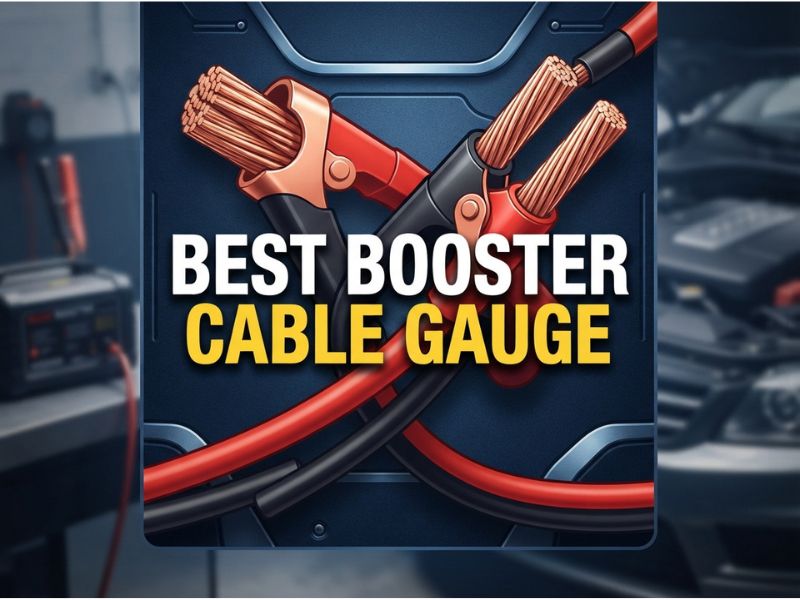
10 Best Booster Cable Gauge
| Image | Product Name | Check Price |
|---|---|---|
Best Choice | Energizer 4-Gauge 20-Foot Heavy Duty Jumper Cables – Best Overall | Check Price |
Second Best | CARTMAN 1-Gauge 20-Foot Heavy Duty Jumper Cables | Check Price |
Third Choice | TOPDC 4-Gauge 20-Foot Heavy Duty Jumper Cables | Check Price |
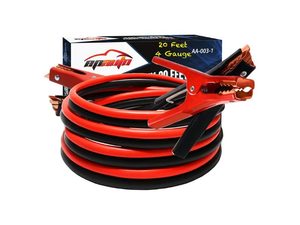 | EPAuto 4-Gauge 20-Foot 500A Booster Jumper Cables | Check Price |
 | Goodyear 4-Gauge 16-Foot Heavy Duty Booster Cables | Check Price |
 | ABN 2-Gauge 25-Foot 600A Jumper Cables | Check Price |
 | EXTRESPO 0-Gauge 25-Foot 1000A Heavy Duty Jumper Cables | Check Price |
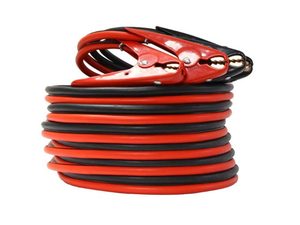 | A ABIGAIL 1-Gauge 25-Foot 800A Heavy Duty Jumper Cables | Check Price |
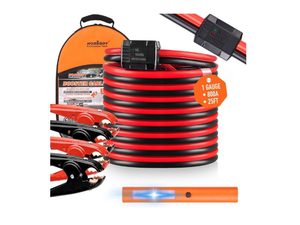 | HORUSDY 1-Gauge 25-Foot 800A Jumper Cables | Check Price |
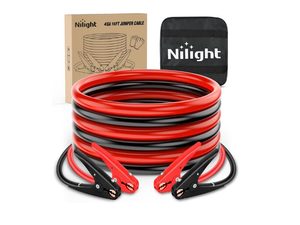 | Nilight 4-Gauge 16-Foot 600A Booster Cables | Check Price |
1. Energizer 4-Gauge 20-Foot Heavy Duty Jumper Cables – Best Overall

Key Features
- 4-gauge booster cables
- 20-foot total working length
- Heavy-duty automotive construction
- Flexible insulated cable jacket
- Insulated battery clamps
- Suitable for common passenger vehicles
- Carrying bag included
- Designed for cold-weather flexibility
For the majority of drivers, I consider 4 gauge the best all-around booster cable size, and this Energizer set is a particularly easy recommendation.
Four-gauge cable provides significantly more conductor area than inexpensive 8- or 10-gauge emergency cables. That lower electrical resistance helps more of the donor battery’s voltage reach the disabled vehicle’s starter.
The 20-foot length is another important advantage. Short 10- or 12-foot cables may work perfectly when two vehicles can park nose-to-nose, but real emergencies rarely happen in ideal conditions. A dead vehicle may be parked head-first against a wall, beside another car, or in a narrow driveway. Twenty feet gives you considerably more flexibility.
At the same time, 20 feet is not excessively long for 4-gauge construction. Longer cables create additional resistance, so cable thickness becomes increasingly important as length increases.
The insulated clamps are clearly identified for positive and negative connections, and the cable remains manageable enough to coil into the included storage bag.
For ordinary gasoline cars, crossovers, minivans, and many SUVs, this is the gauge and length combination I would keep in the trunk.
What I Like
- Excellent 4-gauge all-around size
- Long-established customer-feedback history
- Practical 20-foot reach
- Easier to store than 1- or 0-gauge cables
- Flexible jacket
- Good choice for everyday vehicles
- Carrying bag included
What I Do Not Like
- 4 gauge is not my first choice for large diesels
- Heavier than basic 6- or 8-gauge emergency cables
- CCA-type construction does not match premium pure copper for conductivity
Verdict
The Energizer 4-Gauge 20-Foot set is my top choice for the average driver because 4 AWG provides the best compromise between current capacity, weight, storage size, and price for normal automotive use.
2. CARTMAN 1-Gauge 20-Foot Heavy Duty Jumper Cables – Best Heavy-Duty Gauge

Key Features
- 1-gauge construction
- 20-foot length
- 800A-class configuration
- High-density CCA conductor
- Heavy-duty insulated clamps
- Cold-resistant TPR/PVC-style jacket
- Suitable for full-size vehicles
- Carrying bag included
The CARTMAN 1-gauge set moves well beyond the minimum cable size I would choose for ordinary roadside emergencies.
Remember how AWG sizing works: the smaller the gauge number, the thicker the conductor. Therefore, 1 gauge is substantially larger than 4 gauge.
That increased conductor area reduces resistance and helps maintain voltage when the disabled vehicle’s starter draws a large amount of current.
This matters particularly with:
- Large gasoline V8s
- Full-size pickups
- Large SUVs
- Cargo vans
- Cold-weather starts
- Longer crank times
The 20-foot length is also a smart pairing with 1-gauge wire. Because longer wire produces more resistance, a thicker conductor helps compensate for the additional distance.
CARTMAN uses insulated clamps designed to attach to common battery configurations, and the flexible outer jacket is intended to remain usable at low temperatures.
The main downside is physical bulk. One-gauge cable takes more space in a trunk and weighs significantly more than a 4- or 6-gauge set.
For someone driving a compact four-cylinder car, that extra capacity is usually unnecessary. For a truck owner, it can be worthwhile.
What I Like
- Thick 1-gauge conductor
- Better suited to high-current starting
- Useful 20-foot length
- Strong insulated clamps
- Good for pickups and large SUVs
- Cold-resistant construction
- Substantial customer history
What I Do Not Like
- Heavy
- Bulky to store
- More than most compact cars require
- CCA is less conductive than an equivalent pure-copper cable
Verdict
I recommend the CARTMAN 1-Gauge set when high starting-current capability matters more than keeping the cable light and compact.
3. TOPDC 4-Gauge 20-Foot Heavy Duty Jumper Cables – Best Everyday Alternative

Key Features
- 4 AWG cable
- 20-foot length
- Heavy-duty booster design
- Flexible all-weather jacket
- Strong battery clamps
- Designed for cars, SUVs, and trucks
- Storage bag included
- Wide operating-temperature capability
TOPDC’s 4-gauge, 20-foot set competes directly with my first pick and uses essentially the same basic formula: enough conductor size for normal vehicles combined with enough length to make roadside positioning easier.
This is exactly why 4-gauge cable appears repeatedly among the most popular booster-cable configurations.
A normal car starter can demand hundreds of amps for a short period. Thin cables create voltage drop and convert more electrical energy into heat rather than delivering it to the starter.
A quality 4-gauge cable reduces that problem while remaining manageable enough for ordinary drivers.
Twenty feet also provides more flexibility than compact sets. You can often park the donor vehicle beside or behind the disabled vehicle instead of needing perfect bumper-to-bumper positioning.
I particularly like this combination for households with several gasoline vehicles of different sizes because it avoids the two extremes: cables that are too thin for larger vehicles and enormous 0-gauge cables that take up unnecessary space.
What I Like
- Excellent 4-gauge everyday configuration
- 20-foot reach
- Large current customer base
- Good balance of capacity and weight
- Flexible across broad temperatures
- Carry bag included
What I Do Not Like
- Not ideal for the largest diesel engines
- Thicker 1- or 2-gauge alternatives offer more electrical headroom
- Takes more trunk space than short emergency cables
Verdict
The TOPDC 4-Gauge 20-Foot set is a strong alternative to Energizer for drivers wanting a versatile booster cable for cars, SUVs, vans, and light pickups.
4. EPAuto 4-Gauge 20-Foot 500A Booster Jumper Cables – Best Complete Roadside Kit

Key Features
- 4-gauge conductor
- 20-foot cable length
- 500A-class rating
- Heavy-duty clamps
- Flexible cable insulation
- Carrying bag
- Safety gloves included
- Suitable for common automotive batteries
EPAuto combines the same 4-gauge and 20-foot specifications I recommend for general vehicle use with a few practical accessories.
The included gloves are not the reason to buy the set, but they can be useful when working around dirty, corroded, or cold battery terminals.
More importantly, the underlying cable dimensions make sense.
A 20-foot cable provides meaningful flexibility around parking arrangements, while 4 AWG limits the voltage loss that would become more problematic with a similarly long 8- or 10-gauge set.
The clamps are sized for normal automotive battery terminals and provide enough spring tension to maintain contact while the vehicle is being started.
At roughly the 4-gauge level, the cables remain relatively manageable. They are certainly heavier than a bargain 10-gauge set, but they do not feel like professional 0- or 1-gauge truck cables.
For a typical family emergency kit, that balance is valuable.
What I Like
- Proper 4-gauge general-purpose size
- 20-foot reach
- Strong long-term feedback
- Safety gloves included
- Carrying bag included
- Good balance between portability and current capacity
- Useful for cars and SUVs
What I Do Not Like
- 500A rating does not make it a heavy-diesel cable
- Gloves are basic
- Cable is bulkier than short compact sets
Verdict
The EPAuto 4-Gauge cables are ideal for buyers who want a complete, organized roadside set for typical passenger vehicles.
5. Goodyear 4-Gauge 16-Foot Heavy Duty Booster Cables – Best Compact 4-Gauge Pick

Key Features
- 4-gauge wire
- 16-foot length
- Heavy-duty booster cable design
- Insulated clamps
- Flexible cable jacket
- Designed for cars, trucks, and SUVs
- Carrying case included
- Compact relative to longer heavy-duty cables
The Goodyear set illustrates an important principle: length and gauge need to be considered together.
These cables are four feet shorter than most of my general-purpose 20-foot recommendations.
That reduced length means slightly less electrical resistance and easier storage, while the 4-gauge conductor still provides considerably greater current capacity than thin bargain cables.
Sixteen feet is enough for many standard roadside situations, particularly when the vehicles can be positioned relatively close together.
It is also noticeably easier to coil and store than a 20- or 25-foot heavy-duty set.
For drivers with small and midsize cars who still want a legitimate 4-gauge cable rather than an ultra-thin emergency product, this is a practical compromise.
The limitation is reach. If the dead vehicle is parked nose-first in a tight garage or parking space, 16 feet can become restrictive.
What I Like
- Full 4-gauge construction
- More compact than 20- or 25-foot sets
- Lower resistance than similarly gauged longer cables
- Easier trunk storage
- Carrying case included
- Suitable for common vehicles
What I Do Not Like
- Less positioning flexibility than 20-foot cable
- Not my first choice for large diesel trucks
- Shorter length can matter in tight parking situations
Verdict
The Goodyear 4-Gauge 16-Foot set is best when you want proper 4-gauge performance without carrying more cable than necessary.
6. ABN 2-Gauge 25-Foot 600A Jumper Cables – Best 2-Gauge Long-Reach Pick

Key Features
- 2-gauge conductor
- 25-foot length
- 600A-class configuration
- Commercial-style construction
- Strong battery clamps
- Long-distance reach
- Suitable for larger vehicles
- Heavy-duty storage profile
Two gauge is one of my favorite sizes for drivers who need more capability than 4 gauge but do not necessarily need extremely heavy 0-gauge cable.
The ABN set combines 2 AWG with a very long 25-foot reach.
That pairing makes sense because the thicker conductor helps control voltage drop over the extra distance.
Twenty-five feet can be extremely useful in the real world.
Imagine a dead pickup parked head-first against a garage wall. A 12-foot cable may force you to physically move the disabled truck before you can even attempt a jump.
A 25-foot cable gives the donor vehicle many more positioning options.
The tradeoff is weight and storage. These are not lightweight emergency cables.
Two-gauge wire over 25 feet creates a substantial coil, and the cables will take up meaningful space in a compact-car trunk.
For a pickup, work van, RV, farm vehicle, or large SUV, that inconvenience is easier to justify.
What I Like
- Thick 2-gauge conductor
- Excellent 25-foot reach
- Strong choice for larger vehicles
- 600A-class design
- Useful for awkward parking arrangements
- Heavy-duty clamps
What I Do Not Like
- Large storage footprint
- Heavy
- More than most small sedans require
- Long cable still creates more resistance than a shorter equivalent-gauge set
Verdict
The ABN 2-Gauge 25-Foot set is an excellent compromise for drivers wanting extra electrical capacity and maximum positioning flexibility without moving all the way to 0 gauge.
7. EXTRESPO 0-Gauge 25-Foot 1000A Heavy Duty Jumper Cables – Best 0-Gauge Pick

Key Features
- 0-gauge cable
- 25-foot length
- 1000A-class rating
- Heavy-duty clamps
- All-weather insulation
- Carrying bag
- Safety accessories included
- Designed for large vehicles and demanding use
Zero gauge—often written 0 AWG—is dramatically thicker than the cable most passenger vehicles need.
Why include it?
Because for large diesel pickups, commercial equipment, heavy gasoline engines, and extremely long cable runs, a low-resistance conductor can make a meaningful difference.
The EXTRESPO combines 0-gauge construction with a full 25-foot length.
That is a demanding electrical combination because long cables inherently create resistance. Using 0 gauge helps reduce the resulting voltage drop.
The 1000A-class specification and large clamps make the set much more appropriate for heavy-duty emergency work than a small 6- or 8-gauge cable.
This type of cable is also physically substantial. Expect a heavy coil that takes time to put back into the storage bag.
If you drive a compact sedan, there is little practical reason to carry this much cable.
If you operate a diesel pickup, farm vehicle, commercial truck, or large equipment, the extra conductor size becomes much easier to justify.
What I Like
- Very thick 0-gauge construction
- Excellent for high-current applications
- 25-foot reach
- Strong clamps
- Suitable for large vehicles
- Useful in cold-weather starting situations
- Storage accessories included
What I Do Not Like
- Very heavy
- Bulky
- Overkill for most passenger cars
- More difficult to coil and handle
Verdict
The EXTRESPO 0-Gauge cables are my choice when maximum current transfer and long reach are more important than portability.
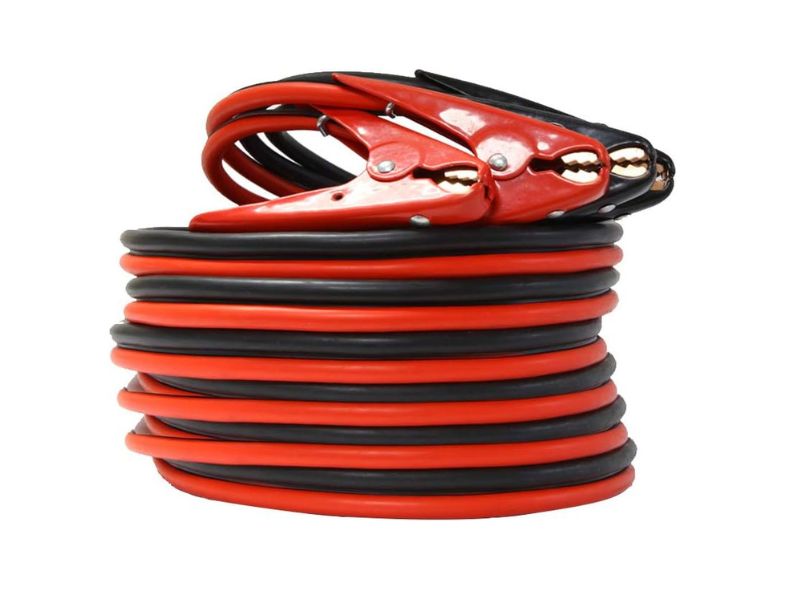
8. A ABIGAIL 1-Gauge 25-Foot 800A Heavy Duty Jumper Cables – Best for Farm and Fleet Use
Key Features
- 1-gauge conductor
- 25-foot length
- 800A-class capacity
- Copper-clad aluminum construction
- Heavy-duty parrot-style clamps
- Oil- and water-resistant jacket
- Cold-weather flexibility
- Carrying bag included
The A ABIGAIL 1-gauge set is positioned between mainstream automotive cables and extremely large professional booster leads.
The 1-gauge/25-foot combination gives it enough conductor area to remain useful over a long distance while keeping the cable slightly lighter than a comparable 0-gauge set.
This can be valuable on farms, construction sites, and fleets where the disabled vehicle might be a pickup one day and a tractor or utility vehicle the next.
The clamps use large serrated contact surfaces intended to bite securely onto battery terminals.
That mechanical connection matters more than many buyers realize.
A thick cable cannot deliver current effectively through a poorly attached clamp. Dirt, corrosion, weak spring tension, or a tiny contact area can all create additional resistance.
The jacket is designed to handle exposure to oil, moisture, and common outdoor conditions, which makes sense for equipment that may live in a truck or workshop.
What I Like
- Thick 1-gauge cable
- Excellent 25-foot reach
- Suitable for larger vehicles
- Strong clamp design
- Good farm and fleet versatility
- Weather-resistant jacket
- Long replacement coverage associated with the product line
What I Do Not Like
- Heavy for normal passenger-car use
- CCA instead of premium pure copper
- Large clamps can be awkward in tight battery compartments
Verdict
The A ABIGAIL set is a strong choice for pickup owners, farms, workshops, and mixed fleets that need one long heavy-duty cable set.
9. HORUSDY 1-Gauge 25-Foot 800A Jumper Cables – Best With Polarity Protection

Key Features
- 1-gauge cable
- 25-foot length
- 800A-class rating
- Reverse-polarity warning system
- LED status indicators
- Heavy-duty clamps
- All-weather insulation
- ETL-certified configuration
The HORUSDY addresses one weakness of conventional booster cables: connecting them backward can create a dangerous situation.
This set incorporates an electronic reverse-polarity warning system designed to alert the user when the clamps are incorrectly connected.
That feature does not eliminate the need to understand the proper jump-start procedure, but it adds another layer of protection.
Electrically, the 1-gauge and 25-foot configuration is substantial.
The heavy conductor provides better current transfer over the long cable than a typical 6- or 8-gauge set, making the HORUSDY more appropriate for larger engines.
The long reach is particularly useful when battery access is difficult or when the vehicles cannot be parked directly nose-to-nose.
The main tradeoff is weight.
A 25-foot 1-gauge cable is something you deliberately store in a truck, SUV, work vehicle, or garage; it is not a tiny emergency accessory.
What I Like
- Thick 1-gauge cable
- Excellent 25-foot reach
- 800A-class configuration
- Reverse-polarity warning
- LED connection indicators
- Suitable for larger vehicles
- Good cold-weather option
What I Do Not Like
- Heavy
- Storage bag can feel tight with such a large cable
- More electronics means slightly more complexity
- Excessive for most compact cars
Verdict
The HORUSDY is a strong option for drivers wanting heavy 1-gauge performance plus additional protection against incorrect clamp connections.
10. Nilight 4-Gauge 16-Foot 600A Booster Cables – Best Newer 4-Gauge Option

Key Features
- 4-gauge cable
- 16-foot length
- 600A-class CCA configuration
- Insulated heavy-duty clamps
- Flexible construction
- Suitable for cars, SUVs, vans, and pickups
- Carry bag included
- Compact emergency-kit size
The Nilight set returns to the gauge I recommend for most normal drivers: 4 AWG.
Its 16-foot length helps keep resistance and overall cable weight lower than a 20- or 25-foot configuration.
The claimed 600A-class capacity provides useful starting headroom for normal gasoline cars, SUVs, and light pickups.
I particularly like this type of specification for someone who wants a strong emergency cable but has limited storage space.
A 1-gauge 25-foot cable may objectively carry more current, but that advantage does not matter much if it is so bulky that you decide not to keep it in the car.
The Nilight is newer and therefore has a smaller long-term feedback history than the older Energizer, CARTMAN, TOPDC, and EPAuto sets. That is the main reason it appears lower in my ranking.
What I Like
- Practical 4-gauge construction
- Compact 16-foot length
- 600A-class rating
- Easy to store
- Suitable for common cars and SUVs
- Carrying bag included
- Good balance between capacity and portability
What I Do Not Like
- Much smaller owner-feedback history
- 16-foot length limits parking flexibility
- Not the best choice for large diesel engines
Verdict
The Nilight is a worthwhile newer option if you want a compact 4-gauge set for normal passenger vehicles.
Booster Cable Gauge Comparison
| Product | Gauge | Length | Rated Class | Best Vehicle Type | Portability | Best Use |
| Energizer Heavy Duty | 4 AWG | 20 ft | Heavy-duty automotive | Cars, SUVs, vans | Good | Best overall |
| CARTMAN Heavy Duty | 1 AWG | 20 ft | 800A class | Trucks, large SUVs | Fair | High-current starting |
| TOPDC Heavy Duty | 4 AWG | 20 ft | Heavy-duty automotive | Cars, SUVs, light trucks | Good | Everyday emergency use |
| EPAuto Booster Cables | 4 AWG | 20 ft | 500A class | Cars and SUVs | Good | Complete roadside kit |
| Goodyear Heavy Duty | 4 AWG | 16 ft | Heavy-duty automotive | Cars, crossovers | Very good | Compact storage |
| ABN Commercial | 2 AWG | 25 ft | 600A class | Trucks, vans, RVs | Fair | Long reach |
| EXTRESPO Heavy Duty | 0 AWG | 25 ft | 1000A class | Diesel/heavy vehicles | Low | Maximum capacity |
| A ABIGAIL Heavy Duty | 1 AWG | 25 ft | 800A class | Trucks/farm equipment | Low | Farm and fleet |
| HORUSDY Heavy Duty | 1 AWG | 25 ft | 800A class | Trucks/SUVs | Low | Added connection safety |
| Nilight Booster Cable | 4 AWG | 16 ft | 600A class | Cars and SUVs | Very good | Compact emergency kit |
Quick Comparison Summary
The Energizer 4-Gauge 20-Foot Heavy Duty Jumper Cables remain my first recommendation because 4 gauge is thick enough for most passenger vehicles while 20 feet offers excellent real-world positioning flexibility.
The CARTMAN 1-Gauge 20-Foot Heavy Duty Jumper Cables are better for larger engines and drivers who want greater electrical capacity.
For long-distance connections, the ABN 2-Gauge 25-Foot set is an excellent compromise between reach and conductor size.
The EXTRESPO 0-Gauge 25-Foot set is the heavy-duty extreme, while the A ABIGAIL and HORUSDY 1-gauge cables make more sense for trucks, farm equipment, large SUVs, and demanding cold-weather use.
What Is the Best Booster Cable Gauge?
For most passenger cars, 4 gauge is the best booster cable gauge.
It provides a strong combination of:
- Current capacity
- Reasonable weight
- Low voltage drop
- Affordable construction
- Easy storage
- Compatibility with many gasoline engines
Drivers with large trucks or diesels should consider 2 gauge, 1 gauge, or 0 gauge.
Drivers of compact cars may get away with 6 gauge, but I generally prefer buying 4 gauge if the cost and storage difference are reasonable.
Understanding Booster Cable Gauge
The American Wire Gauge system can initially seem backward.
A smaller AWG number means a thicker electrical conductor.
Therefore:
- 10 gauge is relatively thin
- 8 gauge is thicker
- 6 gauge is thicker again
- 4 gauge is heavy-duty for ordinary passenger vehicles
- 2 gauge is very heavy
- 1 gauge is extremely heavy
- 0 gauge is heavier still
You may also see 1/0 AWG, pronounced “one-aught.”
That is even larger than 1 AWG.
Booster Cable Gauge Size Chart
| Cable Gauge | Typical Use | Advantages | Limitations |
| 10 AWG | Very small engines/emergency backup | Cheap, compact | High resistance |
| 8 AWG | Compact cars | Lightweight | Limited high-current ability |
| 6 AWG | Small/midsize cars | Good portability | Less suitable for large engines |
| 4 AWG | Most cars/SUVs | Excellent balance | Heavy for minimal needs |
| 2 AWG | Trucks/large SUVs | Strong current transfer | Bulkier |
| 1 AWG | Diesels/heavy vehicles | Low resistance | Heavy and expensive |
| 0 AWG | Heavy-duty/commercial | Maximum current capability | Very bulky |
Is 4 Gauge Good for Jumper Cables?
Yes. Four gauge is the size I recommend most often for ordinary drivers.
It is substantially thicker than the cables included in many cheap roadside kits.
That gives it enough electrical capacity for a broad range of passenger cars while still being easy enough to carry in a trunk.
A quality 4-gauge cable in the 16- to 20-foot range is an excellent setup for:
- Four-cylinder cars
- V6 sedans
- Crossovers
- Minivans
- Many gasoline SUVs
- Light-duty pickups
Large diesel engines are where I would begin looking at a thicker cable.
Is 2 Gauge Better Than 4 Gauge?
Electrically, 2 gauge has lower resistance than 4 gauge when conductor material and length are equal.
That means it can transfer more current with less voltage loss.
But “better” depends on your needs.
Two-gauge cable is:
- Heavier
- Bulkier
- Harder to coil
- More expensive
If you drive a compact gasoline car, the extra capacity may provide little practical benefit.
For a large pickup, long cable length, cold weather, or regular roadside assistance work, 2 gauge makes much more sense.
Is 1 Gauge Better Than 2 Gauge?
Again, 1 gauge is thicker and normally offers lower electrical resistance.
It becomes valuable when you combine:
- High starter current
- Large engines
- Diesel compression
- Long cable length
- Cold temperature
- A substantially discharged battery
For personal passenger vehicles, however, 1-gauge jumper cables can feel unnecessarily cumbersome.
When Should You Buy 0-Gauge Jumper Cables?
Zero-gauge cable is appropriate when you want substantial high-current capability.
Examples include:
- Large diesel pickups
- Heavy gasoline trucks
- Commercial fleets
- Agricultural equipment
- Construction equipment
- Very long cable runs
- Frequent professional use
Do not assume 0 gauge is automatically the best purchase.
A 0-gauge 25-foot set may weigh around twice as much as a compact 4-gauge cable and take considerably more space.
For a compact sedan, that added weight usually provides no meaningful real-world benefit.
Are 6-Gauge Jumper Cables Good?
Six gauge can be adequate for many small and midsize gasoline vehicles.
It is particularly appealing when storage space and weight are important.
However, 6 gauge offers less electrical headroom than 4 gauge.
If the difference in price is small, I generally choose 4 gauge because it gives you more flexibility if you later need to help:
- A larger vehicle
- A neighbor’s SUV
- A V6
- A vehicle in cold weather
- A deeply discharged battery
A booster cable is emergency equipment, so having some additional capability is useful.
Are 8-Gauge Jumper Cables Too Small?
Not necessarily, but they are not my preferred all-purpose size.
An 8-gauge cable may successfully jump many compact gasoline cars.
The problem appears when conditions become less favorable.
A small cable has more resistance, and starting becomes more difficult when:
- Temperature drops
- Cable gets longer
- Engine gets larger
- Battery voltage falls lower
- Clamp contact is poor
That is why I would rather keep a 4- or 6-gauge set in a normal road car.
Are 10-Gauge Jumper Cables Worth Buying?
Ten-gauge cables can function on small engines under favorable circumstances, but they are generally a minimum emergency option rather than my recommended long-term choice.
Their advantages are price, low weight, and compact storage.
Their weakness is electrical resistance.
If you already own a 10-gauge set, it may be worth keeping as a backup.
If you are buying new cables specifically to rely on during an emergency, 4 or 6 gauge usually provides a much better safety margin.
Gauge vs. Cable Length
Gauge cannot be considered separately from length.
Electrical resistance increases as wire gets longer.
Imagine two cables made from the same conductor material:
- 4 gauge, 12 feet
- 4 gauge, 25 feet
The 25-foot cable provides wonderful reach, but electricity must travel much farther.
That increases voltage drop.
One solution is moving to a thicker cable.
For example:
- 4 gauge at 16 feet works well for many cars.
- 4 gauge at 20 feet remains a good general-purpose option.
- 2 or 1 gauge becomes attractive at 25 feet for larger vehicles.
The ideal cable is therefore a compromise between reach and resistance.
What Length Jumper Cable Is Best?
For most drivers, I recommend 16 to 20 feet.
12 Feet
Easy to store but requires the vehicles to be positioned close together.
16 Feet
A good compact everyday length.
20 Feet
My preferred general-purpose length because it gives much more freedom in parking arrangements.
25 Feet
Excellent for trucks, garages, fleet vehicles, and situations where the donor vehicle cannot get close.
30 Feet
Useful for professional or specialized environments but requires heavier conductors to control voltage loss.
Copper vs. Copper-Clad Aluminum Booster Cables
Cable material can be nearly as important as gauge.
Pure Copper
Copper is highly conductive.
Advantages include:
- Lower electrical resistance
- Better current transfer
- Less voltage drop
- Strong performance for a given gauge
Disadvantages include:
- Higher cost
- Greater weight
- Higher material value
Copper-Clad Aluminum
CCA uses an aluminum conductor with a copper coating.
Advantages include:
- Lower cost
- Lower weight
- Common availability
Disadvantages include:
- Higher resistance than pure copper
- More conductor area needed for equivalent performance
This means two products labeled “4 gauge” are not necessarily electrically identical if one uses pure copper and the other uses CCA.
Does Cable Amp Rating Matter?
Yes, but treat advertised amp ratings carefully.
One product may advertise:
- 500A
- 600A
- 800A
- 1000A
Those numbers are useful as general guidance, but they do not replace information about:
- Gauge
- Conductor material
- Cable length
- Clamp construction
- Connection quality
A physically thick, short, high-quality copper cable can outperform a longer CCA cable carrying an impressive marketing number.
Gauge and construction therefore deserve more attention than a single amp specification.
Clamp Quality Matters More Than Most People Realize
The conductor is only part of the electrical path.
The clamps create the connection between:
- Donor vehicle battery
- Booster cable
- Disabled vehicle
Weak clamps can limit the entire system.
I look for:
- Strong springs
- Serrated jaws
- Large conductive surfaces
- Good insulation
- Clearly marked polarity
- Ability to grip different terminal shapes
A poorly attached clamp adds resistance and may prevent a successful jump even when the cable itself is sufficiently thick.
Best Booster Cable Gauge for a Small Car
For a compact gasoline car, 6 gauge is usually adequate, while 4 gauge gives additional headroom.
If I were buying one set to keep for years, I would choose 4 gauge.
The slightly larger cable gives you the option of helping a larger vehicle later without becoming excessively heavy.
A 16-foot 4-gauge cable is particularly convenient for compact cars because it remains easy to store.
Best Booster Cable Gauge for an SUV
For most gasoline SUVs, 4 gauge is my minimum preferred size.
Large SUVs with V8 engines may benefit from 2 gauge, particularly when using a 20- or 25-foot cable.
Diesel SUVs should be treated more like diesel trucks because starting-current demand can be considerably higher.
Best Booster Cable Gauge for a Pickup Truck
For a gasoline pickup, I generally prefer:
4 gauge for smaller gas engines and short-to-medium cable lengths.
2 gauge for larger V8s, long cables, or extra starting headroom.
A full-size pickup used in cold climates can justify 1-gauge cable, particularly if it is part of a work or emergency kit.
Best Booster Cable Gauge for Diesel Trucks
Diesel engines generally require more cranking effort because of their higher compression.
For diesel pickups, I prefer:
- 2 gauge as a practical starting point
- 1 gauge for additional capacity
- 0 gauge for large engines, long cables, or heavy-duty use
Cable length also matters significantly.
A 25-foot diesel cable should generally be thicker than a short cable intended for a small gasoline car.
Best Jumper Cable Gauge for Cold Weather
Cold temperatures make starting harder.
Engine oil becomes more viscous, and lead-acid batteries deliver less available starting power.
This is precisely when avoiding unnecessary cable resistance matters.
For a cold-climate gasoline vehicle, I favor 4 gauge or thicker.
For diesel trucks in very cold climates, 1- or 0-gauge cables provide additional electrical headroom.
The cable jacket must also remain flexible. A technically thick cable that becomes rigid in freezing weather is frustrating and potentially difficult to clamp securely.
Does a Bigger Jumper Cable Start a Car Faster?
Potentially, but not in every situation.
A thicker cable has lower electrical resistance, allowing more voltage to remain available at the disabled vehicle.
This can help the starter crank more strongly.
However, the final result also depends on:
- Donor battery condition
- Donor vehicle charging system
- Dead battery condition
- Cable length
- Clamp contact
- Engine temperature
- Starter motor condition
Extremely thick cable cannot compensate for a donor battery that is also nearly dead.
How to Use Booster Cables Safely
Always follow the vehicle manufacturer’s jump-start procedure because connection locations can vary.
Many modern vehicles have dedicated remote jump terminals rather than requiring direct connection to the physical battery.
A common general sequence involves:
- Turn both vehicles off.
- Confirm both electrical systems are compatible.
- Connect the positive cable to the disabled battery’s approved positive point.
- Connect the other positive clamp to the donor battery.
- Connect the negative clamp to the donor battery.
- Connect the final negative clamp to the approved grounding point on the disabled vehicle.
- Start the donor vehicle if the manufacturer specifies it.
- Attempt to start the disabled vehicle.
- Remove the cables in the specified reverse sequence.
Your vehicle manual takes priority over generic instructions.
Important Hybrid and EV Warning
Hybrid and electric vehicles require special attention.
Their high-voltage traction systems are not ordinary 12V batteries and should never be treated like conventional jump-start points.
Some hybrids and EVs do have a normal low-voltage auxiliary battery that can be jump-started according to the manufacturer’s procedure.
Consult the manual before connecting booster cables.
Never improvise around high-voltage components.
How to Store Booster Cables
After using the cables:
- Inspect the insulation
- Check the clamps for damage
- Remove dirt and moisture
- Let wet cables dry
- Coil them loosely
- Put them back into their storage bag
Avoid sharply folding the cable because repeated bends can stress the conductor and jacket.
Keep the set somewhere accessible.
A perfect jumper cable buried beneath a completely packed trunk is inconvenient during an emergency.
Signs Booster Cables Need Replacement
Replace damaged cables if you notice:
- Exposed conductor
- Melted insulation
- Cracked jacket
- Loose cable-to-clamp connection
- Severely corroded jaws
- Broken clamp springs
- Excessive heating during normal use
High-current electrical connections are not a good place for questionable repairs.
Frequently Asked Questions
What is the best booster cable gauge?
Four gauge is the best overall booster cable gauge for most passenger vehicles.
It provides enough conductor size for common cars, crossovers, minivans, and many gasoline SUVs while remaining manageable to carry and store. Larger trucks and diesels benefit from 2-, 1-, or 0-gauge cable.
Is 4 gauge or 6 gauge better for jumper cables?
Four gauge provides better current transfer, while 6 gauge is lighter and more compact.
For a small gasoline car, either can work. I generally recommend 4 gauge because the additional conductor area gives you more starting headroom during cold weather or when helping a larger vehicle.
Is 2 gauge better than 4 gauge jumper cable?
Two gauge is electrically stronger, but it is heavier and bulkier.
For ordinary cars, 4 gauge usually offers the better overall balance. Two gauge becomes more useful for trucks, larger engines, long cables, and demanding starting conditions.
Is 1 gauge good for jumper cables?
Yes. One gauge is an excellent heavy-duty size for large engines and long cable runs.
It provides significantly less resistance than common 4- or 6-gauge cables. The tradeoff is additional weight, storage space, and cost.
Is 0 gauge better than 1 gauge?
Zero gauge has a larger conductor and normally lower resistance than 1 gauge.
That makes it valuable for large diesel engines, commercial equipment, and long cable lengths. Most passenger-car owners do not need the additional size.
What gauge jumper cables do I need for a V8?
Four gauge can work for many gasoline V8s, but 2 gauge provides additional starting headroom.
Engine displacement, temperature, cable length, battery condition, and conductor material all matter. For a full-size V8 truck in a cold climate, I would favor 2 or 1 gauge.
What gauge jumper cables do I need for a diesel?
Two gauge or thicker is my preferred range for diesel engines.
Large diesel pickups, long cable runs, or cold climates can justify 1- or 0-gauge cable. Check the vehicle’s jump-start procedure before use.
Are 8-gauge jumper cables good enough?
Eight gauge can work for small gasoline engines but offers limited electrical headroom.
I consider it acceptable as a compact emergency backup rather than the ideal all-purpose choice.
Are 10-gauge jumper cables safe?
They can be used within their designed vehicle and current limitations, but they are relatively thin.
A 10-gauge cable may struggle with large engines or severe cold. Four or 6 gauge is a more versatile purchase for most drivers.
Is a shorter jumper cable better?
A shorter cable has less electrical resistance when gauge and conductor material are equal.
However, extremely short cables can be difficult to use because the donor vehicle must park very close to the disabled one. Sixteen to 20 feet offers a good real-world compromise.
Is a 20-foot jumper cable too long?
No. Twenty feet is my preferred general-purpose length for many drivers.
It provides excellent parking flexibility without becoming excessively long. Pairing 20 feet with 4-gauge cable creates a particularly useful everyday combination.
Are 25-foot jumper cables worth it?
Yes, especially for pickups, SUVs, garages, farms, and roadside assistance.
The additional reach can solve difficult parking situations. Because longer cables increase resistance, I prefer 2-, 1-, or 0-gauge construction for demanding 25-foot applications.
Are copper jumper cables better than CCA?
Pure copper generally offers lower resistance and better conductivity than copper-clad aluminum at the same gauge.
CCA is lighter and less expensive, which explains why it is common. A good CCA cable can still work very well when appropriately sized.
Does jumper cable thickness really matter?
Yes. Thicker conductors lose less voltage when carrying the high current required by a starter motor.
Cable material and length also matter, so gauge should not be evaluated by itself.
Can jumper cables be too thick?
Not electrically, but they can be unnecessarily heavy and expensive.
A 0-gauge commercial cable will not harm a normal compatible vehicle simply because the conductor is large, but carrying a 12-pound cable set in a compact car is rarely necessary.
Why do jumper cables get hot?
Heat usually indicates electrical resistance while substantial current is flowing.
Thin conductors, poor clamp contact, corrosion, long crank times, or inadequate cable construction can all create heating. Stop if cables become excessively hot and determine the cause.
Can jumper cables damage a car?
Incorrect connections or an improper jump-start procedure can damage vehicle electrical systems.
Always verify polarity and follow the vehicle manufacturer’s instructions. Modern vehicles can contain sensitive electronics, and certain hybrids and EVs require special procedures.
Is reverse-polarity protection worth having?
It can provide an additional safety warning, particularly for inexperienced users.
However, electronic protection should never replace visually confirming positive and negative connections before energizing the circuit.
What color is positive on jumper cables?
Red normally indicates positive, while black indicates negative or ground.
Always confirm terminal markings because relying only on color without checking polarity is poor practice.
Should the cars touch when jump starting?
No. The vehicles should not be allowed to contact each other during a conventional cable jump.
Position them close enough for the cables to reach safely without stretching them tightly across moving parts.
Can I jump-start a completely dead battery?
Sometimes, provided the battery is not physically damaged, frozen, internally shorted, or otherwise unsafe.
A severely discharged battery may need time connected to the donor source before enough voltage is available to crank successfully.
How long should I wait before trying to start the dead car?
Follow the vehicle manufacturer’s procedure rather than relying on one universal waiting time.
Battery condition, cable gauge, donor source, temperature, and engine size can all change how quickly sufficient energy becomes available.
Are expensive jumper cables worth it?
Better cables are worthwhile when the additional cost buys thicker conductors, quality clamps, flexible insulation, and appropriate length.
Emergency equipment should work when needed. Saving a small amount on an extremely thin cable can be false economy if it cannot deliver enough starting current.
Conclusion
For most drivers searching for the best booster cable gauge, my answer is straightforward: buy a quality 4-gauge set around 16 to 20 feet long.
The Energizer 4-Gauge 20-Foot Heavy Duty Jumper Cables are my primary recommendation because that configuration balances electrical performance, storage size, flexibility, and real-world reach particularly well.
The TOPDC 4-Gauge 20-Foot Heavy Duty Jumper Cables, EPAuto 4-Gauge 20-Foot Booster Jumper Cables, Goodyear 4-Gauge 16-Foot Heavy Duty Booster Cables, and Nilight 4-Gauge 16-Foot Booster Cables are also sensible choices for common passenger vehicles.
If you own a larger pickup or frequently need additional starting capacity, step up to the CARTMAN 1-Gauge 20-Foot Heavy Duty Jumper Cables, ABN 2-Gauge 25-Foot Jumper Cables, A ABIGAIL 1-Gauge 25-Foot Heavy Duty Jumper Cables, or HORUSDY 1-Gauge 25-Foot Jumper Cables.
For large diesels, heavy equipment, or demanding long-distance connections, the EXTRESPO 0-Gauge 25-Foot Heavy Duty Jumper Cables provide the greatest conductor size in this group.
The most important rule is simple: smaller gauge number means thicker cable. Buy enough conductor size for your largest likely vehicle, then choose the shortest practical cable length that still gives you enough reach during a real roadside emergency.