If your car battery is dead, you may wonder, can a jump starter charge a battery starter or simply provide enough power to start the engine? The answer depends on what you mean by “charge.” A portable jump starter can supply a strong burst of electrical power to a vehicle with a dead or weak battery, but most jump starters are not designed to fully recharge the car battery.
A jump starter and a battery charger perform different jobs. A jump starter provides temporary power to help crank the engine, while a battery charger delivers a controlled electrical current over a longer period to restore the battery’s charge.
Understanding this difference can help you choose the right tool and avoid relying on a jump starter as a replacement for a proper battery charger.
Can a Jump Starter Charge a Battery Starter?
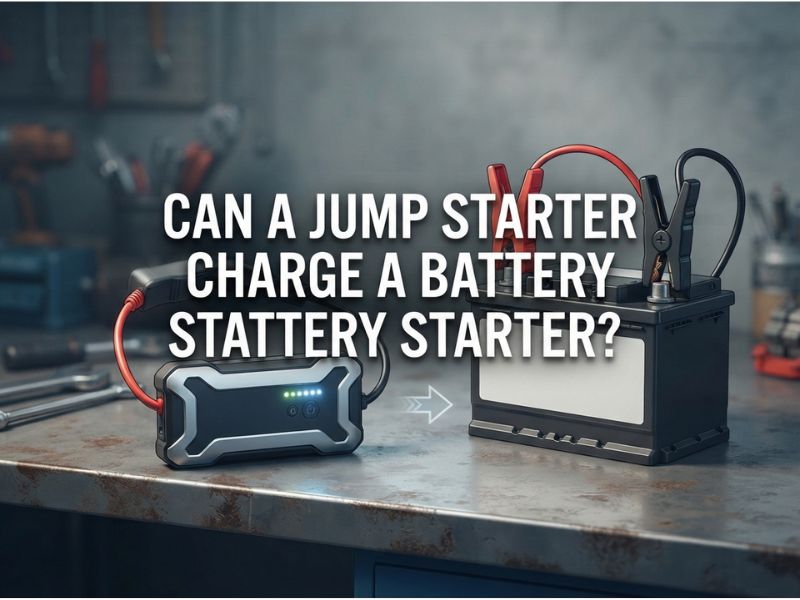
Technically, some jump starters can transfer a small amount of energy into a vehicle battery, but their primary purpose is engine starting, not battery charging.
A portable jump starter contains its own internal battery. When connected correctly to the vehicle’s battery terminals, it can provide high cranking power for a short period. This additional power allows the starter motor to turn the engine over when the vehicle battery does not have enough energy on its own.
Once the engine starts, the vehicle’s alternator normally takes over and begins supplying electrical power. Depending on the vehicle and battery condition, driving the car can restore some charge to the battery.
However, connecting a jump starter to a dead battery for a few minutes does not normally provide the same controlled charging process as using a dedicated battery charger.
How Does a Jump Starter Work?
A jump starter is essentially a portable power source designed to deliver a high amount of current quickly.
When you connect the jump starter’s positive and negative clamps to the appropriate battery terminals, the device can supply electricity to the vehicle’s starting system. This gives the starter motor enough power to crank the engine.
Modern portable jump starters commonly use lithium-ion batteries because they can store considerable energy in a relatively small package. Older jump boxes often used larger lead-acid batteries.
The basic process is:
- Turn off the vehicle and electrical accessories.
- Make sure the jump starter is sufficiently charged.
- Connect the positive clamp to the positive battery terminal.
- Connect the negative clamp to the recommended grounding point or negative terminal, according to the manufacturer’s instructions.
- Turn on the jump starter if required.
- Start the vehicle.
- Disconnect the cables according to the manufacturer’s instructions after the engine starts.
The jump starter is supplying temporary starting assistance rather than functioning like a conventional 12-volt battery charger.
Does a Jump Starter Recharge a Dead Car Battery?
A jump starter generally does not fully recharge a dead car battery.
Its main purpose is to provide enough current to start the engine. After the vehicle starts, the alternator may recharge the battery while the engine is running.
For example, imagine a vehicle has a battery that has become discharged because the headlights were left on. A jump starter may provide enough power to start the engine. Afterward, the alternator can begin replacing some of the energy that was lost.
However, this does not necessarily mean the battery has returned to a full state of charge.
If the battery is deeply discharged, damaged, old, or unable to hold a charge, simply driving the vehicle may not solve the problem.
A smart battery charger or appropriate battery maintainer is a better option when the goal is to deliberately recharge the battery.
Can You Use a Jump Starter as a Battery Charger?
In most cases, no. A standard jump starter should not be treated as a substitute for a battery charger.
There is an important difference between jump starting and battery charging.
A jump starter is designed to deliver a high current for a short period. A battery charger is designed to provide a controlled charging current over an extended period.
Some modern jump starters include additional charging functions, such as USB charging ports or specific battery-maintenance modes. However, these features vary significantly between models.
Always check the manufacturer’s instructions before attempting to use a jump starter for battery charging.
What Happens After You Jump-Start a Car?
After successfully starting a vehicle with a jump starter, the alternator usually begins supplying electrical power.
The alternator is driven by the engine and generates electricity for the vehicle’s electrical system. It also supplies current to the battery so that the battery can recover some of the charge used during starting.
However, the alternator is not necessarily the ideal tool for recovering a severely discharged battery.
If the battery is healthy and only moderately discharged, normal driving may restore much of the lost charge. If the battery has been deeply discharged, repeatedly jump-starting the vehicle without investigating the cause can lead to further problems.
A battery voltage test can help determine whether the battery and charging system are operating normally.
How Long Should You Drive After Using a Jump Starter?
There is no universal driving time that guarantees a completely recharged battery.
Factors such as battery condition, engine speed, electrical load, alternator output, temperature, and the amount of charge remaining in the battery all affect charging.
A short drive may restore some energy, but it should not automatically be considered a complete recharge.
If you frequently need a jump starter, the issue may be more than a temporarily discharged battery. Possible causes include:
- An aging or failing battery
- A faulty alternator
- Parasitic electrical drain
- Loose or corroded battery connections
- Leaving lights or accessories running
- Extreme temperatures
Repeated jump starts are a reason to have the battery and charging system tested.
Can a Jump Starter Damage a Car Battery?
A properly designed jump starter used according to its instructions should not normally damage a healthy vehicle battery.
The bigger risks come from incorrect use, such as reversing the polarity, creating a short circuit, using an incompatible device, or ignoring the manufacturer’s safety instructions.
Many modern jump starters include reverse-polarity protection, short-circuit protection, over-current protection, and other safety features. These features can reduce the risk of mistakes, but they do not eliminate the need for proper handling.
Before connecting a jump starter, verify the positive and negative terminals and make sure the device is appropriate for your vehicle.
Jump Starter vs. Battery Charger
The easiest way to understand the difference is to consider their primary purpose.
| Feature | Jump Starter | Battery Charger |
| Main purpose | Start a vehicle with a weak battery | Recharge the battery |
| Power delivery | High current for a short time | Controlled current over time |
| Portable | Usually yes | Depends on model |
| Starts a dead vehicle | Yes, if sufficiently powerful | Some chargers have start-assist functions |
| Fully charges battery | Usually no | Yes |
| Typical use | Emergency starting | Battery maintenance and recovery |
A portable jump starter is especially useful for emergencies because it does not require another vehicle. A battery charger is more appropriate when you have time to recharge the battery properly.
Does the Alternator Charge the Battery After a Jump Start?
Yes. Once the engine is running, the alternator normally supplies electrical power to the vehicle and charges the battery.
However, the charging rate is not always constant. Modern vehicles use sophisticated charging systems, and the alternator’s output can vary depending on battery condition, electrical demand, engine speed, and vehicle design.
If the battery repeatedly becomes discharged after being jump-started, the alternator and battery should both be tested.
A healthy alternator with a healthy battery should generally maintain the vehicle’s electrical system without requiring frequent external assistance.
What If the Battery Is Completely Dead?
A completely discharged battery may still be jump-startable, but the result depends on its condition.
A battery can become discharged without being permanently damaged. For example, leaving the headlights on overnight can drain an otherwise healthy battery.
On the other hand, an old battery may have internal damage or degraded plates and may no longer be capable of holding a proper charge.
If a jump starter successfully starts the car but the battery quickly becomes dead again, testing is important.
In some cases, the battery needs replacement rather than additional charging.
How to Know If Your Car Battery Needs Replacement
A jump starter can get your vehicle running, but it cannot fix a battery that has reached the end of its service life.
Common signs of a failing car battery include:
- Slow engine cranking
- Repeated need for jump starts
- Dim headlights when the engine is off
- Electrical accessories behaving inconsistently
- Battery warning light or charging-system warning
- Swollen or physically damaged battery case
- Battery that is several years old and losing performance
A battery load test or professional battery test can provide more useful information than simply checking whether the vehicle starts.
Can You Charge a Car Battery With a Portable Jump Starter?
Some specialized jump starters may include a dedicated charging or maintenance function, but a typical portable jump starter should not be considered a full battery charger.
The key distinction is the intended electrical output. A jump starter is optimized for delivering substantial current during engine cranking. A battery charger is designed to manage the charging process and gradually restore battery capacity.
If your goal is simply to get a stranded vehicle running, a jump starter is appropriate.
If your goal is to restore a discharged battery to full charge, use a compatible battery charger instead.
How to Properly Use a Jump Starter
Always follow the instructions supplied with your particular jump starter because connection procedures can vary.
Before using one, make sure the jump starter has enough charge and that the cables and clamps are in good condition.
Check the vehicle’s battery terminals for excessive corrosion and confirm the positive and negative connections before turning on the device.
After the vehicle starts, allow the engine to run and disconnect the jump starter according to the manufacturer’s recommended procedure.
Never assume that a jump starter can safely be used on every type of vehicle or battery. Check compatibility, especially with vehicles that use specialized electrical systems.
What Size Jump Starter Do You Need?
Jump starters come in different power ratings, and choosing the correct size depends on the vehicle.
Important specifications can include peak amps, starting amps, battery capacity, engine type, and recommended engine size.
A small jump starter may be suitable for many compact gasoline engines, while larger gasoline engines, diesel engines, trucks, and SUVs may require a more powerful model.
Do not select a jump starter based solely on its advertised peak-amp number. Look at the manufacturer’s recommended vehicle compatibility and starting-current specifications.
Is It Better to Use a Jump Starter or Jumper Cables?
Both can start a vehicle with a weak battery, but they work differently.
Jumper cables normally require another vehicle with a functioning battery. A portable jump starter contains its own battery, so you do not need another car.
This makes a portable jump starter particularly convenient for roadside emergencies, remote locations, or situations where another vehicle is unavailable.
However, neither jumper cables nor a standard jump starter should be confused with a dedicated battery charger.
Frequently Asked Questions
Can a jump starter fully charge a car battery?
Usually, no. A standard jump starter is designed primarily to provide temporary starting power. A dedicated battery charger is better for fully recharging a car battery.
How long does a jump starter take to charge a car battery?
A standard jump starter is not normally intended to charge a car battery over time. It provides enough power to help start the engine. The alternator then charges the battery while the engine runs.
Can I leave a jump starter connected to charge my battery?
Do not leave a standard jump starter connected for charging unless the manufacturer specifically states that the device has a battery-charging or maintenance function designed for that purpose.
Will driving recharge a dead battery?
Driving can allow the alternator to replenish some battery charge, but the time and effectiveness depend on the battery’s condition and the vehicle’s charging system. A severely discharged or damaged battery may require a dedicated charger or replacement.
Why does my car need a jump start repeatedly?
Repeated jump starts can indicate a failing battery, alternator problem, parasitic drain, poor battery connection, or another electrical issue. The battery and charging system should be tested rather than repeatedly relying on a jump starter.
Can a jump starter start a completely dead battery?
A sufficiently powerful jump starter can often start a vehicle with a severely discharged battery, provided the battery and vehicle’s electrical system are otherwise capable of starting. A physically damaged or internally failed battery may prevent a successful jump start.
Final Answer: Can a Jump Starter Charge a Battery Starter?
So, can a jump starter charge a battery starter? A standard jump starter is primarily designed to start a vehicle, not fully recharge its battery. It provides a temporary burst of electrical power that helps the starter motor crank the engine.
Once the engine is running, the vehicle’s alternator normally begins replenishing the battery. If the battery is significantly discharged or failing, however, a dedicated car battery charger is the better solution.
The simplest rule is: use a jump starter to get the vehicle started and use a battery charger to properly recharge the battery. If you repeatedly need a jump starter, test the battery and charging system to identify the underlying problem.