A plug in car battery charger is one of the most useful tools to keep in a home garage because it can restore a weak battery before it leaves you stranded and maintain vehicles that spend long periods parked.
Unlike a portable jump starter, these chargers connect to household AC power and replenish the battery gradually, making them better suited to proper battery recovery, winter storage, weekend cars, motorcycles, and preventative maintenance.
My primary recommendation is the Battery Tender Junior 12V 750mA Battery Charger and Maintainer. It has an exceptionally long user history, simple automatic operation, float maintenance, and a gentle charging rate that works particularly well for vehicles that sit unused. Its main limitation is speed, so I would choose it primarily for maintenance rather than quickly restoring a deeply discharged full-size battery.
For faster everyday automotive charging, I prefer the Schumacher SC1280 15A 6V/12V Fully Automatic Battery Charger. Its 15A output makes it substantially more practical when a normal car, SUV, or truck battery actually needs significant capacity restored instead of simply being kept topped off.
The NOCO GENIUS10 10A Smart Battery Charger is my third standout choice and arguably the most versatile of the group. It combines 10A charging with 6V/12V operation, AGM and EFB support, compatible lithium charging, thermal compensation, maintenance functionality, and low-voltage recovery. Buyers who want one compact charger for several battery types should look especially closely at it.
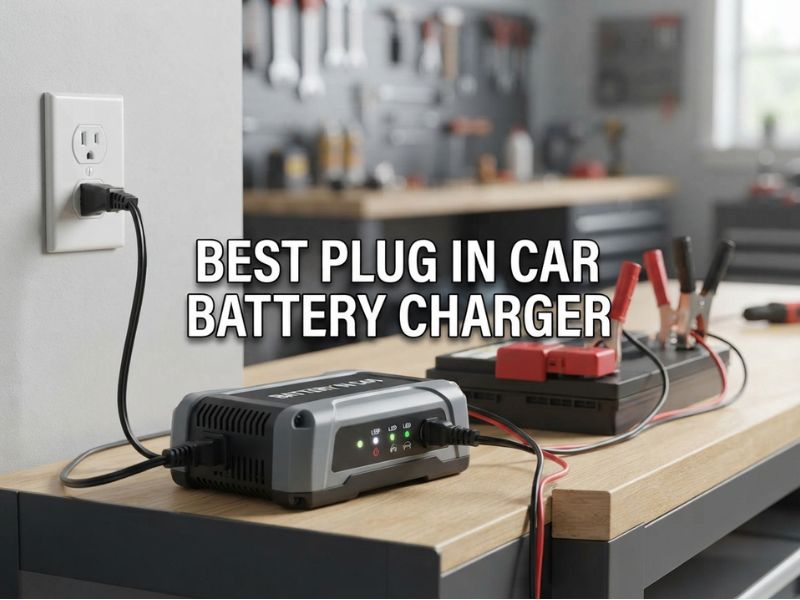
3 Best Plug In Car Battery Charger
| Image | Product Name | Check Price |
|---|---|---|
Best Choice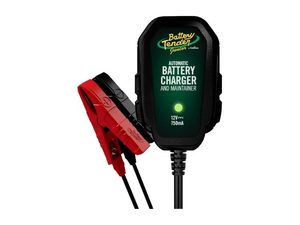 | Battery Tender Junior 12V 750mA Battery Charger and Maintainer | Check Price |
Second Best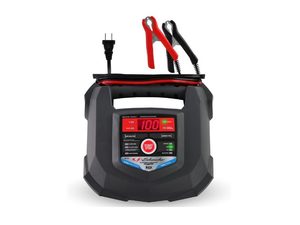 | Schumacher 15A 6V/12V Fully Automatic Battery Charger | Check Price |
Third Choice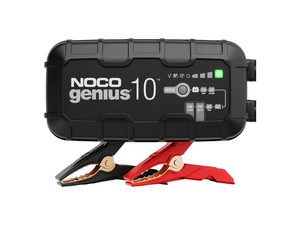 | NOCO GENIUS10 10A Smart Battery Charger | Check Price |
1. Battery Tender Junior 12V 750mA Battery Charger and Maintainer – Best for Long-Term Maintenance
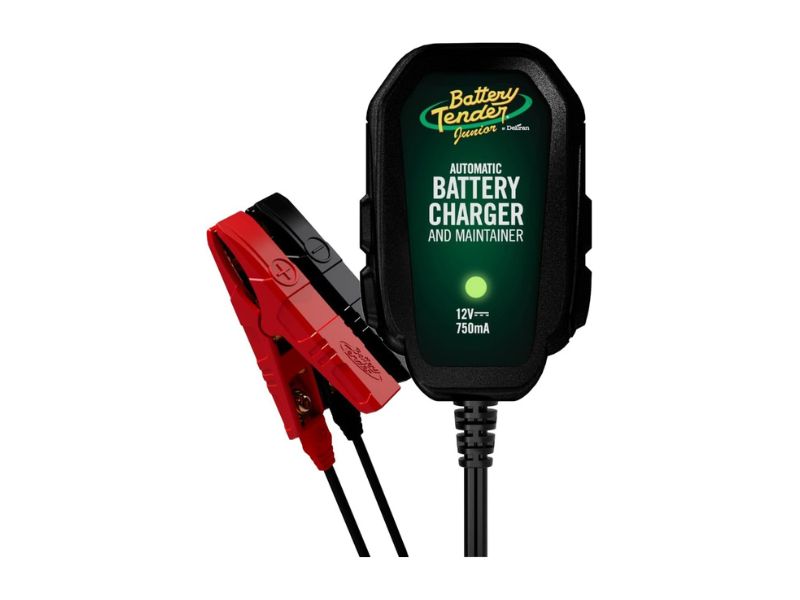
Key Features
- 750mA charging output
- 12V battery operation
- Automatic multi-stage charging
- Float-maintenance mode
- AGM, flooded, gel, and sealed lead-acid compatibility
- Reverse-polarity protection
- Spark-resistant connection design
- Battery clamps included
- Ring-terminal quick-connect harness
- Compact plug-in construction
The Battery Tender Junior is one of the simplest products in this guide, and that simplicity is a large part of its appeal.
Its 0.75A charging rate is much lower than the 10A or 15A chargers reviewed below. That means it is not intended to be the fastest tool for restoring a badly discharged full-size automotive battery.
Instead, it excels at preventing a good battery from becoming discharged in the first place.
This makes it particularly useful for classic cars, sports cars, convertibles, motorcycles, ATVs, lawn tractors, recreational vehicles, collector vehicles, and any automobile that may remain parked for several weeks.
The charger automatically manages the charging process rather than requiring you to monitor voltage manually.
Once the battery reaches an appropriate state of charge, it transitions into float maintenance. The charger then supplies only the energy needed to compensate for normal battery self-discharge and small electrical loads.
That is fundamentally different from an old uncontrolled trickle charger that continuously pushes current into the battery.
Another feature I like is the included ring-terminal harness.
If you maintain the same vehicle regularly, the ring terminals can remain attached to the battery. You then connect the charger using the quick disconnect instead of repositioning alligator clamps every time.
This is especially convenient on motorcycles or vehicles where the battery is difficult to access.
What I Like
The Battery Tender Junior is extremely straightforward.
Its automatic maintenance behavior makes it particularly well suited to long storage periods when charging speed is relatively unimportant.
I also like having both clamps and a permanent quick-connect harness.
The compact charger takes very little space on a garage shelf.
What I Do Not Like
The 750mA output is slow for a full-size car battery that has lost a substantial amount of capacity.
If your battery is regularly discharged enough that the vehicle will not start, I would choose a 10A or 15A charger instead.
It is also limited to 12V batteries.
Verdict
The Battery Tender Junior is my first pick for drivers primarily interested in preventing dead batteries during storage.
It is simple, proven, compact, and exceptionally well suited to vehicles that are driven infrequently.
Best for: Classic cars, motorcycles, weekend vehicles, seasonal storage, and maintaining healthy 12V batteries.
2. Schumacher 15A 6V/12V Fully Automatic Battery Charger – Best for Fast Automotive Charging

Key Features
- 15A maximum charging output
- 6V and 12V compatibility
- Automatic voltage detection
- Microprocessor-controlled charging
- AGM compatibility
- Standard flooded battery support
- Gel battery compatibility
- Deep-cycle battery support
- Float-maintenance mode
- Digital display
- Reverse-hookup protection
The Schumacher SC1280 is the model I would choose if the words “battery charger” mean actually restoring a discharged automotive battery within a practical amount of time.
Its 15-amp maximum output gives it a major advantage over small maintainers.
Consider a simplified example.
If a 60Ah battery has approximately 30Ah of missing capacity, a 1A charger theoretically needs at least around 30 hours just to replace that amount of energy.
A 15A charger can complete the bulk portion dramatically faster.
Real charging always takes longer than simple amp-hour mathematics suggests because battery charging is not 100% efficient and current tapers as the battery approaches full charge.
The comparison still illustrates why charger amperage matters.
The SC1280 supports both 6V and 12V batteries, increasing its usefulness around older vehicles, motorcycles, tractors, and other equipment.
It automatically detects battery voltage and manages charging through a microprocessor-controlled system.
Supported lead-acid battery types include standard flooded, AGM, gel, and deep-cycle batteries.
After the battery reaches full charge, the charger can transition to maintenance operation instead of continuously delivering maximum current.
A digital display also gives you more useful information than a basic charger with only a red and green LED.
What I Like
The 15A charging output is the main reason to buy the SC1280.
It is substantially better suited to full-size car and truck batteries than a small maintainer.
Automatic charging control is another advantage because you get high current when appropriate without having to manually reduce it as the battery fills.
I also like the 6V/12V compatibility.
What I Do Not Like
It is larger than compact wall-plug maintainers.
For someone maintaining only a motorcycle or occasionally stored car, 15A charging may be unnecessary.
Lithium compatibility is also not the main strength of this model.
Verdict
The Schumacher SC1280 is my preferred choice when you need to recharge discharged automotive batteries quickly rather than primarily maintain them.
Best for: Cars, SUVs, pickups, marine batteries, deep-cycle batteries, and DIY garages.
3. NOCO GENIUS10 10A Smart Battery Charger – Best Smart Multi-Battery Charger

Key Features
- 10A DC charging output
- 6V and 12V operation
- Lead-acid battery support
- Compatible lithium battery mode
- AGM, EFB, gel, wet, and maintenance-free compatibility
- Up to 230Ah recommended charging capacity
- Temperature-compensated charging
- 12V repair mode
- Force Mode for very low-voltage batteries
- Automatic maintenance
- Spark protection
- Reverse-polarity protection
- IP65-rated enclosure
The NOCO GENIUS10 is the most technically versatile charger in this group.
Its 10A output is high enough for meaningful automotive charging while still allowing the charger to remain relatively compact.
It can charge both 6V and 12V batteries and supports a broad selection of battery chemistries.
That includes conventional wet lead-acid batteries, AGM, EFB, gel, maintenance-free batteries, and compatible lithium batteries.
This matters more today because there is no longer one universal battery type across modern vehicles.
A conventional sedan may use flooded lead-acid, a start-stop vehicle may use AGM or EFB, and powersports equipment may use LiFePO4 lithium.
The GENIUS10 also incorporates automatic temperature compensation.
Battery charging requirements change with ambient temperature.
A battery in a freezing garage benefits from a different charging voltage than the same battery sitting in very hot summer conditions.
The integrated thermal sensor lets the charger adjust automatically.
Its normal smart charging mode is also supplemented by Force Mode, which can be used when battery voltage is too low for normal automatic detection.
Force Mode should be used carefully because manually forcing charging requires the operator to verify battery type, voltage, and connection polarity.
Another useful feature is Repair Mode for compatible 12V lead-acid batteries affected by certain sulfation conditions.
Repair mode cannot revive every failed battery, but it can be useful when dealing with batteries that have spent extended periods partially discharged.
What I Like
The GENIUS10 provides one of the best combinations of charging speed and battery compatibility.
Ten amps is enough for normal automotive charging without making the unit bulky.
I particularly like AGM, EFB, and compatible lithium support because it makes the charger useful across a modern multi-vehicle household.
Temperature compensation is another meaningful feature rather than marketing decoration.
What I Do Not Like
It does not provide as much maximum charging current as the Schumacher SC1280.
The LED-based interface also provides less detailed numerical information than a large LCD charger.
Force Mode requires careful manual operation.
Verdict
The NOCO GENIUS10 is the strongest choice for buyers who want one high-quality smart plug-in charger for many different battery types.
Best for: Cars, SUVs, motorcycles, AGM batteries, EFB batteries, compatible lithium batteries, and year-round garage use.
4. NEXPEAK NC201 10A 12V/24V Smart Battery Charger – Best Budget 12V/24V Charger
Key Features
- 10A output at 12V
- 5A output at 24V
- 12V and 24V battery support
- Automatic smart charging
- Large LCD display
- AGM compatibility
- Gel battery support
- Flooded and EFB compatibility
- Pulse repair function
- Temperature compensation
- Maintenance charging
- Internal cooling fan
- Reverse-polarity protection
The NEXPEAK NC201 is particularly interesting because it offers genuine automotive charging current at a relatively accessible level.
For 12V batteries it can supply up to 10A, while 24V charging operates at a lower maximum current.
This makes it suitable for normal cars while adding flexibility for trucks, equipment, boats, and other applications that may use 24V battery arrangements.
The large LCD is one of the biggest advantages.
Instead of displaying only a basic charging light, the screen can provide information such as battery voltage, charging current, temperature, and approximate state of charge.
For someone learning about automotive electrical systems, that feedback is useful.
You can see current begin relatively high during the bulk stage and then decrease as the battery approaches full charge.
The NC201 supports common lead-acid battery chemistries, including flooded, AGM, gel, maintenance-free, calcium, and EFB batteries.
It also includes a pulse repair function.
This mode is intended to help with some older lead-acid batteries affected by sulfation.
The important word is “some.”
A repair mode cannot fix a shorted cell, broken internal plate, leaking battery case, badly depleted electrolyte, or a battery that has simply reached the end of its service life.
What I Like
The combination of 10A charging, 12V/24V capability, and a detailed LCD offers a lot of functionality.
Temperature compensation is useful in garages with major seasonal temperature changes.
The display also makes the charger easier to use as a basic battery-monitoring tool.
What I Do Not Like
The NC201 is focused on lead-acid battery families rather than being my preferred choice for lithium.
Its cables could also feel short depending on where the wall outlet and vehicle battery are positioned.
The large number of modes means users should read the instructions rather than simply pressing buttons at random.
Verdict
The NEXPEAK NC201 is an excellent choice when you want 10A automotive charging plus 24V capability and detailed charging information.
Best for: Cars, pickups, boats, lawn equipment, lead-acid batteries, and budget-conscious DIY users.
5. YONHAN 10A 12V/24V Smart Battery Charger – Best Value LCD Charger
Key Features
- 10A 12V charging
- 24V charging support
- Fully automatic operation
- Large LCD information screen
- Standard lead-acid mode
- AGM compatibility
- Repair mode
- Motorcycle/low-current mode
- Temperature compensation
- Float/trickle maintenance
- Charging memory function
- Reverse-polarity protection
- Overcurrent, overheat, and short-circuit protection
The YONHAN 10A charger offers a lot of capability in a compact plug-in package.
Its output makes it far more appropriate for charging normal car batteries than low-current maintainers.
For a 12V automotive battery, 10 amps provides a practical balance between charging time and compact charger size.
It also supports 24V systems, making it useful for owners who maintain different types of equipment.
The large LCD displays charging information such as voltage, current, temperature, and charging progress.
A smart memory function can also return the charger to its previous operating mode after a power interruption, reducing repetitive setup during regular use.
Temperature compensation alters charging behavior according to ambient conditions.
That can help avoid undercharging in cold conditions and unnecessarily aggressive voltage when temperatures are high.
A dedicated repair mode is intended for older or idle lead-acid batteries affected by sulfation.
There is also a lower-output motorcycle mode for smaller batteries and maintenance-oriented use.
This versatility makes the YONHAN particularly useful for households with a mix of cars, motorcycles, lawn equipment, and other 12V batteries.
What I Like
The 10A output and large LCD provide an excellent combination for everyday DIY charging.
I also like having a lower-current mode because one charger can handle both normal automotive batteries and smaller powersports batteries.
Temperature compensation and multiple safety protections add useful automatic management.
What I Do Not Like
The interface has more modes and information than a simple Battery Tender-style maintainer.
Repair mode should not be treated as a guaranteed cure for an old battery.
Buyers should also verify battery chemistry carefully before selecting the charging mode.
Verdict
The YONHAN 10A is a strong value option for drivers who want fast-enough automotive charging, a detailed screen, and maintenance functionality without requiring a large bench charger.
Best for: Budget-focused DIY garages, cars, motorcycles, 12V/24V batteries, and users who prefer an LCD.
Plug In Car Battery Charger Comparison
| Product | Max Charging Output | Voltage | Main Battery Types | Maintenance Mode | Repair Mode | Display | Best For |
| Battery Tender Junior | 0.75A | 12V | Flooded, AGM, gel | Yes | No dedicated repair mode | LED | Long-term storage |
| Schumacher SC1280 | 15A | 6V/12V | Flooded, AGM, gel, deep-cycle | Yes | Battery-care functions | Digital | Fast car charging |
| NOCO GENIUS10 | 10A | 6V/12V | Wet, AGM, EFB, gel, compatible lithium | Yes | Yes | LED | Broad battery compatibility |
| NEXPEAK NC201 | 10A at 12V | 12V/24V | Flooded, AGM, gel, EFB | Yes | Pulse repair | LCD | 12V/24V value |
| YONHAN 10A | 10A at 12V | 12V/24V | Common lead-acid types | Yes | Yes | LCD | Affordable smart charging |
These five chargers serve two somewhat different purposes.
The Battery Tender Junior is the strongest storage-oriented option. It charges slowly but is excellent at keeping an already healthy battery from losing charge over weeks or months.
The Schumacher SC1280 is almost the opposite. Its 15A output makes it more useful when significant battery capacity needs to be restored quickly.
The NOCO GENIUS10 provides the broadest battery compatibility, while the NEXPEAK NC201 and YONHAN offer attractive 10A charging with informative LCD displays.
What Is a Plug In Car Battery Charger?
A plug-in charger converts household AC electricity into controlled DC charging power for a vehicle battery.
For U.S. garages, that generally means connecting the charger to a normal 120V wall outlet and attaching its output clamps or permanent leads to a 6V, 12V, or supported 24V battery.
The charger then regulates voltage and current according to its charging program.
Modern smart chargers are significantly different from older transformer-style manual chargers.
A smart model can monitor battery voltage, reduce current as charge increases, enter maintenance mode after charging, and stop operation when it detects certain connection problems.
Plug-In Charger vs. Portable Jump Starter
These tools are frequently confused.
A plug-in battery charger restores electrical energy to the battery over time.
A portable jump starter contains its own internal battery and provides a brief burst of high current to crank the engine.
If your car is sitting in the garage and you have several hours available, a charger is usually the better tool.
It actually replenishes the battery instead of merely providing temporary starting assistance.
A jump starter is better for roadside emergencies because it does not require a wall outlet.
Many prepared drivers own both.
Battery Charger vs. Battery Maintainer
Charging and maintaining are related but not identical jobs.
A charger is primarily intended to replace substantial missing capacity.
A maintainer is intended to keep an already charged battery near full charge during storage.
Modern smart chargers can often do both.
The difference usually becomes obvious when you compare output.
The Battery Tender Junior provides 0.75A and is excellent for maintenance.
The Schumacher SC1280 can provide up to 15A and is far better at recovering a substantially discharged automotive battery.
Before buying, decide which problem you actually need to solve.
How Many Amps Should a Plug-In Car Battery Charger Have?
0.75A to 1A
This range is primarily for maintenance.
It works well for:
- Stored cars
- Motorcycles
- ATVs
- Lawn tractors
- Collector vehicles
- Seasonal equipment
It can recharge a larger battery, but the process will be slow.
2A to 5A
This is a useful middle range for smaller batteries and overnight charging.
It provides more charging capability while remaining gentle enough for many maintenance applications.
10A
A 10A charger is an excellent all-around size for normal home automotive use.
It can restore a partially discharged full-size battery within several hours in many situations while remaining compact.
NOCO GENIUS10, NEXPEAK NC201, and YONHAN all fall into this general category.
15A
A 15A charger is particularly useful when speed matters.
It makes sense for:
- Daily-driver cars
- Larger SUVs
- Pickups
- Deep-cycle batteries
- Multiple-vehicle garages
The Schumacher SC1280 is the strongest fast-charging option among these five.
How Charging Amps Affect Charging Time
Suppose a 60Ah battery is approximately 50% discharged.
Very roughly, 30Ah of capacity needs to be restored.
Ignoring losses and charging taper for a moment:
A 1A charger would theoretically require about 30 hours.
A 5A charger would require about six hours.
A 10A charger would require around three hours.
A 15A charger could theoretically replace the same bulk energy in around two hours.
Actual charging takes longer.
Lead-acid batteries do not accept maximum current until the instant they reach 100%.
The charger reduces current during later stages to protect the battery.
The calculation is useful primarily for understanding why a maintainer and a high-output charger feel completely different in real use.
What Is Multi-Stage Smart Charging?
Modern smart chargers normally use several phases.
Manufacturers use different names, but the basic sequence is similar.
Detection
The charger confirms that a battery is connected and checks voltage conditions.
Soft Start
A deeply discharged battery may receive reduced current initially.
Bulk Charging
The charger supplies relatively high current to restore most missing capacity.
Absorption
Battery voltage is maintained while charging current gradually decreases.
Analysis
Some chargers evaluate whether the battery appears able to hold the charge.
Float or Maintenance
Once fully charged, the charger reduces output and monitors battery condition.
This approach provides faster charging when the battery can accept it and gentler charging near full capacity.
Why AGM Compatibility Matters
AGM, or Absorbent Glass Mat, batteries are increasingly common.
You may find AGM batteries in:
- Start-stop vehicles
- Performance cars
- Luxury vehicles
- SUVs
- Cars with high electrical demand
- Vehicles with trunk-mounted batteries
AGM batteries require a charging profile appropriate for their design.
Do not assume an old charger intended only for flooded batteries is ideal for AGM use.
All five selections provide some level of AGM compatibility, but you should always verify the battery label and select the correct mode.
What Is an EFB Battery?
Enhanced Flooded Battery technology is used in many start-stop vehicles.
EFB batteries cycle more effectively than basic flooded starter batteries but are not identical to AGM batteries.
Chargers such as the NOCO GENIUS10 and NEXPEAK NC201 explicitly support common enhanced lead-acid battery types.
When your vehicle uses EFB, choose a charger with an appropriate charging profile instead of relying on a generic old-style charger.
Can a Plug-In Charger Charge Lithium Batteries?
Only when the charger explicitly supports the lithium chemistry involved.
Many automotive lithium batteries use LiFePO4, or lithium iron phosphate, chemistry.
Lithium charging behavior differs from lead-acid charging.
Do not use:
- Lead-acid desulfation mode
- AGM mode
- Generic flooded mode
on a lithium battery unless the manufacturer specifically instructs you to.
The NOCO GENIUS10 supports compatible lithium batteries and is my preferred choice in this group for buyers who maintain both lead-acid and lithium batteries.
What Is Temperature Compensation?
Battery charging requirements change with temperature.
A lead-acid battery in cold winter conditions typically needs different charging voltage than the same battery in extreme summer heat.
A charger with temperature compensation adjusts its charging behavior according to ambient conditions.
This is particularly useful in:
- Unheated garages
- Northern winters
- Hot southern summers
- Detached workshops
- Outdoor equipment sheds
NOCO, NEXPEAK, and YONHAN all offer temperature-aware charging features.
What Is Battery Repair Mode?
A lead-acid battery that remains partially discharged for extended periods can develop sulfation.
Lead sulfate crystals accumulate and may become more difficult to reverse through ordinary charging.
Repair or desulfation modes use specialized voltage or pulse behavior designed to improve some sulfated batteries.
This can occasionally help restore usable capacity.
However, repair mode cannot fix every battery problem.
It cannot repair:
- Shorted cells
- Broken internal connections
- Physical plate damage
- Severe plate shedding
- Cracked cases
- Frozen batteries
- Major electrolyte loss
- Normal end-of-life deterioration
Treat repair mode as a recovery attempt, not a substitute for proper battery testing.
How to Use a Plug In Car Battery Charger Safely
Always begin by reading the instructions for your specific charger and vehicle.
Turn off the ignition and all unnecessary electrical accessories.
Inspect the battery.
Do not charge a battery that is cracked, leaking, badly swollen, physically damaged, or frozen.
Charge lead-acid batteries in a well-ventilated location.
Hydrogen gas produced under some charging conditions is flammable, so keep cigarettes, flames, and other ignition sources away.
Identify the positive and negative charging points.
Modern vehicles sometimes provide designated under-hood terminals even when the actual battery is located elsewhere.
Connect the charger according to its specified sequence.
Select the correct voltage and battery chemistry before charging begins.
Allow an automatic charger to complete its charging cycle instead of repeatedly unplugging it because current has started to decrease.
Can You Charge the Battery While It Is Still in the Car?
Usually, but vehicle-specific instructions matter.
Most modern smart chargers are designed to charge installed automotive batteries.
However, some vehicles use an Intelligent Battery Sensor on the negative terminal.
On these vehicles, the negative charger clamp may need to connect to a designated chassis ground instead of directly to the battery’s negative post.
This allows the vehicle’s battery-management system to measure incoming current.
Always consult the vehicle owner’s manual if you are unsure.
Should You Disconnect the Battery Before Charging?
Not automatically.
Disconnecting a battery can erase or reset:
- Radio presets
- Clock settings
- Seat memory
- Window initialization
- Engine adaptive values
- Transmission learning
- Other electronic settings
Some modern vehicles require special procedures after battery disconnection.
If the charger and vehicle both support in-place charging, leaving the battery connected may be preferable.
Follow the vehicle manufacturer’s procedure rather than using one universal rule for every car.
Can You Leave a Smart Charger Connected Overnight?
A properly functioning automatic charger can generally remain connected through its normal charging cycle when its instructions allow.
Once charging is complete, a good smart charger transitions into float or maintenance behavior.
That means a 15A charger does not continue forcing 15 amps through a full battery all night.
The charging system monitors battery condition and reduces output.
Do not apply this assumption to old manual chargers that lack automatic regulation.
Can You Leave a Battery Maintainer Connected All Winter?
Yes, many automatic maintainers are specifically designed for long-term connection.
This is where the Battery Tender Junior is especially useful.
A stored vehicle battery loses charge naturally even when completely disconnected.
Vehicles with alarm systems, keyless-entry modules, computers, and other electronics also create small parasitic loads.
A maintainer compensates for these losses without repeatedly overcharging a healthy battery.
Always follow the product’s long-term connection instructions.
Why Won’t My Charger Detect the Battery?
Modern chargers often require a minimum battery voltage before automatic charging can begin.
If the battery is severely discharged, the charger may interpret it as:
- No battery attached
- A defective battery
- Incorrect connection
Some chargers include a manual low-voltage override.
NOCO calls this Force Mode.
Override modes should be used carefully because some normal automatic safety decisions may be bypassed.
Confirm battery voltage, polarity, and chemistry before forcing charging.
Why Does Charging Current Drop?
This is normally a good sign.
During bulk charging, a battery can accept relatively high current.
As voltage approaches the charger’s target, the charging process enters absorption.
Current then gradually decreases.
A 10A charger may therefore show:
10A early in the process,
then 7A,
then 4A,
then 1A or less near full charge.
That does not mean the charger has become weak.
It means the battery no longer needs maximum current.
How Do You Know When a Car Battery Is Fully Charged?
A smart charger should indicate when its charging cycle is complete.
For a conventional 12V lead-acid battery, resting voltage after charging is commonly around 12.6–12.8 volts, depending on battery chemistry, temperature, and measurement conditions.
Do not immediately judge battery condition from voltage measured right after charging.
Surface charge can temporarily produce a higher reading.
More importantly, voltage alone does not prove that the battery can deliver enough cranking current.
A failing battery may reach normal voltage and still collapse when the starter motor places it under load.
What If the Battery Charges but the Car Still Will Not Start?
Several problems are possible.
The battery may have:
- High internal resistance
- Reduced cold-cranking capacity
- A damaged cell
- Poor terminal connections
The vehicle may also have:
- A starter problem
- Charging-system failure
- Corroded cables
- Ground problems
- A different electrical fault
A battery load or conductance test can provide more useful information than open-circuit voltage alone.
Why Does the Battery Keep Going Dead?
If a healthy battery repeatedly becomes discharged, charging it again only treats the symptom.
Possible causes include:
Aging Battery
Starter batteries have finite service lives.
Alternator Problems
The vehicle may not recharge the battery correctly while driving.
Parasitic Drain
An electrical device may continue drawing excessive current after the vehicle is turned off.
Poor Connections
Loose or corroded battery terminals increase resistance.
Short Driving Cycles
Repeated very short trips may not replace the energy consumed during starting.
Long Storage
Even a healthy battery gradually self-discharges.
Diagnose recurring discharge rather than simply relying on a charger indefinitely.
Plug-In Charger for a Dead Car Battery
If the battery is deeply discharged, charging current becomes particularly important.
For this situation, my first choices from this list are:
Schumacher SC1280 for its 15A maximum output.
NOCO GENIUS10 for 10A charging plus sophisticated low-voltage recovery.
NEXPEAK NC201 for affordable 10A charging.
YONHAN 10A for 10A output and a detailed screen.
The Battery Tender Junior can restore some discharged batteries, but it will do so much more slowly.
Plug-In Charger for Winter Storage
Winter storage requires a different strategy.
A stored battery normally needs very little current once it is fully charged.
For that reason, the Battery Tender Junior is particularly appropriate.
NOCO GENIUS10 is also excellent because it can initially charge a partially depleted battery faster and then automatically maintain it.
The best storage charger is not necessarily the charger with the greatest amp rating.
Plug-In Charger for an AGM Battery
For AGM charging, I would prioritize a charger with explicit AGM compatibility.
The NOCO GENIUS10 is my preferred option because it provides a dedicated smart charging system suitable for AGM batteries while also supporting EFB and other common chemistries.
Schumacher SC1280 is also a strong choice when faster 15A charging matters.
Battery Tender Junior works well when AGM maintenance rather than rapid charging is the goal.
Plug-In Charger for a Truck Battery
Truck batteries tend to be larger than batteries used in compact passenger cars.
For a full-size pickup, I would prefer a 10A or 15A charger.
Schumacher SC1280 provides the fastest normal charging rate among these five.
NOCO GENIUS10 is better when battery chemistry versatility and compact construction matter.
For 24V systems, NEXPEAK or YONHAN may be more relevant, provided the particular battery arrangement falls within the charger’s specifications.
Plug-In Charger for a Motorcycle
Motorcycle batteries are smaller.
A 15A automotive charging rate is unnecessary for many powersports batteries unless the charger automatically provides an appropriate reduced-current mode.
The Battery Tender Junior is particularly well suited to motorcycles because of its gentle 750mA rate and permanent ring-terminal harness.
NOCO GENIUS10 can also work across broader battery types when the correct charging mode is selected.
Common Mistakes to Avoid
Buying a Maintainer When You Need Fast Charging
A 0.75A charger is excellent for storage but frustrating when you need to restore a large depleted battery quickly.
Buying the Highest-Amperage Charger Automatically
Charging current must be appropriate for the battery.
More is not always better.
Selecting the Wrong Battery Type
Do not use flooded mode on lithium or other incompatible chemistry.
Ignoring Vehicle-Specific Charging Points
Modern vehicles may require specific positive and ground connections.
Charging a Frozen Battery
Never attempt to charge a frozen lead-acid battery.
Charging a Physically Damaged Battery
Cracked, leaking, or badly swollen batteries should not be charged.
Treating Repair Mode Like a Guaranteed Fix
Desulfation cannot reverse every type of battery failure.
Leaving an Old Manual Charger Unattended
Only chargers specifically designed for automatic maintenance should be treated as long-term maintainers.
Frequently Asked Questions
What is the best plug in car battery charger?
The Battery Tender Junior is my first choice for long-term maintenance, while the Schumacher SC1280 is better for fast charging.
The right answer depends on your goal. If you want to prevent a healthy battery from going flat while a vehicle sits, Battery Tender Junior is exceptionally practical. If the battery is already substantially discharged, the Schumacher’s 15A output can restore capacity much faster. NOCO GENIUS10 offers the strongest overall combination of speed and battery compatibility.
Does a plug-in car battery charger need a wall outlet?
Yes, conventional plug-in chargers require household AC electricity.
They convert AC power into regulated DC voltage suitable for charging the vehicle battery. They therefore work best in garages, workshops, driveways with electrical access, or other locations near an outlet. For roadside emergencies without AC power, a portable jump starter is more appropriate.
Can a plug-in battery charger start a car?
Most standard chargers cannot immediately crank an engine.
They are designed to restore battery capacity gradually. Some large bench chargers provide dedicated engine-start assistance, but the five models in this comparison are primarily charging and maintaining tools. If you need immediate roadside starting power, use a portable jump starter.
How long does a plug-in charger take to charge a car battery?
Charging can take from a few hours to more than a day depending on charger amperage and battery condition.
A 15A charger can restore significant capacity much faster than a 0.75A maintainer. Battery capacity, starting state of charge, temperature, chemistry, and charging taper all affect total time.
Is a 10A battery charger good for a car?
Yes, 10A is an excellent all-around charging rate for many automotive batteries.
It is high enough to replenish a normal battery within a practical time while still allowing compact charger construction. NOCO GENIUS10, NEXPEAK NC201, and YONHAN all use approximately this class of output for 12V batteries.
Is 15A too much for a car battery?
Not for many full-size automotive batteries when controlled by a compatible smart charger.
A modern 15A charger automatically regulates current and reduces charging output as necessary. Small motorcycle and powersports batteries may require much lower current, so always follow battery specifications.
Can I leave a 10A charger connected overnight?
A fully automatic smart charger can usually remain connected through its normal cycle when its instructions permit.
It should reduce current after the battery reaches full charge rather than continuously supplying 10 amps. Do not assume an old manual charger has the same protection.
Can I leave Battery Tender Junior connected all winter?
Yes, long-term battery maintenance is one of its primary purposes.
Its automatic charging system transitions into float maintenance after charging is complete. This helps compensate for battery self-discharge and small parasitic electrical loads during storage.
Is Battery Tender Junior too slow for a car?
It is slow for recharging but excellent for maintaining a car battery.
At 750mA, a deeply discharged full-size automotive battery may require a very long charging session. If you need significant capacity restored quickly, choose a 10A–15A charger.
Is NOCO GENIUS10 good for AGM batteries?
Yes, AGM compatibility is one of the GENIUS10’s major strengths.
It also supports other lead-acid technologies and compatible lithium batteries. The combination makes it especially attractive for households containing vehicles with different battery chemistries.
Can a smart charger fix an old battery?
It may improve some sulfated batteries but cannot reverse every type of failure.
Repair modes cannot correct shorted cells, broken plates, severe corrosion, physical damage, or normal end-of-life degradation. Have questionable batteries properly tested after charging.
Can I charge the battery without removing it from the car?
Usually yes, provided the vehicle and charger manufacturers permit in-vehicle charging.
Modern vehicles may specify dedicated charging points. Cars with battery-management sensors often require the negative charger clamp to connect at a designated chassis ground.
Should the car be running while charging the battery?
No, normal battery charging is performed with the engine turned off.
A plug-in charger supplies the charging energy. Starting or running the engine during normal charging is unnecessary unless a specific product procedure explicitly instructs otherwise.
Can I close the hood while the battery charger is connected?
Only when the cables can pass without being pinched or damaged and ventilation remains adequate.
Do not crush charging cables between panels. Make sure the charger remains dry, adequately ventilated, and positioned according to its instructions.
Can I use an extension cord with a battery charger?
Only use an extension cord that meets the charger’s electrical requirements.
An undersized or excessively long cord can create voltage drop and heat. Follow the charger manufacturer’s recommended wire gauge and maximum extension-cord length.
Can I plug a battery charger into a garage outlet?
Yes, a properly wired household garage outlet is exactly how most AC battery chargers are powered.
Keep the charger and connections away from water and make sure the outlet provides the voltage specified by the charger.
Is a battery maintainer better than disconnecting the battery?
A maintainer is often more convenient because it preserves battery charge while allowing vehicle electronics to remain connected.
Disconnecting can eliminate parasitic loads but may reset electronic settings. A quality automatic maintainer keeps the battery charged without requiring disconnection when the vehicle permits it.
Why does my charger say full but the battery dies again?
The battery may have lost usable capacity even though its voltage reaches the normal charging level.
A worn battery can show apparently normal voltage but fail under starter load. Repeated rapid discharge can also indicate an alternator problem or parasitic electrical drain.
Does a plug-in charger use much electricity?
Battery chargers generally use relatively modest electricity compared with large household appliances.
Actual consumption depends on charging current, battery condition, efficiency, and how long the charger operates. Once an automatic maintainer enters float mode, average energy consumption becomes much lower than during bulk charging.
Which is better, 6V/12V or 12V-only?
Choose 6V/12V if you maintain vintage or specialty batteries; otherwise 12V may be sufficient.
Modern passenger vehicles primarily use 12V systems. Six-volt capability is useful for older cars, tractors, motorcycles, and specialty equipment.
Do I need a 24V battery charger?
Most ordinary car owners do not need 24V charging.
Twenty-four-volt systems are more common in commercial trucks, certain equipment, marine applications, and specialty battery banks. NEXPEAK and YONHAN provide additional flexibility for owners who actually need it.
Can I charge a completely dead battery?
Possibly, but smart chargers often require a minimum battery voltage for automatic detection.
Some chargers provide low-voltage recovery or manual override. A deeply discharged battery may also have suffered permanent damage, especially if it remained flat for a long period.
How often should I charge a car that sits?
The ideal interval depends on battery condition, temperature, vehicle electronics, and storage duration.
If the vehicle regularly sits for weeks, an automatic maintainer is easier than periodically allowing the battery to discharge and then recharging it. Maintaining a healthy state of charge helps reduce sulfation.
Can a charger overcharge my battery?
A quality automatic smart charger is designed to reduce the risk of overcharging.
It monitors battery conditions and reduces charging current as the battery approaches full charge. Old manual chargers require more supervision because they may not automatically enter a safe maintenance stage.
Conclusion
The best plug in car battery charger depends primarily on whether you need long-term battery maintenance or meaningful recovery from a discharged state.
My first recommendation is the Battery Tender Junior 12V 750mA Battery Charger and Maintainer because it combines simple automatic operation with an exceptionally established track record. It is particularly good for keeping stored vehicles ready to start without requiring frequent manual charging.
If you routinely deal with substantially discharged automotive batteries, I would choose the Schumacher SC1280 15A Fully Automatic Battery Charger instead. Its higher output can reduce charging time dramatically compared with a low-current maintainer.
The NOCO GENIUS10 offers the strongest overall battery versatility. Its 10A output, 6V/12V operation, AGM and EFB support, compatible lithium charging, thermal compensation, repair mode, and maintenance capability make it an excellent one-charger solution for a multi-vehicle household.
The NEXPEAK NC201 is particularly attractive when 12V/24V compatibility and a detailed LCD matter, while the YONHAN 10A delivers similar high-value smart charging with useful temperature and repair functions.
For a car that mainly sits in storage, I would choose the Battery Tender Junior. For a daily driver that sometimes needs real recharging, I would move to the Schumacher SC1280 or NOCO GENIUS10.