A dead vehicle battery can leave you stranded at home, at work, in a parking lot, or miles away from anyone willing to provide a jump.
Traditional jumper cables still work, but they require another vehicle and enough space to position the two cars safely.
A good auto battery booster gives you an independent starting source that can stay in your trunk and be ready when the 12V starting battery no longer has enough power to crank the engine.
The most important factors are real engine compatibility, clamp quality, starting current, low-voltage capability, battery capacity, storage size, cold-weather performance, and safety protections such as reverse-polarity detection.
My primary recommendation is the NOCO Boost GB40 1000A Portable Lithium Jump Starter. It has the largest established feedback base among the relevant models I compared, and its 1,000A output is enough for gasoline engines up to 6.0 liters and diesel engines up to 3.0 liters.
More importantly for everyday drivers, it combines that output with spark-proof connection technology, reverse-polarity protection, an IP65-rated housing, a useful flashlight, and a compact design that is realistic to keep in the vehicle year-round.
For larger engines, the NOCO Boost GB70 2000A Portable Lithium Jump Starter is the stronger choice. It doubles the peak rating to 2,000A and supports gasoline engines up to 8.0 liters and diesel engines up to 6.0 liters. That extra reserve makes more sense for full-size SUVs, pickup trucks, vans, RVs, and households that want one booster capable of covering several different vehicles.
If compact size is less important than heavy-duty cranking hardware, I would consider the Clore Automotive Jump-N-Carry JNC660. Its traditional 22Ah internal battery, 425 cranking amps, 46-inch #2 AWG cables, and industrial-grade clamps make it especially well suited to garages, farms, workshops, fleet environments, and drivers who value sustained starting performance over minimum weight.
Best Auto Battery Booster: Reliable Picks for Dead Batteries
| Image | Product Name | Check Price |
|---|---|---|
Best Choice | NOCO Boost GB40 1000A Portable Lithium Jump Starter – Best Overall | Check Price |
Second Best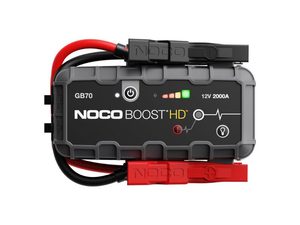 | NOCO Boost GB70 2000A Portable Lithium Jump Starter | Check Price |
Third Choice | Clore Automotive Jump-N-Carry JNC660 | Check Price |
1. NOCO Boost GB40 1000A Portable Lithium Jump Starter – Best Overall
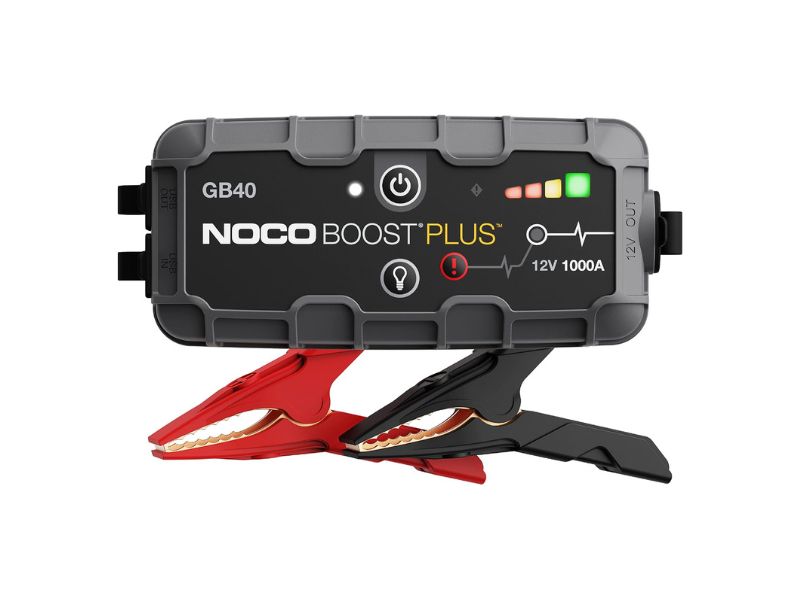
Key Features
- 1,000A peak starting current
- Designed for 12V lead-acid starting batteries
- Supports gasoline engines up to 6.0L
- Supports diesel engines up to 3.0L
- 24Wh lithium-ion internal battery
- Spark-proof connection technology
- Reverse-polarity protection
- IP65-rated enclosure
- 100-lumen LED flashlight
- USB device charging
- Up to approximately 20 jump starts per charge under favorable conditions
- Compact 2.45-pound design
The NOCO GB40 is my first choice because it offers the most useful combination of starting capability, portability, safety, and established real-world use for an ordinary passenger vehicle.
Its 1,000A peak rating may look modest beside newer boosters advertising several thousand amps, but the more meaningful specification is its engine range. It is designed for gasoline engines up to 6.0 liters and diesel engines up to 3.0 liters, which covers a very large percentage of cars, crossovers, motorcycles, light trucks, and smaller SUVs on U.S. roads.
That makes the GB40 particularly sensible for drivers who do not need an oversized battery pack.
A compact four-cylinder sedan does not benefit much from carrying a huge 4,000A booster if a smaller, proven unit already provides enough cranking reserve. Extra power can be useful, but portability matters because emergency equipment only helps if you actually keep it in the vehicle.
The GB40 weighs roughly 2.45 pounds and occupies relatively little trunk space. You can keep it in a roadside emergency bag alongside gloves, a flashlight, tire-pressure gauge, basic tools, and other essentials without giving up a significant amount of cargo room.
Its UltraSafe connection system is one of the strongest reasons I recommend it to everyday drivers.
Connecting jumper clamps can be intimidating if you rarely work around automotive batteries. Reverse-polarity protection helps identify an incorrect positive-to-negative connection, while spark-proof circuitry adds another layer of protection during the normal connection process.
You still need to identify the correct battery terminals and follow your vehicle’s jump-starting instructions, but the electronic protections make the process more forgiving than traditional unprotected jumper cables.
The IP65-rated enclosure is useful as well.
A battery booster stored in a trunk or used on the side of the road may encounter dust, rain, snow, dirty hands, or a damp driveway. IP65 does not mean the unit can be submerged, but it provides meaningful environmental protection when its ports are properly closed.
The built-in 100-lumen flashlight has several operating modes, including emergency signaling settings. This sounds like a secondary feature until a battery dies after sunset and you have to identify positive and negative terminals inside a dark engine compartment.
The internal battery can also recharge compatible USB electronics. In a roadside emergency, that can help keep a phone powered when the vehicle’s electrical system is unavailable.
A Manual Override function is available when the connected battery voltage is too low for the booster to detect automatically.
This is useful, but it should not be treated as a routine setting. Manual override can disable some automatic safety functions. Before using it, verify that the battery is a compatible 12V system, the clamps are connected correctly, and the battery is not frozen, cracked, leaking, swollen, or otherwise damaged.
The GB40’s main limitation is capacity.
A driver with a 6.7L diesel pickup, large commercial van, or very high-displacement gasoline engine should not expect a booster rated for 3.0L diesel to perform like a heavy-duty truck unit.
That is where the GB70 becomes the better choice.
What I Like
The GB40 is small enough to keep permanently in a normal car yet powerful enough for a wide range of everyday engines.
I also like the straightforward safety system. Reverse-polarity detection and spark protection make it more approachable for drivers who might use a booster only once every few years.
Its weather-resistant housing, USB power function, and emergency light improve its value as part of a complete roadside kit.
What I Do Not Like
The clamp cables are relatively short compared with a traditional professional jump box, which can be inconvenient when the battery is deeply recessed.
It also is not the right choice for large diesel engines or applications requiring repeated heavy-duty starting.
Verdict
The NOCO GB40 is the best auto battery booster for most passenger-vehicle owners. It provides enough starting capacity for typical cars without becoming unnecessarily large, heavy, or complicated.
2. NOCO Boost GB70 2000A Portable Lithium Jump Starter – Best for Large Engines

Key Features
- 2,000A peak current
- 12V lead-acid battery starting
- Supports gasoline engines up to 8.0L
- Supports diesel engines up to 6.0L
- 56Wh lithium-ion internal battery
- Spark-proof connection design
- Reverse-polarity protection
- IP65-rated enclosure
- 400-lumen LED flashlight
- USB power output
- 12V accessory output
- Up to approximately 40 jump starts per charge
- Approximately 4.18-pound weight
The GB70 takes the basic approach that makes the GB40 appealing and adds considerably more starting reserve.
Its 2,000A peak output is designed for gasoline engines up to 8.0 liters and diesel engines up to 6.0 liters.
That makes it much more appropriate for:
- Full-size pickup trucks
- Large SUVs
- Work vans
- Larger diesel vehicles
- RVs
- Boats
- Farm equipment
- Multi-vehicle households
For a driver who owns both a compact daily driver and a large pickup, buying one booster sized for the larger vehicle can simplify the emergency kit.
The internal battery is rated at 56Wh, giving the GB70 significantly more stored energy than the smaller GB40.
That additional capacity contributes to its published rating of up to around 40 jump starts per full charge under favorable conditions.
Real-world results will vary.
A warm four-cylinder gasoline engine with a weak battery requires far less energy than a large diesel engine sitting outdoors in freezing weather. Battery condition, temperature, starter resistance, connection quality, and how long each attempt lasts all influence how many starts you actually get.
The safety system remains straightforward.
Spark-proof technology helps reduce accidental sparking during correct use, and reverse-polarity protection alerts you when the clamps are attached incorrectly.
The GB70 also maintains the IP65 enclosure rating of the GB40, making it a practical tool for trucks, work vehicles, and outdoor use.
One meaningful upgrade is the 400-lumen flashlight.
That is considerably brighter than the 100-lumen light on the GB40. It can illuminate a larger engine bay, help during tire changes, or provide roadside warning light after dark.
There is also a 12V accessory output capable of powering compatible equipment.
This broadens the GB70 beyond jump-starting and phone charging. Depending on the device requirements, it can provide temporary power for certain 12V accessories during travel or outdoor work.
The disadvantage is that the GB70 is substantially larger than the GB40.
At a little over four pounds, it is still portable, but it is no longer the kind of tiny booster you forget is sitting in a glove-box-sized compartment.
For someone with a 2.0L gasoline sedan, the GB70 may be unnecessary.
For a truck owner or a driver who wants considerable reserve for severe cold, the extra size is much easier to justify.
What I Like
The 8.0L gasoline and 6.0L diesel ratings make the GB70 much more versatile for large vehicles.
The 56Wh battery, 400-lumen light, 12V accessory output, IP65 protection, and proven safety system also make it useful beyond basic emergency starting.
What I Do Not Like
It costs more, weighs more, and occupies more storage space than the GB40.
Drivers with small gasoline engines probably will not need the additional capacity.
Verdict
The GB70 is my preferred auto battery booster for trucks, large SUVs, and bigger diesel engines when the GB40’s capacity is not enough.
3. Clore Automotive Jump-N-Carry JNC660 – Best Heavy-Duty Booster

Key Features
- 1,700 peak amps
- 425 cranking amps
- 12V starting system
- 22Ah Clore PROFORMER internal battery
- 46-inch cable leads
- Heavy-duty #2 AWG cables
- Industrial-grade clamps
- Built-in automatic charger
- Internal battery voltmeter
- 12V DC accessory outlet
- Approximately 18-pound weight
- Designed for repeated professional-style use
The JNC660 is fundamentally different from the compact lithium packs above.
Instead of prioritizing minimum weight, it is built around a large 22Ah lead-acid/AGM-style internal power source, heavy cables, substantial clamps, and sustained cranking performance.
Clore publishes both 1,700 peak amps and 425 cranking amps.
That distinction matters.
Peak current represents very short-duration maximum output. Cranking amps provide a better indication of what the unit can sustain during actual engine cranking.
This is one reason the JNC660 remains popular in garages, towing operations, fleet environments, and workshops even though much smaller lithium jump packs exist.
Its 46-inch #2 AWG welding cables are another major advantage.
Cable length becomes important when:
- The battery is recessed
- Remote jump points are widely separated
- Vehicles are parked tightly
- The jump box cannot safely sit inside the engine bay
- You work on different vehicle layouts regularly
Compact boosters typically use much shorter cables because the entire pack is designed to sit close to the battery.
The JNC660 gives you considerably more positioning flexibility.
Industrial-grade clamps provide strong spring tension and a substantial conductive contact area.
A booster can have an excellent internal battery and still perform poorly if current cannot pass efficiently through undersized cables or weak clamps. Clore’s approach focuses heavily on this high-current path.
The built-in automatic charger makes maintenance relatively simple.
You can connect the JNC660 to AC power during storage and keep its internal battery in a ready state.
A voltmeter displays internal charge status, and the 12V DC accessory outlet can power compatible equipment.
The downside is portability.
At approximately 18 pounds, the JNC660 is not something most drivers want to move casually between backpacks or small storage compartments.
It takes up meaningful trunk space and requires more lifting effort.
Its lead-acid internal battery also requires appropriate maintenance charging. Lithium packs generally provide a much better power-to-weight ratio for occasional consumer use.
Where the JNC660 shines is frequent use.
If you run a shop, maintain multiple vehicles, own a farm, work with equipment, or regularly help others with dead batteries, its heavy cables and sustained current delivery can be more valuable than shaving several pounds off the product.
What I Like
The cable length and gauge are outstanding compared with most compact boosters.
I also like having a published 425A cranking specification rather than relying entirely on a large peak-current marketing number.
The automatic internal charger and replaceable-service-oriented design philosophy make it particularly suitable for repeated use.
What I Do Not Like
The 18-pound weight is substantial.
It is also physically much larger than a lithium booster and does not offer the same compact USB power-bank experience as newer models.
Verdict
The JNC660 is the best heavy-duty auto battery booster for garage, fleet, farm, or frequent-use environments where cable quality and sustained cranking performance matter more than compact size.
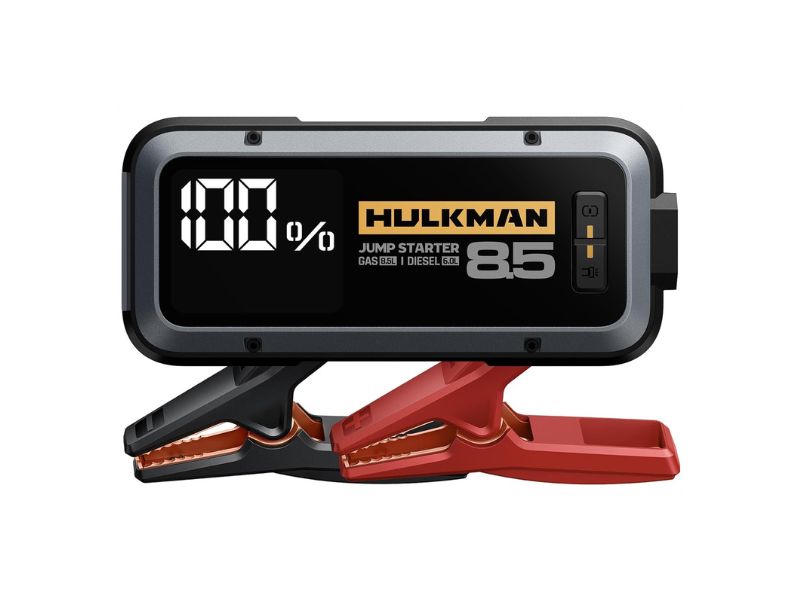
4. HULKMAN Alpha85 2000A Smart Jump Starter – Best Smart Display
Key Features
- 2,000A peak starting current
- 12V vehicle compatibility
- Gas engines up to 8.5L
- Diesel engines up to 6.0L
- 20,000mAh / 74Wh internal lithium-polymer battery
- 3.3-inch information display
- USB-C input and output
- USB-A QC output
- 12V DC accessory output
- Force Start capability
- Multiple electronic safety protections
- Approximately 2.57-pound unit weight
The HULKMAN Alpha85 is especially appealing if you want more on-device information than a row of small status LEDs.
Its 3.3-inch display provides battery level, operating information, and specific error feedback.
That can make a meaningful difference when you are using the booster under stressful roadside conditions.
For example, instead of trying to remember whether three flashing lights mean reverse polarity, low battery, excessive temperature, or another fault, a display can communicate the condition more clearly.
Starting capacity is substantial.
The Alpha85 is rated at 2,000A peak current, with compatibility for gasoline engines up to 8.5 liters and diesel engines up to 6.0 liters.
That puts it in roughly the same large-vehicle class as the NOCO GB70.
The internal battery is 20,000mAh, or about 74Wh at its native cell voltage.
That energy reserve is useful not only for starting vehicles but also for charging electronics.
USB-C and USB-A outputs allow the Alpha85 to serve as a portable power bank for phones, tablets, and other compatible equipment.
The USB-C system supports faster charging than many older micro-USB jump packs, reducing the inconvenience of restoring the booster itself after use.
A 12V DC output can power compatible automotive accessories.
The unit also includes Force Start for batteries whose voltage has fallen too low for automatic detection.
This feature deserves caution.
According to HULKMAN’s instructions, force-start operation disables automatic detection and certain safety protections. That means the operator must be absolutely certain about correct polarity and battery condition before activating it.
Do not use force output simply because the normal start sequence fails.
If a battery is cracked, frozen, swollen, leaking, internally damaged, or connected through an unknown electrical configuration, forcing current can create risk.
The Alpha85’s overall dimensions and roughly 2.57-pound weight remain reasonable given its engine ratings and battery capacity.
It is larger than ultra-compact boosters, but still much easier to store than the JNC660.
What I Like
The large status display is the standout feature.
The 20,000mAh battery, 8.5L gasoline/6.0L diesel compatibility, USB-C charging, and accessory output also make it a versatile emergency power source.
What I Do Not Like
Force Start disables important automatic protection, so it must be used carefully.
The larger battery and screen also make the Alpha85 less minimalist than small boosters designed purely for occasional starting.
Verdict
The HULKMAN Alpha85 is an excellent choice for drivers who want strong starting capacity combined with a clearer, more informative interface.
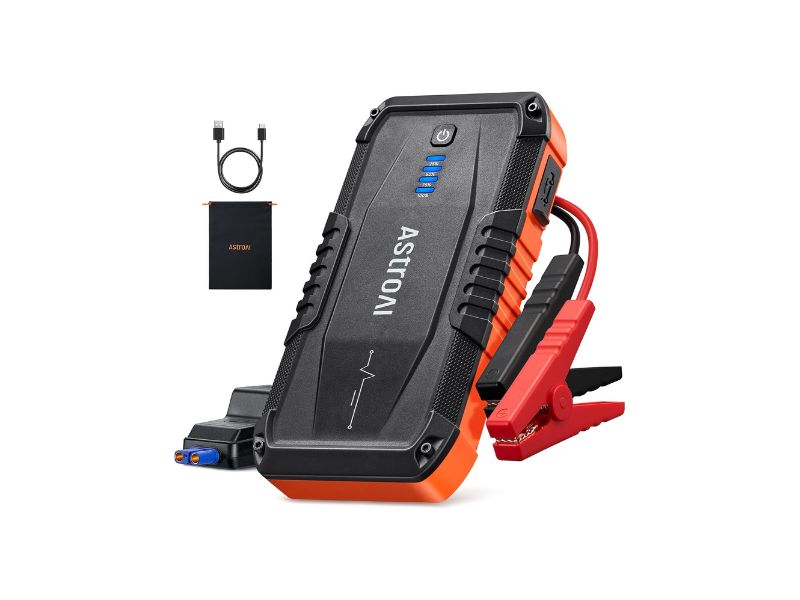
5. AstroAI S8 1500A Car Battery Jump Starter – Best Compact Value
Key Features
- 1,500A peak output
- 12V vehicle compatibility
- Gasoline engines up to 6.0L
- Diesel engines up to 3.0L
- 10,000mAh internal lithium battery
- Compact lightweight construction
- Smart jumper cables
- Boost function for deeply discharged batteries
- Multiple electrical safety protections
- Three-mode emergency flashlight
- USB power-bank capability
- Suitable for cars and motorcycles
The AstroAI S8 is a particularly good fit for buyers who want a small, straightforward battery booster for ordinary passenger vehicles without paying for the largest engine capacity available.
Its 1,500A peak rating supports gasoline engines up to 6.0 liters and diesel engines up to 3.0 liters.
That range is similar to the NOCO GB40’s engine compatibility but with a higher advertised peak figure.
As always, I would not compare the products solely by the 1,500A versus 1,000A numbers.
Peak-current testing is not necessarily standardized identically across every manufacturer. Engine-displacement rating, internal battery design, clamp construction, temperature, and real-world behavior are more useful when evaluating suitability.
The S8 uses a 10,000mAh lithium battery and is relatively lightweight.
Its compact body is useful for small cars where storage is limited.
It can sit in:
- A trunk emergency organizer
- An under-floor cargo compartment
- A roadside tool bag
- A garage drawer
- A motorcycle support kit
The smart jumper cable system includes multiple electronic protections designed to guard against connection errors, short circuits, and abnormal operating conditions.
A Boost function is available for batteries whose voltage is extremely low.
Like any override feature, this should be used only after confirming correct polarity and battery condition.
The three-mode flashlight adds ordinary lighting plus emergency signaling capability.
The internal battery can also charge compatible USB devices, making it useful during travel even when the car battery is working normally.
One limitation is the smaller energy reserve compared with models such as the HULKMAN Alpha85.
A 10,000mAh pack provides less stored energy than a 20,000mAh unit, so it is not designed for repeated heavy-duty starts or extensive accessory use.
That is not necessarily a problem for the intended buyer.
If you drive a 2.5L sedan and want a booster for occasional emergencies, you do not need a huge battery pack.
What I Like
The S8 is compact, lightweight, inexpensive relative to many larger boosters, and appropriately sized for common cars and crossovers.
Its smart clamps, low-voltage boost function, flashlight, and USB charging make it a complete basic roadside tool.
What I Do Not Like
The 10,000mAh battery provides less reserve than larger premium boosters.
It is also not intended for large-displacement diesel trucks or frequent professional use.
Verdict
The AstroAI S8 is my best compact value auto battery booster for ordinary passenger cars, motorcycles, and smaller SUVs.
Auto Battery Booster Comparison
| Product | Peak Output | Gas Engine Rating | Diesel Engine Rating | Internal Battery | Weight | Main Strength |
| NOCO Boost GB40 | 1,000A | Up to 6.0L | Up to 3.0L | 24Wh lithium-ion | 2.45 lb | Best overall balance |
| NOCO Boost GB70 | 2,000A | Up to 8.0L | Up to 6.0L | 56Wh lithium-ion | 4.18 lb | Large engines |
| Clore JNC660 | 1,700A peak / 425A cranking | Application dependent | Application dependent | 22Ah PROFORMER | 18 lb | Heavy-duty cranking |
| HULKMAN Alpha85 | 2,000A | Up to 8.5L | Up to 6.0L | 20,000mAh / 74Wh | 2.57 lb | Smart display |
| AstroAI S8 | 1,500A | Up to 6.0L | Up to 3.0L | 10,000mAh lithium | Under 2 lb class | Compact value |
Quick Comparison
The NOCO GB40 is the best fit for most passenger vehicles because it combines adequate output with compact storage and straightforward safety features.
The NOCO GB70 is the better choice for full-size pickups, large SUVs, and diesel engines.
The Clore JNC660 is much heavier but provides professional-style cables, clamps, and sustained cranking capability.
Choose the HULKMAN Alpha85 if you value a large display and high battery capacity, or the AstroAI S8 if you want a small, affordable booster for a normal car.
What Is an Auto Battery Booster?
An auto battery booster, commonly called a jump starter, jump box, battery booster pack, or portable car starter, is a self-contained source of electrical energy designed to help crank a vehicle when its starting battery cannot provide enough current.
The basic concept is simple.
Your vehicle’s starter motor requires a large burst of electrical current.
When the battery is healthy and charged, it supplies that current.
When the battery voltage or available current becomes too low, the starter may:
- Crank slowly
- Click repeatedly
- Make one click and stop
- Do nothing at all
A battery booster connects to the vehicle’s electrical system and supplies additional current during the starting attempt.
Modern lithium boosters store that energy in a compact internal battery.
Traditional jump boxes such as the JNC660 use larger lead-acid-based internal batteries.
Auto Battery Booster vs Jumper Cables
Both can start a car with a weak battery, but they work differently.
Jumper Cables
Traditional jumper cables need another vehicle with a healthy battery.
Advantages include:
- No internal battery to maintain
- Relatively inexpensive
- Can handle significant current when cables are properly sized
- Simple construction
Disadvantages include:
- Requires another vehicle
- Vehicles must be positioned close enough
- Incorrect connection can be dangerous
- Modern engine bays can make access difficult
- You depend on someone else being available
Portable Battery Booster
A portable booster contains its own power source.
Advantages include:
- No donor car required
- Works in isolated locations
- Compact lithium models are easy to store
- Smart clamps can provide electronic safety protections
- Many include USB power and emergency lights
The primary disadvantage is that you have to keep the booster itself charged.
A completely discharged jump pack is no more useful than a set of jumper cables with no second vehicle available.
Battery Booster vs Battery Charger
This is an important distinction.
A battery booster is designed to help the engine start quickly.
A battery charger restores energy to the battery over a much longer period.
A booster can potentially start an engine in seconds.
A charger may need:
- Several hours
- Overnight
- A full day
depending on charger output and battery condition.
After using a booster on a deeply discharged battery, do not assume the battery is now fully charged.
The vehicle charging system may restore some energy while driving, but a heavily depleted battery often benefits from a controlled charging cycle with a proper smart charger.
How I Chose These Auto Battery Boosters
I prioritized products that have a substantial established ownership history and real relevance to passenger-vehicle starting.
The main factors were:
- Current review volume
- 12V automotive compatibility
- Engine-size ratings
- Published starting output
- Clamp quality
- Cable design
- Reverse-polarity protection
- Spark protection
- Low-voltage starting functions
- Internal battery capacity
- Product weight
- Ease of storage
- Emergency lighting
- USB charging
- Brand support
- Suitability for repeated use
I did not rank products simply by their peak-amp number.
A booster advertising 4,000A is not automatically better than one advertising 1,000A.
Engine compatibility, cable resistance, battery chemistry, clamp contact, temperature, and product quality all influence real starting performance.
How Many Amps Does an Auto Battery Booster Need?
There is no single perfect amp rating for every vehicle.
Engine size and fuel type are more useful starting points.
Small Gasoline Cars
Compact four-cylinder engines generally require relatively modest starting current.
A quality booster in the 1,000A-class range is normally more than adequate when the manufacturer rates it for your engine.
Midsize Cars and SUVs
Many six-cylinder and smaller V8 gasoline engines still fall comfortably within the capabilities of products such as the GB40.
Large Gasoline Trucks and SUVs
This is where models such as the GB70 and Alpha85 become more attractive.
Their higher engine-size ratings provide additional reserve.
Diesel Engines
Diesels typically require substantially more cranking power because of their high compression.
Always pay attention to the diesel engine rating, not just the gasoline rating.
A unit designed for 6.0L gasoline and 3.0L diesel is not automatically appropriate for a 6.0L diesel engine.
Why Peak Amps Can Be Misleading
“Peak amps” is one of the most heavily advertised specifications in this category.
It represents the maximum short-duration current a booster is capable of producing under specified conditions.
The problem is that peak current does not tell the entire story.
Actual starting performance is influenced by:
- Internal battery chemistry
- Cell quality
- Internal resistance
- Cable gauge
- Cable length
- Clamp resistance
- Battery condition
- Starter condition
- Engine temperature
- Oil viscosity
- Cranking duration
This is why I give significant weight to published engine-size ratings and established product history rather than simply sorting by the largest amp number.
The Clore JNC660 is a good illustration.
Its 1,700A peak rating is lower than some compact lithium packs, but Clore also publishes a 425A cranking specification and equips it with #2 AWG cables designed for sustained high-current work.
Lithium vs Traditional Lead-Acid Booster
Lithium Jump Starter Advantages
Modern lithium boosters offer:
- Low weight
- Compact size
- High power-to-weight ratio
- USB power-bank functions
- Smart electronic protection
- Easy trunk storage
The GB40, GB70, Alpha85, and AstroAI S8 all use this general approach.
Lead-Acid Jump Box Advantages
Traditional boosters can offer:
- Large internal battery capacity
- Heavy cables
- Industrial clamps
- Strong sustained cranking
- Proven professional use
The JNC660 is the example in this guide.
Which Is Better?
For most drivers, lithium is more convenient.
For a shop, fleet, farm, or frequent-use environment, a high-quality traditional jump box still has major advantages.
Match the Booster to Your Largest Vehicle
If one booster will be shared among several vehicles, buy for the largest engine.
For example, imagine a household with:
- 2.0L gasoline sedan
- 3.5L gasoline SUV
- 5.7L gasoline pickup
A booster rated only for the sedan is not the best household choice.
Selecting a unit rated for the 5.7L truck allows it to cover all three.
The same principle is even more important when a diesel vehicle is involved.
Consider Cold-Weather Starting
Cold weather makes starting harder for two reasons.
First, the vehicle battery loses available output as temperature drops.
Second, the engine becomes harder to turn because oil is thicker and mechanical resistance increases.
Lithium booster batteries are also affected by extreme cold.
If you live in a region with severe winters, extra starting reserve can be valuable.
Useful winter practices include:
- Keep the booster fully charged
- Check it before the cold season
- Store it within the manufacturer’s temperature limits
- Keep battery terminals clean
- Use a larger booster when the engine is near the smaller unit’s maximum rating
Do not attempt to jump-start a frozen lead-acid battery.
A frozen or physically damaged battery can be dangerous and should be evaluated before charging or boosting.
Why Clamp Quality Matters
The clamps are the connection between the booster and the vehicle.
Poor contact creates electrical resistance.
Resistance wastes power as heat and can prevent enough current from reaching the starter.
Good clamps should have:
- Strong spring tension
- Large conductive contact surfaces
- Durable insulation
- Secure cable attachment
- Enough jaw opening for the battery terminal
Before starting, make sure the clamp teeth contact clean conductive metal rather than plastic covers, corrosion, or painted surfaces.
Why Cable Length Matters
Short cables reduce electrical resistance and allow a compact product.
Long cables improve access.
There is no perfect length for every vehicle.
Short cables work well when the battery is exposed under the hood.
Longer cables become valuable when the battery or remote jump terminals are difficult to reach.
The JNC660’s 46-inch cables are particularly useful for workshop environments because the booster can remain on the ground while the clamps reach into many engine bays.
Reverse-Polarity Protection
Reverse polarity happens when positive and negative connections are accidentally switched.
On a typical 12V system:
- Red connects to positive (+)
- Negative connection follows the vehicle and booster manufacturer’s specified procedure
Modern smart jump packs can detect incorrect polarity and prevent normal output.
This is one of the most valuable features for occasional users.
However, smart protection should not make you careless.
Always identify the correct connection points before attaching anything.
Spark-Proof Connection Technology
Lead-acid batteries can release hydrogen gas under certain conditions.
Hydrogen can ignite in the presence of a spark.
Spark-resistant or spark-proof connection technology helps reduce one potential ignition source during normal use.
You should still keep:
- Cigarettes
- Flames
- Grinding tools
- Electrical sparks
- Other ignition sources
away from batteries during starting and charging.
Low-Voltage Boost and Force Modes
Smart boosters typically look for battery voltage before enabling high-current output.
This prevents the clamps from becoming live when no battery is connected.
A problem occurs when the vehicle battery is extremely discharged.
If voltage is too low, the booster may not recognize it.
Some products therefore include:
- Manual Override
- Force Start
- Boost Mode
These allow output to be activated manually.
They should only be used after confirming:
- Battery voltage is correct
- Polarity is correct
- Battery chemistry is compatible
- Battery is not frozen
- Battery is not physically damaged
- There is no obvious electrical fault
Force modes may disable automatic safety protection.
How to Use an Auto Battery Booster Safely
Always follow the manuals for your specific vehicle and booster.
A general procedure is:
1. Turn Off the Vehicle
Switch off the ignition and nonessential electrical loads.
Turn off:
- Lights
- Climate control
- Heated seats
- Stereo
- Chargers
- Accessories
2. Inspect the Battery
Do not proceed normally if the battery is:
- Cracked
- Leaking
- Severely swollen
- Frozen
- Mechanically damaged
3. Locate the Correct Jump Points
Some cars use dedicated under-hood terminals even when the battery is located elsewhere.
Use the vehicle owner’s manual.
4. Connect Positive
Attach the positive clamp to the specified positive terminal.
5. Connect Negative
Attach the negative clamp as instructed by the vehicle and booster manufacturer.
On some vehicles, a designated chassis ground is preferred rather than the battery negative post.
6. Confirm the Booster Status
Smart boosters should indicate whether the connection is correct.
Do not ignore a warning indicator.
7. Attempt to Start the Engine
Crank only for the duration permitted by the booster manufacturer.
Do not hold the starter continuously for an extended period.
8. Allow the Booster to Rest if Required
Repeated cranking can heat the booster, cables, clamps, and starter motor.
Follow specified rest intervals.
9. Disconnect Properly
Once the engine starts, remove the booster using the specified sequence.
10. Recharge the Booster
Do not return a partially discharged jump pack to long-term storage.
Recharge it so it is ready for the next emergency.
What If the Engine Still Does Not Start?
A weak battery is only one cause of a no-start condition.
If the starter cranks normally but the engine will not fire, adding more battery booster power is unlikely to solve the problem.
Other possibilities include:
- Fuel-delivery failure
- Ignition problem
- Failed starter
- Blown fuse
- Security-system problem
- Defective crank sensor
- Mechanical engine problem
- Severely corroded cables
- Failed battery connection
If the starter only clicks even with a properly connected, fully charged booster, inspect the electrical system rather than repeatedly forcing more starting attempts.
What to Do After the Vehicle Starts
Do not assume the battery is healthy just because the engine starts.
A battery may have gone dead because:
- Lights were left on
- The vehicle sat too long
- The battery is old
- The alternator is failing
- There is a parasitic electrical drain
- Battery terminals are corroded
- A door or trunk remained open
After getting the vehicle running, determine the cause.
A deeply discharged battery should ideally receive a complete controlled recharge with a compatible smart charger.
Short drives are not always enough to restore a heavily depleted battery.
How Often Should You Recharge the Booster?
Check the internal battery periodically.
A practical schedule includes:
- Before winter
- Before long road trips
- After every jump start
- After using USB power
- Every few months during storage
- Before hurricane or severe-weather season
Follow the manufacturer’s storage and charging recommendations for your exact product.
Where Should You Keep an Auto Battery Booster?
A good storage location should be:
- Dry
- Secure
- Easy to access
- Protected from loose metal objects
- Away from liquids
- Away from extreme engine-bay heat
- Within the manufacturer’s temperature range
A protective case is useful.
Do not throw the jump starter loose in a trunk where tools, tire irons, or cargo can damage the unit or connectors.
Is It Safe to Leave a Lithium Booster in the Car?
Generally, these products are intended to be portable automotive equipment, but storage temperature still matters.
Vehicle interiors can become extremely hot in summer.
Lithium batteries also produce less power when extremely cold.
Check the manufacturer’s published storage range.
If temperatures in your vehicle routinely exceed those limits, move the booster to a more appropriate location.
Can an Auto Battery Booster Charge the Battery?
Usually, no.
A standard jump starter provides high current briefly to crank the engine.
That is not the same as completing a multi-stage battery charging process.
A proper charger gradually restores the battery and controls:
- Charging current
- Charging voltage
- Absorption
- Float maintenance
- Temperature compensation on some models
Think of the booster as the emergency way to start the vehicle, not the normal way to restore battery capacity.
Can a Booster Start a Completely Dead Battery?
Possibly, depending on what “completely dead” means.
A battery can be:
- Deeply discharged
- Internally shorted
- Sulfated
- Physically damaged
- Frozen
- Unable to hold voltage
A booster may start a vehicle when the battery is merely deeply discharged.
It cannot safely compensate for every type of battery failure.
If a battery reads extremely low voltage, inspect its condition before using manual override.
How Many Jump Starts Can You Get Per Charge?
There is no universal number.
Manufacturers may advertise 20, 30, or 40 starts, but actual results depend heavily on the situation.
Factors include:
- Engine displacement
- Gas vs diesel
- Ambient temperature
- Vehicle-battery condition
- Starter condition
- Booster state of charge
- Length of each cranking attempt
A small gasoline engine with a moderately weak battery may consume very little booster energy.
A large cold diesel engine with a nearly flat battery can consume dramatically more.
Treat published counts as favorable-condition estimates.
Battery Booster for a Gasoline Car
For most gasoline passenger cars, the GB40 or AstroAI S8 provides a practical balance.
Their 6.0L gasoline rating covers engines much larger than the typical 1.5L–3.5L engines found in many sedans and crossovers.
That gives the booster useful reserve without requiring a heavy pack.
Battery Booster for a Truck
Truck selection depends heavily on engine type.
For gasoline pickups, the GB70 or HULKMAN Alpha85 offers useful extra reserve.
For large diesels, verify engine displacement carefully.
A 6.7L diesel, for example, exceeds the published 6.0L diesel rating of the GB70 and Alpha85.
In that situation, select a booster specifically rated for the engine rather than assuming a 2,000A headline number is enough.
Auto Battery Booster for an SUV
Most compact and midsize gasoline SUVs fall comfortably within the GB40’s rating.
Large V8 SUVs or diesel SUVs benefit from moving up to the GB70 or Alpha85.
If you plan to use the same booster for an SUV and a full-size pickup, buy according to the pickup’s requirements.
Auto Battery Booster for a Motorcycle
Motorcycles generally require far less starting current than cars.
A small lithium booster can be extremely useful because motorcycles are often stored seasonally and may develop weak batteries after long periods of inactivity.
Be especially careful to confirm that the motorcycle uses a compatible 12V starting system.
Do not connect a 12V booster to a 6V system.
Can You Use an Auto Booster on AGM Batteries?
A jump starter can generally assist a compatible 12V starting system using an AGM battery because it is supporting the electrical system during cranking rather than performing a full charging cycle.
However, always follow the booster, battery, and vehicle manufacturer’s instructions.
Charging chemistry becomes even more important when using a battery charger afterward.
What About Lithium Starting Batteries?
Lithium starting batteries can have specialized Battery Management Systems (BMS) and different recovery requirements.
Do not assume a booster designed around conventional 12V lead-acid systems should automatically be used with every lithium vehicle battery.
Check the lithium battery manufacturer’s instructions.
This is particularly important when the BMS has disconnected the battery because of low voltage or another protection event.
Common Auto Battery Booster Mistakes
Buying Only by Peak Amps
Do not automatically choose the largest number on the package.
Engine-size rating and product quality matter more.
Forgetting to Recharge the Booster
This is probably the easiest mistake to prevent.
A booster cannot help when its internal battery is empty.
Ignoring the Diesel Rating
Gasoline and diesel ratings are not interchangeable.
Using Force Mode Without Checking Polarity
Manual override can disable automatic protections.
Verify everything first.
Repeatedly Boosting a Failing Battery
If the battery needs a jump every morning, the underlying problem needs attention.
Leaving the Unit Exposed to Extreme Heat
High temperatures accelerate battery aging.
Treating a Jump Starter Like a Battery Charger
Starting the engine and fully recharging the battery are different tasks.
Frequently Asked Questions
What is the best auto battery booster?
The NOCO GB40 is my top overall recommendation for most passenger vehicles.
Its 1,000A peak rating supports gasoline engines up to 6.0L and diesel engines up to 3.0L, while its compact size, spark-proof system, reverse-polarity protection, IP65 housing, flashlight, and USB charging make it easy to keep in a normal vehicle.
What size battery booster do I need for my car?
Choose a booster whose engine-size rating comfortably covers your vehicle’s engine.
A normal four-cylinder gasoline car usually does not require an enormous booster. Large V8 engines and diesel trucks need more starting reserve. Always check the gasoline or diesel rating separately.
Is a 1000A battery booster enough for a car?
Yes, a quality 1,000A-class booster can handle many passenger vehicles.
The NOCO GB40 is rated for gasoline engines up to 6.0L and diesel engines up to 3.0L, which covers a broad range of cars and smaller trucks.
Is a 2000A booster better?
It provides additional reserve and broader engine compatibility, but it is not necessary for every car.
A 2,000A model such as the GB70 or Alpha85 makes more sense for larger SUVs, pickup trucks, vans, and diesel applications.
Can too powerful a jump starter damage a car?
A properly designed 12V booster does not simply force its full peak rating into the starter.
The electrical system draws current according to demand. Correct voltage, polarity, connection points, and operating procedure are more important than buying a booster with some extra capacity.
Is the NOCO GB40 good for a dead battery?
Yes, when the vehicle and battery are within its specified 12V operating range.
For extremely low-voltage batteries, Manual Override may be available, but it should only be used after verifying polarity and battery condition.
Which is better, GB40 or GB70?
GB40 is better for compact everyday portability, while GB70 is better for larger engines.
GB40 supports up to 6.0L gas and 3.0L diesel. GB70 increases that to 8.0L gasoline and 6.0L diesel and contains a larger internal battery.
Is the JNC660 better than a lithium jump starter?
It is better for some heavy-duty uses but less convenient for normal trunk storage.
The JNC660 provides heavy #2 AWG cables, 425 cranking amps, and an industrial-style internal battery. Lithium models are dramatically lighter and smaller.
How long does an auto battery booster hold a charge?
It varies by battery chemistry, temperature, age, and internal electronics.
Do not rely on a fixed number of months. Check the state of charge periodically and before long trips or severe-weather seasons.
Can I leave my battery booster in the trunk?
Usually yes, provided storage temperatures remain within the manufacturer’s limits.
Protect the booster from liquids, crushing, direct sun, and loose metal objects.
Can a battery booster recharge my car battery?
A typical booster does not fully recharge a deeply discharged automotive battery.
It provides enough current to help start the engine. Use a proper battery charger afterward when a complete recharge is needed.
Does driving after a jump fully charge the battery?
Not necessarily.
A short trip may restore only part of the energy removed from the battery. Alternator output, battery size, electrical load, temperature, and discharge depth all affect recovery.
Why does my car battery keep dying?
Common causes include an old battery, parasitic drain, alternator failure, lights left on, or poor electrical connections.
Repeatedly using a booster treats the symptom rather than fixing the underlying fault.
Can I boost a frozen car battery?
No. A suspected frozen or physically damaged lead-acid battery should not be jump-started normally.
Freezing can damage the battery case and create serious safety risks.
What does reverse polarity mean?
Reverse polarity means the positive and negative connections have been attached incorrectly.
Smart boosters can detect this condition and prevent normal output. Disconnect the clamps and correct the connection before proceeding.
What is manual override on a jump starter?
Manual override activates output when the vehicle battery voltage is too low for automatic detection.
Because this can bypass safety features, it should only be used after carefully verifying voltage, polarity, and battery condition.
How many times can a booster start a car?
The number varies greatly based on engine size, battery condition, temperature, and booster capacity.
Published estimates are best treated as favorable-condition figures rather than guaranteed numbers for every vehicle.
Do I need jumper cables if I have a battery booster?
A booster can replace jumper cables for many emergencies, but carrying cables adds useful redundancy.
Jumper cables do not have an internal battery that can discharge during storage, although they require another vehicle.
Should I buy a booster with USB charging?
USB charging is useful but should remain a secondary buying factor.
Starting capability, vehicle compatibility, clamps, and safety protections are more important. USB power is valuable for keeping a phone charged during an emergency.
How often should I replace an auto battery booster?
Replace it when its internal battery no longer holds sufficient charge or the cables, clamps, enclosure, or electronics become damaged.
Lithium cells naturally lose capacity with age and charge cycles, so periodic testing is worthwhile.
Conclusion
Choosing the best auto battery booster is less about buying the largest advertised peak-amp number and more about matching a reliable product to your engine, climate, storage needs, and expected frequency of use.
The NOCO Boost GB40 remains my primary recommendation for most drivers. Its 1,000A output, 6.0L gasoline and 3.0L diesel ratings, compact 2.45-pound construction, reverse-polarity protection, spark-proof connections, IP65 enclosure, flashlight, and USB power capability make it a well-balanced emergency tool for passenger vehicles.
Drivers with larger engines should move to the NOCO Boost GB70. Its 2,000A output, 8.0L gasoline and 6.0L diesel compatibility, larger internal battery, brighter flashlight, and accessory-power capability provide additional reserve without moving all the way to a traditional heavy jump box.
The Clore Jump-N-Carry JNC660 is the best fit for garages, farms, fleets, workshops, and frequent use. Its 425 cranking amps, long #2 AWG cables, industrial clamps, and substantial internal battery prioritize repeated heavy-duty performance.
The HULKMAN Alpha85 is a strong modern alternative for drivers who want high engine compatibility with a large information display and 20,000mAh power bank, while the AstroAI S8 provides excellent compact value for ordinary cars and smaller SUVs.
For most sedans, crossovers, and light-duty vehicles, I would start with the NOCO GB40. It provides the strongest overall balance of portability, safety, established performance, and practical starting power.