Yes, you can use Windex on automotive window tint, but Windex Ammonia-Free Glass Cleaner is the safer general choice. Standard Windex Original contains ammonia, which some window film manufacturers advise against using. However, certain high-quality automotive films are compatible with ammonia-based cleaners after the adhesive has fully cured.
Cleaning tinted car windows requires more care than cleaning ordinary glass because most aftermarket tint is a thin film bonded to the inside of the window. Using an unsuitable cleaner, abrasive cloth, or excessive pressure can damage the film or its protective coating.
The age of the tint also matters. Newly installed window film needs time to cure, and cleaning it too soon may interfere with that process.
Fortunately, keeping tinted windows clean doesn’t require expensive products. A compatible ammonia-free cleaner and a clean microfiber cloth are usually sufficient.
In this article, I explain which Windex formulas are suitable for tinted windows, how ammonia can affect different films, and when newly installed tint can be cleaned. I also cover a safe cleaning method, alternative cleaners, common mistakes, and what to do if you’ve already used regular Windex on your car’s tint.
Can You Use Windex on Window Tint Safely?
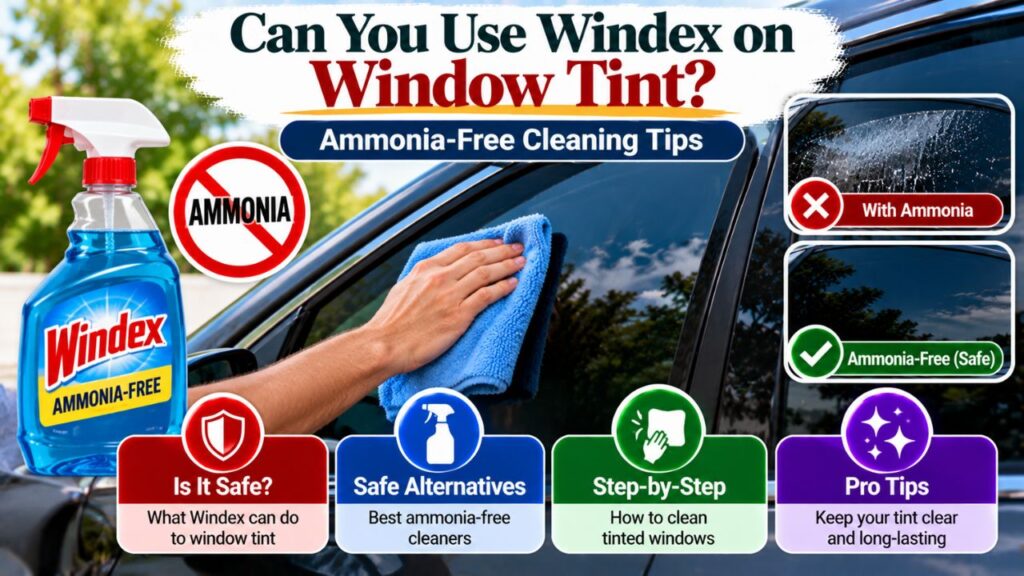
You can use certain Windex products on tinted windows, but the answer depends on the cleaner’s formulation and the type of window film installed.
Windex Ammonia-Free Glass Cleaner is specifically marketed for use on tinted automotive windows. Windex Original, on the other hand, contains ammonia and is not the preferred general-purpose option for unknown aftermarket window films.
According to Windex’s official Ammonia-Free Glass Cleaner information, the product is suitable for tinted car windows. The manufacturer also recommends testing it on a small, inconspicuous area because window tint quality varies.
Windex Products and Window Tint Compatibility
| Windex Product | Contains Ammonia? | Recommendation for Aftermarket Tint |
| Windex Original Glass Cleaner | Yes | Avoid unless the film manufacturer permits it |
| Windex Ammonia-Free Glass Cleaner | No | Generally suitable for compatible, cured tint |
| Windex Vinegar Glass Cleaner | No | Check film compatibility before use |
| Windex Foaming Glass Cleaner with Ammonia-D | Yes | Not a general tint-safe choice |
| Other Windex sprays or wipes | Varies | Check the exact formulation and film instructions |
A product’s brand name alone doesn’t determine whether it is safe for tinted windows.
Always read the label and check the film manufacturer’s maintenance instructions.
Why Ammonia-Free Windex Is Usually Preferred
Ammonia-free cleaners avoid an ingredient that can be incompatible with certain tint films, adhesives, or protective coatings.
They are generally suitable for routine cleaning when the manufacturer approves them.
Advantages include:
- Lower risk of chemical incompatibility with sensitive films.
- Effective removal of fingerprints and light dirt.
- Compatibility with many aftermarket automotive tints.
- Convenient cleaning with microfiber cloths.
- No need for ammonia-based cleaning ingredients.
However, ammonia-free does not automatically mean every formula is safe for every tint.
The cleaner must also be compatible with the film’s surface coating and adhesive system.
Key Takeaway: For automotive tint with an unknown brand or maintenance history, choose Windex Ammonia-Free rather than standard Windex Original.
Does Regular Windex Damage Window Tint?
Regular Windex Original contains ammonia, but that doesn’t mean a single application will automatically ruin every type of window tint.
The effect depends on the film’s materials, age, protective coating, exposure time, and manufacturer specifications.
How Ammonia Can Affect Window Film
Ammonia is an alkaline cleaning ingredient used to help remove grease and other residues.
Some aftermarket window films and coatings may be sensitive to repeated exposure to ammonia-based cleaning solutions.
Potential problems with incompatible products include:
- Deterioration of sensitive surface coatings.
- Changes in film appearance.
- Damage associated with unsuitable chemical exposure.
- Possible effects on adhesive or film durability.
- Increased difficulty maintaining a clear, uniform finish.
These problems are not guaranteed to occur with every film.
Window tint products use different polyester layers, coatings, adhesives, and manufacturing technologies.
Some are more chemically resistant than others.
Can Windex Original Be Safe for Certain Window Films?
Yes.
This is an important exception to the general recommendation to avoid ammonia.
According to 3M’s official automotive window film care instructions, its automotive films may be cleaned after 30 days using normal household cleaning solutions, including ammonia-based products such as Windex, along with a soft, lint-free cloth.
This demonstrates why a blanket claim that ammonia instantly destroys all tint is inaccurate.
However, 3M’s instructions should not be applied automatically to films made by other manufacturers.
If you don’t know which window film was installed, ammonia-free cleaner remains the more cautious choice.
Can Regular Windex Cause Tint to Bubble?
An incompatible cleaning solution may contribute to film deterioration, but bubbling has several possible causes.
Common causes include:
- Poor installation.
- Adhesive failure.
- Contamination beneath the film.
- Aging materials.
- Excessive heat exposure.
- Inappropriate cleaning products.
If bubbles appear after using Windex, that timing alone does not prove ammonia caused the problem.
Persistent bubbles or peeling edges should be inspected by a professional tint installer.
Is Windex Ammonia-Free Safe for Ceramic Window Tint?
Yes, Windex Ammonia-Free is generally suitable for many cured ceramic automotive films when the film manufacturer’s instructions allow it.
Ceramic tint contains specialized materials designed to manage infrared solar energy.
However, ceramic film still relies on a layered construction and adhesive system.
The ceramic technology does not make the film immune to chemical or mechanical damage.
Does Ceramic Tint Need Special Cleaner?
Not necessarily.
Many ceramic films can be cleaned using compatible ammonia-free automotive glass cleaners.
The safest approach is to follow the specific manufacturer and installer recommendations.
A gentle cleaning routine is usually more important than purchasing a product marketed exclusively for ceramic tint.
Can You Use Regular Windex on Ceramic Tint?
Possibly, but only if the ceramic film manufacturer explicitly permits ammonia-based cleaners.
Some films tolerate them, while others have more restrictive care instructions.
If you don’t know the installed product, avoid standard Windex Original.
Use an appropriate ammonia-free cleaner and a soft microfiber cloth instead.
Does Windex Remove Ceramic Tint’s Heat Protection?
A compatible cleaner used according to the manufacturer’s directions should not remove the infrared-control technology from a properly cured ceramic film.
However, harsh cleaning methods can damage the film’s surface or other layers.
Avoid abrasive pads, sharp tools, and unapproved chemicals.
If the film develops permanent scratches or peeling, cleaning cannot restore its original condition.
How Long Should You Wait Before Using Windex on New Tint?
Newly installed window tint requires time for moisture to leave the adhesive system and for the film to settle properly against the glass.
The required curing period depends on the product, installation conditions, and manufacturer’s instructions.
Can You Clean Freshly Tinted Windows?
You should generally avoid cleaning newly installed window film until the installer or film manufacturer says it is ready.
For example, 3M specifies waiting 30 days before cleaning its automotive window films with normal household cleaning solutions.
Other manufacturers may provide different waiting periods.
Do not assume a tint is fully cured simply because the surface feels dry.
Why New Tint Needs Time to Cure
During installation, a liquid solution helps position the film against the glass.
Some moisture can remain between the film and glass afterward.
Over time, the moisture dissipates and the adhesive establishes its intended bond.
Curing conditions depend on factors such as:
- Ambient temperature.
- Humidity.
- Film construction.
- Glass characteristics.
- Sun exposure.
- Installation technique.
Cool or humid conditions may prolong the process.
Can Windex Damage Tint During Curing?
Cleaning uncured film can create problems if the process involves pressure, excess moisture, or chemicals incompatible with the film.
Rubbing near the edges may also interfere with a newly installed film that has not fully settled.
Even an ammonia-free cleaner should not be used before the recommended cleaning period.
Follow the film manufacturer’s instructions rather than relying on a universal waiting time.
How to Clean Tinted Car Windows With Windex Ammonia-Free
Once the film is properly cured, cleaning tinted windows is relatively straightforward.
The goal is to remove dirt without scratching the film or applying unnecessary pressure.
Step 1: Park the Vehicle in the Shade
Choose a shaded location where the glass is cool.
Cleaning very hot glass can cause the solution to evaporate quickly, increasing the likelihood of streaks.
Avoid cleaning immediately after the vehicle has been parked in intense sunlight.
A shaded garage or covered parking area is usually convenient.
Step 2: Choose a Clean Microfiber Cloth
Use a clean, soft microfiber cloth intended for glass or automotive detailing.
Inspect it for grit, sand, or other particles before use.
Dirt trapped in a cloth can scratch film surfaces.
Avoid rough shop towels, abrasive pads, and dirty cleaning rags.
Use a separate microfiber cloth for drying.
Step 3: Apply a Small Amount of Cleaner
Spray a modest amount of compatible ammonia-free cleaner onto the microfiber cloth.
Applying the cleaner to the cloth rather than directly onto the window helps control overspray.
This is particularly useful around:
- Window edges.
- Door trim.
- Electrical components.
- Rear defroster connections.
- Dashboard materials.
Avoid soaking the film or allowing excessive liquid to collect around its edges.
Step 4: Wipe the Tinted Glass Gently
Wipe the glass using light pressure.
Use smooth, overlapping strokes to remove fingerprints, dust, and light residue.
Do not scrub aggressively.
For stubborn contamination, allow a small amount of compatible cleaner to soften the material before wiping.
Avoid scraping with metal blades or other sharp objects.
Step 5: Dry With a Second Microfiber Cloth
Use a clean, dry microfiber cloth to remove remaining moisture.
A light final wipe can help prevent streaking.
Inspect the window from different angles.
If residue remains, repeat the gentle cleaning process rather than increasing pressure.
Step 6: Inspect the Film Edges
After cleaning, check the film’s edges for lifting or peeling.
If an edge is already loose, avoid rubbing against it.
Cleaning cannot reliably repair an adhesive bond that has begun to fail.
Contact the installer if you notice persistent lifting, bubbles, or other deterioration.
What Can You Use Instead of Windex on Window Tint?
Several alternatives can clean tinted automotive windows.
Choose products compatible with the specific film rather than relying only on general household cleaning claims.
Ammonia-Free Automotive Glass Cleaner
A purpose-made automotive glass cleaner labeled safe for aftermarket tint is a practical alternative.
Look for products that are:
- Specifically suitable for window film.
- Nonabrasive.
- Compatible with the film manufacturer’s requirements.
- Appropriate for interior automotive surfaces.
Not every automotive cleaner is automatically safe for every coating, so check the instructions.
Water and a Microfiber Cloth
For light dust or fresh fingerprints, clean water and a microfiber cloth may be sufficient.
Use a lightly dampened cloth rather than soaking the window.
Dry the surface with a second cloth.
This approach minimizes chemical exposure, although it may not remove oily fingerprints as effectively as a suitable glass cleaner.
Mild Soap and Water
Some window film manufacturers permit a small amount of mild soap mixed with water.
However, the soap must be compatible with the film.
Avoid highly concentrated detergents and products containing abrasive ingredients.
Some dish soaps contain fragrances or additives that may leave streaks or residues.
If the manufacturer provides a specific cleaning solution recommendation, use it.
Can You Use Vinegar on Tinted Windows?
Vinegar contains acetic acid and is used in certain household glass cleaners.
However, its suitability for automotive tint depends on the film’s chemical resistance and maintenance instructions.
Do not assume that homemade vinegar mixtures are universally safe simply because they contain no ammonia.
For unknown aftermarket tint, a product explicitly labeled safe for window film is the more dependable option.
Cleaner Comparison
| Cleaner | General Recommendation |
| Windex Ammonia-Free | Suitable for many cured automotive films |
| Tint-safe automotive glass cleaner | Good routine choice |
| Clean water and microfiber | Useful for light cleaning |
| Manufacturer-approved mild soap solution | Suitable when specified |
| Windex Original | Use only when film manufacturer permits |
| Household vinegar mixture | Check compatibility first |
| Abrasive household cleaner | Avoid |
| Acetone or strong solvents | Avoid unless specifically approved |
What Happens if You Already Used Regular Windex on Tint?
If you’ve accidentally cleaned your tinted car windows with standard Windex, it does not automatically mean the film has been damaged.
One brief application is different from repeated chemical exposure over time.
The appropriate response depends on whether the film appears affected.
Step 1: Stop Using the Product Until Compatibility Is Confirmed
Check the Windex bottle to identify the exact formula.
If it contains ammonia and you don’t know whether your film permits it, avoid using it again until the manufacturer’s instructions are verified.
You do not need to assume the tint is permanently damaged.
Step 2: Remove Remaining Cleaner Gently
If the tint is fully cured and there is still cleaner residue on the surface, wipe it gently with a clean microfiber cloth lightly dampened with water.
Avoid soaking the film or rubbing aggressively.
Dry with another clean cloth.
If the film is newly installed, contact the installer before attempting additional cleaning.
Step 3: Inspect the Film
Look for changes such as:
- Persistent haziness.
- Discoloration.
- Peeling edges.
- New bubbles.
- Surface scratches.
- Unusual patches or distortion.
A film that remains clear and securely attached after one cleaning may show no apparent damage.
However, some defects become noticeable only over time.
Step 4: Contact the Installer if Problems Appear
If the film starts peeling, bubbling, or developing unusual discoloration, consult the installer.
The problem may relate to the cleaner, the film’s age, installation quality, or another cause.
A professional can help determine whether the film needs replacement.
Do not attempt to repair failing tint with adhesives, heat guns, or additional cleaning chemicals.
Can You Use Windex on Factory-Tinted Car Windows?
Factory-tinted automotive glass is different from aftermarket window film.
Many vehicles have factory privacy glass, particularly on rear passenger and cargo windows.
The darkness may be incorporated into the glass itself rather than produced by an adhesive film.
Factory Tint vs. Aftermarket Film
| Feature | Factory Privacy Glass | Aftermarket Window Tint |
| How darkness is produced | Often incorporated into glass | Applied film |
| Separate adhesive layer | Not necessarily | Yes |
| Film edges | Typically absent | May be visible |
| Susceptibility to film peeling | Not applicable without film | Possible |
| Cleaning requirements | Depend on glass and coatings | Depend on film manufacturer |
Ordinary factory-tinted glass without aftermarket film or special coatings generally does not have the same adhesive-film concerns.
However, modern automotive glass may have additional coatings or surface treatments.
Check the vehicle manufacturer’s instructions before using strong or specialized cleaning products.
What if Factory-Tinted Windows Have Additional Film?
If aftermarket film has been installed over factory privacy glass, treat the window as film-tinted glass.
Use the maintenance instructions for the applied film.
The presence of factory tint does not make the aftermarket film resistant to otherwise unsuitable cleaners.
Mistakes to Avoid When Cleaning Tinted Car Windows
Using a suitable product is only part of protecting automotive window film.
Cleaning technique also affects long-term appearance.
Using Ammonia Without Checking Film Compatibility
Some manufacturers permit ammonia-based cleaners after curing, while others advise against them.
Avoid assuming every film reacts the same way.
When the film type is unknown, choose ammonia-free cleaner.
Cleaning Before the Tint Has Cured
New film needs time to settle.
Cleaning too early may interfere with the installation or damage sensitive edges.
Follow the installer’s waiting period before wiping the film.
Using Abrasive Towels or Scrubbers
Abrasive materials can scratch the protective surface.
Avoid scouring pads, rough sponges, and cleaning tools containing grit.
A clean microfiber cloth is usually a better choice.
Scraping Dirt With a Razor Blade
Razor blades may scratch or cut aftermarket window film.
They are particularly unsuitable for removing adhesive or stubborn residue from the tinted interior surface.
For difficult stains, contact a tint installer instead of using a sharp scraper.
Spraying Too Much Cleaner
Excess liquid can collect around film edges and interior components.
Spray a small amount onto the cloth when practical.
Avoid oversaturating the window.
Cleaning in Direct Sunlight
Hot glass can cause cleaning solutions to evaporate before they are wiped away.
This may leave visible streaks or residue.
Clean in the shade whenever possible.
Confusing Dirty Glass With Damaged Tint
Streaks and fingerprints can usually be removed with compatible cleaning products.
Peeling, permanent discoloration, and adhesive bubbles are different problems.
Repeated cleaning will not repair physically damaged window film.
How Often Should You Clean Tinted Car Windows?
Clean tinted windows as needed rather than following a rigid schedule.
The frequency depends on driving conditions, passenger use, dust exposure, and how quickly fingerprints accumulate.
A vehicle used daily may need more frequent cleaning than one driven occasionally.
Routine Cleaning
For ordinary dust and fingerprints:
- Use a clean microfiber cloth.
- Apply a small amount of compatible cleaner.
- Wipe gently.
- Dry the glass to prevent streaks.
There is no need to use strong cleaning chemicals for light dirt.
Removing Stubborn Residue
For oily fingerprints or other stubborn deposits, use an approved tint-safe cleaner.
Allow the solution to loosen residue without excessive scrubbing.
Avoid letting the cleaner dry on the glass.
If residue cannot be removed safely, ask a professional installer for guidance.
Protecting Tint for Long-Term Use
Good maintenance includes more than cleaning.
Avoid sharp objects near the film, minimize unnecessary rubbing, and follow the manufacturer’s care requirements.
Check window edges occasionally for lifting or damage.
High-quality window film can remain serviceable for years, but service life depends on material quality, installation, exposure, and maintenance.
Conclusion
So, can you use Windex on window tint? Yes, but the safest general recommendation is to use Windex Ammonia-Free Glass Cleaner on compatible, fully cured automotive window film.
Standard Windex Original contains ammonia and should not be the default choice for unknown aftermarket tint.
However, some manufacturers, including 3M, explicitly permit ammonia-based cleaning products after the specified curing period.
The most important factors are the exact film, cleaner formulation, curing time, and cleaning method.
Use a soft microfiber cloth, apply gentle pressure, and avoid abrasive tools or unapproved chemicals.
If you have already used regular Windex once, inspect the film rather than assuming it is ruined.
Following the tint manufacturer’s instructions is the most reliable way to keep your windows clean without unnecessarily risking film damage.
FAQs About Can You Use Windex on Window Tint
Is Blue Windex Safe for Tinted Car Windows?
Traditional blue Windex Original contains ammonia and is not the preferred general cleaner for unknown aftermarket tint.
Some film manufacturers allow ammonia-based products after curing, but others may not.
Use Windex Ammonia-Free unless the specific film manufacturer’s instructions permit Original.
Will Windex Remove Window Tint?
Ordinary cleaning with Windex does not automatically remove window tint.
However, unsuitable chemicals or aggressive cleaning may damage sensitive films or contribute to deterioration.
Removing tint properly usually requires a dedicated process that separates the film and adhesive from the glass.
Can You Use Windex on Newly Tinted Windows?
Only after the film has reached the manufacturer’s recommended cleaning time.
For example, 3M specifies waiting 30 days before cleaning its automotive films with household cleaning solutions.
Other films may have different curing requirements.
Follow the installer or manufacturer rather than using one waiting period for every tint.
Is Windex Ammonia-Free Safe for All Window Tint?
Windex Ammonia-Free is designed for tinted automotive glass and is suitable for many films.
However, not every aftermarket tint has identical chemical resistance or protective coatings.
Check the film’s instructions and test the cleaner on a small, inconspicuous area when appropriate.
Can You Use Windex on the Outside of Tinted Windows?
Yes, in most conventional aftermarket tint installations, the film is applied to the inside of the glass.
Cleaning the outside surface with a glass-compatible product generally does not contact the interior tint film.
However, avoid overspray onto exposed film edges or sensitive coatings, and follow the vehicle and glass manufacturers’ cleaning instructions.