A 110-volt tire inflator is especially convenient when you want to maintain tire pressure in your garage without starting the vehicle or relying on a battery. Most models sold for U.S. household outlets are technically rated for 110–120V AC, and several also include 12V DC power for roadside use.
My first choice is the AVID POWER Tire Inflator Portable Air Compressor. Its combination of household AC power, 12V vehicle power, dual inflation systems, automatic shutoff, and digital pressure controls makes it one of the most versatile options for home tire maintenance.
The TEROMAS Tire Inflator Portable Air Compressor is another strong choice if portability matters more. It is smaller and lighter while still providing both 110V AC and 12V DC operation, a digital gauge, preset pressure, and automatic shutoff.
I also like the AstroAI AC/DC Dual Motor Tire Inflator for buyers who want stronger multi-purpose performance. Its dual-motor system combines high-pressure tire inflation with a separate high-volume mode for mattresses, rafts, and similar inflatables.
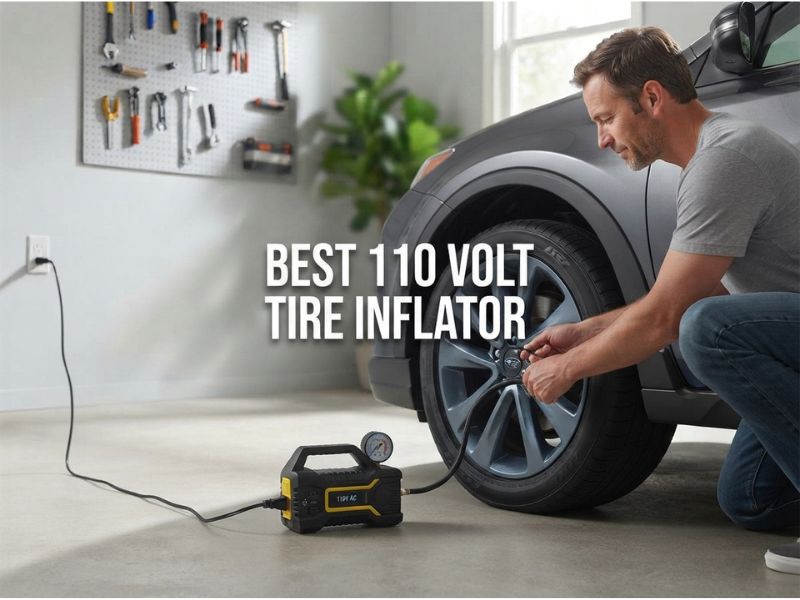
5 Best 110 Volt Tire Inflator
| Image | Product Name | Check Price |
|---|---|---|
Best Choice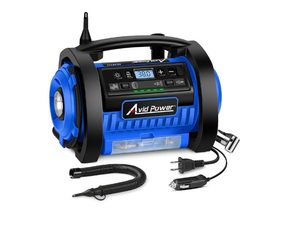 | AVID POWER AC/DC Portable Tire Inflator | Check Price |
Second Best | TEROMAS Tire Inflator Portable Air Compressor | Check Price |
Third Choice | AstroAI AC/DC Dual Motor Tire Inflator | Check Price |
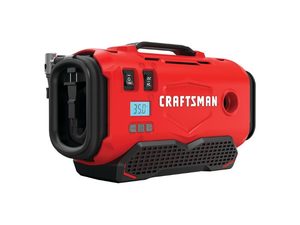 | CRAFTSMAN V20 CMCE520B Tire Inflator | Check Price |
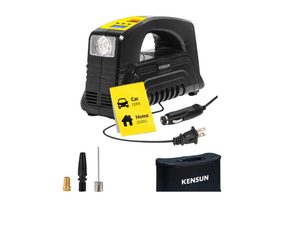 | Kensun AC/DC Digital Tire Inflator | Check Price |
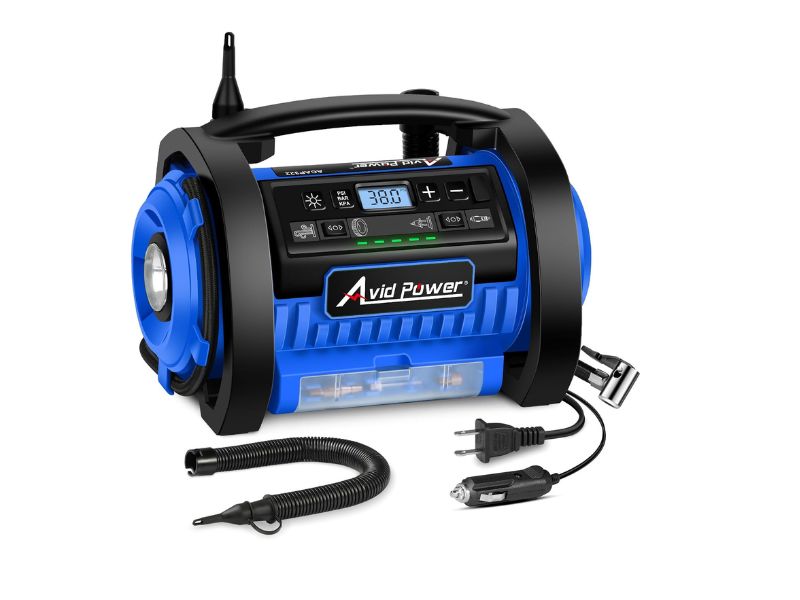
1. AVID POWER AC/DC Portable Tire Inflator – Best Overall
Key Features
- 110/120V AC household power
- 12V DC vehicle power
- Up to 125 PSI
- Approximately 30 L/min airflow
- Dual motor system
- High-pressure tire inflation
- High-volume inflation and deflation
- Digital pressure gauge
- Automatic shutoff
- PSI, BAR, and KPA pressure units
- Integrated LED light
- Long AC and DC power cords
Detailed Review
The AVID POWER is my top recommendation because it offers almost everything I expect from a good home and roadside tire inflator without forcing you into a single power source.
At home, you can plug it directly into a normal household outlet. That is the biggest reason to consider a 110V tire inflator in the first place. You do not need to turn on your vehicle or run a 12V cable through an open door simply to correct tire pressure in your driveway.
When traveling, the same inflator can operate through a 12V vehicle outlet, giving it considerably more emergency usefulness than an AC-only compressor.
The dual-hose system also makes the AVID POWER more versatile than a conventional tire pump.
Its high-pressure side handles tires, sports balls, and other items requiring relatively high pressure. A separate high-volume hose is designed for larger low-pressure inflatables such as mattresses, pool toys, and rafts.
The high-volume section can also remove air, which makes packing inflatable camping equipment considerably easier.
For vehicle tires, the digital control panel is the more important feature. You can choose a pressure unit and set the required pressure before inflation begins.
Once the target is reached, the automatic shutoff system stops inflation. That reduces the amount of bending, checking, restarting, and rechecking required with an old analog compressor.
The ACAP322 platform is rated to a maximum of approximately 125 PSI, although maximum appropriate pressure depends on the object being inflated. Ordinary passenger-car tires normally require only a fraction of that pressure.
The roughly 30 L/min airflow is respectable for a portable household inflator and is much more relevant for car owners than chasing an unusually high advertised maximum PSI.
Another feature I appreciate is cord length. The AC cord is roughly nine feet long, while the 12V cord is close to ten feet. An extension cord may still be useful in a large driveway, but the included reach is better than what many small inflators provide.
At around six pounds, it is not the smallest unit here. However, the additional size accommodates the second motor, high-volume system, power cords, and accessories.
What I Like
The AC/DC dual-power design is the biggest advantage. I can use wall power for regular garage maintenance and keep the 12V option available for travel.
The separate high-pressure and high-volume systems are also useful. Many households eventually use a tire inflator for bicycles, balls, air mattresses, camping gear, and pool equipment, so the additional flexibility has practical value.
Automatic shutoff and the digital display make normal tire maintenance considerably easier.
What I Do Not Like
It is larger than minimalist tire-only pumps.
The control arrangement also takes a little more familiarization because you are selecting both a power source and an inflation mode.
Its pressure capability is more than adequate for ordinary passenger vehicles, but this should still be viewed as a portable inflator rather than a commercial compressor for very large heavy-duty tires.
Verdict
The AVID POWER AC/DC Portable Tire Inflator offers the best overall balance for someone specifically searching for a 110-volt tire inflator.
It provides direct household power, roadside 12V operation, automatic pressure control, good airflow, and useful high-volume capability in one portable unit.
For households maintaining multiple cars as well as recreational inflatables, it is the model I would choose first.
2. TEROMAS Tire Inflator Portable Air Compressor – Best Compact AC/DC Pick

Key Features
- 110/120V AC household plug
- 12V DC vehicle adapter
- Up to 150 PSI
- 120W motor
- Digital pressure display
- Programmable target pressure
- Automatic shutoff
- Integrated LED light
- Multiple nozzle adapters
- Long 12V power cable
- Compact approximately 2.6-pound design
- Carrying bag included
Detailed Review
The TEROMAS is one of the easiest recommendations for buyers who want the advantages of household AC power without carrying a relatively bulky inflator.
At roughly 2.6 pounds, it is substantially lighter than many dual-purpose compressors. That makes it convenient to move between the house, garage, and vehicle.
You get two independent power options.
When performing regular tire maintenance at home, connect the AC cord to a household outlet. When you are away from home, the long 12V cord can connect to your vehicle’s accessory outlet.
The combination is particularly useful if you plan to keep one compressor rather than purchasing separate home and emergency inflators.
Its digital pressure controls are straightforward. Connect the air hose, select your pressure unit, enter your target pressure, and start inflation.
The automatic shutoff function stops the compressor after reaching the programmed setting.
For routine tire-pressure corrections, this is much easier than constantly stopping the motor and using a separate pressure gauge.
The compressor is rated up to 150 PSI, providing ample maximum-pressure capability for typical passenger cars, motorcycles, bicycles, and similar applications.
As always, the 150 PSI figure should not be interpreted as a recommendation to inflate your vehicle tires anywhere near that pressure. Follow the cold-tire pressure listed by the vehicle manufacturer.
Another strength is its long 12V power cable, which helps when reaching rear wheels. Power-cable length becomes especially important on SUVs and longer vehicles.
The unit includes an LED light for nighttime roadside use and several nozzle adapters for non-automotive inflation.
What it does not provide is a dedicated high-volume motor comparable with the AVID POWER or AstroAI. That makes it better suited to tire inflation first rather than serving as a complete inflation/deflation station.
What I Like
The compact design is excellent for a dual-power compressor.
I especially like being able to use 110V power in the garage and 12V power on the road without batteries or separate power adapters.
Its automatic shutoff and digital pressure controls make routine tire-pressure adjustments simple enough for virtually any vehicle owner.
The carrying bag is another small but worthwhile advantage when keeping the inflator in a trunk.
What I Do Not Like
The relatively small compressor is not intended for heavy-duty truck tires.
The air hose is also shorter than I would prefer, although the long 12V electrical cord compensates for this during vehicle use.
Unlike the AVID POWER, it does not provide a dedicated high-volume inflation and deflation system for large household inflatables.
Verdict
The TEROMAS is my choice for drivers who prioritize compact size and simple AC/DC operation.
It delivers nearly all the features needed for normal car-tire maintenance while remaining easier to store than larger dual-motor compressors.
For commuters, sedans, crossovers, motorcycles, and regular home pressure checks, it is an excellent option.
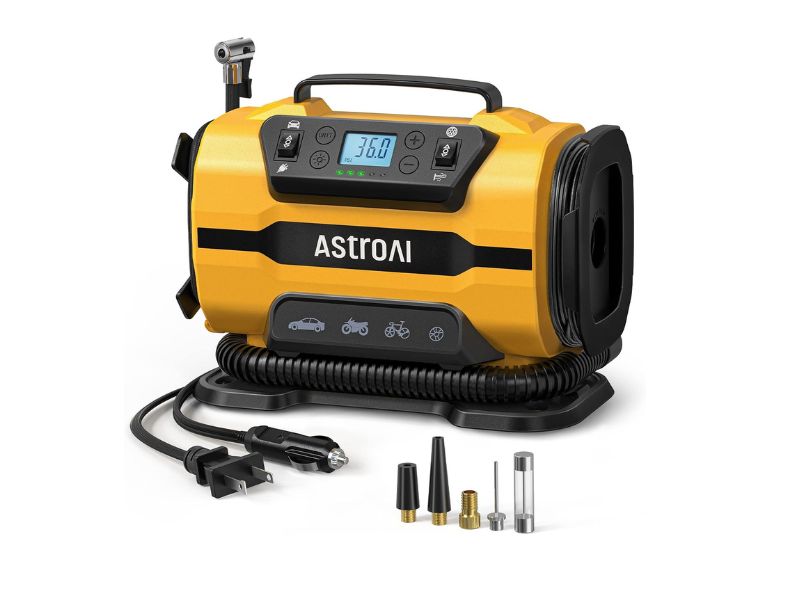
3. AstroAI AC/DC Dual Motor Tire Inflator – Best Dual-Motor Pick
Key Features
- 120V AC household operation
- 12V DC vehicle operation
- Up to 150 PSI
- Dual metal motors
- High-pressure inflation mode
- High-volume inflation mode
- Digital pressure display
- Automatic shutoff
- Integrated LED lighting
- Approximately 4.3-pound weight
- Presta adapter included
- Multiple inflation nozzles
- Accessory and cable storage
Detailed Review
The AstroAI is a particularly attractive option if you want a home tire inflator that can handle more than vehicle tires.
Its most important design feature is the use of two inflation systems.
The high-pressure system is intended for car tires, motorcycle tires, bicycle tires, and sports equipment. The separate high-volume system moves larger quantities of air for items such as inflatable mattresses and rafts.
This distinction matters because inflating a tire and inflating an air mattress require very different kinds of airflow.
A tire requires relatively low air volume at relatively high pressure. An air mattress requires huge air volume at very low pressure.
Trying to make one tiny piston do both jobs is inefficient. A dedicated high-volume system makes the AstroAI noticeably more useful around the house.
The unit can operate from either 12V DC or 110/120V AC. That means regular tire maintenance can be performed directly from the garage wall outlet, while the 12V cable remains available when you are away from home.
Maximum pressure is rated at 150 PSI, comfortably above normal passenger-car requirements.
You also get digital pressure adjustment and automatic shutoff. Select the appropriate inflation mode, set the desired pressure, and the compressor handles the remainder of the process.
Integrated lighting provides additional visibility in dark conditions.
Cable and hose storage are built into the housing, which is important for a unit with multiple cords and accessories. Without organized storage, dual-power compressors can quickly become a tangled mess in a trunk or garage cabinet.
At roughly 4.3 pounds, the AstroAI sits between the lighter TEROMAS and heavier AVID POWER.
That makes it a good compromise for buyers who need multi-purpose inflation but still want something reasonably portable.
What I Like
The dual-motor setup is the strongest reason to choose this model.
I would especially consider it for a household that regularly inflates both vehicle tires and large recreational inflatables.
AC/DC versatility is another major advantage. Household power is convenient for preventive maintenance, while 12V provides a practical backup on road trips.
Automatic shutoff, digital controls, and integrated cable storage make it feel like a more complete product than a basic portable compressor.
What I Do Not Like
It is larger than simple tire-only inflators.
The high-pressure hose can also become hot after extended operation, which is normal for compact compressors but still something users need to keep in mind.
For oversized off-road and heavy-duty truck tires, I would move to a dedicated high-output compressor rather than relying on advertised maximum PSI.
Verdict
The AstroAI AC/DC Dual Motor Tire Inflator is one of the most versatile choices in this group.
Its combination of 150 PSI capability, two power sources, dual motors, automatic shutoff, and high-volume inflation makes it particularly useful for garages, family vehicles, camping equipment, and recreational gear.
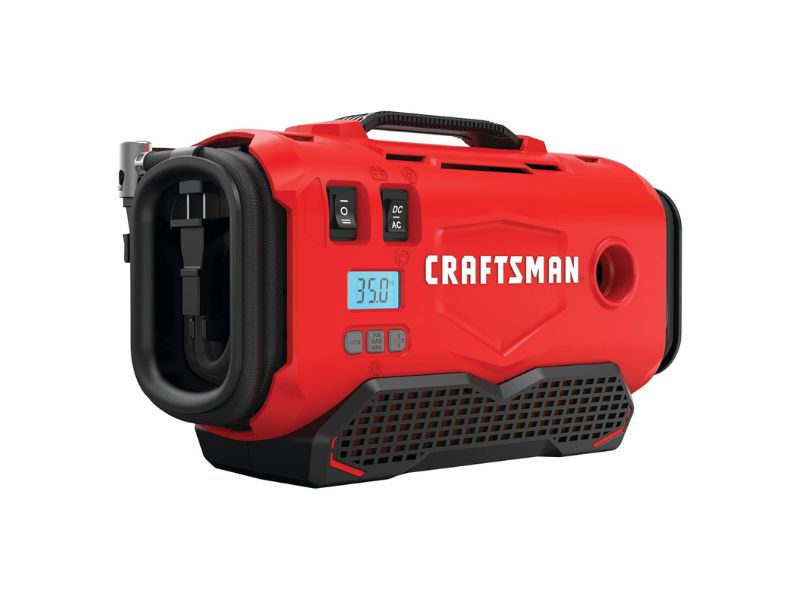
4. CRAFTSMAN V20 CMCE520B Tire Inflator – Best Three-Power Option
Key Features
- 120V AC wall power
- 12V vehicle power
- Compatible with V20 batteries
- Up to 160 PSI
- Digital PSI gauge
- Automatic shutoff
- High-pressure inflation
- Low-pressure/high-volume output
- Large-volume hose included
- Approximately 4.9-pound weight
- Onboard accessory compatibility
- Battery and charger sold separately
Detailed Review
The CRAFTSMAN V20 CMCE520B offers something unusual among household tire inflators: three potential power sources.
At home, you can plug it directly into a 120V AC outlet.
Inside a vehicle, you can run it from a 12V accessory socket.
And if you own a compatible V20 battery, the inflator can operate completely cordless.
That combination makes it one of the most adaptable products in this guide.
Cordless capability is convenient for checking multiple vehicles in a driveway because you do not need an extension cord or have to reposition a 12V cable.
At the same time, including direct 120V capability solves the biggest limitation of battery-only inflators: you can still operate it if your cordless-tool battery is discharged.
Its digital gauge supports preset pressure control.
Enter the required PSI, begin inflation, and the unit automatically stops when the selected pressure is reached.
Maximum pressure is rated at approximately 160 PSI, although ordinary passenger-car operation occurs at much lower pressures.
CRAFTSMAN also provides a low-pressure output for larger inflatables, making the unit more useful for air mattresses and similar items.
At just under five pounds, it remains reasonably portable despite offering several operating modes.
The biggest consideration is the battery package.
The inflator can run cordlessly, but a V20 battery and charger are not included with the tool-only configuration. This is much less significant if you already own CRAFTSMAN V20 equipment.
For someone who does not own compatible batteries, AC and 12V operation still make the inflator fully functional, but one of its headline benefits remains unused.
What I Like
Three-way power capability is outstanding.
Being able to choose between 120V AC, 12V DC, and cordless battery power means there is almost always a convenient way to operate the inflator.
I also like the automatic shutoff system and separate low-pressure capability.
Its construction and controls are especially appealing for someone who prefers tool-style equipment rather than a small emergency pump.
What I Do Not Like
The compatible battery and charger are separate purchases.
If you do not already own the V20 battery platform and do not care about cordless operation, a simpler AC/DC inflator can provide better value.
It is also bulkier than the TEROMAS and other compact tire-only designs.
Verdict
The CRAFTSMAN V20 is the best option here if power-source flexibility matters most.
Owners already using V20 cordless tools receive the greatest benefit, but even without a battery, its direct 120V and 12V operation make it useful for both the garage and the vehicle.
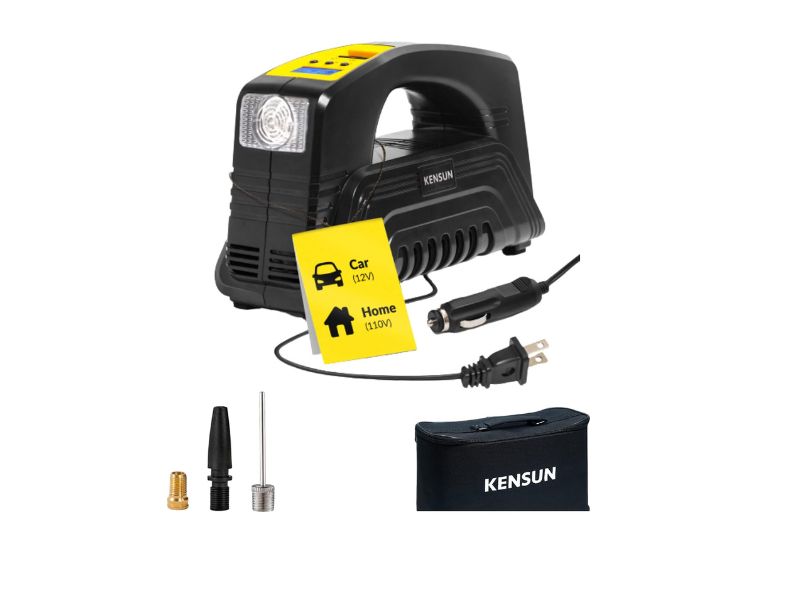
5. Kensun AC/DC Digital Tire Inflator – Best Straightforward Home and Car Pick
Key Features
- 110V AC household operation
- 12V DC vehicle operation
- 120W motor
- Up to approximately 120 PSI
- Around 30 L/min airflow
- Digital LCD pressure display
- Automatic shutoff
- PSI, BAR, and KPA readings
- Built-in LED work light
- Accessory nozzles
- Carrying/storage bag
- Approximately 5-pound construction
Detailed Review
The Kensun takes a more traditional approach than the feature-heavy CRAFTSMAN and dual-motor AstroAI.
Its main attraction is simple: you get a dependable AC/DC tire inflator that can be used in the garage or on the road.
The 110V plug connects directly to a household outlet, while the 12V connection provides vehicle power when traveling.
The motor is rated around 120 watts, with airflow around 30 L/min and maximum pressure capability around 120 PSI.
Those figures are appropriate for passenger cars, sedans, motorcycles, bicycles, and many midsize SUVs.
A digital LCD shows tire pressure and allows you to select common measurement units.
More importantly, the Kensun includes preset pressure control and automatic shutoff.
That means you can program the desired cold-tire pressure instead of continually watching an analog needle.
The integrated LED work light is useful during nighttime tire inflation, while supplied adapters increase compatibility with bicycles, balls, and other inflatables.
One aspect I appreciate is the relatively conventional layout. There are fewer modes to learn compared with dual-motor inflation/deflation systems.
That can be an advantage for someone who primarily wants to maintain car tires and rarely inflates large recreational equipment.
The tradeoff is versatility. It does not provide the same dedicated high-volume functionality as the AVID POWER or AstroAI.
It is also approximately five pounds, so it is not especially light compared with the much smaller TEROMAS.
What I Like
The Kensun’s strongest quality is simplicity.
It provides household and vehicle power, a digital gauge, automatic shutoff, and useful accessories without adding unnecessary complexity.
For someone who primarily needs to top up tires at home, that formula works well.
What I Do Not Like
It is heavier than some newer compact designs.
The compressor can also be relatively noisy, and it is not designed as a high-output solution for oversized truck tires.
Buyers who regularly inflate mattresses, rafts, or other high-volume items will get more functionality from the AVID POWER or AstroAI.
Verdict
The Kensun remains a solid choice for buyers who want an established 110V/12V digital tire inflator without needing advanced modes.
It works particularly well as a garage and roadside maintenance tool for normal passenger vehicles.
110 Volt Tire Inflator Comparison
| Product | AC Power | Vehicle Power | Cordless Option | Max Pressure | Digital Gauge | Auto Shutoff | High-Volume Mode | Best For |
| AVID POWER AC/DC Inflator | 110/120V | 12V | No | 125 PSI | Yes | Yes | Yes | Best overall versatility |
| TEROMAS Tire Inflator | 110/120V | 12V | No | 150 PSI | Yes | Yes | No | Compact storage |
| AstroAI Dual Motor Inflator | 110/120V | 12V | No | 150 PSI | Yes | Yes | Yes | Tires and inflatables |
| CRAFTSMAN V20 CMCE520B | 120V | 12V | Yes | 160 PSI | Yes | Yes | Yes | Three-way power |
| Kensun AC/DC Inflator | 110V | 12V | No | 120 PSI | Yes | Yes | Limited | Simple tire maintenance |
Comparison Summary
The AVID POWER AC/DC Portable Tire Inflator provides the strongest overall combination of household power, vehicle power, tire inflation, automatic shutoff, and high-volume functionality.
TEROMAS is the better choice when you want the smallest practical AC/DC model.
AstroAI is particularly strong for households that frequently inflate both vehicle tires and large low-pressure items.
CRAFTSMAN offers the widest power flexibility because a compatible battery can supplement its 120V and 12V inputs.
Kensun is the straightforward option for drivers primarily concerned with checking and topping off ordinary tires.
Buying Guide: How to Choose the Best 110 Volt Tire Inflator
Understand 110V vs. 120V Tire Inflators
You will commonly see both 110V and 120V used when shopping for household tire inflators in the United States.
For this type of product, both descriptions normally refer to compressors intended to operate from standard U.S. residential AC power.
Manufacturers may label one model 110V and another 120V even though both are intended for ordinary household receptacles.
The important point is to verify that the specific inflator is designed for U.S. household AC voltage rather than assuming that any corded compressor can be plugged into your wall outlet.
Why Choose AC Power for Tire Inflation?
The biggest advantage is convenience at home.
With a 12V-only compressor, you normally need to connect the inflator to your vehicle whenever you want to correct pressure.
With an AC tire inflator, you can pull the compressor off a garage shelf, connect an extension cord if necessary, and work around the vehicle without relying on the car’s electrical outlet.
That makes AC models especially attractive to households with multiple vehicles.
There is also no rechargeable battery to maintain.
A cordless compressor can be extremely convenient, but its battery may gradually discharge during storage. An AC-powered compressor is ready whenever household electricity is available.
AC-Only vs. AC/DC Models
For most buyers, I prefer AC/DC dual-power models.
AC operation is ideal at home, while 12V operation gives you a backup power source if a low tire occurs during a road trip.
An AC-only model can work perfectly well when its purpose is strictly garage use, but it becomes much less useful as a roadside emergency tool.
That is why all five models in this guide provide some form of household AC operation while also offering another power option.
Is Maximum PSI Important?
Maximum PSI matters, but shoppers often give the number too much importance.
Most passenger cars operate at roughly 30–40 PSI, although the exact specification depends on the vehicle.
A 120 PSI compressor therefore already has far more pressure capability than a normal car requires.
A product rated to 160 PSI is not automatically faster than one rated to 120 PSI.
Inflation speed depends on airflow, compressor efficiency, tire volume, starting pressure, hose restriction, and motor performance.
For ordinary vehicles, I would prioritize realistic inflation performance and duty cycle ahead of an unusually high PSI number.
Look for Automatic Shutoff
Automatic shutoff is one of the most worthwhile tire-inflator features.
You enter your target pressure, switch on the compressor, and the inflator stops when that pressure is reached.
Without auto shutoff, you may repeatedly need to stop inflation, check the gauge, and restart the compressor.
Preset pressure control makes it much easier to maintain consistent inflation across all four tires.
I still recommend verifying a new inflator against a reliable standalone pressure gauge so you know how closely its built-in sensor matches.
Digital vs. Analog Pressure Gauges
Digital pressure displays are generally easier for occasional users because the pressure is displayed as a direct numerical value.
You can quickly distinguish between 32.0 and 35.0 PSI without interpreting small marks around an analog dial.
Digital models also make automatic shutoff and pressure presets possible.
Analog gauges have advantages of their own. They do not require complex electronics and can be easy to read when designed with a large dial.
For most home tire-maintenance applications, however, I prefer digital controls.
Consider Inflation Speed
The faster an inflator can move air at useful tire pressures, the less time you spend crouched next to each wheel.
This becomes especially important if you routinely maintain several vehicles.
A small difference when adding 2 PSI to one tire may seem insignificant. Across eight or twelve tires, it becomes noticeable.
Do not judge speed entirely from advertised maximum PSI.
Airflow and realistic inflation-time specifications are more useful indicators.
Check the Duty Cycle
Small compressors create substantial heat during operation.
A model may be capable of reaching high pressure but still require cooling periods after several minutes of continuous operation.
The duty cycle determines how long the compressor can safely operate before it should rest.
This matters most when filling a nearly flat tire or working on larger SUV and light-truck tires.
Follow the manufacturer’s stated operating and cooling intervals.
Ignoring those limits can shorten compressor life or activate thermal protection.
High-Pressure vs. High-Volume Inflation
High-pressure and high-volume inflation are not the same thing.
High-pressure mode is designed for tires, sports balls, and similar items.
High-volume mode is designed for air mattresses, pool floats, rafts, and other large objects that need lots of air but very little pressure.
The AVID POWER and AstroAI are particularly appealing because their designs address both requirements.
If tires are your only concern, a high-volume mode is unnecessary.
If you camp frequently or have inflatable recreational equipment, it can significantly increase the compressor’s usefulness.
Think About Cord Length
An AC inflator is only useful if you can reach the vehicle.
For a garage installation, you may need a properly rated extension cord.
With 12V operation, the cable should be long enough to reach every tire from your vehicle’s accessory outlet.
Long SUVs, pickups, and vans require more reach than small sedans.
Check both the power-cord length and air-hose length, because their combined reach determines how convenient the inflator will be in practice.
Portability and Storage
A garage-only compressor does not necessarily need to be tiny.
But if you plan to move the same unit between your home and vehicle, size becomes much more important.
TEROMAS is particularly attractive for trunk storage because it weighs only a few pounds.
Larger models such as the AVID POWER provide greater multi-purpose capability but occupy more storage space.
Built-in cord compartments and carrying bags are also worthwhile because AC/DC compressors have more cables than cordless models.
Tire Size Matters
Small portable inflators are primarily intended for passenger cars, motorcycles, bicycles, crossovers, and many conventional SUVs.
Large pickup, RV, commercial, and oversized off-road tires contain considerably more air.
A small inflator may theoretically achieve the required pressure but take an impractical amount of time to fill the tire.
If you regularly inflate large-volume truck tires, look for a heavy-duty compressor with strong airflow, long duty cycle, and documented large-tire performance rather than relying solely on PSI specifications.
Who Should Buy a 110 Volt Tire Inflator?
A household-powered inflator is particularly useful if you regularly check tire pressure in your driveway or garage.
It also makes sense for families with several cars because you can move from vehicle to vehicle without depending on each car’s accessory socket.
Home mechanics benefit from direct AC power because they can maintain tires alongside other routine services without worrying about rechargeable batteries.
Motorcycle and bicycle owners may also appreciate AC operation because there is no need to park close enough to a running vehicle for 12V power.
For emergency-only trunk storage, however, 12V or battery power is normally more important than AC capability.
That is why a dual-power AC/DC model is usually the safest all-around purchase.
What PSI Should You Inflate Car Tires To?
Use the vehicle manufacturer’s recommended cold tire pressure.
The correct value is commonly printed on a placard inside the driver’s door or door jamb and is also available in the owner’s manual.
Do not automatically inflate your tires to the maximum PSI molded into the tire sidewall.
That number relates to the tire’s design limits and load specifications. It is not necessarily the correct pressure for your vehicle.
Pressure should ideally be checked before substantial driving because tire temperature increases while driving, which temporarily raises measured pressure.
Can a 110V Tire Inflator Fill a Completely Flat Tire?
It depends on why the tire is flat.
If the tire has simply lost air gradually and remains properly seated on the wheel, a portable inflator may be able to restore pressure.
A compressor cannot repair a puncture or damaged valve.
It also cannot make a tire with a severely damaged sidewall safe to drive.
If pressure immediately begins dropping again after inflation, have the tire inspected rather than repeatedly adding air.
A tire that has separated from the wheel bead may also require equipment beyond what a small portable inflator can provide.
Safety Tips for Using an AC Tire Inflator
Always connect the inflator to an electrical supply that meets the manufacturer’s requirements.
If you need an extension cord, use one suitable for the compressor’s electrical load and outdoor environment where applicable.
Keep the compressor away from standing water.
Place it on a stable surface with ventilation openings clear.
Compact compressors become hot during extended operation, particularly around the cylinder and high-pressure hose.
Do not touch hot components immediately after a long inflation cycle.
Follow recommended maximum operating periods and allow appropriate cooling time.
Finally, never exceed the recommended tire pressure simply because the compressor is capable of producing substantially higher PSI.
Frequently Asked Questions
What is the best 110 volt tire inflator?
The AVID POWER AC/DC Portable Tire Inflator is my best overall choice.
It combines standard household AC operation with 12V vehicle power, digital pressure controls, automatic shutoff, and separate high-pressure and high-volume inflation systems. That makes it useful for regular tire maintenance at home as well as emergency and recreational inflation tasks.
Is a 110V tire inflator better than a 12V model?
A 110V inflator is more convenient at home, while 12V is more useful on the road.
That is why AC/DC models are particularly practical. You can use household electricity for routine garage tire maintenance and switch to the vehicle’s 12V outlet during a roadside emergency.
Can I plug a 120V tire inflator into a normal household outlet?
Yes, U.S.-market 120V tire inflators are normally designed for standard household AC outlets.
Always verify the voltage and electrical requirements printed on your specific product before connecting it. The terms 110V and 120V are frequently used interchangeably by shoppers for ordinary U.S. household electrical equipment.
Is 120 PSI enough for car tires?
Yes, 120 PSI capacity is more than sufficient for typical passenger-car tires.
Normal recommended operating pressures are usually far below the compressor’s maximum rating. The correct pressure should come from your vehicle’s tire placard, not the compressor’s maximum capability.
Does higher PSI mean faster tire inflation?
No. Maximum PSI does not tell you how quickly a compressor moves air.
Airflow, motor output, tire volume, and compressor design have a major influence on inflation speed. A well-designed 120 PSI compressor can inflate an ordinary car tire faster than a poorly designed model advertised at 150 PSI.
Can a 110V tire inflator be kept in a car?
Yes, but an AC-only inflator may not be useful without access to household electricity.
For vehicle storage, I prefer a model that also accepts 12V power. Products such as the AVID POWER, TEROMAS, AstroAI, CRAFTSMAN, and Kensun can operate away from a household outlet using their secondary power source.
Which 110V tire inflator is best for SUVs?
The AVID POWER and AstroAI are strong choices for typical crossover and SUV tire maintenance.
For very large truck-based SUVs or oversized off-road tires, a higher-output heavy-duty compressor may be more appropriate. Tire volume and compressor duty cycle matter more than maximum PSI alone.
Which model is easiest to store?
The TEROMAS is one of the easiest models here to keep in a vehicle.
Its relatively lightweight, compact body and included storage bag make it better suited to permanent trunk storage than larger multi-purpose compressors.
Which 110V inflator can also run cordless?
The CRAFTSMAN V20 CMCE520B can operate from a compatible V20 battery.
It also supports 120V wall power and 12V vehicle power. The battery and charger are normally separate, so this feature is most valuable for someone already using compatible cordless tools.
Can these inflators pump up an air mattress?
Models with dedicated high-volume modes are better for air mattresses.
The AVID POWER and AstroAI are especially suitable because they include separate high-volume systems. A high-pressure tire compressor alone can be inefficient when filling a large low-pressure mattress or raft.
How often should tire pressure be checked?
Checking approximately once a month and before long trips is a sensible routine.
Pressure can change with temperature, gradual air loss, valve condition, and small punctures. Checking cold tires regularly makes it easier to identify a recurring leak before pressure becomes dangerously low.
Should I buy an AC/DC or cordless tire inflator?
Choose AC/DC for dependable dual-location use and cordless for maximum mobility.
An AC/DC compressor does not depend on keeping a rechargeable battery charged. A cordless model is easier to move around multiple vehicles. The CRAFTSMAN offers all three possibilities if you want AC, 12V, and battery operation in one unit.
Final Verdict
The AVID POWER AC/DC Portable Tire Inflator is my top recommendation for anyone searching for the best 110 volt tire inflator.
It provides the most complete balance of direct household power, 12V roadside capability, automatic pressure control, solid airflow, and high-volume inflation and deflation.
The TEROMAS Tire Inflator is my preferred compact alternative. It is easier to store and still offers the AC/DC flexibility most drivers need.
The AstroAI Dual Motor Tire Inflator is particularly useful for homes where the compressor will handle tires, mattresses, rafts, bicycles, and recreational equipment.
The CRAFTSMAN V20 CMCE520B is the standout choice when you want the option of AC, 12V, and cordless battery operation.
Finally, the Kensun AC/DC Digital Tire Inflator remains a good straightforward option for drivers who primarily want convenient household and roadside tire maintenance.
For the broadest mix of tire performance and household versatility, however, the AVID POWER AC/DC Portable Tire Inflator remains my first choice.